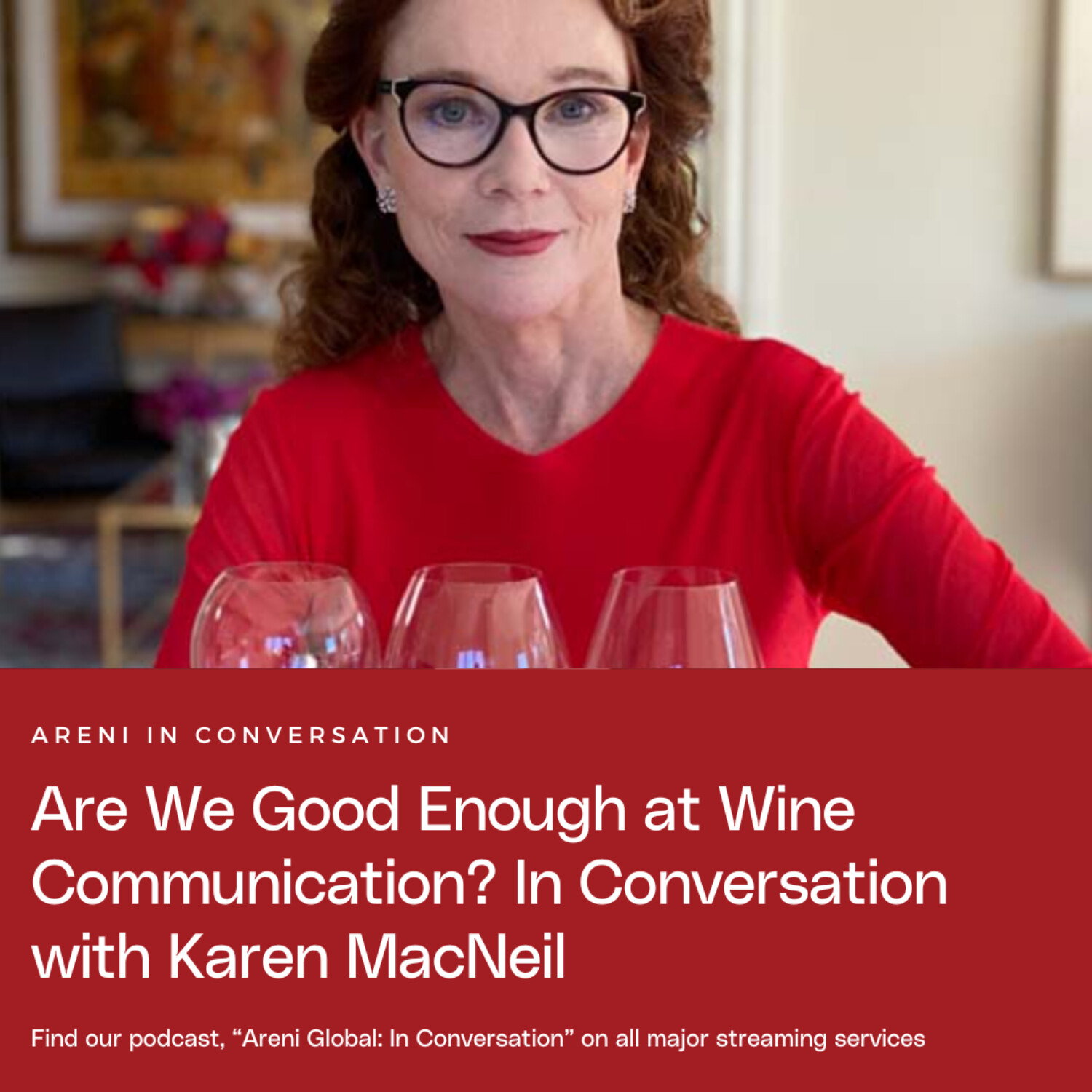
Are We Good Enough at Wine Communication? In Conversation with Karen MacNeil
60m 40s
In this episode of the Aurene Global Podcast, host Budin Vicar interviews renowned wine communicator Karen McNeil about the state of wine communication today. McNeil defines effective wine communication as the ability to inspire people to buy and share a bottle, emphasizing emotional connection over showing off knowledge. She worries that poor communication over the past decades has contributed to declining wine sales, as much writing comes off as show-offy, weedy, or too precious. The core purpose, she argues, is to convey pleasure and joy, but this is hindered by regulatory environments and a rising prohibitionist movement, exemplified by trends like Dry January and sober sommeliers. McNeil highlights wine’s overlooked role in fostering community and combating loneliness, especially in an era of social isolation. She advocates for shifting the language from "responsible drinking" to "respectful drinking," which promotes moderation and self-respect. The conversation also touches on the importance of mindfulness in wine consumption, noting that the greatest pleasure comes from the first sip. Ultimately, McNeil and the host agree that wine’s value lies in its ability to provide beauty, respect, and wonder, connecting people to nature and each other through shared experiences.
Welcome to the Aurene Global Podcast. Aurene is a global research and action institute for the future of fine wine. In this series we bring you conversations with thought leaders in and adjacent to the fine wine world to discuss how we as an ecosystem can ensure the collective future of fine wine. Welcome to this new episode of the Aurene podcast in conversation. How I guess this week is so special that I went to Napa almost exclusively to records this very special episode with her. So especially in fact that UC Davis University made a point of protecting and saving every single tasting that she had ever written as a testament to the impact she had on the developing California and wine industry. But Karen McNeil's influence and reach goes well beyond the borders of California. Just imagine her award-winning book The Wine Bible is one of the best-selling wine books of all time and has sold more than 800,000 copies. Her newsletter Wine Speed is read by 10,000 of wine novels around the world. And of course Karen is probably one of the only person in the wine world to have a very own barbie that Mattel created at her FG a few years back. So I met Karen in her offices in Santillina and I had so many questions for her that our conversation on and off the record lasted more than two hours. So what does one of the world greatest wine communicators think about the state of wine communication today? Faced with the clienting consumption and a threatening regulatory environment are we even good enough at talking or writing about wine? Why? What could be the levers of a new narrative for wine? And what could be the risks of not improving our game? I am your host, Budin Vicar and I hope you enjoy this fascinating episode as much as I did. And if you do, don't forget to subscribe to our podcast channel on whatever platform you are currently using, it really helps. Karen, thank you so much for being with me today. I'm very, very excited about that conversation and we're doing a live from Naffa so that's even more exciting. And we are going to talk about communication for the next hour together and communication within the context of wine of course. And I can't help but stop with a very, very classic question of definition which is how would you define wine communication today? What's wine communication for me? I would say that wine communication is the ability to excite someone about wine enough that they want to run right out and buy a bottle of wine and open it and get a friend over and open it. It's a practical definition in a sense because you know all the words in a world. If it doesn't inspire someone to actually want to have a great class of wine, then then what is the point? So the inspiration is the point. Did that definition of wine communication in both? So your career did you have another way of understanding it before did it change at all? Did it look that even? Put on that definition? Not for me but I have to say that when I started as a young journalist and when I was learning about wine a lot of wine journalism was what I think of as I had a great time, too bad you weren't there journalism, right? It was show off, wine writing. That doesn't make people feel good. People can tell when you're showing off by saying you know oh I got to drink Shatou again back to 1929 or whenever it's very off-putting. So for me that style of journalism I've never liked and I'm always thinking when I'm writing what would make someone sitting with me really say I can't wait to try that. That's that's a very different style of journalism than just sort of writing down everything you know to show off. In the format of wine communication because of course that exchanged the logs and before it was just about writing and even physical paper we're talking about this offline and now it's all those different forms of communication this audio, this video, it says you know blog this it seems that the format is multiplied. What does that change or what's the impact of that? It's wonderful but there were always different mediums even when people maybe didn't use them. I mean again for me I started out doing a lot of radio and then a little bit of television and then advertising copywriting and then writing for magazines and then writing for books and I think when you are a good communicator you are hoping for lots of different mediums because if you can master more than one medium then you really are a communicator. You're not you're not limited by just one type of writing. I mean people who for example wrote you know 5,000 word magazine articles online in the 1980s had nowhere to go if that was the only way they knew to communicate about wine. So to be a good communicator you always have to I think embrace all kinds of different forms of communication and the more you embrace the better you'll be at every single one of them I believe. So you don't have to be a wise man to be a communicator. I don't think you have to be a good writer. I think you have to be capable of helping people feel something. You know that's a part that we don't talk a lot about in wine communications is but but we know for a fact that the great wines of the world are listed in emotional response in the drinker and if you are a good communicator I think you have to have the ability to to make people feel to help people feel something. Which is also you know you don't remember what people did but you remember how you made it feel that's what you remember. The mission is that that's a memory as well interesting and so my next question I mean you kind of answered it but I'm so gonna ask it again but what's the purpose of wine communication today because you know the conversation that we had but you know you came with the self-question of what masses do you need to be served who should benefit from communication and what's at stake today with one communication and five questions in one yes well I you know I'm worried about this because I don't think we're doing a particularly good job at wine communication today and I and I wonder if some of the downturn in wine sales today is the result now of two to three decades of not particularly good wine communication. I think a lot of people are myself included are sort of searching for ways in which to inspire people but it is hard to communicate about wine and a lot of wine communication comes off if not very show offy then a weedist or just to precious the purpose still though to me is to inspire and to have people feel that that this is one of the great pleasures of the world that they can enjoy you know there's a an anthropologist whose name is Lionel Tiger who wrote a book many years ago called the pursuit of pleasure and when I think about that title even I think about lots of wine communication doesn't immediately go to pleasure it goes to oh here's how we made the wine here's what we did here here the types of tanks we fermented it in but his his thesis in this book was that pleasure early on in the whole history of human evolution that humans in fact would not have evolved were pleasures out of reach the two primal pleasures had to be something good to eat and something good to drink because otherwise early man would have thrown himself off the cliff right it would life was just too hard to enjoy a pleasure yes yeah and I think we you know it would be interesting right now to take I don't know you know 50 pieces blogs articles books and just see the word pleasure even even appears in I think we've found in front of you to be allowed to have it by law you're not allowed to talk about pleasure or joy or anything that can poke my shoes so every those friends what I know shined everything that you say the purpose of communication is which I tend to read is something that you can't do in front because we've got the way around that actually tells you that you can't the only communication that you allow it's very informative in its fact based even in marketing you can't have someone with a glass of wine smile on their face if you see they are happy when they're trying to find it if you're pleasure or joy then it will of course encourage you to drink and we all know that we are not responsible enough to enjoy drinking integration that is only to overcome the assumption because I think that's also another part of the conversation that's quite important around wine communication today and that's how well you eat maybe your definition of
to inspire people to drink a bunch of wine, but I mean we have to say in moderation also, in a way that is responsible and respectful for many different reasons, for legal environment that's changing for healthy reasons, but also because if you don't drink in moderation, then you lose the pleasure and the joy over consumption, doesn't lead to pleasure and joy to right, but I guess it's important to remind that here, but in many countries at least in France, which is maybe one of the strictest countries that I know of in terms of regulation that's something that you would be allowed to do. You will have to be very, very creative to inspire any forms of emotion around communication. It's so interesting, I mean here in the in the US you're not allowed of course to make health claims, you're not allowed to say this will make your life better or this will be a good addition to your diet or any of those things, but then I would say certainly here wine articles, we could certainly imply that moderate, I agree with you, moderate consumption, test bring happiness to people, it brings people together, and in the United States right now, I don't know about France of course, but there's an epidemic of loneliness. A reported 20% of American men say they don't have a best friend, they have associates, but they don't have a close friend, and when you think about those kinds of social issues, and you think about even like a half a glass of wine that you might enjoy with a friend, it's historically been an important part of bringing people together, and then I was being Elizabeth community and it's like this, and I guess that's also one of the things that changed in during COVID, is that people start drinking along that home wall, and again when we talk about the joy and the pleasure, I guess the sharing part of that is also really important, and there's been many different study and I will never make claim about wine and health, but there was a study about French people being happy, and that was linked to the social consumption of alcohol also, and that being very important in, in all that area of mental health, I've seen those data from the world you can inform about those epidemics, and all the type of disease that it can create, and and problems in society, and it was like, they find really what it claims to be, which means things that brings people together, again that's one of the responsibilities that we have to carry, what can wine make us do, into action, like break solitude, and in a responsible way, but that's an interesting question, if you start from the found that people are lonely, lonely, isolated, what can wine do about this in this responsible way? You know, with the exception of maybe airlines, and now we see, you know, wine in cans, but for most of history, wine has been served in a communal vessel, and it is something that in find sharing, and not just unique serving measures. Yes, and I think that's often overlooked that everything about it was meant to imply something that you did with another person, and you know, it's a very bonding kind of experience. We know from both being in the industry, when you share wine with someone, you are, you are now friends. You may not have thought you were going to be friends, but you are definitely now friends. And helping that be wrong or bad, I just think it's a part of wine story. It's such a simple but primal part of wine story that we don't talk about enough. The fact that it brings people together. Yeah. Yeah. So, you know, one part of my five hard questions was, you know, what set stake? Would you say that that's what set stake for wine communication today? Yeah, I think what set stake is, by losing any effective wine communications, I think, you know, it's not hard to see that wine can begin to take on almost, that people can begin to be alienated by it, that it begins to be seen as this negative, completely negative influence on society. I'm worried about what I see in the US right now as sort of the threads of another prohibition, another prohibitionist movement. You know, we see both dry January and sober October, 17% of the calendar year. I did a video not so long ago, a few weeks ago. And the first line was, I hate dry January. And the premise was, not that I believe everybody should just be, you know, drinking massive amounts of wine I don't, as I believe in moderation. And I certainly believe that everyone should have control over their own body and what is right for their body. Most women believe that. I mean, for all kinds of reasons, right? But what was so surprising to me in this video, I say, you know, I just don't feel that wine's story of its positive role in culture and history is ever told enough. And surprisingly, the person, this got 11,000, quick responses on the Instagram, the very first person who said, you know, I think you're wrong about this Karen, was one of the sommeliers at the French laundry, one of the most famous restaurants in the United States. I thought, oh my god. And the sommelier at the French laundry went on to say that he was participating in dry January. Subsequently, I learned that there are a whole group now of sommeliers called sober Psalms in the US. And I thought, boy, this is a trajectory that 10 years from now could really mean that wine is viewed in a very negative way because the opposite of sober is drunk. And we know that the vast majority of wine drinkers, I believe, are moderate wine drinkers. They don't even drink wine necessarily every day. But to set up this oppositional idea that you read their sober or your drunk is dangerous for wine. It allows none of that beautiful cultural middle. It doesn't invite for new, despite it. No. I mean, it's a sign of the time that we have to be otherwise. And that you share as a swing of the pendulum. And I was just thinking when you were talking about pleasure and that comes with, my point is pleasure is moderation. There's no pleasure without moderation. And one of the most interesting, I mean, a very interesting interview that we did recently was with a researcher from the insia in front about behavioral economics. And he actually there demonstrated that pleasure. He did that for food, but we can actually easily extrapolate for wine. But when it comes to pleasure for food when you're eating, the maximum pleasure is the first food. So if you eat chocolate foods, the pleasure is not a sub of all the spoonful that you're going to take because it's not a linear relation. The first one, that 80% of the pleasure that you will get from that moves comes from the first spoon. And all the rest you actually eat and those are extra calories that you might not eat. And I was just thinking if we have an education around pleasure in wine, hey, it comes with when you live in the UK, you understand why dry drink really actually came to play because when you see people drinking in December, you're like, well, it's balanced against. But if you have a very moderate consumption all the time, you kind of not really need to try it, I like that it invites people to be mindful of that consumption. But if we were taught this, that pleasure is now the sum of all the things that we eat or drink, but it's a decreasing relationship with that. That will change our perspective. And then that's, you know, as I don't know if it's as a French, but in my family, you were taught to taste and not to eat and not to drink because it was about higher attention to this and remember what it makes you feel. And I think that's a really important part of the education as well, because education and communication can be linked to discuss that. But I'm teaching people to recognize the pleasure that they get from one or two sip, you know, half a glass or just a normal size of glass and not the 215 in the UK that should be living all by the way. I don't understand how you can sell a sort of a bottle of wine in a glass, but anyway, that's another conversation. But I love that, Pauline, I think you are so right. It's why that we're mindful is
it can so appropriately be attached to wine drinking because when you have that mindful first sip and you're experiencing all that texture and all that delicious flavor and of course all those aromas. Yes, that is the most impactful sip of all. Sip number 27, if that's even consumable, that would be glass number five and you know sip number 27. Can't possibly carry the same kind of pleasure. Yes, and I wanted to advocate for changing the words "murgant" I think moderation is an important topic. But I think we say you know drink responsibly and I think responsibility is something that people don't want more of like who wants to have more responsibility and when you drink or when you share a glass of wine with someone you don't really want to think about responsibility. And so I thought you know having a respectful drinking could be an interesting change of language. It encouraged not responsible drinking but respect for drinking. Again, it comes with that notion of pleasure and moderation. If you want to respect yourself and if you want to respect others, you are not over in dorge because you know being drunk in the middle of the street and showing, having a behaviour which is not respectful to either of you or others, they had their conversations with people that are in charge of putting the people message on all the problems. And actually we didn't want to spoil people' returns because it has to be responsible. So then it can be responsible in front of the law and respect for what we didn't play like this, within flight, like that. But in terms of communication, I think having more peace about respect and pleasure and joy that is ultimately leading to moderation and life style is interesting. Yes, I love that idea and I think you're right because it starts with a respect for yourself. For a respect for what is good and helpful and hopefully contributes well to society. So we were discussing one of the questions that you asked why makers recently at Napa Premiere, which is why wine is important. And that's kind of linked to our conversation because it's when you know what's important that you want to communicate about it. I guess it's very linked to that in purpose. And to me, if you look at what the world needs more of, the world could use more beauty, respect and wonders. And that's exactly what wine is for me. Wine is something and you can interpret all those three words about why wine is without beauty, it is about aesthetic, it's about contemplation, it's about expressing that beauty and gender, it's about showing it with others, respect, it's about respect of nature, that environment, yourself, that other people. Because when you're talking about respect, it's also respecting the product, if you're doing it too much and you are sick, what's the point of drinking good stuff? And the last part being wonders, there's something that's part of magic that wine, there's a little star in your eyes and your eyes that sparkles when you talk about this, there's something spiritual, that can be whatever, but there's something that allows you to introduce dimension, three wine, it's quite interesting. So I like those three lines as well, from respect and wonder. Those are fabulous words. And for me, I have never gotten over the fact that it is so pivotal way that having a glass of wine is taking nature into your body. It's a different idea than other commercial products, right? It's not a stereo, it's not a dress, it's not a car, it's not, there are very few ways in which other than just breathing and eating, we actually take nature into our bodies. I can understand how originally that was considered a very sacred idea, a very religious idea. And I'm reminded of that when you talk about respect, because the respect for yourself and the respect for nature is so clear here, you are taking nature right into you and hopefully you're not from nature. So it's common, it's common self. I'm going to ask you a question straight away because of course we are having a very inspectual conversation about wine and pushing the ideas, that's what we like doing. But does it mean that one communication has to be intellectual? It doesn't have to be intellectual and it shouldn't be didactic in my opinion. It shouldn't be pedantic didactic. I mean, that's really off-putting so quickly. However, I think it sometimes takes a person of considerable intellect to figure out just the way of using words to effectively to turn the key in the lock to talk about wine in a way that is so moving that the reader wants to experience that wine. So I think it takes some amount of at least at the very least good writing skills, if not intellect to do that. Oh, the speaking skills again, because it can be as you were mentioning something of audio or video or speaking in communication. But a good mastery in words, you can say. And I was going to be a question for a bit later, but I'm going to ask it now. You know, through all my life I've heard what we want to do is to domesticate wine and use one to make wine simple. And I was like, "Can you really like. I understand wine is a very, very complex thing, but isn't that the magic of wine? I mean, shouldn't we leave simplicity to spirits? But I guess people, or people just even me like we tend to mix complexity and elitism or bidentism. And I guess it's back to my original question, but should language be simple or precise? Like, what's the best language to talk about wine? And is it just language to a voice? How can we keep the complexity of wine but not talk at people? Yes, well, first I completely agree with you. And I hear people say, "I want to demystify wine." I think, "Oh God, please no, no, don't. Because we're moved from mystery. Wine becomes ethanol. It becomes nearly alcohol." And, yeah, there's a drinker glass of vodka. But also, the more I learn about wine, the more I convince about that it wouldn't have passed. At least in the interesting wine that I drink. And that would be part of my definition of fine wine is fine wine has that capacity which you provoke on doors and emotions. And the more you learn about those wines, the more you learn that you understand only part of how it works. You know, wine is the second most complex liquid after blood. So there's human blood in them, there's wine in them, there's complexity in the structure. So of course, you know, science matters and understanding matters. But this will always be that part of magic. At least I hope that it will always be. So simply fine, I guess the goal is good in the way that if it allows more people to be inspired. But the fine wine in wine communication is how can you be simple enough that you inspire a larger audience while not losing sight that wine is inherently fine nature, the complex to think. You know, I mean, there I think there are two things happening here. Maybe when people say, you know, I want to simplify wine. And maybe they're talking about explaining a technique. They're they want to explain malalactic fermentation in a simple way. Okay. The hope is that if you simplify terms like that in the name of effective communication, that has nothing to do with what's sitting sort of over here, opposite that, which is to also be able to talk about wine in a way that underscores its its mystery, its magic. I almost it's role in religious history. And that should not be simplified. That should be acknowledged by by talking about things that, you know, it's wine's capacity to incite emotion, for example. I have taught wine classes where at the end of the class, people are crying. And they have said, you know, I'm so sorry, I'm crying. I'm like, don't be sorry. I feel great that you're crying. I am so happy. I can see as a joy. Yes. Yes, because you've been moved. You know, you've been moved by the wine, been hopefully moved by something I said. And, you know, I think if communicators, those of us who find ourselves in that rule, thought about
But our goal is not necessarily to simplify malalactic fermentation. Our goal in a sense is to talk about wine, to write about wine in a way that could actually be a single cry. In a good way. In a good way. Yeah. So you said that one of the purpose of a definition of wine communication is something that should encourage people to go and open a bottle. So it's also very easy then to fuse communication and marketing or sales. How do you distinguish about the, you know, setting points or marketing would also be ultimately to sell your wine? So what's the difference between communication and marketing in that sense? Yes. Yes. Well, I suppose good communication does wind up in the end having a marketing impact. And a sales impact because you do want to run right out and try that algorithm or that even valley re-sling from South Australia. And I don't think that's a bad thing. Marketers, people who are not necessarily solely communicators, but they are actually professional marketers, have to work really hard though at being good communicators because a lot of wine marketing is meaningless words like approachable. If I could take one word out of the English language, if someone says this wine is really approachable, I don't know. I can feel like my head explodes. I'm like, no, that means nothing or icon. These are words that people say when they don't know what else to say. Expensive? What's the line? Yes. Even a word like balance. People say balance all the time because they don't know what else to say. And you know, if you are truly a communicator, to me, it means you're capable of laying awake at night, trying to put wine into words that you can say or write because it isn't inherently easy to write or talk about wine. But I think a lot of marketers fall back on a few key phrases that the more they're used, the less and less they mean. I want to make the best wine possible. Great. You and 20 million other people. You get emails every day from public relations people and marketers around the world with the same old phrases over and over again. Eventually you shoot yourself in the foot by doing that if you're a marketer, I'd say. Whereas I think wine communication implies a responsibility to agonize over it a little bit more, to try and really find words that can move people. It's a powerful and if you can use them well, it's stunningly powerful. Is there a different, you know, I had that question, what masters do we serve in wine communication because you can hear a lot of critics about wine communicators that are serving the, that are paid to write those things and not. So I was wondering if wine communication, the master that you serve is the audience and the public when wine marketing is actually the winery, well, that should change the way you put your message forward, right? Yes. I mean, I think it completely. Yeah. I mean, I think if you are, markets are going to hate me saying that. Yeah. They just serve the winery purposes because of course when you're good markets, and you care about the audience, you're client, and you should care about them. So that's not what I meant. Right. No, I mean, there's no shame in being a good marketer and in telling the story of a winery or a wine in a way that is compelling and galvanizing and fascinating and interesting. That's an important role in the entire wine world. But it is a slightly, you're right, your obligation then is to the winery, whereas communicators obligation is to his or her audience. And I'm going to, I wanted to talk to you about audience because you said to be a good communicator, you have to master different formats, then you've got more arrows to your art, then you've got more options. There's a good point when communicator needs to be able to talk in front of very different audience, or do we need to aim for breadth and be able to talk or with like, do we need to talk very well to one particular audience, or to be able to adapt and to reach and engage with different style of people? I believe that the best wine communicators, you can stand them up and they could talk to wildly different audiences of different nationalities, different genders, different age groups, different income levels. I mean, that's the job. The job is to be thinking about that audience well enough that you can find the key in to them. And some of that, by the way, I really believe, is being the capacity for the communicator themselves to be vulnerable, to be not the show off expert, but to be humble and vulnerable and compassionate and to talk about wine in such an emotional way that anybody in the audience says, "Yeah, and I want in on that," right? Because not everybody understands chemistry or science, but everybody is an expert in how we feel to appeal to someone's feelings. It may be scary. Yes, it's much more universal. It's a little scary, but it is the key in because people will let you help them feel and everybody wants to feel something, what everybody wants to be moved and to be connected also. Yeah, I think. So we know how smell is important. I can't remember exactly that, but we have got more genes that are dedicated to smell than any other responses. And not only we have more genes for this, but those genes and how they express themselves is highly different from an individual to another. So what, a use smell will be very different from what I smell. And most of wine communication, a lot of wine communication is about describing the taste and the smell of wine to other people. And when we know this, when we know that what we sense is going to be extremely different or has the possibility to be extremely different to other people that actually might not even be equipped to sense pepper or anything like that. How does that change? How does this should impact the way we communicate? Yeah, it's a very sophisticated question because if we're all in our own sensory worlds and those worlds are not overlapping, what's the point of saying to someone, you know, this wine smells like old books and beautiful old Italian leather. If they've never smelled beautiful old Italian leather, or meanwhile they're tasting the same wine and smelling an entirely different idea. But that's all we have. That's the thing. All you have with wine is metaphor and simile. There are very few actual things, right? We are all filtering, whatever that wine is, we are all filtering it through our own brain and our own sense of perception. It doesn't really matter if to me, if I write cherries and someone else is experiencing pomegranates. It's okay. It's okay. They can hear cherries and think, "No, that's not cherries for me." But if we didn't do that, what else would we have? Wine would be reduced to nothing. There would be nothing to say. So better to say, you know, for me, this wine is reminiscent of cherries and let somebody else say, you know, for me, this reminds me of my mother's rhubarbai or whatever, right? Because at least it's an attempt of two people trying to take the complexity of their perception and their sensory worlds and verbalize it. And it's fun to do, even as imperfect as it is, the goal is not that your perception should be exactly like mine. It's that the two of us will have fun tasting the same wine, even coming to different conclusions about what it's like and what it reminds us of. So putting wine into words will always be an imperfect activity, but it doesn't mean we shouldn't try because it's fun to do that. And thinking about what you're saying, that's a good wine communicator. It's part of a job of a wine communicator to be able to lead people to communicate themselves. Oh, I think so. In fact.
You know, one of the things that one realizes early on is that we kind of live in various metaphorical worlds that make sense to us. And one of the, one of the, but not by any means of the entirety of one of wine's languages is the language of food, right? We say, "This wine reminds me of cherries or strawberries or whatever." But any metaphorical world works. There are people who know a lot about music, who taste wine, and they're listening in a sense. They're hearing music. I remember I had a client, I was a private wine tutor for a while, and this man, who I won't name, but was a very famous architect, we were tasting up our dough once, and I asked him what was wine tasted like to him. And he got this sort of far away looking his eyes, and he said, "This wine is the cathedral at shard, the stained glass, the transom." I thought, "Oh my God, this man is seeing every wine he tastes, he's seeing it as a building." Because he's an architect, this week's complete sense. And we talk about structure. Yes, and we've got. It was perfect. And we have a lot of that, so that works. I tend to see people when I drink wine, like, "Yeah, it reminds me of either someone I know or just like a body shape, but that's what some of you have experienced to express myself in terms of body." And we have a lot of body vocabulary, to describe wine in French a lot, to the point that sometimes we have to change it because of course we use it about the body of a woman, so in the traditional language of that wine. Which is a good point, is there a good language to talk about wine? I mean, there's a lot of conversation about the words that we're using and what they can mean for other cultures and people from another background. And there's not only just a misdefying wine, but to colonize wine. How does that translate to the job of a wine communicator? You can be open-minded and one should be open-minded. But we are all products of our own culture. And the fact that I'm like used a word like, I don't know, blueberry, knowing full well that in the audience maybe someone from Shanghai, and who has never seen a blueberry or tasted a blueberry. Again, I guess what I would say is, you know, as imperfect as it is, we have to create an environment in which everyone feels like they can jump in the pool. So great, I'm going to say blueberry and I'm hoping that that person from Shanghai is going to say, and you know, it reminds me of, I don't know, some of the spices that doesn't exist in it. And you're like, oh fabulous, great, let me add that to my vocabulary and you add blueberry to yours, right? It's an additive process. So I guess it's in the attitude more in the language that you use. If you use your own language because you're very much aware that it's the only one that you have, but you're inviting people to share their own language and experience, that's where inclusivity is. It's not just in the use of words, but in how you create that communication around things. I was thinking of one of the most interesting things that I had with people from very, very this background, but it includes things from Mexico, someone from Tunisia, someone from China and me. And I was telling you, is that one spicy? I mean, all in two three. I know. And I would say, yeah, spicy, it's like, love and nutmeg. And then it was like, those are not spicy. Yeah. I was an interesting one, but I get what you're saying. You are limited by your words and by your senses, but it's okay because you know your own limitation and people know that people can access it. Yeah. And it's fun when you invite other people to share your own language. Yeah. And you learn so much. Exactly. So there are a couple of words that are quite debatable or as a French people, I still feel very much uncomfortable for a lot of reason using and one being brand or one being industry. I cringe every time I say wine industry and I was wondering if that was words that you mentioned some of the words that you did in life. Are there any other words that you do like or why are there some of those words that are still creating a lot of emotions and opinions in the wine world? Well, certainly words like industry and brand bring up associations with industrialization and wine and that can be seen as the opposite of artisanal fine wine. I guess I don't think so much about the wine industry unless I am thinking about the broad commercialized, big brands with millions of cases. I find myself just using the word the wine world. It is a sensory world and it's also very idiosyncratic. It's a people business. Here in the US it's every now and then a winery will hire someone from Procter and Gamble who will say, "Oh, it's just another consumer product wine. It's not that different from shampoo or whatever else." I've seen those kinds of people come and go in the Napa Valley for years. After about two years someone from Procter and Gamble will be shaking their heads saying, "I don't know, I don't get it. Wine is really not shampoo. It's very hard to." So it's a sense as well as my every time I hear it being a criminalization because that's an FMCG vocabulary and that's a fast moving good language that comes with fast moving good leaf or to success which is usually a huge marketing budget that we don't have. So we can't be premium. We can do a lot of things with premium is something that we might not be able to be. You just because we don't have the resources to be premium. Are there any words that you like on the contrary? I have changed the way that I taste wine dramatically and it has changed the words I use to. We all know the sort of system of, you look at the color, you smell the wine, you taste it, you think about the finish, how long it is and that very standardized way of thinking about a wine. We're here in my office and in this office we taste maybe 2,500 wines a year and I know that my employees are going through that process. I can almost see their minds thinking in that way. But I now, I taste the wine. I don't look at the color, I don't tilt the glass. I might smell it but first I taste it and I think about the energy of the wine. Is this wine alive? Does it have a lid from within quality? If I were here by myself with this wine would I almost feel like it could talk to me or is it sitting kind of dullly in the glass and this may sound sort of, I don't know, too far out there to be sort of imagining that wines have a life. But I think wines do have a life and I think wines can seem alive and I think the best wines have a kind of vibrational energy to them. It is different than just straight beverage wine that is, I don't know, a $10 sharp maze unlikely to vibrate with energy. So all of these words about vibration, energy, aliveness, vibrancy, I'm using those words more and more I notice. And then the other thing I think about is what is the choreography of this wine? Because there's no good language for this part of wine. We say, "Fortnessy, at Romans, we say flavors." But often what makes wine so interesting is how it moves across the palate, right? Is it waltzing across the palate? Is it this big exploding firework and then? It's a rock concert. Yes. It's in that house. Yeah. And wine has volume and velocity. So things like words like langerists, I love it when wine takes a long time sensorally to move through its flavors. Whatever those flavors are. So I think about these ideas now, a lot more volume, velocity, choreography, aliveness. It's an attempt for me, myself, to get closer to a wine. I don't know if it makes me a better communicator.
I do know that we are as the world of wine only after the beginnings of trying to put wine into words. And so anything is helpful, right? If I say that and someone tasting the wine with me is like, "Languers, hmm, I'm not sure I get that in this wine." It's okay, it's my own, at that moment anyway, it's my own attempt to get closer to this very beautiful thing that is so sensory and so breathtaking often. If someone's into you, I don't get what, you know, what do you mean by this? That's a very inviting question and it's like the communication as well to how people ask a new question, and have it to waste with. We haven't touched on that yet, but that's a question that's always dear to my heart because with wine communication, with all great powers called great responsibilities. What are the responsibilities of wine communication? I think the responsibility is to be true, to give your best, truthful attempt to capture a wine in words and then share it in a way that is respectful of the product, respectful of nature, respectful of your audience, respectful of the hard work that went into the making of that wine. You have a, yes, I think, a responsibility to be true and honest and not just, I don't know, dash something off. That is, I sometimes worry about critics being 224 Sonoma Shardinay's review that I think, "I wonder how long that person sat with each of these wines attempting to get to some essential truth of that wine." Is that a notion of fact checking as well as being honest? For me it really is. It makes me crazy when I read something and I think this person wrote this in 20 minutes and nobody fact checked it because that is, in a sense, of using your position as a communicator. It's incumbent upon you, if you are in that role, to make sure that you've gotten as far as you can to the truth about something. And it can take you a long time. I mean, some of the best parts, I think, of the wine Bible are things that took me two weeks of research to get to maybe just be able to say one line in the book. But now I know that, I know it for a fact because I worked hard at being sure that that was a verifiable fact. One of the fact was I was using our voices for at the moment. I mean, wanting the case, it can be just about the taste and describing it. One of the writers and communicators who work hard at being good at that and who do fact check and who have audiences have some amount of power. And I, for myself, always was worried about using that. I kind of steer clear of anything that even smacked the politics in the world of wine. But lately I've changed that. And one of the ways that I have is to come out, I came out a few weeks ago, saying that we would no longer write about heavy bottles. It's been, it created a lot of consternation in, because we're here in Napa Valley. I mean, I write about lines of the world, but there are a lot of big heavy bottles in Napa Valley. And these are sort of the hummers of, you know, they weigh five pounds with wine in them. And I just thought to myself, you cannot wine world, have it both ways. You cannot talk about the importance of nature and how your wine tastes the way it does because of the beautiful terroir that vineyard is on. And at the same time of then do something that is so patent-ly against nature, right? Because heavy bottles constitute as much as 40% of the winery's carbon footprint. So I think there is a responsibility to not meanly, but to, in the telling of truth, is to say things like this. We are proud that we are not going to write about wines in big heavy bottles because we feel that it's duplicitous for wineries to, and one hand tell us their wine is all about terroir and then do something that is so obviously, outrageously, not friendly to the environment. And my God, we live in a world of climate chaos. I mean, it's not like this is news to anyone that if you are, if you will make a product that is a product of nature, what you should be doing, everything you possibly care to protect nature, to protect nature. And my last question is because we are about fine wine that we spend a lot of time thinking about that very niche segment. Is there anything particular about fine wine communication? Do you need to communicate differently? Is there anything that needs to be, should be specific or not a school? I think we have, we the fine wine industry, if I can add myself into that industry, have a, in a sense, a responsibility not to have done it down. When you wind up talking about it in a commodity kind of way, that it just becomes a sum of, oh, we put it in French Oak for 20 months and 73% of the barrels were new and, you know, that, that, that, that. And, and when you talk about fine wine that way, when, when those kinds of facts that you could easily read on a text sheet, nobody has to talk about that. When it, when that becomes the conversation, then the beauty, the awe, the wonder, all of that is, is left unsaid and not even attempted to, to, to be talked about. So, it's why I wanted to ask those wine makers last week, why is wine enforcing? Why is wine enforcing? Why are you making this wine like, because we don't need one more wine, right? We have enough. Why does this one matter? Even if it's to you, I mean, that's enough. You know, it needs to matter to someone. Why is it important to you? Exactly. And if you can't, if you're a fine wine maker and you can't to answer that question, and all you want to really talk about is the recipe that you made this wine, I think that's, that's wrong. That's, that's not being a good communicator about fine wine. Well, maybe they're answering those questions, because that's the questions that they've been asked for 20 years also. Maybe it's, you know, there's a responsibility for my own, because we didn't ask them, why do you buy matter? So that's, that's a good point. So, and the final question, what do you think the role and the place of communication will play in the future of fine wine? It plays and it will continue to play in the enormous role. We may be getting it wrong, right? Now, or, or at least we could do, I think, a better job. But, you know, as we just talked about, there are, yeah, poor wine, one of the great beverages of human evolution, so good in so many ways. And, just being kind of left to the side lines, it's, we're going to lose something very precious if we don't, as communicators, work harder to, to capture the beauty of the all of its story. Thank you so much, Karen, for being with me today and I'm daunting all my questions. And no one asks better and more interesting questions than you, Pauline. So I am very pleased to be here. Thank you. Thank you so much. Thanks for listening to this episode of In Conversation with Karen McNeil. If you want to engage more with Karen's great content, have a look at Wine Speed. First, fast wine E letter with great info and advice all from Karen and use the code Arrini20, so that's A-R-E-N-I-2-0, for a 20% discount on standard annual Wine Speed subscription. In Conversation is a podcast series produced by Arrini Global, a stingtank dedicated to the future of fine wine. Arrini Global helps wineries, distributors and retailers to understand how the world is changing and how that creates risks to be managed and opportunities.
to be seized. What risks, what opportunities? Well, be sure to visit our website to Reenie.Global and become a member so you don't miss any of our reports, events and analysis. Because whether you are producing or selling fine wine, you need reliable specific data to make informed decisions. And we have just that installed for you. Until next time, cheers! Thank you for joining us for the Arena Global Podcast. If you liked what you heard today, please give us a positive review and share this episode widely. Stay connected with us and join our conversations via Facebook, Twitter or Instagram and visit our website at Reenie.Global to find out how you can take action to ensure the future of fine wine.
Podcast Summary
Key Points:
Wine communication must inspire people to buy and share wine, focusing on emotional connection rather than showing off expertise.
The industry faces a decline in sales partly due to ineffective communication that is often show-offy, weedy, or too precious.
The core purpose of wine communication is to convey pleasure and joy, but this is challenged by regulatory restrictions and a growing prohibitionist sentiment (e.g., Dry January, sober sommeliers).
Wine’s role in bringing people together and combating loneliness is a vital but under-told story that could be emphasized in communication.
Shifting the narrative from "responsible drinking" to "respectful drinking" could better promote moderation and pleasure, aligning with mindful consumption.
Wine’s importance lies in its capacity to offer beauty, respect, and wonder—taking nature into one’s body and fostering shared experiences.
Summary:
In this episode of the Aurene Global Podcast, host Budin Vicar interviews renowned wine communicator Karen McNeil about the state of wine communication today. McNeil defines effective wine communication as the ability to inspire people to buy and share a bottle, emphasizing emotional connection over showing off knowledge. She worries that poor communication over the past decades has contributed to declining wine sales, as much writing comes off as show-offy, weedy, or too precious.
The core purpose, she argues, is to convey pleasure and joy, but this is hindered by regulatory environments and a rising prohibitionist movement, exemplified by trends like Dry January and sober sommeliers. McNeil highlights wine’s overlooked role in fostering community and combating loneliness, especially in an era of social isolation. She advocates for shifting the language from "responsible drinking" to "respectful drinking," which promotes moderation and self-respect.
The conversation also touches on the importance of mindfulness in wine consumption, noting that the greatest pleasure comes from the first sip. Ultimately, McNeil and the host agree that wine’s value lies in its ability to provide beauty, respect, and wonder, connecting people to nature and each other through shared experiences.
FAQs
Karen McNeil defines wine communication as the ability to excite someone about wine enough that they want to buy a bottle, open it, and share it with a friend. The point is inspiration, not showing off.
The purpose is to inspire people and help them feel that wine is one of the great pleasures of the world. She believes current wine communication often misses this by being too show-offy, weedy, or precious.
She is worried because poor wine communication over the past two to three decades may contribute to declining wine sales. She also sees threats like a new prohibitionist movement, with trends like Dry January and sober sommeliers framing wine as negative.
She emphasizes that pleasure is central to wine, but many wine communications ignore it, focusing instead on technical details. She believes pleasure, linked to moderation and sharing, should be a key part of the story.
She sees the multiplication of formats as wonderful. A good communicator should embrace different mediums like radio, TV, writing, and audio to connect with people and make them feel something.
Wine is historically served in communal vessels and encourages sharing. It helps bond people, addressing issues like loneliness, as sharing wine often turns acquaintances into friends.
Chat with AI
Loading...
Pro features
Go deeper with this episode
Unlock creator-grade tools that turn any transcript into show notes and subtitle files.
 PodcastTranscript AI