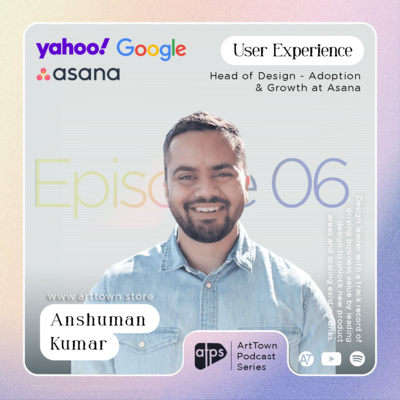
Architecture to UX Design & Beyond | Anshuman Kumar | Yahoo Google Asana | IIT Bombay | S3 Episode 5
47m 38s
En este episodio del podcast Arton, se entrevista a Shun Kumar, un diseñador con una trayectoria que va desde la arquitectura hasta liderar equipos en empresas tecnológicas. Kumar discute el impacto dual de la pandemia en la industria del diseño: por un lado, generó obstáculos para la investigación y colaboración; por otro, aceleró la adopción de servicios digitales y la innovación en áreas como la salud. Explica cómo su formación en arquitectura, centrada en diseñar secuencias de emociones y experiencias, fundamenta su enfoque del diseño de interacción. Define la experiencia de usuario (UX) como un campo que ha evolucionado desde priorizar la mera utilidad y eficiencia, hacia la búsqueda de crear deleite, fomentar conexiones humanas y garantizar la inclusividad. Kumar enfatiza que, aunque la utilidad central sigue siendo fundamental, los productos digitales ahora se diferencian también por el valor emocional y experiencial que ofrecen a los usuarios.
Transcription
6796 Words, 37113 Characters
Hello everyone, welcome to Arton Podcast series or ATPS as you like to call it. Every week on Friday, we feature art and design professionals who take us to their journey in this fascinating world of art. Make sure you follow us on Instagram, YouTube and Spotify. With that, let's continue with this show and dive deep into the ocean of art. Design is everything from the art video wearing to the mobile you are wearing and the feeling the experience which is gives is user experience design. Today, we have with us an instrument Kumar, who has done his post-gear suggestion from IIT Bombay and then he landed into Yahoo, followed by 9 years in Google and now he is creating a design in adaptation and growth in art. We are going to touch on depth of user experience design in collaboration with technology, presenting you on Shun Kumar on Arton Podcast series. Hi, Shun, it's my pleasure having you on my show. Yeah, pleasure is mine and I must credit your perseverance, I have been a little difficult to catch but I admire your persistence and being in touch and I am glad to be here. Thanks a lot for that compliment. With that, I would like to ask you so how have you been and how has this logged in actually TTDU and water changes have you observed in design across this pandemic situation? That's a loaded question, I have been doing good, lockdown has been like many people, it has impacted me in positive ways and in personal painful ways, I have lost family members to COVID, at the same time my son was born during COVID and the bright side of the civil lighting for COVID and for me has been that because we were working from home, I could spend more time with my son and I could see him grow and get to his first birthday that I would have never had the chance to do if I was actually going to work every day. So in certain ways, there have been dark sides of COVID which have been very hurtful and there are also a few civil linings. So your last question of how it has impacted the design industry, I will say many different ways and again there have been positive changes and there have been major setbacks and it impacts the design industry like so many different ways it starts from design is for people and if you're a designer suddenly because of these restrictions your access to people ends, your access to your colleague ends so working with other colleagues become difficult, your access to your consumers or users and so running research becomes very difficult and this is at a very tactical level where you're designing something. If you bubble it up to an industry level, there are certain products that found it really difficult to succeed when COVID restrictions came in. So any product that was around say events went into a very difficult situation and designers and people working on this products found it very difficult. At the same time, the civil linings was COVID also pushed boundaries for certain new kind of products. So a lot of like on demand product services which were there at the horizon but they became necessary in a sense of everyone. So be delivering your medicines, your food, your clothes to home, something that people were not always very comfortable with but suddenly they became very comfortable with and they were expecting all those services to deliver to them. So on demand changed and if you also look at it like designing for healthcare services changed drastically. If you look at healthcare sector, there were like a lot of startups and a lot of companies have been there for years and decades but they were very, they were was very scientific. A lot of it was not like user centered work because the scale of that, the scale of those projects and how it interfaced with customers were very limited. So during this phase, last 15 months, 18 months, the way telehealth has changed is phenomenal to see. So I would say COVID has its dark sides, I try to focus on the positives. Yeah absolutely, this pandemic has actually brought in many advantages with a downside obviously involved with that and when there is a pandemic, people actually start looking for solutions to actually overcome it and which has been a positive side over this which actually mentioned very rightly and also congratulations on your baby and it was great hearing that in your head, you could see your first year of your baby. So with that, let's actually before getting into design and more deeply into that, I would like to ask you so how we actually got into architecture first. So you have actually done your architecture and then you have actually moved to design. Yeah. How would say it happened by chance and if I look back, I can see certain. The elements in my personality growing up which showed some creative streaks, but I never grew up imagining that I'm going to be an architect or a designer like and we were chatting offline a little bit earlier that break up in India, especially I was growing up in like teens were in like 2000s, 1 to 10 and I'm not the teens actually in the early 20s. I would say still like it was like growing up in middle-class Indian family, you have to be an engineer, you have to go to engineering college and so I didn't have a very different journey. I never tend to be a designer, what I really dream to do was do something with planes. So either I wanted to fly them or build them, but unfortunately or fortunately, I realized that I was not fit enough to clear India to join Air Force or I was not smart enough or focused enough to clear GE to join an aeronautics program and there was a moment where I was completely lost because that's what I wanted to do and I was finding no avenues and at that moment I was introduced to a family friend who happened to be an architect and the more I looked into architecture I found this amazing blend of creativity and engineering and building something like physical and tangible that people use and I would just drawn to it and I decided to join an architecture school and that's how it happened, it was not planned at all. That's wonderful. So how has your journey been in architecture? So people actually spent five years and which are one of the hectic years of your life of being an architecture student, so how has that journey been? I think it was the most formative phase of my life and my personality, architecture is an advantage of engineering schools which is that you have one more additional year to spend time with your friends colleagues, it's also a very creative program, so I remember the first year of my architecture school we were the first semester, we were basically drawing freehand parallel lines and that was if I talked to my like other previous like 12 standard classmates who were like an IITs doing engineering, they were like what are you doing? Like I have you join an arts program, so it started with that, it was very unexpected and but the more we got involved in those five years, what I really discovered was architecture was not just about utility of the space we are designing for people, but it's core, it was more about designing for human feelings and how we can stitch a series of spaces together and imagine how people would feel in that space as they live their lives in those spaces as they move from one space to the other, so my big learning from architecture was to really look at experiences from a human feeling perspective and then thinking of a sequence of emotions that we want to tailor for people as to explore that space, in certain ways it's very close to a theatre where you are very intentionally creating a plot, a narrative to invoke certain emotions in people, so some of the good architects and their creations are, it's like theatre, you actually step in and you feel something, you go through a space, you feel something else, so it's like a choreography of emotions, very purposefully stitched together. Yeah absolutely, architecture or any field related to design is a human centric wherein you actually look towards a person and you actually design it for a person, as you actually mentioned, you actually tailor it for that particular person and that's actually wonderful and with that I like to ask you, so actually you move from architecture to designing and you have done your interaction design in masters from IIT Bombay, so how did you actually go from here to there, whereas from listening to you I found that you actually love architecture also, so I did actually move towards design. Yeah so what happened was as I was completing my architecture program, I got to work with a very talented at that time, a very avant-garde architect in India, his name is Guruji Singh Matharu, he is an office in the bar and I work there, I got a chance to, and he is a very versatile designer, he yes, he's known for his architecture work, but he's also a very talented like automobile designer, so as I was working over there, I was working on the more traditional architecture projects, but because of Guruji's interest in automobile design and other disciplines of design, I got a chance to work on some of those projects, and that taught me that learning architecture doesn't mean that I can only design spaces and buildings. I think what I learned in architecture can be applied so many other disciplines, and I could see Guruji doing it right in front of me, and I got a chance to kind of do that and dabble with it, and I found that to be very fulfilling and very exciting, so that opened my mind about looking at architecture, not just as a profession, but as a set of learning that I can apply to other aspects of design, and being in MDabad was great because I was close to an ID and a lot of friends over there, and I got a chance to dig into what's happening in an ID, and exposed to even more design avenues and streams over there. Also, when I was doing my architecture program, there's a fellowship in India, I don't know if it's tillings, it's called KBPY, Young Scientist Fellowship Award, and in my second year of architecture, I submitted a proposal for that fellowship, and it was basically about like a new kind of brick bonding that can make thermally insulin, better thermally insulin buildings, and somehow they like the proposal. I got that fellowship, and under that fellowship, every summer of my architecture program, like four years, I got a chance to go to IIT Bombay in IDC, industry design center, and get to work with a very, very versatile professor, he's no longer at IDC, he's a professor of IHASRA. He also had an architecture background, and he was trying to do things in solar passive architecture, he was also an industrial designer, he used to teach industrial design and visual design at IDC. So every summer at IDC, and I was exposed to so many new streams of design, so it was more like the more exposed I got to different disciplines of design, I could see how architecture can connect to them, and what I was learning can have wider application, and yeah, just spending four years at IDC was like, I want to be here, I want to kind of spend my time here, I want to kind of work with all these nice cool projects, and that was a very easy path for me to move from architecture to interaction design, so experience of working with Gurgit, and how he used architecture with me with other disciplines, an exposure to an IDC, made it very clear for me that I wanted to move to interaction design. That's spectacular, and I must say that you had your every options, not actually options, but actually your every decisions which you made in life, so what do you purpose you actually wanted to achieve? I can say that in the hindsight, in those moments, nothing is planned, it was like very it was like very much led by like feeling what I wanted what I was interested in, and growing up in India is like also like career, where do you have a better career, and I would be dishonest if I could say this was just about passion, this was also being very practical about like where do I have a better career, and I was, I graduated from IDC, did my masters over there in 2008, and UX design was picking up at that point of time, especially in India, and I could ride that wave, so I think that was the more practical decision, part of my decision, but a lot of it was more like I was just inspired, and I wanted to kind of invest my time and energy in this new domain, so I would say both of it was there. That's wonderful, so you actually ride the wave, and you actually end up in Yahoo first, and then you have actually spent nine and a half years in Google, and now you're actually ahead head of design at Asna, so how was your this wave of journey been? So I don't know the head of design at Sana, I am actually the head of growth and adoption, so it's a large team, and my team works on making the product more easy to adopt in the early days of teams using Asana, or Asna, both the names are fine, it's actually based on like the Buddhist or Yog Asana, so that's where the name comes from, but in America people always refer to it as Asana, and that's how it's become more popular, but the real name is Asana, so Sanskrit word. So anyways, to answer your question, yeah, my journey has been a little wild, and when I talk to people, I often compare my journey to some of the shots in Jurassic Park, because my journey has been very adventurous at times, it has been very unexpected, as I was saying, like not a very little of it was planned, and very little of it was traditional, it has been thrilling at times, because at least in the last six years at Google, I got to work on a lot of like emerging technologies, from self-driving cars, to VR, to AR, and on the projects, we were pushing the boundaries of technology to find like to solve new kinds of problems, and we had no idea if things were going to work, so there was always a thrill of like, is this going to work, is this all going to work, and many at times things didn't work, so it has been very thrilling, and I will also say it has been scary at times, because I have intentionally, that's intentional, part, put myself in new fields and new disciplines, where I don't know a lot about those disciplines, I don't know about that product space, I don't know about the technology, and suddenly I'm reading design, I'm reading the design team, and it's this very uncomfortable feeling that I don't know anything about this space, and I'm expectively, so there have been scary moments, but you just kind of focus, learn, and get over it, absolutely, so when a person is actually pushed out of his comfort zone, that's when he actually starts to succeed, and also to learn new things, and if you don't learn new things, you just go behind the time, so that's actually a great that you actually could push yourself, and you have pushed yourself to a greater edge that you have achieved a lot, I would also say that I think my biggest reward during this period happy, just some of the most brightest and smartest people I've worked with, and in addition to just having growth mindset, it's like these people who have helped me grow personally, and professionally, some of them have been my role models, so I think it's just like apart from the work, it's more importantly it has been the people who have been very fortunate to work with closely, that have inspired me, and continue to inspire me, yeah actually you just told me your life is only, and with that I could just summarize that people have got a have been a greater influence in your life, people have actually achieved how we are today, and also how your path of your journey have been, it wasn't by your decision making, but it was actually by what influenced you along the way, exactly, so I'm very grateful for those people, I mean without their inspiration, I don't know what that would be doing, that's great, so with that let's actually dive into UX now, so can you just define UX for us, and you actually before talking, you had actually mentioned that, you guys actually just a sub part of UX, so how do you define UX, and how does everything work around? Yeah, so I'll go back to my previous conversation we were talking about architecture, where I was saying it was, architecture was creating a series of like stitching a series of experiences, that can make people feel something, with a very clear intent, like what we want people to feel, so I actually want to draw a parallel between architecture and interaction design, or more like digital user experience over here, because it's important to reflect on it, I would say the discipline of user experience is, especially for digital products, it's very nascent, it's barely, you can like, you know, 30, 35 years, it might have been in more research labs earlier, but like the more consumer side of those disciplines is barely a few decades old, and when you compare with architecture, which is like some top, some number of thousands year old, that discipline has so much time to mature and refine, and every discipline starts with solving the problem. Architecture started with solving the problem of shelter and safety, shelter from the weather elements, safety from animals, and it's at its core, that's what it does, that's the utility of it, and then you add more functions and utility, and when you start meeting utility, you start thinking of aesthetics, and when you start kind of, you know, hitting the bounds of aesthetics, you start thinking about feeling, oh, how I should feel over here, okay, so, and then as you think about feeling, feeling is a lot very sensorial, like, what should it feel when you touch it, what should it feel when you smell it, okay, so architecture has already gone through that journey, and when it comes to digital design, or UX design, which is where UX is open to refer to, I think we are in the very early stages of that journey of maturity, so when I started my journey of, as an interaction designer at Yahoo, a lot of the work we were doing was primarily based on utility, let's get this thing done, we want people to be able to send Yahoo, email through Yahoo, and the focus was entirely to stitch like the right user flow steps next to each other, so that people can very efficiently, very quickly, with how minimal error complete that flow. There was some focus on like, what's the visual experience of it, but that was not the most important thing. Now, if I look at the industry now, I think utility of like, or the usability, if you may call it in, in a UX terminology, that is a given. It has to kind of solve that problem, it is no longer like a unique feature, oh my app is more helpful or usable than the other app or the other product, it is more fundamental to any product that we build. I think people now are starting to differentiate products on the level of delight that it creates, and the value of offer, the value they offer in terms of more human connection. There has been so much more awareness in these days around making products more inclusive. That was not a consideration 10 years back. So, coming back to your more focused question on like, what is user experience? I think user experience today is an amalgamation of multiple things. It's about how we can create a journey for a consumer to get something done. At the core of it is still utility. I am waiting for dinner. I don't want to cook. I want to order something from outside. Beats vegan India or be a doodash over here. The utility is the core. Can I find food options? Can I search them, browse them, filter them to my liking? Can I customize what I'm ordering? Can I track if my food is on the way? Is it being delivered now? Is it delivered to the right address? If there is something goes wrong, can I talk to the person delivering it? Can I logic complain if something goes wrong? So, that's the core utility. I think everyone is solving that. And I feel still that utility is a big part of the experience. But as I was saying, a lot of these as an industry, we are spending more time on delight now. And that's where we started to differentiate. Because Swiggy and Doodash, they solve the same problem. At the utility level, they are pretty much the same. But how did they differentiate? And that's the delight factors that they differentiate on. And these are these micro interaction, micro moments that makes it like, oh, this feels so nice. And it could be a very simple interaction where you like, you know, on mobile web, if you pull down the page, it reloads. And I don't know if you know like Facebook use that interaction pattern to kind of drive more engagement. So, it, user experience is now utility and plus delight. I hope in the next 10 years, it becomes more sensorial, it becomes more immersive. We're starting to see the signals, but it's a long journey ahead. Absolutely. So recently, we actually interviewed one more person, which is Kalyb Greeneer. He is in head of service design at Royal College of Arts. So, he's actually heading service design, which is actually a new concept which has been introduced, wherein people actually solve the question, keeping the deep of person or the audience in the core and then actually designing everything around it. So, that's something which I could see UX get into after a couple of years. Yeah. I mean, service design has been there for some time. It has been there for easily, like, 15 years, 20 years that I am aware of. It has been more popular in their cadmings circles. They have been some agencies in Europe and the US and some in India who have tried to bring the concepts or the methodology of service design. But yeah, at its core, it's all about, like, identifying all the touch points with the customer and thinking of that experience holistically, as what at its core service design is and at its best, user experience is service design. Yeah, absolutely. Also, if I could just break down all of this conversation into us into one or two lines, we can just see that the surface is actually about, if we are actually designing a car. So, firstly, we actually just design the engine and the machine we can just get it rolling on. Then after that, we actually add customizations like how this should look. Then we actually look about how aesthetically it should look and then we actually holistically go around it, how it should actually feel when a person actually sets into it. So, that's so we can actually break it down of our audience to get to know that how we actually use it experience work. So, with that, I would like to ask you, so you had actually mentioned about VR and also autonomous vehicle project which you have done. So, could you just tell me any one of the project which actually loved it? Oh, there are many. Let's see, given you talking about car, I could talk about the self-driving car project that Google had. I was, I joined the project as a 20% designer, but I started spending a lot of time on that project and the story over there is which is like a life lesson for me is and this is happening in 2015 and the self-driving car project has still been going on like three years within Google or maybe a little more. And when I joined the team, I realized that how challenging that problem was. It's easy to imagine just say, "Oh, cars will drive by themselves." And that's where like from a user experience point of view, safety becomes very important. Reliability becomes very important. Trust becomes very important. As a person sitting in the car, do I trust this car to drive me safe? As a person sitting in the car, can I, how do I know that I'm going to be safe? So, there are different aspects of user experience that emerge as you go into new disciplines. So, the one thing that can really stood out for me and I learned it from a PM who used to run that project was how to solve seemingly impossible problems. So, making a car that drives itself on the road with people, animals, cycles, cars and taxis and buses and next to each other, go existing, understanding signals, understanding people's intent, because people don't always do what they were supposed to do on the road. It's a very challenging job. So, what I learned from the SPM was for any seemingly challenging problem, if the first thing is to kind of dissect that big problem into smaller subproblems. And the moment you kind of break the larger problem into smaller subproblems, you realize that 70% or 80% of the problem is actually soluble. It has already been solved or there are existing solutions in other industries that can be adopted for this particular problem. It's only the remaining 20% which has not been solved yet. And that is making this whole thing challenging or seemingly impossible. And his approach was, or maybe I'll say his approach, I'll say the whole self-driving car scene approach was, let's find that person in the world who believes that this problem can be solved. And let's not just find one, but we find a few more people who believe that remaining 20% is a solvable problem, bring them together and give them the time, space and resources. To go ahead and solve that problem, trust them that they can solve this problem and then make the other part of the team focus on the remaining 80% of the problem to kind of do that thing right. And that just kind of switched up like light bulb in my mind where suddenly everything seems possible. And when you look what SpaceX is doing, it's like, wait, how is that possible? How can they do it in five years or now that I couldn't do it in, I don't know, 50 years or more? I think it's that mindset of very analytical mindset of looking at a problem, not getting even how, whatever, however daunting it might look, not getting intimidated by that, but looking at it from a very rational perspective, breaking it down and believing people who believe, who could solve that problem. So, yeah, actually, toward the ideology, which I could just summarize in one sentence, which would be like when crazy people come together, who think that the thing is impossible, impossible turns out to be seemingly simple. I was crazy, I was optimistic. People who believe things can be done and they might seem crazy, but they might be the most part of people you might have come across. Yeah, so actually meant by crazy is that when people in this background, they actually need to have an thinking which is out of the box and wherein they actually discover things which a normal person wouldn't even discover. That's why I actually turned it as crazy. So, with that I would like to ask you, so do you have any inspiration? So, when we are actually designing anything, do you have any inspirational, how do we actually go to design anything? Yeah, I mean, I generally don't have like a go-to source for inspiration. Inspiration many times is around us, but if I really squint my eyes, I feel the aspects of architecture that still inspire me. So, it ranges from the work of Tadawanda, or these, no more, to some of the more emerging architects. And I still look for inspiration architecture. I look for inspiration, other disciplines of design. For example, a lot of what that happens on product design and industrial design, how sustainability has to be a big part of that discipline. How can we learn from that discipline? How can we inspire the work we do on UX design through what other disciplines are prioritizing and who are they thinking about designing products? So, I think the inspiration is from other disciplines of design, which are more mature and how we can bring those inspirations back to what that we do. So, as I said, architecture and architecture, so, in your of the right now, when you are actually having all day, do you actually go and seem to what's new in architecture and what's actually going on in architecture? Yeah, I'm still very, I'm very interested in what's going on, where we are pushing the boundaries of architecture. And my personal area of interest is how we are making architecture more sustainable, environmentally sustainable. And that's a big, that's a big, like, that's a big mission for the earth. And if we, if we, an architecture I feel has done, has gone through significant rounds of evolution. Even the last, like, I'll say, 15 years, 20 years to actually start marching towards that mission. And if you remember previously in my conversation, I mentioned I used to work at my summers and IDC and the professor I used to work was, his idea of research was sort of passive architecture. So, I think that interest kind of is rooted over there and I love and enjoy seeing how that philosophy is evolving in some of the world that's happening now, these days, these days. That's wonderful. And actually sustainability is actually going to be the future of architecture. So, what do you think is the future of design? Oh, that's a, that's a whole question. I have, I've thought about this question many times and the way I have internalized it for myself is we, what we're looking, if you just step away from everything that's happening in the last 40 years, just look at this, how technology has evolved from a bird's eye perspective. The way I look at it is, is that we're looking at a journey of humans and computers. And it's the distance between them that's reducing. So, if you look back, I don't know, 30 years, 35, 40 years, if you had to use a computer, you had to go to a particular building in the city, in a particular city, you go to a particular room and that room was the computer. And so, you had to travel miles or kilometers or hundreds or thousands of kilometers to access the computer. 2025 years back, those computers became smaller and they became PCs and then now they could be sitting in your office desk or your own desk. So, you have to now just drive or walk a few kilometers or a few meters and then the computers came even closer, they became laptops. So, the way their form factor has been shrinking, they have been becoming more and more closer to humans. So, with laptops, you can carry them around, you don't need to go to a particular room, you can be sitting anywhere, opening a laptop in the world, that laptop became phone, you don't need to carry your bag now, if computers in the pocket, wherever you go. And now, the computer is sitting on your wrist as you watch it and a few years will be on your face as your smart glasses. And then a few years will be inside you and it already is. And for me, as an interaction designer, I'm always looking at the interaction between computers and humans, how we understand each other and how we communicate with each other. So, when communication is input and output. So, I don't know if you've seen neural links, recent experiments where they are using neural links, chips within, they were actually testing with the monkey. They planted the chip and the monkeys, I don't know which part of the brain, but the monkey can actually think of what they want to do and they make monkey play a game, I think it was a game of pong. And after some training, the monkey could control, play the game just by thinking of what that monkey wanted to do. And that was like, for me, a very pivotal moment in how this journey between computer and machine and humans are shrinking. And it's like a little more dystopian future, maybe I'm trying to paint, but yeah, the future of design, I feel, is very, very immersive, where input will become, we don't need, we might not need a mouse, we might not need a physical device, it's just thinking or intent your eyes or multiple other things, where we'll be easily interacting machines. You might not need a screen because the screen is in front of the infront of the glasses. So, in terms of hardware, either display or interaction, the form factors of these tech will reduce, they will be more closer to us. In terms of just a whole experience of different product experiences on these devices, I think that's where we'll start seeing more immersive experiences, which goes beyond just your utility and delight, but it's more like immersion. And that's where I'm very fascinated to see how AR shapes up or the AR shapes up. That, I'm saying it's not a discount that there will still be forms, there will still be apps, there will be a co-existent of these products. And on the more traditional form factors, I feel design is going to become as a designer, it will become more intelligent, it will become more automated. So, what will happen is we will remove the busy work of designing and we'll create more time for designers to be more creative. And if you look at in the last even one and a half years, actually that's one of the advantages of COVID. Our design tools have improved significantly, they have become so much more collaborative and I feel that this development will continue happening. So, our tools will become much more smarter, we'll reduce the busy work and we'll be able to kind of focus our time on more creative and sensorial designs. And that's what that's very exciting is a designer. Absolutely, that sounds to be a golden era for designers, I must say, this coming 10 or 15 years will be a golden era for design in India absolutely because it's actually emerging in India right now only. So, with that I would actually have to ask you a personal question right now, which we haven't actually discussed, but yeah, so I, so I actually mentioned that this technology has been over for 40 years only and and when we actually look at generation gap between me and my father or my grandparents, it gets very hard for them to actually cope up with this technology. So, how does UXG's actually help to incorporate them into learning this technology seamlessly? That's a great question and that's where the utility part becomes very important, where are we building this experience that is accessible and when I say accessible, I mean accessible in the its widest meaning, where can my father whose eyesight is not like perfect, can they still use it? Can they even understand those mental models of these devices to actually navigate it? How do they understand app structure? So, that when they're using the phone, they know how to minimize the app, when to bring it up, how to switch between apps, how to delete the app, so all those are like new and evolving mental models and I'll say it's a very difficult job because as designers, we have talked to kind of solve, like imagine a user and their needs and solve for them and when we are designing for the whole world, it's a daunting problem because people are so different the way you use a product will be so different from your parents. So, I think that problem aspect of design has not been very well solved just yet and there's a lot of work that needs to be done. I feel right now the burden has been borne by like the generation of parents or grad parents where they have taken the extra effort to learn this or our generation has taken the extra effort to teach them how to use it but I think that's a huge need where technology can by itself reform or reshape itself to become usable for different kind of people or accessible to different kind of people who might not be well versed with technology by itself. Yeah, absolutely this can be an area which has not been touched yet because design has actually worked over a quick two decades only. So, it didn't as you mentioned before it didn't get time to actually measure enough to actually contemplate every of your users in it. So, with that I would like to ask you the last question for today which is could it just give our audience some insights and also any take-aways from this conversation. I think the one thing that your audience is very wide and the one thing that I would probably sum up is keep learning and have a growth mindset get inspired by other disciplines of designing. So, you mentioned a few like a few episodes back you were talking to tattoo artist. Imagine what a tattoo artist can learn from a beaver. What a beaver can learn from a tattoo artist and what they can teach the people who are designing I don't know the astronauts suits for SpaceX. So, it's all about like appreciating the other disciplines of design and really been curious about what's going on over there and trying to connect the dots and borrow things from there. We don't need to reinvent the wheel every time every during this design. So, I'll say be curious learn more, observe more. Thanks a lot. It has been actually my pleasure hosting you on this show and thanks a lot for giving us your time and coming on the show. Oh, thank you so much. This was a pleasure talking to you. Till the end, I really hope you liked our show. You did please leave us a review on YouTube comment box and by the way if you had any question which came up because of the content we covered with our guest go on YouTube, go on Instagram and you can leave us a comment. We will surely get back to you and help you as much as possible. Arttown.store. That's the website name and our Instagram ID 2. Find us and talk to us. We are waiting to converge with you.
Podcast Summary
Key Points:
El podcast presenta a Shun Kumar, un diseñador con formación en arquitectura y un máster en diseño de interacción del IIT Bombay, que ha trabajado en Yahoo, Google y ahora es responsable de crecimiento y adopción en Asana.
Kumar reflexiona sobre el impacto de la pandemia en el diseño
Su transición de la arquitectura al diseño digital se debió a la inspiración de mentores y a la exposición a diversas disciplinas en el IDC, viendo la arquitectura como una base para diseñar experiencias emocionales secuenciales.
Define la experiencia de usuario (UX) como una disciplina en evolución
Summary:
En este episodio del podcast Arton, se entrevista a Shun Kumar, un diseñador con una trayectoria que va desde la arquitectura hasta liderar equipos en empresas tecnológicas. Kumar discute el impacto dual de la pandemia en la industria del diseño: por un lado, generó obstáculos para la investigación y colaboración; por otro, aceleró la adopción de servicios digitales y la innovación en áreas como la salud. Explica cómo su formación en arquitectura, centrada en diseñar secuencias de emociones y experiencias, fundamenta su enfoque del diseño de interacción.
Define la experiencia de usuario (UX) como un campo que ha evolucionado desde priorizar la mera utilidad y eficiencia, hacia la búsqueda de crear deleite, fomentar conexiones humanas y garantizar la inclusividad. Kumar enfatiza que, aunque la utilidad central sigue siendo fundamental, los productos digitales ahora se diferencian también por el valor emocional y experiencial que ofrecen a los usuarios.
FAQs
The Arton Podcast series features art and design professionals who share their journeys in the world of art and design. It is released weekly on Fridays.
COVID-19 had both positive and negative impacts. It restricted access to users and colleagues, making research difficult, but also accelerated the adoption of on-demand services and telehealth, pushing new product boundaries.
Working with a versatile architect and exposure to different design disciplines at IIT Bombay's IDC showed how architectural principles could be applied broadly, inspiring a shift to interaction design.
UX design has evolved from focusing primarily on utility and usability to now emphasizing delight, human connection, and inclusivity. Utility remains a core foundation, but differentiation comes from emotional value.
He studied architecture, then pursued a master's in interaction design at IIT Bombay. He worked at Yahoo, spent over nine years at Google on emerging technologies, and now leads growth and adoption design at Asana.
Architecture taught him to design for human feelings and sequences of emotions, similar to creating a narrative in theatre. It's about choreographing experiences tailored to how people feel in spaces.
Chat with AI
Loading...
Pro features
Go deeper with this episode
Unlock creator-grade tools that turn any transcript into show notes and subtitle files.
 PodcastTranscript AI