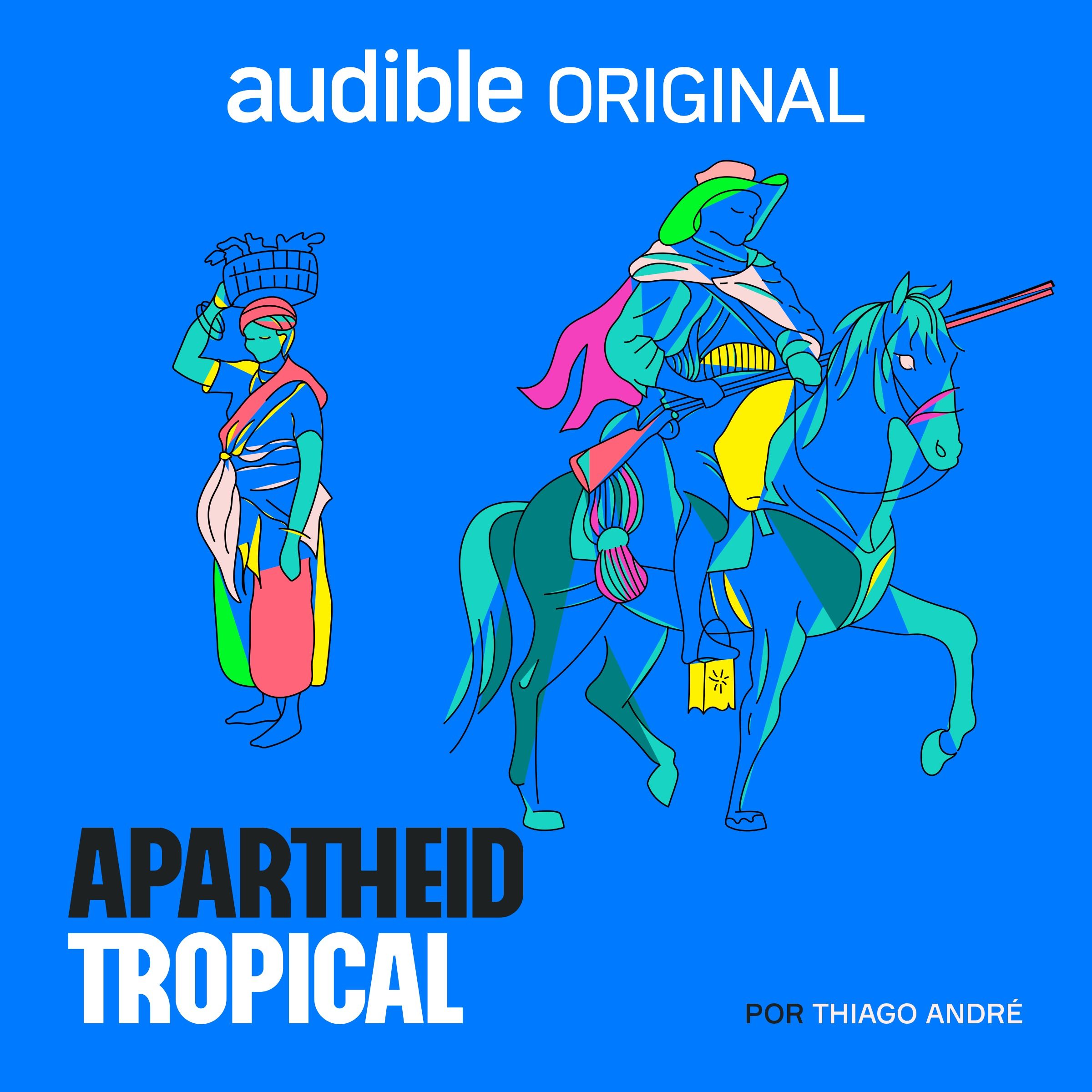
The "Tropical apartheid" audio series explores how Brazil implemented racial segregation post-abolition, hiding mechanisms in its laws to hinder the progress of the black population. It discusses the formation of the Black Guard, a political movement defending the interests of urban black Brazilians, and the repression it faced from the Republican government led by figures like Sampaio Ferraz. Ferraz, known for his severe actions against capoeiras, symbolized the strict control imposed on black bodies to maintain social peace. The transcription delves into the complexities of Brazil's racial democracy narrative, revealing the underlying racial issues and contradictions prevalent in the country's history post-abolition.
Transcription
6628 Words, 39801 Characters
Hello guys, here is Thiago André and no, this is not another episode of the Black History.
I am here to share with you a very special work that we developed with the audio, the Tropical apartheid.
In recent years, the Black History has been telling fundamental stories about Brazil and the black people.
And one of these stories grew so much that it became an original audio series of the audio.
Many say there was no apartheid or segregation in Brazil, but in the Tropical apartheid I show you
how Brazil used its laws to prevent the progress of the black population.
As after the abolition of slavery, the Brazilian state hid in its laws sophisticated mechanisms
of racial segregation with the aim of eliminating the black population from the country.
Until today, this content was available exclusively in the audio, just for viewers.
But as we are about to launch the second season of the Tropical apartheid,
we managed to exchange an idea with the audio and make available the first season completely free here in the Black History.
I hope you like this content, which is a result of a lot of research and collective work.
And get ready, in a few weeks, the second season of the Tropical apartheid will be released exclusively in the audio.
The Amazon Audio Book Service.
Check it out, you can test the platform for free and marathon all our content and much more.
It was here at Beir Amar that Brazil made its country. From here in Rio de Janeiro,
in the aura of the 20th century, the Republic designed for the world the image of a modern and cordial Brazil.
In this small piece of land lost in Aleimar was built a paradise.
They said it was here that there was no sin and no sadness.
Over time, travelers and foreign naturalists recorded in their newspapers that here in this land everything that is planted is given.
The men here are happier, the women are more beautiful and nature is more exuberant.
Here, unlike other parts of the world, the different races are doing very well.
In the tropics even the colonization was more bright. Blacks, whites and indigenous people lived in perfect harmony.
Brazilian scientists made colors to foreigners. They wrote books, gave lectures, left an international commitment to say to the world that here the different races lived very well.
In Brazil there was nothing similar to the laws of the United States, which imposed by force the white supremacy, keeping the blacks in a position of legal and social inferiority.
Which separated between whites and blacks all aspects of social life, such as schools, restaurants, seats in the bus, drinkers and even bathroom.
Not here. In Brazil there was nothing close to the barbarity of the South African Party, which by using the law institutionalized racism by separating and hierarchizing society in different racial groups with more or less rights.
That divided the territory in exclusive areas, separating 87% of the country from the whites, which prevented the marriage between people of different races.
Not here.
Brazil has always been proud of being a mixed and cordial country, a racial democracy in the tropics, a paradise of the races.
Well, this was the official speech, but as you should imagine, there is a big problem in the paradise.
If we live the same racial democracy, what explains the inequality between whites and non-whites?
Here, blacks and white people are the majority of the population, but they are the white people who live the best.
While black people are the main victims of violent crimes and homicides, in addition to having the least expectation of life.
While the white people occupy the best jobs, the black people are the majority who love the job and the analogous work of slavery.
While white people access the best education institutions in the country, black people are the majority of the people in the alphabet and minority in the universities.
While most of the judges and promoters of Brazil are white, black people are the majority of the prisoners.
Black people who have less access to basic health and decent housing are the main victims of the unemployment, epidemics and hunger.
While the Unicrow laws in the United States or apartheid enshrined their racism and violated human rights to the light of day, in Brazil we had something more sophisticated and much worse.
The Brazilian state developed mechanisms for segregation and imprisonment.
It was hidden in its armed laws that made it difficult to advance the black population.
It created what we call "Brazilian segregation", a tropical apartheid.
My name is Thiago André and you are listening to Apartheid Tropical, an original audio.
Episode 1, The Black Problem.
This recording is from the beginning of 2023. I went to the National Library with Geronimo Cruz, my research partner in this original.
I went down there on the Mexican road, I thought it was around there.
The National Library is in Rio de Janeiro and opens a gigantic national documentary in Brazil.
On that day, me and Geronimo were behind the 14th of May, 1888, one day after the abolition of slavery.
Because we wanted to understand how Brazilians, mainly the black Brazilians, received the news of the abolition.
Aurea's signature didn't take place a new moment in Brazilian history.
For the first time, the black population in its entirety was benefited from a direct action by the state.
That's why, after the signature of the law, the Brazilian did what he knows how to do better.
Party, a lot of party.
A lot of people took the streets of Corte, Rio de Janeiro, and made practically a carnival out of time.
Maschado de Assis came to write in a chronicle that it was the only public public day that remembered to have seen.
It was fully documented by the press, as is the case of the newspaper, on the 15th of May, 1888, that we checked in the National Library.
The people's waves percolated the street of Vidor and other streets and squares in all directions.
By the explosion of the most vivid contentment, its enthusiasm for the promulgation of the glorious law, which extinguished the civil element,
signaled the beginning of a new era of grandeur, peace and prosperity for the Brazilian Empire.
As we can see, besides the party, there was a general atmosphere of hope, a hope never before seen by the blacks of Brazil.
Finally, they could think about having a future, a future where they are alive and free.
But this hope would last a short time.
The abolition party would end in tragedy.
It is that so many centuries of slavery left deep marks in the nation.
And many members of the class leaders could not conceive the idea of building a country where the black people were so free,
as the whites were.
It is the case of the deputy José Marcelino, who in September of that same year made the following speech in Parliament.
The only law that regulated our work was the law of slavery.
The only constant, permanent and stable agent of the work was slavery.
We did not elude ourselves, members of the parliament.
We did not elude the government, we did not elude the press, especially the court,
which faced our society under the best conditions.
Before, we had the authority of the Lord over slavery.
It was the suggestion that determined the work.
But today, what is the law that obliges the free and proletarians to work?
Under the excuse of concern with the productivity of the workers, now free,
the deputy left a thought that had been circulating in the corridors of power for some time.
How to maintain the order and social hierarchy of slavery without the institution of slavery?
How to maintain the black body under control,
if there is no more law that allows the suggestion through violence?
There are many news reports.
I think it would be interesting to see on November 15th,
what was happening at the time of the proclamation of the Republic.
I think these data can be interesting for us to see both the party and...
How did the black community, the black population receive the news of the proclamation of the Republic?
As you can remember, the nature of the law and it helped create a political crisis that was already growing.
In a little more than a year after the abolition,
political forces defeated the monarchy and established the Republic of Brazil through a coup.
And the irony is that this new regime was established precisely by the old slave oligarchies,
members of the agrarian elite resented to the end of slavery in Brazil.
So the republic was born under a liberal, modern discourse that supposedly would bring a new one to Brazil.
But that in fact carried in its entrances the slave values of an old social order that they wanted to preserve.
And that's why the Brazilian racism, the tropical apartheid, is so sophisticated.
It was born from this scene game that shows itself modern, liberal,
but that hides in its interior a racist ideology based on the black slavery.
This made a warning on the black population.
And then there is a global newspaper on November 21st, let me see the annotation.
The global newspaper here is from São Luís do Maranhão, not the Carioca that would be founded 36 years later.
There was a conflict in front of the newspaper, did you get it?
Of this black population that was not very satisfied with the proclamation of the republic.
What happened was that the news of the proclamation of the republic arrived in Maranhão two days later,
on the 17th of November, and as soon as the news spread, a crowd of liberals, men of color,
left the city's streets in a large protest hall.
The destiny was the headquarters of the global newspaper, which on that day forced a republican conference.
The reason for the protest was clear, the black population was against the republic's institution.
And when I say black population, I'm not talking about a specific group of blacks.
The sympathy for monarchy, especially for Princess Isabel among the blacks,
is a significant mark of this period of immediate post-abolition.
And it's not that the black population was to see the republican values, it's not that.
For them, at that time, the abrupt establishment of the republic
represented the interruption of a process of liberation and constitutional guarantees.
There was a general fear in the black population that the new republican regime
could reestablish slavery and put everyone back in captivity.
And this fear was not without a reason, it had a foundation in history.
In the 19th century, Napoleon Bonaparte, when he ascended to power,
restored slavery in the French colonies, a few years after the abolition.
In another case, in Nicaragua, the president revoked the abolition that had been promulgated 27 years before
and led the blacks to slavery.
They feared that the same would happen in Brazil.
Therefore, when they learned of a possible fallout of monarchy,
the liberals took the streets in Maranhão and went to the headquarters of the global newspaper.
When they came closer to the entrance of the newspaper,
the black man's crowd was spotted with a pilot of soldiers strongly armed,
formed in line.
But this did not intimidate two protesters,
who continued to advance over the building as if the freedom of each one of them depended on it.
They did not stop marching even under the guise of the republican soldiers.
It was then that the pilot shot the rifle in the direction of the crowd.
It massacred the black population that was organized in revolt.
We do not know how many people were gathered in the protest,
but we know that three black people were killed and eleven were left on the ground seriously wounded.
This episode was known as the Massacre of the Liberals
and may be the first of many popular revolutions led by the black population,
in search of the maintenance of the conquered rights.
The following decades would be marked by conflict, genocide
and cruel repression of the republican state against the black population organized.
The wars of Canudos and Contestado, the revolutions of the Shibata vaccine
were some of the great national conflicts traversed by racism
and by the search for black people for full citizenship.
Prove that the Liberals massacred in Maranhão had some reason to fear the new social order.
Somehow, it was a glimpse of the kind of country that the brazilian blacks had from there to the front.
In Rio de Janeiro, the conflicts between the blacks and the new republican order
were escalating too fast and would soon cause violence.
After the abolition for the first time, the black population could express its political will in the public square
and decided to organize around a party itself, not a traditional institutional party.
A party in its most elementary sense, the meeting of people on the same ideal.
It was a bunch of capoeiras, as was said at the time,
which added up to more than a thousand men and would enter history known as the Black Guard.
Who told me about this? It was Carlos Eugênio Líbano Soares,
professor of the Department of History at the University of Bahia,
researcher and author of a black institution on the capoeiras in Rio de Janeiro.
There is a mulatto, which is a leader who regularly goes and is interviewed.
And he says, "The Black Guard fights for the black politicization, for a political party of the black population,
for a political action that represents the black population."
This is in the Patrocínio Journal, in the Rio City.
Some say that the Black Guard was founded within the newspaper "Cidade do Rio",
which was the property of José do Patrocínio, the main leader of the Brazilian abolitionist movement.
But in fact, Patrocínio only gave space in his newspaper so that the Black Guard could speak.
So this person has space to publish, so there are articles.
We want to politicize the black after slavery, we want a black political party,
we want a black political movement. Is it on? We are in the Patrocínio Journal.
Unlike the most current notion that we have of capoeira as a cultural expression that mixes martial art and dance,
at the end of the 19th century, it had become an important political tool for its violent potential.
It stopped being a capoeira only for personal defense and resistance, as it was in its primordials in the colonial period,
to become another tool for negotiation in the urban and free environment.
So instead of diminishing the end of slavery, it expanded, but changed the character.
It became a capoeira of free men, no more a capoeira, but a slave.
What I call a capoeira is "criola".
The term "criola" means "created".
Someone who was not brought up as a slave to a new land,
someone you know, you in the case of a lord, know the idea of a little one.
So these criolos participate much more in the white world, in the fears, in the anxieties.
In this context, the malts, as were called the organized groups of capoeiras,
start exercising social influence in the urban black communities
through the territorial control they obtained because of their ability to apply violence and protection.
The Black Guard is a chapter more than what I call "politization" of slave culture, or "politization" of the capoeira.
The Black Guard emerged shortly after the abolition of slavery.
Before the Urals and military elites, they gave a coup d'état that would establish the Republic in Brazil.
In fact, the Black Guard was born with the purpose of defending the interests of the urban black population of Rio de Janeiro.
In general, it was against the Republicans and their attempt to demolish the monarchy
and interrupt the possible third reign of Prince Isabel.
Because the monarchy is very popular among the black population and it is popular as never before.
And this movement is understandable, after all, it was in the regency of Prince Isabel that the slavery ended.
For the black population, this was not a small thing.
It was as if the whole world, known, had only changed once, and for the better.
It was as if, for the first time, someone had looked at the blacks of Brazil.
On the other hand, the opposing group was working to stop this process of change.
Not that the monarchy was better or worse than the Republicans,
but at that time, in their reading, what was in game was the maintenance of freedom and the future of the black population.
But the inevitable happened.
And on November 15, 1889, the monarchy fell.
What is going to happen in Brazil after the Republic is a military dictatorship.
And then you have what? That rural Paulist elite, reactionary.
São Paulo is a sad reaction.
The Paulist elite comes to Rio, we take power.
So what happens?
Then there begins the dismantling of the scenarios.
Who are the first to be hit by the military coup of 1889?
The capoeiras.
The Republicans knew that the stability of this new Brazil that was born
depended largely on keeping social peace in the heart of power.
And for that, they planned to keep a strict control over the black bodies that were being organized politically.
With the parliament closed and the traditional politicians still out of the scene,
the Republican government launched the police chief of the now federal district to repress and imprison the black people.
The task was chosen by a young promoter called Sampaio Ferraz,
who soon would be known by his most feared name, Cavaniac de Aço.
What is Sampaio Ferraz?
A promoter, Republican, moralist, son of farmers from Campinas.
For him to be a scarecrow, created a little like a little playboy,
green-haired, from the farm.
A rural formation.
But it was in Rio de Janeiro that his career was promoted.
It became a reference to set up cases that caught black people, and mainly capoeiras.
For these last ones, he even nourished a particular hatred.
Two years before becoming a police chief, when he was still a public promoter,
Sampaio Ferraz gave an exclusive interview to journalist Júlio Ducarmo.
The two took a good lead in the direction of São Francisco,
where today is the Institute of Philosophy and Social Sciences of the FRJ.
On the way, he gave the details of his performance against the capoeiras,
and how he felt deep into the version of the rapes that terrorized the city.
In the instant that he jumped from the bond in the square,
a violent fight broke out between two capoeira rapes.
From afar, Sampaio Ferraz managed to identify the involved.
They were the Guayamus and the Nagoas,
two of the most feared capoeira groups in the imperial court,
who at the time were disputing the strategic control of the region based on the porrete and navallada.
Sampaio Ferraz and the journalists hid inside a store,
while the others quickly closed their doors.
The rapes vowed to alert the police forces, but it was useless.
It was then that one of the rapes ran to the side of the step, followed by its rival.
Then the capoeira lowered, and when it all ended, the victims appeared,
an elderly man on the back, a wounded child in the mouth,
and a pregnant woman with hematomas in the belly.
The people hidden in the stores left slowly
and approached the young promoter, who looked penetrated to the rest of the fight.
In a mix of revolt and indignation,
under the gaze of a scared population, he made a promise.
If one day I become the head of the police of this land,
I swear that I will exterminate this cursed corpse.
This story of origin, in fact, was written by the journalist Julio do Carmo,
30 years after the occurrence.
It seems a little suspicious that capoeiras appear in it,
just to attack an elderly man, a child and a pregnant woman.
Before they disappear through the streets of the city.
The only unquestionable thing in this myth of origin
is the hatred that Sampaio Ferraz nourishes the capoeiras.
He is convoked by Deodoro and already says,
"I want to end with the capoeira."
He says that, in this condition.
I want a free hand, I want a white card.
If you don't have a white card, I don't accept it,
because if the black people are corrupt,
they bring corruption in the population.
The capoeiras are bought by the political elite.
So there is a corrupt relationship
between the black population and the politics in Rio de Janeiro.
And this corruption has to end,
as to put the corrupt in the chain.
In this case, the capoeiras.
In fact, even before the black guard constituted itself
as an openly counter-republic movement,
the capoeiras were allies of the most diverse parties,
acting on the streets as a kind of political militia,
influencing the popular layers
and confronting with adversarial violence.
The malts of capoeiras, with all contradictions,
may have been the first black groups
that managed to somehow expose their world view
and participate in the political game,
at the moment when many of them could not even vote.
And this, in that context, was unforgivable.
To break this black influence in the political world and in the streets,
Sampaio Ferraes, now known as "Cavanhaque de Aço",
got the white card
and was ready to eliminate the federal district,
the capoeiragem and all the black practices
considered repugnant and degenerate.
And for that, he told a broad support
of the press, of the leaders' elites and of the intellectuals.
And that was the reason.
At the end of the 19th century,
just a short time before slavery,
the big discussion in Brazil was
what to do with all these blacks.
Brazil received almost 4.5 million slaves
over three centuries.
This is 12 times more than the United States.
Half of all the slaves in the period.
But most of this contingent
arrived in the last decades of slavery.
This means that there were many black people
circulating in Brazil when Prince Isabel signed the law.
55% of the population needed to be more.
So it didn't take long
for this mass of black people, now free,
to become a reason to worry for the leaders' elites.
At the end of the discussions about abolition,
it was already circulating through the corridors of power
and intellectuality,
racial theories that said that the blacks
weren't ready for freedom.
What were these theories?
They were theories that tried to justify
the new subordination of the black people.
Not by slavery,
but by biology.
This is Lilia Schwarz,
anthropologist, historian and author of the book
"O Espetáculo das Raças".
They were theories that assume
essential and ontological differences
between races.
But what would exist between the white race
and the black race?
The same difference between, for example,
a horse and a donkey.
Theoretics said this way.
These are not my terms.
They are the terms of the time.
With these supposed ontological differences,
these theories and hierarchies
human gender in different races,
with the white people at the top
and the black people at the base of the social pyramid.
And the assumption is that
the mestizagem of races so different
produced what they called
at the time of the racial degeneration.
And that's when the idea came that
the blacks and their descendants
were ready for freedom,
who would not know how to live in society.
That the black element, as it was said at the time,
was naturally dangerous,
undisciplined, criminal,
given to the ungenerated vices.
And without slavery to discipline their conduct,
in a short time
they would destroy the Brazilian society.
The idea was to associate
issues that are social and historical,
to biological issues.
And what is the problem
of this association with biology?
It is that with nature,
theoretically, you do not dialogue.
It is a truth.
And the truth is immutable.
That is, according to them,
the blacks and their descendants
were predestined to the vices,
to crime, to degeneration.
And this represented a risk
to the future of the country.
Still in the first months,
after the abolition of slavery,
it was already discussed the possibility
of making a legal order
to control and discipline the freedoms.
A penal code that could give
legal rights
to the pseudo-scientific doctrines
and racists,
which were guiding
the thinking of the national elites.
The free black was not seen
as a subject of rights,
but as a problem
to be solved.
But before this code
could be ready,
the step to solve this problem
in the first hour of the republic
was Sampaio Ferraz,
Cavaniak de Aço.
His speech was radical.
To clean up society,
to clean up corruption and all that.
Then what happens?
To break this black political base
of monarchy
in the city of Rio.
The repression of Sampaio Ferraz is inedible.
What does he do?
He goes from house to house,
from door to door.
He doesn't lose capoeira in the street
playing capoeira, or arguing,
or running, no.
He goes to jail.
Here Sampaio Ferraz had access
to the previous processes
and other liftings
of Sampaio Ferraz.
And in a completely legal way
he invaded many houses
and sent a lot of people to jail.
It turns out that the capoeira
and some other practices of the black population
were not forbidden by law.
There was no crime in practicing capoeira.
There was no crime
in the political assembly
of organizations like Guarda Negra.
The action of Cavaniak de Aço
was completely illegal.
But about ideology,
scientific pseudo-cleansing
and racial degeneration,
Sampaio Ferraz found support
in the press and in the ruling classes.
It is what is explicit
in this newspaper that we found,
the Diário de Notícias do Dia 2
de Janeiro de 1890.
And its coercive measures
are extending, according to us
inform to certain women
that so much disturb
the feelings of morality
of this capital.
Sampaio Ferraz then
starts to act as a front line
of the national elite,
which, moved by racist ideologies,
wanted to wear to society
all the unwanted element.
While political,
journalists, intellectuals
and lawyers
discussed what to do
with the black element,
Sampaio Ferraz arrested the manga
and did the dirty work.
In the middle class,
the Republican white,
the Carioca,
who corrupted the empire
was a black people,
a black population.
A corrupt population.
It is dangerous,
violent,
and corrupt.
So, he
fights the candomblé,
fights the Brazilian religions,
fights the practices
like the Batuque,
all the black practices
are pursued at the time of Sampaio Ferraz.
Because the middle class
saw it as criminal practices,
the offenses of God,
the offenses of science,
and so on.
You understand?
This includes
a political character
of the repression of Sampaio Ferraz.
In a few months of the republic,
under a provisional government,
without a parliament,
the Brazilian state began a repression process
released against the black population
recently free.
It invaded houses, closed the sidewalks
and sent to arrest capoeiros
due to the legal process.
But it wouldn't be like that for a long time.
This process dominated streets and villages.
In the corridors of power,
the people of the Brazilian state
prepared what would be a perfect crime
against the black population.
A new penalty code.
The republic could not stay
forever in the provisional.
I act illegally
through a police chief.
I needed to institutionalize,
create standards,
and be replicated in the entire
national territory.
Then I needed to create a set of laws
to control and discipline the black body.
And before anything else,
the republican elite
ran to promote
a new penalty code.
Interesting.
The constitution of rights,
penalty codes and duties.
The republic
published the penalty code
before publishing
the constitution.
In addition,
a penalty code
collects several norms
that categorize crimes
and their respective penalties.
And since the slavery was abolished,
the political elite
was concerned about sanctioning
a new penalty code
that attended the new reality
of a country that had just
transformed thousands of slaves
into free citizens.
For several times,
it was discussed the need
of a legal ordinance
to deal better with the freedoms.
Just to give you an idea,
I'll read a part of the speech
that the MP McDo made
in 1888.
As a consequence of the liberation
of a huge mass of slaves,
shot in the middle
of the civilized society,
slaves without stimuli
for good, without education,
without noble feelings,
that can only acquire
a population of people.
It was following this line
that, even during the empire,
began to be formulated
the new Brazilian Penal Code.
The text was written by
a jurist named João Vieira
de Araújo, who was
a deputy and a deputy
of a racist theory called
"Criminal Anthropology".
João Espoente was Cesar
Lombroso, an Italian theorist
who said that, for example,
crime was a stigma
of degenerate races.
Not only crime,
like madness, like epilepsy,
they said that these are
external practices
that basically mean
that the phenotype, the physical type
and the race of individuals
were intimately connected
to their propensity to crime.
In the case of Brazil,
jurists believed that the black people
and the poor were predestined
to crime.
It was there, in this ideological
set, that João Vieira
de Araújo wrote the prototype
of the first Penal Code
of the Republic.
These are very
strong issues at the moment
and the politicians were not isolated
in any way.
The civil society
also involved in this debate.
Some experts of the medical class
linked to the medical faculties
came to defend in a magazine
called "Gaseta Médica"
that the Penal Code should not
focus on crime, but
on crime.
That is, it should be very clear
what type of people
supposedly would have
propensity to crime
and thus legitimize the actions
of jail, forced labor
or anything else
that could control and discipline
the blacks.
These debates, supposedly scientific,
were projected
in all areas of civil society
organized.
Medical, jurists, journalists,
intellectuals, businessmen
and the political class
were deeply
compromised with these
racial ideologies
and the black population was
surrounded.
They could write
with all the letters
that the black cannot do this,
the black cannot do that,
could, other countries
did and would do something
similar in the future.
It is the case of the United States
and the American Civil War
that they signed a series of laws
of racial segregation, mainly
in the states of the south
that left explicit in the text
that white people and non-white people
should participate in social spaces
separated, restaurants, schools,
parks and even neighborhoods
divided racially.
It is also the case of South Africa
that in the 1940s, the 20th century
established in law
the racial classification
of the entire population of the country,
dividing all of them
between the black race,
mestiza and branca.
With this, established residential
and commercial sections for each race
and gave 87%
of the territory to the white
prohibiting the members of other races
from living
and doing business on it.
But in Brazil it was different.
In the thinking of the Republican
political class
that in the construction of a modern
and civilized
country, it was explicit
that the state discriminated its citizens
in accordance with their social
and, above all, racial origins.
So they threw away a more
sophisticated solution.
Instead of directly criminalizing
black people, they criminalized
their customs,
their cultural and religious expressions.
Finally, in 1890,
just
two years after the abolition of slavery,
was promoted
the Penal Code of the United States
of Brazil.
And in Article 157, 158
prohibits
expressly the practice
of spiritism, of magic
and of its hostages.
It also forbids the use
of talismans, cartomancia
or any other practice
to promote the cure of diseases.
And who were the people
who, without access to health services
traveled the religiosity
of the African matrix?
The magic, as the legislators
used to say,
the black population.
And without having to write
in the text of the law
about race, about blackness,
the Penal Code made it very clear
what kind of person
would want to criminalize,
what kind of religious practices
would want to annihilate.
And more,
in Article 399,
the Penal Code criminalizes
anyone who has no means
to gain life,
to work formally
and, as a result,
to approve physical residence.
Facing the black population
who, after the abolition,
had to immigrate to rural areas
to urban centers without work,
without formal instruction
and without regular housing.
The social vulnerability
of the recently free blacks
was neglected by the Brazilian state.
And more than that,
it was criminalized.
From the moment
there was no employment,
there was no house,
there was no prison,
the Brazilian made it very clear
that the project of the country
that they have for the blacks
is the extermination,
is the death penalty.
All this without having to write
in the text of the law
about race, about blackness.
The Penal Code and its operators
knew very well
who each of these articles
in the Penal Code
was in vigour until 1940
when it was replaced
by the current Penal Code.
My grandfather, for example,
was born in 1927.
A person with whom I lived directly
was under this Penal Code
approved in the first years
of the Republic.
It was 50 years of Brazil
persecuted, imprisoned,
disciplining the black bodies
under the rule of law,
and the Penal Code
in 1890.
And it didn't stop there.
Right after these two articles
in 402
the new Penal Code
criminalized the practice
of capoeira in the streets
and public squares.
And again, without having to
write in the text of the law,
no "A" about race,
about blackness.
The Penal Code and its operators
supported a legal arsenal
against capoeiras
and who were the inventors
and practitioners of this art,
the black population.
So he managed to put there
a law
that criminalized capoeira.
Especially public space.
That's interesting.
Public space on the street.
And on the streets of these events
he managed to arrest
practically all capoeiras
in the federal capital.
Among them,
59 of the most important capoeiras.
Leaders recognized in the city
who were also locked up
waiting for their fate
to be avoided.
On the first of January,
in the New Year,
São Paulo Ferraz visited his victims
in the Fortress of Santa Cruz
taking care of everything
to give his final letter.
On the second of January
the sail went to Madeira,
left Barrafora, taking all
to Esquecimento,
in the Presidio de Fernando de Noron.
You can see the size of the operation.
Vapors
entrusted by the Navy by the Navy
with military troops,
a bayonet inside the ship,
the capoeiras in the ship,
leaving Porta Alegre,
leaving Rio de Janeiro,
leaving Espírito de Santo,
leaving Zabaía, leaving Recife,
leaving every place
in the direction of Penanoronha.
Because Penanoronha was isolated,
it was gray, gray in the back of Brazil.
Nobody escaped from there.
Mission accomplished.
But he created an image,
that he fought the corruption
of the capoeiragem,
he fought the macumbaria,
he fought the capoeira,
he fought the black vagabonds,
he fought the monarchy,
in general,
he fought the crime,
the one that is incorruptible.
This is the image
that Cristalina is in the middle class.
And with this image,
he stops being a police chief
and is elected
Federal Deputy.
In just two months
of the proclamation of the Republic
on the second day of January of the following year,
Sampaio Ferrais arrested,
judged and legally condemned
the capoeiras.
I say legally,
because the Penal Code would have been approved
only in September 1890.
And during this period,
he operated without the arrest of the court.
With this,
the Brazilian state made it very clear
to the blacks
what kind of country they were building.
That the modernity, the future
prepared for that young nation
did not contemplate the full freedom
of the black people.
The Penal Code was the first step
in Brazil in the direction of a forged segregation,
of a discrimination
simulated
of an extermination with the Brazilian way.
With our face.
A tropical apartheid
that begins with a party
but ends in tragedy.
But always with the good conscience
of the Brazilian white community.
In other words,
no, I'm not doing anything about it, no.
Those who do this are the United States.
Those who do this are South Africa.
Here we don't do this.
Here we are against this.
It happens that Brazil
would do this dissimulation
in operating modes.
It would deny with all the letters
that there was separation,
racial conflict.
In different moments in our history,
the class leaders of Brazil
would launch a hand of sophisticated
segregation mechanisms
so that black racism would remain
as a perfect crime.
With abundant evidence
of its existence,
but without any apparent author.
We built this official representation
that Brazil was a racial democracy
but was very far
from racial democracy.
The official politicians
spoke separately.
This here is really crystalline
only in 1911.
When João Batista Lacerro, the anthropologist,
is sent by the Brazilian government
to the first World Congress
of race in London.
And there they say,
so festive, that if Brazil
continued doing what it was doing,
in less than a century
before the year 2000,
the black population would disappear
completely from Brazil.
And it gave three main reasons.
Eugenia, through miscegenation,
public policies
of racial whitewashing
and the abandonment
that blacks were forced
to face after the abolition.
Without any shame
an official representative
of the Brazilian state
said that our country had a plan
for blacks.
Complete extermination.
But what seems
did not work out.
More than 100 years later
the black population continues here.
Long live and majority in America.
In the next episodes
we will understand
how the Brazilian state
for 100 years
made different plans for extermination
and how the black population
resisted each one of them.
This is an original audio.
Produced by
original, b9 and black history.
Written and presented by
me, Thiago André.
Developed by black history.
Executive production and creative development
original audio
Leon Neumann and Luisa Migheis.
Executive production
b9 by Carlos Merigo
and Alexandre Potachefe.
Financial by Thelma Zenaro.
Executive production
was made by Caio Santos.
Production by Ruth Rayane.
Editing by Voice, Sound Design,
Mixage and Masterization
by Jana Inoliveira.
Original music
and soundtrack by Jonathan Cristino.
Research by Geronimo Cruz
and Thiago André.
Editing by Teisto
by Geronimo Cruz and Caio Santos.
Checking facts by Jacqueline Rodriguez
in visual identity
by Raimundo Brito.
Team of content from Audebaú Brasil.
Director of Audebaú Studios
Brazil, Leon Neumann.
Manager Luisa Migheis.
Creative Coordination.
Juliana Dendem and Arcanjo.
Development and acquisition by Latam.
Claude Esteves.
Acquisition by Camila Leme.
Coordination by Giovanna Garseis.
Production by Fernando Scherre and Tim Warner.
Production assistant, Alison Borges.
Content manager, Indre de Félix.
Content leader, Latam.
Paulo Lembrubber.
Directora Geral, Brasil.
Adriana Alcântara.
Production leader, Audebaú Studio.
Mike Tarzek.
Content leader, Rachel Guiasa.
Creative Consultation.
Mariana Romano.
Content development.
Isadora Diaz Vieira.
Copyright 2024
by Audebaú Inc.
Copyright by the sound recording
of 2024 by Audebaú Inc.
(upbeat music)
Podcast Summary
Key Points:
The audio series "Tropical apartheid" sheds light on racial segregation in Brazil post-abolition.
The Brazilian state implemented sophisticated mechanisms for racial segregation.
The Black Guard, a political movement formed by urban black population post-abolition, aimed to defend their interests.
The Republican government initiated repression against the Black Guard and capoeiras, using strict control over black bodies.
Sampaio Ferraz, a key figure in repressing capoeiras, had a deep hatred towards them.
Summary:
The "Tropical apartheid" audio series explores how Brazil implemented racial segregation post-abolition, hiding mechanisms in its laws to hinder the progress of the black population. It discusses the formation of the Black Guard, a political movement defending the interests of urban black Brazilians, and the repression it faced from the Republican government led by figures like Sampaio Ferraz. Ferraz, known for his severe actions against capoeiras, symbolized the strict control imposed on black bodies to maintain social peace.
The transcription delves into the complexities of Brazil's racial democracy narrative, revealing the underlying racial issues and contradictions prevalent in the country's history post-abolition.
FAQs
The Tropical apartheid explains how Brazil used its laws to hinder the progress of the black population after the abolition of slavery.
The second season of the Tropical apartheid is about to be launched exclusively in the audio.
The abolition of slavery led to a celebratory atmosphere, with the black population benefiting from a direct action by the state.
The black population had fears that the new republican regime could reestablish slavery, leading to protests against the Republic's institution.
The Black Guard was an organization formed after the abolition to defend the interests of the urban black population of Rio de Janeiro.
The Republican government aimed to maintain social peace by repressing and imprisoning politically organized black people, particularly capoeiras.
Chat with AI
Loading...
Pro features
Go deeper with this episode
Unlock creator-grade tools that turn any transcript into show notes and subtitle files.
 PodcastTranscript AI