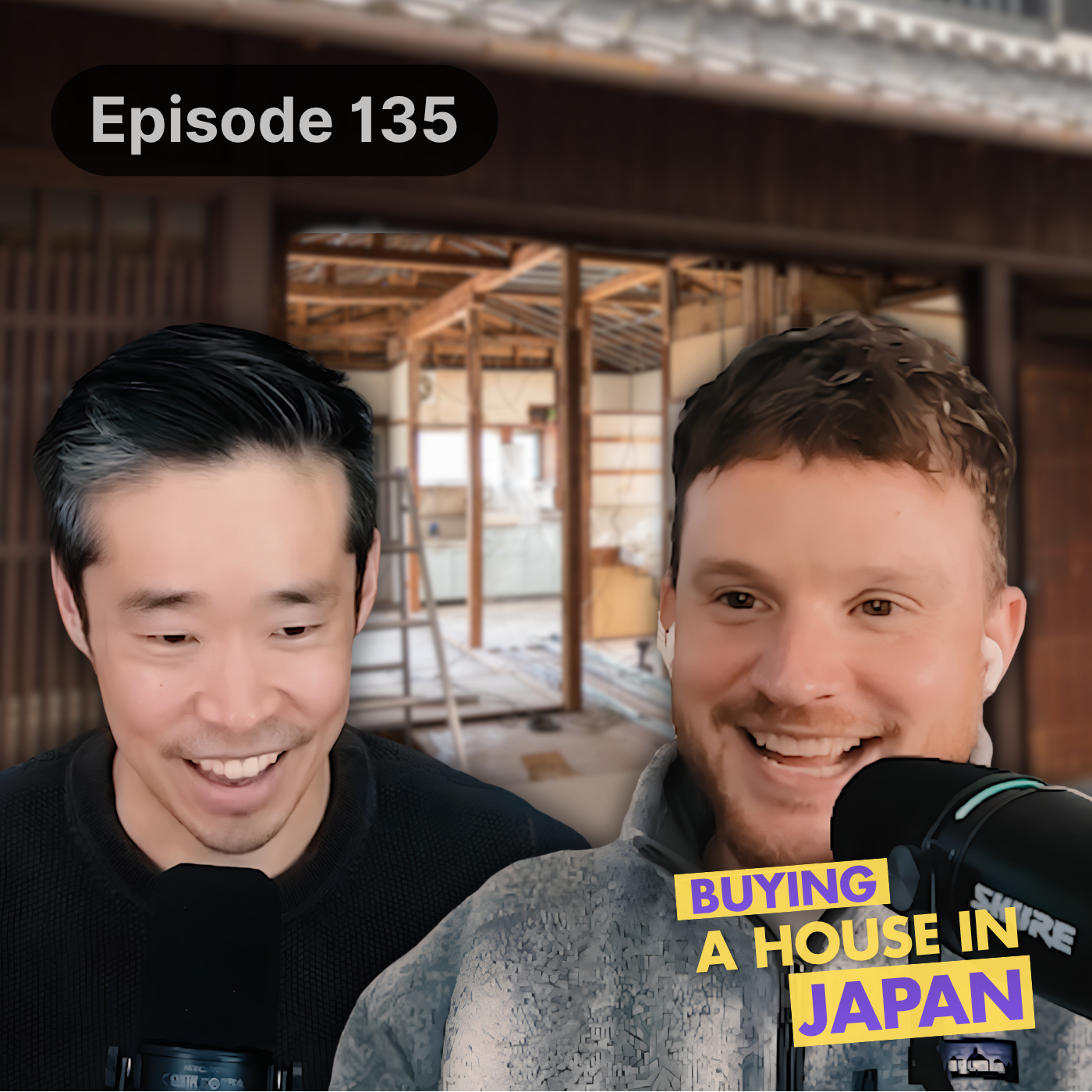
The podcast episode discusses key aspects of buying property in Japan, emphasizing that buyers should first determine their preferences rather than relying solely on ROI guidance. The hosts share personal experiences, including a trip to Ishigaki Island in Okinawa, which is remote and faces logistical challenges like delayed Amazon deliveries but benefits from consistent energy prices despite fossil fuel reliance. They also touch on Japan's excessive plastic packaging, hoping scarcity issues might shift toward more eco-friendly options.
The main segment covers the top 10 frequently asked questions from over 350 client consultations. Key points include: foreigners can buy property without a visa and with the same rights as residents; loans are nearly impossible (99% of cases) unless one has permanent residency or a stable Japanese job; properties can be viewed in person or virtually, with virtual viewings being more common due to time constraints; short-term rentals are possible but subject to local zoning rules (e.g., 180-day rule with restrictions in some areas); and purchasing property does not help with immigration or visa status. The hosts stress the importance of narrowing down locations for efficient agent-assisted viewings and recommend verifying Airbnb eligibility before committing to a purchase.
I say the best customers we have have an idea where they want to buy. So I would say even before booking console, you should do some self introspection to be like, oh, I taught, you know, jet down in Oita and I want to be down there again. Like awesome, great answer. But if you're coming to us and be like, Hey, where should I buy based off ROI? I'm going to probably push you away and say like, Hey, Japan has so much to offer. You need to figure out what you want. Welcome back everybody to another episode of the buying a house in Japan podcast. The number one, Ikea podcast in the world. Welcome back to a physical, it's been a while since we recorded. If you've listened to our last podcast, there's been a month time skip since that. And coming back feeling feeling good. How are you feeling, Joey? Pretty dang good myself. Yeah, we recorded a lot of podcasts on our recent trip to Japan, kind of like, I don't know if we recorded a podcast every other day, but felt like we recorded a lot and sort of. Those are the ones we've been releasing over the past month. We're content machines now. This is what we've learned with building this business is like, you can make the best product in the world. But if nobody hears you or sees your stuff like there's no, there's no traction. There's no point kind of Joey. Since the time skip of Japan, what, what, you know, spark note a version, what, what happened this past month for you before we jump into today's topic? So I went down to Ishigaki in Okinawa. It's like for listeners of, or people that might not be familiar with Okinawa geography, it's way down south. It's one of the furthest, it's not the furthest south island, but it's way down south, went down there. It's kind of not quite a tropical island in the sense of like Hawaii or. I don't know, Indonesia, but it's quite close and it's in Japan. I think it's a really cool island. So I went down there. I've rented an apartment down there and so I was setting that up for basically the month of April into about first week of May. And then I came back here to Canada. Welcome back all over the place. We're bouncing around. You know, Japan is the four main islands and then has a ton of other islands at various distances from the main islands. And the ones that are quite small and quite far are called the Rito. So Rhi means like Hanada do. Like so like far away and then toe is islands are like the far away islands of Japan. Difficult to get stuff to those islands. For example, can't get IKEA furniture there, although IKEA does deliver in Japan. It doesn't deliver to these islands. Amazon packages do deliver, but it's like you wait two weeks for a package. Kind of thing. So it's interesting. It's like at times there's like the fact that Amazon works feels like, wow, this is like, you know, such. Yeah, such a luxury here on the side, but then a bunch of other things don't work. So it's kind of like halfway in between convenience. If you got these like pretty much an exit Taiwan, it's like way closer to Taiwan than it is to like mainland Japan. Right. Way closer. It's like 60 kilometers to Taiwan. Like that in a car that's like an hour drive in a car if you're to drive that in a car. They're fairies for me. Shogaky over to Taiwan. No, apparently that waterway is like extremely strong currents. So very rarely do ships cross there. It's more, but you can get planes. So Ishigaki Island has an international airport. Flaz Taipei, Beijing, Singapore, you know, Seoul, all these different places. Last week, Chad, we think they were whole straight of hormones kind of hold that whole oil crisis was happening. How did that affect you? Shogaky, did you feel that being such an isolated island out there? They burned diesel to generate electricity there. So I was thinking, okay, with straight-of-war moves, if basically electricity, it comes from fossil fuels, you know, gasoline. You know, the stuff you put in your car comes from fossil fuels. I was expecting electricity prices to go up. I was expecting, you know, because it's one of these retail islands, the far away islands. I was expecting gasoline to go up. It went up by about the same amount I saw when I was in Tokyo again. And it's about the same amount price here in Canada. So that makes me think Japan has done a good job, like at least not, not, yeah, subsidizing, at least not letting harder to get to places have crazy energy prices. Because, you know, it's the same price that I'm seeing here in Canada. So I would have expected it to be more extreme on Ishigaki, but it seemed about the same. But maybe it's a masking, you know, a real problem underneath the surface and it's a fragile balance at the moment. I'm sure it's a masking. How much oil reserves is Japan have? And I mean, it seems like things are generally getting resolved. But I saw that they change the Calbee chips to black and white because they couldn't print them in color. I think that's the current Japan news. I actually think this is a good thing. Like Japan uses, I was telling my, talking to my mom about this the other day, but like Japan uses so much plastic packaging. You know, you buy the, the omiage type kind of snacks and it's in a plastic packaging and then everything's individually wrapped in there. And sometimes with a little tray, plastic tray. And that, based on my understanding, comes from NAPTA. So NAPTA, I don't fully understand what NAPTA is. It's some kind of fossil fuel derived thing, but it's used to make all these plastic packaging. And as you mentioned, the Calbee chips in the dies that they use on the plastic packaging. So I was reading online and people are complaining like, oh, like, we're going to have to go back to paper and like papers actually way worse for the environment because they got to chop down trees and then burn the tree or whatever they do with the trees. And like, it's actually better to have all this plastic packaging is better thing by. And I'm like, all right, what a fine maybe like tree production does put like more carbon into the atmosphere. But like, there's no micro paper in our bodies, right? Like all this micro plastic is getting into our bodies, but you know, there's no micro paper in our bodies. I would prefer to pay more for paper packaging. I hope this, I hope Japan and the world, you know, learns from this and like, hey, let's do more paper packaging and less plastic packaging, which depends on these fossil fuels. It's insane. They wrap their bananas in plastic packaging. After bananas and like, all right, I got this open. Then I got this open like, all right, the styrofoam things around the apples. Like it's annoying to deal with this plastic packaging. Okay. Well, hopefully there's a, let's see if there's a scarcity problem that creates a better environmental shift in plastic packaging in Japan. But I'm very doubtful. But I think I think they like the plastic packaging there. Cool. Joy, let's go ahead and skip straight on to today's topic. Over the past three years, I think we've done at least 2000 consultations with people. I haven't looked at the data, but I just ballparked them pretty sure it's close to that number. Joey and I have done started out, I think, 2024 and we were just doing like back to back calls just to understand what customers wanted. And that's kind of how we got to where we are today. I think I actually look fondly back upon those times, Joey. I remember they were, they were grueling at times though. Yeah, we're doing like six to eight calls with clients per day. Yeah, it was, it was good, you know, exciting times in the business was that small. And I was kind of talking to you recently, like, I'd like to start doing a few more calls per month, just to kind of like stay in it as a founder of the business. And sneak preview, we will talk to you about that offering a little bit later. But today we have something special for you. We've now analyzed about 350 of our recent calls of this past quarter and pulled out the top 10 most frequently asked questions. If you've done one of these consoles with our team, we have hired a couple amazing folks. You've actually maybe heard them on the podcast. They are front line talking to customers. Unfortunately, Joey and I are busier so we can't be doing all these calls, but want to let you know we still have consultations with trained folks on our team. But we wanted to give it to you straight and answer the top 10 most frequently asked questions. Joey, I'm going to start at the bottom and we're going to work our way to the most frequently asked. But we got number 10 for you here. Can I get a loan or is this all in cash? Excellent question. Japan is different. Long story short, no, you cannot get a loan to purchase these homes. That's going to be true. I would say in 99% of the cases for our audience here. Japanese banking system is just very closed off. And even as a current resident of Japan now with less than six months history in the country, it is still closed off to me. So it is just a very close off banking system. And so no, you can't get a loan. There are exceptions, exceptions being when you do get residency, maybe you get permanent residency, you have a stable job and high income in Japan. That's one exception when you can get a loan for a property. The second exception, which I've been hearing about recently, there's a company out there called Yen loans, I believe I have not spoken to them personally. But I believe again, it's probably going to depend on a lot of factors affecting you like your current setup and situation. I don't know if everybody gets approved for these loans, but what I heard is stuff like needs to be within Tokyo's 23 wards. It must be a concrete structure. And even then I think you only get about 40 to 60% of the value of the home in the loan. So if the house is a million dollars, you only get, let's say, 400 to 600,000 dollars as a loan, you still need to pay that difference out of pocket. So maybe not the best loan. And I don't know what the interest rates are.
probably a little bit higher than the sub 1% loans for you. Okay, 4 to 5%. Not the greatest loans, but it's better than nothing. So yeah, check out again, loans. Again, I don't know exactly the specifics, but there are exceptions. 99% of the time, no, you cannot get a loan. We'll get him on the podcast, actually. We were meant to meet up with him, but we last time we were in Tokyo, but didn't go through. Yeah, just plus wanting to everything, Joey said, this is a frequently asked question. 99% of the time, you cannot get a loan. I know you hear about Japan having sub 1% interest, 35-year loans, but they're just not achievable for foreigners, unless you have a long-term employment history in Japan. Okay, question number two, this is an easy one. Can foreigners even buy property in Japan? The short answer is yes. You can buy in Japan with the same rights as the Japanese resident. You do not need to have a visa. You can buy on a tourist visa. We've helped many, many people, hundreds of people at this point, who are tourists or not Japan nationals or have visa, visas in Japan, purchase in Japan. So yes, you can. We get questions and fear mongering a little bit of like, is this going to stop? We have no idea. But for at this very moment of recording, yes, as a foreigner, you can buy property in Japan. Yeah, winds of change are in the air, I think in 2026. They decide to just start recording the nationality of people purchasing real estate. But again, I think that's pretty standard, not cause for concern. Who knows the way things will change? But yes, as Takuya mentioned, no restrictions on nationality whatsoever at this time. Okay, next question. This is a fun one. Can I actually see the property before buying? I think this is fun because it's fun to go check out properties. And yes, you absolutely can see the property before buying. Our clients roughly 50% choose to book a trip to Japan around the same time that they're interested in looking at property. And they kind of line this whole thing up where they're going to see a few properties at this time, whether planning a regular vacation to Japan, and they can see some properties that they're interested in, and actually go see them in person. Our agents facilitate that. It's not a problem, which probably try to get you to narrow down your search, at least to one specific area because the agent will be traveling with you. So for example, if you wanted to see a property in Fukuoka and in Tokyo, you know, we would probably ask you to figure out which ones you're a little bit more serious about, narrow down on that location, whether it is Fukuoka or Tokyo, or if you're buying two properties, then maybe we could figure that out separately. But narrowing down the location and maybe checking out a few homes in one specific location is just going to make everybody's life easier. So yes, you can totally come to Japan, plan a trip here, and see properties with our agents at that time. The other 50% of our clients they choose to do virtual viewings. Takenai, I believe, out of the seven properties we purchased, maybe five or six were virtual viewings only. We did not see the properties in person before purchasing. So what our agents do is they will go to the property and there's two options. They can pre-record a video for you. So if you're in North America and the agent is going to see the property at 2 p.m. Japan time, it's going to be 2 a.m. for you. So you can choose or ask the agent to record a video for you and then send it to you later. Or if you want to be up at that time, you can jump on a Zoom call and view the property with the agent live at that time as well. We're also experimenting with 360 camera. So at this time, we offer paid virtual viewings of properties with a 360 camera in Tokyo only at this time. We're planning on expanding to Niigata. So you don't have to join our Akiyamaar Direct Purchasing Program to view these properties with our virtual viewing product for Tokyo and coming soon Niigata. Normally, to view a property, you'd have to get started with our purchasing program. You'd be working with a real estate agent and then you would do the virtual viewings under that purchasing program. But for Tokyo only at this time and Niigata coming soon, you can choose to just book to view certain properties virtually. Say about 80% of our customers do virtual viewings first. 80. It's hard sometimes to move fast, especially if a lot of these properties are hot, especially in Niigata, or some of these snow country spots that people don't have time honestly before the offer. An offer gets accepted. So doing virtual property viewings, I'd say 80% of the time, we should actually look at that data is more common. And if you do want to come in person, we do require a week or two weeks of advanced notice, just so we can get our ducks in the room and make sure we can logistically help you get out there. I think the virtual viewings are great. Again, as I mentioned personally, we've booked, we've purchased most of our properties with the virtual viewings. That being said, there's always stuff I feel like I notice after viewing the property in person, but none of them are deal breakers. Yeah, it's kind of fun actually. It's like a little bit of a game like, okay, I've gone over every square foot of this or square meter of this on pictures in the video and then you get there in person and you're like, whoa, this is different, this is better, this is worse. So it is a little bit of a gamble, but I think it's personally fun. It's fun watching the video. Like if you do the virtual viewing and you've got the video recorded, you're going over the same scene because you're like, I wonder what that thing is there and you're trying to figure stuff out. And a lot of times you can ask the agent specific things like, hey, I'm very concerned about this specific thing. Can you make sure you go over that in the video? If you want to make sure you understand what the views of the window are, you know, you can work, talk with your agent and make sure that they cover that in the virtual viewing. Number four, can I air be in Beatt? And what is the 180 day rule? I'll give a quick answer. Short answer is maybe you can air be in Beatt. Take a look at Occupymart. We have an air being be filter that'll show you zoning. So each city basically has its own rules on where you can air be in Be. There's a couple different air being be rules. We have a podcast actually with you. I recommend listening to if this is kind of your jam. But short story, there's either no air being be 180 day air being be is okay or 365 day is okay. This was a law. Mim paku is what you're going to hear be called is for the 180 day rule. This was a law passing 2018 to help regulate some of the short term rentals. So short answer. Yes, you can air being be it. It is a little bit more of a complicated new on stands or on specific properties. Our agents can help you verify if something is air being beable. Definitely recommend before you go too far in the process that you get our agent to call the city office and just verify like, hey, is this address of this plot of land okay to air being be because that would suck if it was not possible. As far as getting the license and operating, we do have a couple partners of deal. One of them who can help you run a air being be in Japan. So you are not needed to be on ground and managing it. And if you are considering purchasing one of these properties and you definitely want to air being be out. Recommend checking out our Akiah mart. Mim paku or air being be eligibility overlay on our website. I'm just go to the overlays tab and you can you'll see it right there. Short term rentals and this breaks it down into four categories. As Taken mentioned, there's no definitely cannot run a short term rental here. There's the 180 day short term rental. There's the 180 day short term rental with restrictions and then there's the 365 day rental eligibility. The one with restrictions is kind of like the interesting one here. So for example, a lot of places in Tokyo, you'll be 180 days okay, but weekends only. And that that would be like okay, so you need to pick every single weekend of the year to try to get 180 days, which you won't be able to. So it's kind of like, all right, so it's not truly 180 days. In terms of the law, it's 180 days with additional restrictions applied to it. So be aware of when it says when you're looking on our map and it says that 180 days with restrictions. It just means that there yes, you're subject to the 180 day rule, but there are additional restrictions on top. Shout out to Joey. He went through all the local ordinances. The ordinances is a lot of Japanese legal congee. I think you got pretty good at it though, right? You learn to memorize certain words like supply and demand. I feel like we're some economics words. You learn to memorize those and you're like, okay, this means supply. I mean, it's a man. And then you roughly like, you can skim different sort of sections of these dense Japanese documents and you can kind of like figure, you know, you sort of, I call it like pattern matching almost in my head to quickly parse what you're trying to get out of this dense Japanese document. And it felt a lot like back when I was in university studying in Japanese. Cool. All right. Next question. Hey, if I purchase a house in Japan, can I get an immigration visa as a result of purchasing that house? And the answer there is a big fat no, unfortunately. So property ownership in Japan has absolutely no impact on your ability to get some sort of immigration status in the country. Now there are things that owning a property in Japan make easier for, you know, the maybe the logistics. If you are applying for a Japanese visa, for example, you'll have a place to stay when right away when you get there.
because renting an apartment in Japan, if you haven't listened to podcast I did with talking about my experience down in Ishigaki and then Carlos' experience in Fukuoka renting a apartment, very difficult to rent an apartment in Japan as a foreigner. So property ownership, if you are planning to stay in Japan long term and get an immigration visa, there are nice things that the property can help you with. For example, you can skip that whole rental fiasco, but in terms of actually getting a request for immigration accepted by the Japanese government, it has no impact whatsoever. - It's interesting how the visa landscape is ever changing too. So this podcast episode, if you're listening to this, 2027 might be outdated. So do your own due diligence, immigration is tricky and an ever shifting. - Two years ago we had a completely different answer. We would have talked about the business manager visa. We're not even gonna mention that right now, just 'cause it might just confuse listeners, but two years ago we would have had a completely different answer about property ownership and immigration to Japan. Next question, what are the taxes like? What do I need to expect to pay? Great question. When buying a property in Japan, there's a few taxes to keep in mind. The first one is after you purchase the property, there is a real estate acquisition tax. This is going to be 3% of the assessed value of Japan. We can go down a pretty big warmo with assessed value in Japan. So let's say you bought a house for $100,000, but it's, you know, 1980s build kind of like big plot of land. It's most likely not gonna be taxed at that $100,000 assessed value. So the assessed value is what the government perceives the value of the land. So a lot of times, for example, our Tokyo house, we bought for 114K, I think the assessed value is much lower than that, probably 20 to 30% of that value. So when you buy a property in Japan, you are gonna be getting a tax bill for 3% of the assessed value. When you work with one of our agents, they'll be able to tell you better idea of what that number is, but just know it's not the full price you pay. And it's usually a lot lower, especially for these older properties. Next up, we have property tax. Property tax is gonna chain, be a little bit different from, you know, city to city, but roughly about 1.7% is what we tell customers. And this is also of the assessed value of the property. So back to our time of base cap analogy here, we pay at 114K, we pay about 114K US dollars is the total price we paid for the property. We spend about $500, I think, a year, $400 here on property tax, so quite low comparatively to other places in the world. So those are the taxes I think you should be expecting to pay. So one, the acquisition, actually, this is one time property tax, and then you have the reoccurring yearly property tax. Do note we need to have, we have a program called Aki-Marcare where you do need to sign, when to be your tax representative. Like where does Japan send that tax bill? So know when you do acquire property, you do need to sign someone in Japan to receive that tax bill on your behalf and pay it. So those are taxes, at least from the property perspective, Joe, anything that. - I think it'd be interesting to do like a podcast episode where we get our tax bill back from the government. Maybe we have Ryan help us go over it to actually say, like, hey, yeah, like this is, this is how much we bought the house for, and then this is actually how much they're taxing us, and this is the assess value. I think that would be interesting episode. But yeah, just the one more tax involved in the transaction is the stamp duty, which is a tax on a document. I think it's the, I think it's when you sign the contract document, there is a tax on that, or maybe it's the sales agreement. There's a tax on some document during the transaction process. It's extremely cheap. It's usually like $7,000, like 1,000 yen. It can go higher, but it's not gonna be more than like one month. - Sneak preview, we also have a question later to go over all and cost. We'll talk a little bit about per rated property tax. If you're buying the property in the middle of a tax year, which most likely you are, there is some closing costs associated with it. Gonna extrapolate also. What about income tax, all this kind of stuff? So this is a, I don't know, a big question mark sometimes, we don't know your tax situations, but we do recommend, and we can recommend a few tax advisors in Japan. If you are worried about making some income off your Airbnb and filing taxes in Japan, do know who are responsible for that as well. But with the house itself, acquisition tax, per yearly property tax, and that Hanco tax, as Joey mentioned, are the taxes to keep in mind. - I don't know if it's a frequent strategy, but a strategy I've heard people do before is the kind of like max out a tourist visa. So you stay 90 days, you leave the country, come back, you stay another 90 days. From a tax perspective, you can do that, but if you are in the country for 180 days or more, even as a tourist, you need to file income tax with the Japanese government. They are gonna say, well, you are effectively in this country for that year, you need to file income tax. So if you are doing those visa runs, just be aware. Again, I think it's personally hard as a tourist to hit 180 days in the country, but just be aware. - Please consult with a legal professional on personal income tax related stuff. Also on the real estate acquisition tax stuff, our agents will go over that much more in depth with you. - Next question. What does renovation cost and who do I trust to do it? Very broad question here, but a fantastic one because I think most of these properties, people are gonna want to do some sort of light renovation at the very least. So great question. Personally, we have a really funny story about renovation in Japan, the whole Satosan saga. I think there's several episodes that features Satosan from way back earlier in our podcast. Long story short, we had a kind of roller coaster ride with our first contractor down at our first property in Beppu. So yes, I would say it can be a little bit hit or miss from our experience. That being said, sorry, I'm getting into the trust answer first here. That being said, we have had way better experience. So Satosan was like a one guy handyman. He didn't really have a business. He was just kind of like, he himself doing his own thing, kind of helping us fix up the house all by himself. We've had way better experience with contractors and it's part of a company. So we eventually started working with another guy, Mizzotasan, who seemed like he had a much better put together business down in Beppu. And I think you're kind of like, I don't know if you get what you pay for, which I do think is true to a certain extent here, but it's more like whatever your impression is of the person. If you think they're a little bit like fast and loose like cowboy handyman, that's probably the service you're gonna get. And versus if they show up very professionally, and that's probably the service you're gonna get there. So I don't personally know of a great way to find contractors in your area, what we recommend clients to do when they purchase the house that's work with the real estate agent. They will be helpful in helping you, at least put you in touch with a few different contractors in that area. Some of our real estate agents won't handle like project management for your renovation. And then some of our other real estate agents might be more willing to help with that project management to a certain extent there. So it depends on the real estate agent. So talk to us, talk to your agent when you, if you have questions and concerns about how to get started with a contractor. But again, I would say our personal experience has been somewhat hit or miss. I think in terms of trust, kind of go with your gut. If you feel like they're a professional service, they're probably gonna do a professional job. If you feel like they're kind of an unprofessional service, that's probably a service you're gonna get. - With Akimart Care actually, Joey, we're spinning this up where we are trying to tackle the renovation problem. So, Dio, for example, is one of our Akimart Care providers. He will do, I think, the full project management but charge a percent fee. So no, again, things can change from when you listen to this podcast, but this is kind of the next zone that we're trying to figure out. It's a very, very difficult one to be very honest. And as for cost joy, what do you think about the renovation cost? - I think it depends. I'm gonna say. So for example, we've had some quotes recently about double painting the windows in the house in Tama in Western Tokyo, also about underfloor installation. Japanese homes are not insulated. I feel like that quote was about two million yen. Was that for both the installation and the double painting? It's for both. Okay, two million yen, about $16,000 US, 13,000, between, let's say, 15,000 to be, I don't know, rough numbers here. $15,000 US, two double plain, a two bedroom, two floor house and also put installation under the floors. What else? Our total renovation for the Beppu house was about maybe $40,000. And that was like a quite in-depth renovation there. I've heard quotes for like a redo a roof, about three million yen. I think when we were looking at a property around ICU that had holes in the roof when I was looking at, I remember a real estate agent quoted about three million yen. I think you're looking in the millions of yen. Small scale renovation is probably gonna be between 10 to $40,000. I would just say have 50% of your purchase price satisfied for renovation. For us, what we say is we bought a new one.
our Batboo spot for 40k, we put another 40k in it. Kind of wish we had just stuck with 80k in the get-go, but we live and we learn. - So 100% of the cost of the house. - In our case, we put 100%. But I would say, for customers who are looking at some of these older homes at least put 50% aside, hard to say, again, everyone's house is gonna be different, land, everything's gonna be so different. But general theme compared to the US, this labor cost is much lower. The quality you get is higher, but you still have the shady contractors, I think is the one thing I was personally surprised about. If you are gonna DIY yourself, it's also a good option, it's a lot of fun. If you personally wanna do yourself. - Yeah, and Japanese hardware stores are a lot of fun too. - Our third most asked question is, where should I buy? This is a weird question for us to answer, as we are, there's so many homes, there are nine million abandoned homes in Japan. I feel weird telling people, oh, you should buy in this spot. So we usually flip this question back onto you and say, okay, buddy, where do you want, what do you like to do, where do you like in Japan? - I say the best customers we have have an idea of where they wanna buy. They actually don't ask this question. So I would say even before booking console, you should do some self-interspection to be like, oh, I taught, you know, jet down in Oita and I want to be down there again, like awesome, great answer. But if you're coming to us and be like, hey, where should I buy based off R-O-Y, I'm gonna probably push you away and say like, hey, Japan has so much to offer, you need to figure out what you want first. What do you think about that answer, Joy? - I think fantastic answer. As you said, the best clients coming to us, they know where they want to buy. Planet Tripp, if you don't know the answer to this question yourself, planet Tripp to Japan, I would recommend going somewhere off the beaten track, for example, if you like snow, which I think a lot of people are drawn to, powder in Japan, go visit some of those areas, better to plan a trip in the winter. But yeah, I personally like the warmer parts of Japan and we have not had a single client that everyone would buy down in Okinawa. So if someone asks me, where should I buy in Japan? I'm gonna say tropical, but you know, I'm clearly not, or like I think most people would disagree with my answer there. So it really is such a personal thing. Although I would say, I have a sneaking suspicion. So Niseko, priced out, Meoko priced out. A lot of people like Japan and Hakuba kind of priced out. These are like kind of the more famous snow ski areas in Japan. But if you go on the Akiamar website, again, hit the overlays tab, hit the snow fall filter, you're gonna see kind of like above Nigata, that whole sea of Japan coastline. So what happens is all this cold air from Siberia, it comes down, it hits the sea of Japan and it picks up moisture. And that's why Japan gets a tremendous amount of snow. It's this cold air mixed with all this moisture from the sea of Japan. And that whole coastline is where you get so much snowfall in Japan. Now, there are places outside of Hakuba, Meoko, Niseko, etc., that get this, you know, the same amount, if not more snowfall. Again, maybe like there's something special about these, the Niseko snow, I've heard people say like, "Oh, it's so light and fluffy." And it snows consistently every day, whereas other places, it comes in these big dumps. I don't know, I think that the powder is gonna be phenomenal everywhere. And I think there's gonna be a lot of hidden gems in that above Nigata all the way up to Akita Almori region. If I had to, I don't know, want to say put money on it, but I think there's hidden gems there. My flip side on hidden gems is I would say the Seto Island, inland island sea area. It's been showing a lot of popularity, specifically around, like Onomichi. There's like a big famous shimanami kaiido, I think that's what it's called, bike trail. And I think there's a lot of art, residency type stuff. So we've heard a lot of interest. Yeah, again, snowy regions, maybe Seto Island, inland sea, Eto, Atami, coastal view areas seem to be the hot spots, but have your own adventure. I agree with you. If you've never been to Japan, you want to buy just like, book a two week trip out, go get lost, have a lot of fun. I'm sure you're gonna find a neighborhood you like. Next question, how does the buying process actually work? There's lots of like quirks along the process. There's like very Japanese type aspects of several of these steps, but the process is quite simple. The first step is booking a consultation with someone on our team. So first step is book a consultation with our team. And in this meeting, we're just gonna go over the basics, what the purchasing process actually looks like, so what I'm gonna explain right now. And the time is for you, so we're there to answer any questions at all that you might have about the process, or purchasing property in Japan, or renovations, whatever, the times for you. If that sounds good, the second step is we put you in touch with one of our trusted bilingual real estate agents. They cover the entire country, so it doesn't matter where you're purchasing. We have an agent that can handle that for you. We also have specific agents that handle Airbnb. So if you're looking specifically for Airbnb, we've got an agent that can guide you through that incredibly complex topic as well. At that point, if you'd like to move forward and everything sounds good, we will send you over a like contract discussing the roles and responsibilities of you the client and the agent. We have a, our purchasing process fee that we charge a client at this time. Again, this is to ensure that our entire ecosystem here can operate. We give the majority of this fee back to the real estate agent. Again, they're working for low commission, especially on some of these more rural and cheaper homes. So we invest this money back into the ecosystem. We make sure that we pay our agents fairly for dealing with cheaper homes. And if that all sounds good, is when the fun part starts. So after the fee is paid and the contract is signed, we move on with virtual viewings. And as we mentioned before, can be a lot of fun at this step. After you do the property viewing as you find a property, we can go ahead and submit an offer on your behalf, typically when we submit an offer we do. So contingent of a home inspection. So we give you the optionality to submit a, submit a request to do a building inspection. These building inspections typically cost 500 to up to 1500 depending on how big the property is. They're going to get like a 40, 50 page paper of everything's wrong. Every small tilt, every small crack, which is great. But no, these are not necessarily always bullet proof. See, listen to our podcast with Melanie Uey, where she found termites after everyone. But once we submit the offer, we got the home inspection back. If all things sound good, we set, we sign what is known as a contract. That real estate contract legally binds you and the seller to do this transaction. When we do this contract, there's a 10% down payment due. We can talk about transferring money later. But through this all, the agent is your power of attorney. So they're going to be navigating all the paperwork for you. They're going to be guiding you along the way. They will explain everything they signed to you in English before they sign in Japanese. A couple of weeks later, we then have settlement. The settlement is when the remaining payment is due. Again, our agent will do this as power of attorney. This is where you transfer the money over and we get the keys and all the documents settled out for you. A little bit of a truncated version, we can go over this whole thing more in detail in our consultation. But high level, it's pretty straightforward. The one thing that I think is really beneficial to use us with is the English link. You don't have to sign anything Japanese. You don't need to attend any of these meetings. You can do it all remotely. I would say dealing with Japanese seller's agents is very. It's kind of like a crapshoot. We really sometimes they are very, very easy to work with. Sometimes they are an 85 year old dude in the middle of nowhere, Japan who's never talked to a foreigner or and still uses the facts machines exclusively. So just know there's a lot of wild card aspects to the real estate transaction. It can seem very straightforward at times. But if things get complicated, they get complicated, I think quite quickly. We see this all the time with clients. Either the client will have reached out to the seller side before, tried various things, tried calling them, tried sending emails, and they get no reply back from the seller side. Very common for that to happen. The second problem, that's where we come in. We can definitely represent you as buyer, even if this Japanese seller side agent ignored all your attempts at communication. The second thing we see with seller side again. So let's say you do reach out to the seller side and there is some communication going back and forth, but ultimately communication breaks down, which is something that we see. And then the buyer will come to us and like, "Hey, I've already made contact with this agent. I just need some help because communication broke down for whatever reason." What's going to happen at that point? And this can be very frustrating as the client is, yes, we can definitely represent you. But when we reach out to the seller, what the seller is going to say to us is, "Hey, I found this client first." The seller is going to say, "I found this client first." So I should get both the buyers commission and the sellers commission. They're going to demand to get both of those commissions. So this is a little bit unfair to the agent you're working with on our side, because the agent you're working with on our side is effectively acting as your by our side agent, you know, they're doing the whole process with you in English.
as Takay mentioned, you know, doing the virtual viewings for you. And it's just the seller side kind of putting up this guard that, hey, you know, they're not going to sell you this property unless they get double commission, which can be extremely frustrating for you, the buyer in this case, because we're going to have to charge you buyers commission to, and you're going to have to pay the seller side double commission again. So it can be, you're going to have to pay two commissions, which can be quite frustrating. And this is very common in Japan. It's called double-handed deal. And we see it quite frequently, I would say, when the property price is cheaper, because the seller side, they get very aggressive about this double-handed deal, because they're not making much commission anyways, so they're doing anything they can to sort of, you know, get, make more money off of this sale. So they get very aggressive there. So again, it can blow your chances. And I'm, you know, I'm sorry, it kind of sounds like I'm saying, like, oh, you got to work with us. Don't reach out directly. But it can be very frustrating if you do try to do things yourself. And then your only option to purchase this house is paying double commission. So again, it's the unfortunate quirk of the Japanese real estate market here that it can slightly blow up in your face if you do reach out to the seller side directly. It's a lot messier. Yeah, we do get customers come by like, hey, I got in contact with this agent for this property. I'm interested in making offer, but he doesn't know how to help a foreigner. And then this whole conversation starts. So, yeah, you know, I don't want to stop any listeners from reaching out directly, but just know it is harder to come back from that versus starting on a very clean slate having a Japanese real estate agent represent you in contact. That sellers agent just makes it a much cleaner, I think smoother process. But, you know, we are still willing to try to help you, but just know it is going to be, it is going to be a lot messier sometimes if you come with a preexisting content or some history in trying to purchase. Yeah. Okay. Our number one most asked question, Joey, is what does an akea cost me all in million dollar question. I'm going to go real broad strokes here. We go a lot into the costs in our consultation call. And again, things are going to be different per house, but let's just take, for example, you want to buy a $10,000 home in NIGATA. You found it on a KMRI like, whoa, this is too good to be true. Well, I'm going to tell you it's going to cost you more than that $10,000 in closing costs to get keys in hand. Okay. So spoiler alert. I'm going to go, there's five big costs when working with us that I think you need to keep in consideration. So $10,000 home, first off, is our akea, my direct fee. At time recording, we charge $5,000 for this. A lot of you guys are going to be like, whoa, that's a lot. As Joey mentioned, we give a majority of this back to the agent. As you can imagine, there's not a lot of upside for a bilingual Tokyo agent to go out and check out that $10,000 home when they could be selling million dollar homes in Tokyo. So we had to create kind of an ecosystem to incentivize folks to want to go and help these cheap rockies. A big part of that fee also goes to our team. So Joey and I are on every single email chain. So if you go through the process with us, you'll see that you'll get support. We will not let you fail. That's kind of the short answer to this. You have a direct line to me and Joey, if something shit hits the fan, but we're in communication with our agents pretty much every week. We check in very frequently. Short answer for this $5,000 fee. We won't let you fail. You can totally do this without us. We aren't the most expensive. We aren't the cheapest. You know, you decide if you want to go with us, but we designed this product for ourselves and that. If we were to do this again, I'd rather just pay someone $5,000 to handle it correctly with expertise and be hands off. So that's my spiel for the 5,000. Okay, so $5,000 for our Acky and my direct fee. Next up is the buyers agent commission. So the buyers agent our agent still needs to collect commission by law. This is roughly around $2,200. We'll go into it as you go higher and price closer to the $100,000. That's where the buyers commission changes, but anything under $50,000 is $2,200. Next up, closing costs. Closing costs are another $2,200. Roughly. This includes things like title transfer deed to get the deed in your name, hiring the paralegal, which is called a she ho show she. We also have the Hanco duty, which Joey mentioned is like the stamp tax and then we have pro rated property tax. So that is kind of all incorporated in this $2,200. So up to now we're at $9,200. Next up insurance. We quote roughly insurance of a $10,000 home costing around $500 a year for earthquake and fire insurance. We used to quote this out by five years, but it got confusing. So just no insurance is going to cost you roughly $500 for your property. Okay, very last one. This is optional, but this is our post purchase program called acumen care. You will need someone to be your tax representative once you purchase a property. So where is the tax bill going to from Japan's perspective. You'll also probably need help with utilities. So we charge about $1,700 for the first year to get all your utility setup, your mail digitized and also take over tax representation duties when that we will be your go between between the Japanese government and you to make sure your property is not. To make sure your property tax are paid on time. So in total, all those costs are about $12,000. Just going to go over them again. AMD is $5,000 are the expected buyers agent commission is $2,200. The expected closing costs are another $2,200. The insurance is $500 and we expect our post purchase care program to be $1,700. So you're looking at a $10,000 house adding another $12,000. That's the short of it. We can go much more in depth on to renovation costs and stuff with you later. But if you're listening to this podcast, you want to cheap home just no $12,000 extra will get you keys in hand again. We're not the only way to do this. But this is what we've built and we've helped 100 people hundreds of people go through our program to date. $12,000 on a 10 K house. Yeah, sounds like a lot. But you get all the paperwork done correctly. You get lights and utilities turn on. I think that is the biggest thing. Imagine trying to call a utilities provider in Japanese like the documents they send you all in Japanese like having that handled for you is again, I just want to do this process with a rental apartment down in Ishigaki. And then we're going to first hand how much Japanese documents these utility providers will send you. So to be hands off and have all that handled for you and you just get the property going right away. All you got to worry about is going to IKEA and filling it with furniture pretty great. Yeah, I want to emphasize like again, we are here to support you, you know, we're on every single email chain, making sure things go well. But if you are an existing customer, a future customer, you have direct line of access, please email us, please let us know if something is not going right. We are, you know, learning as we go to, you know, a couple years ago, we were flying the plane building the plane as we flew it, as I'd say, and I think over time, we really started to understand more transactions, understand the process, understand some of these like really far out. We knock a weird kind of land deals and stuff like that. So we aren't afraid of trying something that is, or also we're not afraid to admit that we don't know the answer. So sometimes if we don't know, you know, just know we have a team that we'll try to figure it out. So when working with us, you're not just working with two people, you're working with our full team. We have about 10, 10, 15 folks that can help through this program. So there's about 12 K and that number goes up as the property price goes up. Yeah, just naturally. So let's say you're at a 25, 250,000 quarter million dollar house, you know, I think it goes up to around 20 Kish. So just scales up with, I guess, both property tax rate, commission, insurance, everything goes up a little bit proportionally. Right. Okay, those were our top 10 most frequently asked questions from the hundreds of consultations we've done Joey. It has pretty much stayed the same. I think our console deck, we've updated numbers here or there, but it's good to see that, you know, we refined, I think this these calls and these are the same questions if you're booking a consultation with us, please, if you can listen to this, this might save you a lot of time. And we can talk a little bit more about your specific property, but as a final plug, if you want to do a consultation with our team, we'll drop a link in the show notes or you can just go into akiamart.com and you'll find a way to book on any listing. And the wild card project that Joey has mentioned before we are going to be opening up one spot per week with me and Joey, we are going to jump on a call we're calling us kind of like Hormosi hotline akiamart hotline where we will jump on a call. The one catch is we are going to be recording this and it may be used for a podcast. So do you know that we'll drop that that link in the count, a count only link in the show notes. We're doing one podcast recording a week. I think it'll be exciting. I think it's fun to do consults every once in a while, I've been out of the weeds for a little bit, but I would like to jump back in to you know, a small number per week. So I said one could go up to two, but let's start with one for now. But yeah, it'll be talking with me and tech. So we purchased seven properties and rented one property in Japan. So we've been doing this for you know past three years now we've and we've also seen a lot of deals through our clients as well. So I think we have some great conversations. If you're up to being recorded and potentially us using the content in our social media. Hell yeah. All right, Joey. Good stuff. Congrats. We've come a long way. A lot of consults. Glad we are now doing recorded consults and looking forward if you're a listener.
Please check the show notes book a time with us. We'll we'll get those that available the availability Thanks for listening to this week's episode of buying a house in Japan If you find the show helpful or at least entertaining give us a five star rating takes five seconds and really goes a long way If you or someone you know is looking for a Japanese home check out akiamart.com our English friendly site that lets you browse over half a million listings That's a K-I-Y-A-M-A-R-T.com to find your dream home in Japan. If you've got questions or feedback Drop us a line email contact at akiamart.com you can also find us on Instagram as well as TikTok where we post properties Tips on the home buying process and updates on our own purchases and renovations. Thanks again for listening and we'll see you next week
Podcast Summary
Key Points:
Self-reflection is crucial before buying property in Japan; buyers should know what they want, not just ask for ROI.
Foreigners can buy property in Japan without a visa, with same rights as residents.
Loans for property are nearly impossible for foreigners (99% of cases), except for rare exceptions like permanent residency.
Properties can be viewed in person or virtually (via pre-recorded video or live Zoom), with 80% opting for virtual first.
Short-term rentals (e.g., Airbnb) are possible but depend on local zoning rules, including the 180-day rule and additional restrictions.
Buying property does not grant immigration status or visa benefits in Japan.
Summary:
The podcast episode discusses key aspects of buying property in Japan, emphasizing that buyers should first determine their preferences rather than relying solely on ROI guidance. The hosts share personal experiences, including a trip to Ishigaki Island in Okinawa, which is remote and faces logistical challenges like delayed Amazon deliveries but benefits from consistent energy prices despite fossil fuel reliance. They also touch on Japan's excessive plastic packaging, hoping scarcity issues might shift toward more eco-friendly options.
The main segment covers the top 10 frequently asked questions from over 350 client consultations. Key points include: foreigners can buy property without a visa and with the same rights as residents; loans are nearly impossible (99% of cases) unless one has permanent residency or a stable Japanese job; properties can be viewed in person or virtually, with virtual viewings being more common due to time constraints; short-term rentals are possible but subject to local zoning rules (e.g., 180-day rule with restrictions in some areas); and purchasing property does not help with immigration or visa status. The hosts stress the importance of narrowing down locations for efficient agent-assisted viewings and recommend verifying Airbnb eligibility before committing to a purchase.
FAQs
In 99% of cases, no. Japanese banks are very closed off to foreigners, even residents. Exceptions include having permanent residency with stable high income or using a company like Yenloans, but that may only cover 40-60% of the property value at higher interest rates.
Yes, foreigners can buy property in Japan with the same rights as Japanese residents. You do not need a visa, and you can purchase even on a tourist visa.
Yes, you can either book a trip to Japan for in-person viewings or use virtual viewings via pre-recorded video or live Zoom calls. About 80% of customers start with virtual viewings.
Maybe, depending on zoning. Check our Akiya Mart map with an Airbnb filter. Some areas allow 180-day rentals, 365-day rentals, or have restrictions. Always verify with an agent by calling the city office.
No, property ownership has no impact on immigration status. However, owning a property can make visa logistics easier, like having a place to stay.
The 180-day rule limits short-term rentals to 180 days per year, passed in 2018. Some areas add restrictions like weekends only, so check eligibility carefully.
Chat with AI
Loading...
Pro features
Go deeper with this episode
Unlock creator-grade tools that turn any transcript into show notes and subtitle files.
 PodcastTranscript AI