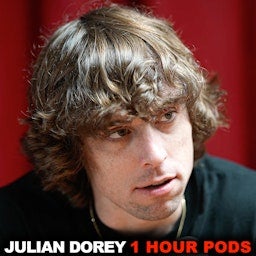
Annie Jacobsen WARNS: “Everybody’s Dead” Is The Actual Plan
1h 1m 5s
The transcript details a personal encounter with Annie’s podcast, where a surreal car fire incident underscores the powerful, immersive impact of her storytelling. Annie’s writing journey—from niche historical works to mainstream success—mirrors growing public anxiety over national security, bioweapons, and global threats. A core focus is the Nazi biological weapons program, particularly the work of Dr. Blum in Poland, which influenced Cold War arms races and remains a haunting historical enigma. The narrative explores why the Nazis, despite possessing advanced biological and chemical weapons, never deployed them, possibly due to Hitler’s personal trauma. Personal stories, such as that of Allen Dulles’ son who suffered brain damage and lived with retrograde amnesia, reveal the moral ambiguity and human cost within intelligence operations. These experiences illustrate how government preparedness for biological crises—like the strategic national stockpile and the “devolution plan”—is flawed, leading to societal collapse in war scenarios. The author emphasizes a nuanced understanding of history, rejecting simplistic judgments and instead embracing complex motivations and contradictions. This approach fosters deeper insight into the human dimensions of war, security, and power, showing that history is not just about facts, but about the moral and psychological realities behind decisions. Ultimately, the story highlights the importance of questioning narratives, holding multiple perspectives, and recognizing systemic vulnerabilities in national security planning.
Hey, guys, if you're not following me on Spotify, please hit that follow button and leave a five-star review. They're both a huge, huge help. Thank you. You know, Annie, the first time I ever heard of you was back in 2019 when you were on Joe Rogan's podcast. And I'll never forget it because I think it'd come out maybe like October, November, something like that. And that first Monday after Thanksgiving, I'd been down in South Jersey with my parents for the weekend, and I was driving back up to North Jersey where I lived and worked early in the morning. So I turn on the podcast. I see like, "Oh, this lady came on and talking about like the Nazis and stuff cool." And you know, I start listening to it and I'm sure people have told you this, but you have a very entrancing voice. And it's kind of like a trippy experience because I'm sitting there listening to like you speak very sweetly, but you're like, "And then the Nazis killed everybody." I'm like, "Wow, this is like kind of darn it." So I'm on the Garden State Parkway, and after a while, like all of a sudden, this smell hits me, like right in the face. And I'm like, "What the fuck is it?" Like the kind of smell where you're like, "This had to be happening for a while," and I just didn't notice it. And I look on the front of my hood and my car's on fire. So I'm like, "Oh, shit." And like in the background, you're like, "And then they were dueling with each other." And I'm like, "Oh, shit." So I like, "And we go off the side of the road." I open up the windows because I think they're smoking there. And then I'm like, "I gotta get the fuck out of here." So I get out of the car. I don't press pause, like you're still talking. Cars on fire. I get off the side on the grass, I call 911, and I hear like out of the car, "Are you talking about the Nazis?" And then, and my car just explodes. No way. And so whenever I think of you, I think of an exploding car. And now I met you. So. Oh my goodness. That's the best introduction I have ever had. Well. Thank you so much. Listen, I'm happy it was. It did come at the expense of a car, but I think it's worth it. Oh my, I mean, you can't make that up. That's brilliant. I'll show you the videos afterwards. Yeah. But it's just like, literally, like, you can hear, and then the, you know, the speaker starts going out, so you hear the, like, the, "And then the road starts going like all dark and shit." I was like, "Oh my God." But I did get insurance money for it. So it worked out. So. I'm delighted to hear that story. Well, you have another book out as I understand it. You've written, well, like, 10, 11, 8 books at this point. It feels like more. But your books are also thick and detailed and cover the things that we are all interested in. And I always kind of wondered that, like, how do you, how do you zone in on picking a topic that you want to write about? It is fascinating that my books, I mean, eight books, first six are history books. The most recent two are scenarios based on more games, nuclear war, biological war. It's fascinating that my books have gone from kind of niche, like people who are very interested in national security, military, intelligence, community work, to very mainstream. And I don't know the answer why. I wonder if this is like in the zeitgeist that suddenly everyone is much more concerned about national security than say 10 years ago, or I don't know, but it's very interesting to me and it's certainly kind of wonderful that my back list, people tend to sort of read one of my books. And then they read my back list. Hey guys, three quick things. Number one, if you haven't subscribed, please subscribe to Hugh Joo Chelp. Number two, if you'd like to join my Patreon for early, uncensored releases of the full episodes, you can join via the link in my description or in the pinned comment below. And number three, if you'd like to join my clipping community for a chance to make content from the show and make money, you can join via the Discord link in my description below. Well, that's what happened. You build a great library. It doesn't actually get read, get read on day one or day five. But then you get the one that hits and people are like, wait a minute. I'm going back in time. I'm going to look at all this other stuff. Yes. And of course, they all entwine. You know, like you mentioned the Nazis, the Nazis kind of hit two points that you asked, which was, how do I get my ideas? In the book Operation Paperclip, which was my second book in 2013, it came out. You know, America had a biological weapons program in the Cold War. And it was largely sort of flourished because of the Nazi scientists that we brought over under Operation Paperclip. And so that planted this seed in my brain about biological war, because it's such a bizarre concept. Like it's so strategically ineffective when you really think about this. And this is such a common question that people ask because like the obvious thing is blowback. You use a biological weapon and you're going to kill a lot of your own people. You can't control where it goes, I say, yeah. And so the fact that it existed for decades and the fact that it's illegal now except for people still make biological weapons, what a bizarre kind of paradox that has this origin story that's really dark and nefarious. Why do you think the Nazis, if they were so extensively like, unfortunately good at science, which obviously they were, I've always thought like, man, you look at what they used like in the camps, you look at what they were willing to do. When they were going down, why do you think they didn't drop some of these secret serums that they had just on, you know, the invading armies left and right all over the place? It's a really good question. And in fact, in paperclip, I write about how the chemical, so they had a biological weapons program and they had a chemical weapons program. Their chemical weapons program was seriously advanced to the point where they actually had munitions like sarin gas loaded onto warheads ready to go and they never used them. And this remains a puzzle among historians. Why didn't the Nazis use the chemical weapons that they had in that sort of, you know, fire and brimstone ending of it all? And the best that anyone can come up with, which I think is fascinating, is that because Hitler himself was the subject of a gas attack in World War I and was hospitalized, he had some kind of deep personal aversion to chemical weapons. That's speculation. I mean, he, he authorized the whole program, but he, you know, he had a deep aversion to their use. That's really interesting to think about that even Hitler had his limits. I've always thought about that even at the next level with nukes because like these guys, unfortunately, like some of the scientists were very talented and very smart. And I always wondered. And it's pure spec. I mean, I have no evidence to back this, but it's just a hypothetical. Like even beyond chemical weapons, what if they really did figure out the nukes thing? And they had just enough humanity left in whatever little humanity they had, which wasn't much to start with, to say, you know, maybe the guy with the stash shouldn't have this. And I wonder if that was a calculation that could have been made at the biological level too, where, yeah, maybe he did have an aversion to it, but if he was cornered like a rat towards the end, he would have been like, fuck it, you know, do it. Interesting. I'm not sure I would agree with that and I'll tell you why. And, but you're, but you're absolutely right because the, the chemical weapons conundrum remains this mystery. I'm like, well, if he didn't use that, you know, but I'm pretty certain they did not have nuclear weapons. I mean, at least the historical record is clear about that. Most of conspiracy is about, you know, maybe, but the most compelling evidence I found because I'm so interested in human details of it all, Albert Speer, who was his Hitler's sort of secretary of defense, if you will, said to him very early on, we should really have an atomic weapon to which Hitler responded. That's Jewish science. We're not going to do that. Well, the one time as racism really came through and it's something good for everybody. You know, and that's wild. Isn't that wild? I mean, and it says so much and it's like, wow, but the biological weapons are interesting because he was really pushing for the biological weapons program, which was led by Dr. Blum, who was his like, rikes, given gazuntite fures, the German name that was the deputy surgeon general of the Third Reich. And Blum had been a cancer specialist and became this biological weapons designer. And most of his, I mean, I really got into this in paperclip because I visited the Bundesarchives in Germany with the German PhD, by the way, because it's the only way that they will take you seriously. If you go in there and say, I'm an American journalist, like, you don't really get very many good documents. Oh, so you had to go with someone. Yeah, I had a German PhD with me who would like, they really respect their PhDs. And so the biological weapons program was really sort of like a Hitler favorite, but they were having problems developing and Blum was actually working on a plague weapon. So this plague weapon? Yes, the weapon of plague, which is the weapon I use, I use in the book. Siberia. Yes. Neumonic plague, there's, of course, bubonic plague, there's septicemic plague, and there's pneumonic plague, which is transmissible because pneumonic, think pneumonia, think the lungs, think airborne. Right.
Yeah, it's been a while since I read paperclip. But if I remember correctly, I hope I'm thinking of the right book because I think this was the Nazis, but you were saying that in the closing days of World War II and right after they like found some of these guys and underground bunkers. Right, and they were building this stuff down there, but they were able, that was also was wild back in 1945, 1946, you come in touch with insane biological weapons and there wasn't like an accident, at least reported or something like that where it got out. Well, they were under very early development, right? So one was in charge of it. And from what we know from those records, I was talking about that like when the Allies were attacking and coming from, you know, the West. Hitler sent his scientists east into Poland, you know, not realizing that the Soviets were going to kind of come in from the other side. And that Blum had a biological weapons laboratory underground in a place called Posen in Poland. And that's sort of like the last remaining evidence of what happened to his sort of test tubes filled with, you know, pathogens. And what's interesting is the Soviets got a hold of that facility and this kind of kicked off the biological weapons arms race of the Cold War because America became obsessed after the conclusion of the war after the peace was won with like the Soviets are now the new enemy. And they have all the Nazi secrets and so much of it was divided up between the two of them in this just spawned this profound Cold War arms race, the results of which we're dealing with today. One of if not the most common DMs I get on Instagram are many of you asking me what my favorite books are. Well, today's your lucky day because if you use the link in my description below to join my newsletter, I'm going to give you my top 10 book recommendations right now. Also, if you'd like to join my clipping community for a chance to make money producing content from the show, you can do so via the discord link in my description below. And finally, you can join my Patreon for early uncensored releases of the full episodes via the Patreon link about a description below. As always, please take one second to hit that subscribe button. If you haven't already, I really appreciate that. Also the like buttons, a big help and you can join my newsletter via the link in the description below. Before you did, because this is all tied to the book you wrote right now, biological war, this is like the predecessor, if you will, like the Hobbit to the Lord of the Rings. But before you did Operation Paperclip, obviously you'd found out about it, you knew the specs of like, okay, we had taken Nazi scientists when the war was over and gave my houses and huntsville and they built rockets. But, you know, it's also hard, at least as a human, no matter if you're a historian or not, to go into something a story that sounds so wild like that, like, wow, America took Nazis in and then said, you know what, you can work for us too and have a nice life. It's really hard to not fully judge that out front. So I guess my question is, upon writing that book and doing all the research, was there any nuance to it that you had at the end? That you did not have at the beginning of writing the book? If you're constantly low energy dragging through the afternoon or hitting a wall by two to three PM, the fatigue could have more to do with your liver than you realize. Your liver is your body's primary metabolic regulator, storing and releasing glucose to help maintain steady energy throughout the day. But when it's constantly busy processing highly processed foods, drinks, and everyday stressors, the system can slow down. So that afternoon crash might not just be about sleep or needing another coffee. Your liver might actually just be working too hard, which is why you got to check out DOS for your liver. DOS for your liver is a clinically backed formula that promotes liver function, supports healthy liver enzyme levels, and helps your detoxification and metabolic processes. This isn't just another capsule or powder either. DOS is a liquid supplement. It tastes just like orange juice and all it is is a daily two-ounce shot. A lot of people don't realize that your liver is literally your biggest internal organ and performs over 500 functions a day. It's main role is filtering everything that comes through your body and helping your liver function at a way higher level. DOS for your liver is going to reduce fatigue and sluggishness, ease bloating, support your metabolism, and perhaps most importantly aid in digestion after heavy meals. So if you're ready to give your liver the supported deserves head to dosedale.co/julian that link is in my description below or enter Julian to get 35% off your first subscription. Your body does so much for you so let's do something for it. That's d-o-s-e-d-a-i-l-y.co/julian for 35% off your first month subscription to DOS for your liver. Check out the link in my description below, try it for three months and see what you think. I mean what a great question and what you're asking is really important. It's like try and hold the ideas of the opposition, of the of the adversary in your own head before you go black and white. I think this is really important and I was asked to do that by my very wise book editor because it was so easy to see these Nazis as these odious individuals that should have at least from my perspective going into it that should all be hung at Nuremberg. That's exactly what my position was and might still be however I hold a little bit of room for the idea that at the time the Cold War warriors in the United States were absolutely convinced that the Soviet Union wanted to take over the West, take over the world. And they would do anything they could to stop the Soviets. And so that's where you have the birth of this program. And so you know one idea that some of the when I was interviewing the book there were people that were in that book that were still alive that were alive, you know that fought in World War II, World War II heroes. And they would often say to me like there was the threat that we would all be speaking Russian if we didn't do this. Which is an interesting exercise in putting yourself in the shoes of someone in history. Yeah, it goes down to the do you say the enemy of my enemy is my friend and I think it's weird because you can even see like I think there was a famous quote we can check this amendment but there's a famous quote from like patent where he's like damn did we fight the wrong enemy or something like that, you know, which communism and fascism are both like pretty goddamn bad but it's it was a strange bedfellow moment because it went from like all right we'll be friends for a few years just to get this done and it's like all right now we kill each other. Bizarre. But it's it's so human nature. You know and so I think it's endlessly interesting and it's why all my books kind of it's very easy for me to move on to another subject that links up with the previous subjects because so national security and human nature go hand in hand like war fighting offense defense war peace these are those opposites that's that black and white that we were just talking about that you have to think about okay it's black and white or is it you know how can I think a little differently here and that to me makes for serious drama. Yeah I you ever read devil chessboard by Talbot. I have not it's the CIA book about down in dollars. Yeah you should read that for sure because you know it does kind of show to me it's never like every single person is bad in any type of situation and it's also not every single person is good but there are good guys and they're bad guys and I think the real villain story of like the Dulles brothers was they were just their own mercenaries kind of out for themselves and they use the vehicle of the United States government to do that and they built precedent with people who had to say yes or to what they did and I you know they kind of liked the Nazis in business before the war and then after you know then they're like all right I guess we'll fight them and then they're instrumental in some ways in some of the operation paper clip particularly Allen does yes you know and it's like I understand people I'm perfect but I don't think he had a moral compass at all to begin with before yes even before he was starting to make calls on stuff like that I think it just didn't exist so you know do you judge John F. Kennedy for sitting next to Werner von Braun at NASA while they're trying to get to the moon 20 years later maybe but also like he inherited that. So I have a very interesting Allen dollar story if you want to hear it I would love to hear anecdotally too. So because I think it's really interesting what you're saying of like when you when you make that point about a moral compass and can we really decide yes we can look at somebody's actions but maybe for me I'm always trying to get either talk to the person themselves or talk to their family members to get an idea and yes people can hide things from their family members but I had this interesting moment when I was writing operation no when I was writing the Pentagon's brain about Darpa about Darpa so Allen dollars had a son named Allen Macy dollars and he decided to go to Korea to be a soldier in Korea much to his father's chagrin and he goes to Korea and he's like you know in that war goes out to check the perimeter and everyone's like no no no no don't go check the perimeter you're the son of dollars was then the deputy director of CIA not quite the head number two
If you get captured, we're like all in serious trouble. And Alan Macy Delas insists and he goes out and he gets hit with a mortar in the head. They drag him into the base and he has brain damage, like serious brain damage. And then the story of what happened to Alan Macy Delas gets a little wonky like he gets into a mental institution and then he disappears. Well, I found him and he was still alive. Was he with it? So, um, Alan Delas happened to have gone to Princeton where I went. So I go to Princeton because they allow you to look at this library. They're called the mud library if you're at alumni and you can pull up records. And I found where he lived in Santa Fe, New Mexico under the care of his sister who was Delas' other child. And Joan was an amazing person. She was in her 90s and they told me the whole story of what actually happened to him. So he was as chipper and old met and he looked exactly like Alan Delas. There's a picture of him in my book, The Pentagon's Brain. He has what's called retrograde amnesia, I think that's the correct term for it. So he can remember every, or he could, he's now since died, but he could remember every single detail from his childhood up to the moment he was hit in the head with the mortar, with extraordinary precision. And he was an expert in Greek and Roman warfare, which he studied at Princeton. And he still had that? He's still like, we had this long talk where he relayed everything to me. So he could remember everything perfectly. But he couldn't remember beyond five minutes of the present time, or really kind of like ten minutes. So you could have a conversation with him that was perfectly real, you know, and I would say to him, Alan, it's in the book, I quote him and I would say, you know, because I recorded the whole thing like, you're not going to remember this conversation after I leave. And he would say, no, no, no, I'm not. It was an incredible experience. But here's, here's a real kicker, which is, which is what's super interesting, is that that is the reason why MK Ultra began because of the sun. So there had been some early workings for MK Ultra at a place called Camp King, and this is tied to Operation Paperclip, because Dr. Blom, I told you, was the doctor there. Oh, that's nice. So which makes a lot of sense. I'm shocked that this hasn't been more explored. Everyone's very focused on MK Ultra in the 60s. To me, the early program is the interest, origin story is always really interesting. Is he working under Gottlieb at the time, or like the later later later, this is, Camp King, this is like a few years after the close of the war. We set up a facility in just outside of Frankfurt. We're controlling Nazi Germany, whether it's no longer Nazi Germany, we're controlling Germany. And we decide to do these programs to try and get secrets out of Soviet prisoners through torture. And through sort of like giving them drugs and seeing how you can make them squeal. And this is how it all began. It's called Operation Artichoke, Operation Bluebird. So Dulles sort of like is working a little bit on this as Deputy Director, then his son has a brain injury, and he pivots over and tries to get help for his son from some of these doctors. And that is, you know, a really interesting dark thread. And it's sort of a full circle loop to the idea that the father is trying to help his son. And it spawns this profoundly dark mind control program. The son gets shipped off to a mental institution in Switzerland where he lives all the way until his father dies, at which point his sister, Joan, whom I would meet with and have long conversations with, brings him back to the United States after Dulles dies. Was that out in burn, like where his father had been during World War II? Is that why they sent him there? That was sort of the area that Dulles was familiar with, and it was like Jung was there, and they were trying to do some, you know, Carl Jung, they were trying to do some things more sort of beneficent, if you will, with, you know, therapy with him at that point, after heavy duty, sort of mind programs did not work on Al and Macy Dulles. That is such a, that's a strange thing, awful thing to be like a prisoner in your own mind in that way where you can, it, obviously when people see their loved ones get all timers and they can't remember anything, it's torture on loved ones. But the fact that someone could be aware of their existence and their previous existence and also be aware that they are not going to remember the things they have now. That was what was the most intense moment when he's, when he could acknowledge that yes, I won't remember it. Like you're just in the moment. Well, that's crazy. That's got to be one of the craziest sit-downs you ever had. I mean, you've had a lot of them, but. That was pretty next level. It really was. And also that Joan explained to me that Alan, Macy Dulles, her brother had, he could read. And somehow he had like an obsession with his father. And he would read a lot of books and there were a lot of books there in the library. And he, like, would sometimes talk about their father in a conspiratorial manner. Interesting. I was going to ask that. Like, what is the opinion of his dad? This is, I haven't ever been able to make sense of this because he couldn't remember in real time. And so yet he was able to, like, books had a really big impression on him. That was really clear. He would read even though he couldn't remember. Well, was he, like, 30 years old, 25 when his head got hit, something like that? Younger, I think he was in his early, mid 20s. I mean, he was 86 when I went to him. I think the ages are actually in the book, but it's a wild picture because he looks a lot like. He has a mustache and everything. He looks just like his father. Yeah. I'd be curious because he can't remember everything from before he got hit of, like, if he ever was wondering about things about his dad or had a chance to talk with him about stuff and can relay that. I mean, me too. And I asked those questions of Joan, you know, really, and she was such an honorable person. She was so interesting. She gave me a couple really interesting books on war and on warfare. And she was very much a pacifist. She was very interested in America's obsession with war. That's fascinating. Isn't that interesting? And one of the books she gave me, she had read it herself and lined it, you know, with things that interested her and wrote notes on the side. And it's an incredible thing to look at. It's a great artifact. I have so many of those interesting artifacts from my reporting career that even gained more interesting and sort of momentum in my mind over time because, you know, they lay down tracks of history that are so mysterious and interesting to all of us. I got to imagine because of all the different things you cover that happened to come back in some way to, like, A, the history of America and the world order as you will. And also, like, the national security apparatus of everything, I got to think that there is a lot of interviews or sources or investigations over the years that you get to. And you're like, wow, this is, this is crazy. But then five years later, you're like, that was even crazier than I thought. And you're absolutely right. And sometimes things make more sense when you say make more sense, meaning you just get more pieces to the puzzle to put together. Yes. Yes. You kind of have aha moments. You can also see programs, like, for example, you know, I looked a lot in early nuclear threats. This is sort of like in the Cold War. America had this incredibly robust and completely ineffectual program called civil defense. Civil defense. That's why you would see old photos of the 50s and 60s of, you know, there would be like a nuclear symbol and it would say bunker. And there was this idea that America could survive a nuclear attack. Everyone would go into these bunkers and, you know, weighed it out. And there were even plans like if people were driving on the road, there was like, missiles to oh, have a shovel in your, in your trunk so that you can dig a ditch and climb in it. I mean, absolutely apocryphal sounding now when you think about it. And eventually the government realized this is ridiculous. Never going to work and they canceled the civil defense program. And so there was a long sort of period of time that I would look at where there was no civil defense program. And I always thought that was fascinating like what usually stuff gets replaced in working on biological war, a scenario. One of the things I really wanted to know was why do all the Pentagon war games and the pandemic planning games. These are unclassified or declassified. Why do they always end at a certain point, which is basically anarchy and chaos in the United States. And why is that? Okay.
like that is how they go and you could look at them, I cite them in the book, you can read them online You know, they show it shows how it happens and then takes you all the way up and then it's game over everybody's dead They don't say that okay, so of course naturally, right? No, it's just it's not death yet It's like some people are dead and or you know anarchy's happening and cities are collapsing and Then then there's kind of like game over what so I asked all kinds of people and I got you know, you get a little bit of like Yeah, that is an interesting question You don't get taken there and sometimes that has to do with the fact that people simply don't know and people in government Are really trained to ask questions that they don't have a need to know that's right But in my interviews with President Obama's former FEMA chief Okay, or he was President Obama's FEMA chief. He's now retired. What's Craig fugate great? And he was extraordinary helpful with me in nuclear war You know, he's the one who told me like in a nuclear war there is no population protection planning because everyone's dead direct quote from him He said we plan for asteroids We plan for nuclear war. It's called a High consequence low probability of that everybody's dead no planning Bio was different. Mm-hmm. I got a little bit of a Okay, so and then I learned about the devolution plan the devolution plan as in pleasant evolution with the D in front of it Uh-huh, okay, right like D for dead. Okay, okay, and this is a highly classified program and the reason that fugate could tell me about it is because about 10 years ago a journalist by accident sort of wrote the Devolution plan learned about it and somehow wrote it was just a one-line according to fugate by accident by accident It's a whole of an accident. So it got the name got declassified as a result and there is an Specified version online which I was directed to okay, and then I learned from Craig fugate What can be known and this is like the teeny tiny tip of the iceberg and that is that You know, so in biological war I take the reader from Lab accident outbreak to anarchy in six days six days six days How far are we talking we can get into what happens with the pathogen, but okay, so okay, so then then that then there's that What happens that I had the question of well then you have in United States of America the president declares the insurrection act How often do you hear about a supplement that's one you never heard of before and that you got to try and that multiple Other ones you've been using for years that someone else told you to use actually aren't good and here you are Starting over and you got to go on Amazon and buy it if you like me this happens all the time in health Everybody disagrees with everyone. It's absolute chaos. They all sound confident and it's hard to know who to trust But who needs Twitter threads from random bot farms when you got blueprint longevity mix Blueprint is built on scientific evidence so the guesswork is over every ingredient they use fights for its life They earn their place through population level research and real world testing not just what's trending on TikTok and instead of having just a whole cabinet full of Pills you got one scoop water mix it and you're done and that one single scoop is gonna help support energy cognitive performance mood focus sleep Cellular resistance and healthy aging blueprint is also third-party tested for purity and toxins like heavy metals They published their results on their sites You can see exactly what's in their supplements and this whole thing is the work of Brian Johnson Who is the guy who is literally trying to live forever quite a lifestyle? He lives but it's fair to say he knows a lot about what goes into the human body This is a company that's science-backed precision dozed with no BS for a limited time only new customers are going to get 20% off Plus free shipping at blueprint up Brian Johnson dot com link about a description below by using code Julian at checkout That's code Julian at blueprint up Brian Johnson dot com link about a description below for 20% off But if it's black Friday skip the code and take advantage of even bigger markdowns during their exclusive black Friday sale After you purchase they're gonna ask you where you heard about them. Please support our show and tell them I sent you, okay? When anarchy takes over president declares the insurrection act Now the military can act like law enforcement. Oh, okay Without that the military is not allowed to act like law enforcement That's called that's because of the Posse Comatata's act the president has the sole power to be able to activate that He doesn't have to go through Congress or anything Insurrection act he just declares it. Oh my god. And then Separately the Department of Homeland Security has a readiness condition. You've heard of DEF CON one that you've heard of DEF CON right? Of course that's defense readiness condition for the Pentagon Homeland Security has its own readiness condition Almost completely unknown to most people It's called CogCon continuity of government condition And once the insurrection act is declared And CogCon one goes into effect for would be the lowest we were I think at two during the pandemic Although that is not declassified Well, they haven't declassified that like what we were But CogCon one gets declared and then the devolution plan goes into effect And their the devolution plan involves a pre-selected Group of government officials They've been chosen. They know who they are They've signed a contract. They've rehearsed They disappear into a set of secret classified Underground bunkers across the United States who picked to these people That's classified We don't know we don't know who's on the list. I would guess it changes by administration, right and they disappear off to the To the bunkers cold sites hot sites warm sites depending on how much is set up and then they wait out and they allow the pandemic the plague the catastrophic biological event that started all of this I write this in the scenario They waited out it burns out plague eventually does You can like a pneumonic plague or something would just burn out it will burn out if it kills 150 million people How would you mind explaining the science of that? Yeah, someone who's not in epidemiology so okay Okay, tell me where you start. I know I look like one. Yeah, you do look like tell me where you want to start So if you had like let's compare to COVID which had a way lower kill rate or something like that like minutes School compared to something like this. I'm just throwing round numbers on this. You have a pneumonic plague It's something that can kill 40% of all people it touches How does something like that die out yeah at If you're saying 150 million and you're just referring to America I can understand the math there because there's three under 50 million people here But like I'm thinking this from a global standpoint how that ever fully dies out while people are also somehow still being born Yes, okay, so Three things to think about I'm gonna keep this simple. Oh, I like that. Okay. You're a New Jersey When we're talking about pathogens first starters virus bacteria right two different, but they're both pathogens. That's why I'm using pathogen okay virulence transmissibility Medical countermeasures these are the these this is the recipe for a bio weapon, okay? How virulent is it? How many people will it kill? COVID had a case fatality rate of 1% Or less so it killed one and a hundred people who got it at the very beginning maybe yeah transmissibility COVID was airborne CDC and WHO said it wasn't airborne for a very long time Remember the whole oh you can get it from a surface inaccurate One in 10,000 cases came from a surface. Right. COVID was airborne. There's a lot of insecurity in biology a lot of unknowns And this is important because people pretend there aren't unknowns. There are unknowns. Okay So you have virulence transmissibility and then you have medical countermeasures so Can you stop it? Can you kill the disease? Well, if you have a strap throat and you take antibiotics gone, right? Mm-hmm That's bacteria. Hey guys, if you haven't already subscribed, please hit that subscribe button It's a huge huge help. Thank you. So you get bubonic plague You take antibiotics You're pretty much have a very good chance of living if you have a high level of care even with bubonic plague bubonic plague is the least The least of the problems am I misremember that or is that what the black plague was? Well, you're not misremembering. So boop which this was not understood by epidemiologists and historians until recently that boop It starts as bubonic flees transmit Your sinneapestus. It's a bacteria. Okay, it attacks your lymph system and you get big boobos Hence the blackpay they turn black and the product. Yeah um It can go into the blood system Then it's called
septicemic plague, like septicemia in the blood, okay? If it goes into the lungs, you have pneumonic plague. Now it can be transmitted, generally by spit or by coughing. - Because of your lungs, funny. - Because of your lungs, 'cause think about when you have a terrible lung cold, okay? So that's how all the people died in the bubonic plague, which began as bubonic, but the cases would turn into pneumonic. And that's how 150 million people across Europe died. Did that one come from a rat? - It did, it came, well, it's naturally in the environment. - Okay. - Not all environments, but like in the American West, there's some plague in Mongolia, there's plague in parts of Russia and Siberia, there's plague. So it's naturally occurring bacteria, which is killed by antibiotics. So pneumonic plague, pneumonic plague, you said 40%? - Yeah, I just threw over it, I don't know. - Pneumonic plague has a 100% death rate. - 100%? - 100%, unless you have antibiotics within 24 hours. - So it's like a faster-acting different rabies? - Good point, rabies and bubonic, rabies and pneumonic plague are pretty much the two 100% killers without medical countermeasures, okay? So this is why pneumonic plague is what's called a tier one select agent on the biological war threat spectrum for everybody, because it is so virulent, it's transmissible and it has such a high death rate. Now move into where we are and where we have been since 1971, since genetic engineering came to be, you can now goose up the virulence, the transmissibility and you can create a way to defeat a medical countermeasure. That's biological weapons engineering. - So they can basically, it's like steroids but for killing people. - I mean, you can't make it more virulent, so it's at 100%, but you can make it more transmissible, you can make it airborne, okay? You can goose up the sort of spitting and coughing into actual breathing like with COVID, okay? And then you can make it defeat antibiotics. So what happens in all the biological war gaming scenarios when you have plague and there have been many of them gained out at the Pentagon. And I interviewed subject matter experts on this people who designed them and this is how the book lays out because I base it on the science behind what the Pentagon is most worried about. And so you have a situation where if pneumonic plague were dispersed, people panic about getting antibiotics. And that's why the war games always end in anarchy because the government doesn't want to show that it can only have so many antibiotics stored in the strategic national stockpile also classified. - Yeah, why is that? - I would think, 'cause you know, when I sometimes when I've had like a long lingering lung cold or something like that, my doctor probably three times in the past eight years has been like, we'll get a Z-pack, boom, got it. - Yes, exactly. - So why is it so limited? Why isn't that something we just have on tap, if you will? - It's not the quantity that's the problem. It's the expediency with which you can get it out to the people. So pneumonic plague, 24 hours, right? That's your window or your dead. The strategic national stockpile is located all around the country in underground bunkers, all classified where it is, okay? And are these bunkers just everywhere? - Well, I feel like everyone's got a goddamn bunker now. I never see anyone. - I mean, the bunkers that the that the government has are basically big where the strategic national stockpile is in warehouses. They have pictures of it online. They just don't tell you where they are. - You haven't been in one? - No, but I was able to get chat GPT to tell me where the one closest to my house was, which is another story. - Okay, yeah, okay, okay. So, okay, but stay with me here. So this is what happens. The strategic national stockpile, which is facilitated by DHS in concert with, you know, HHS, CDC, I mean, think of the bureaucracy I'm talking about right now. They have what are called 12 hour push packages. That's how they get the antibiotics out to the places where the plague has broken out in the event of a biological catastrophe, which by the way, it doesn't have to be an attack, it can be an accident, it can be a lab accident. - Sure, something like that, we know a lot about that. - Yeah, so think about that. It's a 12 hour push package. You got 24 hours, that's not enough time. There's a run on the strategic national stockpiles. And that's what the Pentagon war games are focused on, many of them, which became most interesting to me. And that's where anarchy happens. And that's where when you consider America, is a country of 500 million guns. What do you think is gonna happen with an outbreak of a catastrophic outbreak of a biological weapon. It doesn't have to be an attack. And that's the premise of the book. And that's what's so terrifying. - It's scary, and what's scary about it is that it's not beyond the Rome of possibility. You know, at all, unfortunately. - And precisely, and people say to me, well, why do you write such terrible books? Well, because they sell. Well, here's the thing, I actually believe in prevention. - Yeah. - Okay. - So there's no Hollywood ending in this book. There's no one to come save the day. I follow it through the logical conclusions that the Pentagon and epidemiologists, pandemic planners come to. And the reason I do that is because I want people to be able to confront this idea of like, oh my God, we spend so much money, there is a system in place and it's completely flawed and it's not gonna work. Man made problem, man made solution. There's a solution to these. This, there's a solution to nuclear war. But there isn't if people pretend that it's never gonna happen. It could never happen. - I do think you have, especially over the past two books and particularly been really good as like a mainstream educational resource on like, hey, these things exist that previously maybe we took for granted or weren't thinking about somehow obviously because of COVID people are a little exhausted by like the whole like, oh, pandemic and stuff like that. But I think about this a lot because I don't know what COVID was and all kinds of thoughts, like I'm sure a lot of people go through my head one of the things like when you're talking right there and you're talking about these people who have been secretly assigned to go into mode. Like are these gonna end up being the same people who blew it last time? You gotta ask that question, like who, how are we deciding who's gonna do this? And then also, you know, was something like COVID and all the psychological warfare of the people that happened as a result of that. Some sort of precursor, I don't know, psi-op or whatever to make sure that the next situation just gets really fucked up when it's actually way worse or something like that. I have no idea. I just think about this a lot, you know? - I agree with you. I think about that a lot because I cannot believe that people are so black and white in their insistence about the origin story of COVID. They are either or or they don't wanna discuss it at all. And, you know, it goes back to what we were talking about at the beginning about like, you should be able to hold two ideas in your head simultaneously. And the other thing that I find fascinating. - You listen to my podcast, I like this, okay. - The other, is that really something you say? - All the time. - I'm like, I got this insane superpower. Never thought it was a superpower, but I can hold multiple thoughts at the same time. - Unbelievable. - Wow, you know. - Yes, well, it actually makes your life a lot better because you don't, you don't sort of spiral into anger and resentment. Because you're like, hmm. And it also leaves the door open for changing your mind. But I think it's fascinating that people also conflate, like you can really question the origin story of COVID as I certainly do and have a separate position on vaccines and have a separate position on government response. They don't all have to go into one bucket. - That's interesting, yeah. - And I think people jump to a conclusion that if you're saying one thing, you also mean all of the others. And that has to do with tribalism, which is, you know, I worry, not worries the wrong word. I contemplate whether or not, how much of this is like a deep effort by America's enemies to create that division. Because that's a cold war spy attack. - Sure, like you can thrive on division and then when you inject into its censorship and stuff like that, oh, you can market that. And there's so many people that I have a lot of respect.
back for in COVID, who were canceled off the internet, who would find a way to just come back with studies and information and say decide for yourself. And like that is, that's what it's supposed to be about. Like we really exposed, you use a great word there, the awful tribalism that we are unfortunately capable of, especially from behind keyboards these days, during COVID. And I would like to think that you could respect people for having a different opinion or, you know, coming to a different conclusion from going through evidence. I was talking with someone the other night, who went through, I mean, all kinds of studies of every goddamn thing from a scientific lens and has that kind of background on the vaccines and had concluded that this was a huge mistake with COVID. And I'm like, okay. So if someone who maybe was more biased towards the vaccine side and went through a bunch of their studies and decided like, okay, I think this was fun. If those two could respect each other, then maybe we'd be okay. But instead, you know, one's like, no, cancel this guy for thinking that. And I think that's so, it goes, science is supposed to be about questioning everything. So like if you don't let that happen, you don't have science anymore, you have religion. I have to tell you about this game-changing product I drank before a night out on the town. It's called pre-alcohol by Zbiotics and you've heard me talk about it before. Zbiotics pre-alcohol probiotic drink is the world's first genetically engineered probiotic. It was engineered by PhD microbiologists to break down Ace Taldehyde, an unwanted byproduct of alcohol and metabolism. So make pre-alcohol your first drink of the night, drink responsibly, and then enjoy your next day activities. And this is a product that's been around for a little bit now and people are loving it. Zbiotics has sold more than 15 million bottles and earned the trust of thousands, including us. I remember my first time using this two and a half years ago at my buddy's wedding. We'd been looking at this company as a sponsor. I was in the wedding. I knew it was gonna be a crazy night. So I drank my Zbiotics before I went out. I think we were out to like 6 a.m. that night as well. I woke up the next day. I was able to drive all the way home, absolutely fine with a coffee. Got home, did chores, did my wash, felt good and I was ready to go the next day. And now with holiday season officially here, you know what that means? You're gonna be having some really fun nights from friends giving to new years. These are the moments you don't wanna miss. That's why I make Zbiotics pre-alcohol part of my routine before drinking, because the best part of the holidays is being present for it. Try Zbiotics pre-alcohol for yourself. And if you're not satisfied, don't refund your entire order, no questions asked. Head to zbiotics.com/jullian that link is in my description below and use code Julian for 15% off your first order. Once again, that zbiotics.com/jullian code Julian. Absolutely. And you know, planting stories and creating division is an old Soviet playbook. Even really seriously closely tied to biological war, in that one of the first exposed efforts to do this was something called active, okay, so the Soviets had a program called Active Measures. Yes. You know about that? Active Measures. Okay, and they spread this idea in the '80s that AIDS was created at Fort Detrick, the Army Research Institute, where there's a BSL-4 lab where I visited recently. And they pushed out this idea first through like an article in a newspaper in India, literally, and then it sort of like went to the Eastern Block country. And before you knew it, this idea was being circulated that America was the, and actually, of course, they involved the CIA. And that this was going, you know, the idea was that America was willing to kill all its homosexuals. And this was in the '80s. And the exposé of this became a state, a really important state department effort because it was so dangerous, and it could create such division, and it was such a horrific idea. And so I just think about that a lot. Like that is an actual program, the reality of which has been documented. And when you look at the way in which, and the whole point was to divide people. Of course. To make you, but even more specifically, to make Americans mistrust their own government. That's the most dangerous thing you can do as a precursor to civil war. You want to hold two thoughts at the same time with this one? Yes. - I love living here. I count my lucky stars every day. I was born here. We've got our problems. I think there's so much great about America in this 250-year-old-going experiment. At the same time, I can also recognize mistakes we've made in the 250 years. I can recognize that has happened in our own government and stuff like that. And while I can recognize his places like the Soviets that are now Russia, obviously, China, Saudi Arabia, Israel, Britain, all these different places that have their own interests and certainly engage in psychological warfare, I also have to recognize, like in the interest of fairness, that we do it all the time too. You know what I mean? And so, yeah, I hate it. And I wish it didn't happen. But I, you know, if you're a Russian looking at me, like, well, you guys fucking been doing this to us forever, I say, well, then I understand why you're doing it too. And I think everybody loses in all societies because no one ever knows the truth. They just know whatever gets the most volume in their region of the world. You ever think about that a lot, especially with the people you talk to? Absolutely, but that's the reason to hold multiple ideas in your head. Precisely that because you can hear something and learn something, I often say, oh, that looks like this to me. And then I'm thinking about it and thinking about it. And then I'm kind of putting it into the context of certainly any issue having to do with national security. I can look at the bigger, the bigger picture, maybe, you know, and there's a maybe in that that is really important. Absolutely. You know, I always ask this question of the journalist like you and my friend, Joby Warwick, and people who are reporting on anything around national security and in particularly the bureaucracy, intelligence agencies, stuff like that. And it's kind of an impossible question. But, you know, are you ever in situations or is it every situation where you're constantly asking yourself, why are they telling me this? I mean, of course, that's something you're always thinking about. But that usually comes, let me think of, you're talking about like specific sources telling me. Anything, basically. You're covering some of the most sought-after, secretive, high-stakes stories known to man. Yeah. Kind of comes with the territory I got to think. Absolutely. I mean, so you mean, am I being misled? Sure. I mean, you always have to think about that. But a lot of times that has to do with what people want me to write about as opposed to what I want to write about. So most of the things I'm like really trying to get the answer to the question. And sometimes I have to go about it in different ways. And sometimes I have to go off. Sometimes someone will not talk about something. And I will go and find declassified documents and make them comfortable that this is a program that has been declassified. And therefore, I want to know what it was like. And then that opens up the dialogue. Because people who have top secret clearances in the past, you know, most of my sources are retired. They really honor those. They're not like trying to keep things secret unnecessarily. They have a obligation to do that. They go to prison, in some cases, if they get quiet. Yeah. There's a give and take in terms of-- but I'll tell you what I also am interested in. I think that I know that I'm really interested in people and in their motivation. And why something was done? And how individual people think within that operation. And this is actually what led to the nuclear war book in the first place. Because so my first six books, you know, I've covered every-- I've interviewed, let's say, 100 or so people for each book, fought in World War II, Korea, Vietnam. I mean, you go through every war to the present. I've heard these stories about just absolute, horrific situations, violent, lots of people dying, including people's friends, you know? And then I've also heard stories about like-- and then I did this. And then I did that. And you're-- that's hard to hear sometimes. And I write a lot of it in the book because people are not shy about telling me. And then I cut the guys throat, right? So often I would ask, especially if I work with someone for a long time, why did you do what you did? Like why? And many times people said to me, I did what I did to prevent nuclear World War III. It was always this North Star. And that's why I wrote the nuclear war book, because I wanted to know-- Whoa.
what would happen if deterrence failed? Do you ever think that you're running into situations maybe with that specific example where you were talking to people where that was their north star and in your head you're kind of thinking good north star, great north star. But maybe some of the actions you're taking are an example of road to hell is paved with great intentions. Absolutely and I if you work with sources like I do where you know people start out as sources and kind of become a friend. Yeah. And they're supposed to stay a source until the book is done and I do make every effort to you know follow that journalistic code. Thank you guys for checking out this clip. If you haven't already subscribed, please subscribe and hit the like button on this video. It is a huge huge help. And if you'd like to check out this clips full podcast episode, that link is in the description below or right here. And finally you can follow me on Instagram and x by using the links in my description below.
Podcast Summary
Key Points:
The narrator recounts a vivid, surreal incident where listening to Annie’s podcast triggers a car fire, highlighting the immersive and unexpected impact of her storytelling.
Annie’s books evolved from niche historical works on national security to mainstream bestsellers, reflecting broader public concerns about war, bioweapons, and global threats.
A central theme is the paradox of biological weapons—how they were developed by Nazi scientists despite being strategically ineffective and morally repugnant.
Historical puzzles remain, such as why the Nazis never used their chemical or biological weapons, with some speculation linking Hitler’s personal trauma to his aversion.
The biological weapons program under Dr. Blum in Posen, Poland, influenced Cold War arms races and remains a key origin point for modern bioweapons fears.
Personal stories, like the son of CIA director Allen Dulles suffering brain damage and living with retrograde amnesia, reveal deep moral ambiguities in intelligence and military history.
Government planning for biological crises, such as the strategic national stockpile and the “devolution plan,” reveals systemic flaws that lead to societal collapse in war games.
The narrative emphasizes a nuanced, non-black-and-white understanding of history, where moral complexity and human fallibility shape decisions in times of crisis.
Summary:
The transcript details a personal encounter with Annie’s podcast, where a surreal car fire incident underscores the powerful, immersive impact of her storytelling. Annie’s writing journey—from niche historical works to mainstream success—mirrors growing public anxiety over national security, bioweapons, and global threats. A core focus is the Nazi biological weapons program, particularly the work of Dr.
Blum in Poland, which influenced Cold War arms races and remains a haunting historical enigma. The narrative explores why the Nazis, despite possessing advanced biological and chemical weapons, never deployed them, possibly due to Hitler’s personal trauma. Personal stories, such as that of Allen Dulles’ son who suffered brain damage and lived with retrograde amnesia, reveal the moral ambiguity and human cost within intelligence operations.
These experiences illustrate how government preparedness for biological crises—like the strategic national stockpile and the “devolution plan”—is flawed, leading to societal collapse in war scenarios. The author emphasizes a nuanced understanding of history, rejecting simplistic judgments and instead embracing complex motivations and contradictions. This approach fosters deeper insight into the human dimensions of war, security, and power, showing that history is not just about facts, but about the moral and psychological realities behind decisions.
Ultimately, the story highlights the importance of questioning narratives, holding multiple perspectives, and recognizing systemic vulnerabilities in national security planning.
FAQs
The story began when the listener was driving on the Garden State Parkway and heard a podcast featuring Annie. As she listened, a sudden smell hit her, and she realized her car was on fire. The podcast's narrative continued, and the listener later confirmed this was a real event, though it was later noted that the car did receive insurance compensation.
Annie was inspired by the history of Operation Paperclip, where Nazi scientists were brought to the U.S. during the Cold War. This led her to explore the paradox of biological weapons—though illegal and strategically flawed, they were developed and hidden for decades, sparking a deeper interest in their implications and legacy.
Historians speculate that Adolf Hitler had a personal aversion to chemical weapons, stemming from a gas attack he suffered during World War I. Though he authorized the program, this personal trauma may have prevented him from using the weapons, even though they were well-developed.
The Devolution Plan is a classified U.S. contingency strategy that outlines how key government officials would evacuate to underground bunkers during a catastrophic biological event. It ensures continuity of government and is activated when the President declares the Insurrection Act, leading to a breakdown of normal operations.
These scenarios end in chaos because the government lacks sufficient medical countermeasures, like antibiotics, to treat a widespread outbreak. The strategic stockpile is limited and cannot be delivered quickly enough, leading to panic, social collapse, and breakdown of public order.
The book relies on real-world science, such as pneumonic plague's 100% fatality rate without antibiotics and its airborne transmission. It also explains how the lack of rapid antibiotic delivery—limited to 12-hour push packages—creates a crisis, leading to societal collapse in war games.
Chat with AI
Loading...
Pro features
Go deeper with this episode
Unlock creator-grade tools that turn any transcript into show notes and subtitle files.
 PodcastTranscript AI