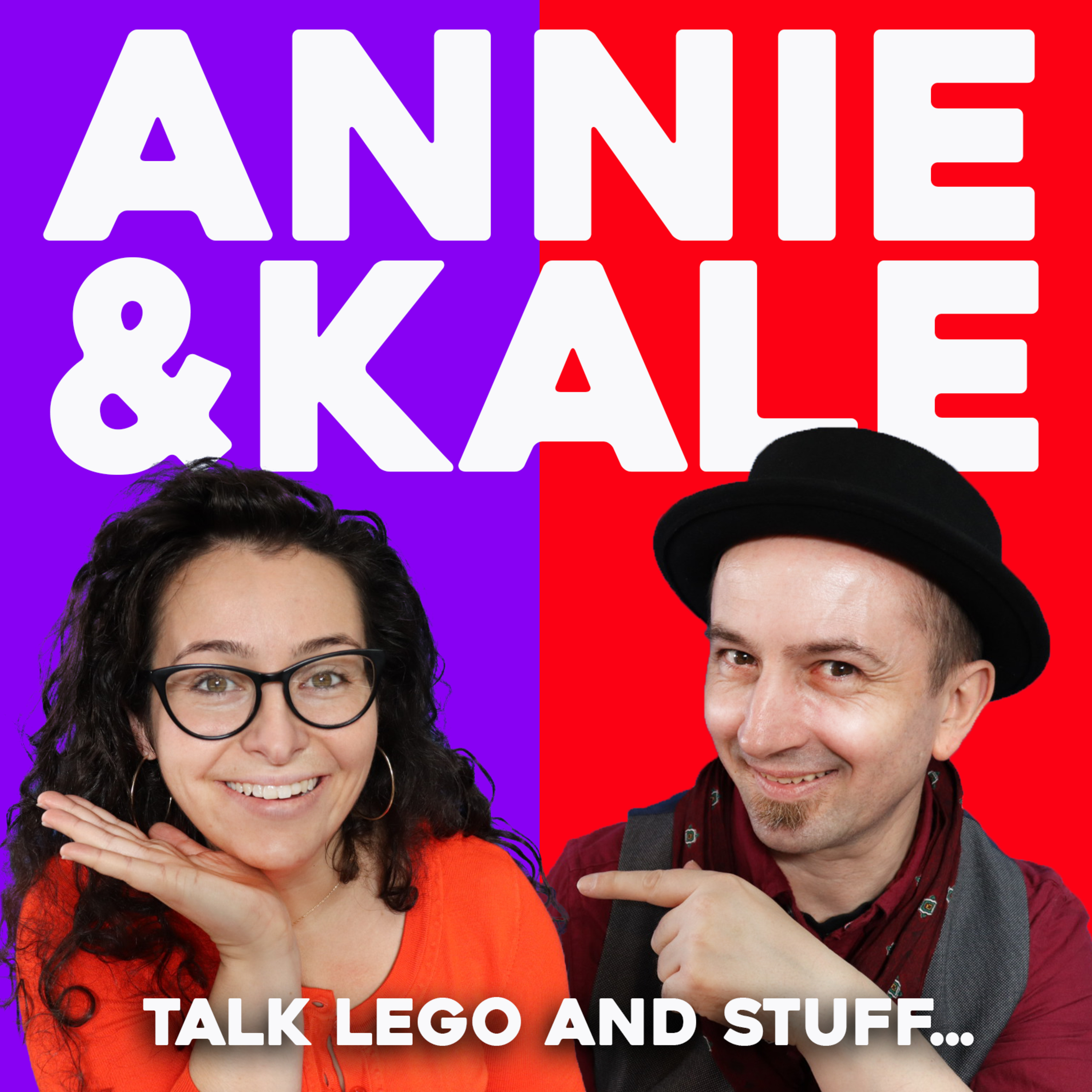
Annie and Kale - Ep 1. Meet Annie and Kale, know their mission.
36m 24s
Annie and Kyle introduce their podcast, which aims to discuss Lego, neurodiversity, and practical building skills. Annie shares her story of surviving a brain infection and using Lego as therapy, leading to a career in Lego education, volunteering at Brickvention, and appearing on Lego Masters. Kyle describes turning to Lego after his premature son’s birth, which sparked a journey into Lego photography, community involvement, and eventually becoming a Lego Master. Both identify as neurodiverse—Annie with ADHD and Kyle with ADHD and possible autism—and emphasize how Lego helped them find their tribe and process trauma. They highlight Lego’s role in supporting neurodiverse individuals, from fine motor skill development to emotional expression, as seen in an event where a nonverbal girl built an emotion mosaic. The episode includes a building challenge where they create emotions using a Harry Potter BrickHeadz set, with Annie building hope and Kyle building a cake. They also explain RLFM (Recognized Lego Fan Media) and LUGs (Lego User Groups), noting how these networks support creators and events. Kyle mentions the Bricklink Designer Program as a pathway for fan creators to produce official sets, reflecting Lego’s expansion into fan-driven markets. The podcast aims to offer tested skills, guest interviews, and updates on Lego news, blending personal stories with practical advice.
[Music] Hi, I'm Annie. And I'm Kyle. And together? We're Annie and Kyle. Bingo. [Music] Alright, Kyle. So, our podcast or this concept of creative thing that we're doing has a few reasons for existing. Yeah, number one, I think, is so we can chat about logo. Number two, to discuss our experiences within neurodiverse community. Number three, is talking off. Sorry. We can edit. It's okay. I don't want you. I want to take number. I'm just picking up what you said. Number three. Actually, no, I know what was tripping me up. We need to have a more of a welcome listeners in there somehow. What does? It's going to be personal. Okay. Personal, and personal. Well, we do the actual take like that. Number three. Chat-parroting and how we use Lego within our families? That's beautiful. Also number four, to kind of offer our listeners real tested skills that they can utilize in their own building journeys. And just talking Lego experiences of ourselves and also some of the special guests and friends. Yes, I'd like to have some special guests in here. And that'd be quite fun. Alright, so basically, we're A-Files, we're parents, we're neurodiversity advocates, and we're also Lego masters with stuff we think that you'd like to hear. You've got our mission segment on to introductions. Hello. I'm Annie, and I've been involved in the Melbourne Lego community for more than 15 years. My Lego story starts with me on the brink of death, having regular tonic clonics seizures, which sounds very dramatic, but it is true. So when I was a kid, around 15 I was diagnosed with my brain infection, and I ended up dying twice, which seems great for everybody. But it means I couldn't, it meant that I couldn't read or write. So they gave me Lego as my rehabilitated therapy, and I got better, despite all of these people telling me that I wouldn't. At 21 I decided to run away from Perth, live behind my sickness, and the labels that I had, and move to Melbourne. So on, I came on a two week holiday, and on day three I signed a lease, and I didn't go on. My parents were not impressed with me. But while I was here, I needed a job, so I walked into this lovely little Lego store in Muni Ponds, and I asked for a job, and they said, "Yup, here you go." So I got my first job in Lego education, and I learned how to teach English maths robotics. And pretty much everything with Lego through that system. Then I ended up in the brickvention community, where I volunteered for 10 years, and did all of the marketing and creative stuff for Australia's premier Lego fan convention, which was amazing fun. And then somehow I ended up on Lego Masters through that, being a woman in Lego. It's a lit-eddy body on. Oh yeah. They kept ringing, so that's where we went. And from Lego Masters, I got to launch my Building Mindfulness program, which I've been running for a few years, but I got to properly get it going after that point. Then we had COVID, and then Kale and I decided to talk to you, which is where we are now. So that's a very brief introduction, as to me as a Lego person, but Kale, what about you? In a similar way, I turned to Lego to help get me through a difficult time, about 12 years ago now. My second son was born six weeks early. Now, it's a good ending to the story. He's all fine and healthy now, but then straight into the neck, you straight into a humidious creed, full of tubes. I didn't get to hold until the fourth day. Scary, okay? Scary. Like, my partner's downstairs. She couldn't even walk yet. They were surgery involved. This is 12 years ago, so you know, happy and shut up. But there I am, standing in the neck, you hadn't even holding yet. Didn't know if I was ever going to get to. And the nurses were all like, go home, get some rest, go home, get some rest. And I knew that wasn't happening, right? So I shuffled out the door eventually, but on the way home, I hit one of those big box stores. I don't remember exactly where I think it was Northland. I picked up two really big Lego sets when I got home. I just dumped out all the parts on the floor of my lounge room, threw away the instructions, and just built as a way of processing. And that so quickly just, like it really helped. And yeah, it just snowballed from there. Within six months, I was at my very first prevention. Within 18 months, I was, had picked up a photography. Thing to do with Lego. And that had picked up enough traction that I was doing a market stall around that. And I think my first commission I got was within that first two years. It also snowballed very quickly. And it took over my life. And it's good reason. Yeah, well, you know, there's people, Lego masters in there. And these days pretty much everything I do in my life comes back to Lego somehow, way shape or form. And there's three million bricks in my house, which is more than the brick pit has. Yes, yes. And the masters. Yeah. All right. Yeah. Quite an amazing story. I like that we're both kind of bonded by trauma. That works well. But ideally, Lego is something that, ideally, Lego is something that has given us, or definitely given me, and from what I can understand, given you a sense of hope. Yeah. Yeah. It's the same space that I turn to. So our main topic for today is something that we haven't discussed yet. It's neurodiversity. Neurospiciness. Neurospiciness. Because whilst we have introduced ourselves, we haven't really touched on this. Kale, how do you describe your neuropathy? I identify as ADHD. There may be a little bit of autism in the mix. We'll never know. Kale is never being tested. No, no. No, no. Well, I'm old enough that it didn't happen when I was a kid. But certainly, like a lot of adults or parents, I got diagnosed because my child, my eldest child, got diagnosed. And it led to me realizing that we shared many of certain symptoms and that maybe I should go check myself too. And yeah, medication was life-changing, just life-changing. So I identify as ADHD yourself. I have a different story in that on Lego Master's, my beautiful partner that I was working with, Bruno, who's an amazing Lego builder in her. We bonded over our brain experiences where she had a brain tumour, I had a brain infection. Then we realized we were both good at building Lego and we became teammates with prevention. She told me that through her diagnosis, I should probably get one as well. And I took it as a compliment because I really admire her as a builder and as a creative. And that was one of those snowball moments where I went, "Oh yeah, I have a bit neuroquerky." Well, I think that's worth touching on. The idea that it helps you find your tribe. Absolutely, it helps you find them. And certainly for me, that finding the Lego journey I mentioned getting involved with the Lego community, etc. There was that element of finding my tribe. And certainly that slightly older me looks back and goes, "It's because we're all new I see in this field." He kind of got to be a little bit. So Lego is one of those things that genuinely supports the neurodiverse community. Not just through its mainstream processes or marketing or products that it produces, but the communities that it ends up building through secondary and tertiary experience. How do you think Lego supports the neurodiverse for you? Well, I actually had probably approached the answer from a slightly different perspective because I mentioned most of my work in voles Lego in some way shape or form. And certainly I've done a lot of work with autism charities, again, started with my older son. But it's such a great OT tool and it helps scaffold so many other things in terms of activities that you can build around it. And when you're teaching any kind of skill, it's really better to not be teaching it overtly and let it be subtle. And Lego makes such a great vehicle to therefore pin those lessons to and take it in that other direction. So yeah, it's a lot of OT type exercises, a lot of various little simple little structures like Build a Mosaic. [BLANK_AUDIO]
based on emotion. Some of my most fondest recent Lego memories involve having done an event for an autism charity. And this girl who was practically nonverbal comes up and she reads, it was a mosaic building activity, but the prompt was build an emotion. And so I had to be at another table. I'm doing something else over there, don't I? But at the corner of my eye, I see this nonverbal girl sitting there and she's just practicing faces for like a full five minutes. And it takes me a bit to register that what she's really doing is going through that range of emotions that is a big issue. I mean, for everybody in that room had some degree of issues with it, that's why they're in that room. And yeah, watching her kind of process and think about it and then build and reflect. And yeah, it's a mosaic building activity that where the prompt is, build an emotion. But the impact it had, like that was one of those, and I'm probably not describing it as fully as I could, but seeing the impact and her engage in that way, that's the power of it. That's the power of Lego right there. That's amazing. And this was at one of your most recent events? Yeah, yeah, that's about a month ago. So you do quite a few really cool events with autism charities and schools and community-based sessions and things like that. I've had the pleasure of doing stuff like that too. Not to the same scale as you, but, you know, scale scales, a big thing. But I've also had beautiful experience with how Lego supports the neurodiverse community, not just for kids, but also for adults, because we've worked, both of you, both of us, have worked within that Lego space with children and grownups. And most recently, I've been working with some universities and some young adults, let's say, in a similar circumstance where they've had enormous challenge and we've used Lego to encourage them to step out of that space and build themselves up. So you're right. Lego has this amazing ability to support the neurodiverse community without people even realizing that that's what it's doing. Yeah, and I mean, like to talk a little bit about a further about it. There are so many skills that we kind of take for granted when we're playing with Lego, the fine motor skills. The ability to look at a pile of Lego instead of seeing a pile of Lego, seeing individual bits, identify them, the perception ability, however you want to phrase it around that. - Becoming a master builder. - Well, I certainly wouldn't even go that far because they were all transferable skills. - I'm thinking about the Lego movie. - Sorry. - Oh, yeah, yeah, yeah. Seeing the piece and going, I see where your head's at actually. - The piece of resistance, yes. - But no, certainly just being able to look at a big pile of Lego and say, that's the one by one piece I need. You know, as opposed to just getting overwhelmed by a large pile of Lego. And so certainly all those little tiny, little skills that have to go along before, I totally adjacent to whatever you might actually be doing. And certainly for, I don't know how deep we want to go into the reeds here, you tell me. But certainly, you mentioned corporate events and young adults. - Yep. - That becomes a whole different level of experiences too because quite often adults need permission to play and to create and breaking down those boundaries around that. And again, the creative skills. - Because they don't rush at it like kids do. They wait and they stand back and they hover. And you're right, it was a permission-based thing to be able to say, please come in. - Yeah. - I will happily trade you a bubble tea for a creation. (laughing) - Oh yeah. So certainly, I mean, how many times have you been in that space with the adults there? And they're like, I can't, I can't build. That's not true, that's not true. - Not true. - You can't build yet, you know? - You just need that little bit of inspiration or a challenge that's set for you. - Sometimes. - Sometimes. - But it's set. - I feel like that might. - Is that my icebreaker? - Yeah, is that our segue to a build thing? - That's a great segue. (bells ringing) (blender whirring) - So one of the things we wanted to bring to you every episode is a little Lego building challenge where we throw the instructions away. Sometimes, well, we'll vary it up a little beyond that. But start off with a Lego set. Open it up, talk about it a little bit, and have a challenge to go with it. And so you guys can play along at home. The idea is that we've got a couple of building tips along the way, you don't need to have that set, obviously. But having some bricks to be able to play with and come along with the little challenge is a good idea. - I'm keen for us to not even use set sometimes. I'm happy for it to just be your loose Lego. 'Cause there are plenty of families that have a massive tub of Lego that they just need to dump on the floor and stick their fingers in. - Oh, yes. The feeling of just running your fingers through the bricks. Yeah. But today, I have the Lego brick heads, Harry, Hermione, Ron, and Hagrid set 40495. And. - And set 40496. Voldemort, is it Nagini on a genie? - You're the Harry Potter fan. - I'm the Harry Potter fan. - I don't know what it is. - Nagini and Beljuergs. It's the snack. - Oh yeah, the. - It's the boop noodle. - The boop noodle. (laughing) - Or is it dangerous spaghetti? - Oh yeah. Where are these danger rope? - Yeah. (laughing) - I used to be a country boy in Queensland. We used them as door stoppers a lot. It was a country boy thing. - Right. (laughing) - I prefer them as necklaces. - Well, no. - No, no. - No, no. - They're very nice to have around your neck. They can dance and. - Oh, it's, I don't know. I was a young kid in the country. I've lost track of the numbers of them I read accidentally ran over with my bike. - It was a thing growing up there. Never got bit. Thank gosh. Came close. - But anyway, still a live count. - Back on track, talking about the Lego set. Here, we're gonna pick up on some of what we said, talked about earlier. And we're just gonna have a challenge here. We are going to build an emotion. And if I, you know, using the parts here, start by running your hands through, finding what parts speak to you. And yeah, let's see what we build. - So I built this. - You built a beautiful little skyline. It started, you had a vibe to begin with. - I had a vibe. I had a vibe of feelings. And I built hope. - Hope. Hope, it's a beautiful emotion. And because the colors were black, I guess it went briefly in a different direction. And building with, you know, these Harry Potter brick heads is only a few colors available. Don't have a full spectrum of colors here. But I definitely had some sunshine in that nice yellow piece. And I contrasted it against this black. - Yeah, yeah, it is a very dark set of parts in this set. It's so much black, so much black and dark brown. The dark brown does make me think a cake. - Yum. - Why didn't you build a cake? - There's a reason I didn't build a cake. And that's because Bricklink Designer Program 8 has gone up this week. And I have an entry into that, which is coffee and pets. I've also been battling and learning how to get better renders out of studio. And certainly that's been a bit of a limitation. But certainly, I've spent a bit of my week building cake and sharing cake and talking about cake in that particular dark brown, in fact. And yeah, it's when this goes to air, I'm assuming that coffee and cake has not become one of the produced sets. And so you'll be able to find the instructions for Bricklink. Oh, sorry, a very brickable, very brickable. And if we've set up Patreon by now, we might even share it with some of our listeners. - I made a cake. - That is a beautiful cake. - I made a red velvet cake for you while you were talking. A simple five piece build. - Five pieces, little candle at the top and everything. - I used to want as my candle. - Yes. - So that's really cool. - Yeah. - Happy birthday, Cal. - Let's segue again. - S segue. - Let's talk about RLFMs. - RLFMs. - Because we've had our brief introductions. Talked about neurodiversity. I want to sidestep entirely and learn more about what you do with RLFMs. What kale is an RLFM? - Yes, I was gonna say, we should define it. Recognized Lego fan media. So, recognized Lego fan media is basically a thing that Lego does for anybody in the Lego related space, making social media content. Whatever that may be, that might be blogs, that might be a podcast. It might be some guy who started a Lego 365 project over on Instagram. That's a photo of Lego every day for a year, just to learn how to get good with a camera and photography. And then about three months in, finds that he's got quite a lot of followers who are really vibing with what he creates. And that's how it starts. - That kind of sounds like you. - Yeah, yeah, yeah. [BLANK_AUDIO]
That's a very personal story that one. But that's how I became. Got us on to Legos Rader and they were like, "Hey, recognise Legos fan media. We can help you create content and work with you to do that stuff." Because certainly you were heavily involved in a log, which is a similar but different side to that. Tell us about logs. Legos user groups and they're a recognised logo user groups and then they're not recognised logo user groups. But in order to become recognised you've got to start somewhere. So there's plenty of amazing logs around the world. I think in the recognised community there are over 400 our logs. Yeah, I think that's right. And they also gain support for their events and community activities, things like that. So I was part of the main log here in Melbourne for a little while until I decided to have more kids. It is a lot of work and certainly it's worth saying because it is such a massive amount of work and so much is needed not just in terms of work but equipment. That's where the Lego assistance comes from, in handy. It does. So you have your RLFM. Which is how I got this Lego set over here. I got this Lego set. We've just supported in here's creativity. And our plan, or one of our plans in this particular series that we've created is that we're going to utilise your RLFM knowledge and talk about it every so often so people can get updates. Yes, yes. Interesting Lego news updates. I feel, well certainly. I just mentioned brick link designer programme eight. By the time people are hearing this we're probably well on track to number nine. If you're unfamiliar with the brick link designer programme, basically it's an alternate pathway for fan creators to turn their sets into official sets. So we know all know what Lego ideas is but Lego ideas is basically you submit an idea that gets turned into an official set by a Lego creator, somebody in house. The brick link designer programme, the instructions and the model you receive is made by that fan creator. Completely. Completely made by them and they get a good chunk of the proceeds, not all obviously but certainly those proceeds go directly to them. Because Lego recently acquired brick link. Yes. Brick link used to be independent. Yes. And it was created by Dan Jessica. Shout out to the Jessica family. And then Lego realised how epic it was so it went back in to the Lego network of what do they have? They've got a whole network of amazing businesses under the Lego brand. Yes. Yes. I mean, Lego, they're a global multinational company and therefore there's a lot of space for little things that the fan community wants which is only a small portion of Lego's market. Needs and brick link gives us that opportunity to get parts of specific parts for whatever we need to make our own specific models which is not something that kids and a lot of parents even care about. You know, they're happy to play with what they've got. But brick link, great thing and certainly. If you need one very specific part, you can help on Brick link and find it. Yep. Yep. If you want to make a big mosaic of Batman Suitman and need 20,000 plus cheese slopes. Brick link is great. Okay, we can do that. Brick link. That was one of the very first times I turned to Brick link. Was that Batman Suitman mosaic that you've seen? It's a lenticular mosaic. Again, we'll put links hopefully, maybe in the contents. But a lenticular mosaic, you'll walk past it at changes. Change the image. Just like a hologram, Pokemon card. And certainly, the scale of it meant I needed tons of cheese slopes. I'm not kidding when I say 20,000 of them, which was actually very easy to get in large quantities very cheap from a couple of German stores. And that's only possible because Brick link exists. And at that point in time, it wasn't under Lego hands. It had been created by fans to give us that ability to do that. So that we could then go on to make those things. I'm just spread the word about how cool Lego is. Yes. Well, I guess that's the other half of it. Because we're already, whether it be log or LRFM, we're already spreading that word. So we're already putting in that work. We're putting in that mileage. We've got those people that are vibing with our work and want to see more of it. And so that little extra bit of assistance to help make it happen. It's great. From what comes back to how Lego really does care about the people that love it? Yeah, it's really hard to name any other fan community that has that same relationship. I'm not sure I can, in fact. I think that's why I like Lego so much. Yes, yeah. How lovely. So, Kel, we've had an epic chat, I think. We have. We have. But I feel like there's one more segue we should show up for our win. Which one? Do you have something about mindfulness you'd like to talk about? Oh, yeah, we've talked about frost bricks. You can talk a little bit about building mindfulness, too. Yes. Yes. I did mention before that through my Lego journey, I've had the honour of creating my own little Lego business as well, just like yours. However, I'm not a big scale, kale scale builder. Not a kale scale builder. I am a. How would you say it? Not even really a builder. I think we're putting the cart before the horse in a way there. I never set out to become a Lego creator. It's just that there were enough people vibing with what I did while I pursued my passion that had ended up becoming my career. And I guess I'm assuming that. I'm the same. Yeah. Absolutely. Because I'm just passionate about the Lego brand and the Lego products. And I just love them so much that I wanted to be an advocate. And that's how I became an ambassador for a period of time through my lug. But actually, the building mindfulness started at least 10 years ago, if not more, when I was hosting events for my lug and therefore developing the skills that turned into my business. So the key thing was I realised kids wanted to build, but they were getting stuck with the inspirational piece and they were absolutely getting overwhelmed by the big parlour bricks in front of them. And we didn't have instructions. We had loose bricks. Most of the time I was taking my kids Lego, which is mostly a pile of mess with a few hands that have been ripped off. Kale, why did children take the hands off minifigures? I don't know. Why do they do it? Tell us. I don't know. Do your kids take hands off minifigures? Anybody's listening? Right into us. If your kids take the hands off minifigures. I put complete minifigures into the playbags and then I pull bits out. I'm longer connected. But you know what figbafing is. So for those who don't know what figbafing is. Basically it's making your own characters. Maybe it's your favourite movie. Like sure, we've got lots of Harry Potter minifigures, but we don't have any one piece minifigures yet. That's coming. But my little one loves one piece. He wants to have Laughy, he's a Lego city and he can do that by taking official parts and recombining him just for a different minifigure that looks like Luffy and that's called figbafing. So to be generous, they're not trying to be destructive. They're just trying to create a cool little minifigure that represents their favourite character. Are you saying bafing or bafing? We've already covered. We, apholes, they do like a bad childish joke. I mean, it's not bricks. It's not bricks and vomiting up Lego minifigures. And figbafing. Alright, great. I genuinely didn't know that until right now. That's the name for it within the hobby and yes, it's, don't think too hard about the name. Okay, perfect. Well, very often when my big parts of Lego would go to these events, my figures would absolutely get bafed. But the kids were overwhelmed and so the techniques that we developed, or the techniques that I planned and created over this 10, 15 year period, were about centering back into that mindfulness moment because my favourite quote, and I'd like to share it with everybody, is Eckhart toll. And my understanding of the quote is, it's in today's rush, we all think too much. So the idea is to not think and to just do. And I think in a neurodiversity community, that's awesome because sometimes we don't want to think. We want to just be completely centered in one moment. So I developed a few lovely techniques to really get into that space. Maybe we should do one now. Yes, yes. Do one with me? Well, I mean, ADHD. The brain. The brain off. It's pretty much there in the name. Fabulous. So I want everybody listening to find a 2x4 Lego piece. It can be a plate, it can be a brick. We just need one. I'm going to talk you through some block breathing. All right? Because we want to centre into that space of mindfulness. And this is a technique you can use at home with your families. You can use it with your kids or with your classrooms or anything like that. just a beautiful way of taking a trip.
traditional breathing exercise and pulling it back into that Lego world. So we're at our 2x4s. And the studs on the top of the 2x4 are going to act as your guide for your hands as your breathing, because I've found, especially with my own neuro systems, that I like to touch things while I'm also doing something else. It's very hard to do just one thing. So we're taking that concept of one thing and adding in one tiny extra thing. Touch it twice, ADHD, talking to the converted people. This is absolutely a fidget to go with breathing. So we're going to block breathe. And we're going to inhale, hold, exhale and hold again before inhaling again. So it sounds a little bit complicated, but kale's going to demonstrate this for us while I talk you through it. Okay, okay? Yeah, yeah. So as I count with you, I want you to inhale and press your finger on the four studs as you inhale to keep the count. You ready? Inhale, one, two, three, four, hold, one, two, three, four, exhale, one, two, three, four, hold, one, two, three, four. Okay, resume normal breathing. So that's how we do it. But I'm going to repeat it this time twice. And the idea is we're going to bring that breath completely centered in. So we're in a perfect space for the rest of your day. Right? Yep. Ready? Inhale one two three four hold one two three four exhale one two three four hold one two. Three four inhale one two three four hold one two three four exhale one two three four hold one two three four now you can resume normal breathing. Cal's holding his breath. It's quite a challenge to hold your breath for four seconds in between breathing in and out. I'm going to keep a lamp shading the ADHD being able to pause and be still. It's not something I am very good at at all. And yet I'm watching you and you nailed it. Well after a bit yes. Started well. But certainly we're having to use it into it. It was it's helpful. It is helpful. It's a great way of centering. Yeah. Especially when we're building logo. And the reason that I really created this exercise was because with that overwhelm and the craziness of oh my gosh there's logo in front of me let's go nuts. I needed a way of pulling it in. And this was the perfect way. So I usually start my sessions with something like this. And then we get right into the building and the creativity. So yeah that's what I do. And it's not the only thing we do. There's plenty more. But that's a nice taster or intro. Yes. Yes. So we've got frost bricks. We've got building mindfulness. There are two businesses. And part of this podcast will also be so we can share our information from those two spaces into one place and offer some interesting insights that you have access to. Yeah. Well I mean we should give ourselves proper plugs. I'm usually bad at the ESPEG. I feel I've been prompted to. Frost bricks, Instagram and Facebook. Look me up. There's cool pictures and I share tips and tricks regularly. I'm over there on YouTube too. Yeah, Frost bricks. That's my name again. That's Frost bricks. Yeah. And frostbricks.com. Yes. Frostbricks.com. My very out of date website. We want to find a commission or something. And yeah, there's some extra Lego instructions to be found on there too. And re-bricable has a steady stream of instructions by me appearing there. Awesome. And yeah. On Instagram I am tea with Annie. But also, okay, we have our own Instagram now. Oh, wait. We do. It's Annie and Kale. We have an Instagram. And we also have a website that is currently in production which is Annie and Kale.com. But hopefully it's already live and people can see. Absolutely there will be. And the idea is that if you want to link through with any of the stuff we do either through Frost bricks or building mindfulness, it will all be in that one space that can then link you through. Awesome. And yes, I guess that was a good time to take little photos of everything we built. And put it on our website because we will link all of the things that we talk about through the website and through the podcast platforms because we'll be on as many as we possibly can to reach whoever would like to listen. And another really thing that's important is that we're just regular humans, aren't we? Speak for yourself. I think we're good. That's like a master's ability for a dog. I own it. I own it. But we are human. And we have people and we love connecting with our audience. So if there's anything you want to talk about or you'd like us to talk about, you can absolutely email us. You can send us messages on Instagram or through any of our channels. And we will do our best to incorporate that because part of us talking to you is talking about things you want us to talk about. Yeah, tell us what you want to hear. Share your creations. I love seeing what people create. We've got an email just to Annie and Caleb G. Mal.com. Oh, see. Good thing we remember this plug out so it was business. But we definitely want to stay connected. So by all means reach out. Yes, yes. Thank you. Thank you for listening. Thank you for reaching out. Thanks, Jane. Thanks for all the support. And we'll see you at our next session. Yeah. All right. Annie and Caleb. Bye. We need to jingle the exit on.
Podcast Summary
Key Points:
Annie and Kyle host a podcast focused on Lego, neurodiversity, and creative building.
Annie’s Lego journey began as rehabilitation after a brain infection, leading to roles in Lego education and Lego Masters.
Kyle turned to Lego after his premature son’s birth, eventually building a career in Lego photography and community events.
Both identify as neurodiverse (ADHD and possibly autism) and see Lego as a tool for processing trauma and building hope.
Lego supports neurodiverse individuals through fine motor skills, emotional expression, and community connection.
The podcast includes building challenges, such as creating an emotion from a Lego set.
They discuss RLFM (Recognized Lego Fan Media) and LUGs (Lego User Groups), highlighting opportunities like the Bricklink Designer Program.
Summary:
Annie and Kyle introduce their podcast, which aims to discuss Lego, neurodiversity, and practical building skills. Annie shares her story of surviving a brain infection and using Lego as therapy, leading to a career in Lego education, volunteering at Brickvention, and appearing on Lego Masters. Kyle describes turning to Lego after his premature son’s birth, which sparked a journey into Lego photography, community involvement, and eventually becoming a Lego Master.
Both identify as neurodiverse—Annie with ADHD and Kyle with ADHD and possible autism—and emphasize how Lego helped them find their tribe and process trauma. They highlight Lego’s role in supporting neurodiverse individuals, from fine motor skill development to emotional expression, as seen in an event where a nonverbal girl built an emotion mosaic. The episode includes a building challenge where they create emotions using a Harry Potter BrickHeadz set, with Annie building hope and Kyle building a cake.
They also explain RLFM (Recognized Lego Fan Media) and LUGs (Lego User Groups), noting how these networks support creators and events. Kyle mentions the Bricklink Designer Program as a pathway for fan creators to produce official sets, reflecting Lego’s expansion into fan-driven markets. The podcast aims to offer tested skills, guest interviews, and updates on Lego news, blending personal stories with practical advice.
FAQs
The podcast aims to discuss Lego, share experiences within the neurodiverse community, chat about using Lego in families, and offer tested skills for building journeys.
Annie was given Lego as rehabilitative therapy after a brain infection at age 15, which helped her recover. She later worked at a Lego store, volunteered at Brickvention, and appeared on Lego Masters.
Kyle turned to Lego to cope after his second son was born prematurely. He bought two large sets, built without instructions to process his emotions, and it snowballed into a passion involving photography and commissions.
Neurodiversity refers to variations in brain function, like ADHD or autism. Annie identifies as neuroquirky, and Kyle has ADHD, diagnosed after his child's diagnosis. Both find Lego supportive for their neurodiverse experiences.
Lego helps with fine motor skills, perception, and emotional expression. It serves as an OT tool and a vehicle for teaching subtle skills, as seen in events where nonverbal individuals use Lego to explore emotions.
The challenge is to build an emotion using Lego parts from the Harry Potter BrickHeadz sets. Annie built hope, and Kyle built a red velvet cake, showcasing creativity without instructions.
Chat with AI
Loading...
Pro features
Go deeper with this episode
Unlock creator-grade tools that turn any transcript into show notes and subtitle files.
 PodcastTranscript AI