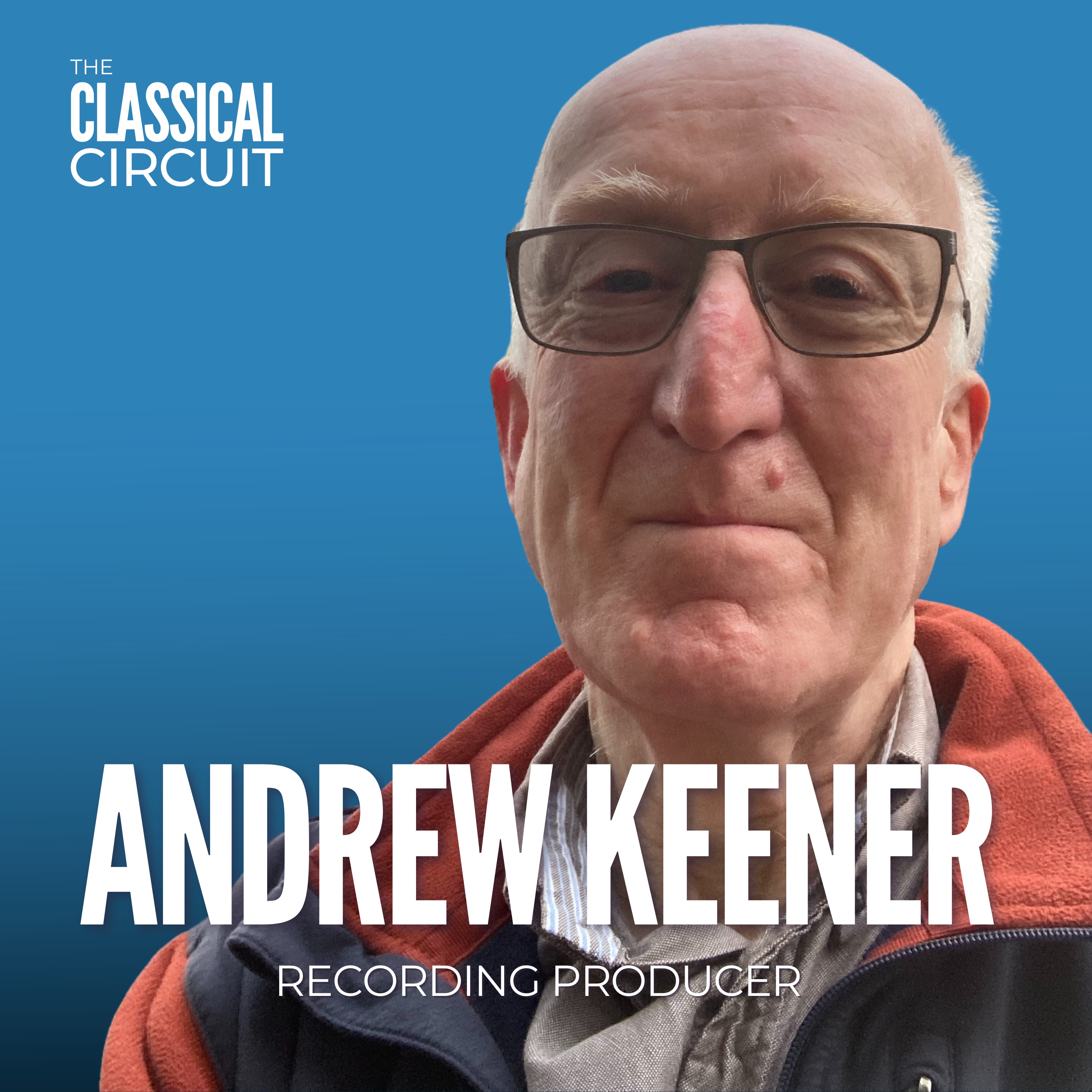
32. Andrew Keener on the role of a recording producer, working with different personalities, and messing up his first ever session
47m 24s
"The Classical Circuit" podcast episode features host Ella Lee interviewing recording producer Andrew Keener. Keener discusses the significance of recognizing musicians as both individuals and artists in his work. He reflects on his career path, acknowledging early challenges and mentorship from renowned figures in the recording industry. Keener shares personal anecdotes, such as his debut recording experience and the importance of balancing technical aspects with emotional engagement during recording sessions. The conversation delves into interpreting artists' choices, handling disagreements in a professional manner, and the evolving standards of recorded music interpretations. Keener's insights highlight the blend of technical expertise, people skills, and passion required in the classical music production field.
Transcription
8279 Words, 44615 Characters
Hello and welcome back to The Classical Circuit, the podcast that deep-dives into the intricate
world of classical music and all that comes with working in it.
I'm your host, Ella Lee, and each episode I'm joined by a brilliant guest from across
the industry, discussing their best career high, their worst career low, and other things
that show you a different side to the one you might find on their website.
My guest today is the recording producer, Andrew Keener, who for four odd decades has
been working with the most prominent artists and orchestras in the classical music business,
and as it currently stands, he's produced more than 1,600 recordings.
Now, if you are a regular listener of this podcast, you will know that I normally give
sort of top-line info for each guest so that we all have a bit more context, but I'm going
to forego it here for two reasons.
One, we find out a lot about Andrew's path, as it were in the episode itself, and two,
the main reason, actually, I would prefer to direct you to Andrew's website so you can
read his biography for yourself, because it is just so full of personality and it put
the biggest smile on my face.
I think we should all write biographies like this now, to be honest.
I had the most wonderful time recording this episode, not least because Andrew has such
a warm and generous spirit, but he's such an engaging storyteller, and I really loved
hearing more about the role of a music producer through his lens, especially the sort of people
and personality aspects.
You know I love all that.
Yeah, I could listen to him talk all day.
But anyway, as I think I mentioned in an earlier episode, I'm going to be trying out some different
things with the format of this podcast, which happens to work out nicely on this particular
occasion, because at some point early on in the conversation, Andrew expertly woven his
career low, which really tickled me because it just immediately threw the usual format
out of the window, and I was quite delighted by it.
And it was an interesting one for me editing this back, because Andrew is such a legendary
name in the classical world that I'd almost, I guess I went into it almost forgetting that
he's also a human being, and it took time for his career and his reputation to develop,
which is so obvious, but you know when it comes to really mega respected figures like
this, it's easy to forget that they also had to start somewhere once upon a time.
So I will stop yapping, prepare to be charmed not by me, alas, but by Andrew.
I hope you enjoy the episode.
Andrew, hello and welcome.
Hello.
Nice to be here.
Thank you for asking.
Thank you for your time.
I have to say your biography, I was having a read and it might be one of my favourite
biographies I've ever read, thoroughly entertaining and written with so much personality.
Something that we share very much in common, one of the lines I sort of picked up from
that biography is that you are fascinated by musicians, both as people and also as artists.
So I'm curious, first of all, to know what it is that you find fascinating on both of
those fronts.
Well, I think first of all, the first point to be made is that when I'm working with musicians
who happen to be people or people who happen to be musicians, you can't separate the two.
One of the prerequisites of this job, as I see it anyway, is that to see both the person
and the musician is essential because one feeds the other in understanding this job
is a people person job.
Okay, I have to be able to read music well.
I have to have a decent pair of ears.
I'll be more self-deprecating later.
But I think it's necessary for the job to be a score, to know the literature.
I always say that no theatre director I hope will be taken seriously if he or she didn't
know the, his or her, Ibsen or Shakespeare or Alan Bennett or Lakebourne or whatever.
And I think a classical record producer has to know the core repertoire, not every byway
but the core repertoire.
So that's the understanding of the musician, gaining trust in a musician if you know that.
And then also realising that every musician is as different from his or her fellow musicians
as people, one person from another.
And I think reading that as this is a people job as well as a musical discernment job,
if you like, is vital, absolutely vital in order to, one insight will feed the other.
Like to say to a musician if things get hairy, if the musician is hitting a temporary bad
hair day in the studio with this or that bar or an indecisiveness, then knowing what to
say in other words reading that person is, well, essential.
Are you someone that is naturally good with people anyway and you've always been that
way or is this something that you've had to really hone?
It fascinates me so I hope I'm okay at it.
All of us say the wrong things sometimes.
But well, when I was a school boy in Comprehensive School in South Wales, Barry Boy's Comprehensive
School, I was very badly bullied.
I was different, I must have struck my contemporaries as something rather strange.
I had several, two or three very close friends who were, my contemporaries would have thought
were equally strange to me.
And therefore, if anything I suppose gave me an insight into how other people operate,
reading other people and trying to take a step back to read them, I suspect if we're
talking about formative influences that was the one which helped me in understanding people.
In what way, what did you take from that?
Well, seeing other people bullied around me as well and seeing how other people reacted
to that and being able to read other people and seeing what was empathetic and what wasn't
in the way people dealt with each other, I suppose it's the old cliches and it's what
doesn't kill you will make you stronger.
And although among my many weaknesses, I think that made me stronger.
The scar tissue is very, you know, scar tissue is strong and white.
Gosh, kids can be really mean, can't they?
I hope that those bullies could just take a look at this room that we're in now and
you've got walls and walls and walls and shelves of all these CDs that you've produced
over the years.
But anyway, that's sort of that roundabout answer to your question about reading people.
I think that's an early thing which helped.
Yeah.
And then on the music front, you know, you mentioned the fact that you need to be able
to read music very well and also have that discerning ear.
I think that the question that I have about you and your role as a sort of recording producer
is, to what extent do you feel that you have to know the music that is being played, that
is being recorded?
And does your personal taste come into your work at all?
Well, of course it must, I think, but also part of it is learning a technique if you're
working with music, which doesn't say anything to you, not to let that get in the way.
And of course, it's the old cliché again, even if it's music which doesn't strike a
sympathetic chord in you, when you're working with it with a sympathetic artist who offers
insight, then arguably, at that moment, it's the most important thing you're doing.
But I think if you, I find famous-ass words, I can separate the judgment of how it's going
with the emotional response to music.
I'll never forget, this sounds very tween, very pathetic, but...
Is that self-deprecating?
I'm sure.
Well, that's self-deprecation number one.
I'll try and keep them to a minimum.
I've recorded five complete Vau-Milliam symphony cycles.
It cannot be enough, that music which touches me at a very deep level as do the Elgar symphonies,
all two of them.
Sorry, Tony Payne, there are not three, and much as I admired him.
And when I was recording my first Vau-Milliam cycle, which was with the wonderful and now
overlooked Vernon Handley, who was a great conductor especially of British music, and
I found my score of the fifth symphony I did with him.
That was the first Vau-Milliam symphony I recorded, A, because it was the first cycle
with him, and that was the first symphony I recorded with him.
And if you look at my scores, as the music was this by, I mark up in heavy red byro.
I'm a very untidy notator.
We talk to some of my colleagues who much more.
And then I mark up the score with the editing instructions in blue for my editing elves.
And I got this score of the Vau-Milliams fifth up from 1985 for God's sake, or six or seven.
And the red byro was as rigorous as ever.
Take 34 NT, meaning not together, and take 56 Big Tick, and take 64 OT out of tune.
And alongside these markings were blue blobs, and it was, well, it was tears.
Which fell on the score.
And I think a good producer has to have those two halves of his or her mind going on at
the same time, as the music's going by, "Oh, it's not together."
"Oh, it's not together."
"Oh, that's out of tune."
"Oh, that won't match with the take he just did."
"Blah, blah, blah."
At the same time, you have to keep the other part of the mind working to see how the take
is affecting you emotionally, is affecting you psychologically, aside from the nuts and
bolts of together out of tune, blended, blah, blah, blah.
And I think if you can do that as a producer, even with music which doesn't have a great
deal of emotional significance for you, then you're doing a well-balanced job.
Do you ever work with people whose artistic choices you don't necessarily agree with?
You mean interpretative choices, of course.
So what happens in those circumstances?
Is that when you're really switching off your own preferences and you have to just act from
a place of objectivity?
Yes and no.
This is where the reading of people comes into it.
For instance, if there's, I won't name names, there's a conductor I've done probably about
80 records with.
We're very good friends.
I admire him a lot.
I've done records with him all over the place and I can say things to him, not in front
of the whole orchestra.
I can say things in front of the orchestra down the talk back, like it's not together,
we need to do this again, but the nuts and bolts thing.
But I can say to him, person to person, in the control and quietly, do you think that
works at that speed?
Or do you think that rich in each hole?
I don't think it'll appear repetition.
That's if I know the person really well and of course that person must always have the
way with all and entitlement to say back, no, that's how I feel it, end of.
If it's an artist I don't know very well and don't know quite A, how to read this artist
or even getting to know this artist even better, knowing what not to say, it's very different.
So it's the scale of how much you can say to an artist about interpretation and how
much not.
I think it's a reading person thing as well as reading the musician.
Because people are coming to you for a reason, even if you didn't have all these years and
years and years of experience and I imagine even in the very beginning people were coming
to you for a reason and that is what you can personally provide in terms of a discerning
ear and all of that as well as the perhaps more technical side of things.
I think that comes later, at least in my case.
I was very lucky, a bit of potted biography, when I graduated in music in Edinburgh I drifted
mindlessly into doing a teacher-trained degree because I admired my old level and day-loving
music teacher in my comprehensive school to destruction.
I went to Edinburgh knowing how to harmonise bar corrals, knowing about structure, he fed
my appetite for repertoire, so I knew these things before he was mad.
So I admired him so much I thought I wanted to be like him, big mistake.
I was a dreadful teacher, absolutely dreadful.
After 18 months before running screaming from the profession, not knowing whether I was
doing more harm to myself or to my charges, I went to work in a record shop in London.
My best friend in Edinburgh, still one of my best friends now is the conductor, Sir John
Runicles and he was the star in our year and he was doing a post-grad degree in London Opera
Centre as a repetitive term so I slept on the floor of his room and worked in his record
shop, EMG handmade gramophones for your elderly listeners, which was a very much gentleman's
record shop in Soho Square.
And because I had the confidence of someone who didn't know the depth of his own ignorance,
which is common I suppose among, I mean young people in their early 20s are much more safi
than I was.
We're talking 1980, you know, '84.
And because I had that confidence some people saw through it and saw that I possibly had
some potential.
So it wasn't a question of artists coming to me right from the beginning, how would
they know, you know, how good I was or whatever.
I was always fascinated by records right from the age of six and in a brief career as a
music journalist and critic I used to sit in all the sessions and looked at producers
and thought oh that looks easy, big mistake.
And so one of two people not directly involved with the recording industry but journalists
and extinguished critics mentored me.
One was Robert Layton, the great Sibelius commentator, author.
Now there was John Laid, very elderly people listening to this podcast will know who he
was.
He was the editor and presenter of Record Review on a Saturday morning.
He gave me my first broadcast, I did a building a library on the music of Bax, which there
wasn't much on record at that time, we're talking 1980.
And so initially it wasn't the people directly involved in the recording profession who mentored
me and therefore I started going to recording sessions and then it was that my depth of
ignorance giving me confidence said oh I want to do that production, I was always fascinated
and recorded some.
When other kids were kicking a football around when I was in school I still locked myself
in my room, borrowed records from Cardiff Record Library, I was born in Barry and played
these records.
Why does that recording of the Agar-Chelkin should have sound better here than that one?
Just fascinated by the noise that records made.
And so it was these people who took an interest in me rather than recording industry people
and it was only when I visited a few recording sessions and a wonderful other man came into
EMG, handmade gramophones, a man called Ted Perry who founded Hyperion Records.
And he said I'm taught how to do quite a good imitation of this self-taught man who founded
Hyperion by selling ice cream outside the Tower of London driving a taxi at night, real
autodidact.
He said I'm starting a new record label Andrew and I said oh yeah do you want to produce
a?
Yeah alright, hot face!
And the result was a disaster, absolute disaster.
He gave me a recording of the Chopin Studies, this is The Career Low, right at the beginning.
And by a wonderful pianist called John Bingham made a few very good records, the one he made
with me was not one of them and never got released it couldn't.
And I remember I had dinner with John the night before the sessions and I was in awe.
Andrew he said I want this to be as accurate as Polini.
Oh absolutely John, absolutely.
Wrong answer.
A you're not Polini or John Bingham, that's not a qualitative saying that you're different
artists.
And I just want to play bits that I want.
Absolutely John, wrong answer number two.
Right answer would have been there were certain studio procedures, you know you don't have
to hear the take numbers, I won't call them out but we need to identify every event.
And so it went on like this and this was my, this was the way I hanged myself.
And the result was at the end of the third day at midnight I was in no help to him psychologically
at all.
And so he was in the groove of his nerves, third day at midnight I was still saying oh
win to win, that bar I couldn't get in win to win, no, oh what about the win in thirds,
I couldn't get bar six, no, and at midnight on the third day Ted Pay was sitting beside
me on my debut and I burst into tears and he said right I'm taking you home and I got
into the car blubbing I'm so sorry Ted, I'm so sorry.
And he said would this happen in the industry now?
He said don't worry Andrew we'll make lots more records together.
Second chance, if I'd blown the second chance he would if I'm sure and said no it's not
for you this career but I'd learnt just enough to not mess up the second record I did which
was The Virtuoso Mandolin, wonderful mandolin and domra player called Keith Harris with
Leslie Howard and I learnt just enough to make it issuable, the jombing record bless
him never got issued it was impossible it was like a million mosaic tiles and I walked
around London four months after that in a pool of guilt until one day I was on the tube
and going from one line to another round to the corner and there was John bang and he
gave me a hug and said Andrew that was a psyched up mess wasn't it, bless him he's long gone
he's long dead and the guilt fell away and I thought bless you.
Yeah sometimes you're just going to call a spade a spade don't you?
He was a wonderful pianist.
When you say that was your debut do you mean in sort of high stakes recording was that
really your first ever?
Oh my very first yeah I went in totally unprepared and to go back to your original question then
people started to say well this is a freelance producer well you know let's see what he does
with sonso and other people helped me like crazy the person that gave me my first orchestral
record was one for Martin Stilwell and I'm still a great friend Simon Foster who was
head of classics of pleasure at the time the bargain arm of EMI and then went on to EMI
Classics UK and then at Richard Branson's he has founded Virgin Classics and thanks
to Simon I had a lot of records offered me too and that's how wood gets out.
I actually can't remember what my original question was I was so engrossed in your story
but when you started from the sort of technology perspective absolutely everything looked very
very different and there are a lot of older recordings that are full of I don't know little
blemishes that make live performances exciting and feel very real and that was perfectly
acceptable and we're now in the stage where we can use the word perfection for lack of
a better word but the standard of recordings has become so clean.
Are you talking about standard of recorded sound or are you talking about what artists
expect their records to sound like interpretatively?
Well both obviously the standard of recorded sound you know we have much better equipment
these days but I suppose I'm more curious about the latter.
Interpretation.
Interpretation and the actual performance the execution of that interpretation.
It's a very difficult question not difficult it's complex and if I can come the answer
from another direction very often if I've had an intensive day recording I get on and
I still feel like listening to any other music at all I'll reach something down from these
shelves that are surrounding us and the chances are the record will have been made either
before I was born or before I went to university.
It's a good balance it's a very difficult one occasionally I give talks to recorded music
societies and what used to be called gramophone societies and one of the things I do if I'm
talking about me as opposed to something other like an artist I work with or whatever is
I'll play two recordings of the Storm Interlude from Britain's Peter Grimes and I say which
one has the more editing in it and one sounds you know alright the other is on fire and
of course you'll have to get me very drunk for me to tell you which conductors and they
always choose the one which is heavily edited.
Now that session we've recorded other Benjamin Britton stuff and there was little time left
on the session and the orchestra was tired and so the only way to get through this with
some kind of energy was not to say let's do a complete take I always do a first complete
take and a second complete take but this was different because it was the end of a session
and not much time and everyone was tired as I say and if I'd said let's do a complete
take they would have run out of steam at the same point in every complete take.
So okay let's go from bars 1 to 16 again and then edit together and results are electrifying
so there are no rules really asking for short takes can kill the music but depending on
what stage we're at in the session or what the state of the artist is it can be something
rather special as I say there are no rules which is why I don't believe that just pressing
necessarily pressing record button at the beginning and stop at the end is necessarily
going to make the most exciting records but it can I mean there's a wonderful Agaritch
Rachmaninoff 3 which I'm told and I believe you that has no editing at all there are spills
in it but you know it's a concert so there's no feeling of oh I can retake that because
it's a one-off that's wonderful I only listen to it occasionally because it's for high days
and holidays but the other the other issue is artists have a great deal of recorded history
behind them the artist you record today I'm recording with a pianist the list sonata a
few years ago and there was one bitch which was to use my phrase familiar was giving
them a temporary bad hair day so that happens to everybody and after about six goes of these
eight bars I said well we got it haven't we oh I don't know the accent is the only clue
I'll give yeah I don't know really and it's not as good as it could be I was set all of
my notes there and it sounds rhythmically rigorous and the dynamic is it'll match with
what we've done before no I said really Fred not his real name I said really Fred who your
favorite dead pianists and he named all these people like Cortot, Edwin Fisher, Moisevich
so all their records have wrong notes especially Cortot's and Schabel's Horvitz lots of wrong
notes on Horvitz's record I said so you know what's what's your criteria here and he said
well it's fear of rejection by his peers and we producers are you know we're as much under
the same pressure as the artists in a way in the sense that even labels there's a label
I work with a lot of it's a wonderful label the owner of the label really wants to hear
the fine ledger as well as the musician before he will pass it because he's very well aware
of the competition from other labels that's interesting he's quite rare usually the artist
too is terribly conscious of the competition for other artists of course yeah do you go
to many concerts not as many as I should okay what's the last one I went to viking go all
of some doing Brahms one at the festival hall a couple of weeks ago okay Tastic okay I don't
know him so I can say it's no agenda sure okay so you so you do still hear a lot of
live music yes in that setting as well yes you know what what do you think the recording
industry having come up so much because of technology and because we can achieve this
so-called perfection now what do you think that that has done for the artists and also
for the for the audience in a live setting I feel like there's unconscious or not raised
expectations you know people kind of expect a certain level of perfection and by perfection
I don't even mean in an artistic sense you know together in tune I don't know this may
sound terribly patronizing I mean you know the average concert goer unless there are
many wrong notes or unless it's a bitch I'm Volcker I'm not sure that there is a difference
it's discernible to most people look at your young brilliant violinists and pianists and
cellists today the level of accuracy in concerts is pretty awesome you're speaking from my
point of view very often when I'm going to a concert by such an artist part of my brain
will hear the odd they're bound to be the odd in felicities part of my brain will hear
them but at the same time if I went home and heard a recording of that performance I would
hear far more on my headphones than I would notice at the concert so I'm not sure the
average concert goer unless unless there are too many spills it's going to notice a huge
amount of distance between what Yoshi hears and what comes off when they're listening
to Spotify or grabbing a CD from their shells no of course you're absolutely right I think
I just shows how many musos I spend my time around other people may disagree with me maybe
that's a terribly patronizing thing for me to have said patronizing I think it's I think
it's true I don't think that's a bad thing at all but it's not a bad thing no it's a
very good point though when you're in a session whether it's with someone that you've worked
with before or not how often do you find as the producer that you have to tweak your approach
again it depends on who I'm working with as I as I think I said before how well you know
that person and what you feel you can say to that person tweak my approach apropos sound
or apropos interpretation both sound I have to say straight away I'm not a technocrat
I'm not I know just as much as I need to know I'm an actual music producer there are producers
who know far more about the digits far more about the actual technology than I do I know
just what I need to know but a producer without a good engineer is lost as the great Christopher
Bishop EMI produced used to say and with sound I generally in the early stages of a session
the first hour when we're setting up the sound when we're doing a sound check if we're working
with one of the three engineers I work with most the conversation will generally just
apropos sound be predominantly between the artists and the engineer I will have an input
into the sound of course but that's the first protocol between those two and the interpretation
again it depends on how well I know the artist this conductor I think I mentioned to anyone
who I've done about 80 records but I can say I can say anything to him he's a native New
York he's very direct back get lots of pushback it's lovely you would hope given that it's
there recording as well of course absolutely in the last analysis of an artist stands by
something which I find interpretively no no no no perverse let's say or let's even be
even nicer and say what I really hadn't expected then there's nothing more I can say and should
nothing more I should say but at the same time the great Walter Legg described a producer
as a musical midwife and I have a lot in common with that philosophy on the one hand
it's up to me to bring the artist vision of a piece to record in a way which will a stand
up to repetition and that doesn't only mean eliminating long notes but be in a way which
any totally individual bit of interpretation will stand up to repetition as well that said
there are some wonderful quirky things in the studio which I do relish even if I don't
agree with them I'm talking about records I haven't worked on so oh was that said to
earlier on there are no rules it's quite clear that the recording process is very intense
and the way in which the artist has to prepare for the session is fairly different to the
way that they might need to prepare for a standalone concert yes or even at all not
night and day but there are differences I don't know perhaps I'm just curious to see
if anyone has really lost it in the studio but let's not go there yet an inexperienced
recording artist might come into the studio and be quite surprised don't know what this
answer is your question we'll come into the control and listen to the first take and say
I'm really doing that but it doesn't come out I'm really playing quietly there and
it sounds mezzo forte and it's an oversimplification but there's some truth in it where you have
as an artist with the microphone to exaggerate certain things especially dynamically and
I think that is something which a good producer has to bear in mind especially when dealing
with an artist who seems perplexed by what is heard strikes the artist here this seems
to that first playback and what the artist thinks he or she has done that's one thing
I'm sometimes asked especially by a singer should I address the microphone like that
or should I sing to the back row there are differences the answer often is no you know
don't sing to the back row but I mean out of 1600 records I've done just six operas
I wish I understood singers as well as I understood instrumentalists or conductors it's partly
because I know the repertoire better I mean the operas I know very well and love but there
are some singers who don't seem like singers in the sense that they are just musicians
who happen to sing and that's wonderful but you know the great Christopher Rayburn who
was a DECA producer really was magisterial in such situations he would Simon Eden who
was a recording engineer I worked with a lot he would say about Christopher Rayburn that
he would sit in the control on the playback and there would be an Italian ten on one side
of him and the Russians apparently he could just converse with them in their own language
and in their own technical language if a singer has difficulty I'm less able to offer any
crumb of advice than I possibly am if it's a pianist because the singer or an violinist
or a cellist or an oboist not only because I have a sort of working knowledge of the
stringed instruments but because all those instruments are external to the body whereas
a singer's instrument is the body I'm not a doctor as well you know so it's very difficult
to talk that kind of technique other producers can do that very well how did I get here what
was the original question well I was curious if anyone had ever lost it in the studio alright
this one perhaps illustrates my learning curve fairly early stages maybe I've been producing
for about three four years it was only about my 20th orchestral recording and I could have
handled this better we're doing the Gershwin Plano Concerto I've done it enough times
for this not to be too transparent that wonderful dialogue in the reprise of the slow movement
you know the trumpet has the tune at the beginning of the slow movement and then at the end it
comes back and he's in dialogue with the flute and as with most orchestras the trumpets were
on the far right and the flute was three quarter left and on the reprise it was woefully un-together
woefully un-together I thought what do I do you know the break came up and I went out
and most trumpet and flute players I knew very well and I said to the trumpet player
I gathered them together I said look what you're going to have to do you know just ignore this
guy on the podium and he wasn't very good and just treat it as chamber music and there's
voice three inches behind my head because he'd crept up on me the conductor shouted and he banged
the table and screamed it's not chamber music it's the blues I thought no no that was a bad
tactic and another occasion another occasion there was such a thing as the orchestra orchestral
foot shuffle and it can mean one of two things if an orchestra does that okay it can mean
if they just heard a colleague of theirs doing a wonderful solo and perhaps I might say after
that great solo and the orchestra will go which means great colleague wonderful the other one
directed perhaps as conductor sometimes who has said something silly always not very good that
were me you idiot all words to that effect and there was this occasion as doing a strip producing
recording was just home for him Don Juan with a gorgeous oboe solo in the middle which goes on
and whole gaggle of orchestral players came in to listen to the first playback and it was
gorgeous and the first day of war and I looked across the control room at each other and we
both nodded as if to say don't need to do that again do we now there was a whole gaggle of other
orchestral players who saw that eye contact and conduct who didn't notice the eye contact because
he wasn't the kind of person who notices people said oh mr. Oboe mistake number one you learn
your players names oh yeah he actually said mr. Oboe yes even if your guest conductor as this
guy was mr. Oboe there is too much diminuendo between so-and-so so okay that's his prerogative so
Oboe snagged at each other and shrugged and smiled okay next take conductor was losing the
orchestra goes out talks about points arising from what we've all heard and says oh mr. Oboe
in letter e producer says there's too much of diminuendo of course I hadn't said that but he was
trying to carry faith with the orchestra and there was a foot shuffle that's the foot shuffle which
says you ass so okay orchestral mentality is very interesting have you played in an orchestra no
never and orchestras fascinate me because they are they're a microcosm of society you have your
loyalties you have your relationships sometimes you have your friendships and you have your
agony aunts and uncles you have your anxious people you have your peacemakers so you have this
microcosm it's like a it's like a society and orchestras fascinate me like that and this microcosm
of society in one way it hasn't altered at all in terms of orchestral humor players humor and
irreverence but total dedication but once each change I have seen over the past 40 odd years is
is orchestral players attitude to conductors it might be something to do with the fact that maybe
there's less work around I don't know where there is but a lot of people are playing for their own
recordings which is understandable and many marvelous recordings exist thanks to that but over
simplification in old days let's say in the 80s and 90s there will be far less patience with a
situation in either engender by the conductor or not or an incompetent producer which wasn't going
well nowadays there's much more of an obvious engagement a place will come into play back and
say Andrew and those two takes I did of that sort of can I hear them and blah blah I think about
what you think oh yes I think this is better blah blah blah the old cliche it ever if ever
it was existent two orchestral players in the pub if ever it was existent this cliche oh what
you do tonight obey oven six who was conducting oh I didn't know I didn't look and so that that
is gone and as far as I can see and I think that's very healthy even if it part of the reason is
that work is scarcer that's the silver lining you said to me before we started recording that you
whenever a performer yourself did you play any instruments at any point yeah I played the piano
excruciatingly in the cello abominably I never practiced I did atrocious imitations of people
I've reviewed on record I did world-killing imitations of the young Jacqueline Dupre and we
have to play along with her records and the same with the young barren boy as well I mean
really I never practiced but but it did develop my ear and that's how I as well as devouring scores
as a listen I'm a kid I'm a vicarious musician as well as devouring scores I was fascinated by the
sound that musicians made then you want the difference interpretively between one and the other
so in that sense learning two instruments helped me yeah but I never practiced I still
have dreams occasionally about turning up to the third Saturday for my piano teacher in school
not having practiced she was very nice but the essence of a great teacher is that that teacher
knowing you haven't practiced will start to talk about the great musicians they've worked with
and it becomes a great and that was an insight for me as well my child teacher in university
in Edinburgh those were the days you know at the days of grants in the 70s and where you know
these lessons would be paid for outside the actual be must course I was doing and my great
child teacher was Kitty Gregson who taught people like Murray Welsh and she was wonderful she lived
she lived to 103 and she lived in this flat with an eye overview of Edinburgh Castle so it was a top
no lift she was amazing and she used to talk about people like Tortellier and Rostrompovic and people
she'd met and so although none of this developed my instrumental technique it developed my curiosity
and hunger for the life of musicians I admired and what made them special and therefore developed
my ears so in terms of your earlier years do you think that the majority of your development
of this ear that you have had for clearly a way before you started actually working professionally
do you think that that mostly comes just from the fact that you are always listening to music of
course absolutely absolutely yes yes because a lot of people will be very quick to judge anyone
regardless of their role or what they do for work if they haven't done the thing themselves
whether it's a manager or someone that works in radio or you know a lot of people will say
if they haven't performed to themselves if they haven't been the artist themselves but you are
you're very clearly disproving that well thank you I mean some very good producers who are
goodnessful metalists or conductors yeah I mean John Fraser who was an EMI producer and is now
freelance is still a very good pianist I don't think it's essential clearly um well I would I
wouldn't think it was essential would I um but uh but I never you know the thing about producers
they never see other producers at work so no John was the first person I saw at work he's slightly
older than me another Edinburgh graduate and I did see him when I was briefly in my musical
journalist in the critic days when I sat in on a recording he was producing with Lazar Bearman
but apart from that producers never see each other at work so I wouldn't know
what his fine capability as a pianist would bring to working with artists who are pianists
I'm sure it brings something I can only speak for myself but I just think it's really remarkable
to have it proven I suppose just how much you really can learn from listening alone
and the the act of studying I suppose yes um no absolutely to an obsessive degree I was an
obsessive I still am as an obsessive yeah do you find that the standards have changed over the years
of what of whom of you production standard yeah well yes um along the lines of what we've said
about what we expect from records now in terms of manicure perfection yeah I'm have you noticed
that is that something that's been apparent well yes as I say when I get home late at night and
I listened to a record which was made a long time ago there were different criteria but driven by
technology and driven by artists who know exactly how their colleagues play or conduct how have you
adapted to that over the years not I've not had to adapt a great deal because I've only been doing
this for 40 years only 40 years no that's not as fabulous as it sounds because um you know I came
in this at the beginning of the digital era the early 80s and um therefore certain criteria which
hold fast now to a greater extent now I agree but were nascent at the start so of when I first came
in I mean I taught myself to edit in the last days of analog by wielding a blade and the you know
cutting tape um that develops one's editing years as well for what will work from matching one take
to another and I actually did my own digital editing in the early days of digital technology
so that that helps the ears in the last 40 years I think the criteria for hygiene on record
manicured hygiene has developed a bit but not as much as between the beginning of digital era
and the 40s do you have any particular feelings towards that towards what's demanded now
yeah yeah I think it's a double-edged sword but we want records of repeatability and I want records
of repeatability which will stand up to being listened to again and again but at the same time
I am distracted by faults on records now it's partly because I've done myself faults on records
by other producers and there aren't many now there's some bloody good producers around distract me
less than my own but I'm sure they feel the same about me hearing faults on my record oh that
doesn't bother me on Keena's record but it bothered me on mine oh well you you talked about your
supposed career low earlier on but um is there anything that is you don't have to name names I
know that you don't want to offend anyone as it were but is there anything that's really stood out
for you over the years I'll speak generally recording certain repertoire okay um recording the
Vormilliam symphonies four times recording a whole Lord of Elgar which music as I say which speaks
to me on a very deep level with conductors I admire tremendously I'm in who have I done
the Vormilliam symphonies with Vernon Handley Andrew Mancy Leonard Slatkin some Andrew Davis
ones and Martin Brabhins all of these people who understand and in Todd's case understood
Vernon Handley was called Todd understood this music it was in the bloodstream and Todd Handley
taught me more about this music than I thought I knew psychologically structurally um I thought I
knew it I've known the Vormilliam symphonies since I was 15 but my god when I came to record them with
Todd Handley in the early 80s and early 90s it was a perfect example of people say oh if you
know too much about music you know it destroys no the more you know about something the more you love
it the first careless rapture of listening to a piece of music is of course wow bam it hits you
especially when you're adolescent but the more you know about how it works I don't agree with you
pick petals off a flower it's not beautiful anymore we're not talking about flowers we're talking about
something very complex and and deep and multi-layered and so I think the more you know about about how
music is put together then the emotional messages is stronger you know Brahms symphonies I know in
vertical commas know them very well but every time I hear Brahms symphony I hear more thematic
into relationships gosh that's in the second you know that that mid-texture thing happens
more overtly in the movement before astonishing complexity and it makes you love it more
I don't believe in the argument that says that that kills it not at all it enhances it
do you feel like that about music generally yeah oh absolutely yeah not just Brahms symphonies
yes don't you well I mean there's something to be said for not necessarily being able to
switch off the part of your brain that can hear the imperfections can hear the bits that you love
can hear the bits that you don't love yes and sometimes I just think oh I really wonder what
it would be like to go to a concert or listen to a recording and just enjoy it without the
without the chatter do you mean the chatter as in I mean the commentary yeah oh but look I'm
over simplifying you know if I'm knocked over emotionally by a performance then the analysis
will take second place and so and can strike you in a very fun when you're very vulnerable in a
completely emotional and emotive way those two words mean different things and a completely
unguarded way um so yes then you're not thinking necessarily a retrograde inversions or counter
point oh god yes I'm not sure I do too I don't dream about them but for now let's just wrap
this up so Andrew I'll just say thank you so much for your time today it's been a pleasure to
hear so many fascinating stories from you well you've been a virtuoso in bringing them out um
I hope you'll pay my my legal bills but there you go thank you so much
thanks for listening to another episode of the classical circuit if you have a spare
couple of seconds on you it would be a huge help to me and also for the podcast if you could leave
a rating on Spotify or Apple or wherever you're listening and if you want to be mega mega nice
and go one step further you could maybe hit the follow button that means that you will always
be notified of new episodes when they drop and you will have my eternal gratitude an accolade
of the highest honor obviously and you can also follow the podcast on instagram at the classical
circuit for more updates and I'm going to stop yapping now see you in the next one
Podcast Summary
Key Points:
The podcast, "The Classical Circuit," features host Ella Lee and guest recording producer Andrew Keener.
Keener emphasizes the importance of understanding both the person and musician when working with artists.
Keener shares his career journey, including early struggles and mentorship in the recording industry.
Summary:
"The Classical Circuit" podcast episode features host Ella Lee interviewing recording producer Andrew Keener. Keener discusses the significance of recognizing musicians as both individuals and artists in his work. He reflects on his career path, acknowledging early challenges and mentorship from renowned figures in the recording industry.
Keener shares personal anecdotes, such as his debut recording experience and the importance of balancing technical aspects with emotional engagement during recording sessions. The conversation delves into interpreting artists' choices, handling disagreements in a professional manner, and the evolving standards of recorded music interpretations. Keener's insights highlight the blend of technical expertise, people skills, and passion required in the classical music production field.
FAQs
The podcast features in-depth discussions with guests from the classical music industry about their career highs and lows.
The host of the podcast is Ella Lee.
Andrew Keener has produced more than 1,600 recordings.
Andrew Keener believes that understanding both the person and the musician is essential in the role of a music producer.
Andrew Keener's early experiences, including being bullied, helped him develop empathy and the ability to read and understand people.
Andrew Keener acknowledges that personal taste plays a role in his work, but he also emphasizes the importance of setting aside personal preferences when working with artists.
Chat with AI
Loading...
Pro features
Go deeper with this episode
Unlock creator-grade tools that turn any transcript into show notes and subtitle files.
 PodcastTranscript AI