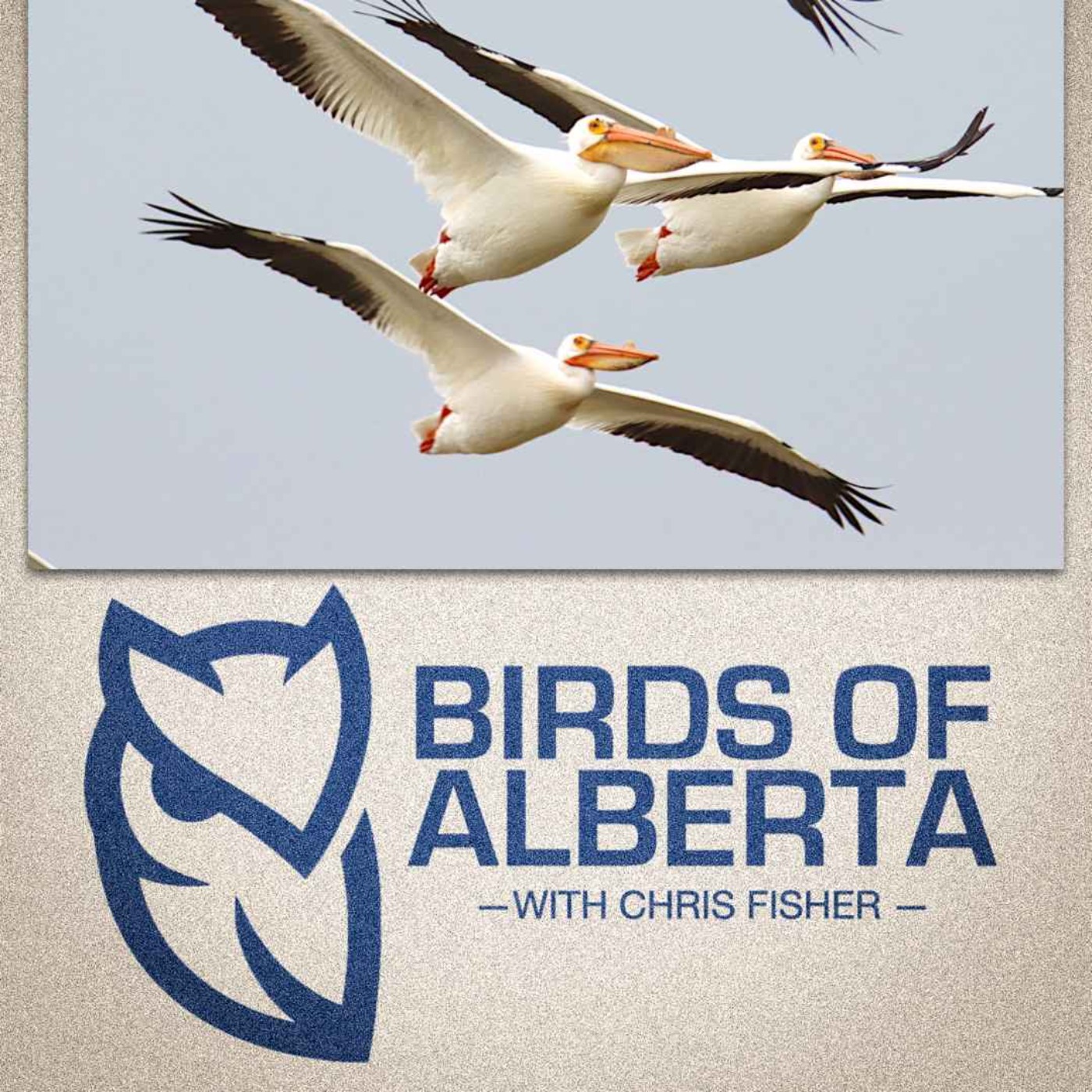
The American white pelican is a prominent and iconic bird in Alberta, easily recognized by its large size, white plumage, black wingtips, and long orange bill. Its striking appearance often reminds observers of dinosaurs, reflecting the scientific understanding of birds' evolutionary origins. A key adaptation is the gular pouch—a flexible, elastic throat sac used for catching fish and cooling the body, supported by a unique jaw structure (streptognathism) that allows it to expand dramatically, similar to baleen whales. Pelicans breed colonially on barren islands in Alberta's lakes, with significant populations at sites like Pelican Lake and Hayes Reservoir. Historically, they faced declines due to nest vandalism, DDT pesticide exposure (which thinned eggshells), and persecution by fishermen, but conservation measures, including seasonal wildlife sanctuaries established in the 1970s, aided their recovery. Culturally, pelicans appear in Indigenous traditions, early explorer accounts, and local place names, and were once featured in the Canada Life insurance logo. The story of "Elsa," a pelican that survived winter at Frank Lake, underscores their emotional impact on Albertans. Despite being portrayed as clumsy in media, pelicans are complex birds that inspire public interest in nature, serving as a gateway to birdwatching and symbolizing ecological resilience in the province.
[Music] Welcome to the Birds of Alberta podcast. I'm Chris Fisher, co-author of the best-selling field guide birds of Alberta. Now, we all remember our first time spotting them. For me, I was just out visiting a school friends family cabin on the shoreline of Laxante, just southwest of St. Paul and Central Alberta's Lake Country. Now, while I was not a hardcore birding kind of kid, well, not in the way that I have come to known so many of these kids over the years, but I was keen enough on nature that when I saw a few of these white wing giants skimming over the waves of the lake, the moment bird itself into my soon-to-ignite birding brain. While this was in the 1980s, long before the evolutionary proof that birds were, in fact, dinosaurs, but the distinctive arrangement of angles and wings and bills and neck can tell of these birds had me thinking of terrors. And I know I'm not alone in making this connection, it is a spark that fires off in the brains of all who see these birds. And I am fairly certain that the phrase "Flying Dinosaur" has never been applied more to any other type of bird and never more so than now, as the direct linkage between birds and pheropod dinosaurs, not the terrors I was thinking of, has never been so well understood by the scientific community and much of the general public alike. And so when we spot one of them flying overhead, especially when it flaps and morphs into a critatious shape with angular wings and a long and pointed snoot, even the most creationist-addled within the Bible button of this province can't help but explain, "Hey, look at that flying dinosaur." These large birds stand out from all others in the province. They are attention-grabbing, in-year-face, conversation starters that get people talking about nature and as such, they are top influencers among all the birds of Alberta. They are of course American white pelicans. Now to a birder and to beginner birders, particularly pelicans are the counterbalance to all our confusing impossible to identify fly catchers, sparrows, sandpipers, and fall warblers. No one misidentifies a pelican. American white pelicans are conspicuous indeed. They're large white birds with black wingtips and a long, orangy bill. They are as tall as an Ewok with a wingspan of LeBron James. Ask a preschooler to draw a pelican and the sketch you will get in return will be recognizable. The pelicans we see here in the province are an interesting blend, part cartoonish, part exotic, with a hint of melancholy flown in. They are projected socially around the world to be somewhat comical and clumsy. This is how they're portrayed in films such as "Find In Nemo" and "Little Mermaid". There are only eight species of pelicans found throughout the world. I've been fortunate to see about five of them. They all share a similar motif. The ones on the coastal regions tend to be gray or brown, whereas the inland ones such as ours tend to be mostly white. So it's definitely not the color or even the size of the birds that make them stand out. Point to one thing among the pelicans and you keep coming back to the pouch. See, pelican beaks are incredibly long and there is a flexible pouch that hangs below the lower jaw that allows them to of course capture their prey in the water. This design goes back 30 million years. There's been fossils found in southeastern France that so closely resemble the modern day pelicans that they all fall into the same genus. The pouch is very, very remarkable. Of course, the angles below the lower jaw. It does have elastic properties due to the skin being infused with all sorts of collagen. There's no feather on the pouch and it is riddled with blood vessels and nerves running through this scratchy skin so that the pelican can really feel anything such as a fish that enters the pouch so that it triggers its bill to snap shut. All those blood vessels also provide an important mechanism for temperature regulations being being very large birds while pelicans can overheat. They're usually sitting out in the sun. They don't favor shady situations all that much but they can flutter this vascularized pouch effectively in order to release a little bit of body temperature that does build up. This is a bit similar to the way that elephants flop their big ears backwards and forwards in order for those large animals to cool down. So a pelican's goolor pouch, as it is officially known, is very important not just to the look of a pelican but their very lifestyle. So every now and then you see them taking care of it. They can stretch it by extending it against their lower throat. This keeps it nice and flexible and healthy for the next time they go fishing. But the amazing bill of the American White Pelican does not just begin and end with the goolor pouch. It is in fact all amazing. The upper bill is mostly flat but does have a nice curved rounded tip that serves to keep the fish inside the bill if they're fortunate enough to catch anything. The lower jaw is very amazing unto itself. It's made up of two long bones that are amazingly flexible. They can bow outwards under pressure, for instance when the water gets caught into it, which dramatically enlarges the opening of the goolor pouch, which of course stretches to compensate for water that enters into it. The technical name for this jaw bending skill is streptopnathism and it is a very odd in particular adaptation indeed. But amazingly enough, it's something that shared with another group of unexpected type of animals, the Bolleen whales. You see, both pelicans and Bolleen whales have large jaws but those jaws only encompass about 25% of their total body length. Both of them have these soft, stretchy tissues on the floor of their mouths, the goolor sack, of course, in the pelicans. And what's called the ventral groove blubber that is found in whales. Now, when both of these species feed, they can take in massive, massive volumes of water containing, with any luck, their prey. And this stretchy tissue used during the feeding process will increase a whale's body volume by almost 50%. But for pelicans, their body volume can increase more than 100%. American white pelicans, of course, are large and in conspicuous birds, so it's no surprise that first nations across North America had attributes for them from medicine and weather forecasting to being teachers of humility. Now, when the first European explorers came through the region, didn't take them very long at all to find American white pelicans in parts that have now become the province of Alberta in 1789. Sir Alexander McKenzie found the breeding colony on the, what is now known as the slave river on his way to the Arctic Ocean on that river that now bears his name. That colony that was identified back in the 18th century persists to this day at the small town of Fort Smith right across the Northwest Territory in Alberta border at 60 degrees north. That's a funky little community that was established along a portage route that was required to go around the very rapids and rocks that the pelicans called home. There are of course other place names in the province that are named after pelicans. Most of them are found in the northern parts of the province. There is Pelican Island, there's four pelican islands, there are three pelican lakes, there is a pelican portage, a pelican mountain and even a pelican river and close to Stettler, Alan Buffalo Lake, there is a fairly well known pelican point not far from a breeding colony in central Alberta. So unlike many birds that go off
and nest individually, Pelicans are very social, and they literally put all their eggs in one island basket. They breed on barren islands, mostly, in large lakes throughout the province, and these can be quite globally significant as Alberta represents a fairly generous portion of their summer range on the great plains and prairies of North America. A typical breeding colony, a large one, for instance, up at Pelican Lake, can have as many as 2000 young on one single colony up near Wabisca. There's other colonies in those areas that have lakes with large uninhabited islands on them. The south, perhaps the largest colony, is on Hayes Reservoir, not far from Brooks, Alberta, and that particular colony has a population that represents almost 4% of the entire species, global population, so that obviously is very important as well. Pelicans are so prominent, many of the early naturalists in the province made note of the locations of many of the colonies, and unfortunately some of these colonies no longer persist to this day. There was one at North Micallon Lake, not far from Camros, that was identified by legendary ornithologist Frank Farley, over 100 years ago. There were some at Oliver Lake, Lacklabish, had them then lost them, but has them back again, even in the South Lake Newell, had them at one time, and that population has come and gone several times, Beaver Hills Lake, near Toefield, has had them in the past, Utica Malay, Pelican Lake, Namor Lake, Slavery of Rapids, of course, Utica Malay. These are persisting colonies that are very important to the overall Alberta population, the reproductive population in Alberta. Many of these colonies, of course, are on large lakes, but they tend to be relatively shallow water depths, between 6 and 20 feet, and often quite near to the shoreline. The waters tend to be a little bit cloudy. There is essentially non-vegetated islands, when which they nest often with sand or soil surface, very few trees or bushes on these islands to speak of. The island must be high enough, but it still must be high enough for the pelicans to be able to walk into it, but high enough so that the tallest waves don't crest over the island and wash off any nesting opportunities such as eggs or baby chicks. These islands, in part, are some of the reasons why their population declined so much. So years ago, you see American white pelicans, of course, are fish eating birds, and that brought them as a regular target in criticism for commercial and sport fishermen who thought that they were primarily responsible for the decline of fish stocks. So being conspicuous breeders on these islands, well, these vandals could easily enter these colonies and in fairly short order, destroy nesting colonies, entire nesting colonies. That were fairly accessible by boat for some of these naturalist vandals. Now because of a pelicans association with eating game fish, this is one of the reasons why they were excluded from the groundbreaking conservation legislation, the Migratory Birds Convention Act, or convention treaty that was signed in 1917 for the first time between the United States and Canada. And in fact, extending all the way to today, they are still not protected by that bit of legislation, however, they have since been protected by provincial and state legislation throughout North America. The fate not only of pelicans declined as the result of a nest vandalism, but also by organochlorians such as DDT, which is, of course, most famously associated with the decline of raptors such as Paragon Falcons and Bald Eagles, but this pesticide also accumulated in fish as it entered into lake. And river systems and that caused the thinning of pelican eggs just as it did cause the thinning of raptorial eggs. So these eggs were crushed by the weight of incubating adults and by the 1950s and 1960s that also led to a decline in the productivity of pelicans such that when DDT was officially banned in Canada. And by the mid 1970s that contributed to one important step in the conservation and recovery of pelicans throughout North America. By the mid 1970s there was important local Alberta-based solutions that were being proposed to benefit the conservation of American white pelicans. Seven breeding areas were designated seasonal wildlife sanctuaries under the provincial wildlife act making it illegal to enter or even approach these islands. And that certainly led to a greater recognition and appreciation among Albertans to the benefits of American white pelicans. And there are certainly more pelicans in Alberta today than there were certainly 100 years ago and many of their breeding colonies that have been established in northern Alberta's around our large lakes and reservoir. Their distribution in fact is probably greater now than it has ever been. Even the presence of invasive fish which is known to be an ecological calamity for so many reasons might have a very thin silver lining as pelicans don't seem to mind the taste whatsoever of prussian grass carp. Now in spite of being so recognizable it's a bit surprising that pelicans are not more widely used as icons or even corporate brands. Now this may be something to do with their somewhat clumsy and whimsical attributes. But there is of course a Canadian exception to this or at least there was and that is of course Canada life which is a major insurance provider. Based out of eastern Canada out of Toronto and the Hamilton area where it was founded in 1849. Now there aren't really any breeding populations of American white pelicans out in the Great Lakes region. It is kind of a western Canadian thing so we'll set aside our little bit of western resentment for that because they did feature for almost over 100 years. A logo in a coat of arms depicting a pelican. Their first logo had a pelican feeding four young and the reason for that it was a medieval symbolism of charity and devotion. Harking back to pelicans that occur in Europe at least. So this was the symbol used for many many decades by Canada life. However it became a little bit more appropriate biologically as pelicans never have four young. So they corrected this. Agregious affront to their pro-curative prowess and updated the one that I became familiar with with a logo that fed two young. And in fact American white pelicans are the very ones that nest in Alberta do lay two eggs. However one of the unfortunate and emotionally distasteful acts of American white pelicans is that the young that tends to hatch. First tends to get most of the food in almost every situation leaving a very weakened and young one very vulnerable to not only being not fed but also something called "cibless side" which is an unfortunate thing that sees the older stronger young often killing its younger nest mate. Well that's probably not the reason why Canada life insurance abandoned their logo for the next generation.
featuring Pelicans in the year 2001. They now have a logo without any Pelicans. It's just a cursive expression of the Canada life name, but I predict in the future, if my kids are any example of the future, they don't learn cursive writing, they can't read cursive writing, so Canada life may have to abandon this 21st century logo and who knows, maybe the Pelican will make a comeback in the decades ahead. There is really no doubt that Pelicans do hold a bit of a special place with people and perhaps the best local example of that is with Elsa in the year 2022 and 2023. See, John Reesback is a retired, a birder and naturalist and photographer and we spent quite a bit of time in and around Frank Lake and noticed that there was a certain American white Pelican that did not fly off in the fall of 2022 with all other Pelicans that spend the summer at that very popular birding destination. He started posting about this obviously injured Pelican and garnered quite a bit of notoriety, John would continue to go check in on this Pelican through the coldest winter days. Now the gates locked at Frank Lake, so John would have to walk in quite some distance to where the Pelican was hanging out. Near the outflow warm water discharge, so whereas most of the lake froze solid, there was this small patch of open water where the Pelican hung out and fortunately where a whole bunch of fish, these invasive, prescient cart mostly hung out as well. So there was plenty of food for the bird to eat in spite of the very cold temperatures. Over a series of visits and right ups, John eventually nicknamed this bird Elsa, no doubt influenced by grandchildren, who watched the Disney movie Frozen as the main character. Elsa was a queen of the cold because and sang the very famous lyric that cold never bothered her anyways. He was said to say I wanted to see how this Pelican can survive in winter conditions and one thing led to another and he started doing these visits out to Elsa, every three or four days throughout the winter and documented quite beautifully and poetically the Pelican's ability to survive the coldest winter days of the winter and in fact Elsa made it all the way to the spring and in fact greeted the returning Pelicans that came to summer at Frank Lake. This of course was a great interest not only to John but to many of the loyal readers that followed him on social media, particularly the 100,000 members of the Facebook group Alberta Birds. Eventually John would turn all his writings into a nice self published book and that of course was a great interest to many of the followers but really what this story reveals to me mostly above all else is not necessarily the individual drama that a single bird can endure although that is very compelling no doubt. The most striking thing is how nature and particularly an emotional impact of an individual bird and how that can provide importance into the lives of Albertans and we see it time and time again but most notably between Elsa and John we have seen perhaps our most recent widely known communion and connection and reliance between wildlife and a dedicated Albert. Now aside from the cartoonish nature of Pelicans that has entered the main state of the North American public there is also one other thing that many of you have been thinking about during the course of this long podcast and that of course is the poem. Pelicans may be the subject perhaps the most famous bird poem there is it goes as follows. A wonderful bird is the Pelican. His belly can hold more than his belly can. He can take in his beak enough food for a week but I'm damn if I see how the he'll. Well that poem was written by a newspaper copywriter by the name of Dixon Lanier Merritt. Oh back in 1913 and it serves as one of the best known bird lemurics ever put to paper. Now old Dixon while he was from Tennessee and there aren't too many. Pelicans that hang out in Tennessee so I thought as an Albertan someone who was grown up with Pelicans that I could perhaps offer. In the Dixonian spirit of a bird poetry my own lemuric on the American white pelican. A pelican group on a lake were trawling up fish in one take with their beaks like a scoop. They'd heard chasing loop then float in the sun on a break. The American white pelican stands out as one of the most intriguing birds in the province of Alberta. It is, it's a breakthrough bird. One that even non-bird watchers tend to notice on our lakes and rivers and this just gets people into birds. Pelicans provide a huge payoff and kick most of our early birding efforts into a whole new high gear. See pelicans are big and this size is easily appreciated as the birds tend out to be too too skittish. When you see one you usually can enjoy them for a few minutes before they fly or float away. But pelicans are complex and they can be very showy but they can also be quite secretive. You could spend your summers practically in daily contact with pelicans but spend your entire life without ever seeing them on their nest. So it's been really kind of nice digging into Albertan's pelicans for this episode. Not only are they a bit of a celebrity in our birding world but it's been really great looking into our own past history with this bird because you can't help but feel a little bit of optimism. You see they were in pretty serious conservation trouble back in the 70s and these concerns were being raised by Albert's wildlife managers at the time about their future and well-being. But these managers did have a vision and they thought that if Albertans just gave our pelicans a chance their numbers could well recover because this province has everything that pelicans need. Well it turns out that 50 years on these biologists were right and prophetic and today the pelicans, well they loaf in full view of many of us in our community lakes in our larger cities and they soar in groups high above us on summer days. And how could seeing these things not make us feel good about these birds and a little bit about our lives as well. Pelicans, they can sometimes reveal inner truths about ourselves. You see like those weird rosharts tests that are designed to reveal personality characteristics based on viewers perceptions of art, well perceptions of pelicans from around the world and through the centuries have projected onto them die-metic traits, both melancholy and strength, sacrifice and protection, transformation, dignity, humility and generosity. So this may be why we continue to marvel at these great birds to this day. Maybe more than all others, the attributes and emotions that we assign to them, well these reveal and reflect whatever inner feelings we are dealing with at the time. A pelican may be our avian psychologist and it facilitates the gift of introspection that is awfully valuable among the birds of Alberta.
Podcast Summary
Key Points:
American white pelicans are distinctive, large birds in Alberta that evoke a "flying dinosaur" appearance due to their angular features and evolutionary link to theropod dinosaurs.
Their most notable physical trait is the gular pouch, an elastic, vascularized throat sac used for catching fish and regulating body temperature, with a unique jaw adaptation (streptognathism) shared with baleen whales.
Pelicans are social breeders that nest on barren islands in Alberta's lakes, facing historical threats from nest vandalism, DDT pesticide effects, and persecution by fishermen, but have recovered due to conservation efforts like seasonal wildlife sanctuaries.
They hold cultural significance, featured in Indigenous traditions, early European exploration records, place names, and even corporate logos (e.g., Canada Life), though their portrayal in media often emphasizes clumsiness or whimsy.
A notable local story involves "Elsa," an injured pelican that survived winter at Frank Lake in 2022-23, highlighting the emotional connection between Albertans and wildlife, and symbolizing resilience and public interest in nature.
Summary:
The American white pelican is a prominent and iconic bird in Alberta, easily recognized by its large size, white plumage, black wingtips, and long orange bill. Its striking appearance often reminds observers of dinosaurs, reflecting the scientific understanding of birds' evolutionary origins. A key adaptation is the gular pouch—a flexible, elastic throat sac used for catching fish and cooling the body, supported by a unique jaw structure (streptognathism) that allows it to expand dramatically, similar to baleen whales.
Pelicans breed colonially on barren islands in Alberta's lakes, with significant populations at sites like Pelican Lake and Hayes Reservoir. Historically, they faced declines due to nest vandalism, DDT pesticide exposure (which thinned eggshells), and persecution by fishermen, but conservation measures, including seasonal wildlife sanctuaries established in the 1970s, aided their recovery. Culturally, pelicans appear in Indigenous traditions, early explorer accounts, and local place names, and were once featured in the Canada Life insurance logo.
The story of "Elsa," a pelican that survived winter at Frank Lake, underscores their emotional impact on Albertans. Despite being portrayed as clumsy in media, pelicans are complex birds that inspire public interest in nature, serving as a gateway to birdwatching and symbolizing ecological resilience in the province.
FAQs
They are large, conspicuous white birds with black wingtips and a long orange bill, often described as 'flying dinosaurs' due to their distinctive appearance and evolutionary link to theropod dinosaurs.
They use a flexible pouch below their lower jaw, called a gular pouch, to scoop up fish and water while feeding, thanks to elastic skin and a unique jaw adaptation called streptognathism.
They breed colonially on barren, non-vegetated islands in large, shallow lakes throughout the province, such as at Pelican Lake and Hayes Reservoir, which host globally significant populations.
They were historically targeted by vandals and fishermen, and suffered from DDT pesticide exposure, which thinned eggshells, but protections and bans have helped their populations recover.
They flutter their vascularized gular pouch to release excess heat, similar to how elephants use their ears, as they are large birds that can overheat while sitting in the sun.
They have inspired place names, local stories like that of Elsa the winter-surviving pelican, and even corporate logos, reflecting their special place in the community and history.
Chat with AI
Loading...
Pro features
Go deeper with this episode
Unlock creator-grade tools that turn any transcript into show notes and subtitle files.
 PodcastTranscript AI