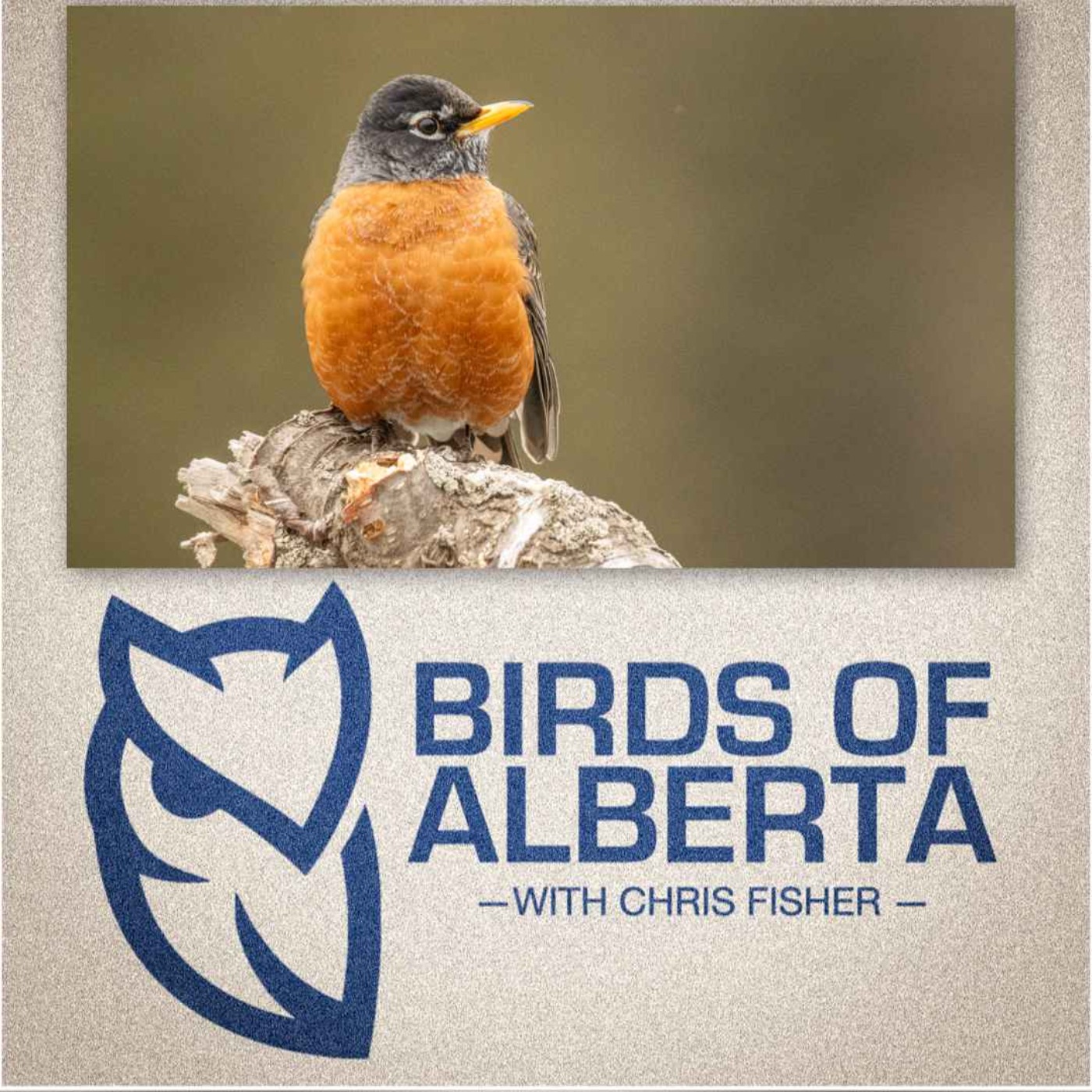
The podcast highlights the deep connection between birds and human well-being, with the American Robin serving as a prime example. Birds have been important cultural symbols throughout history, from ancient myths to modern music. The American Robin is exceptionally abundant across Alberta and North America, familiar in both cities and remote forests. It is visually and vocally distinctive, with males having brighter plumage. Robins often raise two broods per summer, nesting near humans and providing close observation of their life cycle. Their diet includes worms, fruits, and berries, and they exhibit unique behaviors like "anting." The name "robin" originated from English naming traditions and was applied by early settlers. Ultimately, the American Robin is celebrated as a "spark bird" that fosters an intimate, joyful connection to nature, marking the seasons and enriching daily life through its pervasive presence.
Welcome to the Birds of Albert, a podcast. I'm Chris Fisher, co-author of the best-selling field guide, Birds of Albert. Now our world is a better place with birds in it. And I think that we are also better off as humans, the closer we get to birds. More and more, we are understanding the physical and mental health advantages that there are when spending time outdoors and while we are out there, birds play an outsized role in catching our ears and eyes and sparking our thoughts. And while we might now understand more than ever that birds can play a part in our prescription for happiness, it would seem that there's always been an understanding that birds were always a special part of our living planet. These stories from the ancient Greeks have helped inform stories of all of Western civilizations and one of their most important and meaningful myths involved Icarus and Deadlyz, remember that they took flight with wings that were made of bird wings. This story has been an inspiration to art and has been imitated for over 3,000 years. And it isn't alone. The Ibus and the Falcon, while they are common in Egyptian hieroglyphics, symbolizing Toth, the God of Wisdom and Horus, the God of Kings. There's obvious connections between birds and angels in Judeo-Christian cultures. The best among us seem to be granted wings for eternity. Ugen and Mune, well they were a pair of ravens that served under the Norse god Odin, and in China cranes and starks are commonly depicted in historical art forms representing well deference, ambition and nobility, while in Europe these same birds represent renewal and fertility. And in our area of North America, well there's a deep meaning of a gifted eagle feather in blackfoot culture and it rings as true today as it did in pre-colonial times. Birds? Well they're even injected into our modern Canadian culture as well. The choice of a bird is more than just a little allegorical when Ann Murray sings about the snowbird or when Cylindion sings about Ine-Colomb. Birds are just so much part of our lives and they have been used for millennia as cultural symbols to represent an entire spectrum of the human experience from birth to death, happiness to melancholy, hope and dread, prosperity to greed. But for the most part, birds have served primarily as symbols of good and uplifting things. And for all the warm vibes that we get from all our birds, there is one particular type of bird that connects us all here in Alberta and throughout North America, owing to its ubiquitous presence and familiarity. It is the archetype of birddom, whose sightings and soundings are so much part of our reality that we rarely take time to really appreciate how exceptional such an everyday relationship can be. And if there had to be just one front burner bird for us here in Alberta, we could not have asked for a better avian neighbor. It is abundant, well-known, admired, cared for and. If this were indeed possible, I'd go as far as to say that it is the most perfect of the birds of Alberta. The American Robin. Now here in Alberta, like elsewhere in North America, American Robbins are near ubiquitous. During the summer months, they are found all over the province. And I really mean all over the province. There is likely no quarter section in Alberta that doesn't experience Robbins for at least a brief period of time. They nest in every single Alberta city, town or even Hamlet. They are on every farm, city park, and neighborhood, and every provincial park from those in the badlands, up to the parklands, to the forestlands of the north, you know, the population of Robbins vastly outnumber the populations of people here in this province. In fact, they are one of the most abundant birds in all of North America with an estimated population of 370 million adult birds, with about half of that occurring in Canada, about a third of that number, more than 100 million individuals likely breeding in the boreal forest sweeping across northern Canada and Alaska. You know, even at several points during the spring and fall migration, even in the heart of our largest cities, Robbins will appear to be the most common thing around. You'll find them in every backyard, on every berry tree, on rooftops, in every parkland, throughout your very own neighborhood. These fallouts occur even more significantly right following significant storms, particularly in the spring, but sometimes also when there is an early storm in the fall as well. They start to arrive by mid-March in southern Alberta, usually with the males arriving first, with the females typically following a week or so later. They spend the entirety of the summer breeding close by and nearby, but also in distant places in remote forests of Alberta. Do breeding bird surveys as I have done from one end of the province to the other, you hear them calling and singing from my back deck, but also along remote roads that pierce the boreal forest and even on distant hikes up in our mountainous areas. Here they stay for our warmer bits, but by late November after quite frankly most of us taking their immense numbers in presence for granted for near six months. Well, by that time each and every sighting becomes a little bit noteworthy, particularly as the calendar flips over into December and the last few stragglers of our summer robins depart for southern areas. Well American robins are so familiar for us here in Alberta that it really takes a short description to talk about their look and what they sound like, but the closer you look at them you'll start noticing slight differences. For instance, not many people realize that males and females look a little bit different, just a little bit different. They're not as sexually dimorphic as many of our songbirds, but they are slightly different. The males typically have a little bit brighter of a chest, a little bit more reddish, kind of like the color of tomato soup, but the main difference is seen on the head. If you had a close look, the males will have a darker, almost a blacker head, whereas the female's head is a little bit more ashy gray, that brighter chest on the male like all vivid color forebirds is just a bit of a flex for the male muscle. It kind of shows off that it is a very capable and strong breeder with these darker heads and these darker underparts. Young robins of course, as they leave the nest, look similar to their parents. They're about the same size and certainly the same shape, but their chests are quite different. They're quite a bit spotter with only hints of the reddish orange that kind of burst through some black spots. Now their songs and their calls are well just as familiar as their looks and we're really grateful throughout our neighborhoods in our urban areas and in our rural areas in our final farm yards that we have these spring songs, equine across the landscape. It is a pretty loud voice. It's really pretty impressive that it's produced by something weighing no more than a tangerine. And it's song, which is the utterance of the male and the male alone is kind of a very distinctive cheer up cheer up cheerlead. Well aside from the beautiful and distinctive courtship songs of American Robins, they also produce quite a varied series of calls and these calls are typically in response to perceived threats whether they come from us while we're walking around our backyards or magpies flying on through their territories or small fox. They've got a lot of talking to do and they're not shy about doing it. Now while there are many birds, songbirds in particular that spend a lot of time in our backyards, really the prototype.
of that is the American Robin. They of course do nest in backyards as they nest in wilder areas as well. But really it is in the backyard that we really get a special insight into the life of a bird, you know, in the early spring. The males will arrive and start establishing themselves in familiar territories and the action really heats up when the females arrive. The males will certainly recognize and start puffing and singing a little bit more prominently when the females are around and they'll even fly to potential nest sites and let her around them like an over-eager real estate salesperson to show off potential areas where the pair can build a nest. For reproductive needs, the female Robin will obviously make the final call on the site and mud and grass, the very familiar mud and grass nests that we see built on eaves and elsewhere in our close proximity is built primarily by the female and then of course the female will lay four to five distinctively blue eggs. Now that teal blue color is so distinctive even that the luxury brand Tiffany was so inspired to use it for their trademark gift boxes. The female will incubate on this nest for a couple of weeks and then when the nestlings hatch they are fed by both parents ideally and after another two weeks or so the birds will fledge and fly off and usually at the tail end of that time period that's when we see those young spotted young hopping around our yards sometimes on the ground sometimes in low bushes and they can be particularly vulnerable in that time of year. Now American Robbins they really seem to know that our summers are really really brief and it's kind of easy to miss the baby bird time or even the blooming flower time so I'd like to think that that really it's for our benefit that normally Robbins will have a second round of babies after the first batch have flown off and this way American Robbins can treat us to their parenting skills well way into the summer vacation season just a little bit longer than many of our single nesting songbirds elsewhere in the province. What we like to think of American Robbins is urban birds that's a bit of a bias since we typically live in urban areas in association with that but they can live in more remote areas and forested areas they're quite commonly found typically in forested areas that have a little bit of open areas closely associated close forest is something that entirely to their liking and of course they've been around this part of the world for tens of thousands of years even when the glaciers pushed down all the way down into the United States about 20,000 years ago it's likely that American Robbins obviously were perched south as well and as the glaciers receded that didn't leave a lot of soil in this part of the world it took tens of thousands of years from that soil to reform so while Robbins were around at that particular point in time they probably weren't eating a lot of what we commonly associate them to eat which is earthworms in fact without top soil in those millennia after glaciation they were probably eating very few earthworms and one of the interesting things is most of the earthworms that we find around in our top soil today are in fact arrivals from Europe so they certainly have a capacity and historically would have eaten a lot of native invertebrates whether they're invertebrates larvae like caterpillars and other types of grubs they can certainly feed on adult invertebrates as well and certainly later in the summer and into the fall and even into the spring as we see from our ornamental plantings Robbins take a big fancy to fruits and berries that are common in ornamental plantings nowadays but of course are also quite common in natural settings as well they tend to prefer to forage in short grassy areas to be able to detect predators so it's probably a safe assumption to speculate that they evolved in tandem with some of the major grazers like bison certainly but also horses and mammoths that previously existed and it's likely because of their strong association and proximity to our backyards that we associate Robbins and worms so very strongly and so many people think when they see that Robbins running through the short grasses are hopping through longer grasses and cocking its head that it's in fact listening for worms because that's how we would be listening for worms but in fact their ears are not so good they're in fact looking for worms and Robbins do not have binocular vision are very good binocular vision like we do we have eyes basically on the same side of our heads as a potential prey species Robbins have both eyes economically placed on either side of their head so they can see a bigger sphere around them so they have to choose when they are looking up close whether they're right eyeed or left eyeed and it's still amazing of course that their eyesight is that good that they can see a subsurface worm wriggling through the topsoil of course worms aren't the only thing that they eat they'll eat fruit of course that are planted in our ornamental areas that in fact are very very important ecologically for these birds and while city planners probably didn't envision this ecological importance of planting sugar cherries and choked cherries and crab apples throughout our cities and towns it is in fact become a very important food source for Robbins and other birds throughout the months where insects aren't quite so available other behaviors that are particularly interesting to Robbins and observable for us because they are so close to us something called Antine well if we want to go to a spa we'll rub minerals and oils and have them the sauce will birds luxuriate in a different fashion altogether Robbins and sometimes flickers will find a crawling ant pile on the ground sometimes even in your own backyards they will stand and spread their wings right above this and allow the ants to crawl all over them leaving hints of formic acid in their feathers and this is called Antine and it is in fact a real and observable thing that we can see during the summer months lastly one other behavior that is fairly regularly encountered particularly in late april our early may when males are at the peak of their breeding frenzy is when a male American Robin sees its reflection in a mirror or more typically a window pane and it thinks it's its rival male moving about in its home turf well the hormones are so high in these springtime birds in fact they're they're gonads there's testes shrink during the winter months but by april the organs have increased in size 1000 fold so they are swirling with testosterone and fighting vigor and they will launch into an attack on their own very reflection and try to defeat that rival even if they only end up banging against a pain of unmovable glass the american robin is one of the best known bird names in the world as well but before it was called an american robin the bird was known as pipitju by the kree and pipitju it sounds a little bit automatic pique to me and boy i'd really like that to be the case that it was named after it's very distinctive call now american robin as many people will know as it's been widely shared throughout bird literature is named after the eurasian robin for which it is not commonly associated and it is a very distant relationship between those two birds and i discussed a little bit of that fun nomenclature taxonomy puzzle in episode 16 of the bird's developer to podcast when we talked about the red wing black bird so i invite you to revisit that podcast for a nice little run on the strange naming of north american birds being inspired by european birds but there's also a really cute story to the
name Robin itself, see prior to, well prior to even Shakespearean times, the English had a really oh so cute habit of giving sweet human names to the birds that lived most commonly around them. And that is why there was a Willie Wagtail, a Philip Sparrow, a Polly Parrot, Tom Titt, and even a Jenny Ren. Well, most of these bird names have long since been forgotten, but even today, there is legacy of those names in the word magpie. It's actually short for Maggie or Margaret. Now most famously, the English also gave their ubiquitous and beloved orange bellied tennis ball of a bird, a human name. See the first recorded Anglo-Saxon name for what we now know as the Eurasian Robin was a Ruddock, meaning the little red one. Now by the medieval period, its name evolved to Redbreast from Ruddock. And during this period of cutesy English common name, well it became known as Robert Redbreast, but then that Robert morphed into the popular Tudor nickname, Robin. And so there we have it. Robin Redbreast came to be, and eventually the Redbests was dropped all together because it kind of seemed a little redundant. And of course as English settlers and English scientists, biologists began arriving in North America in the early 1600s, they made sense of all the new things they were seeing on this continent by giving the names of the flora and fauna that they previously were familiar with back home. And the English of course didn't just propagate the the term Robin here in North America, but throughout the lands they colonized. And today more than a 100 birds carry the common name Robin. But while much of the rest of the colonized world has Robin Chats and Magpie Robbins and Scrub Robbins and Bush Robbins, here in Alberta we only have one very distinctive very well known bird that carries the Robin name. We are just plain lucky to have as one of our most familiar and loved birds, the American Robin. It is it is visual distinctive, vocally soothing, and unusually approachable. And most joyfully, you know they insert themselves into our lives, whether it's while nesting on the front porch, on the farmhouse, or at the work site. It is the bird whose live we watch in full HD through our kitchen windows. We thrill. We thrill at their arrival, delight in the early bird sing songs. We take care when they nest on our downspouts, eaves and shrubs, and we are emotionally invested when a magpie arrives to steal their eggs or even their egg color. Yes, even their egg color is so well known that Robin's egg blue is a shade available at the paint store or candy shop. And when we ask children what do birds eat? They undoubtedly say, well, well birds hop around on our front lawns and they eat worms. And the early bird that catches that worm, well it undoubtedly is a Robin. Robin is the first bird we hear in the cradle, and the last one we hear in hospice. And because of all of this, the American Robin is not only a bird that is familiar, it is a bird of the family. We watch baby birds grow day by day until they leave the nest. Their first tentative flights to safe areas nearby and eventually we watch the young leave. And for many of us winter truly begins when the Robin's leave and spring begins upon their return. They are the spark bird that ignites within us an acknowledgement of the natural world around us and provides an intimacy that simmers a greater love of nature. Robbins, through the course of our seasons, hold up a mirror to our lives and play a transcendent role among all the birds of Alberta.
Podcast Summary
Key Points:
Birds, especially the American Robin, significantly enhance human physical and mental well-being and have been profound cultural symbols across civilizations for millennia.
The American Robin is exceptionally abundant and familiar across Alberta and North America, thriving in both urban and wild settings, with distinct behaviors and a notable two-brood breeding season.
Its name originates from English settlers who applied familiar European bird names to New World species, evolving from "Robert Redbreast" to "Robin."
The robin's life cycle, from nesting in human-made structures to its diet and unique behaviors like "anting," offers intimate insights into nature, making it a cherished "spark bird" that deepens human connection to the natural world.
Summary:
The podcast highlights the deep connection between birds and human well-being, with the American Robin serving as a prime example. Birds have been important cultural symbols throughout history, from ancient myths to modern music. The American Robin is exceptionally abundant across Alberta and North America, familiar in both cities and remote forests.
It is visually and vocally distinctive, with males having brighter plumage. Robins often raise two broods per summer, nesting near humans and providing close observation of their life cycle. " The name "robin" originated from English naming traditions and was applied by early settlers.
Ultimately, the American Robin is celebrated as a "spark bird" that fosters an intimate, joyful connection to nature, marking the seasons and enriching daily life through its pervasive presence.
FAQs
The American Robin is a ubiquitous and beloved bird in Alberta, symbolizing the arrival of spring and playing a key role in local ecosystems. Its familiarity and presence in urban and rural areas make it a cultural and ecological icon.
Male American Robins typically have a brighter, reddish chest and a darker, almost black head, while females have a more ashy gray head. The differences are subtle but noticeable upon close observation.
American Robins primarily eat earthworms, insects, and fruits or berries. They forage in short grassy areas, using their eyesight to detect prey, and rely on ornamental and native plants for food sources.
American Robins start arriving in southern Alberta by mid-March, with males usually appearing first. They depart by late November, with stragglers leaving in December, marking the transition to winter.
American Robins build mud and grass nests, often on eaves or in shrubs, with the female primarily constructing it. They lay 4-5 distinctive blue eggs and may raise two broods per summer, with both parents feeding the young.
The name 'American Robin' was given by English settlers who associated it with the Eurasian Robin due to its reddish breast. The term 'Robin' itself evolved from medieval English nicknames like 'Robert Redbreast'.
Chat with AI
Loading...
Pro features
Go deeper with this episode
Unlock creator-grade tools that turn any transcript into show notes and subtitle files.
 PodcastTranscript AI