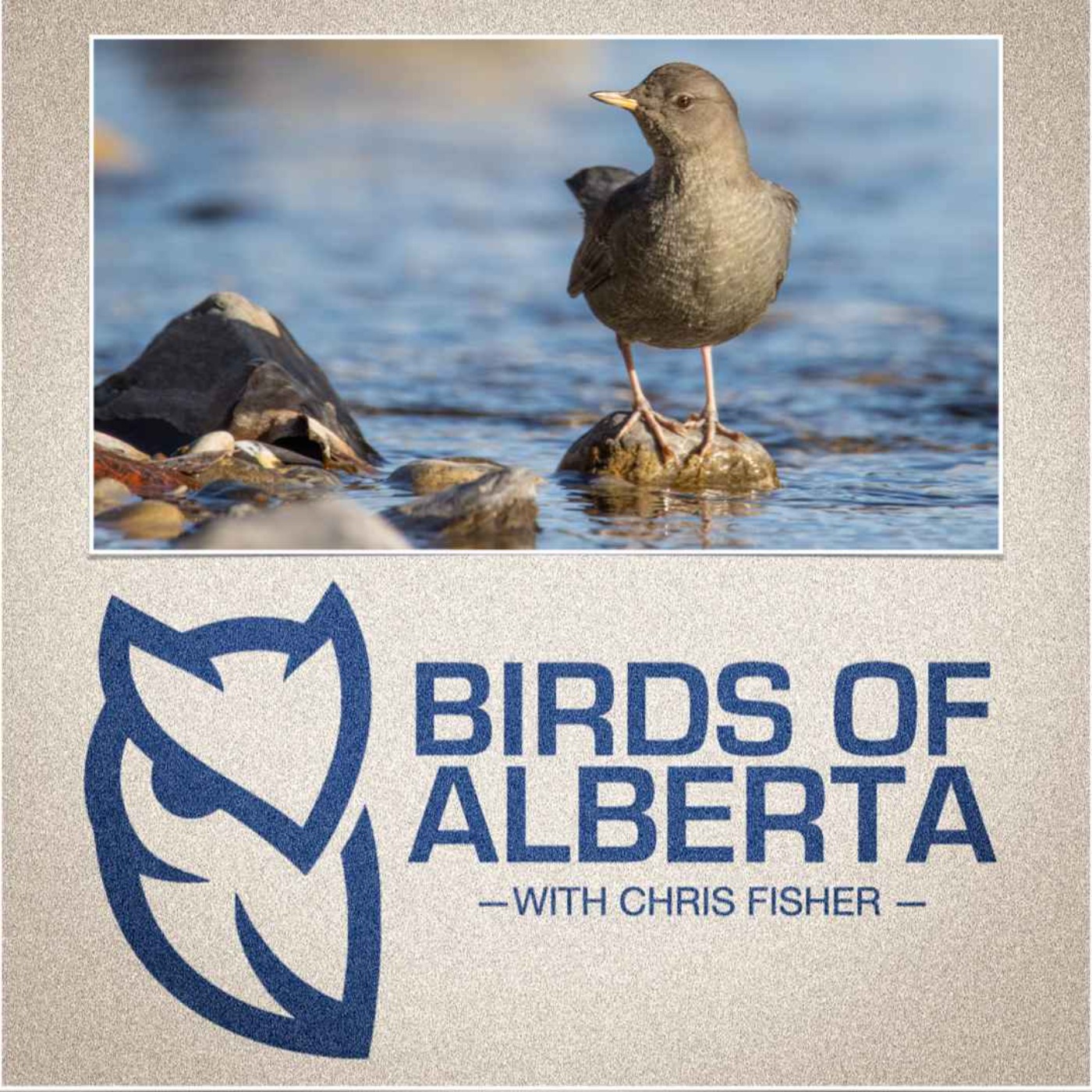
In this podcast episode, host Chris Fisher shares an anecdote about birding with a biologist from Florida, leading to a discussion on the American Dipper, a bird he considers Alberta's top avian attraction. He describes the Dipper's unique behavior, such as diving into cold, fast-flowing rivers year-round and its distinctive bobbing motion. The summary includes insights from naturalist Ben Gadd, who poetically details the bird's habitat in mountain rivers and canyons, and references research by Dave Ealey on nesting and migration patterns. The Dipper's physical adaptations, like waterproof feathers and a compact body, enable it to thrive in harsh conditions. Fisher emphasizes the bird's appeal to birders and outdoor enthusiasts alike, noting its energetic presence makes it an ideal species to introduce non-birders to the wonders of Alberta's natural world.
Welcome to the Birds of Alberta podcast. I'm Chris Fisher, co-author of the best-selling field guide, Birds of Alberta. Now, a few years back, I was working on a very large industrial project that required biologists, not only from Alberta, elsewhere in Canada as well, but actually also from around North America. And it wasn't long until I was spending quite a bit of time alongside a fellow biologist named Adam who was from Florida. He was a big time birder like myself, and I must have impressed him early one morning when driving to work in the pre-dawn hours. He asked me about seeing a great gray owl. And since we're driving through the southern boreal, I confidently equipped that we might just come across one at any time and well sure enough, as luck and a lot of luck at that, would have it a few minutes later, I pointed out one of these grandest of owls on a fence post to Adam, and he had his life a bird. And I guess a reputation as an ornithological nostradamus. Now as the project was drawing to a close, Adam was looking at extending his time here in Alberta to do some birding for things that he really had no chance of ever seeing in his home state. So I drew up a map of targeted bird stops and stunning drives for him to maximize his remaining time here. And doing this had dawned on me that that both Adam and I saw our first cherished North American field guides the same way, although through very different eyes, as I thumbed my golden guide to the Birds of North American in the early 1980s, I used to linger on the pages, containing the herons and egress and the enhingas and the frigate birds, really these birds were unlike anything that had flying around my neighborhood and left bridge. From where I lived, they're very existent, seemed implausible. The birds I knew didn't look like that or do those things. These birds were exotic and seeing them was unattainable, living to a kid on the frozen flanks of the Great Plains. Now Adam would have been doing the exact same thing, although growing up on the Gulf Coast of Florida, it wasn't the birds of the mangroves and the salt marshes. Instead, it was those of the deep wilderness of the Canadian North that caused him to linger and dream. So as Adam checked in with me the day before he would return to Gainesville, he happily checked off his exotics that he had added to his hit list. Not only he had the Great Gray, but also he managed to get a rosy finch and a tarmigan and then one other that he would convincingly describe to me as the five star target among all the birds of Alberta and that's the American Dipper. Well the wonders of the American Dipper, well they're not very well served in the pages of a field guide or birding app even. There tends to blur into the big songbird mix, but to anyone who has ever seen one in the mountains, the American Dipper is really one of a kind. Their behavior and their home turf is quite like none other. So I was thinking who in Alberta could best describe them? Why it would have to be Ben Gad of course. A man also like no one else. He's a master storyteller, a sage, he's admirably witty and like the Dipper itself, Ben Gad is also of our mountains and his massive self-published when that was a huge and novel idea. His magnus Opa and probably the greatest natural history publication in Alberta's history is of course his handbook of the Canadian Rockies. It's really it's really the go-to scientific reference for that area of Alberta, but it's also something that emotionally connects us to this very special area and Ben's description of the American Dipper is pure perfection. It drills in flight and sings beautifully arrest, cheaping, buzzing, whistling and warblings. It does so all year round. I'll be skiing up a snowy frozen stream on a deathly cold day in January when the song erupts. There at a small patch of open water is a Dipper. It plops in, stays under a moment hunting the aquatic larvae, snails and tiny fish of eats, then jumps back on a rock bobbing up and down like a kid needing a pattern. It sees me, flies squirting a line of blackish poop into the snow on takeoff and then lands at the next open spot. I have never seen a Dipper's tracks in the snow. Well, I could probably finish this podcast off with Ben's quote, but I'll go on because the American Dipper is worthy of it. It, seeing one, brings us into some of the best scenery of the province, of course. Their range overlaps with the Rocky Mountains and the flowing waters of the Rocky Mountains. There they find the clean waters, the trout eggs, the invertebrates that makes an ideal home for these particular birds and for us to visit them. They are found in the large rivers, such as the bow, the Athabascan, the North Saskatchewans whose headwaters are in our Rocky Mountains and in our national parks, but I don't find those places the best to observe them because they can be all the way on the other side of the river and there's a lot of geography between you and the American Dipper. So I tend to prefer to scout out the mid-size mountain rivers like the Maline in Jasper, the Living Stone, the sheep, the Crozeness River, Canon Ascus rivers. These mid-size rivers are really my very favorite places to find these Dippers among their flowing waters pretty much year-round. And as I as Ben mentioned, certainly wherever there's a patch of open water in the coldest days of the winter, you will also have a good chance of finding American Dippers there. American Dippers, of course, are also found in some of the other touristy areas of our mountain parks, such as the Canyons, Maline Canyon, Red Rock Canyon, Johnston Canyon, all really good, reliable places to find American Dippers and if the Canyons aren't the only viewpoints, well of course they're also found in your waterfalls, elbowfalls, Cameron Falls and Martin Lakes, At the Baskofalls, sheep riverfalls. These are all pretty regular haunts of not only the crowds of tourists but also American Dippers and just to wrap up the tourist destinations that are favored by most people but also many Dippers as well. They often hang around warm water springs so not far from the yet hot springs in Jasper or around the cave and basin springs in Baff. You're likely to find some American Dippers and if you go walk it around some of the larger lakes, you might see them on the shorelines, particularly later in the summer. American Dippers will favor large lakes like Maurene Lake later in the summer because at that time of year the waters tend to get a little bit turbid in the stream so they'll go to the cleaner waters of the lakes, particularly younger individuals that have just fledged, can be productive in finding a little American Dipper as well. All in all and this is a really special aspect of looking for American Dippers, whether you're going to the hottest spots or the coolest creeks they're found in both accessible areas and inaccessible areas alike and really they invite you to prolong your stay longer than that simple Instagram instant. The strongest habitat association with American Dippers however is with rivers, they'll forage in open rivers but they will nest in steep sided rivers and they'll often of course move between the two throughout the day. The rivers where they choose to nest are often have very high noise levels you might imagine with all the water rushing through 24 hour noise is something that they deal with all the time. They tend to be highly inaccessible for you and I and other would-be predators. The rock faces which they invariably build their domed nests into often in a hollow in these rock faces have a lot of stability they don't fall apart they're not in earthen banks but rather in rock usually that situated over water and close to really fast flowing water and I've had the fortune of seeing dipper nests throughout the Canadian Rocky mountains but maybe the one that I remember most was when I was doing a survey in the Rocky mountain parks and I was required to check under a bridge on the Trans-Canada Highway one of the busiest highways in all of Canada and on one of the girders, well there was a massive
heinous that could only have been made by an American Dipper, and sure enough. Before long there was an American Dipper coming back and forth, and as I peaked under the bridge every few seconds, of course, since we were under the Transcanda Highway, semi-trailers were thundering across the bridge deck above, and clearly aside from all the other wonderful qualities that American Dippers possessed for their nesting, they must also be very very deep sleepers for the noise that they must have endured throughout the hatching and fledging period was enough to make my bone shutter, and I was much larger than any of those little American Dippers. Their net's itself is, well, it's about the size and shape of a hollowed out sourdough loaf, composed of mosses, and other grasses, and sticks. Often it is wet, but it does need to be sometimes the mosses that are stuck on the outside of the nest are in fact growing because of the spray that pervades the environment in which it is nested. They're very loyal to nest sites, so whether it's under a bridge or in a rock face, these sites are pretty prime real estate and likely to be used by generation after generation of American Dippers. They do seem to have really high-end nest-building skills, and I don't think they get quite enough praise for the elaborate and quite beautiful and resistant nests that they do have. I would suggest that if it was such a thing, they would be professional engineers of nest-building, and they're pretty fascinating and pretty distinctive things when we do run across them in the Canadian Rockies. Now these nests can be fairly well clumped in Good Habitat where those rock faces are. In fact, one study done in the 1970s found over 74 nests, and they were clumped, in a fairly small area of sheep, what is now sheep, river, national park, and this study was done by none other than Dave Ely, who is a very, very well-known naturalist from the Edmonton region, anyone who has gone to absolutely any function over the last 30 years at Edmonton, put on by the Nature Club or other organizations, has likely run into the very friendly demeanor of Dave, and it's just wonderful to look back on his master's thesis, which he did in a round-sheep river, Southwest of Calgary, and he was stationed at the RB Miller Biological Station, that is along the ride into sheep river provincial park, it's on the north side of the road that you drive into sheep river falls for, so it would have been a great place to spend a couple of summers as a grad student, that no doubt contributed to Dave's sunny disposition that he is carried with him throughout his life. Not only did he look at the habitat requirements of the American Dippers, he was actually doing some banding of American Dippers, and even though he only banded for a couple of years, more than half of the 296 American Dippers that have been banded in Alberta history were done by Dave in 1975 and 1976, and he was tracking the movements of these birds, and it was finding out that they're they're pretty good homebodies, particularly during the breeding season, it's not only it's only until later in the summer and into early September that these birds will start to move. We do have them spending of course the winter in Alberta, but these are in very concentrated areas of vast majority of the Dippers, no doubt migrate out of Alberta, likely to British Columbia, but one of the very interesting things to me is that a Dipper has never been banded at one of the many banding stations set up, places like Calgary at the Inglewood Bird Sanctuary at the Beaver Hills Bird Observatory over at Lesnar's Slave Lake, clearly demonstrating that these birds are very deliberate in their migratory patterns, they don't tend to sway outside of their regular course, and I suspect when it's time to move and the rivers start freezing out, they make a bee line to open waters of British Columbia where they can bob and weave and spend their winters in those waters. Well American Dippers are really all in on this mountain environment in and around fast flowing rivers. Their body form is really perfectly suited for this very thing, if you think of the way a cork floats really nicely or a bobber or even a white water kayak, these all have the same sort of characteristics as does a American Dipper and also a Harlequin duck, which also occurs in these areas, they tend to be quite round as a round bobber in fast flowing water. You don't get spun around quite as much as a long canoe with or a long sea kayak would, so short and dense and round is really the perfect shape for these particular environments. And if you're an American Dipper living in Alberta year round, well you've got to face the facts that you're going to have to deal with some very cold water, but you know, in truth the mountain water streams that stay open on the water itself is far warmer than the air temperature, it would be above freezing because it isn't frozen at all, but being in and out of the water all the time all day long would require the water not to freeze to the plumage or anything else. So they do maintain their plumage in excellent waterproof resistance so that it doesn't freeze up and cause them any difficulty at all. And quite honestly, even in the coldest days that I've met them, they seem to be doing much better than I. Certain certainly if I was going in and out of the water, I would freeze right away. So, so forget Neal Prin and Goretex after seeing an American Dipper, I just get the sense that to dress me up in whatever they're wearing and I will be nice and comfortable all day long in our mountains. So because of the setting which they live and the frenetic pace and excitement that they bring to the world, American Dippers have a huge fan base and I count myself a big part of that and it isn't just bird watchers and nature geeks that admire them. Talk to the legions of fly fishers and kayakers and hikers that spend time along our fast flowing waters of Alberta's west country. They can't help but know them as well not only because they're shared love of rushing waters but because American Dippers are really the personification of our white water arteries. But I think we still take their presence for granted. Most Albertans are oblivious to these teeny natural wonders. In my world, you showing friends visiting our province, a Dipper should be a requisite as showing them the the Chateau, the River Valley or the Mall. So along the Cree or River or by the waterfall, there amongst the distracting splendor of our world famous mountains, these teeny birds have an outstanding ability to grab attention. It is kind of an ADHD bird, you know, a trait that's challenging a present in a child but in a bird and especially in this busy, noisy place of waterfalls and rushing water, well their frenetic energy is magnetic. Dipper zip up and down creeks, veering around bends of the waterway like a formula one racing car negotiating the course moments and when they land, they erratically bounce from rock to rock like a super ball unable to come to rest. They seem slightly unsettled and simply living alongside a raging river, so they will frequently plunge eagerly beneath the foamy waters disappearing into the shallows between mossy rocks and then emerge triumphantly from the waters with a stone fly snack. There is simply no other bird in Alberta that puts on an exhibit of equal energy. And for this reason, this is the top bird to share your birding bug with to your non-birding pals in your skeptic spouse. Northern bird brings so much persuasive energy making the American Dipper the greatest avian champion for the birds and the birders of Alberta.
Podcast Summary
Key Points:
The host recounts a story about impressing a fellow birder from Florida by spotting a Great Gray Owl, leading to creating a birding map for him.
The American Dipper is highlighted as a unique and iconic bird of Alberta, with distinctive behaviors and adaptations for fast-flowing mountain rivers.
Ben Gadd's vivid description emphasizes the Dipper's year-round activity, nesting habits, and preference for specific river habitats.
Research by Dave Ealey reveals details about Dipper nesting, banding, and migratory patterns, showing their loyalty to sites and deliberate movements.
The Dipper's physical adaptations, such as waterproof plumage and round body shape, suit its cold, aquatic environment.
The bird is celebrated by various outdoor enthusiasts and serves as an engaging ambassador for birdwatching in Alberta's scenic landscapes.
Summary:
In this podcast episode, host Chris Fisher shares an anecdote about birding with a biologist from Florida, leading to a discussion on the American Dipper, a bird he considers Alberta's top avian attraction. He describes the Dipper's unique behavior, such as diving into cold, fast-flowing rivers year-round and its distinctive bobbing motion. The summary includes insights from naturalist Ben Gadd, who poetically details the bird's habitat in mountain rivers and canyons, and references research by Dave Ealey on nesting and migration patterns.
The Dipper's physical adaptations, like waterproof feathers and a compact body, enable it to thrive in harsh conditions. Fisher emphasizes the bird's appeal to birders and outdoor enthusiasts alike, noting its energetic presence makes it an ideal species to introduce non-birders to the wonders of Alberta's natural world.
FAQs
The American Dipper is a unique songbird found in Alberta's Rocky Mountains, known for its distinctive behavior of diving into fast-flowing waters. It is often regarded as a top bird to observe due to its energetic and captivating presence in mountain streams and rivers.
American Dippers can be found in mid-size mountain rivers like the Maligne in Jasper, as well as canyons, waterfalls, and warm water springs in mountain parks. They are also present in large rivers such as the Bow and Athabasca, but may be harder to observe there due to distance.
American Dippers have excellent waterproof plumage that prevents freezing, allowing them to stay active in cold water. They often seek out patches of open water in winter, where they can forage for aquatic larvae, snails, and small fish.
American Dippers build dome-shaped nests from mosses, grasses, and sticks, often on rock faces or under bridges near fast-flowing water. They are loyal to nest sites, which may be reused by generations, and their nests are designed to withstand noisy, wet environments.
While some American Dippers winter in Alberta, many migrate to British Columbia when rivers freeze. They are deliberate in their migratory patterns, often following specific routes to open waters, as evidenced by banding studies.
American Dippers are highly energetic, diving into water to forage and bouncing erratically on rocks. Their frenetic movements and ability to thrive in rushing waters make them a standout bird for birdwatchers and outdoor enthusiasts alike.
Chat with AI
Loading...
Pro features
Go deeper with this episode
Unlock creator-grade tools that turn any transcript into show notes and subtitle files.
 PodcastTranscript AI