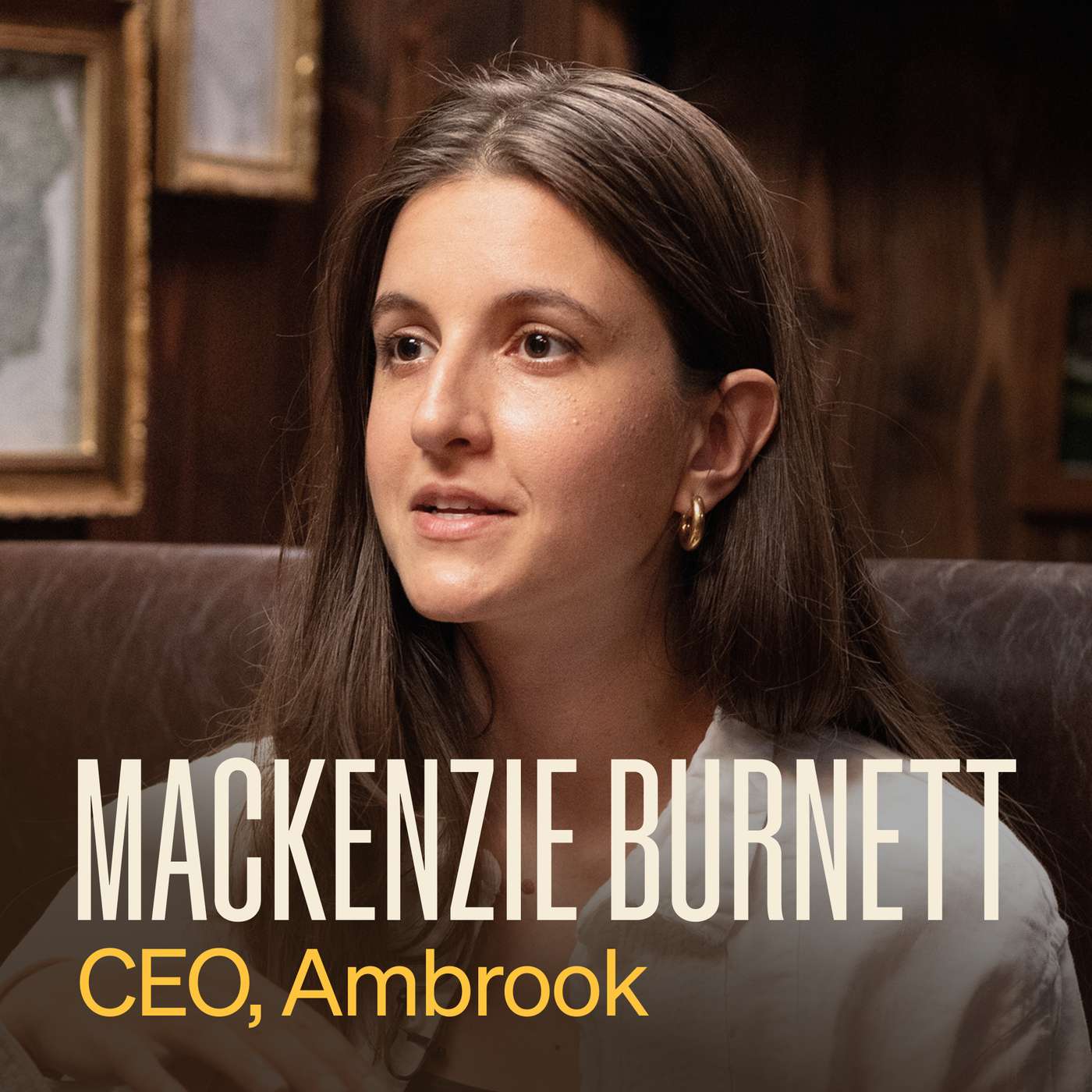
Ambrook CEO Mackenzie Burnett on American agriculture, rural resilience, and carrying 50lbs of fresh pork on Amtrak
from Cheeky Pint
54m 53s
Ambrook is a financial software company designed specifically for U.S. farms, ranches, and small businesses that face unique accounting challenges. Unlike generic tools like QuickBooks, Ambrook’s platform addresses the complexity of agricultural operations—such as multi-entity structures, seasonal labor, and diverse revenue streams—by offering intuitive, accessible financial management. The company began by helping farms access pandemic relief funds, which revealed a critical gap: most farms lack proper financial records due to operational complexity, not technology lag. Ambrook solves this by enabling real-time, mobile-first accounting, advanced analysis (like cost per acre), and seamless digital payments—overcoming reliance on paper checks. The software is built with flexibility, supporting diverse operations from crop farming to cattle feeding, and has expanded beyond agriculture due to the shared complexity of small businesses. A key insight is that financial resilience in rural communities depends on accessible, trusted systems that empower individuals to manage their businesses independently. Ambrook avoids free money giveaways early on, focusing instead on product excellence and user trust. The company also believes in long-term economic resilience, advocating for local capital retention, better financial literacy, and sustainable farming practices. Ultimately, Ambrook aims to make entrepreneurship and wealth-building accessible to all, especially in rural areas, by creating a future where small businesses thrive with transparent, efficient, and community-backed financial tools.
We decided actually early on not to give away free money.
So that was a controversial start-up line.
And I think it actually was controversial at the time.
It was, and we grew slower in the beginning because of it.
We ended up butchering the pig at the end, and we took home that meat.
It was like 50 pounds that we carried on the Amtrak.
You're the person that people love to have sitting next to them on Amtrak.
90% of payments in US agriculture still go through paper check.
And it's not because they're behind the times,
it's because digital payments can be expensive for long use for users.
What are things that people should buy directly from farmers
as opposed to in the supermarket?
You can just call up a local farmer and most likely,
they'll figure out a way to sell you half a cow.
How long did it take you to pour a perfect pint, I'm gonna tell you.
How many points?
These are particularly perfect, but. Better than the first couple of, so. Yeah, for sure.
Not that I want to blame the cake, but it was all the cake.
Mackenzie Burnett is the CEO and co-founder of Ambrook.
Ambrook provides financial tools for farms
to help them stay independent and build better businesses.
Cheers.
I just want to start with Ambrook.
Many people who are not in farming will not know what Ambrook is.
Tell us the Ambrook product story and how you got here.
Yeah, so Ambrook, we build financial management software
for farms, ranches, and increasingly other, I would say,
industrial and mom-and-pop shops.
So these are more complex businesses,
typically family-run in the US.
What financial management software means is it's
accounting software, payments, and banking.
A lot of that is built on a Stripes infrastructure
and is, I think, made a lot more possible
to be able to bundle a lot of that.
I think you had sort of the bundling, the great unbundling,
and now you have the great re-bundling
that has been enabled by a lot of embedded infrastructure tools.
But that is what we build.
The broad mission is, how do you help American family businesses
become more profitable and more resilient?
And resiliency is both economically and environmentally resilient.
And we had started by trying to help
a lot of farms access working capital during the pandemic.
And then we pretty quickly realized that while we could help them
with these one-off pandemic relief programs,
which are actually designed to be extremely simple
to apply for and simple to get the money,
even then, a lot of businesses were struggling to get that.
Those checks, we found that trying to help them
with the more routine, you know, working capital,
whether through public or private,
lenders and grant givers,
it was just basically people didn't have a lot of these businesses
didn't actually have the financial record keeping that you needed to.
And it wasn't because they were behind on technology necessarily.
It's because their businesses have a level of complexity
that you would see if it was a startup, it would have a CFO.
Yes.
That was a big unlock in realizing that a lot of,
you know, when we were asking,
oh, you actually do have all these tools that, you know,
are, you know, built for a lot of these,
these SMBs sort of accounting software
and they still weren't able to put together their balance.
They couldn't produce a balance,
which you need for a loan.
Okay, so farms are very complex businesses.
Yeah.
You started off helping them with COVID stimulus, essentially.
And then as part of that, you realize that just,
it's very hard to understand the farm's finances,
which got you into financial tooling.
Yeah, exactly.
And we spent the first year and a half
just trying to access the problem.
I think that's what I talked to the team about.
And it's like, you're not your first job
as a founder is to get access to the problem.
And sometimes people get it right pretty quickly
and sometimes it takes a little bit
to get access to the right problem.
So the first thing was just get access to the problem,
talking to like hundreds of farmers
and the whole ecosystem around them.
So we would talk to a bunch of ag lenders
and we're like, well, how do you do it?
And they're like, we drive to the farm.
And we like put that on.
And see, they're like, yep.
Yeah, they, a lot of fences.
They actually drive, so they drive to the farm
and they sit down in the kitchen table
and they actually put together their balance sheet
with the producer.
I see. So as an ag lender,
you have to actually get in there
and help them understand the finance.
Yeah, exactly.
So I think that, and that's,
I would say that's more typical than not.
There's actually a level of complexity here
for farms and a lot of these types of like,
I would say I would say resource intensive businesses
where you're dealing with like locations,
inventory, right, loans, right?
So you're dealing with a balance sheet heavy.
Right.
And it's what it would call a multi-p&l.
So you have multiple business lines,
multiple pin-out payment methods, right?
Even like the rise of the pandemic, for example,
I think increased kind of accelerated the complexity
of a lot of these businesses,
because suddenly you could actually have an online shop.
Totally, yeah, yeah.
We've got a lot of snake river farms.
Yeah.
Steak during, during. Yeah, pandari is really good.
Exactly, yeah, no, exactly.
And I think, and that is a nightmare to book keep for.
Yes, yes.
Because individual transactions
is not just like one supplier.
Exactly, direct and style it against
like what actually hits your bank account.
Yes.
And so, so yes, it's great.
All these tools have accelerated
businesses' ability to do business.
But it's also increased the complexity of business.
And a lot of these businesses,
because they're so low margin.
Yes.
And have tons of pressures on both sides
and both input suppliers
and the marketing side of things
that are squeezing margins
for a lot of these small businesses.
They have to diversify in order to be able to. It's smart business to diversify,
but it also makes it a much more complicated business
to actually figure out
where are you making losing money.
Okay, so I have so many questions.
One last question about your business
and Emberka also want to ask questions
about the general direction of agriculture in the U.S.
But maybe let's start with,
what segment of the market are you addressing?
Can you guess how many farms in the U.S.
make more than 5 million a year
in annual sales?
There's 2 million farms in the U.S.,
so I'd say 1.8 million.
How many make more than 5 million a year in annual sales?
10,000.
Yeah, so it's about 10,000.
Oh, okay.
Yeah.
Which is an extreme power law.
Yeah.
So 10,000 out of 1.8 million
means that the majority of commercial farmers
are doing somewhere south of that.
And so they have a level of complexity
that might be sort of like the $15 million business,
but they are at $500,000, you know what I mean?
Okay, so you're mostly targeting farms
that do up to 5 million.
So we started there
and now we're starting to work with farms that are larger.
But if you just go out and market a product to farms
who are going to get the majority of producers
that are in that range between like the 250K year
to about 5 million.
And as a product work for everyone
on the farms in California
and dairy farmers
and the huge crop farms in the Midwest,
is there any particular segment?
We actually deliberately started pretty broad.
It's unusual if you think of us as AgTek Software.
It's not unusual if you think of us as just
financial, like management software.
Yeah, yeah, QuickBooks is not specific to anyone in this world.
And we were pretty deliberate in the beginning
to make sure that we were working with some ranchers,
some row croppers, some more diversified, like Veggie producers,
to make sure that we weren't accidentally building something
for just one sort of one vertical of that.
And actually, I think the thing that was a really happy accident
that was an example of the customers pulling us
into a much broader tam or part of the market
was our second customer
was a cattle feeder operation in Arizona.
And we drove, this is when our first 10 customers
we drove, we onboarded by hand.
So it was a big deal when we moved to like video onboarding.
But no, it was like in there about two hours outside
of a regional airport.
So we drove there and we kind of got them onboarded
and they're like, great, really happy to be onboarded.
Now can you help us with our other four entities?
And by the way, none of them are farms.
And so you had a trekking entity.
You had like a custom service entity
which actually just looks like sort of consulting
or in our invoice heavy business.
And so we immediately realized that in order to well serve agriculture,
we actually had to serve and think about a lot of these other industries
which now is enabling us to expand to a lot of these adjacent
or other just other types of industries.
But in the beginning, we kind of realized
that we had built something that could help a husband and wife couple
be able to handle a five entity business.
Like, as you know, pretty complicated.
Yeah, like for an ERP system, multi subsidiary support,
it's like a pretty advanced feature for something like a NetSweez
and what you're saying is you need that even for your friends.
Exactly. Right now, we're going, I would say,
our main competitive software that folks are switching
from us is Intuit Software.
Eventually, that will be something more like a NetSweep, right?
But I think the thing that we actually realized
was that there wasn't something in between.
Right. Right. We are building for those businesses
that have effectively outgrown QuickBooks.
Yes. But don't have the teams or resources
to onboard to like a Sage or a NetSweep.
Yep. And the-- Are there farms that use NetSweep?
There are farms that use NetSweep.
Yeah, they're in the-- they're in the north of the five million--
That's a big farm, right?
Yeah.
--which is a big farm.
It's when you have teams of people who can afford
to implement and then maintain.
Right, right, right.
That type of software.
So that's where you're getting into kind of agri-business type.
Yeah, exactly.
And so they tend to be much more vertically integrated.
Right. They'll have a processor component or something
like that.
You know, you kind of realize that actually,
I think to go against something like an ERP
because if you can't go, you know, it's a huge feature floor.
Yeah.
You have to--
If you talk to most of those businesses,
even the really complex ones that are using something,
like an ERP are only using 10% of the features.
And so the game becomes like, what is the 10%
and like, what can you pull down for a different audience type?
Like, I think one of the key differentiators
we decided to build toward, I think,
correctly, just like in the beginning,
was instead of building for the financial professional.
Yes.
We built for the--
business owner. Yes. When you think about it, it's kind of funny that ERPs became so horizontal
because yeah, for context for people, ERPs enterprise resource planning software doesn't
really tell you anything, but my understanding, tell me if you think this characterization
is correct, is it is a combination of financial software where it's the three financial statements
and a huge amount of automation around the stuff needed to produce those financial statements.
And so if you think about it, if you run a factory to be able to produce the balance sheet,
you have a bunch of inventory, but to be able to know what should be in that inventory line
in the balance sheet, you actually have to know how many widgets you have sitting in, you know,
bins in the facility in Cleveland. Yeah. And so it becomes just like all singing, all dancing,
multi-tentacles system with very complex limitations and everything like that. And I'd say really
grew up in a manufacturing paradigm. And yet, you know, Stripe has a new ERP system and you know,
lots of regular companies have ERP systems. And so it feels like it'd be much better suited for
them to be vertically specific where there should be farming ERP and there should be manufacturing ERP,
which is what's more the traditional design structure. And I think that that is what, I think the
modularity is what hasn't actually been brought to the SMB level. It does exist at this much larger
enterprise level. Yes. And I think, you know, I do think that software becomes easier to build,
and that's not just from AI, but it's also from a lot of the embedded infrastructure.
There's tons of reasons why it is much easier to build the version of what we're building today
than it would have been 20 years ago. Even cross-platform, like a choice that we made really
early on was to build on React Native, which immediately just gives you, it means that we don't,
like we have not had actually a full-time mobile engineer on the team because everyone has
learned React Native, and you immediately get a cross-platform. And I assume you have a huge amount
of mobile usage because people are. Yes, actually, about 30. So about a third of our customers
use exclusively mobile to do all of their bookkeeping and accounting, which is insane, for
the lot of complexity of their dealing. And for doing accounting, it's like that's a laptop
kind of activity. No, totally, totally. And so I think very early on, we built for the type of
person who was not necessarily financially, didn't have a lot of financial professional training,
who was spending more time in the field than in the office. He was dealing with a level of complexity
that typically these ERPs were better suited for, and we kind of brought all that into a package
that was affordable and accessible. And we also do a ton of financial literacy training and education,
and we wrap a lot of what would otherwise be a custom journal entry in these types of workflows.
It's sort of. Exactly, it's like. You can really think of like an ERP, or like what, you know,
sort of the system is like, get the data in, do something with the data, get the data out,
and then get the data in. It's kind of a central task. Exactly, those are really workflows. Yeah, yeah.
And so you rock up to a farm, you know, you're off in Visalia, or somewhere, and you are
everything a farm, and they're on QuickBooks, or they're on, you know, Sage, or maybe not Sage,
something. And you say, you shouldn't be using your existing system, you should instead switch
to Embrooke. What is the wow feature? What gets people to switch? What's the point in the demo,
or they're like, okay, I mean. Yeah, totally. So there's a couple of things. There are like,
you know, what's in the software, and then there's the advantages we have of just being a startup that
can care harder, you know, in the beginning, you can just care hard about everything. But a couple
of the core things that we have built just differently, the first is that when you look at the
software, it just looks cleaner. It doesn't sound like that's a 10x feature, but it is, we solved
a thousand tiny paper cuts, so that when someone looks and interacts with Embrooke for the first time,
it's a little bit of a breath of relief. The second thing is that we enable the type of multi-dimensionality
in the software, so QuickBooks has a concept like cult classes. We enable essentially a type of
multiple tagging system and splitting of every transactions in a way that you can slice and dice
your data without having to kick that out to a spreadsheet, and you can do it in your own language.
And so we kind of help folks kind of set up, okay, like this is my cattle enterprise, this is my
hay enterprise, it's in their own language, and it's very clean in the interface of how to do that.
So again, it's to get the data in, we made a lot simpler and cleaner, but they're actually doing quite
complex analysis, actually, when they're doing that type of work, and the last thing is actually mobile.
It's like the number of conversations that we had with producers who would describe
an actual shoebox receipts that they would take at the end of the year to their accountant,
and that was their financial management system. We built a lot cleaner workflows around paper,
basically receipts checks, those types of things, so that you can take photos of things categorized
and immediately, we use that, that is actually one one place that we're using, that folks are really
using a lot of like AI features to do a lot of that type of matching and categorization of those
things, but those are sort of like the breath of fresh air when you first see the software, and then
it's these what it enables you to do, it's like the simple, you know, the simple but powerful workflows.
What's an example of a kind of analysis that someone might not do on their farm, but for this
software. Understanding your cost per acre is extremely challenging to get to in something
like a QuickBooks, and so like there's a reason why there's a whole category of startups that are
funded to do FPNA on top of QuickBooks, like you don't have to do that with Amber, it's built in,
and it's because, and the reason why those startups exist is because QuickBooks did not actually have
the underlying data architecture in a specific way that we chose to do native in the beginning,
and so we can do way more complex unit economic analysis and those types of things,
and I think essentially without requiring someone to have financial permission training.
Okay, so I'm running a farm and there's 100 acres for sale across the road. The decision as to whether
I should buy about 100 acres, reading depends on what is my cost per acre right now, so I know what
is the outlay until that becomes productive. Yeah, totally. But I can't work that out unless I know
my existing cost per acre. Totally. Which I probably don't know. Yeah, so I think, I think, yeah,
that's exactly right, and it's, can you put together your balance sheet and stuff in time in a
professional way such you can venture lender your banker to be able to give you the loan to buy the,
you know, sort of, to buy the 100 acres across the road. Got it. Okay, so this better accounting is
a significant reason people are coming to the product today. What are the other reasons that people
come for the product or maybe will come to the product in future? I kind of think about startups as
you have predestribution opportunities and post-distribution opportunities, and the predestribution
opportunities are what, what can you do to convince enough nodes to join your network? And the
post-distribution opportunities are where I can do when you have enough nodes. Yeah.
Ambrick is just now crossing over in some regions because we have enough racial density with some
of these nodes to get into a post-distribution world for some, for some of our customers. But I think,
you know, in that world of you have enough nodes in the network, it should be instant and free
to transact, you know, within the Ambrick ecosystem. And I think a lot of what we are doing or the
vision is to be able to keep more capital in local communities. And I think that has been something
that I've become increasingly passionate about, which is, you know, for example, like 90% of payments
in US agriculture still go through paper check. And it's not because they're behind the times,
it's because digital payments can be extensive for a lot of these producers. And I think actually
something that we're building with because of the Stripe Treasury network is the ability to do
these instant and free payments within the deposit sort of ecosystem. And ideally, and those are,
when they're within the sort of the ERP system, they're also, they have the context and both sides
of the ERP. So you don't, you know, my invoice is your bill. You don't have to actually do the
ARAP shuffle, right? Everything is like reconciled in both sides, right? You have like in the future,
we could say, okay, this category in your system actually maps to this sort of chart of accounts
category in this system, right? Like, you can imagine a lot of what could you do when you actually
have like really rich metadata that's going through the network? No, we think about this
distinction a lot. I think it's very good for startups of, yeah, predisposition versus post
distribution. How do you get people using the products and then how do you make it better
when you're using the products? And when we started Stripe, we were very much building Stripe
in a single player mode where, you know, you have your Stripe account. And the fact that other people
use Stripe is, well, they didn't at the time, you know? Where it's now a big part of how we can
make the products better is the fact that there is so much internet commerce running on Stripe.
I mean, a very simple one, but it's really started working as Stripe radar where just it is now
the case that most credit cards on the internet we've seen before. And so we kind of know it's
suspicious if a credit card comes to us from a totally new device and totally new IP address and
things like that. But that's the kind of post distribution thing where you can't build that
product initially, but when you have enough scale, it comes very significant. I think one of the
most rewarding things about building for small businesses is that you are able to build these
real relationships with people who are entrusting you with their numbers in their future.
And what can we do when we are translating just not just in the individual context of a single
player world, but the multiplayer world is communities. And I just think a lot about that, which is
what does world resilience mean? What does economic resilience mean for a lot of people?
What does rural resilience mean? Where I think there's a general view that the economics
of US agriculture are really hard and it's challenged from a labor point of view. There's
all these different challenges. And so maybe you can talk about the landscape and yeah, that rural
resilience. I think rural flight, you know, which is I think the opposite of rural resilience,
which is what you're seeing in a lot of places. You're just seeing a brain drain from a lot of
rural communities around the world does impact local communities. But I think the thing that is
usually under under-disgusted how it impacts national or like global communities.
as well. But when it comes to real resilience, what I mean is when you have like nodes of
family businesses that can sustain like multiple generations of passing down the business,
for example, or people want to stay in the local community, basically. And I think that
is something that we're really interested in. We have seen worked well for some of our
customers. They're actually able to make the succession planning work, right? They're
able to build a business that can be passed down through multiple generations.
As in you think we need to be more serious about preserving farming as working as an important
part of the U.S. economy?
Yeah, absolutely. I think sometimes the free market optimizes for two small of a unit.
And if we instead optimized for a community unit, for example, how would that change the
way that we made decisions? And that community unit, I think, actually is what sustains local
economies through time. If you are just optimizing for the very short term sort of like turnaround,
which makes total sense actually for like an individual to say, okay, that this is my
only sort of retirement is to sell to this developer, right? And I think that's a world
that I would love to be able to build more business resilience so that they don't have
to feel like that that's your only option.
You're saying farming produces positive externalities. Like if the cartoon villain private equity,
slash and burn costs and make the products worse and raise prices, if that's at the full
negative externalities end of the spectrum, farming is much more the positive externalities.
Yeah, I think there's a lot of positive externalities for it that are under accounted for.
How do you make a medium-sized farm work in the United States? Pick your favorite example
whether it be crops or dairy or beef or what have you, what is required to make? Because
again, it's a hard business. What's required to make it work?
So I'll take a like a counter-anch, for example, for a counter-anch, I think, to work in the
U.S., you have to have a couple of things. One, it's a lot of farming artis like boom bus
cycles, right? So they are subject to commodity markets. They're also subject to like input
prices inflation, those types of things. And so you do see this like boom bus cycle throughout
the economy. So one, there has to be a resilience and ability to like to weather that's one piece.
I think the second piece is to get access to the input's perspective. So you can think of inputs
as like access to grazing land, access to feed, right? Access to a lot of these other things.
A lot of ranchers, ranch on BLM land, right? Yeah, a lot of government leases, which helps get
access to the amount of land you need. Exactly. For context, like ranching,
it's sort of kind of requires quite a lot of land. And there's a way to do it in a way that like is
actually better for like grasslands management. Why is it better for grasslands? Oh, it's fire
management. It can't be. Yeah, so it can be. There is such a thing as like over grazing, right?
Like that is a, that I think a lot of what people talk about with rotational, it's called
rotational grazing. Just a lot of labor to like move the cattle every day to do that. But it
actually does build back up the soil in a way where the cattle graze and then they poop and then
the poop becomes like, you know, better soil. And like you sort of can move throughout. And there's
a lot of interesting virtual offence things to be able to make that easier. But there is a way in
which like good healthy like livestock management also creates healthier soils. And it is possible.
It just is technically you have to be trained and understand how to do it. And there is some capital
bears or labor bears to be able to do that. So there is access to the type of capital that would
incentivize and sort of like create the incentives to be able to make that possible. And then you
have like on the other side access to markets. Historically, if you're just sort of doing wholesale,
right, you're going to get wholesale prices. This is where you see the rise of G2C really help.
And we are able to have access to higher margin markets. So a lot of online payments actually
has helped that a ton. It just is also you need to be able to manage your books in a way that can
actually make that easier to manage. Again, what I'm talking about is diversification, right? And
whenever you introduce diversification also introduce complexity or in risk.
Can any farm do G2C? I would have thought maybe it requires some minimum scale to make sense,
or you know, just reasonably labor intensive, you know, the packing and shipping of individual
shipments to the individual customers. Yeah, totally. There's actually a whole spectrum of
different ways. And once you can make it work, you can do it all yourself. But there's also a lot
of like co-ops basically. And once you can kind of share infrastructure, it just requires a shift in
incentive structures, infrastructure, those types of things. And so it requires, and that that
sometimes can require a lot of public investment. Yeah. Like there's some things that travel pretty
well. Beer travels pretty well actually. And so you don't need to brew your own beer for quality
purposes. You might want to do something fun. I was surprised. I thought the steak in the supermarket,
I assumed it would be pretty good. Like we have local supermarkets. But yeah, the direction
you can see where meat was really good. Veggies as well. Yeah, totally. I think the local stuff
will be better than the long supply chains. I think if you surprise, you can just call up a local
farmer and most likely they'll figure out a way to stall you half a cow. Well, to find an easy online
payment station. Yeah, exactly. Now I think actually the biggest thing people don't really think about
is like freezer storage or something. Yeah, half cow is quite bigger than people experience.
And it's like that feeds like a full family for a while. Actually, there's a lot of things
you can buy direct. But what should you buy direct? I think meat is a big one that makes a way more
economic sense to buy direct if you just are willing to like just economic sense, gastronomic sense.
No, it's so much better too. Something I did with my team, one of my teammates found and
suggested which which was really awesome was have you ever been to a traditional pig harvest?
I have helped butcher pig use. So that was quite an experience. But yeah, I think we didn't see
all the steps. Yeah. So yeah, we saw all the steps. And so that was that was a really interesting
experience of participating in that. Then we ended up butchering the pig at the end and we took home
that meat. It was like 50 pounds that we carried like on the Amtrak.
Who's the person that people love to have sitting next to them on Amtrak?
That was awesome. It was by far the best burger ever had.
Annoyance level one is people playing music with that headphones on their phone. Annoyance level
eight. It's carrying half a pig. Yeah, yeah. No, that farmer went to as a customer now. So it was uh, yeah, it worked.
Yeah. Yeah. Okay, so drugged consumers. But sorry, I'm trying to rewind to where we were.
We were talking about oh yeah, the economics of them farming this teenage labor seems really hard.
Yes, labor is especially hard right now. But it's hard for a couple of reasons. I think
there's a lot of immigration related issues that a lot of folks are kind of facing right now.
But the second action and that is tightening of immigration meaning less labor. Yeah, so
tightening of immigration means that you have less labor because a lot of a lot of farms rely on
seasonal labor farms and processing facilities actually which people think about which is if you
can't sell your product then you know for for a lot of livestock for example then you you know
and that was the issue in pandemic too is a lot of processing facilities shut down right.
But the other side is actually skilled labor. It's not just seasonal labor but it's it's
pretty skilled labor has been harder and harder to get even before the pandemic.
I was wondering what's an example of some of these kind of specific. I think it's just it's
actually quite a lot of skill in in knowing how to like pick a crop without bruising it for example
at below at the speeds that you need or for example like animal husbandry or a lot of these other
types of skills that again this goes back to like how do we make it so that there isn't so much like
rural brain drain and rural flight like a lot of a lot of the labor you know the people who might
otherwise we do that might not actually want to labor work in those areas. Even if they're not
you know sort of seasonal immigrants. From policy perspective if you were in charge
if you were running I know USDA both your parents worked for USDA. Yeah. What would you be waving
your magic wand to do? Oh interesting. I think there's actually two one of them outside the USDA one
of them swim in the USDA. I'm really interested in a lot of stuff that's happening with open banking
regulations because I think actually the cost to a lot of what we're seeing or doing is the lack of
accounting software's just an attempt like all we are doing is trying to get external data sources in
and like make them all make sense you know and kind of what we're talking about with the metadata
and all that before like there's so much information that could actually be really helpful
for our customers that is not being shared or is really expensive and difficult to get.
Yeah. And so that is something that I am super interested in how things are developing there.
So as you're saying concretely there like in many countries it is man-data's that banks provide
structured access to financial data for their customers because they say you know it's the
customer's own data. Yeah. Banks have to give it an unrequest and by you know an API format and
things like this. Yeah. It's actually a very live topic in the US right now and there's lots of
debates over this real 1033 and things like this. We were saying it would be very useful for
Ambrok to have some open banking mandates where you guys can reliably get data in a sensible format.
Yeah it's not just useful for Ambrok it's useful for I mean for our customers like that is
ultimately who we're trying to serve. Yeah it's their data. It's their data and so in all we're trying
to do is get the data from someone else. Yeah. And give it back to them actually we're just kind
of a crazy thing that we have to fight for that but yeah no I think that would be that is something
that if I could wave a magic wand honestly I think that would actually help more than people think
and I know that you asked the question about the USDA but I actually think that that would be
that's your top. That would be my top. Yeah. But I think on the USDA side there's a lot of hoops
that people have to go through in order to be able to get access to like funding or programs that
might be useful for the type of incentive structure alignment that I was talking through and I
I think that's a simplification of a lot.
a lot of that, which I think a lot of people want, but--
- Yeah, we have our thumb in the scale,
but we could at least do it in a more efficient way
of what's good for. - Totally, yeah, yeah.
- Would you tweak farm subsidies up or down?
(both laughing)
- To be honest, like, I think farm subsidies are so sticky
that what I would do instead of tweaking up and down
is I would just be extremely deliberate
about when we just use introduce a farm subsidy,
like what are we doing?
And if this was still around a hundred years from now,
would we be okay with it?
When you are designing these incentive structures,
there's whole livelihoods and politics
that are built around them, and they last from the base.
- And they're gonna be sticky.
- And they're gonna be extremely sticky.
So it's more like, be careful what you wish for,
as I think actually the response I have to that, yeah.
(upbeat music)
- Ambrook is a window into one of the most under-appreciated
stories in the internal economy, vertical SaaS.
As Max is explaining, the finance of a modern farm,
the complex and generic accounting software
just doesn't work.
So Ambrook is building a SaaS from the ground up
to solve deep industry-specific problems
that generic tools can solve
like crop-specific profitability
or specialized agricultural lending.
And Stripe then is the platform for these platforms.
Stripe has tens of thousands of these
from Ambrook for farming to mine-body for gyms.
And collectively those platforms
per millions of small businesses.
The best vertical SaaS platforms
become an all-around system of record
for their customers.
They offer payments and loans and spend management
and subscriptions and invoicing and tax automation reporting,
all of which you can get from Stripe.
There's now 95 platforms on Stripe
with more than a billion dollars in GMV.
So if you're building that indispensable system of record
for your industry, come talk to Stripe.
(upbeat music)
Are carbon credits a big revenue line
for a lot of your customers?
- They're not the biggest revenue line.
- Okay.
- No, but just a relevant revenue line
for a lot of your customers, 'cause you're getting
a forestry stuff for all-around management.
- Yeah, so for many of our customers,
they do participate in carbon credit programs,
but it's not as many as you might think.
It still is a relatively small part of US agriculture,
despite I think them being kind of really big
in the public sort of consciousness.
Carbon payments are on a very long time frames,
and they require you to maintain the same behavior
over about a 10-year period,
otherwise you get clawback provisions.
And so actually, I think-- - Locks you into a plan.
- You kind of locks you into a plan
when you might actually want to be kind of adaptive
or versatile in that.
And I think actually went to a sustainability
and add conference last year,
and something that one of the producers there said
really struck me, which is,
it's not enough to have a 1x payback.
You have to prove that these programs
can have a 3 to 4x payback.
Otherwise, like, why would they do it?
They should just do something else
that is going to be able to better improve their bottom line.
And I think that that just goes back to a lot of art thesis,
which is this idea of pragmatic environmentalism.
You just cannot--
You are not going to see the level of change
that you might want to see or need
unless it makes sense for the bottom line.
- Climate is a very clinically charged topic in the US.
You studied climate security at Stanford.
Most of your customers are in red states
or the red part of blue states,
such as California.
But I also think that people's views
on these topics tend to be pretty nuanced.
Like I think, I bet Stanford Diskins
couldn't effectively steal man the views
of your customers on such climate topics.
So what do your customers think in climate topics?
- It's a great question.
Our customers think a bunch of different things.
So I wouldn't be able to summarize
with just one statement, though I will say that
one of my favorite articles that off range,
which is our editorial independent
media publication published was an article titled,
"Works soil is holy, but climate is seldom mentioned."
And I think that it's kind of like talking about climate
sometimes feels like talking about politics or money.
And yet these producers that this article talks about
and a lot of the producers that we work with
or just around the US are actually doing the type of things
that you would put under like a climate umbrella.
- Yeah.
- Just how branding it is such.
- It's just not branding it as such.
And I think a lot of actually what I've learned
from our customers is that a lot of people
want the same things.
They just aren't talking about it in a way
that might feel familiar to someone who grew up in,
you know, around like San Francisco, for example.
- We're talking a lot here about the insights
of business that Ambroke allows.
One of my favorite books about accounting
is the end of accounting, which talks about
how gap is basically poorly suited to this day and age.
One thing is it points out is that accounting
is trying to do many jobs, right?
Like if you're an equity holder,
it's trying to help you figure out what the future
returns on your equity might be.
If you're a debt holder, it's helping you figure out,
will you lose all your money or will you get paid back
if you're at the IRS?
It's helping you figure out how much taxes this does.
And then there's kind of management accounting,
which is helping you understand,
like you're saying the kind of P&L view of hay
or the dairy side of the operation
or something like that.
And so it's kind of helping management
make better decisions.
But in particular, people tend to have a view
that there is this God-given truth of just, you know,
what the business is.
Whereas in fact, accounting is a tool
for a job, and the job you might want to do
with accounting actually really varies.
And so I'm curious how you think about that,
where we charge the jobs that you want to help firms do.
Like helping them pay their taxes
is all about making different decisions.
And yeah, just that idea that accounting is a bit
overloaded these days.
- Yeah, totally.
Actually, I think the way that we talk about it internally
is there's four types of accounting.
The first layer is just cash.
You know, it's sort of like if you had a snapshot,
like what's happening?
And actually most many businesses in the US file cash basis.
- Yeah.
- The second layer, which I think which a lot of,
like startups are kind of subjected to
because they just like, they meet the threshold requirement
for this is filing a cruel, which is,
we certainly introduced the idea of time into accounting.
So the idea of a Constituable, accounts payable,
ARIP, et cetera.
The next layer is enterprise accounting,
which is that idea of your entire business line basically.
So hey, cattle, et cetera.
And then the final layer is managerial accounting,
which is truly like unit economics.
It's like, what does my cost per acre,
how much should it cost me for a dairy
to produce a pound of milk, like that type of accounting?
And the way that we think about it is
we have customers who come in at every layer.
And I think actually the beauty of building accounting
software is that it can scale.
Like, yes, gap might be overloaded,
but at least it is standardized and it scales.
And so we have folks who come in
who are coming off of actual pen and paper
and a shoe box of receipts
who are interested in adopting software for the first time
to do their accounting, to just get to get tax prep
to be done easier or maybe go from cash to a cruel.
And then we have folks who are at sort of the,
they're at the cruel, arrogant enterprise layer
who are interested in actually getting
to the unit economic analysis.
I mean, I've seen, so dairy's are extremely
complicated businesses.
They're like a cow calf operation,
which is your typical cow ranch.
And then some, they're like a very complex cow calf.
And I've seen dairy's higher ex bankers
to get to that level of the managerial analysis.
- Yes, yes.
- And I think that is what we are building for Ambrook,
is we have customers who are able to get
all four layers of accounting
because of the way that we just like architected
the data structure in the beginning
and the way that we are trying to wrap and de-jog
and a lot of the complexities of doing your books correctly.
- So you want to walk people up the inside's curve
and take wherever they're currently operating
and just making it easy for them to reach the next level.
- And it's okay, we consider customers
to be successful in Ambrook if they just hop one level up.
- Yeah, that makes sense.
People might think you as a software business,
but I got a sense that you identify
in a significant way as a fintech business.
Is that a fair characterization
and maybe you can expand on that?
- Yeah, for sure.
I typically think of fintech businesses
in two different ways.
The first way is just, are you sort of facilitating payments?
And so there's a sense of like, are you in the payments low?
The second way that folks typically talk about
fintech businesses is like, do you hold deposits,
do you lend basically deposits from lending?
I maybe also cards, I think would be part of that.
And so for us, we actually, from the very beginning,
solidum is inseparable.
Like we were just interested in solving our customers' problems
and in order to be able to get more accurate data
into the ERP, like being in the payments flow
was just made it a lot easier to be able to do that.
And I think building with a lot of the fintech optionality
enables us to have a lot more of the options
to solve more of the problems with capital
that we were kind of talking about earlier.
So yeah, I think about that as inseparable.
I think that the choice that we didn't make though
is, and we are just now getting into credit.
So that was a controversial incentive, man.
(laughing)
- And I think it actually was controversial at the time.
It was, and we grew slow.
over in the beginning because of it.
And I think that the thought that I had was that,
and we had raised in the very beginning
and started during Zurb.
And so the thought that I had was basically what I did
was I just, I did all these financial models.
And I was like, I just don't see how this makes sense, actually.
If I'm trying to get to like a healthy merchant's business,
like I don't see how--
- The free money part makes it challenging.
- Yeah, I don't see how this works if interest rates
change even a little bit.
A piece of advice that I got that I thought was really,
really helpful and kind of helped me shape this,
which is I wanted to actually get the hard parts right first,
which I think is the sass side of the fintech side.
And I wanted people to be adopting us
because they like the software.
And we got the workflows, right?
Not because we are giving away free money.
Because we can always give away free money.
Like we can turn that on when we want,
and when we have enough of the partners be able to do that.
And I think because we actually did this log
of like build accounting software that has a high NPS,
like you know, that people actually like using,
like we now have a way more optionality
to be able to leverage the fintech side of the business.
- And when you say free money,
do you mean blow market loans?
Do you mean free payments?
Do you have a specific free money you mean?
- Oh yeah, I mean, blow market anything.
So blow market anything, right?
I think that, you know, you can give away free payments
that actually cost you, you know, cost you money.
So it's anything that that like requires you to have
a negative unit.
- It is how a lot of founders fool themselves
that they have product market fish when they don't.
Are users coming for the product
or are they coming from the subsidy?
- Yes. - And build movie paths.
- Yes, totally. - And you know,
movie efficiency and adders,
a lot of numbers of free movies.
- Yeah, totally.
- The economics make it challenging.
- Yeah, and I think maybe it would have all worked out
if I was willing to do that.
I just, you're all fashioned in that way.
- It's all fashioned.
I was like, I thought we were supposed to be building
for like 70% gross margin.
And so that's sort of like what I was doing.
That was what we ended up building the business around.
- You seem unusually passionate
about instant money movement compared to most people I know.
(laughing)
- Um, 90% dial and instant money movement.
- Is it a reflection of what you're hearing
from your customers or?
- Yeah, I think it's also a first principle.
I kind of, the idea of like a,
like if I'm actually thinking about solving the problem
for what we're trying to solve,
like it seems like actually a lot of the issue
is that money movement is slow and expensive and context less.
I think that, like there's instant money movement
and high context money movement.
And I think there's just a lot of dead money
sitting in the economy.
That's just for some reason,
in transit between middlemen.
- Or too accepting of that.
- Yeah, and I think it's something that people are used to,
right?
But I think if you think of a check sitting in the mail
for like 10, 14 days, a guess maybe it's like,
it's kind of floating, someone's sort of a ability
to get that, so it's cash flow management.
I think it's a legit thing that I think,
you have to solve for.
If you're saying, you know, not everyone actually wants,
not every business wants instant money movement.
But I think, but I do think that there's also a sense of like,
having to go through any set of ACH helps doesn't make sense.
- Yeah.
- I was joking with Jackson on our podcast
that the takeaway I had from strike sessions
was like instant money movement. I was like, all right,
that's going to be a solved problem.
What's the next problem we can solve?
And I was talking to some stripes afterwards
and they're like, no, it's actually still really hard.
I was like, I'm thinking by using the future,
you guys have got this.
- Yeah, no, I think we will make a lot of progress.
- Yeah.
- It feels like many things are coming together.
I'm curious, well, maybe you can explain briefly
how you guys use Stripe to set up my actual question,
which is, if you were running Stripe,
what would you do differently?
- I think you guys doing a great job running Stripe.
- No, no, but actually, I wrote a whole document.
- I know, I read it.
- My sense is that Stripe strategy in the long run
is to figure out how to transcend the constraints
of traditional money movement.
Like, how much do you participate
in the traditional financial institutions that have been set up
and how much do you transcend that
and build something novel?
I think a lot of what actually Stripe is doing
with building its own payments network,
somehow building its own deposits network,
which I think you'd still need to partner
with banking institutions on do that.
So you're still kind of anchored with that.
But I think that's actually where stablecoins
becomes quite interesting because it's permissionless.
And so it's like, who does Stripe need to,
I think the way that I would kind of think about it is,
who does Stripe need to get permission from today
in order to exist in a way that Stripe wants to exist?
- Yeah, I think the thing that we think is interesting about
financial infrastructure is it's by its nature multiplayer.
You look at old e-commerce systems
and ones that even might have been on prem
or just the software is very outdated.
And Shopify came along and built an amazing product
and says here's a much better way
to manage your e-commerce store and manage your inventory
and build a nice storefront and everything.
And they were able to really clean up
the significant part of that market
because you could replace your old e-commerce system
with Shopify.
What's interesting about what we're doing is payments
and two large degree financial services
are by their nature multiplayer
where every payment is with some counterparty, right?
And even if it's not, even if it's something
like where do you store your money
or how do you do AP or something like that,
like there are lots of banks out there
that people have the deposits with
or people wave their hands and say,
oh, crypto will obviate this.
But when people have money in crypto,
they will store it in Coinbase or in Binance or what have you.
And so our view is that for whatever job is being done,
there will be a whole bunch of other counterparties
that we're going to integrate with and work with.
And so an interesting part of running a business
like Stripe is that you're working with all these partners
and you can actually pull things along
and make them way more modern.
We've done that in a bunch of areas,
but it's much more of, you're the captain of a sports team
as opposed to your Alex Hanoz doing solar rock climbing.
It's a different kind of sports.
- Totally.
But there are players that Stripe is just deeply,
will just be deeply competitive with
who will not want to play on your sports team.
I think there's a difference between who do you partner with
and who do you generally have to run through
in order to be able to build a better version
of financial infrastructure that is open,
does actually move on modern rails,
is actually ultimately not better for everyone.
It's not incentivized by about you capture.
But I think there's a lot of sense of how can you get more
the ecosystem cheering you on?
- Sort of it's the transcendence from like,
Stripe as the upstart startup to Stripe as the champion
that's pulling everyone into the future.
- So maybe what you're saying is,
Stripe previously provided easy access
to the existing financial system.
And now we've gotten to a point where Stripe can actually
have some voice in shaping the, and has kind of the scale,
we're gonna have some voice in shaping the future
to the financial system.
And you're saying that we have to take that seriously,
but that is now where we are as opposed to being
a passive participant in, I guess, this industry exists.
- Totally, yeah, I think this is a thing that like,
I mean, we're at a very different scale of Stripe,
but then Stripe, but the thing that I have been talking
about lately with my team is like,
the company changes with under our feet.
Like, when do you wake up and like,
oh, it's like the rules are different, actually.
- Yes.
- Like, people are caring about different things
than they did before.
And like, the voice that we have in the ecosystem
is different in these types of things.
And I think, I do actually think that like,
Stripe is pretty clearly a leader on a lot of these axes,
but I haven't heard as much of the voice in terms of,
like, what is the vision in which, like, we want to build.
I see a future in which like, there is a vision
of the world that I want to exist.
And Stripe is uniquely in a position
to be able to make that vision true.
And I want to sign up for that vision.
- Yeah, I think maybe also, you've probably picked up
in this dispositionly, we're just not naturally drawn
to pre-enhancing products before they're anywhere close.
We like to do a thing and hopefully we get it right.
- Totally.
- And our views, you can't meme your way
to a product being good.
You put out a version of it that's imperfect
and then you gradually iterate on it over time.
And so maybe also we've just been a bit too lily
of what we think are grandiose statements as a product
development method.
- Yeah, I think that's the piece of what feels missing
is a sense of painting the picture of what the world
could look like if Stripe wins.
- What is your answer to this question?
- What does it look like if we win?
I want more people to believe in the American dream.
My grandfather believed in it when he immigrated
from India to the US and he built up his own,
he was built his own engineering practice
and that was sort of what put his fight kids through school.
My mom believed a version of it when she immigrated
when she was eight here with her family
and with my grandfather and went into public service
because she wanted to, she told me a couple of years ago
it was because she wanted to give back to a country
that had served her, had given so much to her.
And I'm doing a version of it.
But because I think I went to a school that got me involved in tech and then I moved
to San Francisco and I became familiar with capital markets and I have access now to a
version of that.
But I see so many of our customers that are trying to live a version of that and are struggling.
And I want that to be, I want there to be many different types of American dreams that
are possible.
When you say making the American dream accessible, you're in particular talking about where
Amber can help is making entrepreneurship and wealth building broadly accessible.
Yeah, broadly accessible, not just to folks who know how to raise venture capital.
Right.
Protect businesses.
Yeah.
Who have you learned from as you built this business?
I think to the people who come to mine or one of them is Josh who, yeah, Josh Cusher
Thrive, who took a really, really big bet on me and the vision that we were building
for the team.
And I think the thing that I really have always really admired about Josh is he's so precise.
We never talked to Josh, he's thoughtful and all of his words, but he's enormously ambitious.
There's a level of quiet ambition in what he does and he has over the course of, even
the past couple of years, become much more widely recognized in terms of his ability to
put his finger on the macro, I think.
Yeah, I mean, he came from, you know, private as founders, Haulango, and now they're one
of the leading multi-stage venture firms.
Yeah, exactly.
So I think the thing that I've learned from him is this sense of like you can be quietly
ambitious.
And that fits my style much better, I think.
I think the second person actually that I've learned a lot from is Dylan Field, who just
had a big investment in Ambrook, and Dylan is so, he's so able to like, if you ever, you
know, have a conversation with Dylan, you know, is one where he can connect the strategic
for the tactical and back up in the same thread.
He can go from 40,000 feet to five feet and back up to 40,000 in the same sentence in
a way that that doesn't create any whiplash.
And that I think I've actually found that to be extremely rare in both investors and operators
to be able to do that.
People are either in the weeds or are so, sort of, at the 50,000 view, that it's
like not very helpful.
Yeah.
And Dylan is able to go back and forth between the two in a way that I've learned a lot from
and I think I've gotten a lot better at.
Is that dispossitional by him or because he's running a, you know, public, SaaS scaled company?
It's a question.
I've met a lot of founders, operators who can't do it.
So I think that probably, you know, Figma, his ability to build Figma has probably taught
him a lot in that, but I also think that it, there must be something more dispossitional
about it.
Last question, why are you building offerings, your media property?
Offering started out as an experiment called amber research.
It was before we had built anything that we could really show people.
And so I wanted a way, for two reasons, one, I wanted a way to kind of talk about our
brand and put something valuable out there that would be useful.
And so we started out by just doing some, we actually published a couple of, like, very
in the early days, research articles with academics using some of our early, like, anonymized
data, the model of the work we were doing.
And then it turned into actually this editorial independent media publication that has become
widely popular in its own right.
I've always wanted to build some sort of my own version of, like, a research or academic
journal.
Like I, a lot of the research I did when I was in grad school on climate security actually
in particular was looking at the co-production, it was called the co-production of actionable
science.
And it's how do you build, how do you create knowledge in a way that involves all the stakeholders
and gets them all on board and sort of the knowledge that is created.
And so it's not just creating these ivory towers.
And I always thought that if I could, I wanted to build something that would evoke that type
of ethos.
And off range was my attempt at doing that.
And it now is sort of stewarded by a really wonderful editor, Jesse, and has its sort of
own life in that.
But in the early days, it was really this idea of, like, I wanted to create actionable
science.
That would be useful for people to be able to make better decisions.
Yeah.
Was that what PC most proud of if people want to check it out?
Was should they go Google?
Well, I already said, I really loved the piece that we wrote.
EV Andrews is the author, where soil is holy but climate is still mentioned.
I love that piece.
Yeah.
That's an old, big, good one.
My favorite.
Yeah.
Well, Kenzie, thank you.
Yes.
Thank you.
Podcast Summary
Key Points:
Ambrook builds financial management software tailored to the complex needs of U.S. farms, ranches, and small businesses that traditional accounting tools fail to serve.
The company started by addressing pandemic-era working capital access, revealing a systemic lack of financial record-keeping in agriculture due to operational complexity.
Ambrook’s software offers clean, user-friendly interfaces with advanced features like multi-dimensional transaction tagging and unit economics analysis (e.g., cost per acre), which are critical for farm profitability.
A major pain point in U.S. agriculture is 90% of payments still relying on paper checks due to high digital transaction costs, a challenge Ambrook is tackling with instant, free, and context-rich digital payments.
Ambrook targets mid-sized farms (up to $5M in annual sales) and has expanded beyond agriculture to serve diverse, multi-entity small businesses due to the inherent complexity of their operations.
The company emphasizes financial literacy and real-world usability, enabling farmers to manage complex finances without needing financial professionals.
Ambrook’s growth was shaped by avoiding early subsidies, focusing instead on building trust through a superior product and user experience.
The vision includes fostering rural resilience, enabling intergenerational business succession, and promoting local economic strength through accessible, community-driven financial systems.
Summary:
S. farms, ranches, and small businesses that face unique accounting challenges. Unlike generic tools like QuickBooks, Ambrook’s platform addresses the complexity of agricultural operations—such as multi-entity structures, seasonal labor, and diverse revenue streams—by offering intuitive, accessible financial management.
The company began by helping farms access pandemic relief funds, which revealed a critical gap: most farms lack proper financial records due to operational complexity, not technology lag. Ambrook solves this by enabling real-time, mobile-first accounting, advanced analysis (like cost per acre), and seamless digital payments—overcoming reliance on paper checks. The software is built with flexibility, supporting diverse operations from crop farming to cattle feeding, and has expanded beyond agriculture due to the shared complexity of small businesses.
A key insight is that financial resilience in rural communities depends on accessible, trusted systems that empower individuals to manage their businesses independently. Ambrook avoids free money giveaways early on, focusing instead on product excellence and user trust. The company also believes in long-term economic resilience, advocating for local capital retention, better financial literacy, and sustainable farming practices.
Ultimately, Ambrook aims to make entrepreneurship and wealth-building accessible to all, especially in rural areas, by creating a future where small businesses thrive with transparent, efficient, and community-backed financial tools.
FAQs
Ambrook is financial management software designed for farms, ranches, and small businesses. It helps them manage accounting, payments, and banking with tools tailored to their complex operations, which often go beyond standard software like QuickBooks.
90% of agricultural payments in the U.S. still use paper checks because digital payments can be expensive and complex for small farms. The cost and technical barriers make traditional payment systems more practical than digital alternatives.
Ambrook is built for the unique complexity of farming operations, offering multi-dimensional transaction tracking, clean user interfaces, and mobile-first design. It enables farmers to manage diverse business lines and perform advanced financial analysis without needing financial training.
Ambrook helps farmers build accurate financial records, which are essential for lenders and grant programs. By enabling clear balance sheets and financial tracking, it makes it easier for farms to qualify for loans and access working capital.
Yes, farmers can buy directly from local producers. Meat, especially from pasture-raised sources, is a great option. Farmers can often negotiate for half a cow or specific cuts, and direct purchases support local economies and improve food quality.
Ambrook includes financial literacy training and simplifies complex tasks like journal entries into intuitive workflows. This helps farm owners understand their finances without needing formal financial training.
Chat with AI
Loading...
Pro features
Go deeper with this episode
Unlock creator-grade tools that turn any transcript into show notes and subtitle files.
 PodcastTranscript AI