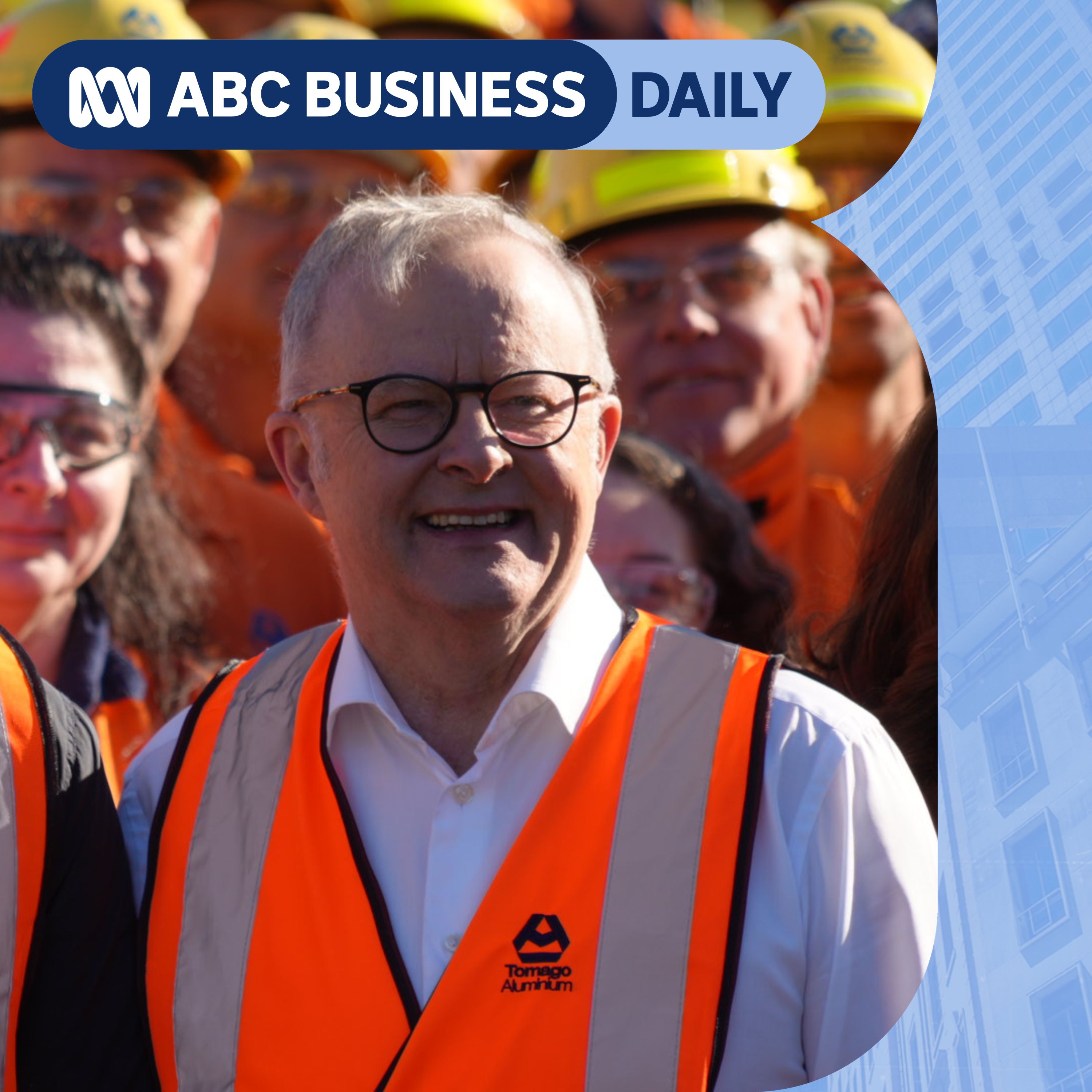
The episode of ABC Business Daily covers major Australian corporate news, focusing on a government bailout for Tomago, the nation's largest aluminium smelter. The federal and NSW governments will contribute $2.5 billion over 10 years, with Rio Tinto adding $1.1 billion, to protect 1,000 direct jobs and 5,000 indirect roles, and support sovereign capability amid global competition with China. However, the deal raises questions about taxpayer costs, profit-sharing provisions, and the viability of retaining industries reliant on high energy costs. This bailout follows a pattern of similar government support for other smelters and steelworks, prompting debates about picking winners and the risks of over-reliance on Chinese manufacturing.
The show also reviews earnings results from corporate heavyweights. Telstra's profit grew modestly, driven by cost cuts and job losses, but its share price fell 4% as investors questioned growth prospects. Executives faced bonus reductions after a nationwide outage, though most retained substantial incentives. Origin Energy reported a 6% profit increase to $1.6 billion despite a major data breach, with its CEO taking a 10% bonus cut. Meanwhile, IAG's profit dropped 25% due to costly storms, even as insurance premiums rise well above inflation, underscoring the financial impact of climate change. Overall, the episode highlights the tension between government intervention, corporate accountability, and economic sustainability.
ABC Listen, podcasts, radio, news, music, and more. Do you ever think that maybe the people making all the important decisions don't have a clue what they're doing? Stable, stable coins. Do you know what a stable coin is? Does anybody know, please raise your hand. The obvious solution to war is to have the West having the strongest, most precise, deadly weapons possible. I'm Matt Bevan, and on my show if you're listening, we take a look at every terrible decision that led to where we are today. New episodes every Tuesday and Thursday on ABC Listen, or wherever you get your podcasts. A more than $2 billion bailout is on the way for Tomago, Australia's largest aluminium plant. It's a move that the Prime Minister says will secure jobs and sovereign capability for the Australian economy, but who's going to foot the bill and what questions does this raise about the costs of decarbonisation? And what to make of earnings results from corporate heavyweights, Telstra, Origin, and Insurance Australia Group after outages, data leaks, and accusations of price scourging? Welcome to ABC Business Daily. I'm Michael Yandre. And I'm ABC Business reporter, Lynne Lynn. So Lynne, lots and lots in the headlines today. It's a very big day, particularly for corporate news in Australia. But before we get to all those results, let's have a look at this Tomago bailout. It's a massive amount of money, $2.5 billion from the government. Another 1.1 billion promised from Rio Tinto, which is the multinational giant that majority owns this smelter up in the Hunter Valley in New South Wales. Anthony Albanese and the New South Wales Premier Chris Minnes were up there at Tomago and addressing the workers to announce this bailout plan. What do you make of it? Well, on the one hand, I really do understand the logic in the sense that, you know, this is protecting jobs, the government says 1,000 direct jobs, 5,000 indirect jobs, and also this concept of course protecting the industrial base. Increasingly, we're seeing around the world, particularly in the US, we're talking about it in Europe. Competition with China, too. Yeah, exactly. It's a theme, right? It's not just an Australia-specific issue. We're seeing it in that context, and particularly in terms of that competition with China. But I do think it's a bet, right? Because it's a huge amount of money. And I guess they're trying to, well, they're hoping that with this injection of money, that this buys Tomago the time to transition to sort of cheaper renewable energy going forward. Yeah, so it's a decade-long deal. Part of this is a deal with Snowy Hydro, which is a federal government owned, you know, Hydro scheme that's a massive producer of renewable energy. So what you're saying in about this renewable transition, I think $100 million of the 1.1 billion that Rio Tinto's committed to invest, and that's a minimum, is slated to go to, specifically, to decarbonising this giant aluminium smelter, which does account for 12% of new South Wales's total energy consumption. Because it runs 24/7. It doesn't shut down. One of the advantages of these smelters, and I'm not sure to what degree this applies in Tomago, and whether this may be one of the things that investment goes towards modernising, but sometimes to an extent you can ramp up and down production at these smelters, and it actually becomes a stabilising factor in the electricity grid, because there's such big users that if you basically ramp down production for a few hours when there's peak demand, say, on a hot summer's night when everyone's running their air conditioning like crazy, then that can help the grid cope when otherwise it might fall over. So there's a whole lot of factors into why the federal government might be wanting to do this. Energy, of course, is the biggest single chunk in cost for something like an aluminium smelter. Believe something like 40% of its cost. So this deal, it's going to rest on the energy supply. It's a big debate too with another aluminium smelter in Tasmania, the Bell Bay smelter that's trying to strike a deal with Tasmania's hydro provider owned by the state government there, and there's apparently a $60 million a year gap between what Rio Tinto, who also owned that smelter, believe they can afford to pay for the power, and what the Tasmanian hydro is currently willing to sell it at. So that's another smelter that's under risk, and we could potentially, well, we are seeing calls for another federal buyout there as well. But in terms of the one that we've heard today, what do we know about who's paying what for this bailout in terms of the government money? It sounds like it's been split 50, 50, between the federal government and the New South Wales government. And this is going to be $2.5 billion over 10 years. My understanding here is that this has been in discussion for some time, and that the New South Wales government was pushing for this 50, 50 split in terms of who was going to. They were trying to minimise their contribution to this, and they have managed to get one concession, which is their contribution is capped, because the federal government's contribution isn't. That has raised some high brows that the federal government's on the hook for an unlimited amount of money. At the end of the day, I guess it's tax payers that are footing the bill, isn't it? Yeah, what's money that's coming from other areas where the government could have spent it? I mean, another interesting part of this deal, and we haven't had specific details, but apparently there is some kind of profit-sharing provision where if the smelter does particularly well, and aluminium prices are high, then the federal government will actually also be able to recoup some of its investment through a share of those profits. But the big argument about tipping this government money in is the employment. That was the main focus for Anthony Albanese at his press conference at the smelter. Today, a thousand jobs on site, and he claims five thousand jobs in the regional economy indirectly linked to keeping this smelter open, and potentially tens or even hundreds of thousands of jobs around the country. How credible do you think those claims are once you start moving from the workers at the plant to these apparent tens of thousands of jobs around the country that are supposedly linked to the plant? Yeah, I mean, I guess that there are going to be indirect jobs affected because of the contracts that the smelter would have with other businesses. But yeah, we don't really know where they've received this sort of modeling in terms of the numbers. But I mean, certainly protecting jobs is something that we know is going to be politically popular to be putting out there as a key reason. And this is coming at a time when the economy is very uncertain, and we know that households are struggling with inflation as well as interest rates. But yeah, certainly the 1,000 jobs, but in terms of the other numbers that have been thrown out there, it's difficult to quantify. Yeah, I guess the local pubs where the workers go after work, where they wouldn't go if they didn't have a job or the cafe where they go and get lunch or the hairdressers where they get their haircuts. And I guess if the plant shut down, maybe some of them would move away altogether to find other opportunities. And certainly we've seen that in areas that have lost major industries where they also then suffer a loss of population. The other big argument around why the government's investing in this is sovereign capability. Again, Anthony Albinese mentioned several times the future made in Australia, which is a major policy of his government. But the question I have around that is, what on earth will Australia do with the raw aluminium? So you turn the alumina into aluminium, but then do we actually have any manufacturing left to use that raw product and have a future made in Australia? Or do we just end up sending that overseas? Yeah. And it's a similar question with other bailouts as well. And there's quite a long list, isn't there, Lynn? Yeah, there's been a number of similar bailouts we've seen over the last couple of years. There was a $2 billion package to also support Rio Tinto's Boine aluminium smelter, $2.4 billion bailout for the Waiala steelworks, $600 million for Glen Cores Mount Isah Copper Smelter. So we're really seeing a bit of a pattern here. Yeah. And I mean, these are some big companies we're dealing with. Rio Tinto's name keeps popping up. But also we're seeing, you know, a multinational giant like Glen Cores. And I guess the really grating thing there is I remember working at four corners on the paradise papers. And one of the stories that we broke out of those leaked documents was how Glen Cores structures its international affairs to minimise the tax it has to pay in Australia. In fact, the tax office successfully ran a case against Glen Cores, which tried to deny access to those leaked documents because they basically exposed some of the ways that they were getting around multinational tax. So you've got a big company that's minimising its tax in Australia and yet getting $600 million of government money to keep, you know, one of its
facilities open it. It's frustrating. It's frustrating. But what's the alternative, I guess, is also the question. I mean, yeah, the alternative is a lot of these plants shutting down. And again, going back into deep history, I remember the famous incident of Craig Emerson, then in the Rudgillard governments, to the tune of, you know, singing the song "Wile Out." I forget what the tune was, horror movie. That's right. It was Skyhooks, you know, with these little boombox in the parliament house courtyard singing, you know, "No Wile Out." Well, you know, there was no Wile Out then. There almost was before it got bailed out again with this large package. And then there almost is again, because it's going to need further support to stay open after, you know, the latest owners couldn't make a go of it. So it does raise this question of when do you draw a line under these things and say, we just can't compete. But as we sort of discussed earlier, if every Western country did that, there wouldn't be much industry left outside. It would all be made in China. Yeah. It would all be made. And I mean, you know, I guess another example we can think about in history is Holden and our car manufacturing sector, right? They had been subsidized for many years, but you know, that tough decision was made on that. I also think about what we've seen recently in terms of the oil shock in the Middle East. And that's really kind of put a spotlight on the fact that we only have two refiners, oil refiners in the country. So I guess, you know, there is the argument there that perhaps we do need to retain some of our strategic assets, even if that means that we'll need the support of government. But I guess it's which ones should be the, how do you pick the winners, I suppose? Yeah. And the case in point there is rare earths and critical minerals, because as we've seen, by allowing the low cost producer, which was state subsidised in China to dominate the supply chain from mining through the processing, all of the Western economies, including the United States, really put themselves at the mercy of China for these absolutely critical elements for modern technology. And while aluminium is a bit more old school, it's still essential to a lot of modern technology. You can't have a lot of modern aircraft without aluminium. It's a lightweight, strong corrosion resistant material. So as you say, Lyn, it's this dilemma, it's going to cost us a lot more money and it's inflationary, but can we afford to be completely reliant on low cost producers like China for all of our metal supplies? Speaking of a lot of money, Lyn, that's a good segue to corporate reporting season, because we've seen some of the biggest names in Australia come out with their annual profit reports today, notably the major telco telstra, which saw its profit go up in line with expectations. But the results were a little bit more complicated than the headline suggests. Indeed. So looking at that result, it does seem like partially, it was funded by some job cuts that we've seen. The company had slashed about 1200 jobs mostly in its enterprise division, but also because of a few other initiatives as well. And then on executive pay, which was really under the microscope after the nationwide outage earlier, especially as, and we have this on the record as well in the annual report today, the company has admitted that the cause of the outage was something within their control. Basically, chaping out on some equipment that they probably should have replaced. Yes, or updating the software on that piece of equipment or documenting the network design change. So this is all in their annual report today. I was looking for updates on how they are dealing with the outage and what is also the financial fallout from that. Basically, the company is saying that they are still in the investigation phase. They've received one regulatory notice. They expect that they will receive more. But when it comes to the costs or how much compensation they've paid, they said that it's still very much unknown, still ongoing. Although we understand that they have credited about $1 million to date. Also interesting what they had to say in terms of executive pay, because this was one of the questions coming out of the outage. Should there be accountability? Yeah, accountability. Should the buck stop with the CEO and with the other executives? It seems like the CEO, Vicki Brady, she still had her pay increase. It went from $6.2 million to $6.8 million. But the board said that in terms of looking at her performance multiplier, I guess it's a bonus. Short term incentives. They've docked $607,000 from her pay. Which is a lot of money. I'd love to earn $607,000 full stop. That would be a very massive pay increase, as I'm sure it would pretty much everyone who works at the ABC bar may be a couple of people. But in the context of things, they've taken 10% haircut off all of their executives because they've said to look everyone shared responsibility for this. It was a network-wide problem. They haven't targeted any particular executive. They've all taken a haircut, which has cost them collectively $1.3 million in lost pay. But I was looking at the numbers. The executives are still taking home the vast majority of them are getting at least 70% of the maximum short term incentive that they're entitled to. That's despite their profit growth only being about 3% over the year and revenue actually falling. None of the executives listed in the annual report got less than 60% of their maximum bonus. They still do have a national outage. You can have pretty weak profit growth. It's really not that far ahead of population. You can have revenue falling. Yet you can still get 60, 70, or 80% plus of your bonus. The share market reactions quite telling as well about these results because Telstra, despite spending more than $1 billion, I think it's $1.25 billion more on buying back its own shares. You push as share prices higher because there's less shares left out there. Despite that, the share price, when we talk in the middle of the day, was down around 4%. I think to me that looks at the fact that the only way they've managed to grow profits is cutting costs. There's only so far you can cut costs before you run out of room to cut. I wonder if investors are starting to think where's the growth in this business? Good point. Speaking of growth, though, Origin had a much more positive reception to its result on the share market as well as a much bigger growth in profit. How much did the big energy retailer see it's earnings increasingly? The second biggest energy company saw its net profit rise 6% for the year, ending in June to $1.6 billion. This is even as its total group revenue fell by 10% to $15.6 billion. They've not been without their own problems over this period, as we well know because we've spoken about it on this podcast. This major data breach that happened last month that affected 900,000 current, as well as former customers. They admitted that data was compromised from names, addresses, phone numbers, also partial credit card numbers and so on as well. So they have very much been under the microscope in terms of that particular breach and how they are dealing with it as well. And we've seen as well on that front a hit to the CEO's STI bonus that reduced by $357,000. Which was also 10%, seems like this is the standard figure in corporate Australia for, "We've done something wrong, I will just take 10% off." And the last of the big results out today, which is interesting to most of us who have car insurance or home insurance, is insurance Australia Group, IAG, owned some of the biggest insurance brands in the country such as NRAM A. It's net profit though, down 25%, despite the fact that we've just had a report earlier this week from the corporate regulator ASIC showing that there's been an 8% annual increase on average in car insurance premiums over the past year and 42% over the past five years or so. Well above inflation. So one of the big drivers of inflation has been insurance premiums and yet IAG's struggled to make money. But an interesting story in their results, I guess it shows the problems of being an insurer. One of the biggest swing factors was last financial year they recorded $195 million favourable benefit from basically benign weather and climate. And then last financial year,
you just ended, they've had a $114 million unfavorable impact from particularly storms in Southeast Queensland and so on and lots of expensive damage claims. So, you know, I guess it's the life of an insurer. You can jack up your premiums and still have a fall in profit and their share price did get whacked 6% again around the middle of the trading session on those results. But I guess from a consumer point of view, it does raise some issues around these climate effects because IAG in the last year hasn't profited and yet their customers have been paying more for their insurance. Yeah, that's a really good point because yeah, I mean, as you say, we're seeing these insurance premiums rising well above inflation and yet as you say, it's been a tough year for them in terms of their bottom line. Yeah, and only going to get tougher the more these intense weather events hit. And you know, we've seen reports about the increased likelihood of severe health storms in some of the major population centers in Australia. And they're the really expensive people think about fires for insurers, but still the most expensive inflation-adjusted insurance event in Australia is the Sydney Hellstorm that happened a couple of decades ago that wiped out thousands of cars, luxury cars in the eastern suburbs. Wow. With that, that's it for today's episode of ABC Business Daily. Tomorrow, be sure to catch that's business with Alan Kohler. We'll be sitting down with Craig Piggett, the CEO and founder of Farm Tech Company Holter, which does livestock collars that let farmers herd cattle from their smartphones. Carrington Clark will be back in the hosting chair on Monday and we'll look forward to bringing you more great analysis on the biggest business headlines to never miss an episode. Make sure you're following ABC Business Daily on ABC Listen or wherever else you get your podcast. Catch you later, Lynn. next time.
Podcast Summary
Key Points:
The Australian government announced a $2.5 billion bailout for Tomago, the country's largest aluminium smelter, with Rio Tinto committing an additional $1.1 billion to secure jobs and sovereign capability.
The deal, split 50/50 between federal and NSW governments over 10 years, aims to transition the smelter to renewable energy, but raises concerns about taxpayer costs and the broader pattern of industry bailouts (e.g., Boyne, Whyalla, Mount Isa).
Telstra's annual results showed a modest profit rise, funded partly by job cuts, while executives faced bonus reductions (e.g., CEO Vicki Brady docked $607,000) after a major network outage, though most still received 60-80% of their bonuses.
Origin Energy's profit rose 6% to $1.6 billion despite a data breach affecting 900,000 customers, with its CEO also taking a 10% bonus cut.
Insurance Australia Group (IAG) saw net profit drop 25% due to severe storms, despite rising insurance premiums, highlighting climate-related cost pressures.
Summary:
The episode of ABC Business Daily covers major Australian corporate news, focusing on a government bailout for Tomago, the nation's largest aluminium smelter. The federal and NSW governments will contribute $2.5 billion over 10 years, with Rio Tinto adding $1.1 billion, to protect 1,000 direct jobs and 5,000 indirect roles, and support sovereign capability amid global competition with China. However, the deal raises questions about taxpayer costs, profit-sharing provisions, and the viability of retaining industries reliant on high energy costs. This bailout follows a pattern of similar government support for other smelters and steelworks, prompting debates about picking winners and the risks of over-reliance on Chinese manufacturing.
The show also reviews earnings results from corporate heavyweights. Telstra's profit grew modestly, driven by cost cuts and job losses, but its share price fell 4% as investors questioned growth prospects. Executives faced bonus reductions after a nationwide outage, though most retained substantial incentives. Origin Energy reported a 6% profit increase to $1.6 billion despite a major data breach, with its CEO taking a 10% bonus cut. Meanwhile, IAG's profit dropped 25% due to costly storms, even as insurance premiums rise well above inflation, underscoring the financial impact of climate change. Overall, the episode highlights the tension between government intervention, corporate accountability, and economic sustainability.
FAQs
The Australian federal and New South Wales governments are providing a $2.5 billion bailout over 10 years to Tomago, Australia's largest aluminium smelter, with Rio Tinto committing an additional $1.1 billion to secure jobs and support decarbonisation.
The bailout aims to protect 1,000 direct jobs at the plant and 5,000 indirect jobs in the regional economy, according to Prime Minister Anthony Albanese, though broader claims of tens or hundreds of thousands of jobs are harder to quantify.
The investment aims to protect jobs, maintain sovereign capability in aluminium production, and buy time for the smelter to transition to cheaper renewable energy, which is crucial as energy accounts for about 40% of its costs.
The deal includes a profit-sharing provision where the federal government can recoup some of its investment if the smelter performs well and aluminium prices are high, though specific details have not been disclosed.
Telstra reduced executive bonuses by 10%, including a $607,000 cut to CEO Vicki Brady's pay, after the company admitted the outage was due to controllable factors like outdated equipment, though most executives still received at least 60% of their maximum bonuses.
Origin Energy's net profit rose 6% to $1.6 billion, despite a 10% fall in revenue to $15.6 billion, and the CEO's bonus was reduced by $357,000 following a major data breach affecting 900,000 customers.
Chat with AI
Loading...
Pro features
Go deeper with this episode
Unlock creator-grade tools that turn any transcript into show notes and subtitle files.
 PodcastTranscript AI