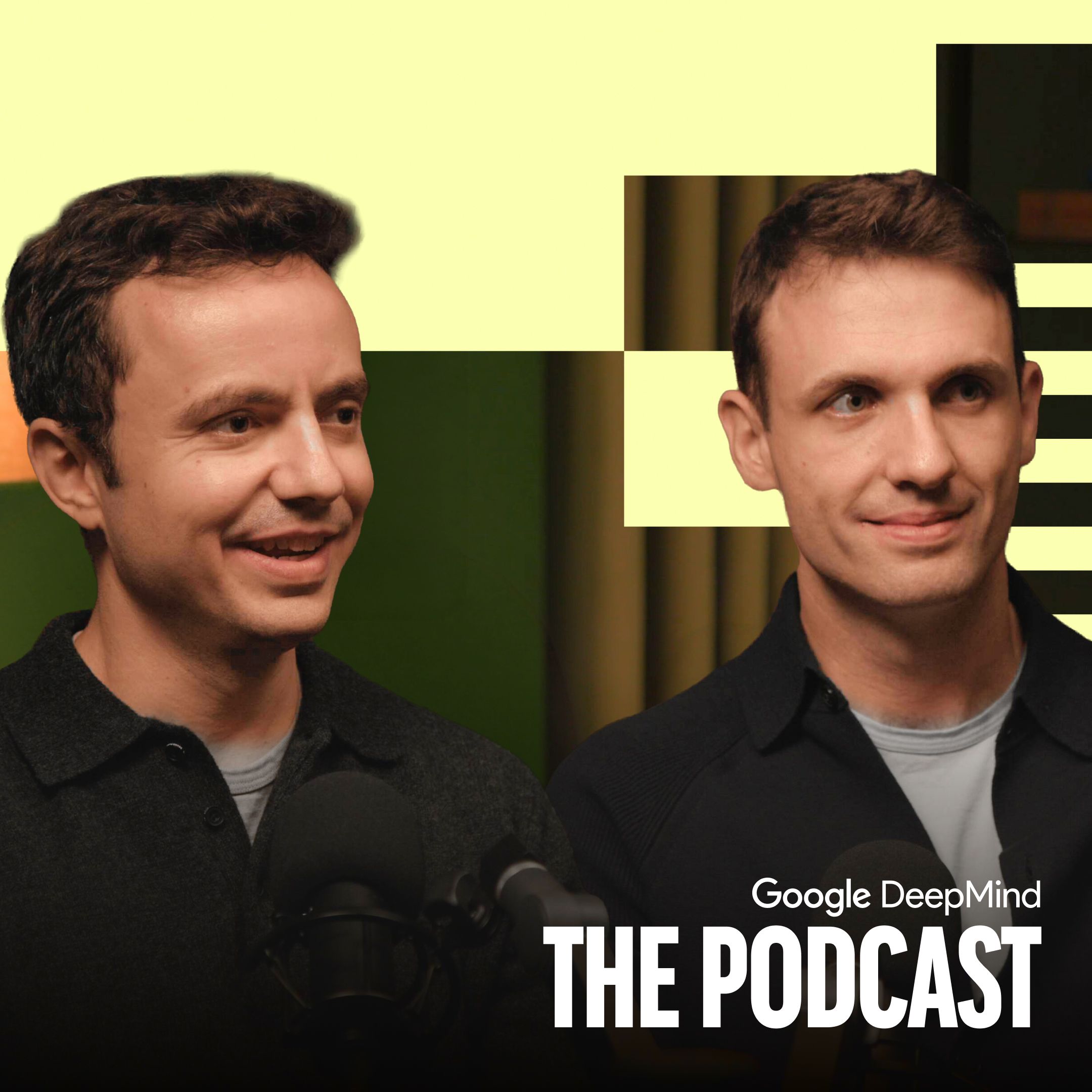
AlphaGenome 2: Teaching AI to read the entire human genome
from Google DeepMind: The Podcast
39m 44s
Google DeepMind's Alpha Genome project leverages AI to decode the complex relationship between DNA sequences and cellular function. While the human genome contains 3 billion base pairs—over 200 times longer than the complete works of Shakespeare—interpreting how genetic variations affect cells has remained a major scientific challenge. Alpha Genome addresses this by using deep learning models trained on public genomic data to predict the functional impact of DNA mutations across tissues and cell types. It advances from initial models analyzing bulk tissue data to Alpha Genome 2, which delivers cell-type-specific predictions, enabling researchers to identify which variants influence gene regulation in specific contexts like immune cells or neurons. The system assigns a variant impact score (AVI) to rank mutations, helping prioritize those most likely to cause disease, especially in rare conditions like pediatric epilepsy. In one case, it correctly identified a splicing variant linked to seizures, later validated in lab experiments. Though not a clinical tool, Alpha Genome aids in narrowing the genetic causes of disease by providing molecular context. It also helps resolve ambiguous findings from genome-wide association studies by identifying causal variants and their cell-specific effects. Despite limitations—such as missing rare structural complexities and false negatives—the tool offers high-precision predictions that guide further biological investigation. The ultimate vision is a "virtual cell" that can simulate how cells respond to genetic changes or drugs, advancing precision medicine. This work represents a critical step toward understanding the full functional map of the genome, bridging the gap between genetic code and biological outcome. While still in early stages, the technology is already transforming rare disease research and is expected to play a key role in future drug development and personalized medicine.
Welcome to Google DeepMind, the podcast.
Sequencing human DNA took 13 years,
and the result is a string of text
that is many hundreds of times longer
than the complete works of Shakespeare.
And deciphering what those strings of letters actually do
has taken much longer.
As Eric Lander, a geneticist involved
in the human genome project put it,
we bought the book, but it's quite hard to read.
But now with AI, that book is gradually becoming more legible.
Now way back in season two of this podcast,
we heard how Google DeepMind had developed a transformer model
that could predict the effect of DNA sequences across the body.
We're trying to build AI that essentially
can understand the genome.
The factors we now have, the kind of level of data
where deep learning can really take hold.
And we've been able to build together
the kind of deep learning models that
are able to read a DNA sequence a bit like he might
read a piece of text.
Since then, progress has been rapid.
In 2025, they unveiled alpha genome,
which predicts the function of non-coding DNA
across whole tissues.
And now alpha genome two zooms down to individual cell types
to shed light on how single mutations drive disease.
As you get at them, thank you so much.
Welcome to the podcast.
Thanks for having us.
In a nutshell, what is alpha genome actually designed to do?
Give it to me simply.
So alpha genome is designed to read a stretch of the DNA,
or the genetic material, the instruction manual in the cell,
and tell us what's happening inside the cell
at that location of the genome.
And also tell us what happens if we make a small change
to the DNA sequence.
If we change the letter A to a letter T, what would change
at that location in the genome?
So it's a tool for us to study sequences and variants
at the molecular level.
Let me ask you both, what was your personal motivation
to welcome this?
I mean, you started off as a physicist, didn't you?
Yes.
During my studies, I realized that physics is not my true calling.
And I stumbled upon a machine learning course, which--
and then I find learned that machine learning
is has a lot of components that I loved
in terms of problem solving maths.
And it was also very applied.
And it turned out this course was
thought by two researchers in genomics.
So after the course, I went to them
and asked if they had any interesting problems
in machine learning in genomics.
And they had, of course, we do have.
And my first project was in trying
to pinpoint variants in a rare disease patients.
And I feel like that problem of not knowing
what mutations do and how should we think about them
really stuck with me over the years.
And I feel like the motivation I feel
like for our work is both to help patients with rare diseases
and also patients potentially suffering
for other diseases as well as the feeling
of being able to advance the frontier of science
is something I find very exciting.
How about you, Adam?
Well, actually, my background is in computer science
and operations research.
I think for me, I'm actually coming
into this field from the lens of a family illness.
And I think what's refreshing about doing things
to improve human health is that there's
a lot of different ways you can do it.
And for me, I literally just googled like machine learning
biology like 12 years ago.
And then I took this route that pretty much ended here.
But because you had the personal experience
of knowing sort of living with rare diseases.
Cancer in this case, but yeah.
So basically, googled it, came across this really interesting
field called single cell genomics.
And then one step after another, I sort of entered
into computational biology in more serious machine learning
models.
And I think I'm really happy with where we're at
in terms of applying these models.
And I think in the future, really making an impact
on human health.
On things like cancer and diseases,
as you were describing.
OK, well, for the nonbiologists among us, IAE, me.
Maybe let's start from the beginning here.
Because you've got a genotype and a phenotype.
And I mean, tell me what those are, first of all,
and how big of a challenge is connecting them both up?
Yeah.
So genotype is really the set of letters
that we have in our DNA, ACGT.
I think a lot of people are familiar with that.
And humans have the genomes 3 billion in length.
And the phenotype, this is really an overused word
in biology.
This can mean like hair color.
But we really think about phenotypes
at this cellular level.
So how will genes change their expression
in different cell types?
And the connection between phenotype and genotype
and phenotype is how does a variation in the genome
affect these phenotypes at different molecular scales?
Because you're right that one example
that people often use, or maybe I often use,
is that the MC1R gene is the thing that gives you red hair.
You've got a kind of genotype and phenotype.
But we're talking down at a much smaller level here.
Yes.
I mean, ultimately, you'd want to really
understand the relationship between high-level phenotypes,
such as whether somebody has a certain disease,
like Alzheimer's, some more type to diabetes.
But this distance between genotype and phenotype
is very long and very complex.
It's a very complex relationship.
A lot of things have to happen in order
for the phenotype to happen.
So we try to simplify the problem by focusing on things
that are closer to the molecular biology.
So they're really the underpinning
of how the genome works at the molecular level.
Because we feel like it's a simpler process.
And we have a lot more data in order
to make accurate predictions.
Because I think for a while there was sort of a suggestion
that if you had a particular mutation,
that would then cause a result in a particular change
in the body.
I'm thinking about the BRCA1 gene, for example, here,
where we know that it's associated with increased risk
of certain types of cancers, breast cancer in particular.
But it's more complicated than that, right?
Yeah.
So I think we can break down these sort of diseases
in two classes.
There's Mendelian diseases where you have a variant
that affects a gene.
And this gene directly causes a particular disease.
And then there's complex diseases.
And essentially, as humans, we have a risk profile that's
determined by our genetic background.
And these are often also caused by environmental factors.
So it's not always just one variant sort of one disease,
but it can be quite complicated across the genome.
And many genes can be involved in a disease.
Because I guess there's a lot going on in the DNA that
is sort of switching things on and off.
I mean, people used to call this junk DNA, didn't they?
Yes, exactly.
So I think the main role of the genome
is to produce proteins, which are these building blocks
in the cell.
And I like to use an analogy of Lego building blocks.
You can think of proteins of these Lego building blocks.
And we all started off as a single cell
that contained one instruction manual from our mother
and one from our father.
And then the cell divided and specialized
into different cell types in our body.
So all the cells carry the same genetic material
yet they get specialized.
And by specialization, this means that they
need to produce different building blocks
to build up different machines, so that they can carry out
specific functions such as cells in our eye
need to be able to detect light.
Muscles need to be able to perform physical movement.
So they need different machines inside them.
So that's why the 2% of the genome
encodes for these-- you know, what are those building blocks?
You know, you think of this as the shape and the color
of the Legos.
But then the rest of the genome, the 98%,
tells the cells how many of these building blocks
should they produce so that they will assemble
into the right machines to carry out the function.
So-- and this code to generate the code
of when and when-- where to produce these proteins
can be quite complex because we have so many different cell
types in our body, right?
So-- and they all have to respond differently.
So there's a lot of action going on in the regulation
part of the genome.
Well, because if every cell has a complete copy
of your DNA, how does an eye cell know to be an eye cell,
and a heart cell know to be a heart cell,
and you know, whatever else is going on in your body?
Yeah, it's really fascinating.
I mean, essentially, as you go-- as you go said,
we have these control elements within this 98%
of the non-coding genome, and really different cell types
use these in different combinations.
And with these different combinations,
they can perfectly fine-tune the levels of expression
that are required to perform-- to perform their function.
Is it a bit like on and off switches?
It's a very complicated on and off switch, yeah?
Yeah.
Yeah, fair.
Yeah.
So about five years ago, maybe six years ago,
on this podcast, we were talking to some of your colleagues
about some work that have been done using transformers
to read DNA sequences.
I mean, quite a lot has happened since then, isn't it, really?
Do you want to give us a rundown?
Yes, yeah, yeah.
So we continued on our mission to try
to use AI to decipher the genome.
And a informer was really our first project
in collaboration with Calico on building these models
that read the DNA sequence.
Then, obviously, Alpha Fold 2 came along.
And we went from also studying the non-coding genome back
to the coding genome because we felt
that Alpha Fold was a great opportunity for us
to really think about how the mutations affect proteins.
So how long on a second then?
Because as a minute ago, you said only 2% of the genome
goes into encoding proteins.
Exactly.
So at this point, you're like, well, let's just go for that.
We've got Alpha Fold.
Exactly.
So protein folding is our thing.
Let's focus on that.
Yeah, I spoke to John Jumper and one of the first questions
that I asked him when I joined DeepMine is like,
how good is Alpha Fold 2 at predicting the effects of mutations?
And he's like, unfortunately, not very good.
It always keeps predicting almost the same structure
because it has been designed to be robust to mutations.
But it felt that there should be something inside the model
that might be helpful for breaking mutations.
Like, if you understand structures and evolution of sequences,
then this might be a continues full clues
to predict what mutations do.
So we've done Alpha Missense.
which really uses Alpha Fold as a base model
and then fine tunes it to predict
which mutations will be potentially pathogenic
or deleterious and which ones will be benign.
So that was our kind of detour
into the world of coding variants.
- 'Cause I think this sort of makes sense.
This is sort of like a,
it makes sense that this would be the first thing
that you would want to try.
- Yes, exactly.
- But you've got this incredibly complicated recipe
that builds a body like builds life forms.
Tiny bit if it will build proteins.
- Exactly.
- You can fiddle around with that.
- Exactly.
We get that map between what the instructions say
and what they help.
- Exactly, yeah.
So that was our, that was one project we've done.
- Only on proteins.
- Only on proteins, yeah.
But we felt that people have been building
these kinds of models for a long time
and I feel like we're getting quite close to these models
being quite good at predicting the effects of variants.
- Were you actually understand the impact
and mutation has?
- Exactly, yeah.
There's still a lot of things we don't understand
such as what precisely biophysically happens
but the accuracies of these models
are getting quite good.
- Unfortunately it's only for two percent.
- Exactly.
- Unfortunately, so this is bothers us basically
that what do we do with the rest of the 98%?
So we went back and we worked on alpha genome
which was then the next iteration of the informer model
where we expanded the sequence from 200,000 to a million
and we also increased the resolution
from 128 base pairs down to a base pair
and that really allowed us to leverage more information
in the data and thereby improve the model.
And then we decided, well it's a complex model
and it still takes quite a bit of compute to run
so why don't we make it more accessible to people to use it?
So we generated alpha genome atlas where we took alpha genome
and we pre-computed the effects of mutation
for every single possible letter change in the human genome
that's nine billion changes
and then we have exposed this resource as a website
and we also made it easier for people to quickly
grok whether a mutation is something worth paying attention to
by compressing down the 10,000 numbers that alpha genome gives you
plus the alpha-mesand score
plus evolutionary conservation into a single number
which we call the avi-score or alpha genome variant impact score
that then allows people to rank mutation
and then find the needle in the haystack.
- Okay, so let me make sure I understand this then, right?
So what is it actually doing?
How are you getting this mapping from the genome to the phenotype?
- So over the last 15 plus years,
the community has really put together
a lot of amazing data resources.
So we actually just use public data
that has been collected at various universities or labs.
- This is people's DNA.
- This is data that essentially takes people's DNA
and measures different properties about it
such as how expressed are the genes?
How open are different regions of the DNA
that allow different proteins to bind it?
Is we're not actually training them out on individuals genomes.
We actually train with respect to what's called the reference genome
which is really interesting
because we make predictions about different variants
in the genome despite the fact that we only train it
with respect to one fixed genome.
So what we do is we take different modalities
such as gene expression, TF transcription factor binding
and essentially we align them to the reference genome
and then just by training a model that maps
from the reference genome to these modalities,
we can make these variant predictions.
- Maybe it's worth also giving a historical perspective.
So after the human genome of sequence in 2003,
people realized, oh, there's actually a lot we don't understand.
There was a big project that spun off
on the back of a human genome project
called the ENCODE Project and the Clopidia of DNA elements
and they've invested a lot in technology development
that allows us to use DNA sequencing
as a way to measure what's happening at the genome
in a molecular way.
- That point you make about the human genome project
is a really good one that you've got.
I mean, it's literally like an entire shelf of books.
It's like a one person's DNA
and that's great, but who knows what any of it actually means.
- Exactly, yes.
- But then it turns out you've got many, many people's DNA
and you can look across them for differences and changes
and work out which ones are the changes
that lead to the individual variation amongst us
in the way that like my DNA might be different to yours
or to yours, but then also people who have rare diseases
to try and hone in on what those differences might be, right?
- Exactly, yes.
And then even though we still don't understand everything
between the genome to what you get as the output,
you're now at least able to predict
how likely a change, a single mutation will be
at impacting the outcome.
Is that a fair way to describe, baby?
- Yeah, exactly, yeah.
So it gives you for a single mutation or a single variant,
it gives you a score, a number between zero and roughly 80
and the higher the number is, the more you should pay attention
to it as meaning that it probably does something
to the cells that you should pay attention to it.
So from a geneticist's perspective,
if you end up with a list of variants
that are all suspects in causing either a disease
or being causally associated with a phenotype,
you can use AVI to sort them, to rank them
and then spend more energy at looking at things
that have higher AVI scores.
- If it comes back with a zero, don't worry about it.
It's not gonna make a difference.
- The way we've trained this is we took all these scores
and we built another model to predict which variants
are frequent in the human population
and which ones are absent from the human population,
because things that are frequent in the human population
are generally benign, we all carry these variants
and we're all fine, we're generally fine,
but things that we haven't observed
in the human population could be because the human population
is too small and we didn't have the time
to observe these mutations or variants
or because they're bad, it is very noisy signal
but it's good enough to point us in the right direction.
So obviously the models and so forth are still imperfect.
There's a lot of things we need to be much better at
but at least it gives us some hints
about what's potentially happening at the molecular level
so we can then better reason about these associations
between the genotype and the phenotype
which can be quite complex.
- 'Cause I guess that's the point, right?
Is that sometimes when the genome gets copied
some typos don't make any difference.
Some typos might change your hair color,
maybe a bit taller, something sort of innocuous
but some end up really causing serious problems
and atlas can tell you which typos
are more likely to be problematic.
- Correct, yes.
It also tells you at the molecular level why that is,
is it because of increased expression
in certain cell types and so forth.
So it allows you to get a little bit more information
than just the score is high, but that's it.
- But this isn't supposed to be a sort of clinical tool,
is it, right?
It's much more of a research tool.
- Yeah, so this is a research tool
that allows geneticists or other biologists
really to prioritize variants and interpret them.
I can say, oh, actually this variant looks like
it causes this particular gene to be processed
in a slightly different way.
And that actually might be what's causing
this particular disease.
But really, this is one part of what would be
a huge pipeline that people follow
and it's very important that this tool is used
as part of an actual rare disease pipeline.
- Like you're looking for clues.
- Exactly, yeah, that's a good way to do that.
You're looking for clues and you need to,
at the end of the day, make sure that all the clues
that you've gotten through different things
might all add up and then you can gain your confidence.
So when we develop Alphaginum Atlas,
we gave early access to it to researchers
at the Broad Institute and particular Laura Covell,
the researcher that really looks at these hard
rare disease cases where people have the,
they were sequins, but they did clinical genesis,
they didn't know what was the cause.
- In one case, there was a patient who was a baby
suffering from a rare epilepsy case
and she was diagnosed at six weeks of age.
And then for a number of years, I think it was like four years
or even five years, they've done a number of tests
to figure out what is the mutation.
- So they knew it was genetic.
- They knew it was genetic, but they didn't know
what exact variant was causing this child
to have this disease.
And then Laura applied Alphaginum variant impact score
to this patient, she ranked the variants
and she saw that the top ranked variant made sense,
that it was affecting a protein that has a function
related to that condition, the seizures and the epilepsy.
And it was actually matching some reports
from the previous literature about this function
of this variant actually.
And they went in and actually validated this experimentally
and then all the puzzle pieces kind of clicked
and connected and they were able to solve that case.
- How did they validate it experimentally?
- So because this variant was a splicing variant
where it changes how Arning gets cut and joined together,
they could design a small gene that contains sub parts of it.
And then you look at where these cutting patterns
will occur and then you insert mutations in there
to see if these cutting patterns change.
And that's how you can experiment to validate
that the splicing matches what you're experimentally predicting.
- So this is all in a lab, presumably all in petitions.
- This is all in a cell line.
You insert this piece of DNA into a cell line
and then the cell line produces this gene
and then you see what kind of version of the gene
it produces, whether it splices here or splices there.
But then if you do identify the genetic cause
of a particular cell.
rare disease like, you know, pediatric epilepsy. I mean, can you do anything about it? How
does it help? I think there are two, two important implications of finding this, the so-called
molecular diagnosis in rare disease patients. The first is, obviously, if you know what the
root cause is, you have more chances of finding the right cures. And also these days, there
are new genetic medicines being developed, such as the antisense oligos, which are short,
pieces of RNA that bind the RNA and can change how this RNA is processed and potentially
reverse that. Or, genome editing is also another option on the table in terms of potential
ways to cure. So, like, knowing the variant, obviously, it's still a very long road to
and small chances of actually developing that medicine. But I think it gives hope that
this might be possible one day. The other thing is, obviously, for family, future family
planning, you don't want to understand, you know, whether the parents had the same mutation,
if you had the second child, you know, how likely it is that the child would have suffer
from the same disease and so on and so forth. Or does anybody else have, in the family,
is pretty supposed for these things. So, it's useful to also understand, so do you understand
the family genetics through that lens? I'm just wondering how these approaches compare
to population-wide studies that have happened for a really long time here. I mean, particularly
in the case of Alzheimer's, for example. Just taught me through those, how do they work?
You know, we've been talking a lot about rare disease, but I think a very common tool
that geneticists use is what's called a genome-wide association study. And this is conceptually
very simple. I just take a bunch of people, I sequence their DNA, and I look at the differences,
and I try to associate that with a trait. And geneticists, they look at all kinds of traits.
I think one of my favorites is like, do you think that cilantro tastes like soap?
Coriander, coriander, yeah, exactly. Do you, by the way?
I don't, but I have a friend who does. I don't think so. No, I don't hate them, not necessarily.
But this is how niche I think the traits are. There's traits like that, and then of course,
there's traits like, you know, risk of inflammatory bowel disease, things like this, diseases,
different kinds of cancer, and so on. So, the thing is though, once you have this list
of associations, they're just associations, right? And what we aim to do with our modeling
efforts is really try to understand which of these variants is actually, what are they doing
at the molecular level, and could these molecular changes be driving particular phenotypes that
we see in cells? And then can we have a better sort of causal association towards a disease?
Because I guess also with the associations studies, we're not necessarily talking about
single letter typos here, right? I mean, genes are sort of, you kind of get inherited
in chunks. Right. Yeah. So, one of the, one of the challenges with genome art association
studies is what's called linkage disequilibrium, which is just a fancy way to say, you inherit
your DNA in chunks, right? And what can happen is that I might see that there's a particular
change that looks important, but that's just because it's correlated with a different
change that's actually the causal one. But because things aren't inherited together,
we can't really disentangle these two things. And this is where computational modeling
and statistics really comes in handy to unpack, you know, which of these changes are really
the causal one? I guess also though, I mean, how good are gene-wide association studies
when you're talking about rare diseases? I mean, the epilepsy example that you gave earlier
if it's an extremely rare thing? I mean, I think this is a question of statistics. You
need a lot of people to detect rare variation. So genome-wide association studies tend to focus
on common variation, which I think we put a line at around 1% frequency of occurring in
human populations. A rare disease would be a different ball game. So they're much less
applicable to rare diseases because you don't have many people that have the same disease
and also the variants that are affecting are very rare. So then, okay, if that's how
you do it with sort of lots of people, how does alpha genome give you a more granular
view of this? I mean, because it does. Yeah. So essentially, we take these mutations
and we just plug them into the model and we record what the model thinks changes about
these different molecular properties. And we can do this systematically and at very large
scale. So, Giga was describing the atlas. This was done over 9 billion possible variants,
which is essentially all the possible variants in the human genome. It's down to one letter.
Down to one letter, right? And really, what we do after the fact is look at exactly which
biological contexts are we seeing these changes? What do you mean by biological contexts?
So, a biological context could be a cell type, but this could be a cell type that's taking
a particular state. Maybe it's an immune cell that's in a pro-inflammatory state, right?
So this is, and these differences can be actually pretty important when we try to understand,
is this variant actually having an effect in this particular state? So they can really
go down to this level of, for example, immune cells in this inflammatory state and not
just broadly the heart or something. I think there are three clues we're looking for when
you try to analyze the genomic association study. The first question is we said that we
co-inherit DNA in blocks and then imagine you have 10 or 20 variants, there all seem to
be associated with a high risk of having Alzheimer's. The first question is which of these variants
actually is the cause of making you have a higher chance. Similar to the rare disease example,
but here we're talking about prioritizing variants that are all associated with the phenotype,
but only one of them is a causal. So the first question, the second question is what gene
is being targeted by these variants? And the third question is what, as Adam mentioned,
is what's the cell type that in which this variant has an effect?
So is this what's going in to give rise to alpha genome 2?
Yeah, exactly. So previous models in this sort of class of models have focused on making
predictions, typically at what's called the bulk level. And this means you're taking a bunch
of cells at the tissue level and sort of grinding them up and making predictions about the heart,
about the lung. With alpha genome 2, we wanted to make these models more capable at the cell type
level. And this leverages a bunch of data that's been generated over the last 10 years with a lot
of credit to the human cell atlas effort. So you can imagine, for example, your blood, your
blood has a lot of different cell types. They're all derived from like a stem cell that's sort of
differentiating into a bunch of different cell types. And when we think about the impact of variants,
it's very clear that certain variants are going to have different impacts in different cell types,
even potentially at different developmental time points. So with alpha genome 2,
we really wanted to improve the model's performance at the cell type level.
So you can be way more specific. You can talk about the difference when a cell is being a T cell
versus a red blood cell versus a room actually where at the limit of the type of cells that I know,
I think in fact. Exactly. So one of the interesting cases that we looked at in the paper has to
do with macrophages. And macrophages, their function is in their name, big eater, right? So they
gobble stuff up. And in the intestine, they're really important because when you start, when you eat
food, they sort of like gobble up different pathogens that might be in your gut. And specifically
with alpha genome 2, we looked at this one locus where there's several variants that have been
implicated in different diseases like inflammatory bowel disease. So researchers have been looking
at this locus and trying to understand what gene is being affected by these variants, right?
And what's pretty challenging is that there's no genes nearby, right? So if you look at this
locus, it's like there's genes over here, there's genes over there, but the variants are kind of
like right in the middle. And you know there's something going on in this section in this locus because of
the genome-wide association, the gene loss, right? And with alpha genome 2, what you can do now, due to
the increased performance is make predictions at the cell type level. So what we did was we took a
particular locus that had been studied. And the model actually predicted that there was a particular
variant that affected a gene that was 290,000 base pairs away, which in genomic terms, that's like
really far. And as it turns out, there was a group at the curriculum institute just down the street
that looked at this locus, and they validated that in fact, yes, this variant very likely does
regulate this gene 290,000 base pairs away. And with alpha genome 2, we're able to successfully
make this prediction, retrospectively validating the results of this other study.
So for alpha genome 2, these are kind of the things that we wanted to tackle. And we made several
architectural improvements that allowed us to make the model more capable and really start to
drill down better than ever before. Can we predict the differences between cell types? And then
can we predict how a variant might have a different effect in different cell types?
But then just this end up affecting how good your model is. If you end up having loads of
data for blood, presumably, like blood cells, I imagine as you describe this in abundance of data,
are the types of cells, bone marrow, for example, I don't know what else would be really difficult
to collect. Other types of cells would be really hard. Do you find that alpha genome 2 is more
comfortable in certain types of cells making these predictions than in others?
Yeah, so certainly the way that the model was trained, there's going to be some kind of bias
probably towards immune cells in the blood because there's a lot of blood out there. But really,
what we try to focus on is to collect different tissue samples that cover that diversity of tissues
in human and mouse. So we try to stratify biology reasonably well, which is very hard to do.
So that the model isn't too biased really in any direction. But I think naturally there are
some cell types that are in a lot more tissues than others. So of course, it's going to be very hard
maybe sometimes to get that extremely rare cell state that might be in, for example, the lung
or something. And one of the things that we also did with alpha genome 2 is allow people to
Basically plug in there on data.
So, what you can do is if you're a lab and you're focused on, for example, some disease
in the lung, you might have your own data, and essentially, you can plug your data into
Alpha Genome 2 and make predictions, variant effect predictions with respect to your data.
If I change this, if I change that, what is with respect to the data that you collected
and you don't really even need to fine-tune the model.
So, this is something that we were focusing on to make the model more usable for everyone.
I imagine there could be some ballgists who are listening to this and thinking, "Well,
this is all very well, but this is all in silicone, you know, you're running all of this
computationally within a machine, how well can it possibly map onto what actually happens
in a petriature or within a body?"
Yeah, I think biology has all sorts of edge cases and exceptions and so forth, which
make it very hard to predict.
Our models don't fully simulate what's happening inside the cells and we'll miss a lot
of these edge cases, but we think that, you know, they're good enough to make useful predictions
and give clues to people and point them in the right direction.
So we're still very, very far from, you know, simulating biology and really, I think, performing
experiments is more important than ever, but we think that the models have an important
role to play because of their ability to scale up and make predictions at the large scale
with fast iteration cycle to make those new discoveries.
So what a stage are we at at the moment then in terms of what these tools can be useful?
Can they reliably identify the cause of a regenerative condition?
No, are we sort of getting close to that?
I think these tools are, I would say, high precision low recall tools, meaning that whenever
these models predict there's a strong effect, they're usually right, but there's a lot
they miss.
So it's very good.
When it says there's something we're going on here, there's a worst, definitely, something
going on there.
Yeah.
But there's a lot of false negatives.
Exactly.
It misses a lot of stuff.
Exactly.
Right.
Because of all of these gaps that you would, I mean, the second, enormous, enormous gaps.
Exactly.
But, you know, really just to be clear, like even when it finds a problem, we're still,
this is still early days, right?
And what the model predicts as an effect, this is upstream of a whole investigation you
might take as a biologist to understand, well, what's the pathway downstream of this variant?
How are these genes co-regulated and potentially causing some kind of, you know, effect in these
cells that it might be associated with the disease?
So really, you know, I think it's very early days, but I think, you know, we've made a lot
of good progress.
Because I guess also one of the things that makes this tricky or trickier in some parts
of the genome than others is that, I mean, you sort of think of DNA as though it's like
a long, nice list, but it's not, right?
It's like a wrapped up, tight little structure.
So some bits of it, I imagine it much harder to read than others.
Yeah, exactly.
So I like to say that DNA is kind of like a boss spaghetti where everything is kind of
entangled.
Some bits are close to each other and they influence each other and some bits are far
from each other.
And things that are far from each other in the linear space, actually, people thought
that these models are particularly bad if the variant is further away from the gene.
But we just, with this alpha genome two paper, we realized it's actually not exactly true.
It turns out that if the variant is in a region that is accessible, well, then it's pretty
good, even if you're far away, but if the variant is in a region that is not accessible,
then it's pretty bad.
So then just like, I mean, that some of it sort of on around the outside is really easy
to read.
Well, easier.
Yeah, there are pockets where they are more available or more accessible or less tightly
bound that are easier to read and access and be bound by proteins.
And there are some parts that are really compacted and sort of stoved away.
And the model is better at making predictions on the bits that are accessible, the bits
are on the outside.
Yes.
I probably don't understand the things that are really stoved away well as well, but
probably things that are in between are probably harder.
But you don't know about, you don't know whether it's just this less data for it or whether
there's something structurally going on in the knotting of this tangle.
Correct.
Yeah, whether there's perhaps a some way of additional repression happening or some
other mechanism.
This is still something we need to speak to our molecular biologists, colleagues about.
Guys, this, how do you, when you leave work, does your brain explode?
There's so much to this.
Sometimes.
Yeah, we have been going around for, like, I think it was two or three weeks where we're
like, what is happening here, like, we don't understand.
But I feel like this is also the excitement of science going into the unknown and sometimes
having no clue what's happening and then trying to gradually unravel it.
Yeah, there's something nice about that process as well if you embrace it.
I mean, it makes quantum physics look like I can actually walk in the park, doesn't it?
Really, frankly.
It's still very complicated.
I know, I know, I'm slightly teasing.
I don't, surely there's going to be lots of genesis who are watching this who are like,
oh, this sounds, I'd like to get my hands on this.
How, how do they do that?
Yeah, so for the alpha genome family of models, we have a public API and basically you
can install Python package, you can basically make these predictions for free.
For the Atlas, the Atlas, we've created a no code website essentially, so you can go
to the Atlas, you get to this nice looking page and you can make predictions, look up
variants and then you get this really nice page that explains, you know, does this variant
have effect in different cell types and also what could be the molecular consequence of
this variant?
It's also very exciting with these coding agents, these days that, you know, once you have
an API, you can ask a high-level question in English, you know, please analyze me this
look is and then the agent can go off and call alpha genome and synthesize information.
I mean, okay, let's let's let's dream big here for a minute because I know that the
moment we're talking about sort of associations between the genome and phenotypes, but what
is the big dream here?
Let's say that we get to the point where you can map directly from one to the other.
I mean, where could this go?
It will be amazing to be able to predict the effect of every single variant fully accurately
at the molecular level, that would be amazing, but then also build towards something like
a virtual cell.
This is a vision that Demis really likes to talk about, which is can you build a computational
system that given a certain cell state and its genome, plus you apply certain perturbation
to that cell? Can you predict how the state will change in the future?
So kind of like simulate how the cells will respond to different changes or different contacts
and these perturbations could be their genetic changes, but it could also be treat them
with a drug and so forth.
So I feel like that vision of being able to simulate biology at the very useful level seems
very compelling.
It's very, very hard.
I shall say and we are still very, very far from this, but this is sort of step one on
that journey.
Exactly.
I really see that understanding the genome as the fundamental component of the cell.
Because I like to talk about the genome being the central command center of the cells
where proteins bind to, turn genes on and off and so forth.
So I feel like this feels like a good starting point to build from, to then build out the
rest of the cell, because ultimately you'd want to increase your chances of making drugs
that pass the clinical trials like the success rate is pretty low, right? Only 10% of drugs
make it through clinical trials.
Which just indicates how a lack of understanding will actually happen.
Exactly.
And it's mostly due to our lack of understanding and biology of what is the true cause
of the disease and how can we intervene.
So I feel like these tools will someday hopefully be able to point us in the right direction
to build better medicines that will succeed much more often.
Yeah.
I think biology is very humbling.
I'm quietly confident we can get to this vision of a virtual cell in the future.
But I think we need to make decisions now that increase our probability of success going
forward.
And I think data is a big part.
We're still really building out all the infrastructure that we need to have the right
data.
Fill in all the gaps.
And I think with off of genome we're focused on the genome and this is sort of one component
of the cell.
But I think for now we're still really building things up and I think I don't want to give
a guess on how many years but that was going to be my next question.
Many, many.
I could be many years but I think we're going to have a GI before we have a virtual cell.
Right.
That's my prediction.
I think you're probably right.
Intelligence is less hard than biology.
It seems like yeah.
Amazing.
Thank you very so much.
That's so interesting.
Thank you.
Yeah.
I really liked what they said about biology being humbling because it is hard.
The goal here is really simple.
They have the genetic recipe.
They have the biological outcome.
The whole question here is just how you get from one to the other but unfortunately life
has had four billion years weaving everything into this unimaginable complexity and by contrast
alpha genome is only 18 months old.
So bridging that gap it's going to be a monumental task but if our vision is a future of true precision
medicine where we can pinpoint and understand disease at the molecular level for every individual
this is an absolutely fundamental step to getting there.
You have been listening to Google DeepMind The Podcast with me, Professor Hannah Frey.
If you enjoyed this episode make sure that you click subscribe as we have plenty more episodes
to come.
See you next time.
Podcast Summary
Key Points:
Alpha Genome uses AI to predict how DNA variants affect gene regulation across cell types, translating genomic sequences into molecular insights.
The tool analyzes over 9 billion possible DNA mutations, assigning each a variant impact score (AVI) to prioritize clinically relevant changes.
Alpha Genome 2 improves resolution by predicting variant effects at the single-cell level, enabling precise analysis of cell-type-specific gene regulation.
The models are trained on public genomic data and reference genomes, making predictions about gene expression and regulatory activity without requiring individual genome training.
Despite limitations, Alpha Genome provides high-precision, low-recall predictions that guide researchers in identifying causal mutations in rare diseases.
The tool helps unravel complex genetic associations, especially in cases where variants are far from target genes or in non-coding regions.
While not a clinical diagnostic tool, Alpha Genome supports rare disease research by enabling experimental validation and narrowing the search for causative mutations.
Future goals include building a virtual cell—simulating cellular responses to genetic or environmental perturbations—to enable precision medicine.
Summary:
Google DeepMind's Alpha Genome project leverages AI to decode the complex relationship between DNA sequences and cellular function. While the human genome contains 3 billion base pairs—over 200 times longer than the complete works of Shakespeare—interpreting how genetic variations affect cells has remained a major scientific challenge. Alpha Genome addresses this by using deep learning models trained on public genomic data to predict the functional impact of DNA mutations across tissues and cell types.
It advances from initial models analyzing bulk tissue data to Alpha Genome 2, which delivers cell-type-specific predictions, enabling researchers to identify which variants influence gene regulation in specific contexts like immune cells or neurons. The system assigns a variant impact score (AVI) to rank mutations, helping prioritize those most likely to cause disease, especially in rare conditions like pediatric epilepsy. In one case, it correctly identified a splicing variant linked to seizures, later validated in lab experiments.
Though not a clinical tool, Alpha Genome aids in narrowing the genetic causes of disease by providing molecular context. It also helps resolve ambiguous findings from genome-wide association studies by identifying causal variants and their cell-specific effects. Despite limitations—such as missing rare structural complexities and false negatives—the tool offers high-precision predictions that guide further biological investigation.
The ultimate vision is a "virtual cell" that can simulate how cells respond to genetic changes or drugs, advancing precision medicine. This work represents a critical step toward understanding the full functional map of the genome, bridging the gap between genetic code and biological outcome. While still in early stages, the technology is already transforming rare disease research and is expected to play a key role in future drug development and personalized medicine.
FAQs
Alpha Genome is designed to read a DNA sequence and predict its function, including how a mutation in the sequence might affect cellular processes in specific cell types.
It improves resolution by analyzing DNA at the single-base pair level and operates at the cell type level, unlike earlier models that operated at the tissue or bulk level.
The AVI-score is a simplified number that ranks the potential impact of a DNA mutation, with higher scores indicating a greater likelihood of affecting cell function.
Yes, it can help identify mutations that are likely to cause disease by predicting changes in gene expression and protein function in specific cell types.
It is trained using public data aligned to a reference genome, allowing it to predict the effects of variants across the human genome, even though it only learns from one fixed sequence.
It is primarily a research tool that helps geneticists prioritize and interpret variants, especially in rare disease cases.
Chat with AI
Loading...
Pro features
Go deeper with this episode
Unlock creator-grade tools that turn any transcript into show notes and subtitle files.
 PodcastTranscript AI