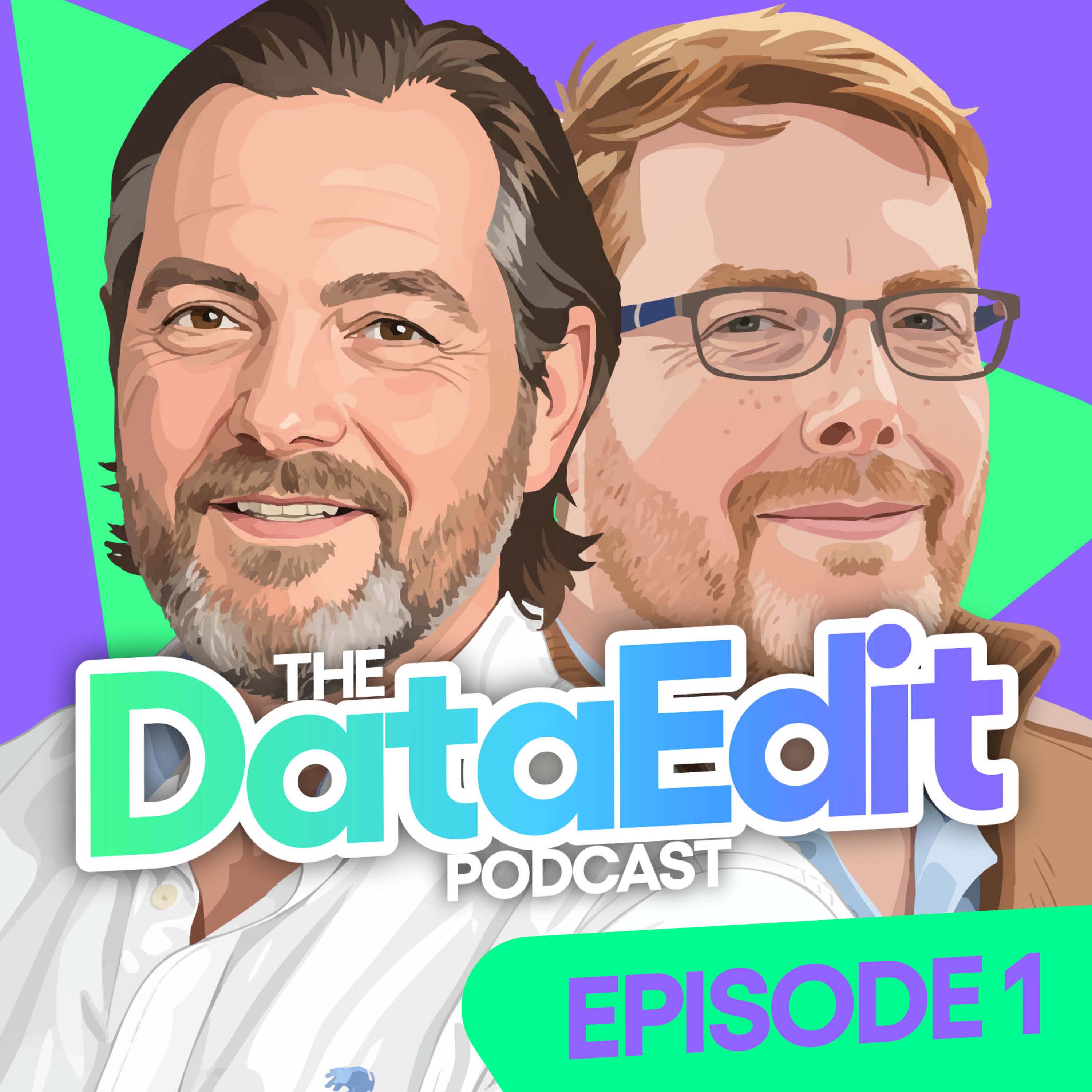
The podcast "Data Edit" hosted by Ben and Oli delves into various topics surrounding data, AI, sustainability, and business value. They highlight the significance of addressing specific business challenges with AI to drive positive outcomes while considering ethical and sustainable practices. The conversation touches upon the impact of AI on data requirements and data center energy consumption, stressing the need for organizations to assess their maturity in AI adoption to avoid unsuccessful projects. The hosts also discuss the importance of building trust in AI solutions, engaging in foundational assessments, and making informed decisions to invest wisely in technology. The podcast aims to provide insights and prompt discussions on relevant issues in the data and AI domain, inviting audience participation and feedback for future episodes.
Transcription
3637 Words, 20492 Characters
[MUSIC PLAYING]
Welcome to the Data Edit, the podcast for data forward thinkers.
Hosted by Agiles Ben-Harris, head of AI and Oli Seger,
account director, we explore the challenges, innovations,
and trends shaping the data landscape.
From governance and ESG to AI ethics, cloud migration,
and analytics, discover how data is driving real business
value.
Hello there.
So firstly, hello from myself and Ben
to anyone who's decided to join this podcast.
My name's Oli, I've been in and around the IT world
for 30 or so years and keen to really bring to light
some conversations that are things that play on my mind
around where IT, AI, data, sustainability, various other
topics might be going.
So welcome to the series.
Here's Ben to introduce himself.
Cheers, Oli.
Yeah, hi, my name's Ben.
Welcome to the audience.
Yeah, similar to yourself, Oli.
I've been in IT now for, again, over 30 years as well.
Always get told I look a bit younger than that,
but there you go, it's life.
By you, interestingly enough, I guess for me,
I'm interested in everybody's thoughts.
So I like to innovate.
I like to try to come up with something that might help
solutions or build and develop solutions for businesses
today.
And I'm interested to know more about ESG thoughts on it,
your thoughts on it, my kind of maybe views on it as well,
and maybe we can find some common ground.
And actually, it'd be interesting from anybody listening.
We are obviously putting some bits out on LinkedIn as well.
For people to comment back, we will refer back to Lincoln
through the series.
We'll see if we can get some polls out there,
get some questions, get some thoughts from some people.
I think it'd be a really good opportunity
to maybe discuss a few things that we all talk about down
the path, but we don't actually talk about in a business world.
Yeah, totally agree.
And by the way, I'm not technical.
You're the technical one.
It's for those that might be listening in.
I'm the one that thinks about things more
from a business, a real world situation.
So we have got some interesting stats
and front and fore for a number of months and weeks, really,
I guess, in terms of what speeds we see on LinkedIn
and news stories, et cetera, around the massive growth
expectation of, obviously, AI, the impact
that has on the amount of data that's
required to run those AI models, the net effect
that has on the data center compute power, electricity
requirements, calling requirements, et cetera,
et cetera.
I think that's a good place to start, right?
It's topical.
It's something that people are talking about.
And there are loads of statistics
which we'll share in a moment or two
about some of the slightly scary things
that are forecasted in terms of requirements moving forward
over the forthcoming years.
Are you seeing similar stories, Ben?
It's something I could say I'm seeing all the time.
So yes, in all honesty, I've put forward
a couple of grants into the innovation grant framework
trying to understand how we control this.
So from my point of view, I'm seeing the actual effect.
Or I believe I'm starting to see the effect
and starting to see the effect inside the business.
And I think this is an interesting part
of correlating the business from where you see it
and the technical business from where
I see it as in that CTO/CDO kind of role.
I'm having to pay for it.
And at the same time, the business
is looking to make use of it.
And I think there's a balance that
needs to be brought between those two kind of things.
I think it'd be great to try and air it
and try and talk about it.
No, for sure.
And I think let's pull out a few statistics.
The first one of which I was looking at here.
So to train a single large AI model,
the estimation is that 284 metric tons of CO2 are emitted.
That's the statistics I'm seeing.
The equivalent of that is a lifetime of emissions
of five cars.
Now, from a technical perspective,
do you think that there are ways
that we should be considering the type of models that
are being built in order to try and address maybe
some of the potential issues around that level of emissions
of CO2 being generated?
First, I think there's a question
that maybe is a step or two steps back before you even
get through to talking about the model.
But what's the model for?
I get pulled into a lot of questions and conversations
about going to build AI.
What are you actually going to do with it?
What's it actually going to do?
Yes, I completely understand the need
and want to build something, put it out there,
play with it, use it, train from it, learn from it,
build your teams, develop your teams,
and all that kind of good stuff.
I get that 100%.
What's it going to be useful?
What's the actual use of it?
And if it is so far wide-ranging,
is that actually answering a business need and requirement?
Or is it just we want AI for the sake of saying we use AI?
So I think there's a set of questions
that maybe don't get asked enough before we get to that point
of let's build a model.
And it starts really with people like yourself
from the business front end of, what is it you want us to solve?
Yeah, there's a massive AI for AI's sake.
And the scary part, a lot of that is coming from C-suite.
And they're feeling the fear of not doing something with AI
because the worry of our competition is going to be using it,
they're going to be gaining an advantage over us.
So we must do it.
And there's a directive filtered down through an organization
to say we've got to do something.
The reality, absolutely, as you point out,
is if you take a step back and look at what business operations,
challenges, customer challenges, et cetera,
could be addressed by the use of AI,
am I right in saying by drilling in on a business challenge
that you therefore can build an appropriate language model that
may not necessarily generate the same level of emissions,
et cetera, is that where you're thinking,
and one challenge can be different from another, right?
So your language model size can vary.
It can change, yeah, absolutely.
So I think if we take what I see is the bread and butter
of what people would like their hopes and dreams.
And I think it does start the C-suite.
And I think that potentially they've
been given a bit of a duff steer, shall we say,
from the start of if we get AI in,
it's going to allow us to put it into the call center
and, in effect, horrible thing to say about replaced people.
That's the truth of what people talk about.
The honest outcome is that AI has gone in in some businesses.
It's been so far-reaching and so wide.
The model hasn't been able to sustain
any kind of customer interaction.
So there's been an enormous expense
and also retention of those people.
And the best four models that I've seen put in
are models that are for really specific small purpose.
So it may still be call center, but it's
that first line of defense.
It's just that first conversation with the customer
to say, what is it I can help you with?
And if it's the simple one of, can I track my parcel?
That's a nice, simple AI interaction.
It's a nice, simple tool.
It's an API for all it to return.
It's the customer.
Customer's happy.
They haven't had to stay on the phone for very long.
Well, they haven't had to be on the phone.
They're just dumb all that you do through a computer.
And what actually naturally happens
is all of those questions and queries
actually relieve the call center of wait-times,
don't end up getting rid of anybody,
because those staff are now able to actually investigate
more comprehensive queries for customers.
Yeah, so you see, it's almost, it's a reduction in complaints.
It's a reduction in wait-time.
It's a reduction in customer dissatisfaction
and using AI for the right point of call,
which is just that first row of how can I help you?
And that's all it's doing,
has actually increased customer satisfaction
and the NSP support and all that good stuff.
And that's a great use case.
Really successful.
Yeah, totally agree.
So in that scenario,
you're talking about absolutely increasing customer perception.
Therefore, there's two things really, I guess.
You know, from a business perspective,
your outcome should be traceable,
or rather it should be trackable,
whatever, over a period of time,
to show client retention rates improving,
customer retention rates improving,
it should be hopefully maybe increasing referrals
and growing your business through more customers
because you're giving a great service, right?
And that makes total sense.
The bit that sits behind that from a client perspective
and a business decision perspective is,
as with all these things, again,
something that's been in the press a lot
is a lot of pilots of AI haven't gone into production.
And I suspect that's for very much the same reason
that the organization is trying to ball the ocean with AI.
You know, it's not looking at a specific problem,
it's looking at let's just put AI or chat bots,
let's do all this stuff because we have to,
because we don't want to be seen to be the one
falling behind from a legacy technology perspective.
And therefore, you're having to ask the question,
"What's our ROI?"
What is the return on the investment in building an AI model?
And it's not always going to be financial,
that's the crucial thing you've got,
kind of get on the table straight away, right?
You know, the perception is we spend money to save money,
it's not necessarily the case in that example you've given,
it's we spend money, we invest in technology
to give our customers a better experience,
to therefore make our brand more well-known,
better regarded and therefore, you know, the net effect of that.
So, I think that's a really good example of where AI
can be used for good from a business perspective
and does solve a challenge and it delivers
a positive business outcome, 100% agree with that.
- And I think the piece that doing
those small initial challenges really helps with,
and we don't talk about this a lot,
because everyone wants to say that AI fixes everything,
is trust.
I know we're kind of going off topic a little bit
from where we started with ESG and everything else,
but the question is, if people don't trust a product,
they won't use it.
And if they don't use it, you've spent all of that time,
money, resource, you've spent your five cars
traveling around the world for however,
until they collapse and you've used all that CO2 up.
For some, nobody is ever going to trust and believe in.
You know, I'm a 49-year-old guy.
I'm from-- - You don't look 49, Ben.
- I'm from the area of Sylvester Stallone
at Arnold Schwarzenegger and all of that kind of,
you know, the good old action films
and all that sort of stuff.
When a streaming service recommends Bambi to me,
it's just going through its AI and ML,
I sit there and I go, "It's a streaming service."
Well, yeah, whatever.
And you go down the path,
he talks to you mates about it
and everyone has a good Google.
Yeah, you've got some up-to-date right now.
- Yeah.
- If it's my bank, suddenly it turns around and go,
"I took a loan out to buy a new car four months ago."
And then somebody goes, "Would you like me loan?"
Because I've hit some credit.
I'm more instantly skeptical of AI.
So I think there's also,
businesses need to also recognize there's a position
and a time to use AI
and what their customer perception is,
trust levels are for their AI
before they also try to put too much in,
if that makes sense.
Otherwise, it is, you can build everything.
Yeah, we could narrow down to that really specific use case
'cause still costs a significant amount of money to build
if nobody is going to use it.
You've got that sort of question.
- Exactly right.
And I think, you know, in the terminology in our world,
for many years has been building a proof of concept, right?
POC.
I see this as a slightly different proposition
where really clients and organizations
need to be looking at a proof of value
when it comes to AI.
So you can demonstrate to your C-suite,
having been told by them,
we have to use AI for something.
Find the business challenge,
address the business challenge,
deliver a proof of value against that single business challenge.
And that is something you can easily then demonstrate
to C-suite in terms of outcomes and positive outcomes
that might then mean there's further discussion around,
okay, this has worked.
Let's look at what else we could do.
And I think that's really important because,
you know, like I said, the phrase earlier,
I use the boiling the ocean, you know,
this is finding something that needs addressing.
And AI might not be the right way
to solve that business challenge, right?
That's the other thing.
It's not the answer to all challenges.
But finding the right area, the right case,
demonstrating it with a proof of value,
absolutely can help.
And it comes back, I'll try and draw it back
to what we started talking about
in terms of the sustainability and ESG,
in terms of, you know, that means we are building LLMs,
language models, which are fit for purpose
to solve a business challenge.
And therefore it can be that you're doing the right thing
for a many ethical sustainability perspective,
as well as solving the business challenge.
Don't try and do everything at once, you know?
And yeah, I think that's important
because if these statistics which we see
in terms of energy and electricity requirements
and the forecasted growth
in terms of data center requirements, usage, energy,
et cetera, et cetera, over the next to 2030, I think it was,
that's exponential and that's scary.
That's not just electricity,
it's where's that electricity coming from?
It's cooling, you know, the water currently
and in traditional data centers required
to cool those computers, et cetera.
I think there's another statistic here.
Again, just coming back to one large language model
can consume 700,000 plus liters of clean water
based on using a traditional data center.
Globally, data centers use 560 billion liters
of water annually.
But those projections are obviously just shorter
increased based on uptake of technology
as we move forward in organizations to it.
But I guess the point is try and use
and investigate whether AI is the right thing
to solve the right effective business challenge
to deliver a client and a business with the right outcomes.
And if that is the case, then, you know, do it ethically.
And I know there's a lot of investment organizations
at the moment who are looking at, you know,
who do we buy into and Google are leading the way.
I'm reading about their sustainability
around their data center growth
and building their data centers out.
There's another kind of whole massive topic
of conversation about how that seems to be looking
at being addressed moving forward.
Rolls Royce have got something quite interesting
around nuclear power and maybe we'll save that
for another episode, but yeah, I think really
if you step back and take a look at it,
you're trying to report back on your ESG metrics
so that you're not getting fined down the line
for not hitting certain metrics in the various scopes
that you need to report back on.
Jumping two feet into massive large language models
that don't solve an effective business challenge,
one would argue are not really ethically
the right decisions.
- And I think there's also a piece in there
that I can get on my hobby horse
and kind of talk about it for hours,
but there's a piece around that we need to also just,
when we talk about AI, we also need to include,
still at NL.
- Yeah, yeah.
- You know, machine learning is driven for a specific task.
We use it to do investigative work more than anything
into our databases, to try and ascertain certain rhythms
and pulses, et cetera, et cetera, and get that.
But it's a very more compact way of doing things.
So not everything has to go to a language model
whether it's a small language model
or a large language model.
There are still better ways sometimes of doing things
rather than just chucking the kitchen sink at it.
And it's experience.
And, you know, I've sat in now on a couple
of AI maturity assessments.
And I think it's, I think the realization
when you actually start talking to people,
a lot of people think they're at that kind of precipice
where they're ready to go and actually when you talk to them,
they're not.
And there's a whole subject in there
that I would like to talk about in another cast
where we actually talk about data center itself
and what was storing.
Yeah, yeah, yeah.
Why are we storing it?
What are we going to use it for?
Yeah, yeah, yeah.
I think there's some real value in there
that we can drive out as well.
100% agree.
And I know exactly we've spoken at length
and kind of how this podcast thing came about.
You and I sitting there on a half an hour initial phone
call that ended up to an hour and a half
and we covered 100 topics and thought, hey, hang on,
we're just having a chat.
Maybe this is something we could kind of stick out there
for other people to maybe, you know, comment on,
have a listen to get involved.
So yeah, I totally get what you're saying for it.
It means you kind of going back to basics
and all these things are based on kind of foundational
assessments that determine your maturity assessment
you talk about, where you're at.
You know, let's be real and let's challenge organizations
to really understand where they're at
because unless you do that,
they are absolutely at risk of making rash decisions
on technology and using some of these tools
which are absolutely going to give bad outcomes.
And they're not going to be successful.
Your dev environment is not going to move into production.
It's not going to expand out.
We've seen it.
It's again, the, you know, known that massive,
I think it's something like 80% of development AI
and data projects don't go into full production.
That's scary.
That's a massive investment.
- It is.
- Hasn't given you what you need.
Look at where you're at first.
Be real, be real and honest with yourselves
as an organization, understand that.
And then you're able to form a solid foundation
that makes sensible decisions as to what you do
moving forward invest wisely.
- Yeah, I'm certainly is.
I mean, it's, I know we've kind of probably
hit it in our 20, 25 minutes for this one,
but it's kind of like, it goes back to the old average
which happens in every business.
And it's not just about technology businesses.
You build the foundations, right?
- Yeah.
- And your house went full over.
- 100%.
- Put bad foundations in, expect it to start leaning
and potentially it'll just topple.
So it's just one of those things.
And yeah, we can talk about if people want us
to have a session on maturity assessments
and what they actually mean
and the open and honest questions.
I think that again, would be a great opportunity
just to kind of talk away from.
- No, 100% and we're not here to bore people.
So you've got on hopefully this has been a first
of a slightly insightful series of podcasts.
And like I said, welcome any comments be back.
We are, as we started by saying just a couple of blokes
talking about what's on our mind,
how these things can be addressed
and what people might consider thinking about
in terms of a different approach.
So in terms of our next session,
I think a good place might be to pick up
on some of this data center challenge.
Bringing it back into the CSG message
about the power issues, et cetera, et cetera around that.
So for now, I mean, thanks everyone
and anyone who's joined the podcast
and look forward to catching up on the next one.
Anything from you, Ben?
- No, it's just gonna say thanks
for the millions and millions that you did.
- This is Lo Burner, I suspect, but thanks anyway.
- You never mind.
Cheers all. - Cheers all.
- Thanks for listening to the data edit.
If you enjoyed today's conversation,
be sure to follow the show and share it with your network.
You'll find more resources, insights
and upcoming episodes at agile.co.uk.
Podcast Summary
Key Points:
The podcast "Data Edit" explores challenges, innovations, and trends in the data landscape.
Ben and Oli discuss the impact of AI on data requirements, data center energy consumption, and business value.
They emphasize the importance of focusing on solving specific business challenges with AI and considering ethical and sustainable practices.
Summary:
The podcast "Data Edit" hosted by Ben and Oli delves into various topics surrounding data, AI, sustainability, and business value. They highlight the significance of addressing specific business challenges with AI to drive positive outcomes while considering ethical and sustainable practices. The conversation touches upon the impact of AI on data requirements and data center energy consumption, stressing the need for organizations to assess their maturity in AI adoption to avoid unsuccessful projects.
The hosts also discuss the importance of building trust in AI solutions, engaging in foundational assessments, and making informed decisions to invest wisely in technology. The podcast aims to provide insights and prompt discussions on relevant issues in the data and AI domain, inviting audience participation and feedback for future episodes.
FAQs
The podcast Data Edit explores challenges, innovations, and trends in the data landscape.
The hosts of the podcast are Agiles Ben-Harris and Oli Seger.
Topics discussed include governance, ESG, AI ethics, cloud migration, and analytics.
Both hosts have been in IT for over 30 years.
The approach suggests identifying the business challenge and ensuring the AI model addresses a specific need.
Trust is crucial because if users don't trust a product, they won't use it, leading to wasted resources.
Chat with AI
Loading...
Pro features
Go deeper with this episode
Unlock creator-grade tools that turn any transcript into show notes and subtitle files.
 PodcastTranscript AI