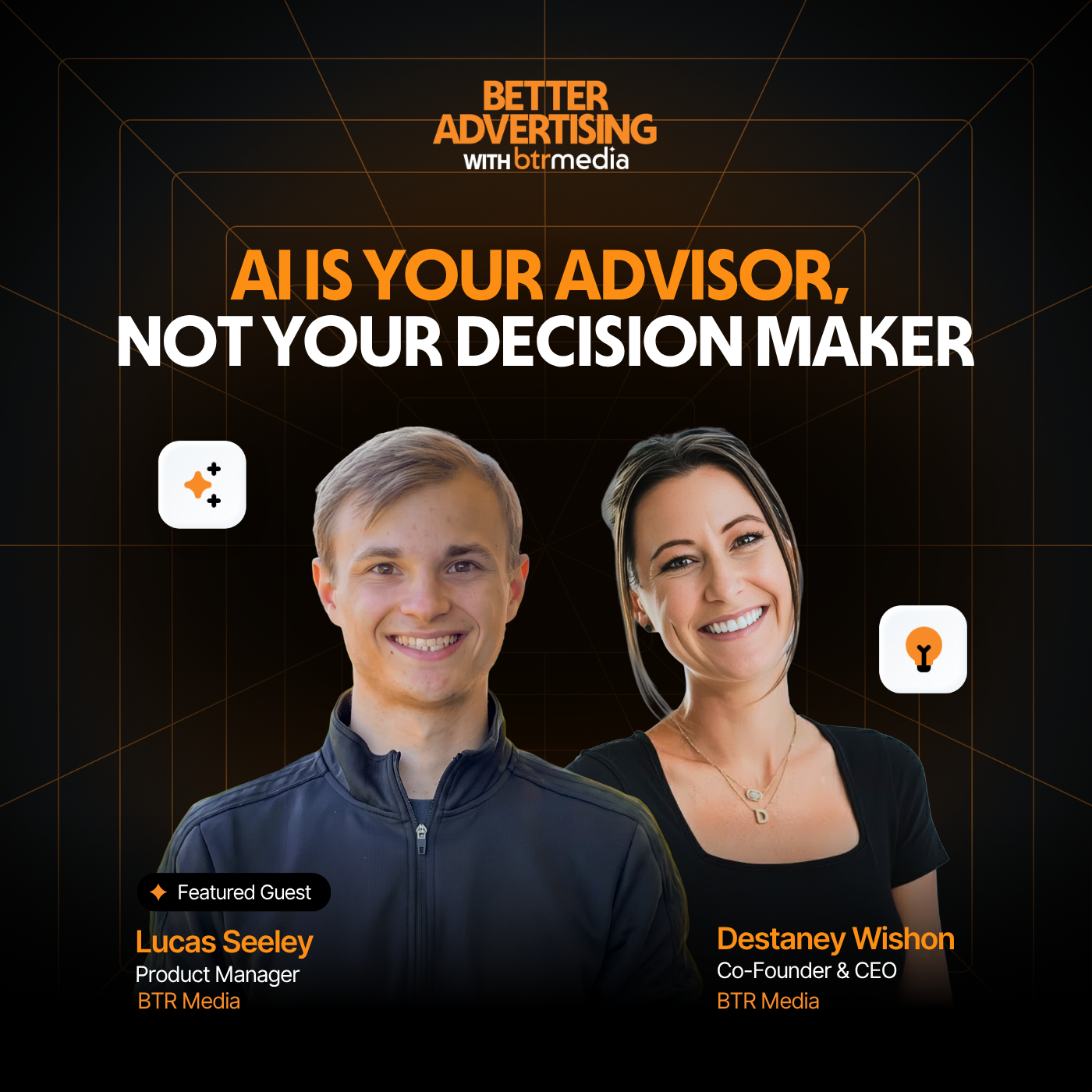
Lucas Seely joined Better Media as a product manager with a unique background rooted in both entrepreneurship and frontline customer interaction. His journey began while bartending at a university hotel, where he met Flywheel Digital and gained hands-on experience with Amazon advertising and e-commerce analytics. This early exposure led him to work in product analysis and software development, where he developed insight into how clients manage ads and reports. Beyond his professional path, Lucas has been deeply engaged in personal AI experimentation, using tools like OpenClaw to build prototypes and explore automation in areas like market trend research and app development. He emphasizes that AI’s true value lies in providing context and actionable insights, not in replacing human decision-making. At Better Media, Lucas believes AI should be integrated into tools like Nexus to automatically summarize data, identify key trends, and present insights in a narrative format—reducing analyst time and empowering strategy. However, he stresses that AI remains an advisor, not a decision-maker, especially in strategic areas like product launches or brand positioning. Human oversight is critical, particularly when considering broader data sources such as Amazon’s organic search and vendor central. Lucas highlights the importance of proper data structuring, context, and prompt engineering to avoid hallucinations and ensure accuracy. He also notes that while AI adoption is accelerating, the real bottleneck lies not in technology but in human understanding and strategic context. For ongoing learning, he recommends X for real-time industry news and direct documentation from AI tools like OpenClaw. Ultimately, Lucas sees AI as a powerful enabler when used wisely, with the future of e-commerce success hinging on human-AI collaboration that values context, strategy, and user intent.
(upbeat music)
- Welcome back to Better Advertising with Better Media.
Today I have Lucas Seely on the podcast.
Lucas has recently joined Better Media
as our newest product manager,
and we are incredibly excited to have you on the team.
You come from a fun depth of industry experience,
and I think you're gonna bring a lot of that
and a lot of passion to our product.
Lucas, can you give us a little bit of an intro
of how you got started in the e-commerce space
and how you got thrown in?
- Yes, of course.
And thank you again for having me.
This is amazing, super excited to be here.
So when I was just 18 years old,
I was sitting in a hotel as a bartender.
It was very uneventful,
but we did get a lot of exciting guests coming through.
One of those guests was Flywheel Digital
and their talent acquisition team
who were recruiting at Penn State,
which was the university right next door.
And I just started getting to talk to them
and getting to know them
and sort of explaining my past experience
with software and also starting my own drop shipping company
where we did make some profit,
but didn't really do too great.
I think the biggest thing was that
I didn't know about Amazon yet.
And so when Flywheel decided to take me on as an intern,
just one year into college,
I started to learn a lot about Amazon
and just a whole ad experience
and the way that we engage our customers
with exciting ads all across the different customer journeys
or funnel stages.
It's super exciting.
And yeah, so I started out at Flywheel Digital
as a product analyst
where I started to really understand
how our clients were using our products.
And I started to get more into writing requirements
and developing some different solutions
for our clients as far as improving
the way that they would manage their ads
and report on them as well.
- Wow, for those listening in,
Lucas and I have actually never bonded over this,
but I had a similar story.
I was bartending at a country club
and the Jet C-suite team
came in around the time of the Walmart Jet acquisition.
And they were really excited about the future of e-commerce.
They offered me a job, I turned it down.
And it opened up this world of opportunity
that I wasn't necessarily aware of.
And I got thrown in in a similar fashion,
but on the agency side, not on the SaaS side,
running ads, hands-on keyboard.
So I took the other approach and dealt with people,
you took the software approach and dealt with code.
But I think that's a really big part of my background,
I always say, was honestly that bartending experience
from the people, skills, the work ethic,
but also the random introduction, right time, right place,
place that actually threw me into the industry.
- Exactly, bartending is a great way to network
and meet new people.
It's so exciting.
And I'm very grateful for the opportunity
that Flywheel had provided me to propel me to where I am now.
- That's amazing.
And what products were you dropshipping?
- It was primarily nicknacks.
I'd say our biggest seller was prom dresses
around the prom season.
This was just post-COVID.
So nobody was really going out,
thinking that they were gonna have a prom.
So that ended up being our biggest thing that we had.
- That's incredible.
Alex had a similar background.
He was going and buying Nike's in store,
flipping them and putting them on Amazon.
So it's a fun combination of service industry
and entrepreneurial background
that's really brought all of us together at Better Media.
- Right, it's awesome.
- So I want to highlight the story you told me the other day
around all of the fun things you've been doing personally
with AI before transitioning into the Better Media AI
because I was incredibly impressed by some of those call outs.
Can you just give the listeners a little bit of insight
of how you started dabbling with AI
and the things that you were doing on a personal level?
- Of course.
Yeah, so I think at the beginning of this year,
I had learned about OpenClaw or what used to be called
MoltBook.
Clawed was also just starting to come out,
but OpenClaw was open source, it was free.
And I just figured I had to get into this.
I've seen a lot of people that were starting to create
really cool products, having them manage different organizations,
having a self-AI organization sounded really cool to me.
So I started experimenting.
And I was able to develop a few different things
as far as like a mission control hub for my AI's
to do regular research on market needs, market trends.
What are the different applications or software
that we could build to solve these issues
or these pain points and then actually building those?
So this was all automated.
Some of the things that I think that came up
were a golf simulation tracker app where,
essentially, if you've seen on TikTok,
there were these scratch-off tickets
that were being advertised for Father's Day
where you could scratch it off.
You would have a specific challenge
that was given to you for that hole.
And it would be something as simple as like no wedges,
no putters, be quiet for the entire round.
And I just thought, well, this is such a waste of paper.
Why don't you just digitize this?
So that's what we did.
And we created a small little app, this is local.
It wasn't something that I actually shipped,
but it worked.
And it was just such an amazing workflow
that OpenClaw is so powerful.
And I think it's very close to Clod,
but Clod is also just way beyond, I think, our time.
And it's really, I think it's underestimated
as far as how powerful it can be.
And it just needs to be studied more
and experimented more so that we can truly understand
its capabilities and its power.
- That is amazing.
For those listening in, I think you see why Lucas is so special.
The ability to go out and learn everything
that needs to be learned, especially your early on
with all of this adoption, but also the visionary.
I think that's something that we've really been looking for
on the product side is someone who could balance both
'cause I wake up every day and I scroll LinkedIn
and it's overwhelming how much opportunity
there is in our industry right now
and never feels like you're doing enough.
So having someone that's just inherently passionate
about the industry, but also a self-learner
and a self-starter like you are,
I think is the perfect combination.
- Yes, totally great.
And I feel like the most important place to pay attention to
is not just in the LinkedIn space,
but also your broader social media spaces
to see what your customers and your shoppers are really into
and what their trends are, what they are paying attention to
because that is what truly matters to them.
And as soon as you have that understanding,
you can start to tell the story that you want to tell
with your product and get it in front of your customers
so that they start building that awareness,
that consideration, and ultimately purchasing
to fit their needs.
- Absolutely.
Now you've been with us for a few weeks now.
You've had a chance to dabble into our internal software nexus
for those who are not familiar what started
as a bit optimization, a keyword engine
has really grown to be the lifeblood of our agency.
It encompasses almost every aspect of operations,
campaign launches, keyword research, bid management,
budget utilization, reporting, all of those fun things.
There's also a side to it that is our full agency brain
which is a really exciting project
where we've been integrating every single system required
to run a successful agency into one hub.
But on the product side specifically
when we're looking at ad tech,
where do you think we can do a better job of harnessing AI?
Where, what's the first thing you're excited
to dive into and to improve?
- Yes, so in nexus, I feel like our biggest opportunity
right now for having a fully harnessed AI state
is having AI turn our insights into a story
or into the conversations that need to be had.
So when our users are open nexus,
they shouldn't need to hunt for these answers.
They need to have them in front of them.
AI can solve that.
AI can read through all of your data.
It can tell you what's happening, why it happened.
Do you need to care?
What do you do next if you do?
And then that just reduces the overall time
that is spent analyzing and lets you spend more time
on actioning and strategizing,
which I think are the two most important pieces
that do require human interaction or human involvement
and you need to kind of leave AI out of that piece.
So as long as you have AI handling all of your analytics,
then you're good to move on to what's the most important.
- I couldn't agree more.
I think this is one of the biggest risks
and mistakes that I see brands making currently
is making the jump for full AI optimization,
without doing the due diligence to build the context layer.
And simply, I've seen brands jump for a software,
and the software tells them, you know,
based off your COGS,
the appropriate ROAS target for you is eight.
They push the button and say, okay, let's hit it eight ROAS.
What happens is all of your bids are slashed,
your budgets are pulled back,
and very quickly they see a decrease in their top line sales.
And they're like, well, what's happening?
Why are my total sales decreasing?
And the problem was that the AI and the human
didn't provide the context layer that, oh, you know,
60% of your total sales are coming from advertising.
So if you lower your bids and you pull back from top of search,
you're gonna see a decrease or a worsening BSR
and page placement, right?
And that's, I think, the area where we're really trying to dial in.
We're not just taking the surface level,
a cost ROAS tacos approach.
You really need to start pulling in things like your organic rink.
I think everything we're seeing on the Alexa shopping
is also gonna disrupt that even more.
Now thankfully, Amazon's opened up more insights than ever before.
When you have a chance to dabble with AMC,
I think some of the insights that we're pulling
across seller central, vendor central,
we're seeing search query performance be opened up
across vendor central, things like that.
We have access to the data, piecing it together,
and then making it actual is absolutely the difficult part
to your point.
- Yeah, and AI can really solve that
as long as it has the proper context and keys.
And that is why we have this curated strategy.
And I would say hub of learning
that can be incorporated into AI
that we've already developed internally.
I think our team has done a really great job
at keeping things tight and understanding
the different aspects of reporting
and the ways to look at different metrics
and understanding how we use those
to actually fit our narrative and boost
whatever it is that we are trying to go towards.
- Absolutely, I think that a lot of the work
that needs to be done is also to your point
on the storytelling side.
And the reason being is at the end of the day,
it's still humans that are making decisions.
And I think that's an element of maybe pessimism
that I have in the future of AI is
that the end of the day we're still selling to humans
and humans move really quickly
in the age of social media.
So making sure that we are not incorporating AI
in places we shouldn't be.
Are there any key areas that you've seen
where you're like, hey, you definitely need to make sure
you have humans overseeing?
Are there, if you break down the advertising funnel
or certain pieces of retail media,
where would you say you have to have a human layer?
- Yeah, I think I touched on this a little bit
in my last point there, but it's all in the strategy.
The strategy is all humans.
AI is your advisor.
It's not your decision maker.
And so AI can identify the patterns and recommend actions,
even predict outcomes, but deciding to invest
in new categories, launch a new product,
or even shifting brand positioning.
That's also a human decision.
And an AI agent cannot value those goals
and really understand what it is you're trying to get to.
It has a very robotic brain.
It is not built for understanding your human chopper.
So it can give you an idea of what the data says,
but ultimately the human is the one that needs to make the call.
- Yeah, yeah, I could not agree more.
I have one last question for you.
I have debated this with Dustin a few times,
so I'm just curious to hear your thoughts.
Do you think we have the infrastructure right now
to keep up with the utilization of AI?
Or do you think that we have a supply and demand problem,
which is the side offense that I am on?
Dustin is all in on educating me on the possibility
of putting data centers on the moon.
Actually, don't know if he's pro that plan,
but he did educate me that that is a possibility
to help us with this issue.
But I've seen a lot of articles lately on some
of the largest companies in the world
that are struggling with AI cost and how it is ballooning.
And you're seeing the pendulum swing too.
Maybe we need human talent for some of these key areas.
What are your thoughts on the next 24, 48 months?
- Yeah, I think that we're going to start to see people
really start to truly understand how to use AI
and those that don't really just fall behind
and they won't be able to keep up with it.
But if you truly understand how to use AI
and you're providing the proper context
and spending time really thinking about
how you want to approach the task
that you're about to give an AI,
it really shouldn't cost a whole lot
to get to the objective that you're trying to get to.
Now, that's more so from a building standpoint.
When it comes to, I guess, producing analytics,
as I mentioned, I think earlier,
where we could have an AI agent in Nexus
that has all these answers for you.
If that's automated, it really isn't going to cost a whole lot.
If we are giving AI the right prompt, the right context,
and it's going through all the data as accurately
as it can and as it should,
then we'll get the proper results.
- Yeah, that makes sense.
That was something that Dustin and I spent quite a bit
of time diving into is creating the appropriate silos
for your data and where you want the context to be pulled from.
I know a lot of people are trying to dump all of their information
to, you know, take Amazon MCP, dump it all into Claude
and that's where you're going to run into issues.
It's too much and it's not necessarily knowing
what are the best insights to pull from.
So you really have to build that foundation of hey,
here's what I want to take a look at.
I think in order to scale it out efficiently
from an operations cost perspective,
but also to keep yourself from running into a position
of hallucinations and things like that.
- Right, and I think that AI is sort of evolved a little
that paths the hallucinations point
where we are really starting to see more thought
through responses from AI, at least with Claude and Claude Opus,
Claude Fable, I am so that skeptical on
because of their data retention policies,
but I think that AI is just such a powerful tool
and we just need to fully understand how to use it
and how to prompt it and how to provide the proper context
to really get the results that we are driving for.
- Well, I want to leave the listeners
with one more actionable points.
Where do you go to learn
when it comes to all of these things?
- Yeah, I get a lot of different places.
I say that X has really been my primary awareness spot
for learning about what's new,
what's being talked about.
There are a ton of different posters out there
that are just talking about AI and talking about Amazon
and advertising and just all the news in the world.
It's a great essential place to just learn
about what's going on, what's happening,
how can you start to use these new tools that are coming up?
Also, of course, the main websites of these places,
like OpenClaw, you want to go to their OpenClaw docs
and start reading through all of that.
Even using AI, you can use AI to scrape your news sources
and understand what is happening, what's new,
and just get that overview of everything
that's been released recently.
- Well, I think that this was an absolutely fantastic interview.
- Incredibly excited to see all of the new releases.
We're gonna have over the next few quarters
and Lucas, thank you so much for taking the time to join.
- Thank you, and thank you for having me.
(upbeat music)
Podcast Summary
Key Points:
Lucas Seely entered the e-commerce space through a bartending job where he met Flywheel Digital, which introduced him to Amazon advertising and led to a career in product management.
He developed early entrepreneurial experience in dropshipping, notably selling prom dresses during the post-COVID era, which helped shape his understanding of consumer trends and market demand.
Lucas has been actively experimenting with AI tools like OpenClaw and has built prototypes—such as a golf simulation app—to demonstrate how AI can automate research, identify pain points, and generate actionable solutions.
Summary:
Lucas Seely joined Better Media as a product manager with a unique background rooted in both entrepreneurship and frontline customer interaction. His journey began while bartending at a university hotel, where he met Flywheel Digital and gained hands-on experience with Amazon advertising and e-commerce analytics. This early exposure led him to work in product analysis and software development, where he developed insight into how clients manage ads and reports.
Beyond his professional path, Lucas has been deeply engaged in personal AI experimentation, using tools like OpenClaw to build prototypes and explore automation in areas like market trend research and app development. He emphasizes that AI’s true value lies in providing context and actionable insights, not in replacing human decision-making. At Better Media, Lucas believes AI should be integrated into tools like Nexus to automatically summarize data, identify key trends, and present insights in a narrative format—reducing analyst time and empowering strategy.
However, he stresses that AI remains an advisor, not a decision-maker, especially in strategic areas like product launches or brand positioning. Human oversight is critical, particularly when considering broader data sources such as Amazon’s organic search and vendor central. Lucas highlights the importance of proper data structuring, context, and prompt engineering to avoid hallucinations and ensure accuracy.
He also notes that while AI adoption is accelerating, the real bottleneck lies not in technology but in human understanding and strategic context. For ongoing learning, he recommends X for real-time industry news and direct documentation from AI tools like OpenClaw. Ultimately, Lucas sees AI as a powerful enabler when used wisely, with the future of e-commerce success hinging on human-AI collaboration that values context, strategy, and user intent.
FAQs
Lucas started in e-commerce while bartending at a hotel, where he met Flywheel Digital. He began as a product analyst and learned about Amazon advertising and customer engagement through hands-on experience.
His dropshipping business primarily sold niche products, with prom dresses being the biggest seller during the post-COVID prom season due to increased demand.
He started using OpenClaw (formerly MoltBook), an open-source AI tool, to build a mission control hub that researched market trends and developed automated apps, like a golf simulation tracker.
He believes AI should turn data insights into actionable stories and conversations, so users don’t have to manually analyze data—AI can explain what happened, why, and what to do next.
AI should provide insights and recommendations, but final decisions—like launching new products or shifting brand positioning—must remain with humans who understand business goals and context.
Better Media leverages data from Amazon Seller Central, Vendor Central, and Alexa Shopping to gain deeper insights into search performance and customer behavior.
Chat with AI
Loading...
Pro features
Go deeper with this episode
Unlock creator-grade tools that turn any transcript into show notes and subtitle files.
 PodcastTranscript AI