AI Builds Obsession for Financial Modelers to Refocus on Specification Testing and Trust Now
43m 3s
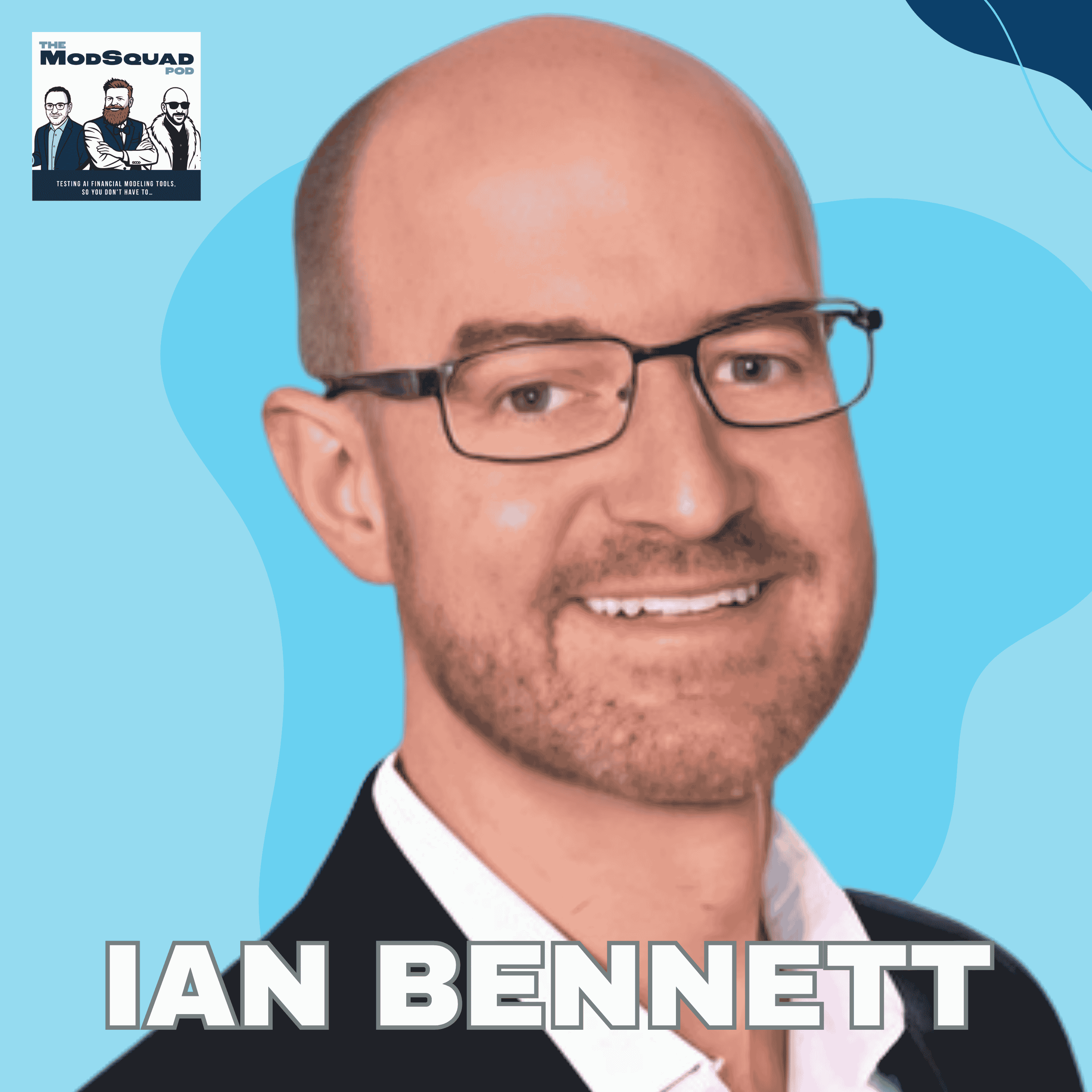
In this episode of the Mod Squad, hosts Ian Schnorr, Giles Mail, and Paul Barnhurst welcome guest Ian Bennett, a PWC partner and expert in deal modeling. They discuss the rapid advancement of AI, particularly Claude, in financial modeling. Bennett notes that while he hasn’t personally tested Claude, he has observed its impact through community content and sees it as a significant shift, though not surprising given long-term predictions. The conversation highlights that the build phase has always received the most attention due to its creative appeal, but Bennett argues that AI should be applied across all phases of modeling—scoping, specification, testing, and handover. Specification is especially ripe for AI, as tools can convert whiteboard ideas into documents, test for ambiguity, and create prototypes. Bennett shares his team’s approach of analyzing every task to identify where AI can augment or replace work, using custom GPTs. He also addresses the future of skills, advising that modelers should focus on higher-order abilities like problem-solving, communication, and strategic thinking, rather than just technical spreadsheet skills. The episode concludes with a reflection on how AI will reshape finance teams and the importance of adapting to these changes.
[MUSIC] The Mod Squad! [MUSIC] We are the Mod Squad! The Mod Squad featuring Ian Schnorr, Executive Director of Financial Modeling Institute. Giles Mail, Humble MVP and co-founder of Full Stack Modeler, and Paul Barnhurst, the FP and AI guy. There is a visceral joy with coding and creating in Excel, at least for those of us who get that pleasure. I appreciate not everybody feels like that. But many of the people watching this Mod Squad will get that pleasure, and there will be less of them, I think. But that said, it has always been in the past harder to do the things that we do than it is today. If I go back 20 years when I started my career, it was slower and harder to build the models, and it was much slower and harder to review them and check that they worked. We haven't complained each time a new tool has come in which has helped us to do that faster. Welcome to another episode of the Mod Squad. We're super excited this week to have a featured guest with us that will introduce here in just one minute. But before we do that, I have back with me for this episode, my co-hosts, Giles Mail and N Schnorr Giles. Want to take a minute and just introduce yourself? Yes, sure. Hi, it's Giles Mail co-founder of FullStatModeller and new, I would say almost hype enthusiasts for AI and Claude. I think it's fantastic. I think I've always said that. Have a nice start. Yes, you've always loved the hype and been very enthusiastic. Right. Over to in for a quick introduction. You're always about the hype, Giles, but you know, just kidding. We're all starting to drink the juice now. Yeah, I'm N Schnorr, great to be back Paul and Giles with a two of you and our very special guest today, Ian. But I currently heading up executive director of Financial Modeling Institute, World's Only Financial Modeling and Credit T-Shinbody, career in modeling and excited to be here to talk with Ian as our guest to get his perspectives on what he's seeing in the world of modeling these days. And then of course we have our guest in Bennett. I'll share a brief little bio about him. Let him introduce himself here and then I know in Schnorr wanted to say a minute. So I'm going to do in and other in I'm skin. In Bennett is a PWC partner who leads deal modeling in Australia and globally. He's a professional financial modeler with over 25 years of experience. He has built and reviewed complex models for transactions, infrastructure, finance, transformation and reporting across Australia and the UK. He was one of the inaugural MFM with the Financial Modeling Institute. He has helped shape industry practice through advisory roles as lead author of PWC's global financial modeling guidelines and the publication of a library of articles. Ian was a founding member of FMI's advisory council and is now a member of FMI's financial modeling global leaders council. So Ian welcome back to the show. It's been a while. Hi guys. It is fantastic to be back. We're really excited to have you. There's been a lot going on over the last year. I think in modeling. So be a great conversation. I know you've known in Bennett for a long time. Anything you'd like to add before we jump into the question. Yeah, you know what I will just quickly jump in and chime in and sing Ian's praises a little bit. He and I first met gosh has been a quite well not Ian hasn't it has been I'm going to it's possible. It's been more like six or seven years at this point and you know when I say the other Ian I feel like we are almost very similar to Ian's in the modeling world that are on opposite sides of the world. And yet where we where I've always felt a strong connection is is you know I feel like a lot of things I have always talked about in my when I train career for 20 years. Ian speaks the same language he has always you know I feel like as I've tried to reinforce modeling is so much more than just a spreadsheet discipline it's always so much more than just building a calculator in a spreadsheet. He's always been impressed me with his view that it's a profession it's a discipline it's a career he's always talked a lot and you'll hear today I'm sure about modeling so much more that includes process and planning and organization and structure and communication. And it's a whole multifaceted skill set and we've I've always felt very very aligned on that I think probably in the only thing that we've ever maybe mildly disagreed on is that you would probably fight to the death about the fact that if anyone ever put a circular reference in a model you'd probably come close to knock their heads off and I don't actually I think you've sometimes accused me of feeling give I don't actually feel differently than that I just believe that everyone doing model is going to encounter a circular reference you better understand it and I want people to understand. If you happen to work in a organization where they you know encourage or like it that's fine but mostly I want people to understand it so they can at least make a right decision but it's thrilled to have you on and I've always felt a close alignment and I'm really impressed with what you've done to build financial modeling is a discipline around the world and I wanted to share that with our audience before we get started. Thank you and thanks to all of you I'll add one thing to that credibly warm and kind of introduction is that I'm also identify as a fan of the mod squad where they've watched all your videos and your content and I just want to thank you if I'm able to on behalf of the financial model and community and indeed as you say the profession in for the work that you have done to drive that profession and to give it credibility incredibly grateful for all of the hard work that you do. So thank you for that and and thank you for inviting me back it's such a lovely group of people to be hanging around with and on that circular reference point it is I think a testament to the quality of a relationship that you can agree on so much that you so quickly get to a point of great disagreement that we had when we first met but only ever in fun and I I think the way that FMI has taken that point and many others and help people around the world to understand them and to have a common sense of the world. So we have to have a common language around them we should probably come back to that question of common language as we chat today has been an amazing difference ever since you kicked that off was a big project all those years ago so thank you for that too. Thank you Paul why don't you do your magic. I think I might find one other area we could have split agreement here is modeller one L or two else. That's true. We've all got energy but we don't have energy for that debate. Exactly we're not going to settle that today but I couldn't resist. All right so why don't we jump in with I think what's been on everybody's mind as you know our last episode we dropped this week has been most popular episode yet we tested Claude. And a lot of buzz around Claude and Excel the whole beta so two part question for you one. Here's if you've had the opportunity to test it and then we'd love to just get your thoughts you know what you're hearing what your experience was like a little bit of that. Yeah so we are we're coming into this conversation at a really interesting point even I don't know what the delay will be between recording and publishing but something's going to happen between then and between now and then as well right so I'm sure I'm sure you're moving pretty quickly here but yes you're right there's been a lot of great content including the video that you guys have just done on Claude and Excel. And I think there was a consensus probably just a few weeks ago that Lord was running ahead a little bit in this area and I think we've seen that proven out. I haven't personally tested it yet I haven't had that specific need to do so but primarily because there's been so much great content around produced by people have used it. So I'm looking quite carefully at that to look for some of the sort of the edge cases the types of use cases that people are using and how it's responded to certain types of prompts and we're forming a view but if I'm honest I don't feel the need to immediately get that one because although this does feel like a big shift and there's genuine excitement about it. And I think that the shift has been significant and each one of them is very much on the pathway that we had predicted. I don't think anybody thought we would never get to this point so I think we're at that point now. I also am not overly surprised by the speed but I can understand why people that have been working as many years and decades as I have would be surprised by the speed because nothing has moved that this quick in my lifetime. And so that feels fast. I don't know I haven't asked someone who's just come out of university whether they feel like this is fast. I'm feeling they might have a slightly different view but certainly the speed feels fast. If I think about the long term trajectory that we predicted I think we're on the path. Interesting. I think it's great you kind of mentioned the path for me it feels like it's gone a little faster than I thought when we started testing six months ago. I think I made the comment look where we're coding vibe coding was 18 months ago and so I figured it would kind of take us 18 months at least a year to get where we're at now I think plot surprise me I think in in jiles would probably agree with that when they tested it that we didn't expect that big of a leap. Because it felt like a quantum leap forward to what we had tested just you know two months ago. Yeah, maybe the one thing I would add to that is I mentioned this on the last episode I I no longer feel like I'm a tester with Claude I'm genuinely just using it everything else we've done I we've tested it because you know we wanted to I'm just getting huge personal value from Claude every day I use it for multiple things. So that's been quite a shift personally. So the next area wanted to talk about in jiles I think I'll send this over to you because I know you've been really big on the whole.
different phases of modeling and how there's been such a focus on the build phase. So I know you had a question there particularly. Yeah it's probably quite a broad question in but as I think all of us have seen there's been so much attention on the build, especially on LinkedIn. You know wow look at this you click a button grab a coffee in the models built which to me felt very reckless last year and I know we're getting close to things working a lot more reliably but as all the other phases there's the scoping, the spec, the planning, the post model build and I'd be really intrigued to see what experiences you've had of value coming from AI anywhere but the build basically. Right big question guys so let's do the foundation. So publicly I've been telling people 20 odd years scope specify design build test and then handover or use and then model running which effectively is many iterations of the same phases I've just talked about. So if you think about that first stage 5-10% scoping, understanding the problem, what's the question to try and answer, what's the story you're trying to tell? Specification 25% of total build time. So if you've got two weeks to build a model and you're not working the weekends then you're kind of looking up to Thursday or week one for that. Then you move into build phase similar length of time to the spec phase, then test phase, similar length of time and then a small amount of time at the end for that real quality handover. So the question is why has the focus only been on the build phase and the answer is that the focus has always been on the build phase. If I go back right the way to be my career that is really the only place that the volume of conversation and effort has been. Why is that? Well there's a couple of reasons. First one is it's the fun sexy bit so everybody loves getting in there, grabbing some stuff and building something. There's a real joy in creating something and for financial modelers there's a real joy in problem solving and problem solving with an elegant solution. I think you're all nodding. We get a really visceral joy from going from nothing. We hate editing other people's models don't we? We hate it. What we really love is creating something for a scratch that is embodied the way that we think and is elegant and it's beautiful and it solves a really complex commercial problem in a simple way. Like there's joy in that bit. Also if I look at all the literature and the training that's out there like if I was to graph that volume take FMI for example but I'm out FMI to everything else it is almost all I don't know what percentage on the build phase. It's about the skills you need in order to be able to code spreadsheet to build the model. We don't spend two day training course on absolutely redo in the side alpha but most of the world doesn't spend two days training had to do a specification and it probably doesn't spend two days training how to do the review either. I'm not overly surprised by that shift right that was exactly the same when people were looking at off-shoring large modeling teams it was exactly the same when Excel released new versions it was exactly the same when power query and power pivot started getting us to question how we were going to be doing financial modeling these questions have come many times over the years and the focus has always been on that phase. For me if I'm going to do deliver a significant project I'm going to be adhering to those phases for now let's just remind ourselves of these things are always in question as new technology comes in I need to just question again is that the right phasing is that the right methodology but let's say it is for a while I need to think about how AI is going to impact on everything right the way across that spectrum so that's why I think we focused only on those things I testing part of it's not people's most favorite part of the role see some people love it don't get me wrong but again I can't see that there's a sort of a reason why we don't go well let's talk about how we can do how we're going to do testing so I think yeah I think that's why we focused on build in a you seeing particular for example a lot in the last episode I have this idea in my head for ages that you could take a picture of the kind of whiteboard model maps and it could turn it into a document you know that says here's the plan and it kind of does do that really well and if there any kind of other specifics you've seen beyond the build way you're like okay yeah this is a change to how we always operate in an huge value yeah so I think this is a question about how is it going to impact on us right the way for men to end I think that's a really big question so let me just very quickly give you a little bit of a framework about how we're thinking about it and I've touched on some of this in my LinkedIn articles I've produced to try and give frame into it but in summary there's the things we do every day how do we make them better how do we make them faster quicker lower risk higher quality etc just change the way we're doing things the next theme for us is how to improve the value proposition how do I make it more attractive how do I win more work how do I attract premium pricing maybe or maybe just reduce my cost so that I'm more attractive and to work with lots of different things I can think about how that value proposition might change the experience that a client has and finally I need to think about new products and services so when I'm thinking about those sorts of questions jails it feels quite specific but I need to think about can I turn that into a brand new product and sell that as a new service to our clients because suddenly there's an opportunity to do that that didn't exist before so I'm going to go through those three things I then need to think about where can AI impact on each one of those and what we've done across our team from build and review and also on into the sort of what we call modern finance transformation and data modeling is looked at every task in the team like the most junior person to the most senior person through every phase of that model build and through every phase of the model audit what are we actually doing in those steps and where can we augment and where can we replace and we are testing lots of different things around that continually and we've launched and what we call custom GBT's in order to be able to have that embedded in the team and they're using standard GBT's to support them in their work you mentioned specification I think that's the most ripe area for this kind of work and I've said that publicly and we're seeing that come to life we have a couple of tools that are designed specifically for the specification phase and targeting the risks around it so yes there's creation of the content so you're right driver trees on a whiteboard 100% notes for taking from the meeting transcription of a meeting all the content can be assimilated into a specification document if you're really clear about what a good specification document looks like and if you want to build a prototype model or an input template or an output template you need to be clear with it what you wanted to create and ask it to start creating those things that you'll use then to confirm you've got the specification correct and then we have another one which tests that content and tests it for things like ambiguity relevant aspects from an industry which are missing inconsistency within the document where you've contradicted yourself and then simple things like using define terms and such so we're really enhancing that particular phase as well as well as all the others. Thank you that's really helpful to kind of think about it in Shnor. Any question here you'd like to ask kind of as we're going through this I'm sure there's some things you're thinking about. Maybe I'll touch on the future of work and the future of skills and teams and this is not specific to your employer, PWC but just you know you're obviously you have colleagues you have friends you are in you know you're in the space just curious to get your thoughts I mean of course there is a camp of people in the world who are of the belief that you know many if not all a white college jobs are going to come to an end that there will be an end to the work that we do in light of AI I don't feel that way I feel differently but I um but I want to hear your thoughts so but clearly we can all agree that the way we work is undeniably changing has changed there's no doubt about that so what do you think are as you think about your sector as you think about your industry your group as you think about other people you know that work in quantitative jobs and corporate jobs what are the skills that you think sort of a junior and mid-level person needs to focus on maybe differently today let's assume that there will be some jobs out there what are the skills that in our world and the modeling world people should be focusing on because it's got to change it's not going to be exactly the same and I guess the way what would your advice be to people in or getting in or in the careers right now how what would you say so that's a really important question because you're right it's way broader than our sector and so I have a real benefit of being involved in that broader conversation global firm level these are things that we are considering but equally when I speak to CFOs leaders in finance around my client base that's one of the first questions they're asking me as well not necessarily about financial modeling but what does this all mean for my finance team and what's the new structure of my finance team and there's a lot of concern about that there's also a lot of energy and excitement not just from the bosses who are looking to transform but for the individuals in those businesses who are thinking about how they can take advantage and use it as an accelerator and there's lots of different perspectives so one is my advice for financial modelers and one of the skills that I needed so it has always been the case that a great financial modeler is curious and they have innovation in their core and they want to solve
problems. To do that, they need excellent modeling skills. And I think those things will still hold as foundations. Now, to really innovate, to really test and try and fail, you need a culture that supports that. So if those individuals are in a team, then you need a look for a team that is going to support that kind of innovative style where you can learn from each other. You can try something. It doesn't go so well. You celebrate what you've learned from that and you move forward. Like we have to have that culture wrapped around those skills in order for us to sort of move forward. After that, like how is it going to change on a day-to-day basis? Well, we're going to be critiquing and considering content much more than we are creating. And as I mentioned at the start, that we have to call out. I think we haven't been honest enough about that because there is a visceral joy with coding and creating in Excel, at least for those of us who get that pleasure. I know I appreciate it. Not everybody feels like that. But many of the people watching this podcast will get that pleasure. And there will be less of that, I think. If I go back 20 or years when I started my career, it was slower and harder to build the models and it was much slower and harder to review them and check that they worked. We are having that conversation today because of the rate of change and the likely more significant impact. But we have always been adopting better ways. And I'm not going to go back and suggest that we were creating spreadsheets with paper and pen, but we kind of were. So there's been an evolution right the way through all those sorts of things where we adopted new technology. And I'm sure there were people who were like, "The hang on, if you don't do it with a paper and pen, how can you possibly understand what you're doing if you give it to the computer?" I'm sure there was arguments along those sorts of lines. And when you come to review, there were people doing things manually that then add in that we all now take for granted would do. And they were probably concerned about that there would be less thought, less imagination, less interrogation if you outsourced it to those tools. So I think we've worked out how to bring these things in and make the very best of them. So we will now become more reviews because we're asking the thing to build things and then we need to look at it. But I think that review thing is going to require some specific skills in it. Don't mind like I think, I think we need to be clear. So yes, you need to be a good model reviewer. I can need to be really good at that. And that's the case for most financial modelers. You can hunt them down, you can look for them. You understand the formula that you're looking at and you can intuitively tell if it's right or wrong. You need to be ready for the fact that for some time, but again, this will probably go eventually. When AI is coding your formulas, detecting algorithms, it's using the full Excel library to do so. And as you guys have seen many times, it then uses some extraordinary combination of algorithms that are in the Excel library, which you have never seen in a financial model to do something which intuitively we all know you do it with a sum if guys. Like obviously that's how you do it. And it's something and it takes us a while to reorientate. And I'm sure that will gradually go, but you have to accept the fact that the machine is coding in a very different way to the way that we think. So we need to review for things which are more complex. We need to review things which have been created very, very quickly. We need to review things that have been created by thing that we don't know. That's important because when I try and graduate over a period of years, I watch them develop and know their strengths and weaknesses. I know when they're having a good day and when they're having a bad day. Like if they roll in in the morning and they're kind of eyes are kind of blurry and you know, they're taking a couple of piracy to more, I know that's not going to be a productive day versus the day before where they just look like they just jumped out of bear with a fire in their soul. I don't know that about the AI machine. I don't know whether it's having a good day or a bad day. And the main reason I don't know that is because of this plausible quality that is produced every single time. And I've talked about this plausible garbage where there's things which look on first glance absolutely brilliant. But then as you start to oh, hang on a minute, this is you've made five points and four of them are the same and the fifth one doesn't mean anything like hang on. And suddenly your confidence is dropped and I was using the air excel agent yesterday and playing around with that, not Lord, but the other one. And in a first glance, this model was absolutely fantastic that it built. And I got right to the financial statements and right there, down before I pressed and pressed F2 to look at the formulae and the net income was not the sum of the two rows above it was the sum of the subtotal and the row above that. Like it was just a row out and it had done that four times in the financial statements again, it'll get better. But it took time to find that and to realize that it was wrong. And then of course, I'm like, how does this balance balance? Something else has been fudge somewhere in order for that to work if that error is there. So then you'll you'll you have to go and do your review in a way that we've never had to do before because we don't have those signals and we don't have those ways of testing. So long answer, but the answer is review. The answer is we need to get really, really good at testing what's given to us. And maybe if I just give you one last perspective, you've got a judgment to make every time it creates it. So it's just built a house for you. You've literally said, build me a house and it's taken have a moment. I can. One just quick follow up then on that. You know, I think I know the three of us and Mazguad have a view on this. I have a view on this and I was recently interviewing someone who's been using Claude in the beta mode for a long time number of months since the fall. And he was feeling very confident. And I asked him if he was feeling confident using it largely because he already had strong modeling skills. And he said 100%. He said, I would be scared. Yeah, I would be scared out of my mind to let someone build a model with AI that does not understand modeling. So my question is, does that scare you? Are you still feeling that to do all the things you just talked about the reviews and other things? Do you still believe that it's critical to have strong modeling skills in my life? I do, but I wonder if you do because it's hard to review and find errors and to push back and challenge and argue with it. If you don't really know how to do it yourself, but that's I wanted to know what your thought on that particular point. I couldn't agree more, but I am terrified in this being on the public record and appearing complacent or looking like I've got my head in the sand and just hoping that this all just goes away. We have been through all of the steps. We beat through all the things we need to do to deliver a service of trust because that's what I trade in. So whether it's the build or whether it's the review, whether it's data modeling and modern finance, whether it's a project finance model audit, I trade in trust. And my client has to be able to trust what I do and therefore I have to be able to trust what we've produced. I cannot get there without humans with really good commercial and financial modeling skills. I just cannot see a way that I can get to that point unless trust is needed less, but as you've made the point in many times on this podcast, you're going to be in that ballroom at some point. Some was going to carry the can. That trust needs to sit with somebody. And so if I'm not giving it to the stakeholders, where are they going to get from? So I think when you think back from trust, I think you have to have those sources. I love that analogy. And I mean, you're right. I've said it kind of differently, but I love that analogy. It's a it's a trust between humans and it's pretty darn hard to look some on the eye and deliver that trust. If you know you or the team or the person you've done it doesn't have the skills you need. Love that angle and that analogy. Paul, that's great. Thanks. Thank you. And I think it gets to something you've said before and you know, like the two uses of AI. One is kind of augmentation. And I think we're all on the same board that it should be augmenting our knowledge. Is it going to know formulas? We don't know. Of course it is. Is it going to be able to build some things that we may not be as familiar with? Sure. Or very familiar with. But if we understand modeling, we understand the accounting, the financial statements, the commercial, we can still validate it. And so I really I think of AI at this point is augmentation versus you hear this idea of AI is just going to do everything. And it's like, yeah, my builder models, but that doesn't mean it's doing everything. Can I add one point to that as well as an observation? But yeah, you can get all your thoughts afterwards. The fact that these are like, stochastic models or the fact that there is no real intelligence in the sense that it's patent recognition, very, very clever patent recognition. And the point you just talk about in way, you know, you might be working on a project finance audit or very large transaction. And if you step back from that saying, oh, it's probably, you know, this model that called as produced is probably 95% likely to be correct. But for a lot of industries, that's not, there's nowhere near enough. Like, you can't go in at 95%. So there's this huge area of modeling that I guess we're all involved in, where maybe there's always going to be a problem because it may never be 100% at really the reason, I guess, why large companies involved in this spend so much money and train their team so hard is like, you've got to get close to 100% certain that the model is right or free from material error. As possible. So, so the example I gave in the last episode, Paul was like, maybe if you're a young entrepreneur and you don't know modelers and you've got to pitch something to try and get angel investor funding, it's like, yeah, I could see where Claude, the other option is nothing, or you try and learn Excel on your own through Google. I can see where Claude could
add massive value and 95% is a very good number for that situation. But then for a project finance deal, 95% nowhere near enough. That's probably my observation. Charles, can I, I'll play that back from a model audit perspective because you mentioned it. Yeah. And so typical project finance model has between three and a half thousand, four and a half thousand unique formally. And I can usually rely on the fact that a unique former is one form in a per row that would be a best practice. I'm assuming that's what the AI would have done. I don't know for certain, but if it's a 60 time period model and they haven't, then it's three and a half thousand multiplied by 60, four many in that model. But I need to check every single one of them. And that takes time to go through each of those things and sort of and get comfort with that thing. There is no such thing as 95% materiality in a model audit because the concept of material to struggles around switches and redundancies in a model. I have a switch over here or a min max, which means that if I adjust my leverage just a little bit, cash flows start to flow into this section of the model, which is in currently used. And in that section of model, the interest rate is materially higher. The current base case model looks fine, adjust one assumption model flows in. Helculation is fundamentally incorrect. That becomes very material. So that's quite binary. Like as things move, sections of model, which currently have zeros in them suddenly become materially incorrect. So to do that, you have to understand almost every single formula in the model. Maybe going back to what Paul said, if a model audit is, and I don't know how other people perform model audits in the world, but if a model audit is checking every single form in the model, there'll be a future where I can still provide the same comfort, the same letter and report to a financial client, but I haven't checked all the formula in the model, or at least a human hasn't checked every single formula in the model, almost certainly. Because if I think about the complexity of most of the formula, commercial complex, the end technical complexity, a very large portion of those formula are actually really simple. In fact, maybe even contributing. So maybe I can also some of that checking and then review it. I still have a review there work, but that will be an excellent. That will help me move faster to a deadline on meat project, find a deadline as quick and maybe even lower my cost to serve, et cetera. So there's there is some replacement there. There's a possibility of replacement in that model audit. There's no doubt about it, but a lot of other things it's all contention. Thank you for that makes a lot of sense. We just have a few more minutes here. I want to touch on something. You wrote an article. You've written several unlinked. I know, but you did one recently about modern finance transformation. And you said something I thought that was really interesting. And I'd love to just drill into a little farther. You said, AI agent mode was the single most transformative moment in the history of Excel. I'm curious. Why did you say that? What is it about the agent mode that is transforming Excel? I believe I'm not an ad-sayer. It's just clickbait. No, it should be some sort. There's probably need to be some thought behind it. So you're getting good on LinkedIn then. Welcome to Club in. I'm just kidding. So I said Excel, right? Now let's think about the Excel user base for just two seconds. So anybody in a corporate setting and many outside of it with a laptop has Excel and 95% of them have used it. I don't know what that number is. You guys will probably know how many hundreds of millions of people, maybe billions of people that is. It's a very large number. It's a billion. Right. It's a billion. That's like the rough top end number, isn't it? So let's take the right nice round number. It's a billion, right? So how many of those people will be able to use Excel mode to change the way they do things. So there's definitely a portion down the bottom that won't. And there's definitely a portion of the top. And the curve is pretty steep when it comes to skills and knowledge, right? Our conversation is limited to this incredibly narrow bit on the far side. That's where we've been hanging around a lot of debate, a lot of discussion, a lot of hype as you guys are frequently saying in that very narrow bit on the end. I think the opportunity is this sort of other half, right? Maybe it's 45, 50% of Excel users. This can help. And that doesn't worry me because I never have any interaction as a professional with any of that, right? That's just going to improve people's days. It's going to improve the speed that a finance function works out. It's going to be financial close. Happens a little bit quicker. I mean, to get your reports to the board a little bit faster. It means that an organization that's desperately trying to raise funds for its charitable purposes can do so in a way that look professional and look slick, which they've never been able to do before. We will be able to achieve things that we've never been able to do before. And I, but I don't think that impacts on my world hard at all. And till it goes wrong and then maybe then I'll start to see some of the some of the things that come out of that. But that's why I think it's transformative is because it's the impact it's going to have on everybody, not just the impact it has on us, professional financial models. That said, if we didn't see this as a moment of change, a material change, if we didn't see this as a greatest opportunity to reinvent the financial model in profession, to understand what we do, to understand the value we give, like what is our purpose, then we have missed a massive opportunity. So when I think I mentioned you, I'm going to bring the global financial modeling leaders from Peter received together in London in a few weeks time, our question will be how do we reinvent our profession? We have an opportunity here to redefine it. And if anybody in that room thinks well, we don't have a value anymore because I'm valued for the quality of my V look up, like we've, they won't, by the way, these are all extraordinary leaders. But I'm sure there are people maybe in the financial out, but not V, but they're basically f**k it. But they're appealing the world that they think they're valued on the quality of the formula they're right, right, in our world, in our profession. And I think you just have to understand that's not what we're valued for. That's we're valued for something much greater than that. And we can take that and we can enhance it. And just to say, I completely agree with that. Again, I think we mentioned this last episode. We're in this bubble of the top end, whatever it is. But for everyone that doesn't wake up thinking, God, can't wait to get better at Excel today. The fact that you could potentially go to an agent and do some pretty impressive stuff is incredible. I love that idea. I really do. So before we wrap up here, I want to ask one more question. We've all seen it, you know, the hype and the clickbait Excel is dead. We now have AI and all this stuff. I find it not surprising at all that Claude didn't build its own spreadsheet. It released a tool inside of Excel. So how do you think about the future of Excel with kind of all this AI and Microsoft? Obviously, they're putting a lot of money behind it. But would love your thoughts of just kind of how you think of the future of the spreadsheet as our world seems to keep changing every time we turn around. Yeah. So here again, I could be in danger of being complacent, right? Because my love of Excel is pretty well known as it is for all of us on this call. And I clearly want to believe that it has a future. There have been times where many people, the overwhelming sense was that it was dead and I was defending it. And I'm on the public record as talking about where I felt like it wasn't loved anymore that it was ignored, that it was just something that existed in the world of 10 knowledge. Everybody had it and the conversation was somewhere else. Two things have changed. One's a bit technical and the other one is strategic. The first one is that we are shifting to a world where licensing, cost, activity is paid for on a consumption basis. That means every time you do something, every time you interact, every time you fire up some intelligence, et cetera, that's kind of the cost model that people will start interface. It's not I bought a license for a year and now I get unlimited use. So that's important. Maybe I'll phone wine a second. And then the second theme is that Microsoft have realized that for the finance world and many other worlds, there's nowhere we feel happier. I'm more comfortable and more safe than inside XL. If we start our journey there, we're reassured, we're happy. Don't say to me, I've got this new system. It's a black box, but if you look at the outputs, you'll understand them. I'm not going to get that. And Power BI dashboards have always struggled for that very same reason. I want to be able to look at inside it and interrogate it. I want to start from a blank canvas and create it. And XL gives us that and we are super comfortable there. There's no surprise that PowerCree, PowerPivot, PowerDomate, Power Apps, Copilot are all accessible through XL. Microsoft know that's our comforting home and we'll start there. Yes, we'll move on into these other tools from there, but that's where we'll start. And so Microsoft has spent a lot of time making that home feel comfy. They want us to stay there and they want us to consume from there. So from that XL place, we will consume AI, we will consume Copilot, we'll consume Claude as well. They actually don't mind that because it's still using that platform for which they are attracting us in and asking us to use it. And we'll consume PowerCree, we'll consume PowerPivot, we'll consume it from that place that we feel most comfortable. So I think the whole perspective on the importance of that place that we love for so long has changed. And getting that's a great answer. I really appreciate that. Before we wrap up here, why don't we just kind of go around every last thoughts or last question you might want to ask before we finalize. Giles, anything you want to say before we wrap up here? I'm just reassured. Again, it's just really interesting to hear your views in and reassuring to hear that they're not completely different to what the three of us have broadly kind of reached. I think over the last few months, and I'm annoyed with all of us because you said that you'd be struggling with any sports analogies and not one of us through sports analogy into
I confuse you time very disappointed football American football skid in snore anything you'd like that it's always great to catch up with you in and to speak and to hear your thoughts and to hear your views and and very it's confirmatory but it gives us a lens into your world and in your mind and you're thinking around kind of the the the future of humanity and the future of thinking in the future of delivering some value that is different than what can be created necessarily from a computer inside a box and so who knows where we're all heading I agree with you though we are far and away you and I you know I guess similar vintage can think back to other disruptive technologies in the last 25 years but absolutely certainly nothing compares to the speed and the intensity and the potential disruption that we're dealing with right now we're in the eye of the storm so no one knows what it's gonna look like on the out once we get through it and but we all know it's happening it's here and changes in the air but to hear your views that there will still be a need for kind of what we bring to the table collectively is is encouraging and validating so thank you for all your continued leadership and and support and look forward to continuing our our journey here together in Bennett last words go to you oh thanks guys this bit of real pleasure what's my last words we all trade in trust like every single one of us has a stakeholder every single one of us has a boss so we're gonna ask these things to take advantage of these things to do them I think I said they build us a house I do need to very quickly have all the skills all the financial modeling skills and passion Excel skills better tell is this a house that needs a quick polish is it's a house that needs a full referred or do I have to move the entire house six inches to the left because if you have you should have done it yourself from the start and we we need to be able to know that really really quickly so that we can offer that trust up to others and I think we mostly have all of those skills and I think we have an innovative we embrace this moment and we've got a fantastic future ahead of us as a career as a profession thank you so much for that in a very positive way to end love that thanks yeah Paul thank you everybody thank you Giles in and in this is another episode of the mod squad and we're really excited that you joined us for this and I think I'll just end on the note think in made a great point here remember we trade in trust regardless of what tool you're using regardless of how you do the build it's your name behind it at the end of the day whether you use Claude whether you use co-pilot whether you built it yourself so remember the most valuable thing you have in this profession is trust people want to know you do a good job think that's kind of that's the key thing here no matter how much you use technology to save yourself's time always remember that trust factor right thanks guys you
Podcast Summary
Key Points:
The hosts and guest Ian Bennett discuss the excitement around AI tools like Claude for financial modeling, noting a significant leap in capability.
Ian Bennett emphasizes that while AI accelerates the build phase, the focus should also include other phases like scoping, specification, testing, and handover.
The build phase has historically dominated attention due to its creative and problem-solving appeal, but AI can add value across all stages.
Ian Bennett outlines a framework for AI impact
Specification is identified as a particularly ripe area for AI, with tools for creating documents, prototypes, and testing for ambiguity or inconsistency.
The discussion touches on the future of work, with a focus on evolving skills for junior and mid-level modelers in response to AI.
Summary:
In this episode of the Mod Squad, hosts Ian Schnorr, Giles Mail, and Paul Barnhurst welcome guest Ian Bennett, a PWC partner and expert in deal modeling. They discuss the rapid advancement of AI, particularly Claude, in financial modeling. Bennett notes that while he hasn’t personally tested Claude, he has observed its impact through community content and sees it as a significant shift, though not surprising given long-term predictions.
The conversation highlights that the build phase has always received the most attention due to its creative appeal, but Bennett argues that AI should be applied across all phases of modeling—scoping, specification, testing, and handover. Specification is especially ripe for AI, as tools can convert whiteboard ideas into documents, test for ambiguity, and create prototypes. Bennett shares his team’s approach of analyzing every task to identify where AI can augment or replace work, using custom GPTs.
He also addresses the future of skills, advising that modelers should focus on higher-order abilities like problem-solving, communication, and strategic thinking, rather than just technical spreadsheet skills. The episode concludes with a reflection on how AI will reshape finance teams and the importance of adapting to these changes.
FAQs
The Mod Squad is a podcast featuring financial modeling experts who discuss tools, techniques, and trends in the modeling profession, including AI's impact.
The hosts are Giles Mail, Ian Schnorr, and Paul Barnhurst, with special guest Ian Bennett, a PwC partner and deal modeling expert.
Ian Bennett is a PwC partner with over 25 years of experience in deal modeling, an inaugural MFM, and a key contributor to PwC's global financial modeling guidelines.
No, he hasn't personally tested it yet, but he has reviewed content from others and is forming a view on its use cases and effectiveness.
The build phase is the most fun and creative part, historically receiving the most attention in training and conversation, similar to past technology shifts.
AI can enhance specification by creating documents from whiteboard sketches, meeting transcriptions, and testing for ambiguity or inconsistency, making the process faster and less risky.
Chat with AI
Loading...
Pro features
Go deeper with this episode
Unlock creator-grade tools that turn any transcript into show notes and subtitle files.
 PodcastTranscript AI