Accounting firms are leading the charge in understanding the impact of AI on professional services, serving as a "canary in the coal mine" for broader industry shifts. While MSPs are already more advanced in AI adoption due to their technical background, the accounting sector is experiencing significant price compression as clients gain access to AI tools like QuickBooks, Digits, and Bench—offering automated bookkeeping at lower costs. This creates pressure on pricing and service value, as clients perceive tasks once requiring human expertise as now affordable. Resistance in the industry stems from conservatism, aging professionals, and a lack of trust in AI’s accuracy, especially in high-risk financial areas. Key professional advantages—such as human oversight, professional qualifications, liability insurance, and risk management—remain critical and cannot be automated. As AI automates routine tasks, there’s a growing need to retrain workers, particularly through simulation-based learning to build judgment and identify errors. The future will involve hybrid human-AI models, where humans handle complex, nuanced decisions while AI handles repetitive tasks. MSPs face similar challenges, including client skepticism and job restructuring. Early adopters are already preparing by redefining service models, emphasizing quality control, and investing in education and risk management—highlighting the urgent need for proactive adaptation in all knowledge-based industries.
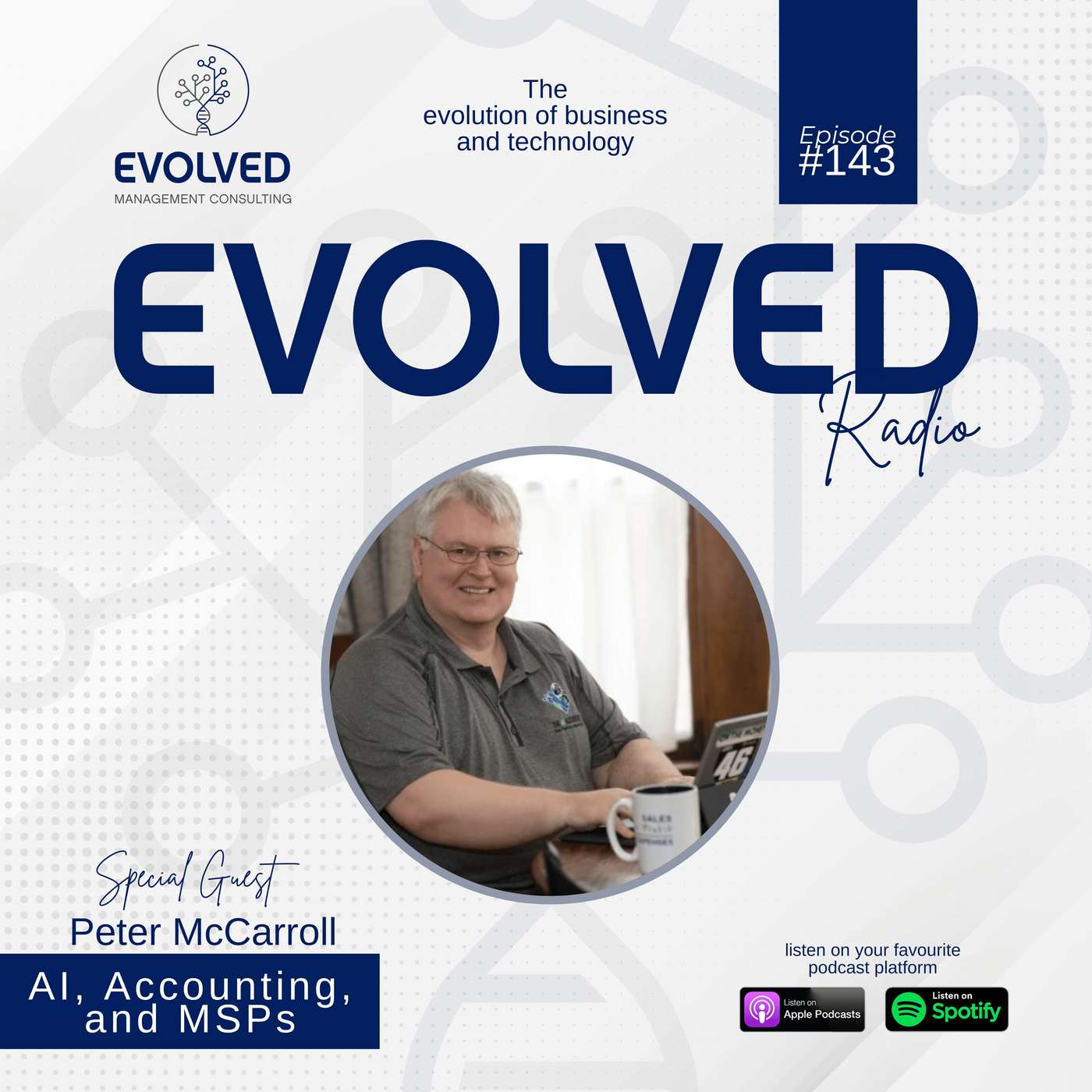
MSPs and accounting firms have a lot of shared DNA. My guest today thinks that accounting is
paving the way for MSPs in AI adoption. Peter McEarl has spent over 30 years in public accounting
and has been helping other firms owners rethink how they price and deliver their work as AI takes
over the routine stuff. His view is that accounting is the canary in the coal mine for professional
services with MSPs next in line. Today we're looking at what's already happening in his industry and
what MSP owners can learn from it before it reaches them. Peter, welcome to the Evolved Radio
Podcast. Thank you so much. Good to be here. Excellent. So I like the description that you kind of
noted for me here is that accountants are the canary in the coal mine for professional services.
I think this is a really apt description of this. You want to give us a reading from the future
on the impacts of AI on professional services. Yeah, so I want to nuance this in a particular way.
I think MSP providers are probably ahead of accountants when it comes to implementing AI. You guys
are the IT specialists. You've been all over this much earlier. Most accountants are still slow to
change. The area where I think we might be the canary in the coal mine is on the price compression
front. I think lawyers haven't felt this yet. I think I was just working with a couple of lawyers
yesterday. They aren't seeing the kinds of things that accountants are now starting to see
that are is putting pressure on pricing. I suspect that MSPs are better at using the technology
and deploying the technology, but the compression hasn't quite hit them yet. That's my thing.
You'd be surprised, actually. I've been ranting about this in the industry for a while now,
not to say that you guys are necessarily ahead of them on implementation per se,
but I think the industry is strangely lacking in the ROI cases for AI. There's a lot of use cases,
I think internally in very specific cases, but I think the utilization of AI certainly for
their customers has been strangely lagging. That's been a fascination of mine as well.
I suppose I think people could maybe assume where some of this stuff shows up for you guys.
Reconciliation, some of the bookkeeping basics, maybe extrapolate a bit out on what does AI
play a role in for modern accounting and how is that creating price compression?
Let's talk about the technicalities first. Where is AI actually changing the work we do?
I would say that up until now, it hasn't. One of the differences between accountants and some
other knowledge workers is that we work very much inside tools. We don't just use the tools.
The tools are the work - QuickBooks, zero - the accounting platforms. They have been, let's say,
on a shaky start in terms of implementing AI. It's really only been the last few months
where we've started to see these tools really start to work out the kinks of how does AI work inside
the product. We're seeing a lot around the edges of the product in terms of other tools that we
might use text, data gathering tools, other automation tools that plug into the accounting systems.
They have actually been much more aggressive in implementing AI, but not every accountant is going
to pay extra for an outside tool to do some of that work. This is why I think the accounting
industry as a whole is still a little behind, because we are very reliant on a very small number
of vendors to work out what they want to do with AI before we can get our hands on it in the
the day-to-day most of what we do is bookkeeping our accounting. Now, that's not to say there's not
lots of opportunity for AI. I have this phrase called AI and the gaps between these systems,
and now that's expanding with MCPs and things like that where now you can now automate between
systems. That's all starting to develop, but just in terms of our core use, today we're just
starting to scratch the surface of how does AI get involved in the accounting process,
and the first place that it gets involved within the tools is in that coding and reconciliation
process. Now, where will we be 12 months from now? I'm very convinced that we will be in a position
where if we've enabled it, AI will be able to code at least 80% of your transactions
inside your accounting ledges, and do so with an adequate, maybe not ideal, but an adequate
level of accuracy. Still going to need someone to monitor it, check it, and do the things that
it can't work out. There'll still be lots of that, but it's going to take a lot of the transactional
work down, and my forecast is that bookkeepers are going to become quality control managers,
not transaction processes. I think there's just a very strong parallel between this and a
help desk, right? So triage process, all of these things will be automated, but they're still a very
heavy QA process. I'm curious because accounting maybe feels higher risk, and granted the stuff
that you're doing is not, it's not like it will get dramatically missed or cause massive issues.
It could, if it's really wrong a lot of the time, but I don't suspect that's going to be the
case, like the LMS are very good now, and I think they'll be quite capable of this. But I think
psychologically, people may be a little more wary about AI playing with their books than they are
managing a support ticket. Do you think there's going to be internal resistance to this in the
industry or a resistance from people saying like, oh no, no, no, I don't want you having AI
playing with my accounting? Yes, there will be resistance. I think the resistance
finally enough is actually stronger inside the industry than it will be from our clients.
It's stronger inside the industry because let's be honest, the accounting industry is an aging
industry. People like me, gray here, they've been in this industry for 40 years,
are slow to change. Now, I've met plenty of accountants older than me who are gung-ho on the stuff,
so I'm not trying to stereotype anybody here. But as a whole, we tend to be conservative,
we don't change fast and we don't adopt technology fast. The whole conversation around cloud
technology, and it took 10 years for cloud adoption to have become normal. And it's only because
companies like into it finally said, you know what, we're going to stop supporting QuickBooks
desktop. The reason they held on so long is because so many accountants did not want to move.
That tells you something about the way our industry works. We are slow. Yeah, even adopters.
Even in our industry, we saw a lot of this that there was accountants that refused to use newer
versions and like certain clients, they would use a specific version, like the really old guard,
yeah, so the changes did not come quickly. Absolutely. And look, to be honest, a part of it is,
you know, accountants have a reputation which is well earned for being cheap burgers.
Okay, and we want to save money on everything we do. Well, here's the secret that you guys might
not know. QuickBooks desktop, you didn't have to pay for every single license. You were able to
run a number of clients you paid for the software and you could create in some cases as many files
as you wanted. In later years, they started to limit that. Of course, the moment you move to cloud,
every client pays. Nothing comes for free. Well, if you're if you're a cheap accountant and you
want to still run, you know, 50 clients for the price of five, what are you going to do? You're
not going to move to the cloud. You know, and it finally took 10 years, 10 plus years for the
for the industry to say, yeah, I think those days are over. We have to change the model. Okay, now,
AI is going to move faster than that. Way faster than that. But there are still going to be
accountants that don't want to make the change. And I remember my dad, I started my first accounting
job was with my dad's firm back in New Zealand. And, you know, he sold his practice. They asked
him to stay on to help with client transition and things like that. But the new owners, they were
younger. They wanted new software, and my dad wasn't a technophobe at all. But, you know, the pace
of change was just too high. And he actually decided to step out earlier than his contract. Allow,
you know, asked him to. He had the right to do it. But they wanted him to stay on for two years.
And he ended up saying, I just can't handle all this change. I think my clients are happy
with the transition. I'm going to step out now. We saw this happen in COVID. A lot of accountants
shut their doors and never came back. And AI is going to be a bit of a trigger here as more and
more accountants get to the point of saying, I can't keep up. And I don't want to keep up. I don't
want to learn a new technology at the stage of my career. I guess that creates an opportunity,
again, like there's so many parallels with the IT industry. Like
the aging population, bit of an opportunity being created for new businesses and we're
seeing a bit of a rise, sort of the early edge, I think, in the MSP industry of a native AI-based
MSP. Like I said, I've joked about the MSP industry being unusually slow to adopt and get
on top of this trend, but there are the people that are just, you know, they're starting a new MSP
because they see the opportunity of being able to leverage these things or consulting in
more of an AI-native way. I suppose that's sort of a similar parallel for your guys' industry that,
you know, it's a bit of a sea change, I suppose, that new businesses will start as a result and
kind of run up the middle, right? >> Absolutely. Well, that leads me to the four pricing changes,
and you alluded to this earlier. The four, I call it the squeeze. The first one might not apply
to MSPs. So the first pricing squeeze is that the tools that we use day-to-day, the quick books,
the zeros, the sages, they are building in AI tools that our clients can now use, that the consumer
or the business owner can now use. So all the things that we ask for for our efficiency
are coming, have come, and they're also being offered to the business owner. And the logical
question here is, well, if I'm getting this as part of my software subscription, which most
accountants pass that charge directly onto their clients or the client pays directly,
if I'm getting that as part of my software subscription, what am I paying you for?
So that's one area of the squeeze, is that the tools that make us efficient are now accessible
by our clients, and they question the value of what they're paying for. The next part of the squeeze
are the new tools that are coming in AI native. So in the accounting world, we've got quick books,
zero and sage, they're the three big native products, or legacy products, I call them legacy products
now. Not applying to us here in Canada, but in the US, which is most of your audience,
digits, kick, puzzle, are now the up and coming software products. Now you may have never heard of
those, but they are new AI native ledges, and they're doing really great things. They're going
well beyond just auto coding a transaction, or reconciling the bank account. They're actually
now putting tools in that deal with reconciling clearing accounts, and you know, all the other
stuff that accountants has to do that is beyond basic coding, which of course most business owners
forget about, because to them, once you've coded something, it's finished, and the accountant knows
that's not true. There's a lot more work that happens downstream from that. But these AI native
tools are building from the ground up. They have no technology debt. They can move incredibly fast,
because they're building in an agentic way for an agentic age. Whereas these legacy platforms,
they can't build an agentic way. Their technology debt is too high. They are trying to convert
their code and their systems into something that will work like that, but these products are massive.
That takes time. So that's the second compression, is that there are these new offerings coming out,
and you know, digits, for example, will offer to not just be your ledger, but close your books
for 60 bucks a month. Cheaper than QuickBooks will do it. And so you have to ask,
is that a competitive threat to an accountant? Absolutely. People are considering changing
services or saving money, and they hear the story about this new platform that'll do it for free,
or do it for a lower cost. They go, "Yeah, I'll give that a try." Usually they end up coming back,
you know, because it's not all they thought it was going to be. They still need to tax work
down. These tools won't do the tax work necessarily, at least not yet. You know, so there's still
sometimes there's room for an accountant, but you know, it changes their relationship. The third
pricing squeeze is perception. This is going to affect MSPs. In fact, every knowledge worker,
and the one of the things I say is that perception is reality. People make decisions based on
opinion, on feelings, and perception more than they do on facts. And you can argue with them
from a rational basis as to why their opinion is wrong, and they will still make their decision
based on their opinion and perception. Okay, it's very hard to convince somebody using logic
when they've made up their mind using emotional perception, just a basic psychological principle.
So what's happening in the whole industry is that people perceive that the cost to do these things
is coming down. Well, it's now cheaper because of AI. What do you mean you want to put my price up?
Okay, I had this conversation yesterday with the client. You know, the perception is that all
this stuff can now be done on a $20 a month subscription. Now, you and I know that that's not true,
not entirely, but it's partially true. Some stuff could be done on a $20 a month subscription.
Okay, and so the perception and the marketplaces, that's what I need.
And so when my accountant or I will keep us here, we want to do your work at $1,000 a month,
or $5,000 a year, we go hang on a second. That doesn't translate to my $20 a month subscription.
And of course, it's not just the $20 a month. That's $20 a month that covers not just what you do,
but everything else I do. And even if that was $200 a month, that perception gap is causing price
compression. There's a classic story in the accounting industry. I think it was KPMG and EY,
I forget which way around the words go. But K, Eastern Young, one of the big accounting firms,
all the accounting firms have, or all the big firms, they have a global practice,
a global head office. And these global head offices get audited by one of the other big firms.
Okay, so we're not talking about the U.S. National Practice or a local office. We're talking about
the international head office. And so they are audited by KPMG. And so they went to KPMG and
they said, AI should be making the audit more efficient. We demand a price cut.
Okay, this is inside the accounting industry. Okay, KPMG said, well, but we're not actually
using AI. So we haven't got the efficiencies you're talking about. You're really paying for
the human expertise and the judgements and all this, yeah, all this kind of stuff. And they use
all the rational logic. And EY said, we don't care. Cut your price. We'll find the replacement.
And KPMG 8% to 14% price cut for nothing. Just because. Just because.
Tired of fighting the MSP fires alone, the Obsleder Pro Group connects service delivery
professionals who understand your daily challenges. From KPIs and workflows to career planning
and team management, Obsleder Pro has systems for you to use. Join operations leaders from
successful MSPs who are sharing real solutions for managing client expectations,
optimizing service delivery and making your service delivery team as effective as possible.
Obsleder Pro, because your service desk deserves more than just survival mode.
Visit obsleder.co. That's OPS leader.co to apply to join the public community. Okay, so this is
going to this is happening in the accounting space. People are starting to push back on price
rises because their perception is this stuff is now free or cheap. They don't understand
that the cost of implementing their technology is incredibly high. You know, and it's not a
$20 a month subscription. In fact, I estimate the average accounting firm will need to spend
between $500 and $1,000 per month per employee. Just on AI and AI that related tools.
Okay, now is that still cheaper? Is that going to give them more efficiency? Yes, it will,
but it's not free. And the perception in the world is this is a marginal free benefit,
which is not true. And an accountant couldn't survive on a $20 a month subscription.
Not if they're really using it. So this is a challenge. That's price compression number three.
And price compression number four you alluded to this a couple of minutes ago.
The rise of new vendors, new AI native vendors, people who say not just I'm not just writing
software, but I'm going to do everything. I'm going to do your texture turn. I'm going to do
your reporting and your advisory stuff. And I'm going to come and I'm going to do it for a quarter
of the cost of the last guy. And I'm going to do it with AI. And it doesn't matter whether
they can do that. All that matters is that they offer to do that. And we've seen them come up.
We're seeing these new AI native accounting firms, you alluded to AI native MSP,
providers, not just software, but providers. And they're automating the heck out of everything.
Okay, now we had a story in the accounting world, you know, last couple of years of a product
called Bench. And it started in Silicon Valley, actually moved to Vancouver. And they were doing
or offering, you know, bookkeeping was supposed to be automated, but it turns out they just had
a whole bunch of people in the Philippines and India for two hours.
hundred bucks a month. They received billions of dollars of investment to create this
new, and of course this is all just before AI. And so they were offering to do all to
do the super cheap high throughput bookkeeping work for a super low price. They went bankrupt
and gave their clients zero days notice that they closed. That was ugly. Yep, their clients
woke up one day and found out that their ledger was locked and they couldn't access it anymore.
Yeah. Okay. Terrible result. Burnt a whole bunch of good will in the industry. But it
proves the point that it doesn't matter whether they can deliver the service. It only matters
that they offer it. And that price point now sticks. And every accountant was now competing
with a $200 a month bookkeeping opportunity. Yeah. So again, like the parallels exist here,
right? That like if you see this coming, like how are you planning your business and you
know, advising maybe other people in the industry and in conferences and conversations? What
do you do with this? Right? Because I think there's some similarity in MSPs that people
are like, well, you know, I've got, I've got Claude to solve all of my, my, my tech support
questions. So what do I need you for? Right? Lawyers probably see the same thing of like,
I don't need to pay you $1,000 to review this contract. Claude can do this for me. I mean,
again, I still struggle with professional certification and sort of the nuances of accounting
as to whether or not the tools could do that all for you. And like you want to make sure
it's right, you know, there's a host of the disclaimer, AI could be wrong, right? I don't
necessarily want that when you're doing your, your books and end up that you, you screwed
something up and I have a giant tax bill. So the ramifications of that feel maybe slightly
more severe than some of the other circumstances. You can get yourself in the legal hot water,
but you know, I think like the, the, the nuances of that, I think you're going to be a little
more detailed. So what do you do with this when your clients may sort of put up a fight
about this or have a misperception about the level of effort and qualification required
to do this work? So there's a couple of things that we as accountants have always sold,
but never listed on an invoice. And, and some of these are, again, we're arguing out
of logic, not arguing out of, you know, emotional reality, or, or perception, I should say,
but this is the reality. And this is how we, we, we have to try and justify our fee to
a certain extent. The first thing is that someone has to do quality control. Even in this new
AI world, someone has to check the machine. And so it's really important that the person
that does that knows what they're doing, they know what good looks like, they know what
bad looks like, they smell a dead fish. Because that's what happens is you have, you have
a sea of transactions and buried in there are a couple of rotting corpses. You know, someone
has to know how to find those, correct them, and then go, yep, we're happy with these
results. Most business owners are unable to do that. Now the AI is getting better at
self, you know, a review, but it's certainly not there today. Two, three years time, maybe
it will be better than a human. I totally can see that point. But for today, quality control
is one thing we sell that the system isn't going to deliver for itself. The next thing
that we sell is what I call the ringable neck. And that's the idea that there's a name
on the file with a qualification or, or, or, or a statutory qualification and insurance.
If you use Claude to prepare your tax return and you file on that basis and it turns out
that it was wrong, do you think that anthropic is going to send you a check? Absolutely. Absolutely
not. Now, if I prepare your tax return and it turns out to be wrong, you've got multiple
avenues to pursue to recover those costs, okay, because I'm required to carry insurance.
I'm a member of a professional organization. You've got a, you've got a procedure to
go through there, whether it works out or not, so different question, but at least those
opportunities are there. There is some accountability, okay. And, and that we've never had to
price that before. The other, and the thing from our perspective, and this also affects
MSPs, and I was talking with it with a couple of lawyers and accountants about this yesterday
is risk. And, and the accounting space, one of the, the trends we are seeing and this is,
this has always been the case, you know, we, we have a service plan for it, we call it
self service, you know, where a client does their own books and zero or quick books, and
then they want us to do the tax return. Well, we won't do a tax return based on a trial
balance. We just don't do it, we decline, because you, you take all the risk, but you have
zero ability to affect the numbers. So, you know, if you, if you called me and said, hey,
here's my quick job balance, can you do a tax return? I say no, I, I'm not taking that
risk. So, we build in review hours and you pay for those review hours. We review your
ledger, we're looking for problems, we're going to clean it up. And if it needs more
than with budget before, you will pay that extra because that was your fault, not our
fault. We want clean books before we start the tax process. And then we do a workup
of every file, we don't just take the child balance and, and, and the ledger and assume
that right, we now prove that that right. That makes me more expensive than some other
tax shops that will just take their trial balance and say, hey, that's the clients risk,
not ours, we don't care if the bank account wasn't balanced, we don't care if the light
of the assets don't exist, we are just going to pump out a tax return. We won't do that.
And the reason we won't do that is we are at risk either way. So, if I'm going to be
at risk, I want to get paid for the risk or at least do the work to know that I'm happy
with the level of risk I'm taking. Now, if we move into a world where AI is doing the
work and you just pay in a professional to file a tax return at a much cheaper rate
because AI is doing all the the aggregation of data, who's paying for the risk? You're
assuming it as a professional, but the client's no longer paying for it. They used to pay
for it because they paid for the hours used to do the review, to do the cleanup, to
prepare the return. Well, if those hours are compressing, they're no longer paying for
risk. So, that's a big issue on the accounting space. And this is going to be a version
of that that applies to MSPs as well. One of the other pieces maybe I'm curious about
is, I think maybe you guys face a similar issue around how do people scale into the industry
if all sort of the remedial junior work is being done by AI agents, right? And similar,
I've been thinking about this in the MSP industry is like, most people will start in sort
of tier one triage doing passive resets and supporting users without look issues. And
if all of that gets given to the robots, how do people scale up to that tier two level
and get to the work that is more of the QA? Is that just sort of that you have to have
some book knowledge around these things to be able to judge whether or not the AI is
doing things properly or it doesn't create a create the situation where it kind of removes
a rung from the ladder and you kind of have to leap up to get to the first place in having
a job in an accounting firm in the future. Yeah. So it definitely does remove a rung
from the letter. And there is a hidden problem that while AI might solve or partially
solve our current talent crisis and the accounting world, we have a major talent crisis
right now. We just can't get good people. And I'm sure many industries have the same
thing. So, so there is a rung that's that's could be taken out of the ladder. And this
is not going to we're not going to see this for maybe another five years. Because in
five years time, we've stopped hiring juniors and all of a sudden we want an experienced
person and we need an accounting space would say we need a manager and we normally grow
our own managers. We haven't been growing our own managers for five years. So, where
are they going to come from and we will desperately need them and they won't be there. So, how
do we deal with this this lost rung as you put it? There's there's two main strategies
that I've been thinking about and and so obviously education is a part of that but we all
know that people come out of school with a lot of book knowledge and they're of no practical
use because they learn by doing and that's the step we are taking away. So, the airline
industry has been has grappled with this for a very long time and they do not let a pilot
get into a live cockpit with passengers on the plane until they have done hundreds of
hours of simulator training. They have flown that plane full of passengers a thousand
times virtually before they ever face a live passenger on a jet on a jet anyway. We need
to start to think in the accounting industry and in the MSP industry we have to think about
how do we simulate real work so that when someone starts to work they are ready to work.
Book knowledge is not enough. You have we have to find a way to do the reps in order to build
the muscle and we can't fake that. We still have to do something to build the reps.
So that's number one.
I think we have to redefine what are we looking for, and quality control, even in MSP land,
is going to be a significant part of what we do. So we have to retrain around what does
good look like. Bookkeepers learnt what good looks like because they spent years coding the
transactions and getting feedback from their supervisors about what the mistakes they've made.
Well, their job is going to move to be doing that same work, but watching the machine instead.
So they have to now start to really understand what good looks like because they don't know what
good looks like. They can't identify bad. So that's how I look at it in the accounting space.
We've got it. We've got to talk about simulations. How do we train without, you know, putting
text at risk, and how do we help train people to know what good looks like rather than letting them
learn that biosmosis, but just how they used to learn it. Yeah, this is interesting. I'd not
considered simulation, but I was wondering where you were going with the pilots, but that makes a
ton of sense. And, you know, to some degree, I suppose this is a strange issue of like the AI's
will sort of remove that run, but also provide the sort of the training and simulation requirement,
right? Like an AI can build a lot of these simulations and act as a customer to give coaching
and mentoring to scale up. This would be, I think, you know, maybe a separate podcast entirely,
but this I think is what you touched on is the future of education in general, right? Like a lot
of this, I think, will be sort of pair based learning of mentorship. And then you kind of exceed
the coach at some point and have human level intelligence to QA and oversight these things for,
you know, things that just require nuance, right? Like robots for now are still very good at
predictable outcomes and are not terribly creative. Like they can act like they're creative,
but they're generally kind of crap at it. And I think that this will be sort of an interesting
future as that shifts and it becomes more of a, I'll help you up to this level and then you get
to a level where you actually start to monitor me. So I think this will be, this will exist in
pretty much every knowledge-based industry. As you said, you guys are kind of seeing the thin edge
of the wedge of this and, but it'll, it'll trickle down and affect all of us, really.
This is fascinating, Peter. Really appreciate your time. We'll link to you, yourself,
your LinkedIn profile and your company fuel accounting. If anybody wants to continue the conversation,
any other sort of parting notes, words of wisdom from the front lines of knowledge work in the age
of AI. Yeah, so I mean, your audience probably works with lots of accountants and in my AI
counseling program, we actually teach accountants how to think about AI and how to implement AI
within their firm so that they can basically, so they can survive the next two years. Because,
you know, I'm convinced that the work will be different in less than two years from now,
substantially different. And someone that hasn't adopted to that will not have a good time
with, with the industry. So if any of your listeners have accountants and they, they are grappling
with what should I be doing with AI. Yeah, send them, send them to the aiaccountant.ai and we have
something called the practice transformation program where we, we, we, we talk through all of the
issues around AI, what it's doing to the marketplace. We talk about that price compression and,
and then how do they prepare for a world where the AI does more and more of the work?
And not only the accountants that work for them, but probably a lot of their clients
are accountants as well. And this could be kind of leading them to that conversation of
this is changing my business, this is changing your business. So let's get on top of this, right?
Well, that's great. Yeah. Appreciate your time, Peter. Okay. Thank you. It was a pleasure.
Podcast Summary
Key Points:
Accounting firms are a "canary in the coal mine" for AI disruption, with MSPs already ahead in AI adoption due to their IT expertise.
AI is beginning to automate core accounting tasks like reconciliation and coding, shifting bookkeepers into quality control and oversight roles.
Price compression is driven by AI-powered tools accessible to clients, new AI-native platforms offering lower-cost alternatives, and shifting client perceptions of affordability.
Resistance to AI in accounting stems from industry conservatism, aging workforce, and distrust in automation, especially regarding financial risk and accuracy.
Key differentiators for professionals remain human oversight, professional qualifications, insurance, and risk management—elements that AI cannot fully replicate.
AI threatens to remove entry-level roles in service industries, creating a skills gap that requires new training models like simulation-based learning.
The future of professional services will involve hybrid human-AI models, where humans provide oversight, mentorship, and judgment in nuanced decision-making.
Early adopters in accounting and MSPs are identifying critical shifts in pricing, service delivery, and skill requirements, signaling a broader industry transformation.
Summary:
Accounting firms are leading the charge in understanding the impact of AI on professional services, serving as a "canary in the coal mine" for broader industry shifts. While MSPs are already more advanced in AI adoption due to their technical background, the accounting sector is experiencing significant price compression as clients gain access to AI tools like QuickBooks, Digits, and Bench—offering automated bookkeeping at lower costs. This creates pressure on pricing and service value, as clients perceive tasks once requiring human expertise as now affordable.
Resistance in the industry stems from conservatism, aging professionals, and a lack of trust in AI’s accuracy, especially in high-risk financial areas. Key professional advantages—such as human oversight, professional qualifications, liability insurance, and risk management—remain critical and cannot be automated. As AI automates routine tasks, there’s a growing need to retrain workers, particularly through simulation-based learning to build judgment and identify errors.
The future will involve hybrid human-AI models, where humans handle complex, nuanced decisions while AI handles repetitive tasks. MSPs face similar challenges, including client skepticism and job restructuring. Early adopters are already preparing by redefining service models, emphasizing quality control, and investing in education and risk management—highlighting the urgent need for proactive adaptation in all knowledge-based industries.
FAQs
Yes, MSPs are generally ahead of accountants in AI implementation due to their IT expertise and earlier exposure to automation. Accountants are still slower to adopt AI, especially in core accounting tools like QuickBooks.
AI is currently most active in transaction coding and reconciliation. In the next 12 months, AI may automate up to 80% of transaction coding, shifting bookkeepers into quality control roles that focus on monitoring and validating AI outputs.
AI is driving price compression through four key factors: clients accessing AI tools directly, new AI-native software offering lower-cost alternatives, widespread perception that accounting work is now cheaper, and the rise of low-cost AI vendors offering full-service automation.
Resistance stems from the accounting industry's conservative culture, aging workforce, and historical reluctance to change. Many accountants fear losing revenue or feel uncomfortable with AI making decisions on financial data.
No, AI cannot fully replace human accountants. Quality control, judgment, risk management, and nuanced decision-making remain essential, especially for identifying errors and ensuring compliance and accuracy.
Quality control will become more critical as AI handles routine tasks. Professionals will focus on reviewing AI-generated outputs, identifying anomalies, and ensuring data integrity, acting as human oversight rather than executing transactions.
Chat with AI
Loading...
Pro features
Go deeper with this episode
Unlock creator-grade tools that turn any transcript into show notes and subtitle files.
 PodcastTranscript AI