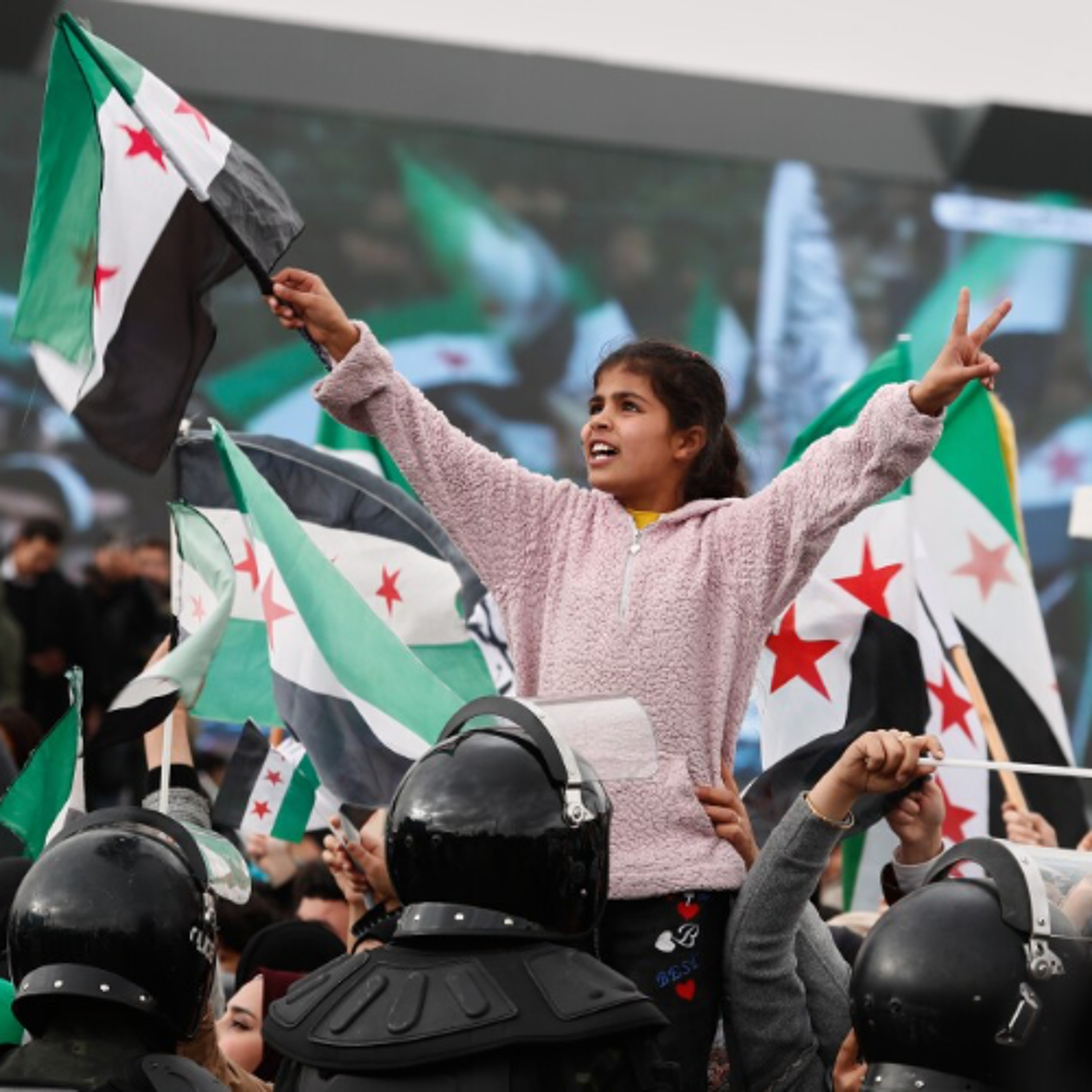
This episode of the Global Inquirer examines the 2024 regime change in Syria, where the long-standing authoritarian rule of the Assad dynasty was overthrown. The discussion, featuring podcast correspondents and Professor Hennadi Al-Saman, outlines the historical context, starting with the 2011 Arab Spring protests against oppression, which escalated into a civil war. The key actor in the change was the Hay'at Tahrir al-Sham (HTS), a group formerly designated as terrorist, which stormed Damascus and installed its former leader, Ahmed Hussain Al-Shada, as interim president. The conversation highlights the profound impact on civilians, particularly women. With many men leaving the country, women increasingly entered the workforce and supported the revolution, though their political representation remains low. Notably, Kurdish-majority regions in northern Syria, such as Rojava, are highlighted for having more progressive policies on gender equality. The professor adds depth by explaining Syria's colonial history and the Assad regime's tactics of instilling fear and manipulating minority groups. While the new government expresses intentions of inclusive democracy, it faces significant challenges, including regional conflicts, economic hardship, and the complex legacy of decades of authoritarian rule.
[MUSIC] Welcome back to season 15 of the Global Inquirer. We are an undergraduate research podcast based out of the University of Virginia, and we are sponsored by the International Relations Organization. I'm your executive producer, Andrew Chan, and I'd like to welcome you to today's episode on the regime change in Syria, which podcast correspondence Jason Kim, Victoria Strama, Anthony Chandler, and Nathaniel Fox will discuss with our expert guest, Professor Hennadi Al-Saman. We're glad you're tuning in and hope you enjoy the episode. [MUSIC] Hello, thank you so much for joining this episode of the Global Inquirer. I am your host, Jason Kim, and today we will be discussing the situation in Syria. Syria has recently undergone a huge regime change, and we are going to talk about the context of this change, and we are going to talk about how this change is affecting minorities, especially women in the country. I am joined by three correspondents, of the Global Inquirer, who have done a great deal of research into the topic, and I think my first question for them is just to ask, what is kind of the context behind what's going on in Syria? What can you tell me about the history? Hi, everyone. This is Victoria, and in terms of the context in Syria, it can be largely defined by the last regime under a saw. And when Assad was in power, we saw a very large authoritarian presence in the nation of Syria. This involved putting down a protest, not allowing citizens to speak up against their government, and other authoritarian systems of keeping rule. The regime first started with Hafez Al Assad, and he passed power down through his son. This multi-generation regime resulted in torture of citizens, as well as the bureaucracy failing to meet a lot of citizens needs. Can you guys fill me in on the catalyst or the actors behind this regime change? Hello, everyone. My name is Anthony Chandler, and first I want to get into the context of what started the Civil War, the conflict broke out in 2011, and it is important to note that this was the time of the Arab Spring, this began in December 2010 as an anti-government protest in Tunisia. Following this, there was a wave of pro-democratic and anti-authoritarian protest throughout the Middle East, which resulted in the toppling of governments in Tunisia, Egypt, Libya, and Yemen, and along with this, the start of civil wars in Iraq, Libya, Yemen, and of course Syria. This is according to the National Geographic. Now, what can you tell me about the specific revolution in Syria? Can you tell me a little bit more about the actors? Yes, there are multiple military organizations in Syria at the time, the largest one being the Hyatt's, Taurir, Al-Shaman, the HTS. The HTS played a large role in the overthrowing of Assad in in December 8th, 2024, when they storm the capital of Damascus with the Syrian National Army. It's important to note that the HTS has been identified as a terrorist organization by multiple countries until recently. And now that this organization, the HTS, is not identified as a terrorist organization, what position have they taken in the country? The HTS is a functioning military group in the nation, but it's not serving as the military force for the country. And if they're not serving as the military force in the country, is there a leader that is currently in Syria that is kind of helping operations move along? Yes, so the HTS former leader Ahmed Hussain Al-Shada has set himself up as the interim president of Syria. All right. And what can you tell me about Al-Shada and his background or his history? Yes, so he was the former leader of the HTS, as I mentioned, which is a Syrian, jihadist movement started in 2017. He was formally affiliated with Al-Qaeda, though he's currently announced those former connections. He's attempting to stress anti-corruption, order and stability under his rule. He's trying to portray himself as a protector of minorities and more moderate ruler of Syria. As we're discussing the context of the new government in Syria, I think it's also important to recognize that we're talking about women. What is the context of women in Syria? Are they leaving the country in large numbers? Are they taking space in the labor force? What can you guys tell me about that? So it's important to note that when the initial fighting broke out, there was a large movement to get away from Syria. This is because the government was coming down very hard on its citizens at first, even accused of using chemical weapons as reported by the council of foreign relations. Because of this, a lot of people were worried not just for their safety, but for their economic prosperity. They had to find a way to feed their children and to keep the lights on. Because of this, many men moved out of Syria and worked to find jobs and God visas and other nations that allowed them to send money home. And the reason that this was so prevalent amongst men and not women is because largely cultural, a cultural background of a very strict Islamic interpretation requiring women to have a male escort essentially across different boundaries and borders of countries. So for travel, women often needed a partner and a male kind of partner to go along with them. And on this note, men moved out in very large numbers. I believe it was around three million men left Syria to go find work and kind of spread across other countries while women largely were their numbers remained in a high two million. Because of this, a lot of women stayed home in their country and took up jobs such as military help, nurses and aides to the revolution. Kind of bouncing off of that discussion of women taking up place in the economic sector of the nation. Do we have any information about their involvement in the political sphere? Yes, we do. Currently in Syria, they're trying to move towards a democratic system with 61% of Syrians favoring democracy according to the Al Jazeera. And this was reflected recently in the People's Assembly election that Syria had in October. It's important to know about the people's assembly, but under Al-Shaba, there are 210 seats. This is 40 seats fewer than under Al-Assad. Members will serve to two and a half years and Al-Shaba will appoint 70 members. While the other 140, we voted in by a subcommittee appointed by Al-Shaba. It's important to note that during this election, 14% of the candidates were women. And along with that, there was a drafted law in Syria stipulating that the electoral colleges must have 20% representation for women. Although this was drafted, it wasn't passed. Now, that's a very interesting point. And I'm kind of wondering if the attitudes that are present and the economic and political spheres are universal in the Syrian nation. Do you guys have any information on whether there are certain geographic regions or maybe ethnic populations that are treating women differently in the country? Former U.S. ally and the largest state-less population in the world, the Kurdish minority in Syria, has a much different view on the role of women. According to AP News, there are essentially a self-governing group in Syria. According to the global conflict tracker in the Kurdish regions, primarily Northern Syria, commonly known as Rojava. Women have significantly more rights and social status compared to other areas of Syria. Women participate in areas of politics, government and military forces who structures primarily being the Democratic Union Party and the all-female women's protection units YPJ. The political framework in Rojava prioritizes gender equality with a co-chair system that mandates equal representation of women and men and leadership roles at various levels. Kurdish women in the region emphasize grassroots democracy. This contrasts with other other areas of Syria, which emphasize authoritarian governance. All right. Thank you guys so much for that context. In a short while, we will be joined by a professor at the University of Virginia, Professor Hanadi Al-Saman, who is a distinguished professor at an art department of Middle Eastern and South Asian languages and cultures.
[Music] Good morning. It's a pleasure to have you with us today, Professor Osama. Before we start, would you mind introducing yourself? Sure. Thank you, Anthony, for inviting me and everyone else. I'm Hannah D. Alsa Man, a associate professor in the Middle Eastern South Asian department at the University of Virginia. I specialize in modern Arabic literature, gender studies, and literary theory and cultural studies. Thank you so much for that introduction. So before we dive into the specifics of what's currently happening in Syria, we think it's important to establish the histories so our audience can understand the changes that are happening. Could you provide us with some context behind the Assad regime and their treatment of minorities? Yes, absolutely. And I think it's important always whenever we want to zero in on a specific problem that we should look at the larger picture and the context in which all the -- the division or complex realities may happen. Syria itself as a state in its modern sense came to be after the solution of the Ottoman Empire after World War I and the -- as a result of the psychspeaker agreement that happened between Great Britain and France, in which basically the whole Arab world was considered as spoils of war and was divided between these two great colonial powers. And so Syria and Lebanon, most of North Africa was under the French control or mandate while the rest of the countries like Palestine, Egypt, Iraq, Jordan were under the British control. So for that reason, then there were several constitutions and several presidents that came either within under the mandate, the French mandate or afterwards, up until the point where Syria got its independence on April 14, 1946 and beyond. There were several constitutions, presidents up to that point and then half of the Assad, the father of the past president, Bashar al-Assad, came into power in 1971. He was the secretary of defense at the time and he did a coup d'état in which brought him to power in 1971 and stayed there until 2000, until his death in 2000. And then immediately the parliament which was basically under the control of the BAS party which was one, they changed the Constitution in about 15 minutes, which was hilarious, to allow his son, who was then 35 years old to basically become president of Syria and he continued until December 8, 2024 after his ouster. Now during that whole period the Assad father and son created a military state, all of Syrian citizens were under the emergency law in which you're not allowed to speak your opinion, you're not allowed together, you're not allowed to create any parties that are not in agreement with the ruling. And they created a country in the state of terror in which everyone would be arrested and it's a really state of fear that put a lot of Syrians in jail and made many others suspect and forced them to leave. So now what brought this is the context of the background of Syria and we see that this is why the Syrian people created this revolution in 2011, they are affected by the Arab Spring that happened in Egypt, happened in, in, in, in, two, this is started in Tunis and in Egypt and in the other Arab nations. They were hopeful that they would also have a chance at freedom in Syria and actually the revolution started with teenager boys writing, and girls writing on the school walls that your turn is next time Dr. Bashar, he was like an optimist, sometimes they call Dr. Bashar lesson. And they were arrested and their nails were, were pulled out and when their parents came to ask for their children to be released from jail, they were told by then the nephew of Assad who was in charge of the, of the prison and the whole security system in that, that you should forget about these children and go get some more children. And if you are in cable who's doing this, bring your women and will father more children for you, which was a great insult to that community and obviously to everyone else. So that's how the, the revolution started, people erupted, they asked for, for dignity and freedom, that's the most important thing we should remember Syrians in the revolution asked for dignity and freedom. And finally after, you know, 2011, they were, they were, we were succeeded in 2024. They suffered so much from the bombing of the regime and the later aided by Russia, also aided by Iran. And so lots of factors that played in this neighborhood that played, played to the where we are right now. So that's a little bit of a background and I think that whenever we look at the current situation after the liberation of Syria, as Syrians would like to say it, we have to kind of temper it with the understanding of this context. That this is a tough neighborhood that there were many actors and political players at hand, some of them are colonial, some of them don't have Syria at their best interest. And that's what we are now. Could you expand a little more on the role of minorities into the Assad regime? Yes, so the Assad regime, again both father and son, tried to use the minorities in a way he would make them afraid of the majority, obviously Syrians Syria has a senior majority, which would include, by the way, both Arabs and Kurds. And also has Christian minorities, Jews minorities, alawait minorities, of which the Assad was part of. And he would basically create the Assad that I am the protector of these minorities and that's why you have to support me because if not, then you're going to lose whatever privileges. And he also like championed himself as the rights protector of the rights of women. He had appointed at the time the one of the ministers was a minister of culture was a woman. And he even used his own sect, the alawait set sect himself, he used it because he made them almost hostage to him. They would always send their kids the only opportunity they would have as meals would be to enroll in the army and be part of his military machine to control the people. He would never do any improvement in the alawait villages. It remained very primitive, very kind of really just beholding to either agriculture or nothing else. So all the males would have to enroll in the army and just have to to loyalty to him. According to the BBC, Syria has almost 6 million people in need of nutritional assistance. 74% of them are women and girls. Why do you think that the Syrian conflict has hit them the hardest? So during this prolonged period of the Syrian revolution and the unsoling civil war that happened a lot of males were killed. And the rest of them basically had to flee, become migrants and refugees mostly in Europe, take the very dangerous road or even sometimes the boats, those death boats to get them to Europe. So that left these women and children without some breadwinner to take care of them. I mean mostly it is a patchy arc also.
society and mostly it's the male who's the print winner. And also at times of war, generally speaking, whether it's patriarchal society or not, you'll have limited resources, you'll have lack of electricity and economic possibility. And so basically that affects the vulnerable the most and the vulnerable then where women and children obviously. - Thank you so much for that. - The Assad regime portrayed itself as a protector minorities. We'll also weaponizing them, restricting their rights. Are there implications for how this new government may treat minorities? - So the new government, at least what we hear from their intentions, from their declarations and what they're saying is that they're open to an inclusive government, to coalition where all minorities are going to share in the governments through the constitution that will be happening and agreed upon. That in reality remains to be really translated 100% on the ground because of all the challenges that I stated earlier on. There were some upheaval in March of 2016 in 2025 in the coastal area where there are reports that government forces were attacked or killed about 14 of them and then that led to the other factors from those government forces to come and then take revenge on other alawight minorities. And so it's kind of back and forth in that sense. Obviously there were mistakes that happened and people that were killed in that way. Then there was the other settling thing that happened in Sueda almost kind of like the same scenario where the government forces, they were a fight between the Arab Bedwins in that area and the Jews, some factors of the Jewish sect, the government came to kind of break up the fight and then they were attacked and that also created this back and forth. And then Israel got on the line as well to support the Jews and practice which is the normal colonial practice of the divide and rule to embolden these Jews factors to kind of break away from the government and this is still kind of ongoing at this point. But if we look at the intentions, the statements of the current government, they would like to include everybody, they would like to have all the minorities. And I also would like to state that, for example, the Christian minorities have been wonderful in stating that they are first and foremost Syrians, that they are part of this country and this nation and they've been included in that. And the recent visit of President Ahmad al-Sharrah to Washington, to meet President Trump just last week. He met with the Syrian American population and some of them were actually the Syrian Jewish group. Those people migrated from Syria during half of the last of the father in the early '70s and even after all this time, they were immensely supportive of the new government, the President and they are looking forward to go back. They went back, actually, and they have the working on visiting and refurbishing their synagogue and starting again. And they are all supporting the government of Syria. So whenever we talk about minorities, we have to look at the whole picture. Again, I started with this whole picture. And it has more voices. Thank you. Our research is telling us that the Kurdish regions of Syria have some of the most progressive policies regarding women's rights. In your professional experience, how do these policies relate to the positions of the larger Syrian government with Syria's position different under Assad? So again, and when we talk about the Kurdish minorities, these are minorities only ethnically, religiously, they are Sunni. So they're part of the majority in the terms of the Sunni, religious sect, but ethnically, they are considered Kurds. And in the past, they were during the Assad regime, they were prevented from teaching their own language and their schools, but then they were just as oppressed as all the Syrian citizens of all sects of all categories under the Assad regime. So when we talk about now the current, what's happening in the north and eastern of Syria since 2015, and this is when what is called this militia group, that is called the Syrian Democratic Forces, that was basically brought upon Syria by the Assad, Bashar al Assad, and supported then by the US, supposedly to combat Daesh, right? Daesh is ISIS. And they're at that point since then, they have been in control of the oil fields, they have been control of the gas, and all these economic resources, that is basically the right of all the Syrians. So at that point, they in order for them to get fighters in the group, they would go and enroll young men and women to sometimes willingly, most of the times it's unwilling and there are many reports of basically children who are 14, 15 years old abducted by these groups so that they can be forcefully enrolled in there. So I wouldn't call them 100% protectors of the minorities or they are the champions of women's rights. Yes, there are some women serving in their ranks and women in leadership ranks as well. When we look at them, we also have to see that they are implicated just as much as everybody else in following the same practices that control and abuse people as well. - Thank you so much for that answer. According to the Tahir Institute, the People's Assembly election resulted in women winning only 5% of the assembly, meanwhile 14% of the 1578 running candidates were women. Are there any nuances in Syrian society that could provide some insight into this trend? - Yes, thank you for this question. Very important question, the participation of women. Again, as I just mentioned that the Assad regime always champions itself, that it is the protector for the rights of minorities but also of women. And yes, there were more, there were freedom that are given to women, at least the Assad and of it. But at the time then, the percentage of the people's assembly under the Assad father and son were not much more than the current constitution. So how would I explain this? There are several factors for the current one now. They were 17% of women nominated, but you have to also remember that this is a patriarchal society and mostly it's gonna favor probably electing a male candidate. Another story that I know, and maybe that has repeated by several other women, I don't know why, for example, they would not be willing to nominate themselves for the election, actually it's a relative of mine and they wanted her actually to be part of this nomination. She's from Aleppo and the people's assembly is in Damascus and they were telling them, you have to be there the whole time, you have to, we have a lot of work to do, you have to actually go and re-sive there. And she's a single mother and she could not leave her kids. That period of time to go and leave from Aleppo to Damascus, that might be the reason why many women don't want to be engaged right now. Plus, the scene at this point is really very, it's kind of a confusion, it's how about, you know, you don't know things that picture is not very clear, so maybe some women don't want to engage as much. I would like them to be more engaged, obviously. The government itself, we have, [BLANK_AUDIO]
a minister of I think labor, labor, she is a Christian minority, she's a Christian woman. But yeah, I mean, again, it is a patriarchal society that probably would favor men and not women as well in the elections, just like in all societies. I mean, you know, with us here in Virginia, we just got after all these years our first governor elects to be in the US, we don't have a woman president yet after all these years. So time will remain, but to be seen and hopefully they'll have more involvement. Thank you so much for that answer. Sirius Labor Market has suffered some decline as a result of the conflict. One may expect women to begin entering the workforce in great numbers. However, according to the women's international league for peace and freedom, women are still experiencing economic barriers. Are there any ideas that can illuminate the reasons behind this? Yeah, so thank you for this question. This, you have to realize that now the international community and especially in the US had something they passed something I think in 2019, they passed Caesar's Act, which is economic sanctions on Syria, the Assad regime at the time. So then it would force it to basically get online with the human rights and get online with not supporting at the time, obviously, Hasbullah and not being part of the Iran. That Caesar law, the reason why it was called Caesar's law is because there was a photographer by the name of Farid Al-Matham. You know his name now, but at the time because he was so secretive, they named him Caesar. He took all pictures of all the tortured prisoners in Sadnaya, this infamous prison that was opened two days after the second day after the liberation of Syria and we saw all the horrific atrocities that were committed on the bodies of the prisoners. And so as a result, he testified in front of the Congress in 2019 and there was this Caesar's law that was enacted. This basically means that you cannot as a group, economic or a company or anything, you cannot have any dealings with the Syrian government. There's no swift system, there's no banking system, there's nothing. So basically Syria in a way is kind of cut off from the rest of the of the world in banking and economic and trade and everything. That will have to have an impact on the people and it did. So it basically created a lot of economic stress on the whole population. So even after the liberation of Syria, this Caesar law is still intact. President Trump, I think, in March said he was suspended but he will only have control to do it for six months at a time. This law was passed by Congress and it will have to be put on the agenda to be voted canceled out also during by Congress, which the Syrian American coalition group is working on this now, but it has not happened. So until then, until this happens, all those promises of investment, working groups and companies that's going to come in the West and rebuilding of Syria, that's what we have to look at, the rebuilding. The whole country is demolished. The infrastructure is gone. There's certain areas in building, no water, no connections, phones, what have you. So basically this economic disadvantage is happening on all Syrians, men, women, and all ethnic minorities. Everybody is under this control. So not just women. How is that going to change? It will change once the Caesar's act is lifted. Once we see more investments, participation, and then mainly also supporting those projects where it's women led. Women led by some businesses, some even small businesses selling things, which is actually what women did in the north, northern area of Syria during the Assad regime. The northern area, which was Idlib, was under like separate from the regime at the time. Women did a lot of investments in group selling, like sewing things and selling stuff that helped them have some income for them and their families at the time. Absolutely. So I think a great follow-up question would be what could the role of internationally, not just the U.S. involvement, but also like the EU's 2.5 billion euros, play an improving women's economic participation amid Syrian reconstruction. I think that really they have to be sure that whatever aid they're giving, if it is earmarked for Syrian for let's say women only, because there are others earmarked for other goals. But if it is just for improving or empowering women, it has to be done with kind of oversight and even the directorship has to be women kind of powered and charged and controlled, I think. So then you would cut out the middleman and cut out like all the patriarchal structures trying to control this effort and maybe put a difference in on it. I mean not all these helps that are promised. Like I said, there are lots of promised help of investment, but nothing really happened on the ground, because if you want to send money to Syria right now, you cannot send money through the banking system, because the swift system isn't even there. So yeah, I think you have to ensure that it's going to women alone and that it is going to cause this woman in children. Would you say that the push factor of the you mentioned earlier of male co-wurst military services is also a factor in the discrepancy of immigration? Yeah, I mean obviously men were during the Assad regime, they were threatened by either you have to migrate or you have to enroll in the army and be killed or kill your fellow citizens and you do not agree with killing them, right? So actually thank you for this question. I had used to have a presentation about the Syrian revolution and that was part of the kind of meme I would put at the end. There was a picture that the Syrian male is left with two choices either putting the military vest or the palm vest. It was like the vest of the swimming vest to migrate, right? So that's part of it when they migrate then there are not many of them left around. In your past research you detailed the idea of Muharram. Could you explain for the audience what this is and its implication or these immigration statistics? Yeah, great. So Mahram is an idea that comes from the Islamic tradition that a woman is not supposed to travel alone because she needs a man to take care of her. Any problems that may happen to her on the road and that so then others will not take advantage of her. Now again this law came as part of her reality with necessity in the Islamic times. Talking 7th, 8th century and afterwards where you have these long trips often done in the desert. Kamal will take you a month or two or maybe more to reach your destination and if you are a woman alone doing this you will be obviously prey to all to all kinds of danger. Men may attack you, you might be raped, you might be not attacked by wolves or what have you. So that was basically the reason for it that you need a male to protect you and this male Muharram has to be someone whom a woman cannot either already marry to like a husband or cannot marry like a father's son brother what have you. So that's the idea came as a result of that certain Arab countries such as Saudi Arabia.
At least in the past, I'm not sure what the situation is right now, but at least in the last 15 years or so, it used to be that you're not allowed as a woman to travel without a maharam like a male guardian. I think they might even have changed that in Saudi Arabia now. But in Syria, this was never the case. Syrian women would always have the freedom to move freely, to be mobile and to be on the move without a maharam. So that was never been the case. I really would think that the reason beyond maybe their fewer migration rather than the meals is the fact that often child rearing is falling upon women. So they would always have the kids with them. So you're not easy to move with two or three kids and travel as opposed to a male traveling alone and he can be more agile and fast-joring. And also it's the cost of it, as I mentioned. It was costing $10,000 to $12,000 per euro sometimes per head. That's what the smugglers would tell you per head. Professor Al-Saman, thank you so much for your time and for sharing this knowledge with us. Thank you for your willingness to learn a lot Syria and I enjoyed my talk with you. And I'd like to thank you. Thank you. Thank you. That's our episode for today. As always, thank you for listening to the Global Enquirer and thank you to all of our correspondence and especially Professor Al-Saman for helping this story come to life. If you enjoyed this episode, please make sure to follow us on Spotify or wherever you get your podcasts. Also, please feel free to give us a follow on Instagram @UVA Global Enquirer.
Podcast Summary
Key Points:
The podcast discusses the 2024 regime change in Syria, where the authoritarian Assad dynasty was overthrown by the Hay'at Tahrir al-Sham (HTS) group, leading to an interim government under former HTS leader Ahmed Hussain Al-Shada.
The conflict's roots are traced to the 2011 Arab Spring, with the Assad regime's oppressive rule, including human rights abuses and suppression of dissent, fueling a civil war.
The impact on women and minorities is significant
An expert professor provides historical context, noting Syria's colonial past and the Assad regime's use of fear and manipulation of minorities. The new government claims inclusivity, but faces challenges in implementation amid regional instability and external influences.
Summary:
This episode of the Global Inquirer examines the 2024 regime change in Syria, where the long-standing authoritarian rule of the Assad dynasty was overthrown. The discussion, featuring podcast correspondents and Professor Hennadi Al-Saman, outlines the historical context, starting with the 2011 Arab Spring protests against oppression, which escalated into a civil war. The key actor in the change was the Hay'at Tahrir al-Sham (HTS), a group formerly designated as terrorist, which stormed Damascus and installed its former leader, Ahmed Hussain Al-Shada, as interim president.
The conversation highlights the profound impact on civilians, particularly women. With many men leaving the country, women increasingly entered the workforce and supported the revolution, though their political representation remains low. Notably, Kurdish-majority regions in northern Syria, such as Rojava, are highlighted for having more progressive policies on gender equality.
The professor adds depth by explaining Syria's colonial history and the Assad regime's tactics of instilling fear and manipulating minority groups. While the new government expresses intentions of inclusive democracy, it faces significant challenges, including regional conflicts, economic hardship, and the complex legacy of decades of authoritarian rule.
FAQs
The Assad regime, under Hafez al-Assad and later his son Bashar al-Assad, was an authoritarian military state that ruled from 1971 to 2024. It suppressed dissent, enforced emergency laws, and created a climate of fear, leading to widespread oppression and the 2011 revolution.
The regime change was sparked by the 2011 Arab Spring protests, which spread to Syria as a pro-democracy movement against authoritarian rule. The conflict evolved into a civil war, culminating in the overthrow of Bashar al-Assad on December 8, 2024, led by groups like HTS and the Syrian National Army.
The interim president is Ahmed Hussain Al-Shada, former leader of HTS, a jihadist group once affiliated with Al-Qaeda. He has disavowed past connections and now emphasizes anti-corruption, stability, and portraying himself as a protector of minorities.
Women have been disproportionately impacted, with many becoming primary breadwinners after men fled or were killed. They face economic hardship, with 74% of those needing nutritional assistance being women and girls, though some have taken on roles in healthcare and the revolution.
In recent elections, 14% of candidates were women, and a drafted law proposed 20% representation in electoral colleges, though it wasn't passed. The new government is moving toward a democratic system, but women's political involvement remains limited.
In Kurdish regions like Rojava, women have significantly more rights, participating in politics, government, and military. They operate under a co-chair system ensuring gender equality, contrasting with the more authoritarian and restrictive practices in other parts of Syria.
Chat with AI
Loading...
Pro features
Go deeper with this episode
Unlock creator-grade tools that turn any transcript into show notes and subtitle files.
 PodcastTranscript AI