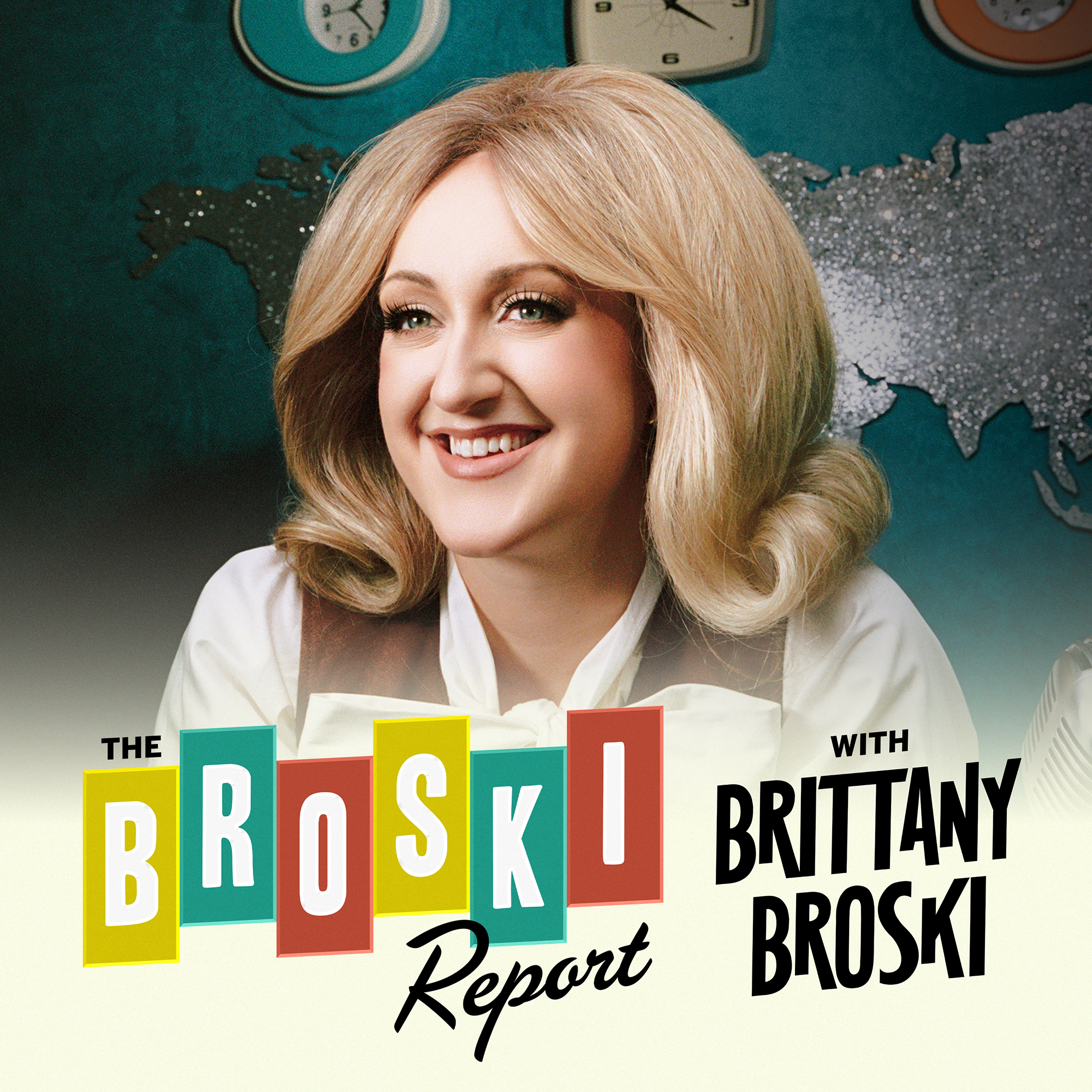
The host, Brittany Broski, opens with a critical appeal on the escalating violence by ICE agents, accusing the Trump administration of downplaying the crisis through deception. She urges listeners to take action through community protests and calls to representatives, emphasizing that resistance is vital to societal change. Shifting tone, the episode delves into psychology, revealing that rule-following stems more from social pressure and fear of exclusion than from an inherent respect for laws. The discussion on power explores two motivations: control over others and personal autonomy, with leaders showing different behaviors based on intent. The concept of "the lion's share" is traced to Aesop’s fables, illustrating how power and inequality are embedded in human narratives. A key poetic moment comes from Shelley’s *Ozymandias*, which critiques the impermanence of power and celebrates art as a lasting form of human memory and emotion. The host concludes by championing creativity as essential to human identity, arguing that making art—even imperfectly—affirms our humanity and resistance against systems that seek to erase it. Throughout, the tone remains urgent, hopeful, and deeply personal, urging listeners to stay engaged, vigilant, and creative in the face of systemic injustice.
Hey guys, I'm traveling right now, so please excuse the poor quality of this iPhone voice memo.
But I just wanted to tell you, I filmed this episode of the Broski Report prior to January 24th.
And in the time since, the continued, targeted, unethical, complete brute violence of masked ICE
agents across the United States has only gotten worse. ICE has killed nine people this year.
It's not even February yet. We're watching the indisputable evidence filmed on phones,
on the ground, before our eyes, and we're watching the Trump administration lie about it.
They're lying about it. Their goal is to exhaust you. Their goal is to make you feel powerless.
And like this is all inevitable, but it's not, and you're not powerless.
Resistance is the only way to usher in true change. History will tell you that.
Community-led protests are happening all across the U.S., and I urge you to participate in any way
you feel is right for you. No small thing is too small. I've compiled some vetted resources on how
to take action for immigrant justice and protester rights. You can check those out in the description.
But the easiest thing that takes less than five minutes is to visit fivecalls.org, locate a script
that you resonate with, and then call your senators and representatives. And keep calling.
If you attend, you'll get a call from the U.S. Department of Justice. And if you don't, you'll get a call from the U.S. If you don't attend any protest, make sure to stay warm, stay safe, keep your phone charged, and look out for each other.
Thanks for listening. I know this feels so heavy, and I'm right there with you, but I need you to
stay strong, stay hopeful. I'm here with you, and they will not win. Enjoy this week's episode. I
hope it provides an hour of escapism, and take care of yourself. Talk to you next week. Bye for now.
Direct from the Broski Nation headquarters in Los Angeles, California,
this is the Broski Report with your host, Brittany Broski.
You know what to do with that big fat butt. Wiggle, wiggle, wiggle.
You know what to do.
This is, let me just say something. This is a prime example of men getting away with anything.
What do you mean? Do you know how many artists would literally sell their soul to be signed to
a record label to, like, share their art with the world? Real. Human.
Well-made art. And what hits the radio is you know what to do with that big fat butt.
I just, that song had popped into my head, and I said, oh my god.
Wow. Okay, guys, welcome back to the Big Fat Butt Report. Today, I'm going to be your host,
Big Ol' Broski. I don't really have. I don't have a big fat butt. I kind of have the opposite. Unfortunately, I'm doing more of a Hank Hill butt.
Okay? And for those of you who are not familiar, Hank Hill butt.
As a woman, why do you have a Hank Hill butt? I was born that way. Okay?
Lady Gaga made me.
I was born this way about my Hank Hill butt, and I think that is really representative. I think
it's very inclusive. And sometimes, if you're a woman with a Hank Hill butt, you just have to
seek community and just pray your way through it. If you have a Hank Hill butt, meaning it's concave,
if you have an ass that is almost inverted, you got to just pray your way through it.
You have to let go.
Let go and let God. And look, that's how life goes. That's how the cookie crumbles. That's what it is.
Hank Hill butt. All right? Guys, this is going to be the research episode. I am in a silly,
goofy mood, and I have a lot to Google. And unfortunately, everything I have to Google
is really smart, and I don't feel very smart right now. So this should be awesome and fun and cool.
Also, I'm not much different than last week. Something, bitch, when I was asleep last night,
deep in the throes of a restful slumber, something crawled up my muumuu and bit me,
and I just found out what the bug was. It was the Jacob Elordi bug. It was the Jacob Elordi beetle.
It crawled up my nightgown and bit me on my Hank Hill butt.
I now have an open sore that the Jacob Elordi bug had kind of, you know,
bit and opened, and now it's festering, and it's just like,
I have to think about Jacob Elordi all the time. That's what it is. And he strikes me as someone,
hi, Jacob, if you're watching, he strikes me as someone who is, you know, like a gentle creature,
almost like, what does Drew say? Like a strike.
A cat. You would almost have to, like, hold your hand out to feed Jacob Elordi and look away
and let him come to you, because you can't command a presence like that, okay?
He, you know what, makes me giggle, and there are a lot of people like this,
and look, I deeply respect it, okay, what I'm about to say. I have a profound respect for this
archetype of personality in Hollywood. The actor,
who does not want to be famous, fucking hates, hates being famous. Like, abhor.
He hates being famous, bro. I think Paul Meskel's the same. Like, in order to make the art that they
want to make, they have to, like, be in the public eye, and that's like torturing them
death by a thousand cuts. Like, it's just intolerable. And it's, it makes me sad watching
him, like, hate it. And he's in his chaperone era right now, clapping back at people who make his
life unlivable, and look, okay, women get it so much worse. Women get it so much worse.
But I do have a soft spot for any person who's, like, in pursuit of doing what they want to do.
You have to deal with ancillary, you know, struggles. I get it. I get it, okay? And I'm
not saying, oh, take pity on actors, but I am saying, holy shit, let the man shop for books.
You know what I mean? Made him all self-conscious about book shopping now. I feel horrible.
Jacob, we're sorry. But did I look up Jacob Lordy wallpaper on Pinterest? Yes, I did.
There's some great picks. There's some great selections on Pinterest.com.
All right. Enough of this bullshit, chicken shit, horse shit. Put this Hank Hill ass on,
my feed. This is the Google episode. Let's go ahead and get into it. I have been compiling
a list of things that I want to Google for the past few months. So this is a long time coming,
and you know what to do with that big fat butt. Drop a like, drop a comment saying,
hashtag big fat butt, hashtag wiggle, wiggle, wiggle. And guys, let's get this video to one
billion views, okay? You want to know something fucked up I just found out randomly?
Okay. I'm going to show you something. I'm going to show you
something that has nothing to do with what I'm about to talk about in this episode.
Hosier has a tattoo. Hosier has a tattoo that is on his arm, and it says,
Noli Timere, which is Latin for don't be afraid, which apparently is one of Seamus Heaney's last
words. What the fuck? Here's the story. It was the last message poet Seamus Heaney sent
his wife before his death, and it was tattooed by Hosier's friend, Stevie,
B. Appleby. Hosier has said that if someone's going to permanently mark your skin, it should
be someone you like. Hosier, it's fucked up and slutty to get a tattoo like that. Like, get a tattoo of a rose and a clock and a lion like every other white guy. Just do it.
Just lean in. I almost think at this point, if you get a tattoo of a rose, a clock, and a lion,
and like someone's name in script, it's camp in a way that the Met Gala could,
only dream of recreating. Bitch, if I would have gone to the Met Gala that year, I would have done
in a whole body like, oh my God, I see the look so clearly in my head. It would have been one of
those see-through Jean-Paul Gaultier a la Jean-Paul Gaultier type of sheer long sleeve turtleneck
fits, except it would have been a dress all the way down to my ankles, and I would have had a
tiny little strappy kitten heel, and the look would have been literally neck to ankle.
shitty tattoos, but not just shitty tattoos, like quintessential overdone mass-produced
bad tattoos. That's what I would have done. That's camp, bitch. Take something that is so overdone
and do it. Like, wait, wait. Yeah, I think that would have been, that would have been my look.
And I would have done it with victory rolls. I would have done it with fifties hair and a red
lip and like a really thick wing eyeliner. I just see this in my head. I have to do it. I don't
know. Is anyone, are y'all rocking with what I'm putting down? Like that's camp. I don't know.
Like when you walk into a tattoo shop and it's all the shit that's on the walls, like
whether it's American trad or whether it's, you know, you post, you see a post from someone you
knew from high school on Facebook, like new sleeve, just,
and it's the worst tattoos you've ever seen in your life. Like that's, that's camp. And if someone
steals my fucking idea, you're done. You're done. And I'm suing. Yeah. See you in court. See you in
court. Okay. Yeah. Can you believe that about Hosea's tattoo? Anyway, here's the preface for
this episode. Here's the preface for this episode. I had an iced coffee and a red ball,
and I'm crashing from the sugar. And so I don't give a fuck. I don't fucking care. Like literally,
I don't care. I am looking at humanity, my humanity specifically from an alien lens.
Let me say that again. I'm looking at humanity, specifically my humanity from an alien lens.
And the lights are hurting my eyes. I have to go get sunglasses. I'll be right back.
You, you, you, you know what to do with that big fat butt.
Bro, bro, no, bro, no, bro, no, bro, no, no, no, no, big fat, big fat butt.
Okay.
I'm looking at my humanity through an alien lens.
Why does it, what, what, why did, why do any of you listen to this podcast?
Okay.
Let's Google some shit about the Romans and about the Titans and the Olympic gods.
Okay.
The Olympians, if you will.
Actually, we're not going to start there.
We're going to start with psychology in my Frankenstein hoodie, in my Guillermo del Toro
Frankenstein hoodie.
Thank you.
In the spirit of looking at my humanity through an alien lens.
And by that, I mean, what makes us fundamentally human?
My top line answer is our folly.
We are so riddled terminally with folly.
We are stupid, impractical, selfish, childish creatures.
And this I find.
Very interesting.
When I take myself out of my human body, okay, when I leave this fleshy meat sack,
this stinky, warm, wet meat sack, and I look at what constitutes my brain and the things
that drive me, the things that motivate me, and I don't mean in a career sense, I mean
in life to do anything, what motivates, like you eat because you're hungry, these basic
motivations.
I am turning and I am questioning because I want to know.
That's the basis of it.
I don't, I took a psychology and sociology class in college and I did it just to get a good grade.
Okay.
And I also took it at a community college and it got to a point where I was so inquisitive.
I was, I'm a teacher's nightmare.
I was so inquisitive that the poor instructor at this community college was like, I don't know.
Okay.
I don't know.
They don't pay me enough to know.
He said, the psychology 101, just do the group project and fuck off.
And I said, okay, but why do you think that?
And what about human nature makes?
He said, I don't know.
Like it got to a point one time where I obviously understood the subject matter to the, to a
level that was far surpassing just mere definitions and whatever.
Like I'm now turning a critical eye on the text that I'm reading.
And I'm like, but why?
And can you answer this?
And okay, what about from this perspective or whatever?
And the teacher literally goes, do you want to come up here and teach the class in like
a really sarcastic, mean way?
This is a community college, by the way.
Do you want to teach the class?
And I said, no.
And he said, don't let me get through the lesson.
And I said, sir, I don't think you should be in education.
That's what I should have said.
I just said, okay.
Cause I don't give a fuck.
I'm here to get a good grade and, you know, apply the credit to my degree at A&M.
Like.
But looking back, I'm like, what a dick.
What a dick.
I made him look critically at the syllabus and the subject matter he was teaching.
And he was like, I don't fucking know.
And so he made the student feel stupid.
That is so fucked up.
Anyway.
Fuck you, Mr.
Whatever your name was.
And now I'm about to Google it and teach everyone what I wanted my question to be answered as.
Okay.
Where you failed to provide an answer.
I will now seek it on my own from a peer reviewed journal.
Thank you very much.
Here's my number one question.
Are humans rule followers by nature?
And I did a little preemptive Googling and I found nature.com.
Now, nature.com is a multi, the world's leading multidisciplinary science journal.
Nature publishes the finest peer reviewed research.
It was first published in 1869.
Okay.
That's, I guess, I'm sure they have other credentials, but.
I wanted to give an overview before I read this.
All right.
Strap in.
We're looking at humanity through a critical alien lens.
Why people follow rules.
This was published about 10 months ago, nine months ago.
Why people follow rules, especially laws and social norms, is debated across the human sciences.
The importance of intrinsic respect for rules is particularly controversial.
To reveal the behavioral principles of rule following,
we develop CRISP, an interdisciplinary framework that explains rule conformity.
C, as a function of intrinsic respect for rules, R, extrinsic incentives, I, social expectations, S, and social preferences, P.
Okay, so let's look at that again.
Rule conformity, intrinsic respect for rules, extrinsic incentives, social expectations,
and social preferences.
We deploy CRISP in four series of online experiments with 14,000 English-speaking participants.
In our baseline experiments, 55 to 70% of participants conform to an arbitrary, costly rule.
Arbitrary, costly rule, even though they act anonymously and alone, and violations hurt no one.
Okay, this is T.
This is like the Stanford prison experience.
No, not the Stanford prison experience.
What's the other one?
The. Oh, come on.
Don't make me Google it.
I know this.
It's the experiment they did post-World War II to see if Nazis really were, quote-unquote,
just following rules, or if there was kind of a pre-existing, you know, you know you're
hurting someone and you continue to do it.
What was that experiment?
The Milgram experiment?
Stanley Milgram's Obedience Studies, conducted in the 19th century.
1960s.
These studies investigated the extent to which ordinary people would follow orders to inflict
pain on another person.
The purpose was to understand how ordinary people could commit atrocities, such as those
in the Holocaust, simply by following orders.
Okay, so with that kind of as context, where this has been studied for a very, very long
time, and I don't know if there's a concrete answer, let's move forward with this CRISP
study.
Oh, this is. This is like. This is a summary. Oh, sorry.
God, it's been so long since I've been in school.
This is the abstract of the experiment, which kind of says what they attempted to research,
how they did it, and then, I guess, the conclusion.
So that's the abstract, and then we'll get into the main.
So, in our baseline experiments, 55 to 70% of participants conform to an arbitrary, costly
rule, even though they act anonymously and alone, and violations hurt no one.
We show that people expect rule conformity and view it as socially appropriate.
Rule breaking is contagious, but remains moderate.
Pro-social motives and extrinsic incentives increase rule conformity, but unconditional
rule following and social expectations explain most of it.
Social expectations, that's not to be overstated, or I guess underestimated, like shame and
bullying and not being included.
All of those things are way more powerful motivators than I think we give it.
credit for. There's nothing worse than being dogpiled on or being called stupid or being
called something that you're not or having your character misinterpreted, maybe because you've
misrepresented your own character. All these things, they really go a long way in terms of
following the rules or whatever invisible rules there are in your life.
Pro-social motives and extrinsic incentives increase rule conformity. Our results
demonstrate that respect for rules and social expectations are basic elements of rule conformity
that can explain why people follow laws and social norms even without extrinsic incentives
and social preferences. Rules regulate social life and are fundamental for maintaining stable
social order and fostering large-scale cooperation in society. Rules are principles or
maxims that prescribe or proscribe a particular standard of behavior, like do this, don't do that,
and they come in various forms as orders, regulations, and guidelines issued by authorities,
as laws and legal statutes, and as informal social and moral norms, which is stuff like
walk on this side of the street, right? Like that's what I'm, and it's interesting how,
of course it's interesting, but that's such a throwaway word of how when you, different countries,
different whatever, how much of an outsider you feel when you don't conform to these rules that
you didn't know existed. That's a whole other piece of this that I can't even, like, how do
you study that? You know, like I'm more than willing to conform to these rules, but shaming
me into not, it all just works together. If I'm in Europe or if I'm in Asia and I'm walking on the
opposite side of the street, or I'm, you know, walking through the middle of traffic and people
are having to part for me, then that's like, I don't know, I don't know. I don't know. I don't
I'm going to feel a certain way about that after I do it enough, or I'm like, okay, I'm going to
conform because I don't, it's uncomfortable to be, you know, have your nose turned up at that,
or like to know that you're the cause of a social disruption, I guess. And maybe for baby boomers
and Gen Xers, they don't really give a fuck. Now that's another thing to kind of investigate is
how it varies between generations, regional differences, country differences, ethnicity,
gender. You know, women, we move out of the way when a man's walking. Stop. Don't do that. I saw,
you know, like if someone's coming at you and you're making eye contact with them,
fucking shoulder, shoulder check them. Like it should be a mutual thing to move out of each
other's way. Men don't do that. Men are not very accommodating. It's a man's world and we're all
just living in it. Like I, it's, it's a personal choice and, and, uh, intentional,
decision to not conform in that sense. Despite the omnipresence of rules in everyone's lives,
the fundamental reasons why people follow them are not well understood. This lack of understanding
is possibly due to a confluence of motives, which are debated controversially across the human
sciences. Do people follow rules out of obedience to authority or respect for tradition? Or do people
have an intrinsic respect for a rule because the rule says do X and therefore people perceive it as
a deontology?
Constraint. That is an unconditional non-instrumentalist required instrumentalist
requirement that places an interior demand or a duty on how they should behave. Or do people
follow rules out of self-interest fearing that the potential costs of sanctions outweigh the benefits
of breaking them? Do people conform to rules to meet social expectations, what they think others
will do or demand of them? Or do they follow rules due to pro-social motivations, considering the
impact of their behavior on society? Or do people follow rules due to pro-social motivations,
considering the impact of their behavior on others?
I think that comes down to the person. I mean, all of these come down to the person,
but that one specifically. Are you considerate enough to think, are my actions or me following
this rule, is that to preserve the good faith or good, I guess, what am I trying to say?
Like, am I considerate of other people? And is that how I move through life?
And will I follow social rules that align with that?
The reason is that intrinsic respect for rules is arguably required for social order in many
situations in which extrinsic incentives, which provide self-interest-based reasons for rule
following, are weak or absent, and consequences for others are not salient. This argument has
been made long before us, but its importance has remained controversial, not least for lack
of evidence for an intrinsic respect for rules. We're not going to talk about the importance of
With the help of CRISP, our study provides lack of evidence for an intrinsic respect for rules.
I get that. I don't inherently respect the law because it's the law. I respect it because I
guess I agree with it. And then that gets down to the nitty-gritty. I don't agree with every law.
And then that's why we vote. And that's why politics is so important, is because we're
mandating how we govern ourselves and our kids and our future, you know, and how we've seen. I just, yeah, I'm not. I don't believe that. I don't believe that humans would ever just follow a law because it is a law. This argument that
humans are subservient by nature or submissive by nature, I don't know if I agree with that.
Our results also suggest that sanctions for rule violations and social preferences
increase rule conformity. Yeah, of course, if there's a punishment that is to be expected
when you don't follow a rule, then people are going to follow a rule. You don't want to be
punished. But they're not necessary to induce substantial rule following. Our findings may
therefore help explain why important types of rule,
social norms, laws, and orders guide so much of human behavior, because conformity with them
is high without any extrinsic incentives. And I think that's just human nature. You know,
we don't. Friction is uncomfortable. Okay. I mean, I could read this for literally ever.
I think that's very, very interesting. You know, something that's tacked on to this,
I guess on the flip side of the Milgram experiment, is why do humans want power? So much,
media, and so much of what we consume in a day is all about the dynamics of power. Obtaining it,
losing it, fighting for it. Like, everything is in the pursuit of it. Every great story,
every book, every movie, it's about a transfer of power or a vacuum of power. All of this is so. Why? Why is it so magnetic? Again, I told you, I'm looking at this from like I was born yesterday.
Like, I've never interacted with you before. I've never interacted with you before. And if I was looking at humans, and you look at the history of the
world, and it's like everything ever has been fought over power. That's all it is. Power and
money. And what is money but power? And freedom. All of the. I mean, it's just so simple. Like,
simplifying it down. So with that being the question, we're now going to go to psychologytoday.com.
want to be in charge? It's a simple question, but like, why? This is by. Who did this?
Jeremy Nicholson, MSW PhD. Persuasion, Bias, and Choice are his specialties. And it was reviewed
by Jessica Schrader. He says, previously, I discussed the difference between harmful and
helpful types of power. Put simply, hard styles of power can diminish self-determination,
increasing motivation, and commitment. In contrast, soft styles of power have the opposite
effect, increasing self-determination, motivation, and commitment. That analysis left open two main
questions, though. First, why do individuals seek to obtain power? Second, how do those motivations
impact their choice of leadership and influence styles? Therefore, I went back to the research
for answers. Okay, he cites a study here from 2018. Individuals seek power and leadership positions
for two reasons. First, they seek power and leadership positions for two reasons. Second,
on one hand, they may be motivated to obtain control over others, especially to influence
their behavior. And on the other hand, they might be motivated by personal control instead,
particularly to increase their own self-determination and autonomy. This difference
echoes back to Mary Parker Follett's earlier distinction between power over others, like
coercion, versus power with others, like co-action, in management situations. Furthermore, much as
almost a century before, they also found that each type of motivation led to different leadership
behaviors and outcomes. Those who sought power to control others tended to be aggressive and
exploitative. Those who wanted more personal control over their own lives, however, were not
aggressive or exploitative as leaders. Thus, power only seemed to be corrupting and negative for
those who sought it to control other people in the first place. Yeah, I'm getting that. But here's the
eternal question. What is the eternal question? Again, I wish I had an expert sitting in the corner that I could be like, come here.
Maybe that's something for 2026 that we'll start working on. If I'm like, this is going to be the
theme of this episode, and I have a resident expert, or we phone them in, I think that'd be
really freaking cool. Because if I had a PhD psychologist in this room with me, damn, I'd be
bombarding them with questions. My question, therefore, is, does power corrupt? Is power the
variable? Or are human beings the variable? And I guess, depending on which study,
or however you want to frame the research, who knows?
But I think that's an interesting point
of if you are altogether an altruistic person,
maybe you only have minimal selfish impulses,
you're a person of the people, you're just normal, okay?
If that person is thrust into the limelight,
given power, given infinite money,
given access and told over and over
that they're deserving of it,
you were meant for this, you belong in this position,
does that power corrupt the individual?
Who knows, right?
I think in some cases, yes.
I think if you have a weak constitution, then yes.
But who knows?
You could be a normal, fine, average, not evil person
and I believe that power corrupts.
In this study, I will now be,
I'm gonna do my own research on broski nation citizens.
I'm gonna round a few of you guys up.
And I'm gonna make one of you be the leader
and one of you guys be the whatever.
And I'm gonna be like, yes, yes, tell me the findings.
Did power corrupt you when you created a city-state
within broski nation?
Yes, tell me.
Yeah, yeah, see?
Yeah, no, no, no, see?
Okay.
Okay, that's about as deep as I wanna get into that.
Very interesting, okay?
I mean, I could read about this shit for literally ever
and I've already been talking for 30 minutes.
About what?
Who knows?
Okay, let's get into some,
some less serious,
that was just some shit, you know,
you know what to do with that big fat butt.
I wanna look up what is meant by the lion's share of something.
The, can I type?
The lion's share, meaning and origin.
Headed over to good old Wikipedia.
The lion's share is an idiomatic expression
which now refers to the major share of something.
The phrase derives from the plot of a number of fables
ascribed to Aesop.
Aesop's fables.
Wow, haven't heard that in a long time.
And now, who the fuck was Aesop?
I love their soap.
I love their soap.
I'm actually burning one of their candles.
This candle is so damn good.
And I don't know, I don't know the name of it.
Okay, it was given to me.
I'll give you the name and the description, I guess.
Aesop's fables or the Aesopica
is a collection of fables credited to Aesop,
a slave and storyteller who lived in ancient Greece
between 620 and 564 BCE.
Of varied and unclear origins,
the stories associated with his name
have descended to modern times
through a number of sources
and continue to be reinterpreted
in different verbal registers
and in popular as well as artistic media.
It was an oral tradition.
They weren't collected until about three centuries
after Aesop's death.
How do we know it's real?
I guess not real,
but how do we know that this is the real story?
The true intended meaning.
I guess we don't.
And isn't that the,
the folly of humanity?
How do we know that the Bible's real?
We don't.
Well, you have to have faith.
Okay, what if I don't?
Isn't that the point of religion?
Yeah, I guess it is.
And I guess that's what separates humans from animals
is like we have a spirituality,
we have a faith system.
Maybe we yearn to worship something bigger than ourselves.
Maybe we recognize how small we are
in the grand scheme of things
and we yearn to worship
whatever created that grand scheme of things.
Who knows?
Especially when the fables were written three,
centuries after Bro died.
Okay, who knows?
By that time,
a variety of other stories,
jokes,
and proverbs
were being ascribed to him.
Although some of that material
was from sources earlier than him
or came from beyond the Greek cultural sphere.
Okay, so keeping that in mind,
let's go back to
Lion, Shares, and Aesop's Fable
and is used here as their generic title.
There are two main types of story
which exist in several different versions.
Other fables exist in the East
that describe,
that feature,
division of prey
in such a way
that the divider gains the greater. What?
What?
Wikipedia, don't piss me off.
A division of prey,
like if you're the lion,
in such a way
that the divider gains the greatest part.
Again, power.
Okay, if you're in power,
you get more.
You get a greater share
or even the whole.
In English,
the phrase used in the sense of nearly all
only appeared at the end of the 18th century.
The French equivalent,
Le Partage du Lion,
is recorded from the start of that century
following La Fontaine's version of the fable.
And who the hell is La Fontaine?
Jean de La Fontaine
collected fables
from a wide variety of sources,
both Western and Eastern,
and adapted them into French free verse.
Okay.
Humorous, nuanced, and ironical,
they were originally aimed at adults,
but then entered the educational system
and were required learning for school children.
Very interesting.
Okay, let's. So there's a bunch of different versions
of the lion's share.
Let's read the Phaedrus version.
The early Latin version of Phaedrus
begins with the reflection that
partnership with the mighty
is never trustworthy.
Bitch, how did I met. You give me two topics
and I will find a through line.
I will find a way to relate them.
Bitch, give me 30 seconds
and I will do it.
This is actually nuts.
I did not plan this.
Everything has a through line.
I take the first. Okay, wait a minute.
The mighty. A partnership with the mighty
is never trustworthy.
Power!
It then relates how a cow,
a goat, and a sheep
go hunting together with a lion.
When it comes to dividing the spoil,
the lion says,
I take the first portion
because of my title,
since I am addressed as king.
The second portion you will assign to me
since I'm your partner.
Then because I am the stronger,
the third will follow me
and an accident will happen
to anyone who touches the fourth.
This was listed as Fable 339
in the Perry Index.
Okay, don't care.
The number of differing. Here's another one.
The lion is joined by officers of his court,
a wild ox and a wolf,
who divide the catch into three
and invite their lord to apportion it.
Then on another occasion,
when the lion is accompanied
by a goat and a sheep,
the deer they take is divided
into four.
In both cases,
the lion begins by claiming portions
as a legal right
and retains the others with threats.
In La Fontaine's fables,
there's a fourfold division
between a heifer,
a goat, and a lamb.
Each of these the lion retains
because he is king,
the strongest, the bravest,
and will kill the first
who touches the fourth part.
A Latin reference to Aesop's fable
is found at the start of the Common Era,
where the phrase
societas leonina,
a leonine company,
was used by one Roman lawyer
to describe the kind of
unequal business partnership
described by Aesop.
The early 19th century writer
Jeffress Taylor
also retold the fable
in terms of a commercial enterprise
in his poem,
The Beasts in Partnership.
Here's the poem.
This firm once existed,
I'd have you to know,
Messer's lion, wolf, tiger, fox,
leopard, and co.
These in business were joined,
and of course,
t'was implied,
they their stock should unite
and the profits divide.
Okay, very interesting.
So it's Aesop's fable.
Okay, in that vein,
I've been trying to find
a standalone copy of Ozymandias
by, is it by Mary Shelley
or is that by Percy Shelley?
I think it's by Percy Shelley.
It's a poem or a story
about the ravaging of time
against all great empires.
That's what I've been told.
Yeah, Percy Shelley.
Ozymandias, summary.
Oh my God, it's so short.
I thought it was a book.
Ozymandias by Percy Shelley
is a famous sonnet
about the transience of power,
describing a shattered statue
of a once mighty king in the desert.
Okay, let's read it.
I met a traveler from an antique land
who said,
two vast and trunkless legs of stone
stand in the desert.
Near them on the sand,
half sunk, a shattered visage lies.
Visage is a face.
Whose frown and wrinkled lip
and sneer of coldness
hold command.
Tell that it's sculptor well
those passions read.
Which yet survive,
stamped on these lifeless things,
the hand that mocked them
and the heart that fed.
And on the pedestal,
these words appear.
My name is Ozymandias,
king of kings.
Look on my works,
ye mighty, and despair.
Nothing beside remains
round the decay of that colossal wreck,
boundless and bare.
The lone and level sands
stretch far away.
I mean, so yeah,
that's actually pretty straightforward.
I don't know why I was like tweaking out,
thinking I have to read Ozymandias.
That's it.
I mean, yeah, man is finite.
Man will never have greater command
over mother nature
than that of God himself.
When men try to play God,
they are humbled, inevitably.
I think all these are takeaways.
Let's read lit charts.
Let's see what lit charts
has to say about Ozymandias.
The speaker of the poem
meets a traveler
who came from an ancient land.
The traveler describes
two large stone legs of a statue,
which lack a torso to connect them
and which stand upright in the desert.
Near the legs, half buried in sand,
is the broken face of the statue.
The statue's facial expression,
a frown and a wrinkled lip,
form a commanding, haughty sneer.
The expression shows
that the sculptor understood
the emotions of the person
the statue is based on,
and now those emotions live on,
carved forever on inanimate stone.
In making the face,
the sculptor's skilled hands
mocked up a person's face,
perfect recreation of those feelings and of the heart that fed
those feelings, and in the process so perfectly conveyed the subject's cruelty that the statue
itself seems to be mocking its subject. Damn. The traveler next describes the words inscribed
on the pedestal of the statue, which say, my name is Ozymandias, the king who rules over even other
kings. Behold what I have built, all you who think of yourselves as powerful, and despair at the
magnificence and superiority of my accomplishments. There is nothing else in the area. Surrounding the
remnants of the large statue is a never-ending and barren desert, with empty and flat sands
stretching into the distance. Guys, everything reminds me of Red Rising. Can he finish the
seventh book? I'm actually getting pissed off. Everything reminds me of Red Rising. This reminds
me of Lysander. This reminds me of, um, who was his grandmother? Alune? Who was his fucking
grandmother? Octavia. That's right. Yeah, this reminds me of Octavia, and like all of the
all of that whole line of just, you think that you are so divinely endowed with the need and burden
of ruling, you think only you can do it, that it's like, oh my god. This happens to every single
person who thinks that! Please let Trump be next. Please, God, please.
One of Shelley's most famous works, Ozymandias, describes the ruins of an ancient gate. Yeah,
hasn't been kind to this statue, whose pitiful state undercuts the bold assertion of its
inscription. The fact that even this king of kings lies decaying in a distant desert suggests that
no amount of power can withstand the merciless and unceasing passage of time. Period, bitch.
And I hit every one of those consonants. Wow.
The speaker goes on to explain that time not only destroyed this statue, it also essentially
erased the entire kingdom the statue was built to overlook. The speaker immediately follows the
king's declaration found on the pedestal of the statue. Look upon my works, ye mighty, and despair!
With a line, nothing beside remains. Such a savage contradiction makes the king's prideful
dare almost comically naive. Ozymandias had believed that while he himself would die,
he would leave a lasting and intimidating legacy through everything he built. Yet, his words
are ultimately empty, as everything he has built crumbled. The people and places he ruled over
are gone, leaving only an abandoned desert whose lone and level sands imply that there's not even
a trace of the kingdom's former glory to be found. The pedestal's claim that onlookers should despair
at Ozymandias' works thus takes on a new and ironic meaning. One despairs not at Ozymandias'
power, but at how powerless time and decay make everyone.
Dude, not to call back on when I walked through the Paris catacombs, but dude,
there are so many inscriptions in there and beautiful quotes on some of the little infographics
on the wall that talk about, you know, the digging up of the bodies and moving them when they had
these big burial pits and how moving them underground was the solution, especially when
the city was full of disease and sewage and whatever. Just these rotting corpses in a big pit
was not the solution. So, you know,
burning them and bringing them underground, whatever. There was an inscription that I
talked about way long ago, like a year ago when I was, had just come back from Paris that said,
here is true equality. Only in death are we all truly equal. And you can hope, and I do hope
for a future full of equality, a feminist future where we are seen for our merits,
all of us, and not for what we look like or what is resting on our name,
for a truly egalitarian future. Of course, that's a bit naive, but a girl can dream.
Only in death have we seen a true embodied picture of this concept. When you and I
are lying in the ground, only our skulls remain. That is true equality. And I think that's a great
again, let me tie it in. Hold on, let me cook. Tying it into something as profound and, you know,
timeless as Ozymandias, like there will always be ruthless and aggressive tyrants
that want to take over the world. That there will always be someone who is desperately
seeking power. And we'll get it because idiots, sheeple, give them the
mic. Until it's too late. And you realize it's too late. And you were a part of the problem.
You know, like this will keep happening. We don't learn from history. We're experiencing it right
now. Whatever. Like it's just, when you look at it through a lens like this, it's like, wow.
Ooh, I like this theme, the power of art. The skillful rendering of the statue itself and the
words carved alongside it have survived long after Ozymandias and his kingdom turned to dust.
Through this, Shelley's poem positions art as perhaps the most enduring tool in preserving
humanity's legacy. And furthermore, fuck AI. And furthermore, oh my God. Guys, I love this podcast.
I love doing this podcast because sometimes you read a line like that and then you get a chill
down your spine and your nipples get hard. The most enduring tool in preserving humanity's legacy is art.
This is why we need to fund the arts. This is why AI should be fucking banned. This is why
creating things from a human hand and from a human mind, we are preserving our own humanity.
A machine can't do that. A machine at its best performance of human artificial learning could
never recreate. The fragments left behind of the statue interpret and preserve the king's personality
and show it to the world. And that's why we need to fund the arts. This is why AI should be fucking
around. onlookers throughout history, what sort of a man and leader Ozymandias truly was. These fragments
then are examples of art's unique ability to capture and relate an individual's character,
even after their death. And also the opposite. You know how Napoleon liked to be painted as tall
and handsome? Girl, he wasn't. Girl, he wasn't. In fact, the poem explicitly emphasizes art's
ability to bring personalities to life. The speaker explains that Ozymandias' passions,
yet survive on the broken statue despite being carved on lifeless stone. Ozymandias may be dead,
yet thanks to the sculptor who read those passions and mocked or made an artistic reproduction of
them, his personality and emotions live. In other words, his legacy and its failure only exist
because a work of art, specifically a written work, preserved them. The poem therefore presents
art as a means to immortality.
While everything else disappears, art, even when broken and half buried in sand,
can carry humanity's legacy. Why do I want to cry?
The power of art is reflected by the composition of the poem itself. Shelley was aware that the
ancient Greek writer Diodorus Siculus had described a statue of the Egyptian pharaoh
Ramses II and had transcribed the inscription on its pedestal as King of Kings, am I, Ozymandias.
If anyone would know how great I am and where I lie, let him surpass one of my works.
Shelley's poem exists solely because of Siculus' description. Shelley and his friend and fellow
writer, Horace Smith, had challenged each other to a friendly competition over who could write the
best poem inspired by that description. This poem was Shelley's entry, and it became by far the more
famous of the two. Wow. It's also man versus nature. I mean, there's so many things from this,
what, 14-line poem?
So much to glean from it. Also, is it glean or gleam? Glean versus gleam. Whoa. Glean with an
N refers to gathering information or objects bit by bit, while gleam with an M refers to a faint
or reflected light. I guess that makes sense. And I guess maybe I knew that. Gleam is a fun word.
Oh my God, you're gleaming. I'm about to gleam. Can I take a second to preach if you guys will hear
me preach for a second? Make art, even if it's shitty, even if it's bad. Just sit down and make
it, please. I think it's important, and I think it's you practicing your humanity, and I think
it is necessary. And I think that if you are a scientifically inclined person, great. But I think
what might make you appreciate the scientific side of you more is if you do something with your hands
and you create something and you say, wow, I made that, even if it's shit.
Like, look what these hands can do. My body regenerates itself and heals itself. And my
hands create beautiful things. And my ears hear beautiful music. And my mouth, I use my mouth to
speak beautiful things into the world. I think that sounds so fucking preachy and nasty, but like,
I do believe it to my core. I think humans are art. And some art is unsettling and disturbing
and bad, just like humans. But at the core of it, I think it's kind of the point is to make art
and be art and appreciate art.
art. Right, guys? Last one. This was from some book I read and I wrote it down. I don't know.
Like taking food in the Sealy Court. And that was written, or I guess the author used it in
a context of, I'm assuming eating fairy food is bad. Eating fairy food makes you crazy.
Let's look it up. Sealy food. Sealy food refers to the magical, often deceptive cuisine of the
Sealy Court in folklore known for enchanting but perilous treats. Sealy food is generally rich,
nature-based, and tied to trickery, sometimes involving hallucinogenic or euphoric effects
that trap mortals in their realm, contrasting with literal interpretations like seed-based
snacks. No, I just know what I'm talking about, bro. Sealy Court cuisine. And you guessed it,
we're on britishfairies.wordpress.com.
Well, it's that time of the show where we've made it to britishfairies.com.
The Sealy and Unsealy Courts. Whoa. Whoa, what the fuck?
The Sealy and Unsealy Courts of Scottish fairies are a particular feature of the folklore of that
country. The clear separation of the fays into good and bad groupings that's entailed is almost
unique in folklore. Moreover, the notion of the two courts has, in recent years, attracted
considerable attention and popularity, notwithstanding the fact that they are not
mentioned in the majority of the Scottish fairy lore texts and collections. Probably the majority
of recorded Scottish folklore relates to the Highlands and Islands, while Gaelic and Norse
speaking regions, which may explain why we have relatively little material documenting the two
courts. The Scots word Sealy derives from the Anglo-Saxon selic, meaning happy or prosperous,
or blessed. The evolution of the word in Middle English and Scots seems to have been in two
directions. One sense was pious, worthy, auspicious, or blessed. The second development extended the
meaning incrementally through lucky, cheerful, innocent, and simple. From whence it was a short
final step to simple-minded, as the modern English silly denotes. What? Everything goes
back to fairies, bro. When I call you stupid, it means you're literally like a fairy. Like,
you're literally silly. You're a fairy. Because of this evolution,
the word Sealy derives from the Anglo-Saxon selic, meaning happy or prosperous, or blessed.
As well as because of the dialectical differences between English and Scots,
it's preferable to use Sealy rather than to try to translate it. Scots is the language of lowland
Scotland, and this gives us a sense of the realm of the Sealy and Unsealy courts. The Unsealy court,
therefore, might be expected to include such creatures as the Red Caps, Shelley Coat,
the Brown Man of the Mures, the Powrie, the Dunter, and perhaps a hag like Gentle Annis.
Hey, what? Um, hey,
what are you guys talking about? Um, sorry, sorry, could you just repeat that one sec?
Yeah, um, sorry, I'm just gonna write it down. The Powrie? The Dunter? How do you spell Dunter?
Okay, no, it's okay, we can move on. The Sealy court, meanwhile, included the elves,
the Brownies, and the Doonie. I've heard of Brownies. Brownies are like fairies.
A very early example of the use of Sealy is to be found in a poem from 1584.
The ranks of the Unsealy court are made up with those who had given themselves up to the devil,
bad men who died fighting, unmarried mothers stolen during childbirth, and unbaptized babies.
The wicked fairies are always ready to inflict harm and loss. They might shave victims out of spite,
abduct people who placed themselves in their power, steal goods, and kill cattle with elf shot.
Be warned, however, that we should not overstate the benignity of
even the Sealy court. For example, in the Ballad of Mary O'Craniontung,
her father curses the Sealy court after his daughter is abducted by a fairy man.
What the hell? He threatens to cut down their groves in revenge. The father is advised how
to recover his child magically, but at the same time, he's warned how unwise it is to make such
threats. By the way, take a moment to pause. You guys should read Half a Soul. The fairy loves
story thing. It's a very short read, Half a Soul, and then the other one, Ten Thousand Stitches. I
love those fucking books. I gave the first one five stars. I think I gave the second one four
stars. It was lovely. It's like a Regency-era fairy tale. Amazing. And I think they do a good
job, and this is me having absolutely no credibility in this field, but having an
opinion anyway. Isn't that how it goes? They do a good job of describing walking into the fairy
realm and also leaving the fairy realm and how everything is different there. They live by the
different rules and terms, and yes, it's still within England, but there's an invisible barrier.
I think they do a really fun job of describing what I envision the fairy realm to be like.
30, by the way. Okay, he manages to retrieve the young woman and seems very like the rescue of
Tam Lin, but he soon dies because Nain e'er cursed the Seelie Court and ever after Thrave.
Can't fuck with the Seelie Court. You'll die. It was well-known
in Scotland that conduct like that. By the way, that was not supposed to be Scottish. That was
just kind of reading it phonetically, so sorry about that. It was well-known in Scotland that
conduct like that of Mary's father could only mean that the person would pine away, having seen all
their affairs go to ruin. An identical fate would befall any person who plowed up a fairy ring.
Now, what's a fairy ring? Oh, duh, it's where the mushrooms grow in a circle.
Fungi are closely associated with the phase. For example, it is said in Wales that mushrooms serve
parasols, and as is widely known, fairy rings mark the site of the fairy's nocturnal dancing.
This fact could easily be proved. Set up a stick and a ring overnight, and it would be found
knocked down by the phase the next morning. All right, guys, I could talk about fairies for the
next three hours. I guess we could pick up next week, but thanks for listening, and what a journey
we took today. I hope you have some things to think about. I would love to hear your thoughts,
opinions, and comments in the comment section, wherever you're watching, TikTok, YouTube,
whatever. Let me know what you think about power and about are we rule followers, and don't ever
step in a fairy ring. Don't fuck with nature like that, okay? You want merch? Go to broski.shop.
If you want to watch Royal Court, go watch it. It's a great medieval-themed interview show.
If you want to listen to the Broski Nation playlist, go find it. There's an official
playlist in the description.
I'll see you next time. Bye.
Spotify. If you are feeling altruistic, there are some links in my description
for various causes that I believe in. If you want this episode ad-free, go to patreon.com
and find me on there. It's ad-free, and you get one message from me a month.
That's it. There's no bonus content. It's just ad-free. Thank you guys so much for listening.
I love you to death, and wow, how is January almost over? What the fuck? Be good,
I love y'all to death, and I'll talk to you next week. Bye.
Podcast Summary
Key Points:
The speaker condemns the escalating violence by masked ICE agents, highlighting that nine people have been killed in the U.S. this year and accusing the Trump administration of lying to downplay the crisis.
She urges listeners to resist systemic oppression through community-led protests, emphasizing that even small actions matter and that resistance is essential for meaningful change.
A key resource is shared
The episode explores human behavior through psychology, finding that people follow rules primarily due to social expectations, shame, and fear of exclusion—not intrinsic respect for laws.
The discussion of power reveals that individuals seek control either to influence others or for personal autonomy, with leadership styles varying based on motivation.
The concept of "the lion's share" is traced to Aesop’s fables, illustrating how power and inequality are central to human stories and societal structures.
A reading of Percy Shelley’s poem *Ozymandias* underscores the fleeting nature of power and the enduring power of art to preserve human legacy and emotion.
The host passionately argues that creating art—no matter how imperfect—is essential to human identity, expression, and resistance against dehumanizing systems.
Summary:
The host, Brittany Broski, opens with a critical appeal on the escalating violence by ICE agents, accusing the Trump administration of downplaying the crisis through deception. She urges listeners to take action through community protests and calls to representatives, emphasizing that resistance is vital to societal change. Shifting tone, the episode delves into psychology, revealing that rule-following stems more from social pressure and fear of exclusion than from an inherent respect for laws.
The discussion on power explores two motivations: control over others and personal autonomy, with leaders showing different behaviors based on intent. The concept of "the lion's share" is traced to Aesop’s fables, illustrating how power and inequality are embedded in human narratives. A key poetic moment comes from Shelley’s *Ozymandias*, which critiques the impermanence of power and celebrates art as a lasting form of human memory and emotion.
The host concludes by championing creativity as essential to human identity, arguing that making art—even imperfectly—affirms our humanity and resistance against systems that seek to erase it. Throughout, the tone remains urgent, hopeful, and deeply personal, urging listeners to stay engaged, vigilant, and creative in the face of systemic injustice.
FAQs
People follow rules due to social expectations, such as shame or fear of being excluded, rather than an intrinsic respect for rules. These social pressures, including bullying or being left out, are often stronger motivators than any inherent belief in rule-following.
The evidence suggests that power does not necessarily corrupt everyone. Those who seek power to control others tend to be aggressive, while those who seek personal autonomy remain non-exploitative. Whether power corrupts depends on the individual’s values and psychological makeup.
The phrase 'lion's share' originates from ancient fables, particularly those attributed to Aesop, where a lion claims the largest portion of a divided prey. It has evolved to mean the largest or most significant share of something.
Ozymandias illustrates how power is temporary and ultimately defeated by time. The poem shows that even a mighty ruler's legacy fades, while art—like the statue—can preserve a person's character and emotions, highlighting art’s role in human legacy.
The Sealy and Unsealy Courts represent good and evil fairies in Scottish folklore. The Sealy Court includes benevolent beings like elves and brownies, while the Unsealy Court consists of tricksters and malevolent creatures, often associated with harm and mischief.
Art, even when damaged or fragmented, can capture human emotions and personalities in ways that survive beyond time. As shown in 'Ozymandias,' art preserves the essence of individuals, making it a powerful tool for immortality and cultural continuity.
Chat with AI
Loading...
Pro features
Go deeper with this episode
Unlock creator-grade tools that turn any transcript into show notes and subtitle files.
 PodcastTranscript AI