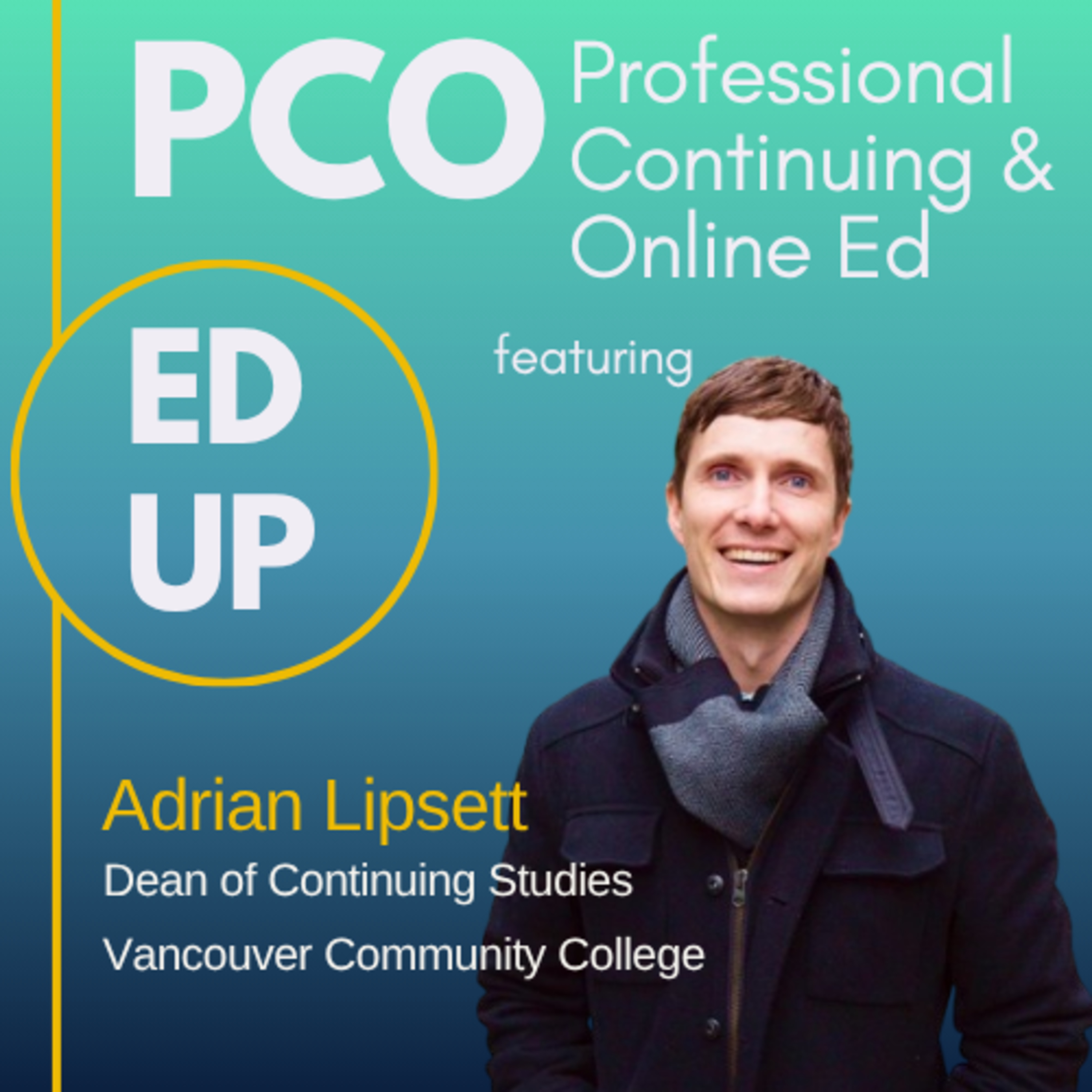
68. Adrian Lipsett (VCC): How Community-Mindedness Drives College Innovation
from EdUp PCO
44m 18s
In this episode of the ETA-PCO Podcast, host Amrital Dalalia speaks with Adrian Lipset, Dean of Continuing Studies at Vancouver Community College (VCC), about credential innovation in Canada's college sector. Adrian shares his journey from teaching to continuing education, noting that initial misconceptions about continuing studies—such as it being a mere "add-on" or limited to non-credit offerings—were quickly corrected. He stresses that non-credit training holds significant value for learners seeking upskilling or career progression, as it prioritizes practical competency over credit hours. Adrian highlights the collaborative spirit among BC colleges, where institutions work together to address community needs rather than compete, a culture exemplified by VCC's annual Credex conference. This event showcases innovative credentialing practices that improve access and learner outcomes. He also discusses the importance of breaking down competitive barriers between urban colleges, fostering trusted relationships that benefit both institutions and the communities they serve. Overall, Adrian advocates for a learner-centered approach that redefines credentialing to meet evolving workforce demands.
Welcome to the ETA-PCO Podcast, a proud member of the ETA-Experience Podcast family. This podcast shines a light on professional, continuing, and online education, the most innovative and fastest-changing sector of the higher education industry. Credentially is one of the key responsibilities the post-secondary space carries. As a sector, we verify and validate learning. But as industry needs and learner demand evolves, along with our own understanding of how learning and expertise actually develop, we're now in a position where we need to evolve our credentialing practices to keep pace. I'm your host, Amrital Dalalia, and this week, which is the second week of our special focus on Canada's College and Polytechnic sector, I'm joined by Adrian Lipset, the Dean of Vancouver Community College, to explore this topic in more detail. Adrian has worked in colleges across BC for his entire career and in 2020, joined Vancouver Community College as Dean of Continuing Studies. Adrian and his team are working at the forefront of credential innovation, and last year launched the annual Credex conference to bring some of this work and innovation into the spotlight. Adrian, welcome to the EDF PCO podcast. It's great to be chatting with you. Like wise, thank you so much for having me, Amrital. It's so great to be here. I got to tell you it's an absolute pleasure. I enjoy talking to you just a lot. I will warn listeners that this feels already like a conversation where we're both going to forget we're recording. We're going to do our best to be on topic. We will try. Adrian, I want to kick off just talking a little bit about you. Because your career has been an interesting one, but the common thread has been a dedication to the colleges sector, specifically in BC. You've worked at a range of different colleges across British Columbia. You're now leading with Continuing Studies Unit at Vancouver Community College. What are some of the things that you think are particularly special about the BC's colleges? I think there's a lot. I'm really glad that you've been doing this series on Canadian colleges. I love that you're inching westward. I think that that's a great place to hang out. It's not calling for people in Ontario, but I'm doing my best. Yeah, we exist. We're flag-weaving over here. It's great. There's a lot of great stuff happening out here. One of the things that has impressed me the most has been the collegiality and collaborative spirit that underpins a lot of what happens across the colleges. Even when I was working in private education, private college here in Vancouver, there was still a warmth and willingness in my role there to engage with people who are also teaching, fostering educational experiences for both domestic and international students, but that willingness to engage in conversation. That even became more of a very evident feature when we got to Languages and of course here at PCC where there's a long history in tradition and active work being done now of colleagues across institutions reaching out to each other for advice, for guidance, and also to work on projects together. We've done a lot of development with other institutions where we develop some course or some micro-cred or something like that together or code-liberate. I think it's a wonderful feature where it's a bunch of colleagues who have a deep appreciation for being relatively in the same boat regardless of region. I'm in Vancouver, so obviously an urban institution. We have a few colleagues here at Linger and Douglas in BCAT, but then there's, but even colleagues on the island or north or in the Okanagan or closer to the Rockies, there's a real spirit of like, "Oh yeah, we know what you're going through. We're also trying the same thing. We also have similar struggles, and so there's a real willingness to lean on each other and to learn from each other. I so deeply appreciate that." In addition, if I could toss up a couple of the thoughts in there, there's also a variable pinning to the local community that comes up consciously and unconsciously in a lot of the work that we do. Obviously, I'm coming at this from a continuing studies lens, so inherently I'm looking at what the community needs when a local workforce needs. That's necessarily my lens, but my fellow deans and department heads across the college here are also bringing the same type of inquiry to their work as well. They're looking into how are we delivering training that's of excellent quality to meet our community needs. There is woven within that question, is this fundamental assumption that we necessarily serve the community, which sounds partly obvious from an institution that actually has community. Woven within the name, they're in the community college, so there's that. It's one thing to have it as a throwaway line, and it's another to actually walk that out. We see this in paying attention to what are our students needing, what are our community members needing, like partners in the community or those that we were delivering training for. Also, how are their needs evolving or shifting over time? What are some of the challenges that they're facing? How can we respond as an institution? Yes, writ large, you could say the same thing is happening, same types of questions are happening in colleges and universities across the sector. That's a wonderful feature of our post-secondary sector. At the college level, I don't think there's a role in the institution that can escape or that isn't impacted by how those strategies are carried out. Training for students is done by all members of my team, all members of my team, and paying attention to how we support the questions coming in. We don't want to bounce students around an institution and go check that office and then they send them somewhere else. We are looking for, if it's not me that has the answer, I will get you the person who has the answer. That's going to happen in the library, learning comments, wherever. It's that immediacy of how the support is carried out. The care is carried out through that community lens that I think is really beautifully captured in the college system. Absolutely. Let's dive a little bit into your sort of enshrie into the world of continuing studies, because it's a relatively new area. But as you've said, in colleges, there is an institution-wide commitment to accessibility, institution-wide commitments to workforce relevance, institution-wide commitments to community service, and to the student's entrustity that follows it. These are typically seen as things that are within the DNA of continuing ed, but obviously making that transition can be a startling experience for folks that are new to it. I'm curious how you found your own transition into the world of continuing studies. And then, whether any sort of misconceptions really brought themselves to the surface as you got embedded into the work. Very much so. They became more articulated over time, where I was able to articulate them more over time. I hadn't really thought of or heard of continuing studies. I had a wonderful friend that recommended the first role in continuing ed to me back in 2018, and so I first made my jump over. And I had previously been taught in the English academic learners area. So I came up as an instructor, then I got into administration and all that, and even dabbled in the registrarial world for a bit, which was quite a nice lesson. When you entered the administrative dark side, you really did the administrative. Oh, I loved it. It was great, though. What it gave me is a real, a deeper understanding of the interconnectedness of various offices and all of that, which is lovely. But again, continuing studies, I had thought of it as the local one here at, near me, as I used downtown and they have, I had a friend who was teaching in essentially like a continuing studies unit. And at that time, it was, you know, I'm teaching about like ancient Greek to 80 year olds. And I was like, okay, so that's continuing study. So that was, that was a fantastic, specifically, though. And so as I was starting to apply for the job, where I would actually be like a program manager in it. It was, it was eye opening. Let's just say I was like, oh, I was really off. I mean, that's one niche, but it's much more than that. And so there was, there was a lot of misconceptions, Emory. So, you know, settle in, grab a coffee, and let's go for it. I think, I think a big part of it was if I look back now to my understanding versus where I, where I began most acutely, there was this, I was at the, the, the, the, the, the, the
The exceptions are that continuing studies is this add on, this weird cousin, if you will, of the academic branch of the institution, because that suggests that, or it doesn't suggest, what I'm trying to get is, there's a real missed opportunity, I'll put it that way, there's a real missed opportunity of what continuing studies could be meaningfully for the institution. So if I'm thinking about how we could be helping each other in terms of continuing studies in academic units, there are so many windows of opportunity for that, that I think go on explored just because of my institutional history or context for the culture of the organization or what have you, or continuing studies has always been just off on the side, it takes place evenings and weekends and we don't really understand it. So the missed opportunities was one of the ones that really started opening my eyes, we can collaborate together. We can have programming that actually provides niche training, a wonderful way that I describe it here at VCC is that we're not taking away training and we don't want to take away training that's happening elsewhere in the house. But what we are doing is adding to the spectrum of training at the institution because we can jump into a new area that is currently not explored. We can forge a pathway into existing programs on the base side. The idea would be that we start that, we find an audience for that and then that actually feeds into a new program area on there so that we would be fostering growth not just for the organization but also for another department at the institution. So it's yeah, the ability that we are truly, we can be quite effective collaborators and broadening the support, the tangible support for community needs is one of the big ones. The other one is that, you know, yeah, misconceptions about continuing studies. I think there's also a real misconception about the value of the learning that we provide, the value of the teaching that we provide, the training if you will. Because yeah, there is, you know, we have credit and we have non-credit and the idea that we have non-credit offerings, I think scares some people or maybe not scares. They made us too dramatic but it maybe puts people a little bit off. They understand like, well, then what's the value of it? And I can understand that perspective because from the, as a registrar who did articulation agreements between institutions, I know that there is, you have to have a credit value that is understood because that is a language of trust between institutions as you're trying to build into degree programs. One of the wonderful eye-opening moments for me was just how many non-credit or let's like say edging towards more informal type of training and learning opportunities actually start to have quite positive effects on people's lives. And for me, that it helped me look at the question of like, okay, so what, like we talk a lot in terms of credit. But if a learner is saying, I need to get upskilled to get a raise and I need, I want to progress in my career and you're offering this and it's zero credit. The last thing I care about is how many credits it is. What I really care about is are you training me to be able to confidently walk out the competency skills and knowledge that you said you were going to deliver to me and does that make a difference in my life? That's that piece is so incredibly important. Does that happen on the academics out of the house? Absolutely. Yes, that does. Does it happen in continuing studies? Absolutely. Yes, it does. I think it's that being able to acknowledge that and then say, okay, but it doesn't need to look like, well, it's 42 hours and therefore it's three credits and it's like, you know, there's going to be one set, like one tutorial session ever. We can package it in a way that is meaningful for the learner. And that to me, transformed my understanding of what it could be. Because now what we're doing is we're not centering our habitual framing of learning. We are starting with the question of what actually needed here? Like what did the student need? And then if we center on that question, then now suddenly, now suddenly you start to be build a healthy framing for whatever training you're developing and delivering for the student. So how are you managing those intraninstitutional relationships, like with colleagues across the rest of the institution when there is typically so much potential for overlap while at the same time, the general democratized understanding of the work that you're doing is still kind of lacking, especially in regards to quality. Yeah. I'll answer this as I think I should. And then if I'm off, let me know. And I'll know. We'll see if we can get rid of that. So. So, yeah, I would say that like, I'll start with the relationships. Number one, it's been a wonderful opportunity. I became less insular when I got into the professionally when I got into continuing Ed world. There's, you know, we have this, we're like, oh yeah, we're getting together with the crazy cats. You know, it's like it's the group. It's the continuing Ed units. What we find is very like-minded people across the province and beyond that we've connected with. And connecting with them regularly is one of those things. In British Columbia, we have the continuing education training association of BC. You know that, you know that really well. And so they are a wonderful group. It's, it truly is like an association in the best sense of the term. We connect and what we're trying to do is help each other and help ourselves. Like we're trying to build our practice together. So connecting on those points is really, it is great because it gives us a forum to have some really open, honest conversations about some of the challenges that we're facing. It could be in, you know, some changes happening organizationally. It could also be some policy change at the ministry level, you know, whatever it might be. But the great thing is like- pardon me- the great thing is that having an avenue for healthy, honest, challenging conversations, nuanced conversations is a must, an absolute must. If we're talking seriously about yes, doing well by our community members, 100%, but also by doing well as a sector, that has really helped me start to conceive of like diminish the siloism that we tend to fall in and necessarily see us as like we are one institution in a system of institutions that's in a system of provinces that's in a, right? So like see these things of these nested Russian dolls or these nested systems where you have, you know, what I'm doing is necessarily connected to in some way what others are doing. And so wouldn't it be better if we do that in a more coordinated and collaborative manner? So that to me is the heart of that. Now, did I answer your question correctly? Yeah, no, you know, is that the direction? Okay. And at a certain point, like I think the orientation towards relationships is something that's really special and unique. I fit the leaders continuing at. And it's because so much of our ability to operate is based on the ban on me of our colleagues and, you know, being able to make sure that we're advocating for our units and for our work. It's so important to the, in the leadership toolkit. But I think for most leaders at a post-secondary institution, the value and place of their work has assumed. And then continuing the value and the place of our work is a bit of a negotiation. It's a negotiation, 100%. Yeah. The other thing is I would say, you know, it's one thing to say, oh yeah, we have a wonderful coordinated and collaborative, you know, working those with colleagues. That's easy to say when that colleague is like, you know, 600 kilometers away from me, you know, in Northern BC. But what I can say, and I think this really speaks to going back to the culture of colleges, especially here in BC, or by night, I would assume elsewhere, but I'll just speak for my own context. You know, I have a great relationship with the CS leaders at colleges, like locally. What I love is breaking down, is really calling into question and breaking down this, like, oh no, there are competitors. It often goes unsaid. You know, we're in an urban setting. Like, you know, we used to market only by post-code, right, with our, send out our flyers and all that kind of stuff. And, oh, don't you jump into my post, don't go, you know, and there's these inherent things. And necessarily, that's how the colleges came about. It was just like, you know, you're going to be helping in this region. Yeah. But of course, this is like, it's 2026. We occupy, you know, marketing environments that bleed across geographic regions, of course, of course.
And so, you know, it kind of became quite evident that I should also personally, like in my own work, like, begin to call that into question. Do I need to just work by the assumption, work on the assumption that these are necessarily my competitors? And so what's been great is having opportunities where you can build trusted relationships with my other dean colleagues from local, like immediate urban colleges. And we could have open nuanced challenging conversations together. I can, I have, I would like to think helped them in their both in personal and professional growth, but also their units growth. And I know that I have benefited from their input as well. And you know, like, there is a level of like, yeah, we're in this together. We're all trying to serve our community. And there's that, you know, the rising type folks all both and it, it, it, walking that out in that immediate geographic region, I would say has been quite, quite satisfying to break down that assumption that it necessarily has to be a competitive engagement. It doesn't, it can be quite collaborative and very healthy. Absolutely. Well, I mean, let's continue on the theme of sort of the community-minded approach that you're certainly taking to leadership at VCC. I believe last year you launched the credit summit. Yeah. You hosted your second annual this year, which is how time works. It's a two day conference focused on innovative credentialing and how innovative credentialing improves access and learner outcomes. I was fortunate enough to, to join you at that last year. And you know, curious what it is about the college sector broadly that positions VCC to be a leader in innovative workforce oriented credentialing. Like, what is it about your space that facilitates this kind of transformation? Yeah. I think you're asking that. It's a great way of looking at it because it's good to be able to think about it and articulate this in a way, you know. And again, you know, I, I don't want to come off sounding, and that's preachy or know at all because that's not the intent. I come off from a very, you know, I, I, I, necessarily, out of state, like of framing it, I'm coming from my own perspective on this and, and necessarily I, you know, live in the context. Blah, blah, blah, all of that. So let's just put that aside. But I mean, that is the context in which, which I go. But I think, I think one of the things is that we have, you know, at operating at a college, we have taken the approach of assuming that students and opportunities aren't going to accidentally fall through our front doors and make their way to, to us. Like, that's just not a business model. It's just not a business model. And so in response to that, what I, what I love about our work in continuing ed, and I've seen it elsewhere across the cross, so the organization here at VCC has been this like, okay, then we're going out. We need to, we need to leave your, we need to leave the doors. We need to get out into the community. Find out what's going on. Find out, talk to industry. Yes, talk to community groups and find out what, what are the struggles? What's, what are the, what are the opportunities? So in the process of making that our habitual, let's do that. Let's stay curious. Let's pay attention to what's going on. You know, yes, we have an eye to finding, you know, yes, leads for enrollment patterns and all that jazz, of course. But in addition to that, we're also finding what are some of the common problems and issues that people are experiencing. And it was, I think, I think that that, that approach puts us in direct exposure to, I think concerns that are impacting more than just your own organization. Like, like when we're talking about training opportunities and, and one of the big threads that we've seen here in Vancouver is that we have a lot of, I mean, Canada across the board has a lot of, a lot of small and medium sized enterprises and fewer large scale. All the large scale ones do a lot of their own and have training. Well, you know, God bless and rock that show. Have fun. But the small and medium ones don't have the luxury of that. I think that they probably are desperate for it and desiring it, but they don't look at how do you go about this. And then over here in the corner, you know, in Western Canada, we're going like microcreds. It's the new thing, as long as that's been said. But, you know, but then we come with, we traditionally come with a framing of, look, I've got a solution to a problem that you have without fully understanding the problem and then generating the solution. And so that's one of the things when we, when we started getting into the community and asking, asking these questions, I'm like, what's working? What's not? Where are your frustration points? Hearing these regular themes of, I just need, I just need training. I just need it to be like, kind of focused on what I need for my team. I need it like develop yesterday. And also I need to know that like if my student went to like, commotion or Lingerra or wherever, that you're going to be able to like do something with it or like it's trust worthy. And so in, and also what's a microcredential also came up a lot. Why are you guys talking about microcreds? Like, what is this? What are these things? Why do they exist? Why do I? Yeah, exactly. And we're like, oh, you didn't read the 300 page report. But okay. So it's, it became, it became quite evident that there was a real disconnect in our province around, or again, again, you know, our context in the community that I was talking to. There was, there seemed to be a real disconnect between a clear understanding of what a microcredential is and could be. What badging is used for, especially when we got introduced to, I want to shout out the tech conference that, that way I had a great fortune to go to for a few years. It is a great one and like open badging and recognition. And then recognition practices, you know, when we think about recognition in BC, we're like, oh, I think you mean like fire learning and assessment, right? Like Clark. And it's like, yes, that's part of it. There's a whole other world. There's a whole other world down that than that rabbit hole. And mostly it's like conversations in BC were not looking at these as interconnected items. And that became the nexus of my colleague, Dr. Tennis Morgan and I going, we need to get conversations like this happening in the province. And that led to what, as you see, the beautiful posters behind me credit. This is me just not filing my things away. This is, this is not subtle advertising. But I, but I think, I mean, to trace it back to the center of your question there, I think it starts with how are we going out into the, are we going out with the community and then how are we going out into the community? Are we walking out there with solution first or are we walking out there with curiosity, active learning and some like not just a tablespoon, but a whole cup of humility around do we know what people need? Because a lot coming from an academic, like, and I mean academic writ large, like from that perspective, we tend to approach problems through the same lens. But they're more complex than that and they deserve more nuanced consideration than that. So, so I, I wouldn't say it's necessarily like, I claim no, that is not, it's definitely not unique to, to us. I'm just, I'm very grateful for my team for having gone, we need, this is the approach that we really need to take because it's, it, it, and I would say again, like, back to colleges with inherently serving the community, you know, like, you can see how this is yet another facet of how the institution, if they carry out this, like, we serve the community, the neck it's carried out into actions such as this, where it's like, if we're really talking about service, true service, then you have to start with, well, what's the issue we're trying to, like, support? How are we trying to address that? Yeah, so, yeah, that's, that's how I would broadly say that's how we got into this wonderful a tangle of fun that it's critics. I mean, it's awesome. And, you know, I, I want to continue on that in a second because I think you're a really, really critical point. But, you know, for our listeners trying to calculate how much humility they need, it's 16 tablespoons to a cup. So you need 16 times the amount of humility. Yeah, thank you. Thank you. There you go. No, I love your morning math. That's great. Yeah. This is, can you tell I've been baking a little bit lately? Um, let's, let's dive into that, that question of where we need to go though, because I think you've raised a critical point, which is that broadly speaking, there's, we have great ideas about what our educational ecosystem should be able to accomplish. We have really big ideas about where we want to go. We have some, some, frankly, some really great models to start providing more competency-based learning experiences to provide greater transferability to group.
Yeah, visibility. And part of the goal of Credex is to democratize some of these ideas to pop and rise their work. That's what you see a number of different efforts across the post-secondary space, all aiming at this same outcome. But as you look at the structure of educational ecosystem, so I'm asking you to go really wide lens here. But thinking about the policies that dictate what we do, the structures that exist within our institutions that guide how we work, the model within which our institutions receive funding, like the as big picture as you wish to go. What are some of the things that need to change within our education ecosystem that can better position professional and continuing ed units to serve their communities? And especially the professional continuing ed units of colleges where there is that secondary layer of community service as a key priority. Yeah, I love operating in the world of blue sky hypothesizing the widest possible lens. The widest possible lens. Let's go. Let's go. Let's put our fisheye goggles on and let's go. I think that there is a lot. And I would start by saying that everyone in continuing ed, and I mean everyone in continuing ed, needs to be examining this question. I think it's a really important question. Because we firmly believe that all of us are active agents for change. And or doing nothing, or just continuing with this system, which by the way, sometimes great. I think that this moment in particular now calls us to examine how we can, this real question, what is the future of continuing ed moving forward? And how do we get there? Okay, so take this as broad hypothesis. I would start from looking at this as a question of culture change. How do we go about shifting the culture? Because right now, obviously you wouldn't be asking the question if it were the case. So something needs to change. So it in light of that, I think that one of the things that we as continuing ed units could be doing a lot better is is along the lines of like data collection that supports the or points to highlights the transformative nature of the work that we're doing. I think in increasing measure, there's going to be a push toward responsive, excellent training for in support of industry and workforce training needs, not just in a region or our province, but like nationally. And I think that there's a, but we don't, like we collect data, of course we collect data. It's in our it's in our Reg systems and okay, so there's all that. And yes, we report it up to the ministry. But we're not doing much more beyond that other than just at least talking about my own stuff here. Like yes, we do internal reports every opportunity I can. I talked about how the excellent work my team is doing here and and other teams, other CS teams are doing across across the province. But there's no there's no active effort to shape of it. Like, you know, locally here about what value it is tangibly offering people. I would say the Ministry of Post-Secondary Education of Future Skills here in BC has been funding some micro-creds, both development and some delivery over the last few years. And what they've been doing is they have been collecting data and some of the data they've been looking at is okay, micro-creds that have been taken, how is that impacting your ability to get a promotion or get a job that does that change your your income. And so they're trying to draw the line or just ascertain what is the what is the impact there. I love that they're doing that. I understand it's a bit of a longitudinal study like it's over a multiple years it's not just something you can roll out, you know. But I would note that other than some updates related to this training there hasn't been a promotional talk about what it could do. I would I think the ministry will eventually get there when they feel like they have enough of a sample size. But then, you know, in doing so, we're probably going to find that like micro-creds were great in this way and probably not great in this way. Good, let's just call it duck-a-duck. Let's see what's working and let's see what's not working. And then let's focus on why did those things not work and conversely why did these things work? Why did they work? Why were those ones so popular? And why were these ones not so popular? Why were these ones really impactful on helping someone get a raise? Why were these ones not? That's the type of information that's going to help us as CS units go all right. So how do we iterate? How do we how do we leverage this data to to make more informed decisions moving forward on our design, development, and delivery components of our work? So I think broadly speaking, there's like about what are the fundamental pieces that would help us talk about it, help us make improvements about what CS is doing more broadly. And then the other pieces I would like as I mentioned the ministry has been helping with micro-cred development and some delivery. The delivery has been like a initiative called the Future Skills Grant. And it's been it's been wonderfully helpful. I think it's like a 3500 dollar grant to every British Columbian over the last three or four years. And it's been and it specifically targeted to those micro-credits that have been developed. It's been great. It's been great. It's been really helpful internally to find out. Like I said, even if it's free, people are taking this interesting. Okay. But which ones are really popular? Which is which is really helpful. The I know that in Ontario, I'm forgetting the name of the initiative, but I believe they did either it was either a pilot or it was a policy ship regarding part-time training where they were putting some like making it student-loan eligible. I think that we need to I would love to see the part of that culture change is like once we start talking about the value of things to really put some money where our mouth is at the very least in making these things more affordable for students to take. Even if there's short part time and it's only like 1200 bucks, sometimes folks need help with that for goodness' sake. It's a big investment. It's a big out of pocket. Yeah. And especially if at the like even even a part-time one, you know, you're still going to be like more exhausted. You won't be able to do XYZ at the home or whatever. So having some sort of like not just like recognition, but something that would enable people to take the part-time training that they that they see as being useful for their their professional growth would be incredibly helpful. But you know, it implied within my idealized vision of that as being like a systemically applied consistent approach is the assumption that people see these as being a value. And that goes back to like, what are some of the misconceptions around continuing education? And that's where we get to this cultural barrier of like there are a lot of people who do understand the value of continuing yet. And they're just like absolutely, you know, it's like training is training. And and the ones that should bear credit, they are credit others don't others others don't and they don't have to doesn't mean that it's less of less value for the learner. That is a that is a that is a that is a battle to be fought. But I think and battle to be fought sounds so like I'm framing it as though it as though it is you know an aggressive discussion coming up. I think what it is is a is a it's a discussion that really warrants like thoughtful nuance discussion. And I think it's also it's a fair it's a fair point to make in those terms because to a certain extent like you're when we talk about these things we're talking about the core the core of what we consider the value proposition of our of our institutions and of our sector of large like these are not we we un we do a disservice to conversations about credentialing by talking them through the lens of credentialing. Yeah, we were talking about learning outcomes. We're talking about what what the thing is that we do in the process of educating and and that's where that's where I think there's really quite a lot of meat on the bone that that we need to kind of start to figure out because that's that is what takes these conversations from being generic tactical you know how are we going to recognize a learning experience to more broad and and wide ranging conversations about what what we show up in the morning to do. Yeah, so I think there's there's something to be said for something of an adversarial conversation but really to your point I'll be ranging in nuanced conversation because that's again like that gives the the correct respect to the depth of the conversation that needs to be had what are we doing why are we doing it and how are we recognizing that. Yeah and it also strikes me that there is
Along those lines, Amrit, it's the assumption that in some way, a non-credit offering or mutually exclusive options within the same organization, as though the one is doing harm to the other or chipping away at an opportunity. Again, I often use the language of, we're adding to the spectrum of training opportunities because that's not a, oh, we have a fixed pie. It's like, no, actually the pie is the wrong thing. This is truly like, it's not a fixed circle of fixed diameter. We are really talking about something that is, it should be as evolving and responsive to the, as evolving as the nature of work itself, of the nature of like how we as a society, as a culture are growing. Like, the training needs need to shift and continuing as an ally, as an experimental go-getum type of branch of the organization, is a real asset to any institution that wants to use it as such. Because then you could try things. You can just give it a shot. I feel like I could go on a lot on that topic, Amrit. So I would love to, love to talk more. And Adrian, I mean, unfortunately, we're not even coming up on time. We're so far past time. Oh, I'm sorry. No, I got, no, this is, it's what I kind of assumed when I was the start, which is we both kind of forgotten what we're doing here and we just have it a chat. But I love, I love. Yeah, well, and so unfortunately, we do, we have to wrap. But I think this gives us a good jumping off point for potentially another conversation. I will close out though, but I just asking you know, if someone's visiting Vancouver, what's one thing they need to see? Oh, Gully, there are a lot. I would actually recommend just because I love biking. I think it's especially between months of April and October. It's a fabulous biking city. Yes, you can bike in the winter, but oh my word, you know, buckle up. We have a lot of snow here. Yeah, I'm actually out near, I'm like further, further east, I'm at Coquitlam and near me, there's this wonderful place, Port Moody. And there's what I love. There's a lot of places like this where you just have, you have great bike routes, like really solid bike routes that take you by the ocean or take you by an inlet or up a mountain or down, always up a mountain or down. But then, but then halfway through your bike route, there's like a series of four or five breweries just kicking over there, hanging out, patio open. And so I do little bike and brew trips. It's just, you know, just get on the bike, bike, put in 20, 20 clicks and then and then pull them for a beer, undo all of your caloric work that you just did. And then bike home, bike home and metabolize. It is, it's a wonderful, it's a wonderful way to kind of just see the, and also of course, it's like these are often accompanied by wonderful food trucks and and all that stuff. So it is a great, yeah, bike and brew, things important moody down on brewery, brewery lane. And then, but, but pretty much anywhere in the city, if you just look up breweries, you're going to see a smattering of them somewhere and you're going to see a great bike route somewhere. So bring a bike or rent a bike and then and go nuts. It's a great time. Adrian, I so appreciate you taking the time out, man. Thanks so much for the chat. Thank you. I really appreciate it, Amrit. And thanks again for this, this series of looking west. It's fabulous and very happy to talk to any time about about what what the colleges can do to improve our community. So thanks again for inviting me on.
Podcast Summary
Key Points:
The podcast focuses on credential innovation in Canada's college and polytechnic sector, particularly in British Columbia.
Adrian Lipset, Dean of Continuing Studies at Vancouver Community College (VCC), highlights the collegiality and community focus of BC's colleges, where institutions collaborate rather than compete.
Continuing studies is often misunderstood as an "add-on," but it plays a vital role in addressing community workforce needs, offering non-credit training that provides tangible value for learners.
Misconceptions about non-credit learning are challenged by its real-world impact on career advancement and skill development, shifting focus from credit hours to learner outcomes.
VCC launched the annual Credex conference to promote innovative credentialing, emphasizing collaboration among colleges to improve access and learner outcomes.
Adrian emphasizes breaking down competitive assumptions between institutions, fostering trusted relationships to better serve local communities.
Summary:
In this episode of the ETA-PCO Podcast, host Amrital Dalalia speaks with Adrian Lipset, Dean of Continuing Studies at Vancouver Community College (VCC), about credential innovation in Canada's college sector. Adrian shares his journey from teaching to continuing education, noting that initial misconceptions about continuing studies—such as it being a mere "add-on" or limited to non-credit offerings—were quickly corrected. He stresses that non-credit training holds significant value for learners seeking upskilling or career progression, as it prioritizes practical competency over credit hours.
Adrian highlights the collaborative spirit among BC colleges, where institutions work together to address community needs rather than compete, a culture exemplified by VCC's annual Credex conference. This event showcases innovative credentialing practices that improve access and learner outcomes. He also discusses the importance of breaking down competitive barriers between urban colleges, fostering trusted relationships that benefit both institutions and the communities they serve.
Overall, Adrian advocates for a learner-centered approach that redefines credentialing to meet evolving workforce demands.
FAQs
It focuses on professional, continuing, and online education, highlighting credentialing innovation and the evolution of learning practices in higher education.
Adrian Lipset is the Dean of Continuing Studies at Vancouver Community College, leading credential innovation and launching the annual Credex conference.
They have a collegial and collaborative spirit, a strong commitment to community needs, and a focus on supporting local workforce demands.
He initially thought it was just niche offerings like courses for retirees, but found it involves broad, impactful training that supports career advancement and institutional collaboration.
It provides non-credit training that upskills learners for career progression, focusing on practical outcomes rather than credit values.
Through collaborative associations like the BC continuing education association, building trust and breaking down competitive assumptions to serve communities together.
Chat with AI
Loading...
Pro features
Go deeper with this episode
Unlock creator-grade tools that turn any transcript into show notes and subtitle files.
 PodcastTranscript AI