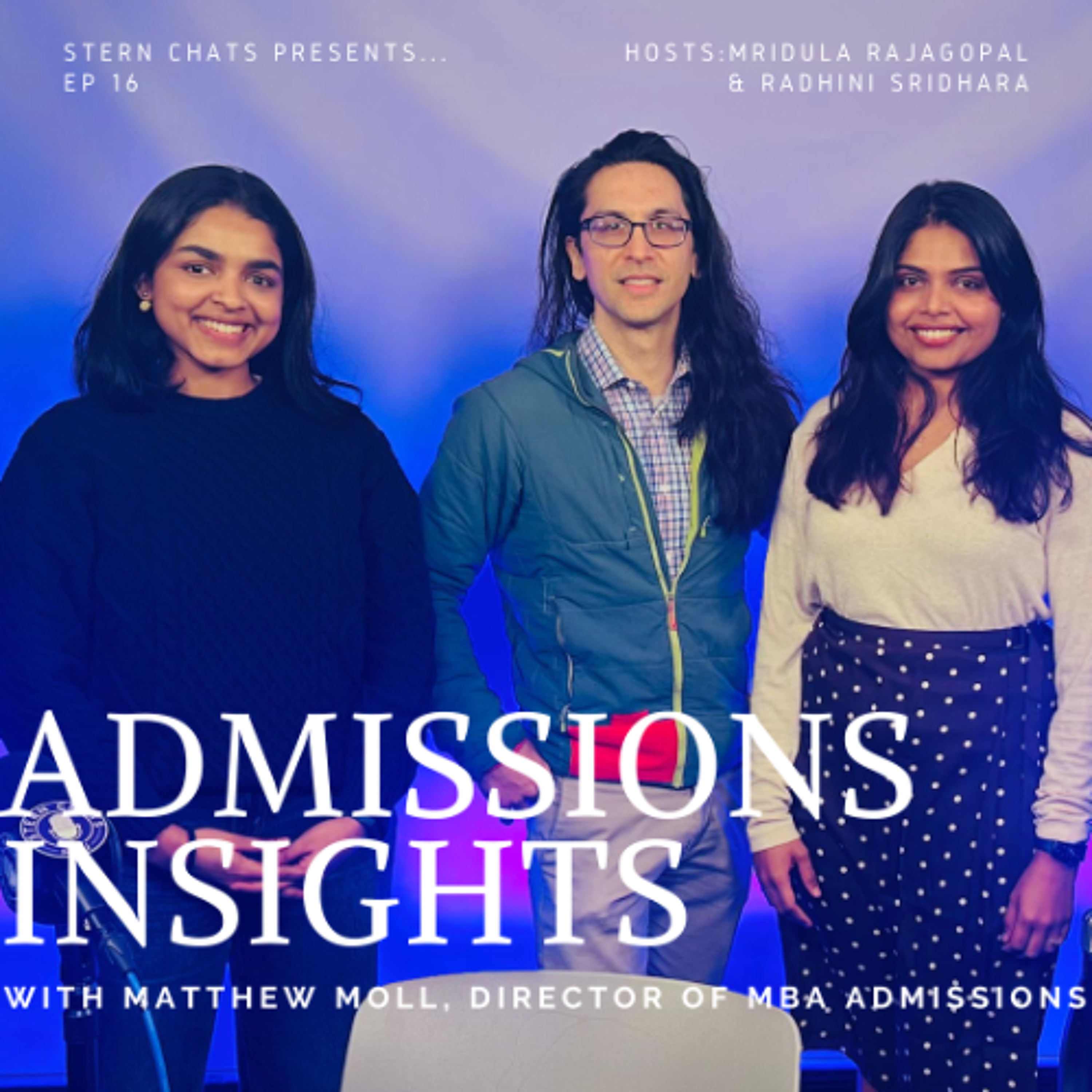
Admissions Insights with Matthew Moll, Director of MBA Admissions
from Stern Chats
35m 20s
NYU Stern’s MBA admissions process prioritizes individuality and authenticity over rigid criteria, emphasizing both intellectual and emotional intelligence. The holistic review considers academic performance, professional experience, and personal values—especially through essays like the change essay and pick-six, where applicants share meaningful personal or professional growth. Stern values real-world experience, offering unique opportunities such as the Stern Signature Projects and global Doing Business In (DBI) programs that provide hands-on, industry-relevant learning. Candidates are encouraged to research Stern’s culture, connect with current students, and engage with clubs to understand how they’ll fit within the community. The admissions team welcomes vulnerability and self-reflection, especially when discussing past challenges as learning experiences. While standardized tests and work experience matter, they are not gatekeeping factors—flexibility and personal insight are key. Final advice includes avoiding reused essays, choosing strong recommenders who can speak to EQ, and not over-analyzing application timelines. A standout moment from the interview highlights a candidate’s creative work with pets, underscoring Stern’s appreciation for authentic, unique stories. This approach fosters a supportive, transformative journey for every student.
[MUSIC]
Hello, and welcome back to Stern Chatz, a podcast that explores the untold stories of the NYU Stern community.
My name is Madella Rajagopal, I'm an MBA-1, and today my co-host is Rathani Shri Thera, an MBA-2.
Hi, everyone.
Just a quick background on us before we jump into our wonderful guest.
I was born in India, grew up in Singapore and Hong Kong, came to NYU actually for
undergrad, so I'm a double violet, where I did journalism and sociology.
Workton news for about four and a half years, to a little bit of PR, and I've now come to
Stern to pursue my MBA.
Do not ask me what I'm pivoting into.
I have no idea yet, but that is kind of the beauty of coming here.
They help you figure it out.
So if anyone who's listening is still figuring it out, you are not alone.
I am Raid Dev, at UMDalala.
I am also still figuring it out.
My name is Raidani, I'm a second year MBA student at NYU, extremely excited to be here.
Prior to Stern, I worked with Deloitte and I have my master's in statistics.
I also, like Brutalala, want to figure out what I want to do after, which has been quite
a journey, but I'm excited to do it at Stern with a very supportive atmosphere.
That is very true.
Joining us today is our guest, Matthew Moll, Director of MBA Admissions here at NYU Stern.
It is great to have you on, Matthew.
Thank you for having me.
Do you want to give us a quick intro?
Absolutely.
Hello, everyone.
Thank you for considering Stern.
My name is Matthew.
I use he/him pronouns.
I'm an admissions director at NYU Stern.
I'm coming up on my three-year anniversary, so that's exciting.
In addition to doing the traditional things, you'd consider for admissions officer, interviews,
publication, reading, meeting folks.
I'm also on the digital marketing team, so if you see anything on the digital side that
you really enjoy, you have my colleagues, Erika, Neji and Meola, to thank.
They're amazing, and I'm really excited to be part of this community and this podcast.
Yeah.
Okay.
Well, before we dive into questions, I think we should also let our audience know kind
of what they can expect for today's podcast.
That's absolutely right, Moll, so today we'll be talking to Matthew about the ins and outs
of the Stern's admission process, expect some helpful tips and tricks for prospective
students preparing for their applications, and do remember to stay till the very end of
the episode for some do's and don'ts.
Matthew, we're going to put you on this board.
I can't wait.
It's going to be amazing.
Good.
Okay, Matthew.
So just to kind of level set and kick us off here, build us a good foundation.
We're wondering, what do you look for in an NYU Stern MBA candidate?
Each person is different, but talk us through the IQ plus EQ component and what that translates
to into the students who are ultimately admitted here.
Awesome.
Thank you.
So I really appreciate that word foundational when it comes to IQ plus EQ.
We'll talk about that in a bit, but I think from the start, it's really important to understand
there isn't a type of candidate that we admit to NYU Stern.
There isn't a person we're looking for to make up the class.
Also for the individual, that should be somewhat of relief.
You can let go of all these preconceived notions of what you need to do to convince the admissions
committee to admit you because ultimately, we want to get to know you as an individual,
and I think if you're looking at the whole of the admissions landscape, it can be really
big and a lot to consider, but ultimately, you are your most valuable asset.
There's no one else like you out there, which can feel really good, but also be a little
scary.
But we want to meet that person.
So ultimately, when you are considering joining NYU, really let us know who you are, and
you have multiple opportunities throughout the application, we'll talk about that.
And when it comes to IQ plus EQ and that foundational piece of the experience, we know that no
matter where you go to business school, you are going to build your knowledge.
You are going to improve that IQ piece.
You're going to be much stronger academically, professionally to go out to your next role.
But we think that EQ piece can really be valuable when you're considering the life of your
career.
And what do we mean by EQ?
Emotional quotient, emotional intelligence.
We want to bring in folks who know they have this opportunity to improve on those interpersonal
skills, so leadership, empathy, being a really good teammate, being a really good supporter.
Because not only are you going to be a leader when you leave business school, but you are
going to be somebody who's not the expert.
And being able to be comfortable in that and be supportive in that is really valuable.
So ultimately, our students, the folks who decide to come to Stern, value that component,
they see that being part of the community that values that component is really going to
help help them in the next step in their career.
I think if we're going to bring it back to a tip and how do we really actualize that in
your application, I will say this a lot, speak to students, understand what the community
experience we like, and understand how you'll fit in that, and the best way is to talk
to our students.
So we have graduate ambassadors, I will talk to them about them a lot, but they're there
to help you guide you through this next phase of your career journey.
That's amazing.
And I'm so glad you brought up the application process and how everyone is different, because
I think that's something Bridaland I see all the time in our classrooms as well.
Every individual is unique and brings their own skill sets.
Can you walk us to the elements of a Stern application and what is the successful application
look like?
Yes, and I think what I mentioned before and I think what was mentioned at the top is tips.
So I will not only dig into the application piece because it's all here.
Yeah, I will try to give a little bit of knowledge on each piece so that you have something
to take away.
All you listeners who are considering Stern, if I were to take a step back while we have
these three components of the application, and it applies to all of our full-time programs.
So we have our two-year traditional full-time program where you have that opportunity for
an internship between the first and second year, and then we have two focused programs,
our Audrey Koo Tech Entrepreneurship MBA and our luxury and retail MBA.
Those are one of your programs where you go through consecutively and then you go back
into the real world, if you will.
And so what I'm about to share with you applies to all three.
Keep in mind that there isn't a single piece of the application that we are emphasizing
any more than anything else.
It's a holistic process and another chance for us to get to know you.
Yeah.
There's the academic, there's the professional, and then there's the alignment with Stern
Core values.
On the academic side, what do you have to submit?
We require that you are an undergraduate.
You have an undergraduate degree, so we'll take a look at your undergraduate grades.
If you are not an English language speaker, we require the TOEFL for the process.
Then we also require everyone's favorite standardized test.
We do have a test waiver.
How did everybody hear "Do" on your test?
We did okay.
I did not do great, but I qualified for the test waiver as a double violin, so if you did
well in the undergrad, my friends, it will be off.
Yes, and so we do have an application for test waivers, so to your point, if you show
that capacity, that competency, we have the ability to waive your test, and I think, since
we're talking about it, when it comes to test waivers, that is a good thing.
I think sometimes candidates will say, "Well, should I use it?"
What are my options here?
You have the option to use it, if you like, if you feel comfortable taking the test as
well, ultimately it's whatever is best for you and what I would suggest with the test
waiver with standardized tests, and ultimately, since we're talking about standardized tests,
if I were to give a tip on the academic side, there are many things outside of your control,
and we'll talk about that as we go through here.
That includes a little bit on the academic side, so your undergraduate grades, those are
in the past.
We will absolutely look at them.
We will want to get to know you from that perspective.
We don't have a requirement as far as what your major was or anything like that.
We have majors across the board, which makes the experience really exciting.
However, the undergraduate degree is in the past, but you do have some control over your
standardized test.
We accept a range of standardized tests, the most traditional, the GRE and the GMAT, so
that's where you'll see most people take their tests.
I'm going to insert a more popular question here.
What's a good test score?
Is that even a non-so for this question?
I think one of the things that I like to point folks to is our class profile.
Take a look at our class profile, students, perspective students, and understand where
folks have landed in the past.
The reason why I'm not sharing the exact numbers from our class profile is we don't have
requirements.
There are not minimums or maximums to apply for the program.
And so that is a big reason why you have so much flexibility with which tests you take
because we do not have those requirements.
Like I said, the GRE and the GMAT are the most common, so definitely take a look at that
two levels set for yourself, but ultimately why I say the
tests are within your control. Because you do have these options, test waiver, test you can take.
We do not have minimum requirements. So on the professional side, we want to learn from you about
your professional success. So as far as what we require, we do not have a requirement on the post
undergraduate work experience side. Those who have work experience have around five years of work
experience when they apply. Again, not a requirement we see folks with below that above that.
But within the professional experience on the application, this is your chance to show your growth.
And so when you are considering how to show that off a tip, when you're thinking about your
resume, this is an opportunity for us to learn about you. And this is a chance for you to quantify
your experience. So where you can share those numbers. What are some of the things you've done
and how can you quantify that for us? Years of experience, number of people you've supervised,
etc. I would also as a tip, avoid as much jargon as possible. While we have seen kind of all of it
on the admission side, I think something that came up recently, someone said, "Hey, I know you've
never done X." And that is going to be true for most of the folks on the admissions team and
most of the careers that we see in front of us. But we have an excellent careers team we can
confer with if we want. We have years of experience on our team. And we can ask a lot of questions
across the network if we need to. But if you're able to make it easy for us, that's great.
And we also require an EQ endorser. Do you remember who your recommenders were? I do. Mine was
my partner, I had to Lloyd. Okay. Very nice. Mine was, yeah, she's a senior producer at Dateline,
one of my mentors. There you go. And I think you both touched on something that's crucial for our
application is that we would like to hear from your supervisors. You absolutely have the option
not to. There's a place to explain why you wouldn't use a direct supervisor. We by no means want
you to jeopardize anything. So we understand this is the real world. I will mention this probably
many times with human beings reading your application. We expect you to be a human being. And so
ultimately choose a person who can champion you and really be somebody who says amazing things
about you. Right. So I tell you, you want this to be a person you've worked with very closely who
knows you and who's guided you in your career path. Absolutely. So the quote unquote requirement is
your direct supervisor. However, we understand that that may not be exactly because of your work
environment or your work experience. But yes, to that to your point, anybody that's able to speak
to your work experience, your growth, your progress, see you in that environment. It's really valuable
for us. So alignment with Stern core values where you have the chance as a candidate to highlight
this is through our essays, particularly the change essay and the pick six, which I know everyone
is really excited about. Oh yeah. We'll talk more about that in a moment. But as far as the change
essay, that's an opportunity for you to write about something professional or personal that really
matters to you. Yeah. You're prompted to choose a change word and keep that in mind throughout
the essay. And that's really that prompt so that you can talk about something that is important to
you how you've shown impact. Yeah. And there's no requirement here. There's no right or wrong answer.
I think it's really important. Again, we want to get to know you. And that's really exciting for
us. But there's no, you can't go wrong here is I think the you should use your judgment. I guess
I should say that throughout the application definitely use your professional judgment. But there
isn't anything specific we're looking for other than learning from you in that capacity.
We also have the pick six where we can see the Stern core values really be highlighted. And
this is I think in both a chance for you to really highlight how you'll show up in the Stern
community. So we talked about IQ plus EQ. I think in these essays you have that opportunity
to talk about the things outside of what you'd seen your resume. Okay. I think it's supposed to be
fun. Yeah. It's supposed to show the fun side of you. Yeah. Absolutely. The whole human. Yeah.
Yeah. Totally. And I we are I think candidates are very curious about this. We'll dig into this
a little bit more. But this is a great way for us to meet you for you to share what is important
to you. Right. And I think as far as a tip take away this is where you can really highlight that
research you've done. So you're already doing it. I assume every school that you're looking at
you're going to think how do I see myself at this place. Do I in what do I envision when I am on
campus. And so this is your chance to show off that research in these essays. Yeah. That's a great
great point. And thank you for being so holistic in your answer. I'm really glad. Do you remember a
photo from a big six that's perhaps on the top of your mind? I think one that stands out is when
I got to go paragliding in South Africa in Cape Town. Nice. Thankfully I grew up with parents
who were obsessed with travel. So I got to travel a lot when I was younger. Yeah. Because I think
the way that I approached the PIXX was trying to show kind of all the aspects of my personality
outside of my professional realm. That is definitely the first and last time that I ever went paragliding.
But I thought it showed, you know, I'm adventurous spirit. I like to travel. So yeah, that's one that's
six out. What about you? A photo that sticks out for me. I'm thinking is one with my mother
that on graduation day. So for my master's from previous school. I made her bear my graduation hat.
And it's a photo of the both of us. Very sweet. Yeah. She's definitely behind or big reason behind
the success in my life. Yeah. And I think what is really great about both those examples is that
and correct me if I'm wrong. But in both of those examples, you shared pictures that you had.
Yeah. This was not expected or we do not expect that you are going to be a graphic design.
No. Absolutely. You are applying to business school. Yes. And this is a professional school. So we
expect folks to come here in a straightforward way. Yeah. Right. There is not this need to become
something you're not in the application. And particularly with the PIXX, we don't expect you to be
this wonderful photographer or anything like that. Some people are and that's cool. Yeah. Yeah.
That's not required. We want to meet you. Yeah. And I think ultimately with all of these pieces,
including the PIXX or the change essay. But in any three of the elements, if there's anything
you're not sure about, that's why we have the optional essay. And if there's anything to take
away from this piece of the conversation is that if you aren't sure, tell us in the optional essay,
we read it. Yeah. Humans read it. And it's exciting for us to have that opportunity to hear you
delve into things that are maybe a little bit trickier. I think one of the things that comes up
the most is the pandemic. It was a challenging time for folks. And so being able to have a place
to say more, that's what the optional essay is for. And a lot of people use that opportunity to say,
here's what happened to me during this strange time in the history of the world.
So Matthew, you were talking a little bit about the amazing resources available here at NYU. But
that kind of brings me to the meat of why we're here, the program itself, the amazing classes
and professors that we have access to. Could you talk to us a little bit about how the core
requirement works, maybe some kind of rare, fun, exciting classes you could point to some of the
professors we have access to here at Stern? Absolutely. And I think being a part of NYU and the NYC
ecosystem is invaluable and will really play a huge role in whatever it is you decide to do.
I think one piece if we're talking about our faculty that we can't say enough about as the
adjunct faculty who are real world practitioners, their industry experts, and they're in the
classroom with you as well as in the industry you're excited to learn more about.
Somebody that comes to mind is Amy Webb, have either you have taken any of Amy Webb's classes?
No. Well, she is a quantitative futurist. I'm not going to pretend to know exactly what that
means, but that's what's so exciting about being in the classroom with somebody like that where
you don't have to be that expert you learn from an expert. And being an NYC really grants you that
access to somebody who's working on things like innovative ways to help companies prepare for
the future that professor Webb does. You mentioned the core. On the core side, I think what's really
exciting is launch. I imagine both of you have gone through launch and the orientation program and see you.
Special fun, you get to meet everyone in the first week and interact with all your classmates,
get to know the group that you're in. Yeah, that's a lot of fun. And my year got to go to
the National History Museum. We did our under the whale. It's fantastic. Very quintessential New York
experience. It's wonderful. Totally. Welcome to New York, you are in the National History Museum.
Are you and I think they took us to the Statue of Liberty?
Oh, very nice. Very, very inspiring. Yeah, cool. Yeah, it's so that's really your introduction to
the program.
through launch, through orientation, and you start taking your core classes. Once you finish
the core, you then have the option to get to the 200+ electives at Stern. If I'm thinking about
these amazing courses as a candidate, this is a chance for you to consider how the academic side
will impact what is next for you. And so when you're putting together your application,
you're thinking about what you want to do, really think about for the academic perspective of okay,
I could take these courses and potentially transform myself. Yeah, absolutely. It's an
experience that you make for yourself for sure. There are some ways for us to get practical
experience at Stern. And I think you can do this through two signature courses that Stern provides.
So there's SSP, which is the Stern Signature Project course, and there's also doing business in.
Matthew, do you want to talk us through these courses, what they are, and how our prospective
students can use them to grow in their career? Yeah, so these are two really excellent ways for our
students to, one, with the SSPs, get real world experience. And the Stern Signature Projects are
this amazing way for our students to partner directly with real companies and give real feedback
on real problems that these companies, these organizations want solutions to. And then DBI,
those are the doing business in. And so this could be a way for you to internationalize your
experience, globalize your experience and being at Stern, having those resources. I can't say enough
about how our students have been able to travel and really see what other cultures are alike.
But let me dig into the SSPs, the Stern Signature Projects. Like I said, these are opportunities for
our students to work directly with companies. And so you are partnered with a professor
who partners with a company on a project that they come to us and ask for help on essentially.
And you as a student get to act as a member of the team as they call it consultant. And these
suite of classes that we offer are pretty vast. But one I'll talk about is fairly recent was with
the Dow climate and they are working on hemp carbon removal credits. I am not going to pretend
that I have any idea what that means. And I think if our students are being honest, they learned
as they're getting right. And that is what's so cool about these projects is that you may not come
in as an expert, but you become one. And then you can lend your expertise that you've gained,
but also the skills that you have from other parts of your career and really come up with
innovative solutions with these companies. And so Neha who is on the, is a tech student.
She had a chance to really build with the founders and a professor on this sustainable solution
in business. And so this is a plug selfishly on the digital side for MBA admissions. But Neha
did a blog for us and she talks about the, the, the tau project with us. It's really great.
Right. You mentioned real life experience and I do want to plug in my experience with SSP as well.
So my client was NBC Universal, which was one of the biggest companies here in the media space.
I worked on their revenue problems. So that was amazing. But there's also an upside to doing this.
You're working with real life data and you're getting experience about the industry.
But you're also working with an amazing professor and mine was a partner at BCGA. So you got to learn
and observe from his working styles as well, which I thought was pretty cool. Matthew. Yeah.
So as far as the doing business in the, again, doing business in DBI, that is a way for you to
globalize your experience while you're in the heart of New York City. And so two years is short.
And this is a way for you to get that experience. Generally, the DBI's are one to two weeks during
your breaks. Great. The DBI's are all over the world. We mentioned South Africa earlier. We have
a DBI in South Africa. New Zealand is a very popular one. There's a sustainability and business
in Costa Rica that folks are always talking about. I got to be a administrative lead last year
in Mexico City. So seeing how, right, and seeing how business is conducted abroad in these
different environments is a really great opportunity for our students to partner with other universities,
see what business is like so that you can really be influenced and impacted by the way the world
works outside of the Stern walls. I think when you're thinking about the DBI's or the Stern
Signature projects and that experiential learning, I think really understand how these could
impact your experience. Like, what do you want to take advantage of? You don't have to talk about
these two things, but this is a way for you to really understand how you can differentiate
yourself in through Stern, for sure. Yeah. Yeah. Exactly. I am very much looking forward to doing
a DBI sometime soon. I hope. So, Matthew, we've talked a lot about the fact that people are most
likely 99% pursuing this degree for some sort of transformational change, personal, professional,
whatever it may be. And we talked about all these incredible resources, classes, special courses
that people can take. But how would you encourage prospective students to learn more about the
industries they are interested in post-graduation? Absolutely. And I think something that you
alluded to is that this could change while you're here and that might. Absolutely. Yeah.
Emissions is not going to look back to see what your career path was in your application.
However, having that template of like, I am going to do X and this is how I think will be useful
no matter what you do and if you change your mind. And so, I think ultimately this process
is about you. And so, we want to know from your perspective, what do you want to do?
And start with our employment report. And I think that's a great jumping off opportunity for
you to see where our students go. What are the opportunities that generally students take advantage
of connecting with our students? I know I keep saying that. Connecting with our graduate ambassadors
will help you dig deeper into that. So, I think start with the employment report. Understand
the potential for your career. But then talk to students. And they can connect you with clubs
because what you will learn through this process is that not only will you take advantage of
all the opportunities within the careers team and what they offer, but you also work directly
with clubs, professional clubs to see where you will go next. So, I think it's really important that
when you hear about the student experience, talk to them about the clubs and how the clubs
have played a role. And then that will be a big part of your experience. So, if there's anything
that you take away from the conversation, talk to your fellow students who are not far from where
you are right now as a candidate. And they'll be excited to tell you about how they are
creating their own template for their career path. Clubs the cruising, for sure.
Yeah, absolutely. Yeah, professional clubs are still in at so much value. I remember
speaking with BE and VC club before coming in and talking to them about the career of
Portuguese outside and they were extremely helpful and hands on. Yeah, I got a chance to speak
with some members from this web Stern Women in Business group and they were fantastic and great
ambassadors of NYU. And you did that before your part? Yes, yes, real life, right there.
Yeah, exactly. Have those conversations before it's really valuable. Yeah.
All right. And then moving on to the final and fun segment now, Matthew, is a game that
Marcela and I want to play with you. It's called the Doos and Dones. So, you'll be asking your
questions about whether a particular thing, for example, wait until the very last moment for your
recommendation that is like idea. It's a good idea. And you'll let us know that's a do or a strong
don't. You could still get in. And it looks like even if you were forever. We wouldn't, we wouldn't
second. Absolutely. So the first question for you is bringing up weaknesses or past failures in
your applications. Is that a do or a don't? I would say that's absolutely a do. Everyone who's
applying to business school to Stern is looking to grow and you can't grow without failing a little
bit, right? And so sharing with us how you've learned from the past, learned from
let's not call it a failure. Let's call it an opportunity. Yeah. Learn from these opportunities,
these challenges. Yeah. I think it's really great. And it's great to see folks who are who are
vulnerable and honest in that way. Yeah, absolutely. Okay. Referring to Stern's collaborative
culture and naming specific clubs you want to join, do or don't. Well, I think that was easy,
too. Absolutely. And I think connecting with those clubs and understanding how they can fit into
your experience and how you'll contribute to the community is super important. Yeah. Yeah.
Agreed. Next. Mentioning a personal passion like a side business or a volunteer work,
even if it's not related to your business strictly, is that a do or a don't?
It's a do for sure. And I think what I would say to you, emphasize this a bit, it should
really matter to you, right? I don't we do not expect you to kind of create this new persona
to apply to business school. So if something like a side business or you are part of a club where
you get together and play board,
games, it doesn't matter. It doesn't have to be something specific. I think there is
a temptation when we say how will you contribute to the community? Folks had immediately
go to volunteer work, which it can. You can be somebody who has that type of commitment.
That's excellent. Share that. But this should be really something that matters to you so
that you can show your impact. And I think if it does matter to you, you will be able to speak
to it in a more authentic way. Yeah, absolutely. Okay. Reusing another school's essay for
the why Stern prompt without major edits, do or don't. That's a major don't. Look, we've
definitely admitted students who have made this mistake before where they've included
something that may not be exactly reference to NYU Stern. However, this goes back to what you
have within your control. You control. Connecting with somebody you really trust. A colleague,
a friend, a parent to reread your essays. And it's really important to consider that this is
your one chance to make a first impression with us. And so doing your best not to have those
copy edits in general. But yes, I will I do want to share that folks make mistakes and still are
admitted. Okay. Yeah. Following up on your application status every day, do or don't.
I think no matter what I say, folks are going to check their portal and check their status.
And that's totally fine. I think the time to check in with the admissions teams when you have
some type of update. And that's going to be pretty rare. So I think ultimately if you're somebody
who is, you know, you're considering when to reach out. Reach out when you have a major update.
For example, you're promoted or you've retaken a test and you want to share how you did.
And so I think those are the examples of the ways that we anticipate folks are going to reach
out to us. But I know that you're going to log in and check your status. That is fine. And
I understand and I feel you. I guess I hope that if I can say anything to you is that we are
looking at the applications and we will, we will get back to you. I promise. And I will a quick note
on that. I think it took almost a month to hear back for me. And it was positive news, obviously.
So don't think the longer it takes. It means something's wrong or something's up. It's just part
of the process. Right. We have deadlines and notification periods. And I think those are your,
I think basis and use those as your decision, part of your decision making process and part of
your kind of emotional waiting process. I think what you'll sometimes be tempted to do is hear
what other people are doing. Right. And that is another example that's outside of your control.
Other people may be invited to interview before you or may get a decision before you,
but that is not necessarily an indication of your candidacy. For sure. Thank you for mentioning that.
Yeah. Of course. Yeah. Of course. Okay. Asking only one recommender for multiple letters for
different schools. Do or don't. I think that makes sense. So you likely don't have, let's say,
you're applying to five schools. That's a totally manageable number, I think. I think it's really
hard to find five different EQ endorsers. So if you have an EQ endorser who is applying or helping
you apply to other schools that totally make sense, we have questions that are specific to NYU.
So when you're speaking to them, make sure you highlight those. We want to know about your EQ
in the workplace. So make sure to connect with your endorsers about that. Okay. Sounds good.
I think we are going to wrap up. We have one final question for you. We thought we'd leave it on
a fun anecdote for our listeners. What is the most memorable or unique answer you ever heard during
an MBA admissions interview or application? Anything that stuck out to you, maybe a really quirky
pick six photos, something fun. I'm an animal person. So confession. And once we, I had a candidate
who I interviewed, who created our installations for their fur babies. And so they could experience
life like drinking water in this unique way. And that was really hard to forget. Yeah. So this
is an admitted student. She is here. So if you're listening, thank you for that. I have not been
able to forget your art installations. Amazing. All right. Well, that sounds like a great note
for us to end on. Thank you so much for joining us today, Matthew. This was a very illuminating
conversation to steal your word. Yes, I said journey a lot too. So thank you all for considering
Stern on your journey. We can't wait to meet you. Thank you for for listening and don't forget
to reach out. Yeah, absolutely. That was my final note as well. If you have any questions or if you're
interested in knowing a little bit more, I'm more than happy to take your questions. So please,
please reach out. And thank you so much for this conversation, Matthew. It was lovely having you
here today. Thank you both. Thanks for the love. Bye. Thanks Radney.
Podcast Summary
Key Points:
NYU Stern admits students of all backgrounds, emphasizing individuality and authenticity over a standardized profile.
The admissions process values both IQ (academic knowledge) and EQ (emotional intelligence), particularly leadership, empathy, and teamwork.
Successful applications include a holistic mix of academic records, professional experience, and alignment with Stern’s core values through essays.
Applicants are encouraged to research Stern’s programs, clubs, and student experiences, and to speak with current students and graduate ambassadors.
Stern offers unique experiential opportunities like the Stern Signature Projects and Doing Business In (DBI) programs for real-world, global learning.
The change essay and pick-six questions allow candidates to authentically share personal growth and values, with no right or wrong answers.
Weaknesses or past challenges are encouraged as they demonstrate self-awareness and growth, especially when framed as learning opportunities.
Key tips include avoiding reused essays, checking application status only when major updates occur, and choosing recommenders who can speak to genuine professional growth.
Summary:
NYU Stern’s MBA admissions process prioritizes individuality and authenticity over rigid criteria, emphasizing both intellectual and emotional intelligence. The holistic review considers academic performance, professional experience, and personal values—especially through essays like the change essay and pick-six, where applicants share meaningful personal or professional growth. Stern values real-world experience, offering unique opportunities such as the Stern Signature Projects and global Doing Business In (DBI) programs that provide hands-on, industry-relevant learning.
Candidates are encouraged to research Stern’s culture, connect with current students, and engage with clubs to understand how they’ll fit within the community. The admissions team welcomes vulnerability and self-reflection, especially when discussing past challenges as learning experiences. While standardized tests and work experience matter, they are not gatekeeping factors—flexibility and personal insight are key.
Final advice includes avoiding reused essays, choosing strong recommenders who can speak to EQ, and not over-analyzing application timelines. A standout moment from the interview highlights a candidate’s creative work with pets, underscoring Stern’s appreciation for authentic, unique stories. This approach fosters a supportive, transformative journey for every student.
FAQs
NYU Stern looks for diverse, unique individuals with both intellectual (IQ) and emotional (EQ) intelligence. They value candidates who demonstrate leadership, empathy, and the ability to be a supportive teammate, not just an expert.
No, there are no minimum or maximum test score requirements. The GRE or GMAT are accepted, and test waivers are available for applicants with strong undergraduate grades.
A recommendation from a supervisor who knows your work and career growth is strongly encouraged. You may opt out if necessary, but the recommender should be someone who can genuinely speak to your professional development.
Applicants can highlight their alignment with Stern’s core values through the Change Essay and Pick Six essays, where they share personal or professional experiences that reflect their values and fit with the community.
SSPs allow students to work directly with real companies on meaningful projects, gaining real-world experience and developing industry-specific skills while learning from professors and professionals.
Yes, through the Doing Business in (DBI) program, students can take one- to two-week international trips to countries like South Africa, Costa Rica, and Mexico City to gain global business perspectives.
Chat with AI
Loading...
Pro features
Go deeper with this episode
Unlock creator-grade tools that turn any transcript into show notes and subtitle files.
 PodcastTranscript AI