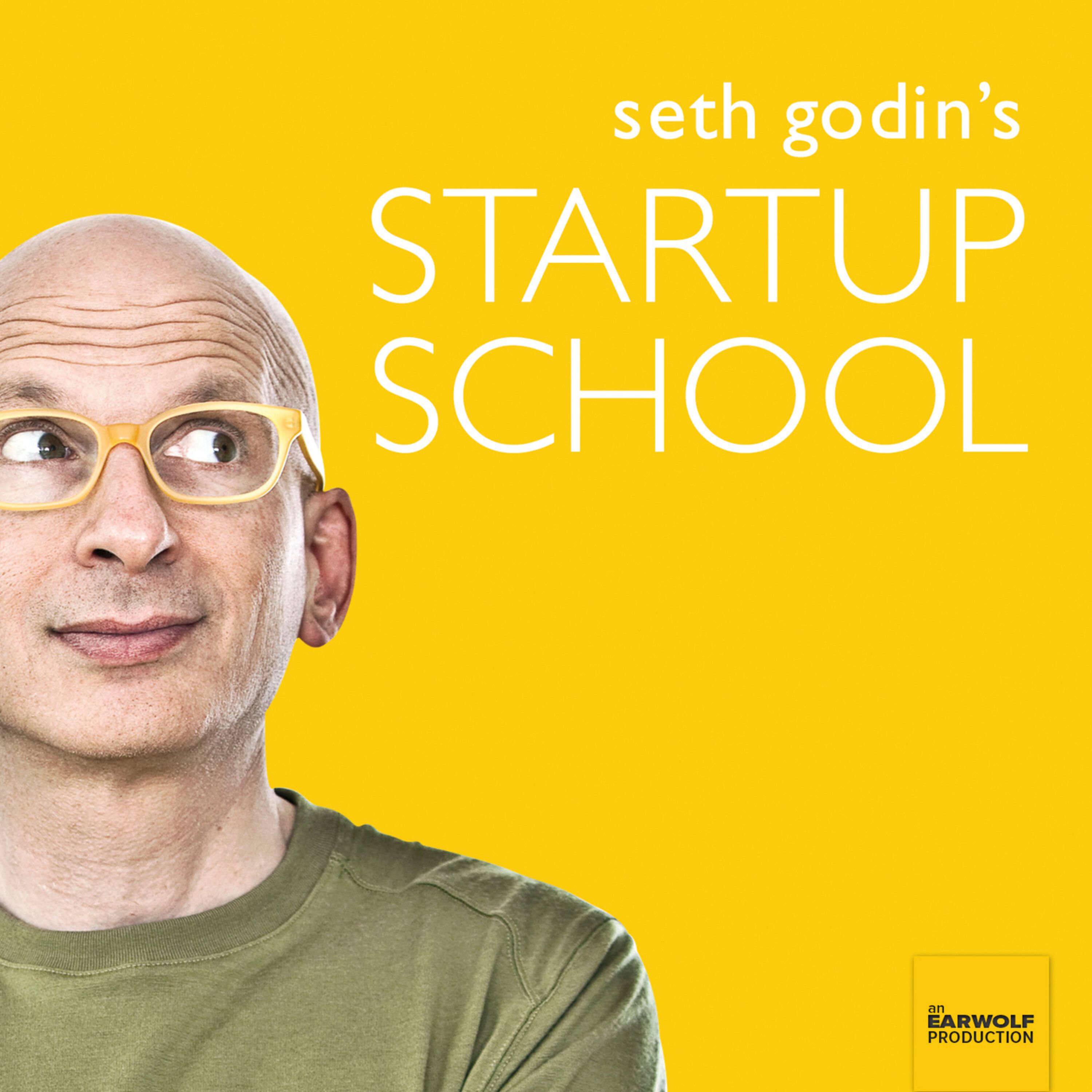
The connection economy represents a deeper shift than industrialization, where value emerges from human relationships rather than mass production. Seth Goden emphasizes that successful entrepreneurship begins with self-honesty — identifying who the target audience is, what beliefs they hold, and why they’d pay attention or trust a business. He stresses that no product serves everyone; instead, it must align with a specific subgroup’s worldview and behavior. A critical distinction is between awareness and trust: knowing a business is not enough; people must believe in its expertise and reliability to act. In this new economy, businesses don’t just sell products but create platforms that connect people — like trade shows or marketplaces — where value arises from interaction. Examples like Google, which bridges users and advertisers, or a broker between philanthropists and charities, show how connection-based models generate sustainable value. Goden also highlights that entrepreneurs must confront their fears and avoid the trap of overcomplicating decisions. Ultimately, the core question becomes not just “what will I sell?” but “what story do I offer that makes people trust me and act?” Success hinges on clarity, authenticity, and understanding the emotional and psychological drivers behind consumer choices.
Hey, it's Seth Goten. In the summer of 2012, I had an amazing opportunity to spend three
days with a group of extremely motivated entrepreneurs, people right at the beginning of building
their project, launching their organization. During those three days, I took them on a guided
tour of some of the questions that we're going to have to wrestle with, some of the difficult
places that we're going to stand up and say, "This is me, this is what I'm making."
I'm sorry you couldn't be there, but I hope this is the next best thing, excerpts from the live event,
unrehearsed, no slides, here it is, enjoy it. But even more important, I hope you do something with it.
Thanks for listening. The connection economy is a bigger deal in terms of the economic
history of the world than the industrial revolution. So if we were having this conference in 1918,
and I was sitting here and I had the guy from scientific tailor from scientific management over
here and Henry Ford talking about mass production over there, and I was describing how you could use
the techniques of mass production and mass marketing and industrialization to make a business,
it would seem just as hard. There were 2,300 car companies in 1918. So there's all this stuff
that's going on. I am not promising that you're going to build a business that's going to make a
million dollars in a year. I think that's unlikely. What I am promising is that you can have a business
plan that lets you see a path to probably succeeding more than not. And the hard part isn't going to
be defining the path. The hard part is going to be doing the scary thing to stick to the path,
because the reason that everyone doesn't do this is it's really frightening and you get very
little support from the people around you to do this very difficult, scary work of putting
yourself out there and saying, "Hi, this is me, I made this." And if you make it and people don't
see the value, you don't give up, you remake it. Zig Ziglar, one of my heroes, tells the story of
plane takes off from New York headed to Dallas. Five minutes into the flight, it's windy, so they're
off course. The plane doesn't turn around land in New York and start over, it just adjusts its
course and keeps adjusting its course until it gets to Dallas. So if you're going to
buy into the life of making it further as a bootstrapped or funded entrepreneur or a freelancer,
you're going to have all these things that don't work. I got 900 rejection letters in a row my
first year in the book business, didn't sell one thing. You just adjust and you learn from it,
but the number of places we need you, the number of places you can add value, so huge that it's a
pretty safe bet that along the way you're going to get to Dallas. Yes, Bob? Are you saying that we
should make the decision as soon as possible whether we're entrepreneurs or freelancers? Yes, by
tomorrow for sure. Yeah, exactly. And the biggest, this is the biggest source of unhappiness
of people who start throwing business, is not being clear on the difference and not being
willing to commit to one or the other. I think I'm slightly confused as to what consulting is
because it seems like that's the mix-up of freelancing and entrepreneurship, like running around
in circles, pretending that some sort of product leaves the office. When you say consulting,
you mean like what McKinsey does? Consulting, Bane, and getting hired for $300 an hour to tell
someone how to do a better job. So consultants are always freelancers. There are a few who pretend
that they're entrepreneurs because they build some proprietary database, Arthur Anderson with
their 2,000 people on the street. And so what will happen is Coca-Cola will decide they want to
switch from a matrix organization to direct reports organization. They have 25,000 employees,
which we do. Arthur Anderson, Arthur Anderson sends 100 recent college grads. They parachute in,
they do all these interviews. They're consultants, right? The thing is, the return on equity at
Arthur Anderson is pretty low. And they only grow by, you know, they're basically a temporary
employment agency, marking up the people who work for them. Real entrepreneurship is about, again,
if the geniuses who work there took two weeks off with the business keep running. No, because
the people who hire Arthur Anderson are paying for the genius to come in and see them. And they're
paying by the hour. So if you're a consultant, the hard part, the easy hard part is, are you smart
enough to give good advice? The hard hard part is, do people trust you enough to pay you to give
them good advice? And so what happens is if you work at McKinsey, you graduate from Harvard Business
School and go to McKinsey, McKinsey's billing you out at $91200 an hour. You say, wow, that's amazing,
because I work 2,000 hours a year, 2,000 times a thousand, that's $2 million. I'm going to quit
and go be me, same advice without the McKinsey name. And what those people discover every time is,
they can't charge $1,000 an hour anymore. Because what you're buying when you buy McKinsey is the fact
that you can go to your board of directors and say, I want to close the plant in Georgia, McKinsey
said it was a good idea. That people believing that the advice is good is what consultants usually sell.
There is a second model, though, which is to say, I'll give you advice. And if it works, then you pay
me. I'll give you advice. I'm a stockbroker and I hedge fund. And I'm going to keep part of the
profit. That starts to shift. And now you're not so much a consultant as you are a risk partner
with somebody else. And that can truly scale in terms of what you're doing. But again, scaling
back to what we heard a little bit earlier, we're going to keep coming back again and again to what
kind of dent are you trying to make in the universe? Are you trying to make the dent in the universe
that you make a decent living doing what you love? Or are you trying to make a dent in the universe
by saying, there are now nonprofits in my town that are extremely well funded because I made a
disruption in the universe to make that happen. And there's no right answer to this. But you have
to be honest with yourself about how big a ruckus are you trying to make and why are you making that
ruckus? Because when it's not working and when it's hard, you're going to keep coming back to,
why am I doing this again? And if there's a mismatch, you're going to flee. Here's what we have to
understand. And we made it a whole hour before I bought up the lizard brain. You can be the smartest,
best educated business person in the world. But if the voice in the back your head
helps pushes you to avoid opportunities, it's not going to do you any good. So as we go through
these questions, you're going to hear a question and party was going to know the right answer
and party was going to say, I don't really want to do this answer. And I need to highlight for you
when that is happening. And you need to be really clear with yourself about why you're avoiding it.
So at 1998, the internet bubble is really starting to get rolling. Why do some people go and start
an internet company and other people who know just as much don't? It's not about the external
information. It's about what are you telling yourself and what are you afraid of. So my story
on this and then we'll go look at these questions is I didn't bring it because it's too valuable.
It's in my office across the street. I have a t-shirt that is worth or was worth about 40
billion dollars. And I keep it in this beautiful green box. If you want to see it, I'll bring it
by tomorrow. In the 80's, I did a job called book packaging. What book packages do is we think
of an idea for a book and we make it into, we sell it to a publisher. And if they like it,
we have to make it. It's like being a movie producer but for books. So I did 120 books,
10 books a year for 12 years. And so millions of copies, some you may have heard of, a couple of
sellers, a lot of books, you never heard of books on stain and spot and stain removal, books on
gardening, a lot of business books. Some have my name, some don't. And I also knew a bunch about
the internet because my background was working a prodigy and a computer software company. So magazines,
being a freelancer, were calling me up to write articles about the internet. And to make ends meet,
I would like stop being CEO of this company with 10 employees and hire myself to write a magazine
article for $2,000. So I wrote one of the very first cover stories about what this web thing was.
So here it is, 1992. And I have a high-speed connection to the internet. And I'm writing articles
about what's on the internet. And I'm seeing the internet start. So I say, "What should I do?"
I said, "I know. I'll write a book called Best in the Net." Because everything I had was a hammer
and that looked like a nail. And I sold it to a book publisher for $80,000. Hired three people
and we worked for a year to put together this big, thick book of 250 cool things you could find
on the internet. There was no worldwide web yet. This was the internet. It was before the worldwide web.
So with all of this stuff going on, I wrote a book, $80,000. Now this guy was on the t-shirt that we made,
that I made.
made for the sales force and it's set on the front best of the net and in the
back it's had worldwide internet surfing team and that guy was on it and I gave a
copy to every single person on the sales force so they would sell at the
publisher so they would sell a lot of these t-shirts, tell a lot of these books
booked in sell. Exactly the same time with less money than I had two guys in
Stanford David and Jerry started something called Yahoo! They saw the internet and
built a search engine, I saw the internet and wrote a 200 page book and their
company at one point was worth 80 billion dollars so I figured I would have had
half of it so my t-shirts are 40 billion dollar t-shirts and I keep it right by my
desk because it's really obvious to me why I didn't start a search engine
because I'm not the kind of guy who starts a search engine, I'm the kind of guy
who writes a book about what's on the internet and that's why this is such an
interesting day because you guys just all bought an acre of beachfront property
you can build whatever kind of house you want on it and if you want to build a
book go ahead but then don't wind later that it's worth 80 billion dollars and
you don't own any of it right and that fork in the road ought to become clear as
we go through these questions so question number one about your business and
what I want you to do as I go through these is feel free to write down the
questions or just think hard about them but I find that in this case writing
something down will force you to be a little bit more honest you all came
because you have something in mind is that true except for Dave or Dave does
too everyone has something in mind so the first question is who is it for
nothing is for everyone nothing the vast majority of people in the world
have never had a couple Starbucks coffee the vast majority of people who have a
phone have never used an iPhone the vast majority of people in India do not
have indoor plumbing so nothing you're you brought here is for everyone if you
think it's for everyone you have to start over okay that's question number one
question number two is this group that it's for has subgroups in it and what I
want to know about any given subgroup you can start with a big one is what do
they believe so let me give you a very specific example of what I'm trying
about when I talk about world view lots of people who live in this part of the
world wake up in the morning and say what a beautiful day I think I'm going to
go to the store and buy something and they don't know what they're going to buy
before they go to the store we call this shopping and they're looking
forward to going shopping and they believe they would never use these exact
words that shopping is an enjoyable activity that going to the store isn't
stressful it's fun there are other people in the world more of them who have
never once in their life bought something that their family has never bought
before never once and if they have to buy something it is one of the most
stressful things in their life because it's a matter of life or death if you
make three dollars a day and you have to go buy something maybe a pair of glasses
and you're wrong and the three or four or five dollars you spend is wasted your
kid might die so that person's world view is not let's go shopping that person's
world view is please please please let's make sure everything is the same now
when we think about world views of smaller groups we could say there is a group
of people who in three weeks when Apple launches its new product we'll buy it
that day because it makes them happy there's a different group of people that
will buy it four weeks later because waiting four weeks makes them feel smart
and there's a different group of people that will wait at least six months before
they buy it because they're smarter than the other two groups of people these
are stories we tell ourselves and in twelve weeks is going to be presidential
debates two people will watch the debates and one of them will have exactly the
wrong impression about what just happened right the other person is sure they
heard the right thing but the second person heard something completely
different not because of what was on TV but because of the stories we tell
ourselves so if you think about the product that you are offering or the service
you are offering and the group or the subgroup you're offering it to what's the
story they're telling themselves so if we look Chris you want to show everyone
your shoes Chris is wearing handmade sneakers for barefoot
munters how many of you have ever heard of barefoot running ways your hand
how many of you have ever done barefoot running how many of you keep doing
barefoot running so we're down to one now it's not that barefoot running is
better or worse for everyone here we could have that conversation it's just
interesting that young is the kind of person who tells himself a story about a
new technology of working out Chris is the kind of person who likes wearing
something that says something about him while he's wearing it on his feet and
most of us are old enough they're like I can't learn a new way to run that's
like completely outside of my comfort zone these are world views they're not
right or they're not wrong they're just true so we have to be really clear when
we talk to each other about who this is for so Christina sells web design and
HTML and graphics and architecture underneath right apps and things yes so if
she is trying to get a new client sometimes she can call on someone and they're
eager to hear from the new sparkly cutting edge designer come on in let's
start whiteboarding it and other people she calls on their arms are folded she
represents a threat at seven different levels now you can beat yourself up
that you did a bad job at the second meeting or you can realize it's not for
them and go call on someone who it is for question three this group that we're
imagining or this subgroup have they ever spent cash money to buy something
like this before because if you're trying to sell the virgins it's a lot more
difficult than it is to go to someone who regularly so an example simple
example is if you sell mattresses for a living there are two kinds of people in
the world people only buy a mattress when they have no choice and people will buy
a mattress because they think it will help them sleep better and they buy
mattresses five times in their lives ten times in their lives if it's the
second kind of person selling them a mattress is much much easier than selling a
mattress so new things they should never have to buy a mattress but I need to
clarify two things one there are three different kinds of revenue I'm
talking about the revenue of cash the revenue of attention and trust and the
revenue of referral so there are lots and lots of businesses that need the
revenue of attention and trust like I'm gonna watch channel four tonight you
not paying them cash but you're giving them attention and trusters they can
figure out how to make money right exactly so we can there's different
flavors of that and we're gonna go deeper into all of them as we go into this
different ways that people are quote paying you I'm gonna do one more and then
I think we should take a good fire break so last one is does this group this
core group this group we know their world view the group that we know it's
for do they know about you do they know you exist there's a huge golf between
selling to people who know about you and selling to people who have never heard
of you okay you with me so far okay so moving on to the next question these
people who are aware of you do they trust you now this is you so you know
Joni lives in Toronto and is able to bump into a fair number of wealthier
semi-wealthy Canadians and he knows people who can introduce him to other
wealthier semi-wealthy Canadians so getting himself to be heard of is not
impossible you can call people you can send them letters in the mail you can
have a cocktail party but do they trust you is that group of people then
going to pick up the phone of their own volition and say I'm changing my will
can we have a meeting so I can hire you to figure out how to solve this
problem there's this big gap between being someone being aware of you which is
really hard and then someone trusting you enough to invest in you or buy from
you so if you go to Christina's website and you dig in there's some real chops
there is that other guy your husband yeah so she and her husband make interesting
good software but she has three seconds on the website to persuade us of
that if we're strangers on the other hand if I meet her at a conference and I
see her do a demo and she's up on the stage and she gets a big ovation at the
end and then my boss comes to me the next day and say what are we gonna do Seth
we need blah blah blah and remember I met Christina I don't need her website at
this point because I already trust her from for a different reason so as I
talk to you about your businesses we're gonna keep taking this apart how did
a stranger know to do business with you and did they trust you so keep
writing it down and I'll put you on the spot as we go so back to the thing that
Kelly said these people are paying and I told you we get back to this are they
paying with money or trust/attention or refer.
and, as Massimo asked, are they paying with their own money because they're a consumer,
or are they paying with their boss's money because they're a business?
So how many of you would like to sell to businesses as opposed to consumers?
Okay, about a third, that's usual.
I always use consumer examples because we all are consumers, but I believe they're the same.
I think a business purchase is the same as a consumer purchase except,
isn't the big except one, they're using someone else's money,
and two, they're not trying to please themselves, they're trying to please their boss.
That the question the business purchaser asks is not, will this improve my profitability?
They only ask that if they're the president, they ask, will this make my boss happy?
So Terry and Kate used to work for ICM, which is a fairly famous agency,
literary movies, etc. Why does an author, or a screenwriter, or someone else,
hire ICM to represent themselves instead of just some guy, you know, with a food cart?
Well, part of the reason is they believe that when it's a meeting at Warner Brothers,
the person who's being sold to will be more likely to spend money because he can tell his boss
he bought it from ICM, right, or he bought it from Binky Urban,
or he bought it from Stewart Krashevsky, as opposed to, I bought it from Cheryl, you never heard of her.
That that story that they tell their boss is actually what they're buying when they buy something from you.
Is this starting to fit into place?
Okay.
Now, we're going to step sideways and say, in the connection economy,
we have to think about the value your business creates.
And there's a lot of business models, and I brought one copy today, and if any of you are interested,
you can leave through it, and I bought five more arriving tomorrow.
This is a book that goes into extraordinary detail about how business models are constructed.
You probably don't need to go into too much detail, but I'm happy to share with you
and talk about some of the things, the books called Business Model Generation,
and they did a really thoughtful job on it.
There's also an iPad app.
Does it say a thing?
That is great, that they build.
It's great to know.
So, the industrial model of value creation is, here, it's a widget, you should buy it from me.
So this widget is the Logitech USB Remote, and it's $29.
If it's worth $30, you should buy it, because it's only $29.
And that's it.
That's the interaction.
Company made a product, offered it to you, probably with a middleman, like Amazon or Walmart or whatever.
You bought it, and a discussion.
There's many new businesses, though, in the connection economy, that exist to connect one person to another person.
That's a fundamentally different thing.
So if you go to use Facebook, you're using it not because you want to hear from Mark Zuckerberg,
not because you want to hear from their advertisers.
That's the tax you pay.
You're using it, so that Chris and Sarah can connect.
One person to another.
And we're going to talk a little bit about this idea of Impressarios, and what it is to put on a show,
and what it is to create a place, or a venue, where people can interact.
And what we see over and over again is those are extremely powerful, seductive, profitable businesses.
Because that's what's missing.
People are lonely.
People are lonely in business settings, and they're lonely in personal settings.
So if you run a trade show for the right people, they're not coming to hear from you.
They're coming to hear from each other.
And building those connections becomes really powerful.
Or are you connecting one customer to what you make, which we just talked about?
Or are you trying to connect one kind of customer to another kind of customer?
And this is Google.
So Google says, if you're a person, a human being, come here to find stuff on the internet.
And they say, if you're an advertiser, if you want to reach human beings, come here to reach human beings.
And both sides are happy with the deal.
Lots of people go to Google and click on the ads, and lots of people run ads on Google so that people will click on them.
So Google is created as a bridge between one kind of customer, the surfer, and the other kind of customer, the person who wants to be surfed.
And one could imagine being a broker between philanthropists and charities.
You could say to a philanthropist, I'm only going to represent a dozen of you.
You need someone you trust to be a middleman, I will take care of the 12 of you, you will get to meet each other.
And I will hand pick the charities that want to come meet you.
And then by connecting the two, you create value, because charities need philanthropists and philanthropists need charities.
Thank you for listening to The Startup School with Seth Goden.
Listen next week to episode three when Seth discusses having McDonald's milkshakes for breakfast and how your job is not to find more customers for your products, your job is to find more products for your customers.
To learn more about Seth or to subscribe to his daily blog, please visit Sethgoden.com.
You can also find his books on Amazon.com or at any bookstore.
This has been an earwolf media production executive producers Jeff Ulrich in Scott Ockerman.
For more information, visit earwolf.com.
Podcast Summary
Key Points:
The connection economy is more transformative than the industrial revolution, as it redefines how value is created through human connections rather than mass production.
Starting a business requires clarity on who the target audience is, emphasizing that nothing serves "everyone" — every offering must be rooted in a specific worldview or subgroup.
Understanding the subgroups' beliefs, behaviors, and past purchasing habits is crucial, as these shape whether a product or service will resonate or fail.
Trust and awareness are distinct
In the connection economy, businesses create value by connecting people (e.g., customers to customers, buyers to sellers) rather than simply selling products.
Successful entrepreneurs like Seth Godin avoid overcomplicating decisions by focusing on clear, personal reasons for starting — avoiding fear of failure through honest self-reflection.
Business models evolve beyond selling widgets to include platforms that enable interactions, such as trade shows or marketplaces, which generate value through relationship-building.
A key insight is that what people buy is not just a product or service, but a story — the narrative of trust, expertise, and reliability behind the offering.
Summary:
The connection economy represents a deeper shift than industrialization, where value emerges from human relationships rather than mass production. Seth Goden emphasizes that successful entrepreneurship begins with self-honesty — identifying who the target audience is, what beliefs they hold, and why they’d pay attention or trust a business. He stresses that no product serves everyone; instead, it must align with a specific subgroup’s worldview and behavior.
A critical distinction is between awareness and trust: knowing a business is not enough; people must believe in its expertise and reliability to act. In this new economy, businesses don’t just sell products but create platforms that connect people — like trade shows or marketplaces — where value arises from interaction. Examples like Google, which bridges users and advertisers, or a broker between philanthropists and charities, show how connection-based models generate sustainable value.
Goden also highlights that entrepreneurs must confront their fears and avoid the trap of overcomplicating decisions. ” Success hinges on clarity, authenticity, and understanding the emotional and psychological drivers behind consumer choices.
FAQs
The connection economy is a larger economic force than the industrial revolution. It involves creating value by connecting people, rather than producing physical goods. Just as mass production in the 1910s created disruption, today's connection economy transforms how businesses operate by enabling human-to-human interactions and networks.
A consultant offers advice for a fee, often on a per-hour basis, and relies on trust and reputation. An entrepreneur builds a business that they own and operate, where they take risk and responsibility. Consultants are typically freelancers, while entrepreneurs are those who create lasting value through their own ventures.
The real challenge isn't in coming up with an idea, but in sticking to it. People often face fear, doubt, and lack of support from friends or family. The hard part is taking the first step and saying, 'This is me, I made this,' even when it's scary or uncertain.
Entrepreneurs must clearly identify who their business is for, including the stories and beliefs that group holds. For example, some people see shopping as fun, while others see it as a life-or-death necessity. Understanding these worldviews helps tailor the message and approach effectively.
Trust is often more valuable than awareness. A stranger may know about a business but won’t buy from it unless they trust the person or brand. For example, a client may trust a speaker at a conference more than a website, leading to a business relationship based on personal connection.
Yes, businesses can succeed by earning revenue through attention, trust, or referrals. For instance, someone might gain influence by being seen as an expert, and others will trust and follow them without a direct financial transaction.
Chat with AI
Loading...
Pro features
Go deeper with this episode
Unlock creator-grade tools that turn any transcript into show notes and subtitle files.
 PodcastTranscript AI