Speaker 1If you read articles, mostly written by nephrologists, on acid-base, some of them straight up say the most important thing for acid-base status, the biggest determinant, is what is going on with these renal chloride bicarb exchangers. And so they're called AE1 and Pendrin, the details of that doesn't matter, but basically what they're saying is, okay, if we lose a chloride, a negatively charged thing, we trade into a bicarb. One-to-one, negative, negative, net electroneutrality preserved, and then if we lose a bicarb, we trade into a chloride. And from an electroneutrality standpoint, your chloride and your bicarb are the equivalent. But from a pH standpoint, they are not. And that is why all these mechanisms have huge implications for acid-base, and that is how we get to the bottom line of hypochloremia will always be synonymous with a non-gap acidosis, and hypochloremia will be synonymous with a metabolic alkalinity. Welcome to Critical Care Time, the
Speaker 2podcast for everyone who cares for the critically ill. I'm Cyrus Askin, one of your hosts here with my good friend and your other host, Dr. Nick Mark. Nick, how's it going?
Speaker 3It's going great, man. Going great. Nice. Love it. So yeah, we got a full show today. We got some exciting stuff. I think, you know, we'll just sort of jump into it because it's like an exciting topic. It's, yeah, it's going to be a really good learning session for all of us. Yeah, you want it? You want to clue our audience into what we're talking about today?
Speaker 2Oh, I suppose I can. Yes, that's, that's, uh, it's always good to let people know what we're going to be talking about before we start talking about it. So, um, you know, once you guys to get excited, we've got a returning guest who we are thrilled to host once again. Uh, she was with us for our late season three episode on VT storm. This is the one and only Dr. Sarah Crager, who's going to be with us to talk about acid base physiology and her approach to acid base, which is super cool. Um, just, I'm going to plug. Her stuff, um, right off the bat. So I see you edu.org is her website where she's got amazing content, uh, including, uh, some of this acid base, uh, material that we're going to talk about here on the show.
Speaker 3She also recently launched, launched a new website called rapid sequence.org, where you'll find a really cool clinical case-based simulation tool where you can, where you can learn a lot of critical care that way. Um, yeah, so we're, we're super thrilled to have Sarah back with us on the podcast. Uh, if you haven't listened to the episode. She did on VT storm back in season three, you should go back and listen to it now. Cause it's great. Um, I'll just sort of give you her bio again, which is that she's an ER physician and intensivist. She works in the medical surgical and cardiac ICUs in LA and Antelope Valley hospital. Um, and she is just a great medical educator. We're, we're thrilled to have her back on the show with us. Sarah, welcome back to critical care time.
Speaker 1Hey guys, it's awesome to be here again.
Speaker 3So, uh, when we were talking before about what to collaborate on. Um, you know, we, we, we decided on VT storm first, but then you have a very strong passion for acid base. And so you, you strongly encouraged us to talk about this. We've done a few episodes where we've talked about acid base before, but you know, we really wanted to, we really wanted to talk to you about this. Um, do you want to kind of tell us like what, what excited your passion for this topic?
Speaker 2And I'll be honest, sorry, Sarah, I'm really looking forward to this answer because when you emailed me about acid base, I gotta say my eyes rolled back a little bit and I was like, okay. You know, she's the boss, so we'll do, we'll, we'll do it. And, uh, and then I got into it and I, now I'm super excited, but yeah. Why, why on earth is this like your, your jam?
Speaker 1So I actually love acid base and I get it that when most people hear, yeah, we're going to talk about acid base, their reaction isn't awesome. But that being said, it's actually so cool because it's one of those things like an EKG that if you know how to read it, you can read a whole story about your patient. And I think once people get comfortable with that, it's actually kind of like a fun game. And this is one of the topics that we really focus on, on rapid sequence. And we knew that we were doing it right when somebody wrote us with feedback and they were like, I really love this game. And, you know, I love the acid base learning. This is the way to do it. I'm enthralled. Enthralled is a word I've never heard anybody use about acid base. But, you know, and I get it because when I was in med school, that's where I was. I was like, yep, this acid base stuff, bunch of math problems. And I got to pass a test and then I can probably forget it. And then when I was an intern, it was still a bunch of math problems that I was trying to recite the answer to on rounds, but didn't mean anything to me.
Speaker 3I mean, most learners, right. They see like pH equals PKA plus the log, blah, blah, blah, blah. They just like sort of zone out and they're gone. Right. And like you have to. You have to get them past that. And you almost have to start the other way and be like, this is clinically important. Let's let's figure out this mystery as opposed to like, hey, here's a blackboard full of equations to memorize.
Speaker 1Because it's not doing math. And I think people can do the math, but then they spit out the numbers and you're like, and what does that mean about the patient? And crickets, crickets, no idea. And so people often feel like it's neither relevant nor interesting nor accessible. You know, my collaborator. My collaborator on Rapid Sequence tells this story that when he was an intern, he asked his senior in the ED, you know, when do you get an EBG for DKA? And they were like, never. He was like, well, why not? Is it because you don't need it for DKA? And they were like, yeah, well, it's because I get the numbers and then I don't know what they mean and I don't know what to do with them. So I don't even bother. Fair enough, buddy.
Speaker 3Surprisingly honest answer, at least.
Speaker 1And honestly, if somebody told. Me, OK, every time you get this one test, you now need to spend the next ten minutes doing math. I would not really be excited about getting that one test either. But to me, the special thing about developing a deeper understanding about acid base is one, it actually doesn't need to involve that much math. But two, it is one of the most useful tests that I can get, and it's one of those things that it's pivotal data for me. And it really has the potential to profoundly change my diagnosis and my management. And I think that especially in ICU patients, the causes and consequences of acid base disorders, it's just an inextricable part of care of almost every single patient, at least at some point, that walks into the ICU. And so because of that, it really deserves us to invest some mental energy into getting not just comfortable, but expert at acid base.
Speaker 2So, you know, Sarah, you mentioned. You mentioned math and sort of how a little bit of math is perhaps inevitable, but maybe we've been going about this the wrong way for the last umpteen years. Maybe you could tell me a little bit about or perhaps unpack, if you will, why, as a community, we struggle with acid base, acid base interpretation. And then help me understand how much math is really necessary to delve into these patients and do them justice.
Speaker 1You know, as Nick and I were kind of talking about before the show, initially, you do need to do some math. But once you get facile with it and once you've done the math repeatedly, it just sort of becomes natural. It's that slow is smooth and smooth is fast thing that it just flows and it becomes obvious to you. And in fact, sometimes that initially was my problem with teaching acid base is you glance at the numbers and you're like, oh, clearly this is what's happening with the patient. But I think any discussion of acid base, we just have to take a big step back and ask why it is that we're currently still using. And. Teaching the approaches we're doing, because if you just historically take a minute and think about this, Henderson Hasselback, that approach was created by a biological chemist and a physiologist in 1916. Everybody, let's just be clear.
Speaker 3So before ventilators, exactly before dialysis.
Speaker 1Yeah. Yep. Before modern resuscitation, before really anything.
Speaker 2Sixty years before the swan gans catheter, 70 years before something like that.
Speaker 1Yeah. Yeah. I mean, like, just is there anything else we do in medicine that we're like, definitely the approach we used in 1916? That's how we should be doing it today.
Speaker 3Obviously. Fair point. Well, I mean, I mean, actually, like residency is basically like, hey, Osler did this this way, like, you know, 120 years ago. But but fair.
Speaker 1But obviously we should keep doing and whether we should keep doing medical education that way is another question. That's a whole nother podcast that we're not going to get another episode on that someday.
Speaker 3I think I have a rant about that one.
Speaker 1And, you know, it did get updated in 1978 by Stuart. And he was another physiologist. And the fact that he tries to have you do six simultaneous equations makes it clear that he never tried to do this while coding a patient. So, you know, we're still doing it one of those two ways. And there's still this debate. Do we do it the way from 1916 or the way from 1978? And I think one of the reasons that we keep teaching these approaches is they're easy to test. You know, it's easy. It's easy to do this on a multiple choice test. But I think we just need to all take a step back and recognize that we are not 20th century physiologists. We are 21st century resuscitationists. And our job is to keep patients alive, not to pass a multiple choice test. So I don't think that there's any reason that we should be wedded to either of these approaches.
Speaker 3Excellent. All right. That's a great intro. I love that. You've you've wedded the appetite of our listeners. So now that now that we're out with the old. the new, what, what is. the new? Talk us through your approach.
Speaker 1So, you know, acid-base is exquisitely complicated. And this is why a lot of people who originally came up with this, biological chemists, physiologists. But I think what we need to do in the year 2026 is kind of lift out mental models from that that can guide us to think about clinical problems in the right way. And so I don't think we need to be trying to reinvent acid-base physiology. What I really was trying to do was reorganize that knowledge into a mental model that allows me to rapidly understand what's happening in the context of specifically resuscitating a patient. And so the way that I tried to do that was, you know, I spent a lot of time reading AVGs and resuscitating patients. And then I started thinking about what do I actually do? Not what I was taught to do, but what do I actually do? Because this happens all the time. You know, if you take somebody who becomes an expert, you know, you're going to be able to do a lot of things. You're going to be able to do a lot of things. And you ask them how they do it, they'll tell you the way they were taught to do it. But if you watch what they are actually doing, they're actually doing something different. So I tried to sit down and back-calculate what am I actually doing, not what I was taught to do.
Speaker 2It's sort of that paradigm of like, you know, do as I say, not as I do. But in reality, it sounds like, hey, maybe- Especially do as I do, not as I say. Yeah, exactly. Yeah, it kind of flips that paradigm on its head.
Speaker 1Yeah, which I think is what we should be teaching. But in order to do that, it takes a lot of work from us because we need to be able to back-calculate and then organize in a replicable way what it is that we're actually doing. So I spent, I mean, I've spent literally years at this point thinking about this, which could lead some of our listeners to question what kind of life I have if I'm spending years thinking really hard about this and I hear that. But this is kind of what I came up with. Like anything else, I think we need a mental model and then a systematic way to apply that mental model at the bed. And the mental model that I, at least for me, is how I actually think about this is to think about acid-base as an aggregate of multiple ongoing processes. And these processes have magnitude and direction. And so I like to just think about it on a vector diagram. And you have four different vectors. You have a metabolic acidosis, a respiratory acidosis that are pulling you in one direction. Then you have a metabolic alkalosis and a respiratory alkalosis that are pulling you in another direction. And so we need to think about this as an aggregate of multiple ongoing processes. And when I'm thinking about acid-base, that's the picture. That's the vector diagram I have in my head. And that's my mental model.
Speaker 3Nice. And for our listeners, we will have some visual aids on the website as well if you want to sort of walk through this. But yeah, there we go.
Speaker 2I did go ahead and throw it up there for our folks that might be watching on YouTube, just so that they get that visual. Maybe you could just recap again, Sarah, what is it that we're looking at here for those people that are looking? Obviously, if you're listening, jump on the website. You can see this there as well.
Speaker 1Yeah. So this is my sort of mental map of acid-base. Fundamentally, your acid-base status, your pH, it's a sum of vectors that have magnitude and direction. And we just need to think of it as an aggregate of multiple ongoing processes. And these are the four multiple processes. And that's the vision that I have in my head when I'm thinking about an acid-base problem. That's my mental model.
Speaker 3And I think notably, this is a clearer model than sometimes you see it represented as that's sort of like a curved asterisk diagram, which I think just profoundly confuses everybody when you have multiple acid-base.
Speaker 2Oh, God. Yeah. It looks like a comet exploding. I don't know. It's not terribly. I don't know. Anytime I see anything like that, my eyes glaze over. I'm a very simple person. So yeah, that's not my favorite. Yeah. I still don't
Speaker 1really understand that. Honestly, I'm like abstract art, maybe. What is it actually? If I had to explain it, probably not. So yeah, just distilling it down to something that is actually not that complicated is step number one.
Speaker 2So Sarah, love the graphic. That's helpful. But in terms of taking that to the next step, why don't you tell us about your state process story in sort of like maybe the 10,000-foot overview, and then we can start to take it apart one by one.
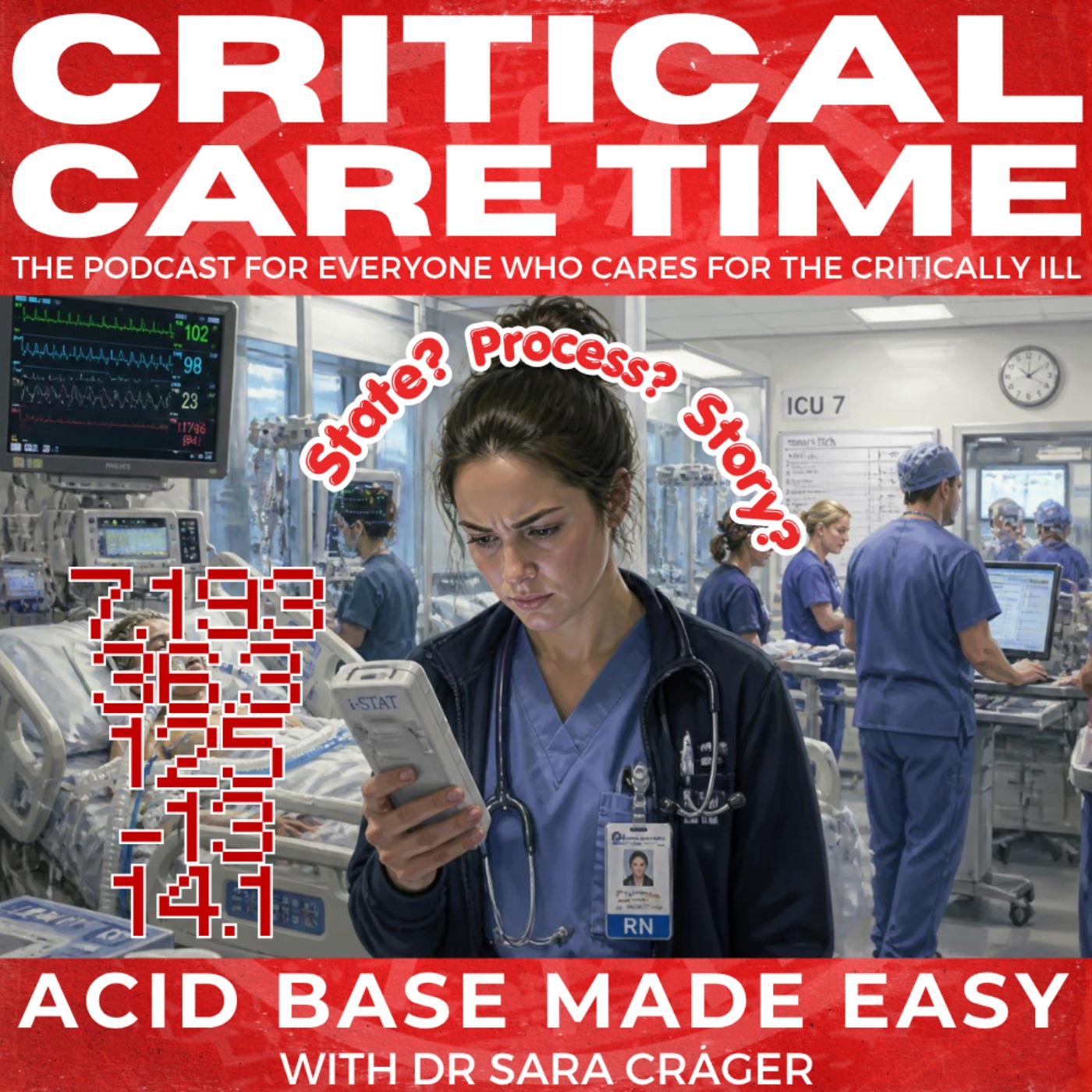
Speaker 1Yeah. So like with any good mental model, you need a way to be systematic. Because in general, I think that we shouldn't be algorithmic. That especially in complicated patients who have a lot going on, we do need to be systematic. So the systematic approach that I use to apply that mental model at the bedside is state, process, story. State. Are they acidemic, alkalemic, or have a normal pH? Process. We break it down into two things. Respiratory, where we interpret the CO2 in the context of the bicarb. And then metabolic, where we interpret the bicarb in the context of the anion gap and strong ion difference. And then metabolic, where we interpret the bicarb in the context of the anion gap and then story. What is the most likely explanation for these numbers, given the clinical context?
Speaker 3I like it. Excellent. I like it. Yeah. So state, process, story. What's the pH? What's the process? And then how can I make sense of this? Great. Okay. So maybe before we get too far into the weeds there, we should talk about kind of like why this is an improvement over Henderson-Hasselbalch model that this corrects.
Speaker 1None of these people were doing this at the bedside. Clearly that wasn't happening because, you know, who can take the next 20 minutes and pull out a calculator and do math when you're resuscitating. But I would also say that both of these approaches individually, when you're just reading them in a physiology paper, they're very clever. They're very thoughtful. And they're not actually inherently incompatible. They're just alternative ways of looking at the same thing. And ultimately, I think we need to take the most important useful parts of both of them. And if we put them together, that gives us the most functional thing at the bedside. I mean, really the major difference between Stewart and Henderson-Hasselbalch is just what it considers to be the independent versus dependent variable. And the way that Hender has it, it sees it, it's sort of the viewpoint is it treats the weak anions as the independent variable. So the bicarb, the lactate. Henderson-Hasselbalch has the perspective that is the independent variable. Whereas Stewart, Stewart treats the strong ions, the sodium, the chloride as the independent variable. And that actually, I think, theoretically is a lot more physiologically coherent once you think about what's actually going on. That being said, it's a lot less intuitive for people to understand that way. Now, that is more variables.
Speaker 3First of all, it's just more things that can change that you have to keep track of.
Speaker 1Yeah. And those six simultaneous equations, like the minute somebody hears six simultaneous equations, they're like, all done. Absolutely not. And maybe we'll just
Speaker 2take a moment, because there are a lot of definitions here, I think, to tease through. You mentioned weak ions, strong ions. What makes one weak and one strong? Does it have to do with how much time it's spending in the gym or is there something else? I tried to go to the gym today.
Speaker 1I am a weak ion, it turns out. But I think it's how they behave in solution and in a way how stubborn they are. So the strong ions are like, I'm in solution, I'm staying ionized. I like being ionized. I'm ionized all the time. I don't care what the rest of y'all are doing. I'm going to be ionized. The weak anions, like bicarb, they're kind of chill. They're kind of relaxed. They're like, I can be ionized. I can be ionized. Whatever the system needs, I can kind of flex in, flex out of ionization, be chill about it. That is the way that I think about it. That's not in the paper written by any of these people, but that's the way that I think about strong ions versus the weak anions. I like it.
Speaker 2It resonates with me. It resonates with the millennial that I am.
Speaker 1Totally. Strong is wrong. But yeah, so that's how I think about the difference between the strong ions and the weak anions. But I do think we really have to incorporate this understanding of the strong ions and really understand that they are intimately tied to acid-based status. And it actually kind of makes your life more difficult if you ignore them. Because Henderson-Hasselbalch, while it seems, more intuitive on first pass, it starts to do this thing where it really ties itself in knots, trying to avoid acknowledging the importance of the strong ions. And you can really see this with Delta Delta, where Delta Delta, what it actually is, is just this really complicated and really, really roundabout way of getting to the strong ion difference. And as far as I'm concerned, you know, if you ask any first grader, what is easier, subtraction or ratios, they're going to go with subtraction. And, you know, with strong ion difference, I got to do a quick subtraction problem that I have to do anyways to get to my eventual anion gap rather than trying to mess around with ratios. Because at 2 a.m., I want to do the easier thing.
Speaker 3As somebody who teaches a first grader math every day, your story checks out.
Speaker 2Totally. Facebook editing.
Speaker 3No kidding. Yeah.
Speaker 2Jeez. Okay. Very cool. Very cool. So, I mean, you're starting to sell me on the benefits of this. And, you know, we've talked a little bit about strong ions, you know, your weak anions, all that good stuff. So, if we take another step and try to, like, tie this together a little bit more, you know, can you help me understand the concept a bit deeper so I can start to apply it to patients?
Speaker 3I imagine there are listeners who are saying, like, why do I care about the chloride when I'm looking at that? That's a different thing. That's a different problem and approach.
Speaker 2Yeah. We should keep things siloed, right? Because your patient's They never interact with one another. They're all nice and silent.
Speaker 1Not even a little bit. And we kind of try and do that. And one example is when we get an ABG without getting an electrolyte panel, which actually, as we'll talk about in one of these cases, there's a lot of good reasons you should not do that. But let's explain what the strong ion difference is, because as I discovered when I gave this lecture the other day and I asked people, OK, what's the strong ion difference? They were like the difference between the strong ions. And I was like, that is true. But now when we explain this, let me just preface this by saying that this is one of the times that we need to sacrifice some physiologic nuance to just optimize our understanding and clinical functionality. And so we're going to gloss over some details here. And any nephrologist listening to this, I apologize if you're like, well, that's not quite. But let's just figure out a way to think about it.
Speaker 3Trigger warning for the nephrologist who's listening, who's like, what about bromide? Yeah, sorry, bro.
Speaker 1Yeah, sorry, guys. But for everybody else, I'm just going to give you the bottom line up front. And the bottom line up front, if you want to ignore the rest of this conversation, is it is always the case that hyperchloremia will cause a non-gap acidosis and hypochloremia will cause a metabolic alkalosis. And so what that means is you can basically treat hyperchloremia as synonymous with a non-gap acidosis. And hypochloremia as synonymous with a metabolic alkalosis. And, you know, if you just remember that, that hypo or hyperchloremia define themselves two kinds of metabolic acid-based disorders, you can stop there. Now, a lot of people, though, are like, why? I mean, sure, I can memorize that. But I often find that I forget things. My memory is actually not that great. And so it's helpful for me to understand what I'm talking about, because then I don't have to memorize stuff. I can just be like, oh, yeah, I worked through this and this is why.
Speaker 2No, no argument from us on this show.
Speaker 1Yep. No, I figured you guys would be amenable to this idea. And you would let me keep going because I'm not sure that everybody would be like, yeah, no, explain strong, high indifference more. But I was hoping you guys would be on board with this.
Speaker 2I mean, you know, it's a free country and our listeners can leave if they want. But I feel like they're going to miss out on some like some money content. So, yes, you have the floor, Dr.
Speaker 1Krager. Okay, here we go. If you want to understand why it is the case that hyperchloremia causes anagma and hypochloremia causes a metabolic alkalosis, you've got to start by talking about pH versus electroneutrality. So when we walk around hanging out with people, we're not constantly zapping each other, are we? Or at least I'm not constantly zapping people because humans on a normal day, they're not walking around with a net.
Speaker 2Only when I have my taser.
Speaker 1Exactly. That's cheating. That doesn't count. But you know, your body, for really good reasons, is quite committed to maintaining electroneutrality. Your body really, really wants the number of positive charges to equal the number of negative charges. And the clinically relevant upshot of your body's dedication to electroneutrality is that the body will sacrifice the pH to preserve electroneutrality because you can't have everything you want at the same time. And if the body is going to pick one, it's going to pick electroneutrality. It's going to pick electroneutrality over pH. And the minute you really understand that, you're like, well, if that's the case, huh, then these strong ions, the positively and negatively charged particles probably do have a lot to do with acid base. So the way this plays out, the two things in the serum that are primarily responsible for electric charge are, of course, your sodium, you're positively charged, and your chloride, you're negatively charged. And those are our strong ions as opposed to our weak anions like Y-card. And so because the body will sacrifice pH in favor of electroneutrality, the relative number of positively versus negatively charged particles becomes just intertwined with acid base status. And the relative numbers, if we're going to calculate it, the relative numbers of positively charged sodium to negatively charged chloride is just the difference between the sodium and the chloride, which we have creatively called the strong ion difference.
Speaker 2So there's no square roots. There's no long division here.
Speaker 3No. No, we should add that you can make it more complicated if you want to. You can make it all of the strong anions and all of the strong cations if you want to. But it doesn't really add that much more information. Right. Like you can make it sodium plus potassium plus mag plus calcium minus chloride and lactate if you want to make it hard. But I really like the simplification to just say sodium and chloride because that's most of it.
Speaker 1Right. And I think potassium and because you also you have your. Phosphates, your sulfates, you have all of your little strong ions. But I think as long as you keep it simple. And this is one of the oversimplifications I'm talking about. And the other reason with potassium is when I'm conceptualizing potassium with the system, because as we'll talk about, potassium is important. Just realizing that the vast majority of your total body potassium is intracellular anyways. And so the main way that potassium interacts with your acid base status actually has a lot more to do with shifting in and out of cells. Right. Than anything else.
Speaker 3It's more of a dependent variable than an independent variable to use your prior framework.
Speaker 1Yeah. Exactly. You got it. And so I think just keep it clean, know those numbers and just make the math easy. Because as we said, subtraction is easy and subtracting two numbers rather than multiple numbers also easier.
Speaker 3And there's one number that our listeners should remember here, right? Like what is a normal strong ion difference?
Speaker 1Yeah. So you don't even have to memorize this. You can just think about it. What's a normal sodium? 140. What's a normal chloride? You know that off the top of your head. What does that mean? On a normal day, your normal strong ion difference should be 140 minus 102. So about 38 approximately is where a normal strong ion difference is.
Speaker 3I even just say it's 40 because it's the same as your CO2. If you really want to keep it simple, a normal strong ion difference is about the same as a normal CO2. I love it.
Speaker 1See, I knew this would resonate with you guys. So that's your strong ion difference. But you have now noticed that. But you actually don't have the same amount of positively charged and negatively charged strong ions in your blood, right? The whole reason we're talking about the difference between the two is that they're not the same. And this creates an electroneutrality problem. And this is where our bicarb comes in. And the bicarb's job is to sort of flex in and out of the space between the sodium and chloride as needed. And so what happens.
Speaker 2Almost like a buffer, if you will.
Speaker 1Yes. In fact. Literally. Literally a buffer. But if I use the word buffer, people have these flashbacks to chemistry in college and they're like, I'm dropping a pipette. And they just have like a way, like a triggered reaction to the word buffer. But that's exactly what it's doing. A buffer. It's flexing in and out to the space as needed because it's flexible. It can accept a proton. It can get rid of a proton. It plays the hot potato game with protons. And what it means is that, let's say, your chloride goes up relative to your sodium. Well, now we have. To many negatively charged particles. So what is the bicarb going to do? It's going to flex into a smaller space. On the other hand, if your chloride goes down relative to your sodium, now we don't have enough negatively charged particles. And your bicarb, that anion, needs to flex into a bigger space. Now, in both these situations, you have successfully preserved electroneutrality, but you've done it at the expense of pH.
Speaker 3Yeah. And I think I like that. I like that framework a lot. I think you could also conceptualize it as if you're having more negative chloride around, you're going to need more positive H plus to balance it out. If you want to think about, you know, those two pairing, you could do it that way as well. You know, they're the same.
Speaker 1Exactly. It's two different ways of looking at the exact same thing. And I think just whichever way is most intuitive to you, understand it that way, because you'll get to the same place. Whatever way is most intuitive to you, you'll understand the same concept. Now, functionally, I do think it's a little bit useful. I think it's a little bit useful to understand mechanistically the mechanisms the body's really using here, because I spent a long time trying to figure out, is it always the case that hypochloremia causes a metabolic acid? Like, is that always the case? Is it sometimes the case? Why does it do that? Why doesn't it do it? And eventually what I came to is ultimately when the body's trying to preserve electroneutrality, and this is why I think the Stewart method makes more sense, because that's really what it's prioritizing. Is we simplify it into the two big things it does. And one is this thing that we kind of talked about, the moving protons around. And one way it can do that is the protonation and deprotonation of the bicarb. But the other way is, as we refer to with potassium, we can move that potassium and the hydrogen in and out of the cells. So there's a lot of, as you said, intracellular and extracellular buffering mechanisms, so that we can kind of at the last minute, move things around to keep electroneutrality going. But there's a second big thing. And this is the mechanism whereby chloride is going to be synonymous with acidosis or alkalosis, metabolic acidosis or alkalosis. And that is the renal chloride bicarb exchangers. If you read articles, mostly written by nephrologists on acid-base, some of them straight up say the most important thing for acid-base status, the biggest determinant, is what is going on with these renal chloride bicarb exchangers. And so they're called AE1. And they're called the penderin. The details of that doesn't matter. But basically what they're saying is, OK, if we lose a chloride. a negatively charged thing, we trade into a bicarb. 1 to 1, negative, negative, net electroneutrality preserved. And then if we lose a bicarb, we trade into a chloride. And that is why all these mechanisms have huge implications for acid base. And that is how we get to the bottom line of hyperchloremia will always be synonymous with a non-gap acidosis and hypochloremia will be synonymous with a metabolic alkalosis.
Speaker 2Huh. So it's like they're playing, it's like they're playing Catan and they're trading like sheep, sheep, sheep for brick and vice versa. No, nobody wants sheep for brick.
Speaker 3That's not. I know.
Speaker 2Yeah. I don't know. Poor sheep. But no, that's, but that's, I honestly, until kind of this discussion, didn't really appreciate that element as much and how it sort of plays a significant role in, in, uh, in maintaining electroneutrality and then also kind of consequently, uh, impacting pH. So that's, that's helpful. Very helpful. Let's be honest, ECMO programs thrive or die by two things. How well your team is trained and whether you have enough clinicians with the skills and expertise to confidently manage these high accumulating patients.
Speaker 3Integration health gets it. Integration health provides comprehensive ECMO education to more than 50,000 patients. And that's what we're doing. So we're doing it. We're doing it to more than a thousand providers every year from high fidelity simulation done at your facility to online CME courses. So teams can stay sharp, even when case volume is low or when there's a long gap between ECMO routes.
Speaker 2Staffing gaps also derail ECMO programs. When you're short staffed or dealing with a busy CDOR, integration health will deploy experienced ECMO specialists to your facility within 24 hours to keep your program running without compromising
Speaker 3care. From keeping your team trained up or providing staff, to cover staffing gaps, integration health has your team's back. Learn more at integration.health. That's integration.health. And now back to our show.
Speaker 1No, I think the other thing that sometimes is confusing to people is when we talk about things like a hyperchloremic metabolic acidosis. And I actually think it's much better to talk about it as a low strong ion difference or a high strong ion difference. Because it's actually not the absolute amount of chloride. It's the amount of chloride relative to the amount of sodium. And so, you know, if you have excess chloride, but like your sodium is actually also in excess compared to a baseline number, like, you know, if somebody's super hemoconcentrated, right? And you look at their chloride and you're like, oh, wow, their chloride is 119. But then you look at your sodium and you're like, oh, yeah, their sodium's like in the 150s. You are still with a good strong ion difference, a normal strong ion difference. So it's important to remember, it's not the absolute amount of serum chloride. You can't just look at that number. It's the difference between the two. It's the strong ion difference. That's really what we're talking about. And that is why it's so important. And you do have to understand that concept to understand acid base. And now we can kind of integrate it into our overall approach.
Speaker 2Okay. Okay. So just to make sure I understand. So, you know, we're saying strong ion difference is the difference between your sodium and sodium. Sodium and your chloride on your metabolic panel, or perhaps if you have, you know, blood gas analysis, you get your electrolytes there. You can do it there as well. Normal strong ion difference, you know, you're saying 38. Nick, I kind of like your, your, your, your mnemonic there, kind of 40, somewhere in the neighborhood, 38 to 40, probably reasonable. So that's normal. And as I understand it, if you have kind of a high chloride relative to sodium. So for example, you know, your sodium is 140, your chloride is 120. You do the strong ion difference is 20. That would be a low strong ion difference yielding a nagma if I'm understanding it correctly. Right. And then vice versa, if you have a low chloride relative to sodium, you know, 140 minus 80, let's say it gives you 60. That's a high strong ion difference. And it's a metabolic alkalosis that we'll see in that patient. And that's, that's really a function of the strong ion difference and how it, and the interplay between that and bicarbonate. Is that correct?
Speaker 1Yeah. Yeah, yeah, yeah. Absolutely. You summarized it better than I did. And I, that was, that was great.
Speaker 2Okay. All right. Well, you know, even a blind squirrel gets a nut. So with that being said, why don't we take this, you know, I sort of alluded to your, your elegant approach, that state process story idea. Maybe we can come back to that now that we've done a little bit of learning with you and see how that actually plays out at the bedside.
Speaker 1Yeah. So I should just first mention the caveat that this just happens to be the alternative approach I've come up with, and it may not be the best approach. And in fact, it probably isn't the optimal approach for all specialties because I tailored it to what I do, which is resuscitation medicine. And if you're a nephrologist, for if you listening, you're probably going to want something different. And also this is not like a fancy published thing at a textbook or a paper. So if you go Google it, you're going to find my website and this podcast, and that's about it. So that's the caveat. This is just something I came up with in my free time because I'm neither smart enough, nor patient enough to do anything involving more than three steps.
Speaker 3Well, I think it's important to remember that nephrologists need a more complex understanding because they're changing more variables than we are. Right. I mean, they're, they're worrying about manipulating calcium and phosphate and stuff like that in a way that we're kind of not. And so I, you know, I think like this is, this is a sufficiently complex understanding for what we need it to do. And that's great. Like you want it to be complex enough and no more complicated.
Speaker 1Yeah, exactly. Simple enough. But not too simple. No, the as simple as possible, but not too simple. That's where I was headed with this. That's one of my favorite quotes. And that's kind of the idea here that this is not meant to be comprehensive. This is meant to be functional. So state process story, let's take a deeper dive state. What is the pH? Are we acidemic, alkalemic or normal? And I was that annoying attending that when you're like the patient's acidotic and I'm like, well, they're acidemic. And I would always correct that. Or I always like to correct. Hypoxemic versus hypoxic. The emia osis.
Speaker 2You're amongst friends with all of that.
Speaker 1Okay. I also kind of hoped I would be because it's so important. And we're going to talk about it in this context, the emia osis.
Speaker 2They're literally different things. I mean, they're fundamentally different things. And so making that mistake, it needs to be corrected.
Speaker 1Yes, because it's incorrect to say the other thing. And not only is it, you know, something that we can be irritated about on rounds, it's actually clinically relevant. So what's an emia versus an osis? It's actually quite simple. An emia is a state. Where am I at this very moment? And you can only be in one state at a time. An osis, an osis is how you got there. Osis is the process by which or processes by which you got to whatever that state. And the thing about the pH, the pH only tells you about the current state. It is one number. It tells you the state we are in, but it doesn't necessarily tell you anything about the various processes that might underlie that state. And so, you know, if we have a pH of 7.2, we have some kind of acidosis that is leading us to that pH. If we have a pH of 7.5, we have some kind of alkalosis that is leading us to that pH. If we have a pH of 7.4 and it's perfectly normal, it could be that nothing's going on. Or if you go back to thinking about our vector diagram, it could be that you have exactly two equal but opposite processes going on. So a normal pH doesn't mean everything is normal.
Speaker 2You're on the spectrum between very boring and incredibly complicated. Yep. So you fall somewhere there. And I like the kind of, I like how you describe that because I'm like, okay, well, I'm, I'm in the state of Wisconsin right now. And I can tell you that I'm in the state of Wisconsin right now, but that doesn't tell you how I got here. I could have driven here. I element of that is sort of like, how did you get to the state? For folks that are, you know, cognitively children like myself, that's how I kind of try to, to piece this together.
Speaker 3And to use your analogy, you could have taken multiple things to get there. There could be multiple processes resulting in one state, right? But simply telling you
Speaker 2that I'm in the state of Wisconsin gives you no insight as to how I got here.
Speaker 1Yeah, exactly. So now let's talk about the OCs, the processes, how we got to whatever state we're in. So big picture, there's, there's this continuous cooperative effort going on in your body between the kidneys and the lungs. And what they are trying to do is collectively maintain your pH in an acceptable range. Now the kidneys, they're going to handle the bicarbonate part of this situation and the lungs are going to handle the CO2. Now there's two really important things to keep in mind about this. One, disturbances of both the CO2 and the bicarb can happen either acutely or chronically. But as far as compensation goes, it's not going to happen. It's going to happen in a very short time. So you're going to need to keep in mind that you're going to need to keep in mind that you're going to need to keep in Only the lungs are actually good at compensating acutely because they can compensate on the order of minutes. Whereas the kidneys, they're a little bit slower. It takes the kidneys a lot longer on the order of days to achieve any compensation of clinical significance. Like they can compensate a little bit within a short period of time, but not really clinically significantly. So disturbances of both can happen quickly, but compensations only happen quickly with the lungs. And the second thing to remember is neither of these processes are going to happen in a short time. So you're going to need to keep in mind that neither the lungs or the kidneys are overly ambitious about compensations. B plus kind of people, they're not going for an A plus, they're like a B plus. And what that means is that you are never going to fully compensate. When we say that somebody is appropriately compensated, we don't mean that their pH is normal. We mean that the lungs and the kidneys are like, okay, we compensated to a B plus, that's enough, we're going to stop there. And what it also means is that you're never going to overcompensate because neither the lungs or the kidneys are going for extra credit here, that's wasted effort. So whenever you say that they're overcompensated, that's not what you mean. What you mean is there are two different disorders.
Speaker 2Glad you clarified that. I'm still a little hurt that, you know, on your, in your lecture, you incorporated a Portia spider as the example of overcompensation. That really like hurt me, made me feel very, very sad because that's like an aspirational vehicle of mine. But that's okay. You know, maybe I am overcompensating, probably I am, or like future me is overcompensating, I guess. But, but your point I think is, is, is well taken, even though it hurts my pride. And it's something that I teach, you know, residents is like, you don't, in the world of acid-base, we don't overcompensate. And if you catch yourself saying that this person is overcompensating, you need to immediately stop and recognize that there is at least one additional process going on, if not multiple.
Speaker 1Yeah, exactly. So what are these two big processes? So the lungs and kidneys are cooperating. And so we, similarly, we break it down into our respiratory processes and our metabolic processes. Respiratory. We're going to start with this one because respiratory is a lot more straightforward. This is where you need to interpret the CO2 in the context of the bicarb. Because without the context of the bicarb, the CO2 doesn't mean anything. It'd be like if I said to you, okay, it's 60 degrees outside today. Well, it depends. Where am I? Am I in Alaska or am I in the Sahara? And if I said to you, okay, it's 60 degrees outside today. Well, it depends. Where am I? Because if I'm in Alaska, I'm like, oh, that's nice and warm, global warming. That's probably bad. If I'm in the Sahara desert, I'm like, oh, this is awesome. I should probably break out my sweatshirt. So that number, temperature, doesn't mean anything without the context of where you are. And similarly, the CO2 doesn't mean anything without the context of the bicarb. So there's two contexts, right? Interpreting the CO2 in the context of a low bicarb versus interpreting the CO2 in the low bicarb. We're going with the most clinically relevant situation. And the most clinically relevant situation is an acute metabolic acidosis. And so this is when you need to say, okay, if I have an acute metabolic acidosis, my lungs need to be compensating. My lungs need to be saying, okay, I'm going to blow off some CO2 to try and bring that pH back towards normal. And so your CO2 should also be low. Now, the way I was trying to do this- There's a nice elegant relationship between the two, in fact. There is, which is not Winter's formula. Do either of you use Winter's formula? I hate Winter's
Speaker 2formula. No? I have used it recently, but I don't use it that often anymore. And mostly it used as a teaching vehicle in the setting of, you're going to get tested on this, I'm sorry.
Speaker 1Totally. Because you totally are. And you're better at math than I am because at 2 a.m. I'm just like one per eight plus minus something. And so I much prefer the no math way. And the elegant no math way that you mentioned is simply the CO2 should equal the last two digits of the pH. When you have a metabolic acidosis and you are appropriately compensated from a respiratory standpoint, the CO2 should equal approximately the last two digits of the pH. So for example, if we have an ABG where we have a pH of 7.24, a CO2 of 24, and a bicarb of 10, okay, the CO2 of 24 is equal to the last two digits of the pH. pH 0.24. Perfect. And this is how you just glance at those numbers and you're like, yeah, okay. Just glancing at them in under five seconds, no math required. We are appropriately compensated.
Speaker 3And I think it's really important to emphasize to learners that when you see attendings do this really quickly, that's how we're cheating. And when you see attendings look at a blood gas and say, oh, they're tiring out. What are we doing mentally to make that determination? We're saying, oh, the CO2 isn't as low as it should be. The CO2 isn't as low as the pH. Therefore, they're not compensating anymore, for example. So there's a nice little heuristic shortcut where you can very quickly sort of bypass some of the math and figure out what's going on.
Speaker 1And that's when I get really worried. That is so clinically significant because often somebody will come to me and be like, oh, this patient looks like they're breathing really hard. I'm worried they're going to tire out. Let's just get an ABG. And if they're working hard to breathe, they're appropriately compensated. OK, we have a minute to work with this. But if we get an ABG and the CO2 is, let's say, 40 with a bicarb of 10, often you'll get a medical student or a resident come to you and be like, the CO2 is normal.
Speaker 3Right. It's black. It's not red in the EHR. It must be OK.
Speaker 1Exactly. But it's not normal. That is a respiratory acidosis. If you have a bicarb of 10 and a CO2 of 40, even though a CO2 of 40 is normal, it's not in the of that bicarb. You actually now have a respiratory acidosis. Now, an important caveat here is that this rule falls apart at a pH below 7.10, although Winter's formula does as well,
Speaker 3no matter how fortunately, fortunately, your patient also falls apart below 7.1.
Speaker 1Yeah, it's usually not subtle. And the reason this falls apart is it's really hard to blow your CO2 below 10. Like, yeah, it's just actually quite difficult to do that.
Speaker 3It's a it's a log. Relationship. So yeah, like logarithmically more.
Speaker 1But I think lungs are good, but they're not that good. Exactly. Strong work lungs. A plus for effort in that case. But, you know, but I think this is also why we start to get kind of freaked out when you hit a pH of 7.1, because now we're at a place that compensation is no longer possible. So that's the situation when the bicarb is low, interpreting the CO2 in that context. Now, what about interpreting the CO2 when the bicarb is high so the most clinically relevant situation in this case is a patient with a chronic respiratory acidosis. And the reason this is useful is that we see this all the time. Patients with COPD, patients with ILD, patients with obesity, hyperventilation. And one of the things that actually made me decide to make this acid based talk years ago is I had this patient who came in horrible obesity, hyperventilation syndrome. And she came in and I got a call. And the ED was like, you know, we intubated her because she had a CO2 narcosis. And I go down and I look at the bicarb and I'm like, she can't be having a CO2 narcosis. She had acute altered mental status. And it turned out she had a big head bleed. But without understanding this and being able to back calculate their baseline CO2 from the bicarb, you wouldn't have known that. And so that's when this becomes really important to back calculate the CO2 in a patient with a hyperventilated acidosis. And the rule I use for this, this requires a little bit of math, but not a ton. The 10-4 rule. And my favorite way to remember this rule is not something I came up with. It's actually something that Ryan, the co-creator of Rapid Sequence, came up with. And he was like, OK, think about you have a big truck driver and this big truck driver, he has COPD and he's sitting there in his truck and he's smoking a cigarette and he's on his radio and he's like, 10-4, buddy. The 10-4 rule. That's it. You just picture the truck driver with a cigarette, the 10-4 rule. What that is, is for every 10 that your CO2 is elevated chronically in a chronic respiratory acidosis, your kidneys are going to compensate by retaining four of bicarb. And so the 10-4 rule, that is how I think about it. That's the math I do in a patient where they come in and their bicarb is 36 and their CO2 is 72. Now you could say, 72. Uh-oh, we better intubate them. Or you could look at their bicarb and do the math with the 10-4 rule and be like, yeah, their CO2 is probably always 72. There is no acute respiratory problem that's actually going on here. And people can live at really high CO2s as long as the kidneys are on board with doing this.
Speaker 3One important caveat for our listeners, though, is that people who live at a high CO2 live precariously. So even a slight increase can knock them over. So sometimes people will make the. The sort of cognitive leap of being like, their CO2 was 70 before. It's only 75 today. And that might actually be enough of a difference to push them into narcosis.
Speaker 1Yeah, totally. Because again, they're right on the threshold of totally falling apart. But that being said, if you came in with a CO2 of 75, I'd be like, okay, something's quite wrong here. We should probably intubate you or give you some Narcan or whatever you want to do first. But if my COPD-er who lives at 70 comes in at 70, I'm like, okay, you're not that far off your baseline. Maybe we just do a little BiPAP and give this a minute and nobody panic, essentially.
Speaker 2Right. And I think the other point, and you sort of alluded to this with your head bleed case, but in my mind, it's not so much as looking at the numbers and making a definitive statement, putting your foot down. It's more like looking at the numbers, questioning the significance of the numbers, and taking the extra step to investigate that patient a little more carefully. I think that's a good point. That's where you can catch the, I guess, occult, I'll call it occult head blue. bleed or whatever else could be going on. Yeah, to me, it's, and Nick says this a lot of times on the show, it's another form of a check engine light.
Speaker 1Yeah, totally. And just like never looking at that CO2 in isolation, that it's very dangerous in both directions to look at it and be like 40 is normal or 70 is abnormal for this patient. You've got to look at the CO2 every time in the context of that bicarb. Now, what about the bicarb? Because this is now when we get to our metabolic processes. And this is another time that you've got to interpret that number in context. But this time, the context we're using to interpret the bicarb is interpreting the bicarb in the context of the anion gap and strong ion difference. Now, respiratory is a lot less complicated than metabolic. And the thing that finally got me to really understand and be able to clinically work with metabolic acid-based disorders was not Delta Delta, because I'm sitting there calculating, ratios that I get two, but I don't remember what that means. It was actually just reframing what bicarb is. And the minute I was like, wait a minute, wait a minute, I'm going to stop thinking about the bicarb as a number and start thinking about it more like a vector sum of three possible different metabolic processes. And in fact, base excess is the literal vector sum of these processes. But the bicarb is a net, sum of three potential things that might be happening. An anion gap metabolic acidosis, a non-anion gap metabolic acidosis, and a metabolic alkalosis. Now, of course, the gap acidosis and the non-gap acidosis, they pull you in one direction. They pull the bicarb down. The metabolic alkalosis pulls the bicarb up. And if you have multiple of these, your bicarb is now the net vector sum of all of these. Now, how do you know which of these you have? This is where, in Henderson-Hasselbalch, delta-delta comes in, because delta-delta is their way of trying to acknowledge that you might have multiple metabolic acid-based disorders at once. So in certain ways, delta-delta is great, but I just find there's an easier way to do this. And this is as follows. If you have an anion gap, you have an anion gap acidosis. Where there is smoke, there is fire. Where there's an anion gap, there is an acidosis. It doesn't matter what your pH is. It doesn't matter what your bicarb is. Equals anion gap acidosis.
Speaker 2And that gets back to that distinguishing an osis from anemia.
Speaker 1Yeah, totally. Because you can have a normal pH if you also have a metabolic alkalosis pulling those numbers the other direction. So that is sort of classic Henderson-Hasselbalch. We know that. Now, the next thing Henderson-Hasselbalch would want you to do is calculate a delta-delta. But that's not really usually what I do. What I instead do is I'm like, OK, I do or do not have an anion gap. Now I'm going to calculate two other numbers. I am going to calculate, say, the strong ion difference. If I have a high strong ion difference, that means, by definition, I have a metabolic alkalosis. So a strong ion difference greater than 40, I got a metabolic alkalosis. If I have a low strong ion difference, less than 38 to 40-ish, that means I have a metabolic acidosis. And so simply by looking at my anion gap and my strong ion difference, I just do subtraction. And by the way, get to a strong ion difference on the way to an anion gap, right? And so if you're doing the math, you're like, OK, 100, you know, the sodium minus the chloride, that's my strong ion difference. Now I subtract the bicarb. I take it one more step. Now that's my anion gap. So it's very quick subtraction. Now I have a gap and a strong ion difference. And depending what those are, if they're all normal, I feel good that a normal bicarb actually is normal. If I have any of those that are abnormal, I have at least one metabolic acidosis. So I'm going to do a strong ion difference or an anion gap or both are abnormal. Now I have multiple acid-based metabolic disorders.
Speaker 3Excellent. Yeah. I want to double click on a couple of things you said because I think they're really, really important to emphasize. Number one, I sort of grew up using the delta delta. So I do sort of think about it, but I don't think about it the way most people do. I don't think about it as a ratio to your point. I think about it as like the bicarb is off by this month. And the anion gap is off by this much. I sort of think about it as the same way you do as like a subtraction. And you're basically just doing the same thing. You're just saying, yeah, we don't even need to worry about everything in the anion gap. We can really just use the most important contributors, the strong ion difference. I really like that. The other thing you mentioned that maybe we can make fun of a little bit is base excess. I think of base excess. I think of base excess as sort of like blood gas training wheels for surgeons. Maybe I'll just let you react to that.
Speaker 1How many surgeons listen to your podcast? I'm just curious.
Speaker 2Fewer now, I think. We're in the business of alienating our audience because I don't know. I don't really know why. But I think, yeah, it's funny because I know. Yeah, I'm curious to hear your reaction to that. I personally in the medical ICU, like never use the base excess. And I think you might be able to explain a little bit as to why that's the case. But yeah, I think I'm curious to hear your base excess thing. As far as the Delta Delta goes, I want to touch on that also very quickly. I I still think about it from time to time. And for our listeners, that's really going to be like essentially trying to determine the bicarb before is the way that I think of that. And it's like it's the bicarb before the sort of anion gap metabolic acidosis reared its ugly head. And so you're determining the difference between that patient's expected anion gap and their actual anion gap. And that difference, you add it to their bicarb time now. And if it's still lower than it should be, that would suggest that there's a non gap. Acidosis. If it's if it's higher than it should be, that would suggest that there's a metabolic alkalosis that's also present. And so that is a way that you can do it. To me, that's that's sort of home cooking. But but again, very open to learning a different way of doing it. It's the same way.
Speaker 3I mean, it's it's fundamentally doing the same thing.
Speaker 2Another perspective, I guess. Yeah. The other thing I'll say is just I think it's with the when you're when you're doing the Delta Delta, the one thing that that incorporates or the one thing you need to think about also is like anion gap of 12, which is kind of the default of what we use. Is that actually correct for that patient? And so if you don't take into account, for example, their albumin and maybe make that adjustment, then that could lead you astray. Whereas I think, Sarah, maybe your approach would would skirt should be robust to that. Yeah, right. And that's that's that was the one point I wanted to make. But anyway, with all that being said, maybe you can take a crack at this base
Speaker 1excess. Yeah. So I actually love base excess. So I work both in the medical ICU, but then I also work in the trauma surgical. And I think it's absolutely true that surgeons love base excess medicine, people not so much. And I think there's a reason for that. So the base excess is literally the vector sum of all currently ongoing metabolic processes. It just matches everything together. And it's like we're just going to like go negative or positive.
Speaker 3If it's zero, it just corrects for the CO2 is what it's doing. It takes the CO2, takes respiratory out of the. So you don't have to think about that if you're using the base excess. But if you're thinking about that anyway, it doesn't add anything.
Speaker 1Oh, no, but I think it does. I mean, I love this because it does give me a sum of just from a metabolic disorder standpoint. Where am I? Because CO2 is related now to the pH. And I got to think about these two things together. But when I have a patient on a vent, I'm controlling their minute ventilation and they're bleeding to death. They're in shock. And I'm just trying to trend not how are they doing from a respiratory standpoint? They're on a vent. I'm making them do whatever it is I want to on the vent. They're on a vent. But how is this going from a shock standpoint? I find the trend of the base excess very helpful. And, you know, if you have a patient who is bleeding to death, it's extremely useful. If you have a trauma patient or a patient who just came out of the OR and their base excess is really negative and they were fine before they got in their trauma and they weren't chronically ill or they were fine going into the OR and you know that if they have a really abnormal base excess, it's probably because one thing is going on, a metabolic acid. And if you have a really abnormal base excess, it's probably due to shock, bleeding and so forth. Now, in the medical ICU, if I have a complicated patient with multiple comorbidities who's been intubated in the ICU for two weeks getting diuresed and I try and take the net vector sum of all of those things, I don't know what that means because they certainly could have multiple metabolic disorders. And so a base excess is much less useful to me in the medical ICU unless I'm hanging out and they've been kind of, you know, base excess of maybe two or three days or something like that. So if I have a really abnormal base excess, I don't know what that means. But if I have a really abnormal base excess, I don't know what that means. And so in the medical patients, if they're acutely decompensating, I do like to trend that number. It's a nice number to trend because the other reason it's a nice number to trend from a metabolic acidosis standpoint, it's totally non-discriminatory. It doesn't care if you have a lactic acidosis, if you have a keto acidosis, if you have unmeasured whatever it is, if you just have a bunch of cells dying because you had a colchicine overdose, it doesn't care. It doesn't matter. It doesn't matter. It doesn't matter. It doesn't care. And so from that perspective, I think it's quite useful because we can't measure everything. Lactate's not always proportionate. Sometimes your ketones, so it just is a non-discriminatory number I find helpful.
Speaker 3Yeah, that's fair. I guess I'll make fun of the situation I see sometimes where people have a negative base excess, right? And they're like, oh my God, they need to get volume. And they give a bunch of normal saline and then their base excess which made it worse. chasing their own tail. I think maybe that's the thing that I'm reacting to here. But your point is well taken that as a trended value, it could be useful as long as you understand what's moving the number. Yeah.
Speaker 2Nick, I think that's a really good point. And I was just going to also chime in here and say, so I think I have a little bit of a different perspective on the base access and the one case where I actually find it useful. So in the case that you described, Sarah, I think the reason why, again, coming from a medical background, so keep that in mind, but the reason why I don't find it all that useful is like my pre-test probability when I'm working in the surgical ICU is already so high for bleeding that I just assume that everyone's bleeding already. And so it doesn't really move the needle that much for me in that context. But where I have found it helpful is recognize, again, as a reminder, your hemoglobin is very much a lagging factor. It's not a lagging factor. It's a lagging factor. And so I think that's a good indicator when someone's bleeding. I find that the base excess is a bit more sensitive. It's a little bit more of an early warning sign. And again, if my pre-test probability is already high, cool. But in a medical ICU, if I'm wondering about a occult or a semi-occult GI bleed, which is often not going to be as overt, at least initially until they have their index melanin, and then it's like, you know, it's going and going. But that's where I have actually found it to be really helpful because sometimes I get caught up in a medical ICU and I'm like, I'm caught a little bit behind the eight ball. I'm not necessarily like I'm in my medical ICU brain and I'm not necessarily thinking about everyone's bleeding. I'm thinking everyone's in septic shock. And so anyway, that's the situation where it has helped me a time or two. But yeah, not using it all the time, but I do think it has some value.
Speaker 1For sure. And I like that idea as an early warning sign in bleeding because a big mistake that we often see interns and people make is they're like, well, yeah, they threw up a bunch of blood in their hypotensive, but the hemoglobin was 11. So I didn't give them blood, you know, and within the next 10 minutes, is their hemoglobin going to be abnormal? No. Might their base excess start to be abnormal? Maybe. So I actually really like that. That's sort of early warning sign. So that's metabolic. And now we come to story. And this is so important because this is where you really need to put this all together. These are not just numbers. You need to take those numbers. And what do they mean? What is the most likely explanation for these numbers given the patient's clinical context? And one of the things that's important about this that we often don't get to on multiple choice tests is that the exact same numbers can be due to totally different stories. So you can take the exact same ABG in three different clinical contexts, and it'll mean something different. So one of the examples I give is, let's say we have an ABG and the pH is 7.18. The CO2 is 42, the O2 is 70, and the bicarb is 15. If we're going to state process story it, we are going to say, OK, 7.18. We have an acidemia. OK, we have an acidemia. Great. That's the state that we're in. Now we're going to interpret the CO2 in the context of the bicarb. So the CO2 is 42, which is normal except a weight in the context of a bicarb of 15. It's not normal. So is that appropriate? No. Because are the last two digits of the pH the same as the CO2? No. 0.18 is not the same as 42. Story checks out. Story checks out. So this patient has a respiratory acidosis. OK, now we're going to interpret the bicarb in the context of the anion gap and strong ion difference. And in this patient, we look and we get our BMP. And he has a bicarb of 15. And we do the math. And it turns out his anion gap is high. His anion gap is 23. And his strong ion difference is, let's say, 38. It's normal. And we look at the rest of this. And yeah, it turns out that he has a lactic acidosis. So this patient has an acute metabolic. Acidosis due to hyper-elevated lactate. And they have an acute respiratory acidosis. Now, what is the explanation for this? Because that is one explanation, that they have an acute metabolic acidosis with an acute respiratory acidosis. And if I have a patient, say, who is, I don't know, a guy presenting as a critical trauma, and he has hemoperitoneum, his GCS is 111, that would be my interpretation. My interpretation is that he's bleeding to death. And he has a lactic acidosis. And he has a hyper-elevated lactate. Because he's bleeding to death. And he's probably not compensating from a respiratory standpoint because his GCS is 111. And he's not breathing. And maybe he has a bad head injury. But what about if I have this exact same ABG, pH of 7.18, CO2 of 42, PAO2 of, we'll call it 70, and a bicarb of 15. But now, this is a 74-year-old lady with a history of bad COPD who's coming in with fever, which is urea and hypotension. And she has this elevated lactate. Now, how am I interpreting this number? Well, there's a different interpretation that might be accurate here. What about in her, we still have an anion gap of 23. But what if now our strong ion difference is more like 50? Now, if we just look at the ABG, we won't realize this. But if her strong ion difference is 50, now I'm like, wait a minute, wait a minute. She probably has a chronic respiratory acidosis. And if she has a chronic respiratory acidosis and is now coming in with fever, dysuria, hypotension, and a lactate, she's maybe uroseptic. And she is just not compensating from a respiratory standpoint because her lungs are bad. And she just can't compensate from a respiratory standpoint. And so that is a totally different clinical context and different clinical interpretation of the exact same numbers. And you could make the same argument, what if it's a 20- year-old who had a staph asthmaticus, who now what's going on with them? Well, maybe they have a lactic acidosis because they've gotten a bunch of epi and a bunch of albuterol and their diaphragm's running a marathon and they're stressed. And their CO2 is 42 because they're in staph asthmaticus and they can't breathe it down. So the exact same ABG can have three very different interpretations depending on the story. And so you take the numbers back to your patient, you figure out what is the clinical context, and then you say, okay, this is what I think it all means. Because you'll notice that state process story does ignore a lot of things. And one of the things that I realized when I was trying to back calculate what do I actually do in the ICU was one of the things that you see people who are evolving experts in anything, whether it's music or chess or acid base or any kind of medicine, is that it's not just learning what's important. It's strategic focus. So it's not just learning what is the important thing. It's learning how to filter the data. And so the critical care boards are a lot of other things that you need to learn to identify. Absolutely. But state process story very intentionally prioritizes relevance over completeness. And so, yeah, there's a reason that it ignores a number of things, which gets at exactly what you were talking about. The most common meaningful acid base disturbance is in critically ill patients. And so we can go back and break this down with the vector diagram. For vectors, what are the things that might be causing either a respiratory acidosis, metabolic acidosis, a respiratory alkalosis, or a metabolic alkalosis? Because then we can state process story and then start mapping the differential diagnosis for what we find onto our vector map that we have mentally of our patient. So differential diagnosis for what might be causing a respiratory acidosis. The obvious one is lung disease, right? And so any COPD, ARDS, ILD, all of the lung diseases can cause a respiratory acidosis. Inadequate ventilation as an independent thing from lung disease. If your lungs are perfectly fine, but you just gave this person 12 milligrams of Dilaudid, they are probably not adequately ventilating. But the other important one here for inadequate ventilation is a call that I get all the time in the surgical ICU, where somebody is like, oh, the patient's getting hypoxemic and hypercarbic. So we're going to get a CTPE. You go and you see the patient and you look at them. And indeed, on the chest x-ray, their lung volumes are very small. They are not ventilating well. The APG doesn't look good. And then you look at their belly and you feel their belly and their belly is massively distended and dilated and it's mashing up on the chest. And that's why they actually can't breathe. And that's why they can't ventilate because of thoracic restriction. And maybe their bowel is obstructed. And you know what you don't want to do? Lie them flat for a CT scan because that's a great way to get a clean kill. So thoracic restriction, fatigue, sedation, or just, you have a little old debilitated person who can't keep up. But the other thing, respiratory acidosis, that we do need to keep on there, especially when we're thinking about how to fix it with regard to vent management, is physiologic dead space, right? Where if we, for example, see the end tidal CO2 is fine, but then we check an ABG and our PA CO2 is 75, but our end tidal was 25 where we just can't get the CO2 to the alveoli because of the physiologic dead space. So a respiratory acidosis, it can be the lungs, it can be the thoracic cavity, or it can be the capillaries and physiologic dead space. Metabolic acidosis. So this one is easy because we've broken it down the way we talked about. The two reasons that you'll have a metabolic acidosis big picture are a gap acidosis and a non-gap acidosis. Differential for gap acidosis. So we were all taught what is your guys favorite differential for gap acidosis we have i
Speaker 3like gold market but i've no gold market i've added to the market the tea for toluene because i like those rare toxic yes sorry you
Speaker 1have a mud piles i guess i mean i guess i was i you know
Speaker 2initially i was taught mud piles then i learned gold mark i i mean i don't i to be honest with you i think i look at it perhaps uh in practice more like you do which is not with a mnemonic but just like like actually looking at the patient their history and it's usually not that hard to figure out if you do that totally i
Speaker 1mean i think that i actually if you ask me to recite mud piles right now i couldn't do it i 100 couldn't do it um i actually hate mnemonics uh the analogy i use for mnemonics is um i just i don't think we should be using them because instead we should understand what we're doing rather than memorize a bunch of random numbers and it's like brushing your teeth so we could come up with well i mean
Speaker 3especially since some of the things in mud piles like paraldehyde isn't like a drug we use in the united states no so like it's a mnemonic from like a long time ago that doesn't even apply so yeah
Speaker 1and i actually would say that for a lot of this mnemonics increasingly don't apply so for a gap acidosis i mean there are certain things i'm both not going to forget because they're obvious and in the year 2026 as opposed to in 1916 we can easily measure so if i am a patient with a gap acidosis i am not going to forget it could be lactate ketones or uremia and then if you look at everything else on those lists of mnemonics they all fall into the category of toxins so my approach to a gap acidosis is to be like okay is it lactate is it ketones is it uremia if not and in the right clinical scenario now i'm thinking toxins but you know the other thing we didn't have in 1916 google i don't need to memorize all the toxins i can just be like in this clinical context i'm worried about a toxin and this particular clinical presentation and i take out my phone and i google a list it'll take you three seconds google a list of all of the toxins that can cause a gap acidosis and then i just cross reference and i have now cognitively offloaded in a very significant way and so i don't need to go through this whole thing i probably couldn't recite gold mark for you either um because that's just not how i think about it and i think that's a much more intuitive way so that's kind of my approach to a gap acidosis those three things lactate ketones uremia and then look the rest up because you're just never going to remember it all and so many of those things are
Speaker 2unlikely totally reasonable yeah and i think yeah i think in the in 2026 uh and in the era of tools like open evidence you can you can you can you can get even more uh specific answers which you know at the risk of uh losing my job to the to the machines uh i'll say this but but then again when the machines look back on this episode they'll know that i was appeasing them and then maybe they'll give me a job in their court but um but no a point being is like there are to exactly what you're saying is is very valid there are a lot of tools out there that we could use to sort of like cognitively offload uh some of these uh quote-unquote shortcuts that can can sometimes be so confusing that you need like a mnemonic for your mnemonic
Speaker 1yeah totally totally and i just truly don't remember them yeah so that's the gap acidosis and then do you
Speaker 3guys know uh the movie annie hall you know there's this there's this scene where jeff goldblum is like in the background and he's like uh talking on the phone he's like i've forgotten my mantra that's that's what i feel about some of these mnemonics sometimes like if you yeah you know forget that it's like i forgot my mantra your life's ruined but yeah you know
Speaker 1they're a great thing to test like they're a great thing on rounds and so it's nice and easy but yeah no i i would fail that test probably at this point so that's a gap acidosis then a non-gap acidosis this is a little bit harder but i think that it's easier if you just kind of put it into cat courts and so one category that becomes intuitive once we understand strong ion difference is simply if you have chloride gain right if you have too much chloride for it doesn't even matter what reason and you can talk about that but if you have too much chloride then you are going to have a non-gap acidosis if you lose bicarb right so for example if your kidney is are completely failing and one of the jobs of the kidneys is to retain bicarb but they're not working so they can't do that so you're losing bicarb or you're losing potential bicarb and so this is what happens like with the post dka where you had a gap acidosis due to ketones and then you feel all good because your gap is closed and then you're like but the bicarb is still it's so not cool now one of the reasons for that often is iatrogenic we just went oh overboard with the normal saline because what are you doing when you give somebody normal saline you're giving them a big chloride load because what is the strong ion difference of normal saline 154 minus 154 the strong ion difference of normal saline zero right so you are giving them a non-gap acidosis so that's one of the reasons but the other reason you'll see this is they're losing potential bicarb in the urine because what's happening is the ketones are getting metabolized and then what you would like to happen is basically during dka the ketone throws the proton the bicarb catches it and is like i'll hold it for the moment and then ideally as the ketones get metabolized the bicarb would be like take back take back can i give it back to you which you could unless instead the ketones like nope i am running off with the sodium and we are loping through the urine and now you've lost all these ketones with a sodium not with a proton and so now you're losing potential bicarb because the bicarb is like well now i'm stuck with the sodium and now you're losing potential bicarb because the bicarb is with this proton i can't get rid of it and so you've now basically lost potential bicarb and then the last one for enigma is renal failure again but also in renal failure the other thing that's happening is not just that you can't retain bicarb is that you can't dump phosphates and sulfates now normally as we kind of refer to earlier phosphates and sulfates don't matter that much they don't really contribute that much unless you're in renal failure because when your u i don't care that much when your phos is 11 now this actually starts to be a significant variable so magma renal failure if you're gaining net chloride or you're losing either actual or potential bicarb that's a metabolic acidosis i want to
Speaker 2i want to chime in just really quickly before we move on because you know you bring up an important point this this idea of like so of quote-unquote normal saline and the potential poisoning uh that that our patients can endure uh with normal saline and i know we talked about this i think nick and i covered this previously on at least one if not multiple episodes but as a reminder i think this is important you know um you might you we think of the of normal saline as having that 154 milliequivalents of sodium chloride right and so it's like but it's it's valid like how are we you know the the difference like you said is zero like how has that become a problem and i think it's just important for folks to remember that the the issue is that 154 milliequivalents relative to the plasma concentrations right so your normal plasma concentration of sodium is like 140 and chloride is 102 so when you consider that 154 in the context of 140 versus 102 you're giving them way more chloride relative to the sodium that you're giving them and our body's mechanisms of really keeping sodium in check versus chloride favor strongly keeping we have more robust means to kind of keep that sodium relatively normal whereas with chloride not so much your kidneys aren't quite as adept at maintaining that chloride level and so i think it's important to think about that and i think it's important to think about the that that i think is really what sets you up for this um hyperchloremic um you know metabolic acidosis just in a nutshell it's not yes the bag is balanced in the bag itself but relative to your plasma it is absolutely not balanced
Speaker 3and the bag has a ph of like 5.9 or six there's nothing nothing normal about normal saline like it's yeah very abnormal not physiologic it's actually a math error by a physiologist in the 19th century like there's a whole bunch of things wrong with that it yeah sorry not we're not gonna normal saline
Speaker 1haters i am 100 on board with all of those and have even more reasons to hate normal saline now so yeah not maybe the best fluid in most situations but we're not even gonna go there because that's a whole different podcast um so that's your metabolic acidosis now let's talk about your respiratory alkalosis so when i think about this i think about a couple things one is hypoxia and hypoxia hypoxemia and this is where we kind of get into the emeosis thing um so hypoxemia that's when you don't have enough oxygen in your blood your pao2 is low as opposed to tissue hypoxia where your tissues are not getting enough oxygen and they're upset either one of those things makes you breathe harder you know if there's not enough oxygen in your blood your brain is appropriately like do more breathing get more oxygen if you are in shock for any reason and any reason that may have nothing to do with your lungs and you may not in fact have hypoxemia there might be plenty of oxygen in the blood but the tissues you have tissue hypoxia your body's still like oh we don't have enough oxygen you better breathe harder and so we see patients in shock breathe harder now if you have totally fine normal lungs say you're in shock you have totally fine normal lungs but you're breathing really hard you're gonna blow off a lot of co2 and so that can give you a respiratory alkalosis and then there's the obvious things pain anxiety we all hyperventilate when we have pain anxiety for sure And that means you should probably do something about that. And then a lot of the time it's our fault that we just get overzealous with our vent or overzealous with our BiPAP. And we force the patient to have a respiratory alkalosis, which is almost certainly not helpful for all kinds of things.
Speaker 3Or even something like they're having hiccups and they're triggering the ventilator or something. You know, like, yeah,
Speaker 1that's totally happened to me. I mean, and then it takes me a long time to be like, oh, what's going on? And you're doing this acid based deep dive and then you go see the patient. You're like, oh, OK. Yep. I should have just seen the first place.
Speaker 2Yeah. Or Nick puts them on SIMV and everything gets better. It works. I know. I know. It's legit. I've done it. I've done it recently. And that's because you taught me that. And it worked out really well.
Speaker 1So we'll have an SIMV debate one day as well. But maybe not today.
Speaker 3That's pretty much what SIMV is good for. It's good for hiccups. Like that's. Yep. And that's that.
Speaker 1SIMV, hiccups. Beautiful. And then the last one is your metabolic alkalosis. Right. And so this is when your chloride is low relative to your sodium. And this can happen for a couple of reasons. Right. So you can lose a bunch of chloride in gastric losses if you're vomiting, if you have an NG tube, because what is in your stomach? Stomach acid. What is that? Hydrogen chloride. So any time you're losing a bunch from your abdomen, your stomach, no matter why that's happening, you're losing a bunch of chloride, but you're not losing simultaneous sodium. Another big one is what we talked about earlier, compensation. If your kidneys are like, yep, lungs, you are just not doing your job chronically. I guess I better retain some bicarb to balance out all this CO2 that you're not getting rid of. Then you get a metabolic alkalosis. And then we can do it with diuresis. And this gets at the renal mechanisms where you get both a contraction alkalosis and then you are essentially forcing the kidneys, to, well, depending on the perspective you have on it, dump a bunch of chloride and now you have a diuretic associated metabolic alkalosis. So there's a bunch of more reasons, but I feel like those are a lot of the important ones that we see commonly in critically ill patients. Any major things to add to that?
Speaker 3I mean, you could, we could always gild the lily. We could always add more things to this list, but I think it's a really good list. It's a really good framework. It's going to cover, you know, 99 ish percent of your ICU patients. I will just say, for sake of fun that I think the highest pH I've ever seen was somebody with Zollinger-Ellison syndrome who had gastro, you know, gastrointestinal tumor and they had an NG tube. We were sucking out all this acid. So their pH was sky high because they were producing all this acid and we were taking it away from them, which is kind of an interesting, don't see that derangement every day. As a fun side note for our listeners, because I know they, some of them enjoy this stuff. That's actually how alligators stay underwater so long they, uh, they buffer their pH, by secreting stomach acid. So they, they get their CO2 rises when they stay underwater for like 45 minutes, right? But they release a lot of H plus into their stomach. So they maintain a normal pH in their blood. So the experiment that I've always wanted to do is to give alligators a PPI and see if they can stay underwater as long, because presumably they couldn't.
Speaker 1But anyway. Are you the one feeding them the PPI or getting the IV on the alligator?
Speaker 3I think, I think probably what I would do is I would, I would take like a steak and stick a, a bunch of protonics in it and then throw it in the water and see, but yeah.
Speaker 1Beautiful. Execution is everything. Someday I'll do that experiment.
Speaker 2Okay. If there were ever, if there were any questions regarding how deranged Dr. Nick Mark is, uh, those questions have now been answered thoroughly.
Speaker 1Yeah. Yes. No idea how you know that.
Speaker 3All right. Should we talk, should we talk about ABGs versus VBGs? This is an important.
Speaker 2This is, I love this. Yeah. So, cause we've been talking about kind of blood gases generally in the abstract. I mean, we've been referring to blood. But does every patient need an ABG for this to work?
Speaker 1Yeah. I mean, a lot of people increasingly are saying no, because ABGs hurt, you know, like were you guys in med school when we did the barbaric thing where we'd practice on each other or did we, had we, am I just really old and you guys weren't doing that? You guys didn't do that. Uh, I've, I've let people poke me before. It's not my favorite. No, it sucks. It's really actually quite painful. Um, and it also requires. And time investment from us either to get the ABG to put in an A-line. So nobody's happy with this. So do you always need an ABG? When can you just get a VBG? When do I specifically need an ABG? Well, if you want to assess their oxygenation, then you need an ABG. Like you just can't do it with an ABG or with a VBG. And that I will do in patients with shock frequently, because often what happens is you get called to the bedside and somebody is like, they're desatting, they're desatting. And you look at them and they have a pulse ox on both fingers. Both ears and their toes. And in the meantime, nobody's checked the blood pressure. And what's actually happening is they're oxygenating just fine, but it's not picking it up and it's not going to be picking it up until I can fix their shock. What that means that I'm sitting there for quite a while, looking at a set that's reading 75 with a poor waveform, but what's their sad, really? So in those situations, I like to get an ABG, take note of what the set was when I drew the ABG so I can say, okay, actually there are people. So PAO2 is usually super high because at that point we have them on a ton of oxygen. So you'll get patients where the SPO2 on the monitor is reading in the 70s and then you get their ABG back and it's like 300 and you're like, okay, okay, this is not an oxygenation problem. So if you want to know about oxygenation, you've got to get an ABG. But if you want a VBG, most of the time that's fine. And in fact, there are things that a VBG is good for that an ABG is not. So assessing perfusion, you know, if you want to get an SVO2 or an SCVO2 and you happen to have a central line or you happen to have a swan, even better, that is a very useful marker, but not for oxygenation. That is a very helpful thing for perfusion. Now, that being said, can you get one the rest of the time? Probably yes. Probably is the case that for most patients, most of the time, your VBG is going to correlate well with your ABG, except there's a caveat. All of acid-base math. Was developed based on ABGs. Now, we could be like, well, we prefer VBGs, so we're just going to reinvent all of acid-base math and then do one version for ABGs, one version for VBGs. That seems sort of cumbersome. So instead, we could just get a VBG, convert it quickly to what would be the equivalent ABG numbers, and then do all the usual math that we would do. And fortunately, it's super easy to do that. So if I get a VBG, there are two numbers I need to correct to functionally turn them into ABGs. One is the pH, the other is the CO2. And if you think about this, right, your pH is going to be lower in your venous blood than it's in your arterial blood. That's intuitive. And your CO2 is going to be higher in your venous blood than your arterial blood. That's also intuitive. You don't need to memorize that. You can just kind of understand that. So how do we correct it? What we're going to do, we have VBG numbers. We are going to add 0.05 to the pH to convert that into an equivalent ABG pH. Then we're going to subtract 5 from the CO2 on our VBG to convert that to the equivalent ABG CO2. And I used to do the thing where I would just write it down. I'd get a VBG and I would actually kind of just like convert the numbers and just write it down real fast so I could see it and then do the math like I would with an ABG, do state process story. These days, you know, as Nick, you said at the beginning of this, I'm so now used to doing that that I often can just like glance at it, quickly do the conversion in my head and run with it. But I do think at first it's helpful to write that down.
Speaker 2And I think, too, it's because I've this is what I've taught as well. And I was challenged once. It's like, where's like the literature that supports this? Or is this just some like bullshit that you're pulling out of like thin air? And in fact, I finally had the time to do a dive on this. And Sarah, what you're saying is actually exactly what the literature would support. And kudos for the caveat in shock. So so in patients with shock, those kind of dynamic patients. This rule doesn't necessarily work so well, but there was actually some data for there's like in 2009. There was a study looking at like nearly 200 ICU patients where 90 percent of the time this rule actually applied, which I think is pretty impressive. And I can I can provide that reference for our show notes. There were several other kind of studies that sort of further supported this. And then on the flip side of that, there was a study in 2025 in the E.D. That identified like 36 percent of cases where this did not work. And it seems like the majority of those cases from what I'm gathering were cases where the patient was in shock. So I think in many cases, this is a reasonable tool that you can use. But in my mind, I mean, I actually this is I think somewhat practice changing for me. It's like the blanket statement of like, oh, you never need an ABG unless you just need to know their PAO2 is probably painting with too broad of a brush. I think if the patient's really dynamic and you're really trying to figure out. Their acid base derangement, you probably do need that ABG to make sure you have the right data. But, yeah, I think that's there. They're for all of that is to say there is actually an evidentiary basis for saying this.
Speaker 1I mean, interesting question about say a patient is profoundly in shock and that's when your numbers start to lose correlation. Is an ABG actually better than a VBG in that situation? And I would actually maybe argue a VBG is more helpful. In that situation, because when a patient's in shock, the numbers I'm trying to trend are the bicarb, the base excess and the CO2 even. But when they're in profound shock and certainly when they're coding, the blood's not moving round and round like you're not getting that. Sure. It's not circulating. So I might even argue that I'd rather have a VBG.
Speaker 3See, I'm actually going to take the other option, which is to say both, because there's this really important concept of like a delta CO2, if you compare the two, because normally in the three of us, right, the difference between our arterial and our venous CO2, it's probably about one to five at most, but in somebody in shock, it'll be greater than six. And the reason for that is if you think about it, if your blood is not flowing well, you're not clearing CO2 effectively from the tissues, so the delta is going to rise. For our more mathy physiology kind of listeners, you can think about this in terms of the Fick equation, if you like, right? Remember that your VCO2 is going to be your cardiac output times the AVCO2 difference. And so you can just rearrange that, and the difference between your venous and your arterial is going to be proportional to your VCO2 divided by your cardiac output. So if the difference is getting bigger, either you're making more CO2, your VCO2 is rising, or your cardiac output is falling, one or the other. So it's kind of a cool. If you have the luxury of having both, it's cool to compare them as a resuscitation endpoint.
Speaker 2That's a really great point, Nick. And I would say, to sort of Sarah's point, actually, I completely agree with you. It depends on, I guess, the question you're asking. If you're trying to quickly assess a patient who's crashing in sort of broader strokes and kind of make some quick decisions, the VBG is generally readily attainable. In most cases, it's a little bit faster to get because more patients will have a venous line or a venous access than an arterial line. I think the point of this literature, what the literature is suggesting is, if you're looking at that question in a vacuum of trying to make that correlation, then yeah, you probably need the ABG because that correlation fails. But I think if you're trying to take care of the patient in front of you, 100% of venous blood gas is going to help you, I think, very, very, very adequately in many cases. Unless, to Nick's point, if you can get both, that's even better.
Speaker 3But I think the other point, too, is that, yes, they may disagree, but they're not going to disagree on the really important thing, which is you're looking at somebody, are they in an acidosis or an alkalosis? They're going to both point in the same direction. They're going to point you in the right direction. Is it a metabolic problem or a respiratory problem? They're probably going to agree on whether it's one, the other, or both. And so numerically, it will be a little bit off, but directionally, it will be right.
Speaker 1The clinical conclusions it will lead you to. And in fact, the discrepancy in a shocky patient is actually a useful piece of data if you see that discrepancy as you were talking about. And so that's actually helpful rather than spurious.
Speaker 3Exactly. Yeah. I think the biggest mistake you can make is not checking a VBG for a long time while you try futilely to get an ABG. That's the mistake.
Speaker 2Yeah. I think that, yeah, hopefully that goes without saying. But yes, probably not. It probably should be stated. So maybe just before we get to the cases, because I know we've been recording now for getting close to two hours and we want to make sure that folks actually will listen to this because I think this is probably the nerdiest episode we've ever recorded. Maybe we can just briefly talk about the bicarbonate on your serum chemistry and the bicarbonate that is, I'm going to say generated to not spill the beans, but the bicarbonate that is generated on your blood gas. And which one should we be using and why?
Speaker 1So this is a excellent question with eventually a simple answer. But the bottom line here is that the bicarb on an ABG or VBG on a blood gas, it is calculated. And actually, one of the nice things about a blood gas is that you can run it really fast. Now, why can you do that? It's because a blood gas machine is actually a very simple thing compared to what it takes you to do a metabolic panel, because all you're really doing on a blood gas machine is just running it really fast. And that's why you can run it really fast. You can run it really fast. Using physical sensors to measure the pH and the partial pressure of CO2. And then you back calculate the bicarb and you back calculate the base excess. Now, does it actually matter that this is calculated, not measured? Well, sometimes it gives you weird numbers. My first shift ever as an attending, I got an ABG back and I'm looking at it and it's telling me the bicarb is negative two. And I'm like, this is my first shift as an attending. So I'm not completely on my way to onboard, but the patient's not like imploding into nothing. Like what would even happen? So I call the lab and I'm like, that's not a thing. Like that can't be a thing. And they're like, that's what the value said. And I'm like, no, no, no, no, no. Like you can't have a negative bicarb. So sometimes because it's not measured, it will give you weird numbers. That being said, if it's telling you the bicarb is negative two, I know what I need to know. This patient has a really, really bad metabolic acidosis. Yeah, their bicarb is probably not 26.
Speaker 2Yeah, exactly. Exactly.
Speaker 1And so clinically, I don't think it's that important. And in addition, it actually, in some cases might be more accurate on your ABG because you're not having as many spurious things. So there's some case reports of like weird proteins or, you know, super hyper triglyceridemia that on the more complicated machine that actually does a chemistry can give you spurious results. And so depending on the patient, you know, if they're not correlating, it might be just a math error somewhere, or it could be spurious. And either way, is any of this clinically significant? Probably not. Right. Because sort of the same phenomenon
Speaker 2is hyperglycemia and sodium and doing it on the blood gas versus doing it on the, you know, chemistry analyzer. Yeah, it's like the compartment of blood and how much of it is actually one thing versus another. Great point. Okay, so so I think in general, we feel like it's in most cases, they're either one is going to be fine. And I think it's going to be fine. I think we've talked about some cases where even that that blood gas, you know, bicarbonate can be maybe maybe more helpful in some of those extreme cases, but generally, they should correlate reasonably well. So it's probably not worth losing a lot of sleep over. Yeah. Yeah, I
Speaker 3mean, I think, you know, there's a there's a couple sort of like weird edge cases to know about, but we probably don't need to spend a lot of time on them. I mean, you know, sometimes if you have a really high white count, the white cells can be consuming oxygen and making CO2. They get a very big difference between what you measure at the bedside right now and what's measured in the lab an hour later. You know, sometimes if the temperature of the blood is really weird, if they're really hypothermic, or really hot, the solubility of gases is going to be different. And some of the the assumptions that the machine is using to do its math breakdown. And then like you said, like, paraprotein lipids, I've actually seen this happen before where somebody had such a high triglyceride that they like contaminated the machine in the lab. And so all the subsequent samples that were run from different patients had like weird low sodiums. So I mean, you know, I think it's like a real punch to the patient. That's like really sad. Like you had so much triglyceride, you messed up everybody's everything for everyone.
Speaker 2Yeah, we can't have nice
Speaker 3things because of you. I think the bottom line is, you know, trust but verify and all things right. If you see weird numbers, think like something's weird here. You know, a bicarb can't be negative, you know, like this, you know, or we're in the upside down or something that doesn't make sense.
Speaker 2I love that. Okay. So we have really covered so much with, with you, Sarah, and thank you for before I forget for spending so much time with us nerding out on, gosh, like acid base and so much more, you know, forays into alligator physiology, so on and so forth. No, no, that was great. Actually, I thought that was super cool. Maybe we can, take on, you know, two, three cases to sort of illustrate the points that you have made for us today. And then finish out with some take home points before we bid adieu to our patient, and now well educated audience. So if your game, Sarah, I've got a case for you. Okay. So we're going to start with a 64 year old lady who has obesity, obstructive sleep apnea and chronic opioid use, who's admitted after abdominal surgery. Several years later, she's been diagnosed with Alzheimer's disease. A few hours later, she becomes somnolent with shallow respirations, and her ABG shows us a pH of 7.18, a PaCO2 of 72, a bicarbonate of 26, and a PaO2 for what it's worth in this case of 68. So, Sarah, what would you do with this in the context of your state process story? So I think
Speaker 1this case is actually a great illustration of the potential dangers of looking at an ABG in isolation without electrolyte context. Because just looking at this blood gas, there are really two potential interpretations. So let's look at each one. So one situation, situation one is if we have a high anion gap and a high strong ion difference. And situation two would be if we have a normal gap and a normal strong ion difference. So let's just take situation one. So in situation one, we have that ABG, and then let's say we have an anion gap of 24 and a strong ion difference of 50. So let's state process story. So state pH, we are acidemic. Our pH is low 7.18. Process, we are now going to interpret the CO2 in the context of the bicarb. So our CO2 is high, it's 72, but we have a normal bicarb. And so if we stopped there, we would be like, aha, we have an acute respiratory acidosis because our bicarb is normal, but our CO2 is high. But this is why we have to go through the entire thing every single time. Because if we stop there, we might come to the right conclusion. by accident and do the right thing for the wrong reason, or we could keep going and make sure that we're doing the right thing for the right reason, which is a better way to go. So now what we're going to do is interpret the bicarb in the context of the anion gap and strong ion difference. So let's take situation number one. In situation number one, we have a high anion gap. Our anion gap is 24. And so if there's smoke, there's fire. I have a high anion gap, so I have an anion gap metabolic acidosis. And in a patient who's post-abdominal surgery, there's all kinds of reasons that I might have that. But the bicarb is normal. But as we talked about, the bicarb, don't think about it like a number. Think about it like a vector sum. And if we have a high anion gap, 24, but we also have a strong ion difference of 50, we have a strong ion difference that's high, well, we have a metabolic alkalosis. Now, how might I interpret that? Now, what's my story here? A story I could tell in this situation is I have a lady who has chronic hypercapnia because of her obesity, hypoventilation, OSA. She has chronic hypercapnia, and she actually lives at a CO2 of 72. And now what's going on is the acute thing that's actually happening is an acute metabolic acidosis caused by maybe her anastomosis broke down. Maybe she's actually bleeding to death. Maybe she's under-resuscitated. Something's going wrong in her belly. And why is she getting somnolent? Because she's in shock now. She's not perfusing anything, including her brain. And so in this particular case, if that was the case, I have this ABG with a high anion gap and a high strong ion difference, I am not so worried about the respiratory status, or I am only in so far as that's where she lives chronically, and maybe she can't compensate. What I really want to know is what's going on in her belly. Do I need to give her blood? Do I need to call the surgeon back? Do I have the exact same ABG? But now in situation number two, I check a BMP. My anion gap is normal. My strong ion difference is normal. And so if we state process story that, we have an acidemia with what looks like an acute respiratory acidosis, because a high CO2 in the context of a normal bicarb, and that bicarb is truly normal. There are not any underlying metabolic processes. And so now I'm like, yeah, we probably just gave her too much Dilaudid. She's overly sedated potentially. And so what did we do to her? And this is now a respiratory problem. And that acute respiratory acidosis is probably causing a CO2 narcosis, and we got to wake her up. So those are two potential interpretations, but this is a situation that either one could absolutely be the case. But if you don't have those other numbers and you start treating her and you start giving her Narcan for her bleeding to death, that's really not going to help you.
Speaker 3Similarly, if you re-intubate her and you start giving her Narcan for her bleeding to death, that's really not going to help you. So what you need to be able to do is do serial abdominal exams. You haven't done yourself any favors either. So yeah, it's a great illustration of one set of incomplete numbers to very different interpretations. You really need all the numbers to make sense of it.
Speaker 2Love that. So I think maybe this is a good case where we can tackle just a couple questions that I think are relevant for a lot of these situations. First of which being, so she has a pH of 7.8, 1.8, not awful, but she could trend, let's say we didn't catch her until her pH was 7.12, 7.13. At what point are you thinking, I need to kind of aggressively manage that acidemia medically, but before maybe correcting necessarily the underlying pathology, when would you reach for, let's say, bicarbonate to try to fix that?
Speaker 1Yes. So this is a great question that gets asked all the time. I think it's a great question. And it's sort of a two-part question, right? Like at which point do I start getting worried about the acidemia itself? What pH is too low? And then when am I going to start trying to do things to correct it? Like for example, bicarb. And so in terms of the question about what is too low, you know, how low is too low for pH? I actually would say that not all pH is created the same. I very much care why their pH is low. Because, you know, clinical context, if I have a patient who has a pure, pure respiratory acidosis, and all that's going on with them is some respiratory process. So a severe asthmatic with no other issues, a severe COPD, who has a pure respiratory acidosis. And every time I go up on their respiratory rate on the vent, they start getting hypotensive and breast stacking. I don't really care if they have a pH of 718. I can kind of live with that pH. That's kind of okay with me. On the other hand, I care more about a pH maybe in a patient who has an EF of 20%. And they just had surgery, and they're bleeding, bleeding, bleeding. Because in that case, a low pH of 7.18, one, their heart muscle is probably not loving that situation. And two, the whole lethal triad of bleeding, right? And now we're getting in this vicious cycle, where a low pH is causing them to bleed more, bleeding more is causing their pH to get worse, which is causing more bleeding. And that patient with this pH of 7.18, I actually would really like to fix that pH. In addition, I also worry much more about a metabolic acidosis than a respiratory acidosis. And specifically, I worry about a metabolic acidosis if I have something I believe is due to hypoperfusion or just straight up cell death. Because you can have a patient in DKA that has a pH of 7.0, and sometimes they don't look all that sick. Because they're not actually hypoperfusing anything. No cells are dying. They just have added acid, essentially, is what's happening. A patient with a pH of 7.0, with shock, with septic shock, with any kind of shock, it doesn't really matter why, or if they have a colchicine overdose or something that's killing their cells, that patient's dying. That patient is going to look terrible. I am deeply worried about that. And that pH is probably not helping my pressors. That pH is probably not helping my heart. So I really, really care about the clinical context of the patient and why they're acidemic. So there's just not a magic number.
Speaker 3I guess a great point. And just a reminder, you have to interpret the numbers in the context of the patient. You can't interpret them in isolation.
Speaker 2Yeah, ever, ever, ever. I think this is a great place to also plug the fact that when you do correct that pH, you give that bicarbonate, you kind of have to make sure that patient can also ventilate. So if you give them bicarbonate in the absence of being able to ventilate that patient, you're actually just going to ultimately make them more acidotic at the end of the day. So just something to think about.
Speaker 1Oh, yeah. And like bicarb, I mean, this is one of the considerations, right? Like bicarb only works because it gets converted into CO2 and water, and then you blow off the CO2. And if you cannot do that, either because you have dead space ventilation or bad COPD, all you have done is literally mole for mole converted their metabolic acidosis into the exact same amount of respiratory acidosis. That is all you have accomplished by doing it if you can't blow off the CO2.
Speaker 3Yeah, this is a great point. This is a great kitchen illustration you can do. Like if you put bicarb in water in the form of Alka-Seltzer, it bubbles, right? If you put a balloon over there, you'll fill up a balloon. If you do it in a sealed container, the pH won't change, right? Because it's actually a fun like kid science project you can do. And we don't have to go there today, but this is an interesting, this is the sort of theoretic value of FAM, right? Using a different buffer potentially in these folks. Probably something we ought not to tackle now. Yeah, because we can't get it anymore, can we? It's back on the market, actually. Oh, is it back? Yeah, so FAM was gone and now it's back. And now we have it again and I'm very happy. I am happy because bicarb
Speaker 1has a lot of potential issues and it is a question, should we be giving it at all? You know, one of my fellows the other day was like, are you pro or anti-bicarb? And I was like, well, it depends. Are you using it in a way that makes sense or are you not? Because sometimes it does make sense. And when it makes sense is usually in a non-gap acidosis. Because in the case of a non-gap acidosis, as we talked about, a lot of the time what's happening is you are losing bicarb, either actual bicarb or potential bicarb. And if the problem is you're literally losing bicarb, you give it back and that actually addresses the underlying cause of the problem. But the other thing to remember when we give an amp of sodium bicarb, we're not just giving bicarb. You know what else we're giving? Chloride-free sodium. And if you think about your strong ion difference, that is actually what's helping you here is that you are widening your strong ion difference, right? And so that's another reason that in a non-gap acidosis, this is helping you potentially in two ways. Now, the real controversy, I would say, is in a gap acidosis. Because the problem with people giving bicarb, I think a lot of the time you see, oh, the bicarb's five. I better give some back. Well, if it's because they're in shock, you have done precisely nothing to fix the underlying process. With an anion gap acidosis, do what you need to do to fix the underlying cause. And giving bicarb in these patients in certain situations is not only unhelpful, but might be harmful. So if you have a patient who's in cardiogenic shock, they're massively volume overloaded, they have pulmonary hypertension, RV failure, bicarb is really concentrated. You're functionally giving them actually a decent intravascular volume bolus when you're doing that, in which case you're making the shock worse, you're making the agma worse, you've hurt yourself. Or in DKA, how are you going to fix the underlying ketoacidosis, cause of the acidosis? Give insulin. What's your rate limiting step for giving insulin? Your potassium. What's going to lower your potassium? giving bicarb. So I think, you know, usually in an agma, it's not what you want to do. Now, that being said, the one time I will do it in an agma is if I think I need to break a vicious cycle. So I'll sometimes do this in hemorrhagic shock, where, as we talked about before, I'm like, okay, you are bleeding, bleeding, bleeding. As you're bleeding, you're getting more acidotic. As you're getting more acidotic, that's causing you to bleed more. We are now in a vicious cycle, and I know that the bicarb doesn't really fix the problem, but maybe it can help me break that vicious cycle. Or if I have a patient with profoundly low bicarb, and their pH is 7, and they're in shock, and, you know, they're in septic shock, distributive shock, I want to give them fluid anyways. And I'm like, hmm, it's debatable at which pH presser stopped working, but at some point, they probably don't work as well. And I'm like, okay, we're in this vicious cycle, where you're in shock, so I need to give you pressers. But because you're in shock, your pH is 7. And I'm like, okay, we're in this vicious cycle, where you're in shock, so I need to give my pH is low, so my pressers aren't working, so your shock gets worse, and off we go. So sometimes in an agma, I will give it if I'm really in trouble, and I think that it's, one, not going to harm the patient, and two, may help me break out of that vicious cycle that is precipitating, or at least worsening their shock.
Speaker 3We clearly need to do a whole episode about bicarb. I feel like there's just so many, there's so many myths and misunderstandings about it. Yeah. Yeah.
Speaker 2And did we want to talk about, too, in this patient, potentially, risks of intubating them? Let's, if we were to just assume that it was a scenario to, you know, this is just a cut-and-dry respiratory acidosis, and you were to intubate them and quickly correct their PCO2, maybe we could talk about the perils of that.
Speaker 1I would probably try not to intubate. I mean, I would, I would start pushing some Narcan is probably what I would do in this patient. Right. You know, in a different clinical scenario, this might also be a time that I would just stick them on BiPAP, because if we really believe that they're in the vicious cycle of they're sleepy because their CO2 is high, so they're sleepy, so they don't breathe, so their CO2 is higher, often BiPAP just fixes your problem, right? Except they just had abdominal surgery. And so I might not be wild about taking this patient and putting them on non-invasive positive pressure ventilation. That might not be a super clever idea. Honestly, what I would probably do in this patient is give them a bunch of Narcan and then just sit there and bother them. You know, we have sitters all the time who are supposed to keep patients calm. In certain situations like this, when I'm like, you just need to stay awake long enough to blow off the CO2 and start a positive cycle. I have literally had a sitter sitting there and I wake the patient up and, you know, you do what you need to do. A jaw thrust usually works. They don't wake up with that. I'm concerned. And so you just annoy them, but then you leave them alone to go see your other patient. They go to sleep. So I just sit there, I wake them up and then I have a sitter come and I'm like, just keep talking to them, bothering them, turning on the TV, just like, don't let them go to sleep. And eventually they'll wake up and start a positive cycle. And I wouldn't be jumping to intubate this patient. I feel like this is probably an issue we can solve without intubating them. So I'm not sure we need to in this situation. I absolutely agree.
Speaker 2I think my question is more like if you were to make what I would say that mistake of intubating that patient, let's say this is someone, you know, because I mentioned this person also has opioid use disorder, right? And so, and obesity. So this person does have an underlying hypercapnic, has underlying hypercapnic physiology. I guess my question is like, let's say you don't do the things that you said, you knee jerk to say, okay, this is an acidosis, respiratory acidosis, I need to intubate this patient. Well, that could cause harm. And so I think, you know, I think you can run into issues when you, when you, when you like aggressively correct, quote unquote, hypercapnia in a patient like this. Yeah.
Speaker 1And I think, especially if you think the patient has some chronic respiratory acidosis, the thing to keep in mind, you don't want to make their CO2 normal. You want to make it normal for them. You want to make it normal. That's what I sort of try to get, you know, like that's what you're trying to do. And this is another reason it's so useful to be able to go and back calculate what is their baseline CO2. You don't want to make the numbers pretty. You want to make them look like their normal numbers.
Speaker 3So let's do another case. That was fun. Let's, let's do more. A 38 year old woman with type one diabetes presents after three days of vomiting and missing her insulin. She's tachycardic and volume depleted, but not hypotensive. Her results are pH 7.39, PCO2 28.
Speaker 2pH is normal. We don't need to do anything. Yeah. Stop there. If you've learned anything from this episode.
Speaker 3Bicarb 17, sodium 132, chloride 88, glucose 560, beta-hydroxybutyrate through the roof, lactate 2, and potassium 3.2. So yeah, walk us through your approach to this.
Speaker 1Yeah. So let's do, let's just stay process story here. And I always start, I just quickly calculate my anion gap and strong ion difference right off the bat as I'm first looking at the numbers. And in her case, her anion gap is 27, not surprising. And her strong ion difference is 44. So state, you know, she has, as a quick
Speaker 3aside, actually one habit that I always have been able to do is like when you're writing labs on your piece of paper and you do that little thing, I always, as part of my little framework, I have anion gap and maybe I'll start doing strong ion difference too, just because it's like you, the numbers are there. You're thinking about the numbers. You might as well process them immediately and then have the
Speaker 1information. Totally. Because having it all right up front, it's that pattern recognition. And if you just put it all out there, especially as you get better at this, you can just immediately see what's happening. So I love that. And so we do that. And anion gap is high. Strong ion difference is high. So pH, she is normal. We don't have any emia. And this is why we don't stop there. Okay. Now we're going to go respiratory. So we're going to do process. We're going to is low and the bicarb is also low. So the patient has a metabolic acidosis. And so we would expect the lungs to compensate. We would expect the CO2 to be low. And if appropriately compensated, the CO2 should equal the last two digits of the pH in an appropriate respiratory compensation for a metabolic acidosis. But we look and it turns out the last two digits of the pH are three, nine, and the CO2 is 28. So she's over, nope, not overcompensated. That's not a thing. What this is telling us is she actually has a respiratory alkalosis because her CO2 is low, but it's lower than it should be given the bicarb. And so again, you're comparing the CO2, not to a normal CO2, but to what it should be in the context of the bicarb. So, so far, I would say this patient has a respiratory alkalosis. Now let's go and take the bicarb and interpret it in the context of the anion gap and strong ion difference. Because if you look at her bicarb, you're like, 17, that's not that bad. And even right off the bat, I'm like, if the beta-iodroxybutyrate is markedly elevated, and you know, whatever markedly I think means to you, but like, I had 17 the other day, 20, like markedly elevated. And I'm like, that bicarb seems actually a little okay. Like it seems a little high if it's markedly elevated. And now when I interpret it in the context of the anion gap and the strong ion difference, I begin to see why. So, I interpret it in the context of the anion gap, where there's smoke, there's fire, there's an anion gap. She has an anion gap metabolic acidosis. And this is not a mystery. She's in DKA. But does she have another process? She does. Because her strong ion difference is 44. It is also high. And why might that be? Probably vomiting. So if we do stay at process story, we're like, she has three disorders. She has a respiratory alkalosis. She has an acute gap metabolic acidosis. And a metabolic alkalosis. And putting it all together, I'm like, okay, what's the story? The story is probably somebody who has bad DKA giving her the acidosis. She's now vomiting, vomiting, vomiting, giving her the alkalosis. And she's probably in pain, distressed because of all of this vomiting and pain and just being miserable, which is giving her the respiratory alkalosis. So that is how I would state process story this patient.
Speaker 3Elegant. Yeah. Yeah, I love that. And I think it I think what's great about it is that you did that very rapidly. And you didn't, you know, you you avoided the pitfall of saying, oh, the first number is normal. I don't have to do any of this work.
Speaker 2Yeah, no, that was me.
Speaker 3I did that.
Speaker 1Yes. Just every time. Because I think the other thing, if you have to do a nine step process, it's really tempting to just, okay, I've done four of the steps. I'm all done now. And that's when you can really get yourself in trouble. And if there's only three of them, then you can just be like, every single time, I'm just going to go through and do it this way every single time and be systematic about it, because that's the way to not miss things.
Speaker 2Slay. Why don't we maybe finish out with one more case? So here is a 61 year old lady who has a history of cirrhosis, and she's coming in with septic shock, oliguric AKI and respiratory failure. She's gotten several liters of normal saline, our favorite medication. And she is mechanically ventilated. Here are her results. So she has a pH of 7.18. She has a PaCO2 of 38. She has a bicarbonate of 14, a sodium of 138, a chloride of 112. Her albumin is 1.5. Her lactate is 5.5. Her creatinine is 4.2. And finally, her beta hydroxybutyrate is mildly elevated, you know, 1.2, 1.3, something like that. So, yeah, what are we going to do here, Sarah?
Speaker 1Let's go through her. So again, systematic, she is acidemic in her state 7.18 paco2 it's 38 so it's normal but interpreting it in the context of the bicarb it is not the bicarb is low it's 14 and so we can just compare the last two digits of the ph to the co2 18 does not equal 38 therefore she has a respiratory acidosis and this is our fault because we're the ones having her on mechanical ventilation so she has a respiratory acidosis she is acidemic now let's look at the bicarb and this patient has a very complicated bicarb interpretation so her anion gap we calculated it it is 12 put a pin in that we're going to come back to that her strong ion difference is 26 so already we can say okay the strong ion difference is 26 that means no matter what else is going on here she has a non anion gap metabolic acidosis why is that well it looks like two reasons her chloride is not anion gap metabolic acidosis so she has a non-anion gap metabolic acidosis so she has a non-anion gap metabolic acidosis so she has a non-anion gap metabolic acidosis is quite elevated due to her uh probably due to us our normal saline that's our fault but also she's an acute renal failure and so all the reasons we talked about earlier that you may have both a gap and a non-gap acidosis in acute renal failure now let's go back to that anion gap because we can add a little asterisk in state process story and interpret the bicarb in the because we can add asterisk in state process story and interpret the bicarb in the weak anion just like bicarb but back in 1916 when we were first figuring out acid-based physiology we couldn't actually measure albumin easily and so it was kind of thrown into the category of unmeasured anions but it turns out that albumin in fact is actually making up the majority of a normal anion gap right because on a day that any of us are healthy and normal we have a physiologic anion gap right so what makes up that physiologic anion gap it's really three things it's the albumin is responsible for most of it and then some physiologic lactate you know normal lactate's not zero it's one maybe and then a little sprinkle of phosphates and sulfates that's kind of what's making up our physiologic anion gap now in a patient with hypoalbuminemia what that means is that a normal anion gap is not normal in the context of this patient because let's say a 12 is your albumin what if your albumin is low well now your normal anion gap is going to be low because the majority of that anion gap is albumin anyway so if your albumin is significantly low your baseline anion gap is also low and so you can correct it and i don't usually bother to do this until it's really low but the correction factor is for every one your albumin is below normal so normal albumin will be lower than normal albumin will be lower than normal albumin will be lower than normal we'll call it four for every one your albumin is below normal you have to increase your anion gap the real anion gap by 2.5 and so if we do the math in this patient if we correct the anion gap for the albumin her anion gap is more like 18 19 somewhere in there and again in a normal patient who looks okay who doesn't have cirrhosis who's not malnourished i might not do that but in this particular clinical context when it's really low i'm going to check it because this changes my map literally that i correct my anion gap and now i'm interpreting my bicarb and i'm realizing i actually have two metabolic acid-based disorders i have both a gap acidosis due to the beta hydroxybutyrate and the lactate um probably primarily lactate and then i also have a non-gap acidosis and i think the real danger with this patient would be if you didn't have the lactate back yet right because sometimes you have this danger where you assume it's not a gap acidosis and here you know it's a little easier because we say oh yeah we have a lactate okay obviously they have a gap and it's more us being like wait a minute if lactate's high why is the anion gap not high but it's a lot more dangerous in the other direction when you have one of these six cirrhotics their albumin is 1.2 and you're like oh no it's fine we don't have an anion gap i'm not going to do that work so that's the story with this patient that she is a sick liver patient she is intubated and she has a respiratory acidosis because we're hypoventilating her we are not appropriately compensating her for her metabolic acidosis and then she has a lactic acidosis from septic shock and a non-gap acidosis from a combination of our fault giving too much normal saline and her acute renal failure that's the story
Speaker 3i think that's a great story yeah i uh i do i guess i'm lazier than you i i just take the albumin times three and i say that's what the anion gap should be and i always sort of think that's what the anion gap should be and i always sort of think i love that but that's that's how i've done it
Speaker 2as well it's like three
Speaker 3or 3.5 i can't remember
Speaker 1can i add this my to my system that's so much better so much less math
Speaker 3yeah i know i i optimizing for mental math yeah um i was like wow sarah you're
Speaker 2really getting into the math i was like yeah i do the same thing as nick
Speaker 1does so doing this amazing okay so now we know so forget the 2.5 thing we are just going to go with the times three thing yeah yeah easier better
Speaker 3perfect yeah excellent well you uh you made short work of that case i think uh yeah uh we we we touched on albumin nicely which is what we were hoping to do so that's
Speaker 1perfect but in a way this is kind of the whole point right like we went through those three cases very quickly and if we missed things they probably weren't big management affecting things and this is the entire point that especially once you get good at this have this system we can very rapidly glance at the numbers we don't need to spend the next five years doing nine math problems we can just quickly state process story and then it gets even easier once you've done it the first time with the patient you know what the story is you get another abg and now you can build on that story so i think this is exactly the point that going through the cases was the shortest part of this episode because we developed a mental model that allows us as resuscitationists to do it kind of like we would in real time because in real time this is i mean we'd go through this even faster
Speaker 3right right in real time somebody's holding the istat machine up to you and like you feel bad because it's like it's heavy and their arms shaking you don't want to take five minutes to analyze it yep
Speaker 1totally and if you pull out your calculator they're going to be like uh guys the patient's pericoded can you stop actually calculating
Speaker 2this or your or
Speaker 1your abacus yeah exactly pull it out of your white coat yeah it's 1916 after all that's right
Speaker 2all right um well uh for those that are still with us if anybody's still with us if anyone's still with us i think i think produced maybe the nerdiest episode we've ever done but also one of the most important things that i think we've covered i'm certainly a believer now in that reality because so much of what we deal with in uh the icu is uh you know some sort of acid-based derangement that is either um that i'll say is is at the very least complicating a patient's course if not um driving their illness um and so i think sarah you've done a wonderful job of underlining how important that is uh in the context of patient care taking us through your um state process story approach which i really do think is elegant it simplifies a lot of the things that i have wrestled with um you know you've explained why that's helpful shown us how that's helpful in the context of these cases man just a just a really really great time with you thank you so much for taking a big chunk of your day to record with us awesome
Speaker 1it was so great to be here and i am so happy you guys were willing to take two hours and talk about acid-based because i think a lot of people would be up for that
Speaker 3you might be surprised i don't know i feel like you know it's an important topic it's an interesting topic i think that the reason why people are are not as excited about it as maybe we are is because they're they're sort of suffering from that henderson hasselbach log eye glaze effect yeah instead of like kind of thinking about how to use it practically as you've as you've laid out so i think you know it's it's not an intrinsically boring subject it's it's a subject which is often taught poorly so thank you for breaking that mold that's yeah and i think
Speaker 2i'll also add that um one of our missions on critical care time is to try to be as as much as we can be a one-stop shop for folks that are trying to really beef up their understanding of uh critical concepts in uh in medicine and this to me like i think if you were to listen to all of this content i i think it'd be hard to come away from it not feeling confident in your ability to at least make those initial steps of uh diagnosing and then initiating management in the context of an acid-based arrangement and that's huge i think that's awesome uh and this is free so um super cool success great success um before we really close things out um just like we did last time sarah i wanted to give you an opportunity to just like um uh plug in and i'll see you in the next one bye anything that you want our listeners to make sure that they know about i know like i said in the beginning of the show several weeks ago that you um have um you know a lot of uh a lot of uh projects that you work on in the side maybe you could remind our listeners what those are yeah and i
Speaker 1think especially for the acid-based topic rapid sequence what one of the things that we were trying to do with it is give people time to just practice because as we talked about you just need to do this over and over and over again and one way to do that is to be an intensivist for the other way to do that is just to give you a bunch of cases where you're forced to analyze these abgs over and over again. And in the teaching videos, this is actually how we talk about it. You know, you get an ABG for most of your patients and we just state process story, state process story. And, you know, at some point one of the listeners was like, I just like, you know, it got boring after it just became so obvious. And we were like, yes, you think that's a criticism, but actually that is a good thing. And so I think just in whatever way it is, whether it's through doing those cases or doing cases at the bedside clinically and getting that ABG, you just have to do it clinically over and over and over again. And then I have a lecture on this on my website, ICUEDU, and then I have a little pocket card in case you want something you can just quickly pull up on your phone to remember what were you been talking about with state process story. So we can post links to those as well in the show notes.
Speaker 3Will do. Absolutely.
Speaker 2And if you are searching for those show notes, you can find them on the show notes. They're pretty easy to find. Go to www.criticalcaretime.com. Grab the show notes, look at some of those infographics, some of the tools that Nick has put together for your bedside use. And if you'd be so kind, subscribe to our mailing list and maybe even leave us a comment.
Speaker 3Yeah, we're about to cross a thousand subscribers, I think. So yeah, you could be the 1000th. We'll have to send you something nice if you are. This is the part of the show where we like to say thanks. Thanks to Sarah for joining us and sharing her really awesome approach to acid base. It was super edifying. Thanks to our listeners for staying with us. We really appreciate you guys, especially the ones who leave us a five star review and share the podcast with others. Thanks to our production team over at Podpaste, you know, for editing out the uhs and ums and making us sound smarter than we are. Thanks to Kurt Belknap for our theme music.
Speaker 2Beautiful. Yes. And, you know, while you're checking out our website, show notes, all this good stuff, maybe you could do us a solid leave us a five star rating if you can. You could also give us a shout. We are on Twitter. I don't want to get chided again by by Nick for calling it X, but we're on we're on Twitter. Worst worst rebrand ever.
Speaker 3It's always gonna be Twitter.
Speaker 2At CritCareTime or individually at Nick and Mark or at Askins underscore Razor. You can also follow us on Instagram, LinkedIn, Blue Sky Threads, YouTube. Just search Critical Care Time and you'll find us.
Speaker 3Yeah. Now, disclaimer time. Views expressed within this podcast and any associated media do not necessarily reflect the views of our employers. All references to patients or encounters have been modified to be HIPAA compliant. Remember, this podcast is educational and informational. Sorry, it's educational and for entertainment purposes only and should not be used instead of seeking real medical advice.
Speaker 2Awesome, man. Well, hopefully, guys, you enjoyed this. I certainly did. I'm Dr. Cyrus Askin. Thanks for listening.
Speaker 3And I'm Dr. Nick Mark. I'll see you next time. Bye.
 PodcastTranscript AI