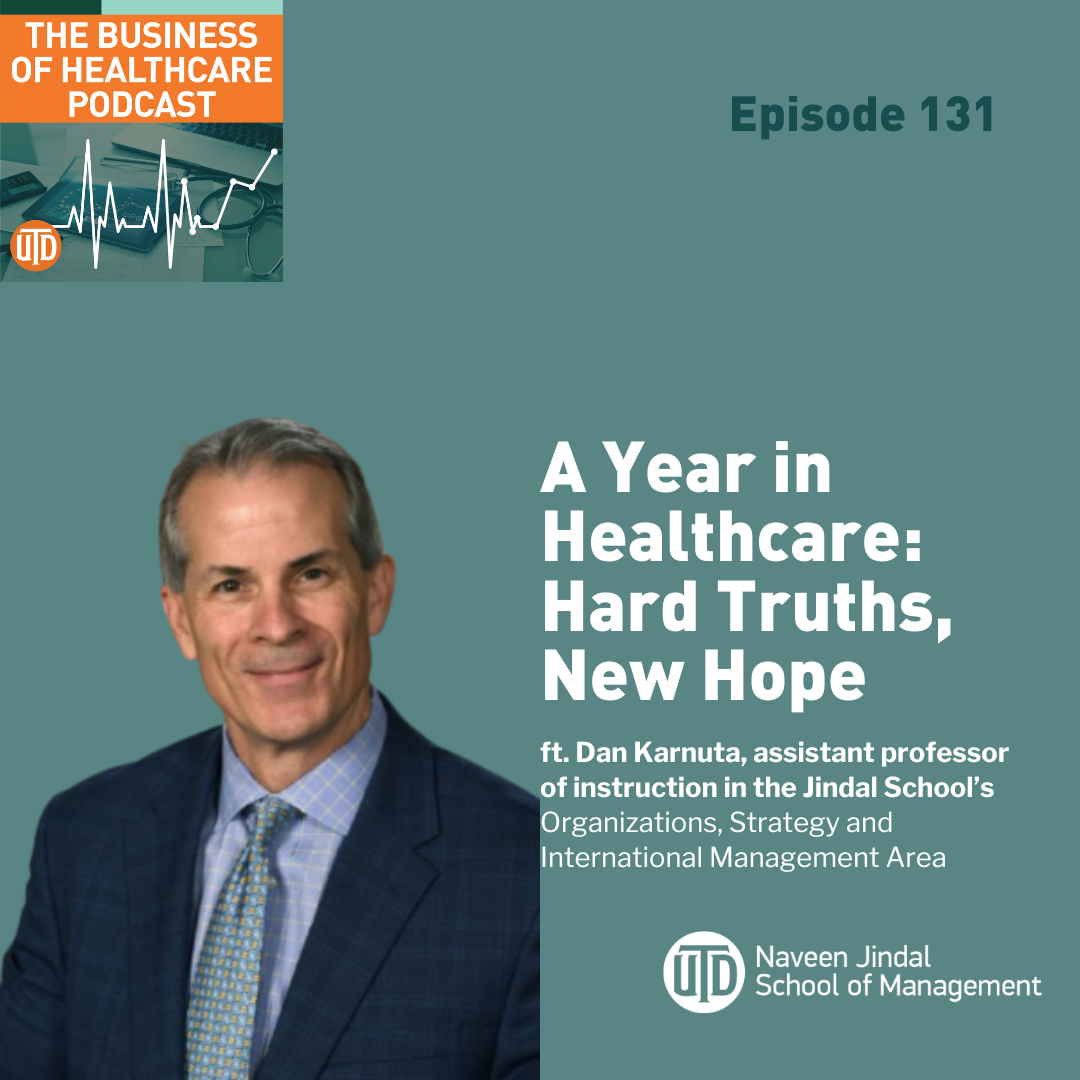
This episode flips the script as producer Jimmie Markham interviews host Dan Karnuta about the year's biggest healthcare themes. They revisit discussions form previous episodes on AI governance, operational adoption, workforce resistance, healthcare education pipelines, insurance pitfalls, nursing workflow redesign and physician well-being. Karnuta emphasizes that rapid technological change demands strong communication, thoughtful change management and a workforce prepared to partner with AI. They also explore deeper systemic issues, including healthcare's "klugeocracy" — a system built on decades of quick fixes. Despite the complexity and inefficiency this creates, Karnuta ends on a hopeful note: the industry is...
Transcription
5900 Words, 32901 Characters
you have to identify and talk about the issues in order for them to even have a chance of being fixed or at least lessened as issues. Welcome to the Business of Healthcare Podcast from the Center of Healthcare Leadership and Management at the University of Texas at Dallas's Navin-Gindall School of Management. Here at UT Dallas, we bring together business executives and other thought leaders to help navigate the challenges of our rapidly changing, increasingly complex healthcare ecosystem. I'm your host, Professor Daniel Carnuda, Director of the UT Dallas Professional Program and Healthcare Management. Be sure to subscribe on Apple Podcasts, Spotify, or your favorite podcasting app to ensure you don't miss any future episodes. You can also join us online at businessofhealthcarepodcast.com. On today's episode, we're going to do something a little bit different. I'm going to turn the tables in a way. Our producer, Jimmy Markham, has been doing this particular podcast amongst his other duties or about a decade now and so he's learned a lot about healthcare just by having to listen to our guests and myself and the other hosts drawn on about sometimes complex, sometimes not too complex healthcare matters. And so he's become sort of an expert because of that. And so Jimmy's come up with some questions on some recent podcast. He's gone back and looked at a few and said he's got some questions for me to clarify or to get my opinion on some of the things we've been talking about. So with that, I'll actually turn it over to Jimmy and he'll lead this one and I'll sort of be the guest. All right. Thanks Dan. Yeah, I appreciate you letting me do this and I would characterize myself more as a healthcare expert layman rather than a healthcare expert. So just to differentiate there. But you know, it's been such an interesting year 2025 for for healthcare and technology for that matter that we did quite a few AI episodes. And so I think we're probably going to start with that. We've had three episodes this year that focused on AI. That works for me. Okay. Well, let's go ahead and get going. You know, so the first one we did was with Don Taylor and we talked about his organization coming up with some national standards for AI governance. And you know, thinking back to that discussion with him, what part of the healthcare system do you think is furthest away from having the guardrails it needs and what's holding that back? Well, I mean, I think all areas of healthcare have a long way to go in that respect because we are just starting out on this AI journey, even though AI is decades old, it's coming to the four hours actually producing products that we can actually use in our business. In this case, the business of healthcare. So I think we got a long way to go and it's not because the awareness or concern is not there amongst leaders of healthcare industries, but much like cybersecurity, we don't know what we don't know. And the rapid pace of AI, what I would call evolution because it's going to be changing rather rapidly over the next decade or so. That'll make it hard for those who are trying to keep up with and thwart the risk issues. It'll be hard for them to stay ahead of it, just like cybersecurity. And also just like cybersecurity, there's no limit to the effort that an organization can put into creating AI risk scenarios and that implementing some sort of policy or technology or solution, mitigate that risk. So, I mean, you could spend your entire expense budget just on this one issue and still not be ahead of the game. So organizations need to think really carefully about how much they are going to commit, how much resource they're going to commit to putting guardrails in place around AI, how much is spending too much and how much is spending not enough. And then come up with that sweet spot of, okay, we're going to dedicate this much time and effort to this particular issue in order to ensure that our particular organization is not at too much risk. So, you know, it's just all matter of balancing the expense budget you have with the risk that's out there. Yeah, that makes perfect sense. And you know, sticking to AI, the next episode was 127 in you and Felicia Cologne talked about AI and healthcare operations. And I think as it moves along, there's always going to be that Pareto principle, the 80/20 rule, you're never going to have a certain segment of workers that even come to want to embrace it. They're always going to be resisting. There's going to be a certain faction. So, you know, so related to that, what do you think healthcare leaders are misunderstanding most about what AI can do in operations and what needs human judgment? Well, I mean, I don't know. I actually don't think there's much misunderstanding if you could put that in quotes about what AI can and can't do in its current state. I think there's a lack of fundamental understanding of what AI is and what's it likely to evolve into. So, I think, you know, people now, even as opposed to two years ago, people now have a little bit better understanding of what is capable of doing right now. But where it's going is a whole different issue. So, we're in the early stages of implementing these AI-based solutions into operational workflows. And with each of those, call it pilot projects, that either bears fruit in the form of improved operational performance or cost reduction or fails to live up to initial expectations, we'll learn from that. And AI will become less of a mystery. And then just when we think we've got this generation of AI tools figured out, the technology will evolve to a place where there's a whole new generation of AI tools and the process, you know, we'll kind of cycle over again. As an example, look back to go all the way back to like the early 1980s. We had something called Lotus 1, 2, 3 that we used. It was a spreadsheet-based thing, and you used it on a big suitcase-sized computer. And you, it was a, you plug your numbers into your spreadsheet, and then you'd hit Enter for the spreadsheet to actually calculate what you wanted to calculate. And then you'd go to lunch and have your lunch, and hopefully it's done calculating by the time you come back. So, that's where we started, you know, with computers. And then that moved barely swiftly to the Apple Macintosh, then the Microsoft Excel, then the Microsoft Office Suite, then all the sudden, you know, years later, cloud computing. So, the software is not even on your computer anymore. It's somewhere else and you're using it to software as a service, to big data, and then, you know, now we're at AI, you know. So, kind of going a little bit off the path here, but you talk about AI. I think we need to be careful of how we embed the term AI driven into our, the marketing we do for our businesses, because in the not-too-distant future, the term AI, again, in quotes, will become a pass-a-turn that's replaced by the next big thing, you know, whatever it's going to be called. Anyway, back to your original point about human judgment, I think people will not be losing their jobs to AI. Jobs will evolve to those that require people with the skills to use AI, and those that don't. And the ones that don't, you know, the jobs that don't require AI skilled to use them will be the lower-paying jobs. And complex medical decisions like reading radiology images, those are always going to require a skilled human to make the final determination, but that skilled human better know how to use and leverage AI to be able to be competitive in the space that they're in and to improve their productivity and their accuracy through the use of AI. So the human judgment will have to be there, but that human will have to know how to interact with and leverage AI or whatever the next generation of AI is. I mean, right now you've got things like radiology, ambient documentation, remote patient monitoring, and back office functions like billing, and claims adjudication, and, you know, kind of a monotonous task like that that are, that we're using AI for now, but AI is going to quickly move its way up that the food chain as successes are realized in these lower level, lower hanging fruits to more, more complicated jobs. And again, the people that have those jobs are going to have to know how to use AI. Yeah, without a doubt. And I touched on it a few minutes ago about episode 129 considering humans in that AI implementation and throughout the industry. And you and Matt Brubecker highlighted what I called the 80/20 rule, and there's, you know, going to be resistance. What can health care leaders do to reduce that resistance? They're never going to eliminate it completely, I don't think. No, and I think Matt and I am mapping the expert in it. He covered it really well and some of the questions that I asked him, but I mean, and I completely agree with them. The communication plan around, you know, what is being implemented, what it's going to do, and how it's going to impact the company from a productivity standpoint, the job that's being done from a productivity standpoint, the accuracy, that communication plan needs to be thorough and continual with the people who are going to be using the system. So to that end, it's no different than any implementations that we've done in the past of non-AI, new technology, new software that's replacing old software that people use. People that use software, and if you think of a big patient accounting system or, you know, whatever the main system is that you're running a hospital, I mean, I guarantee most of the employees that are using that in whatever their job function is, they complain about it. You know, I wish my system did this. I wish my system did that. What was management thinking when they implemented this system? It should be able to be faster, better, whatever it is. But then if you tell them that they're going to replace your system and say, what do you mean? You can't replace my system. You know, it's because they know how to use it. They've grown accustomed to it. You know, change is always the problem. And change management is something that, whether it's AI or anything else, that change management plan is the thing that needs to be the main thing that's considered to reduce the resistance. And companies just don't do a good job of it. Almost across the board because the communication plan starts out. Okay, you got this even up to the CEO level. If it's a really big system that's being replaced, you know, and you'll get him or her to stand up there and give their full support for this new system. And let's go get them guys. And then you never hear from them again, as the things being implemented and all the pain starts happening is the employees need to learn that new system. And so that's what I mean by the communication plan needs to be continual. And that the employees, the staff that's using the system have to continually be reminded of what it's going to look like when they get through the pain of having to learn that new system. Again, it's just that change management process that is the most important thing, which is no more than just a very well thought out communication plan. Right. And, you know, I like to say that we've entered the age of uncertainty because that's just what it feels like every day. And so, yeah, leadership, not just in healthcare, but in all industry is going to involve being comfortable with that and being able to bring the troops along in that. And so I think, yeah, there are some things that leaders have taken for granted that they're no longer going to be able to do increasingly every single day. Right. That takes care of the AI portion. The next one I've got a question about is for episode 126, where you and Caitlin McVey, you talked about heel high school. That's kind of a neat topic to discuss watching our future healthcare leaders grow. What can you tell me about how those pipelines work? Is it meaningful or is the main problem with filling in the increasing number of healthcare gaps? Is that further upstream? Is that problem a bigger problem? Well, I mean, the high schools they're not going to fix the problem, but they're a start. They could be a fairly well publicized start, you know, if they're publicized in the right way. But I think the programs themselves are fantastic. I mean, they're being implemented by skilled professionals with a passion for helping young students and a passion for healthcare. So they're helping these students find a meaningful career that could support their families. But the programs are just seeds. They're initial seeds that hopefully will grow into something bigger and bear fruit in the form of a new generation of successful healthcare professionals that graduate from these programs and they'll pay the effort forward. Therefore, you get this multiplying effect as they want to get involved in continuing this education program. It's one long-term foundational solution, but not the ultimate answer in and of itself. The Hill program is just one of 10 healthcare high schools that were funded with about $250 million of seed money from Bloomberg Philanthropies. So it's one effort. It's one huge effort from somebody who had a really good idea and forethought. It's a start, but it'll take many more such efforts, as well as federal and state government assistance programs to meet the country's healthcare needs that's being created by the aging baby boom population. That's just a fact. And unless something is done in that regard, like these programs that the high schools are doing, we're going to continue to fall short of the healthcare providers that we need to support the growing number of healthcare patients. Right. Yeah, former host Britt Barrett used to call that the silver tsunami and that's so appropriate for that because that's what it is. Yeah, that's what that's what yep. I resemble that remark. All right, the next episode is 128 where you and Becky Greenfield talked about alternative health plans and this is kind of one of those buyer beware situations. What can you tell listeners that they are looking at an insurance plan that doesn't really offer the protections that they need the traditional ones too? What can you say about that? Well, there's nothing easy to it. I mean, the answer is simple, but not easy because people are people, but the answer is read the policy. That's it. Yeah. A health insurance policy is not like your smartphone license or your newest downloaded applications where we all get these, you know, we download these things and then we can't actually click on download until we have to check the box that we've read the licensing agreement. And, you know, have you ever read one of those things? You know, nobody reads those things, you know, we just can't scroll to the bottom of that thing quick enough to hit a gree, so we could get a new little piece of software on our phone. You know, and that's, you know, there's actually a whole section of the law of legal attorneys who are who specialize, you know, in that and some in trying to make those things fair. But reading your health care insurance policy is not like that. I mean, to think about what are you buying when you purchase insurance? So I'll turn it on you, Jim. I mean, like when you purchase insurance, whether it's auto insurance or health insurance, what do you think you're buying when you pay for that premium? I could be totally off base here, but what I think about it is that I'm buying a little bit of piece of mind that I'm not going to have something catastrophic. And even if I do, it's not going to be as catastrophic as it would be had I not signed up for a plan in the first place. That's exactly right. Your wisdom partially because of age. As part of the silver tsunami myself, yes. You're shilling through. You ask, yeah, exactly right. I mean, you're purchasing a risk transfer. You're paying for someone else to take on your risk. So, you know, you need, when you're talking about these policies, you need to know exactly what risk you're transferring and how much of that risk you've transferred for that premium payment that you've made. And there's a commercial balance that play here within the insurance companies. I mean, this is their business. So they collect a premium from you and me and return. They take on our risk. So we pay that premium and some of that risk then gets transferred right back to us in the form of deductibles, copays, co insurance, coverage limits, you know, not everything's covered in all healthcare policies. Not every procedure would be covered. Something like plastic surgery and those type of things that very few policies are going to cover that sort of a thing. But there are other things as well that procedures as well that aren't covered. So, you know, you transfer risk and pay them a premium. But they transfer some of that risk right back to you in the form of those other things that you have to pay. And so it's a matter of, I think back to your question, how do you know when you've got a policy that that may not be what you think it is? You know, you've got to read it. But if you have a low premium, so if your premium is low, comparatively from what you've seen, you should see high deductibles, copays, co insurance, et cetera. So if your premiums low, you can expect your out-of-pocket expense for these other things. There'll be more risk transfer back to you if you're not paying very much for the risk transfer that you're getting from insurance company. On the other hand, you've got a very high premium that you're paying. You should be seeing lower deductibles and co insurance and copay because you should expect that if you're paying a lot of money to the insurance company, they should be taking most of the risk and not mirroring some of it back on you. So that's the first thing that I think I would look at. If I were just trying to figure out, does this policy make sense? If it looks too good to be true, it is. So if I've got a low premium, and then I also don't have a very high deductible or copay or co insurance, then something's wrong. Yeah. Yeah. And if you've got a high premium and a high deductible and everything else, then you probably didn't do enough homework. Yeah, you're probably getting ripped off in that case. Because you pay for risk transfer and then they have transferred it all right back to you. Exactly. This episode is brought to you by the Center for Healthcare Leadership and Management, the definitive resource for healthcare management education in North Texas. The Center is based in the Navin-Gindall School of Management at the University of Texas at Dallas. It plays a unique role in training the next generation of healthcare leaders to meet local, regional, and national demands. The Dindall School uses its strengths in accounting, administration, finance, marketing, and information systems to educate highly qualified personnel for healthcare administration and executive leadership positions. The Center is home to seven healthcare leadership and management programs, including undergraduate and graduate programs, as well as executive programs for physicians and working professionals. For more information, visit us online at gindall.utdallas.edu/healthcare. So, the next episode I want to bring up was episode 130. You and Terry McDonald talked about reimagining nursing and this holds a special place in my heart because my wife is a nurse. So, I'm always in tune with the nursing episodes. So, talk about what you and Terry discussed as far as nursing workflows that are inevitably changing as technology changes. What's an outdated workflow that we should be willing to just do away with instead of trying to modernize it? Yeah, I don't know enough about the details or Dr. McDonald's complex nursing environment, but I would hope that the armies of six sigma consultants, you know, essentially the keystroke counters I like to call them, this six sigma from the an earlier generation of the next big thing, which was looking at your processes and transforming them. I would have hoped that that stage of business, you know, decade or two ago, would have rooted out most of the, you know, completely unnecessary workflows that are out there, but making necessary workflows more efficient is a never ending process. And most businesses, as we adapt to the new technologies like AI, you know, they're going to be continuing to make the processes that they have better and faster and cut out some of the wasteful steps in those processes. But I would hope that there's no, you know, processes that are completely unnecessary. That'd be like totally low hanging fruit that you bang your head on as you walked in the door to your office every day to get rid of. Now, some of processes that we have to do are necessary, but should not be. And that's different than a process that just shouldn't be there, they're outdated. So why are they necessary? Were they necessary because of the healthcare system that we have in this country? Right. Which Dr. John McCracken, one of my mentors, taught me a while back, is called a Clujocracy. And that's a word. You can look it up. It starts with the K. A Clujocracy is an industry or a society, I guess in this case, we'd call it an industry, built and run on a quick fixes. So it's one in which society or the organization, you know, or the healthcare system in this case, tries to solve complex problems in haphazard ways. You know, with kind of patches and quick fixes as opposed to creating a fundamentally new approach to the problem that we're trying to solve. And so the result of a Clujocracy is a policy solution or set of solutions substantially more complicated than is warranted by the problem that it's trying to solve in the first place, which essentially is just patching on quick fixes rather than starting over, you know, and saying, wait a minute, this thing makes absolutely no sense. Let's start from the ground up. So you look at things like the Affordable Care Act, which is Obamacare, which was back in 2010 when that law was passed. But that was some quick fixes. One of the main things was trying to fix was the uninsured population in the US. And it did. It got a lot more people insured, but at a cost. And so it didn't fix the problem. It sort of fixed one part of the problem by creating another problem, which was a higher cost. The Inflation Reduction Act back in, I think, goes to 2022, under the Biden administration, did put some more tweaks under the Medicaid system, and added some more cost to our government spend, which we spend because it's taxes, and we fund that. The one big beautiful Bill Act, which was now at the Trump administration in July 4th of 2025, that was passed that had some counterbalancing provisions in it that did away with some of the stuff that the Biden administration act had done in the first place. So we're just putting patches on patches and reversing things that were done by another administration, and no one's really fixing the problem. In total, we've got things like the no surprises act, and the racing transparency laws in healthcare, they're now coming, they're in their infancies, but they're trying to make us better consumers so that we can see what we're going to spend, and we can be better consumers of which healthcare facility we have. Treat us based on quality and cost statistics, but that's not there yet. It's just starting. I mean, another example of the Clujocracy would be our internal revenue code, the tax code of our country. It's way more complicated than it needs to be, because it doesn't get fixed in its entirety. It doesn't get wiped down the zero, so let's just start over. We just keep putting little patches on it. Part of that is just because of our form of government, which is things aren't supposed to be easy to change, because that would be a dictatorship. And we have congressmen that have to vote for things, and a huge change is really hard to get passed, whereas the little changes and these quick fixes which create this Clujocracy kind of a situation, those can get passed, and that's kind of where we are. So I kind of get off the beaten path there, but that's why you see things being done in a healthcare setting, and you're like, why are we doing this? Well, sometimes we have to, because there's a law out there that says we have to do this. Doesn't make any sense? No, but in the context of healthcare, it doesn't make any sense at all, but we have to do it because it's part of the bigger system, which is just a kind of a mess. So those are the kind of things that AI is going to help. I really believe going to help streamline those processes, but they're always going to be there as long as the underlying rules of our healthcare system are what they are. Yeah, and your description of it all makes perfect sense. I thought of a tire who would trust driving a car that had a tire with 45 patches on it. I don't think I would want to even get in that car much less, put it on the highway. But we're doing that for healthcare at the same time without even thinking about it. It makes no sense. Change is hard. Yeah, for sure. So we started with Don Taylor, and we can use Don Taylor as a book end with episode 131, our most recent one, for healing the healers. His new book Healing talks about how to optimize the well-being of physicians, having heard him and discuss that with him. What do you think it would take for a hospital system to move beyond those gym memberships into something that actually puts the physicians first? Well, it starts with culture. And culture is kind of a loaded word. You often hear that word. It's cited to describe, I don't know, the deep-seated beliefs and behaviors displayed by a society or an organization. But at its core, I like to view it much more simply than that. To me, culture is simple. It's the least acceptable behavior that a society or organization will accept. That becomes your culture. You've set a bar. So if you, as a professor, if I'm okay with students walking in five minutes late to class, our culture becomes one of students you can just come in whenever they want to. That's the least acceptable behavior that I'm willing to accept. And so I say, no, you come in on time or you're going to get embarrassed when you walk in and I ask you, what time does the one o'clock class start and you say one o'clock and I ask you, well, it's 105. So that's what this issue comes to, the healing of the healers, I think. You have to set the bar so that individuals are actually accountable for their actions. And if they're not accountable, then you don't, you're not going to get what you want. So we have a culture and healthcare organizations and the physician training process itself where productivity becomes paramount. Productivity in treating more patients because more patients is more profit, filling beds because patients in beds is profit, empty beds is not, where sacrifice in the form of intentional and physical training is accepted. Not because it's the best way to create proficient physicians, but because that's just a way it's been done to me. So that's the way it's going to be done to you. I'm talking now of the residency programs and the training programs of how do you get, you know, from a college student through med school, through residency, through fellowship, to, you know, family year, you're an attending physician. The ones before you have gone through it a certain way and therefore they're teaching you the same way. And a lot of times it's heads down, work, you know, sometimes you work in 24 hour shifts, sometimes even longer than that, which is great in the way of training. I mean, it trains, it trains and gives our physicians a lot of experience, but it creates a lot of early burnout situations as well. And when you sort of get into that mode, it's hard to get out of it. Not only in the work environment, if you truly get into that sort of gears grind in 24 hours a day, always thinking about work, then you leave other things behind like your family and other commitments, without really even thinking about it. And then by that happening, you become part of the problem. Now you're the next generation of the problem. So in order to fix that, healthcare organizations and our whole system of training physicians, we need to step back and take a zero-based look at physician training and later physician productivity standards and kind of set a whole new set of rules. In a way, like I was talking about before, the Clujocracy, we have the same sort of thing here, where unless the whole system is kind of put on hold, someone's looking over from the top, I say, no, we're going to, we're going to got the whole thing. And here's what we're going to do. Then, you know, we're going to have these issues with physicians. And I think things can, things can help fix it along the way. If you have organizations, you know, that have, have individuals in the human resources department or an upper department, such an employee centric department that are watching out for these type of things. And putting their expertise at work to try to lessen the impact, then that could be a start. Yeah. And since you come from the healthcare industry as a CFO, that reminds me of a CFO term, cost-benefit analysis. You're doing a cost-benefit analysis on human beings is really what it boils down to, isn't it? Yeah. And it would be an interesting study to see, you know, we're so focused on productivity, would we be more productive if we were less demanding on productivity? And I would we get more out of the physicians when they were, you know, actually, you quote, unquote, on-duty, if they had a little bit more off-duty. Yeah. Or a little less stress. That's hard to calculate, though. It's more, it's easier to calculate a number of bed-filled occupancy rates than it is to try to figure something like that out. Yeah, for sure. So wrapping things up, you know, this has kind of been a really interesting episode for me, just looking back on the whole year. So the ideas you've heard from our guests in 2025, do they leave you optimistic or more frustrated about where healthcare has headed? Oh, optimistic. No doubt. That's a no-brainer. I mean, you have to identify and talk about the issues in order for them to even have a chance of being fixed or at least lessened as issues. So just the fact that these things are being talked about and there's people out there, like Dr. McDonald, who are, you know, looking at their staff and their staff's time and in her case as the nurses, what's the best use of their time and how can we deploy technology to help get the most out of them without taking the most from them? The fact that there are people like that out there, and there are a lot of them that are thinking about these things. You know, that should give us all hope that the future is bright. It's just, it's not going to be an easy road to get there because of the, you know, the mess that the system is in right now, just because again, the Clujocracy, the way it's created. And I'm not using the word mess to say that our system is terrible. I'm just saying that it's complicated. It's overly complicated for the patient and the providers, but there's enough folks out there that are worried about these things and focused on these things and dedicated to making these things better that I just think that the ultimate end will be that it will get better. You know, just because those kind of folks are out there. Yeah, and I like to think that the guests that we're bringing on are thought leaders who will help everybody in the industry, it'll plant seeds in their minds on the right way to go. And I think that's what we've been doing on this podcast for the last eight years. Exactly. Well, I think on that note, yeah, let me just end by thanking you for putting me in the driver's seat and putting you in the hot seat. I really appreciate this perspective of yours as a healthcare expert. And I know you don't get a chance to stretch yourself as a host as often as you'd like, but hopefully you've gotten to as the guests this time. It was fun. Now, I just got to look over my shoulder now to see if you're ever going to be in my seat. I don't think you have to worry about that. All right. Well, thank you so much. I really appreciate it. Okay. No problem. All right, ticker. Thanks for listening to the Business of Healthcare podcast. To learn more about the Center for Healthcare Leadership and Management and the Healthcare Management Business Degrees and Certificates, available to seasoned clinicians, master students, and undergraduates with University of Texas at Dallas. Go to jindall.utdallis.edu forward slash healthcare.
Podcast Summary
Key Points:
Summary:
Chat with AI
Loading...
Pro features
Go deeper with this episode
Unlock creator-grade tools that turn any transcript into show notes and subtitle files.
 PodcastTranscript AI