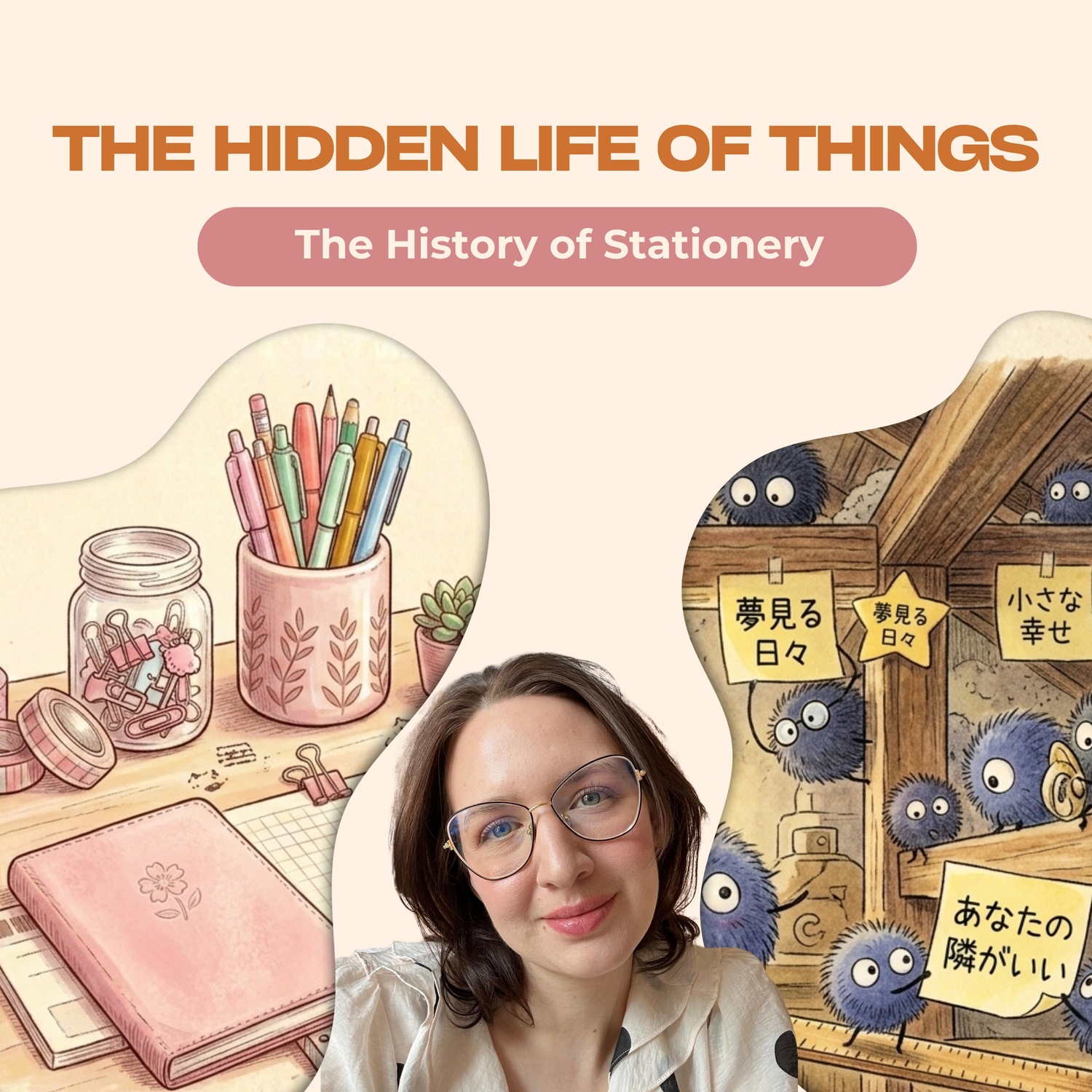
A World on Paper: The Secret Psychology & Engineering of Stationery - Episode 20
27m 33s
Stationery is more than a utilitarian tool—it holds deep emotional and psychological significance. From ancient papyrus to modern Japanese innovations, the evolution of writing materials reflects humanity’s enduring relationship with tangible objects. The emotional responses to a well-designed pen or notebook stem from a phenomenon called "tool-body extension," where the brain merges the tool with the self, enhancing focus and creativity. Research shows that handwriting engages the brain differently than typing, promoting deeper cognitive processing and better retention. Japanese stationery culture exemplifies this through *mono-zukui*, a philosophy of perfecting small, often invisible details—like a pencil that rotates its lead or an eraser that regains sharpness with heat. These solutions, born from real user frustrations, are evaluated not by marketing but by frontline shop staff who observe actual daily use. Notable products include the LeComix Solid-Ride pencil, the Puni Kuru Toga mechanical pencil, and the phone-locking desk box, all designed to balance efficiency and joy. Even the colors of stationery, like the accidental yellow of adhesive, reveal how design can emerge from simple, overlooked moments. Ultimately, stationery is a quiet archive of human ingenuity, connecting us to history, craftsmanship, and a sense of calm in a digital age. The hidden life of objects like pens, notebooks, and tapes reveals that small, precise design choices are not trivial—they are essential to how we think, create, and feel.
I have a new cozy corner for the podcast today.
We're back to school preparations, I have been thinking about stationary a lot, and as
I usually do, I have also been getting philosophical in my thoughts, not just practical.
If I ask you to think about the last time a piece of stationary made you feel something,
knowing a dramatic way in a small specific way that happens when you find a pen that writes
perfectly, or open a notebook that lies completely flat, or peel a posted note off the pad and
it makes exactly the right sound, or, and I know some of you will know exactly what
I mean here, walk into a good stationary shop and feel immediately calm.
That feeling is real, it's not trivial, it's not just liking nice things, there's actual
psychology behind why certain objects produce that response, and we're going to get into
that today.
But first, some history, because stationary, everything from the read pen on the banks
of the Nile to the self-rotating graphite lead inside a Japanese mechanical pencil, is
the technology that made every other technology possible.
Before you could write down a law, you needed something to write on.
Before you could draw a blueprint, someone had to invent the pencil.
Before the printing press could change the world, someone had to figure out ink.
History is not the footnote of civilization, it is the thing civilization was written
on.
And then there is Japan, which looked at a pen and notebook, a piece of tape, and decided
the rest of the world had been doing it wrong, and proceeded to spend a century solving problems
so small, so precise, so quietly maddening that most of us didn't even know we had them,
until we held the solution and felt it.
I'm Alexandra, welcome to the Hidden Life of Things, this one is for everyone who has
ever felt something in a stationary shop.
Let's start at the beginning.
Not when pens with the surface, because before you could write anything, you needed somewhere
to put it.
In ancient Egypt, around 3000 BCE, the answer was Papyrus, made from the Papyrus plant that
grew along the Nile, sliced into strips layered in a crisscross pattern, pressed, dried in
a sun.
The natural sugars in the plant acted as their own binding agent, nor glue required.
To write on it, Egyptians used "read pens", a "read" cut at an angle into a fine, split
point, almost identical in principle to the nib of a fountain pen today.
Ink was made from soot mixed with water and gum arabic, hardened sap for my cazia trees.
The result was a rich permanent black we can still read 5,000 years later.
Then what did they write?
Religious texts, government records, personal letters, shopping lists.
Shopping lists have existed for 5,000 years.
Humans have always needed to remember what to get from the market.
The word paper itself comes from Papyrus.
We stopped making it from that plant roughly 2,000 years ago.
The word "state".
Paper, as we know it today, was invented in China, standardized by a hand-in-a-stick
court official named Kai Lun around 105CE.
His method makes rags, hemp, bark, old fishing nets into a pulp with water, pour it onto
a flat mesh screen, drain, press, dry.
The revolutionary thing was the raw materials, not a specific plant from a specific river,
rags, old rope, bark, waste.
Paper that could be made almost anywhere from almost anything.
China guarded the method as a state secret for centuries.
The story of how it escaped involves a battle in 751CE in Central Asia, where Arab forces
defeated a Chinese army, among those captured according to some accounts were paper makers.
Whether or not that specific claim is fully accurate historians debated, what is certain
is that around this time paper making appeared in Baghdad and spread through the Islamic
world.
And there it reached Spain in the 12th century, it spread north through Europe, and arrived
just in time for Gutenberg's printing press to need something to print on.
Quick thing before we go further, because I know this bothers people.
Stationery with an "E" paper pens notebooks comes from Stationer.
A stationer in medieval times was a bookseller or writing supplies merchant who had a permanent
fixed pitch.
A store that stayed in one place as opposed to traveling market traders.
Stationers literally stood still, from the Latin "Statuanarios" fixed.
The first stationers appeared in medieval university towns, Oxford, Paris, Bolonia, supplying
students with writing materials.
Stationery with an "E" is goods from stationers.
Stationery with an "A" means not moving, completely different words, everyone gets
them wrong at some point, even me.
Now the pen, I want to tell you one story about one man.
Lazlo Biro was born in Budapest in 1899, journalist, painter, chess champion, Jewish in a Hungary
that was becoming very dangerous for Jewish people in the 1930s.
As a journalist, he worked daily with newspaper printing ink and came home frustrated by fountain
pens.
Newspaper ink dried almost instantly, fountain pen ink smeared, blotted, required constant
refilling, the contrast nagged at him.
His solution was a tiny ball bearing at the pen tip, a sphere that rotated as the pen
moved, picking up thick, fast-drying ink from a reservoir and depositing it smoothly
on the page.
He patented it in Paris in 1938, then the war arrived.
Biro was a Jewish, he had to choose between his remaining financial stake in his invention
and using that money to get his family safely out of Europe.
He chose his family.
He arrived in Argentina in 1943, essentially penniless having surrendered the commercial
value of one of the most significant inventions of the 20th century to survive.
In Argentina, the Royal Air Force became his first major customer.
The pen's leaked at altitude, the bow point didn't.
After the war, a French businessman named Marcel Beech boxed the patent.
He dropped the age from his name to avoid an unfortunate English pronunciation.
And became big.
Over 100 billion big crystals have been solved.
If you placed them end to end, they would circle the earth over 250 times.
Lazlo Biro died in Buenos Aires in 1985, aged 86.
Argentina celebrates an invented day on his birthday September 29th.
In the UK, we call a bow point pen a Biro.
We name the object after him and then mostly forgot who he was.
He never became wealthy from the thing that made billions for everyone who came after.
This one has to be in this episode because it might be the best stationary origin story
ever told.
In 1968, a 3M chemist named Spencer Silver was trying to develop an extremely strong
aerospace advisor.
What he accidentally made was the opposite.
Week, pressure sensitive, removal without leaving residue completely useless by any obvious
measure.
Silver spent five years trying to convince people inside 3M that his failed glue was somehow
valuable.
He called it a solution without a problem.
Nobody could figure out what to do with it.
In 1974, a fellow 3M chemist named Art Fry was sitting in his church choir rehearsal
in Minnesota quietly irritated.
His paper bookmarks kept falling out of his hymnal at exactly the wrong moments.
He remembered the adhesive that was just sticky enough to hold paper without damaging it.
He put sovers adhesive on the back of small pieces of paper, the bookmarks state.
They peeled away cleanly, they could be repositioned, a posted note was conceptually
born in a church from lost bookmarks and a failed glue.
3M launched a version called "Preson Peel" in 1977.
It failed.
Nobody bought it because nobody knew they needed it until they tried it.
So 3M gave them away free to consumers in Idaho.
94% of people said they wanted to buy them.
The posted launched nationally in 1980, one of the best selling office products in history.
And the yellow?
Also an accident.
The lab next door to the posted team had only yellow scrap paper available when testing
the adhesive.
Nobody designed the color, nobody chose it, it was just what was on the shelf that day.
The most recognizable color in the office stationery is an accident.
Before we get to Japan and we are getting there I promise, I want to spend a moment on
something that I think explains why so many of us have a relationship with stationery
that goes beyond the functional.
Why does a good pen feel good?
Why does opening a fresh notebook produce a specific kind of quiet pleasure?
Why do people collect washi tape?
Why does the weight of a well made pencil in the hand feel different?
Not simply meaningfully different, from a cheap one.
Psychologists who study what's called the tool body extend itself have found something
interesting.
Once don't entirely experience well used tools are separate from themselves.
When you become fluent with an object, when it fits the hand correctly, when the mechanism
responds exactly as expected, your brain begins to process it almost as an extension of your
own body.
The pen becomes part of the writing hound.
The friction between nib and page is registered as part of the act of thinking.
This is why writers often have very --
specific pen and paper preferences that feel almost irrational.
Hemingway roads standing up on yellow legal paths with a pencil until this hand cramped.
Rolled down used only dicks and pencils exactly six at a time and sharpened all six before
sitting down.
These aren't quirks.
These are people who had found the specific physical conditions under which they're thinking
flowed most freely.
Beyond the extended self, there is something simpler.
In a world of infinite digital distraction, the specific limitation of paper is part of
its appeal.
A notebook doesn't notify you, a pen doesn't have other apps.
When you sit with paper and append the only thing available is the writing.
The constraint is the feature.
And there is research.
From neuroscientists and education researchers consistently finding that writing by hand
engages the brain differently from typing.
The slower pace forces a processing of information that quick typing bypasses.
Students who take hand written notes retain more than those who type.
Even when typed notes are more comprehensive, the act of physical writing, the movement
of the hand forming letters, activates neural pathways that keyboard input simply doesn't
reach.
There is something about the objects we choose to write with, the specific pen, the particular
notebook, the colour of ink, that becomes a private language over time, a short hand
for itself.
Someone who knows you well enough can look at what you've chosen and read something
in it that a stranger never could.
I think about this with the natural world too.
How bees find their flower across any distance, not by accident, not by chance, by something
encoded in them that makes one particular thing recognizable above all the noise.
They could land anywhere.
They come back to the same place every time, I think that's what the best stationery
does too.
It lets you leave a trace that is recognisably unmistakably yours, not for everyone, for
the right person.
Japanese stationery culture understood all of this before the West started writing wellness
articles about digital detox, which brings us to the part of the episode I have been looking
forward to the most.
There is a Japanese concept called mono-zukui, which roughly translates as the art of making
things, not just making things, making them properly, making them as well as they can possibly
be made.
It captures a philosophy where every element of a product design is treated as a genuine
engineering question.
Not just does it work, but does it work as well as it possibly could?
Is the weight right, is the angle correct, is the mechanism satisfying?
Could that 0.5 second moment of friction, the tiny annoyance that occurs every time a
user does a specific thing be eliminated?
Western product design, broadly speaking, tends to solve macro problems, getting from
A to be connecting to things, storing data, Japanese stationery design at its most developed
focuses on something different, micro-friction.
The small, almost subconscious irritations that occur dozens of times a day during ordinary
use, a page that flips back on you, the pencil that rolls off the desk, the eraser that loses
its sharp corner after one use, the book that once they open because you are at page 10
on one side and page 300 on the other.
These are not the problems that make headlines, they are the problems that accumulate into
a slightly worse day every day for years.
Japanese stationery engineers treat them as worthy of serious attention, the results are
extraordinary.
Did you know that there is an official Oscars of stationery?
In Japan, the Bunbogo Taisho, the Japanese stationery awards, has been held annually since
2013, and a thing that makes it interesting is who does the judging?
Not marketers, not designers, not executives, the judges are frontline stationery shop clerks,
the people who stand behind counters every day, hand products to thousands of customers,
watch how they interact with them in real time, observe which things get put back on the
shelf, and which things get carried to the till.
They evaluate tactile friction, weight distribution, economic comfort, and what they call psychological
satisfaction, the feeling of product gives during use.
This is when you think about it the most honest form of product evaluation possible.
Not what looks good in a focus group, not what photographs well in packaging, what actually
works in the hands of actual people who actually use it?
The 2026 awards produced some winners that I find really fun, let me take you through them.
Firstly, let me describe a problem.
You're using an eraser, you use it once, twice, three times, the corners, the precise
90-degree edges that let your eraser single thin line without touching the lines around
it, are gone.
Rounded, soft, useless for precision work, so you either suffer through imprecise erasing,
although the eraser away, when it's still 90% in tap, Japanese solution from seed, instead
of throwing it away, you warm the eraser and press it into a shaping sheet.
The heat makes the eraser material malleable, the mold reforms the sharp 90-degree corners,
you reset the eraser the way you reset the hot iron, the eraser is restored, you use it
again.
This is the kind of solution that when you hear it produces a specific reaction, a pause
followed by why did nobody do this before?
The top prize over every major legacy pen manufacturing in Japan was won by the LeComix
Solid-Ride Mechanical Pencil, and its design philosophy is pure subtraction.
It is completely jet black, 23 grams of brass, no unnecessary branding, just a tiny logo,
no colour, no decoration, and instead of a bulky clip to stop it rolling off the desk,
which adds weight in the wrong place and creates an asymmetry that changes the feel in your
hand, it has a single hexagonal ring near the top.
That's it.
The ring adds just enough asymmetry to stop the pencil rolling, acts as a weight anchor
that balances the tool in the hand, and adds visual distinction without visual noise.
Did you know that Japanese mechanical pencils rotate their own lead while you're right?
This is real, this exists, let me explain the problem itself.
When you ride with a mechanical pencil, the lead makes contact with the paper on one side.
That side wears down faster than the rest.
Within a few lines, the lead tip is no longer a point, it has a flat edge on one side,
your line thickness becomes inconsistent, your handwriting starts to feel uneven, you compensate
by rotating the pencil slightly, which you do without thinking, but it's still a thing
you're doing.
Puni Kuru Toga, made by Mitsubishi Pencil Company, has a microgear mechanism inside the barrel.
Every single time you lift the tip from the paper, the mechanism rotates the lead exactly
9 degrees.
You ride a stroke, lift the tip, the lead rotates, you ride another stroke, lift the tip,
the lead rotates again.
After about 40 strokes, the lead has done a full 360 degree rotation.
Every part of the lead tip has worn evenly, the point stays consistently sharp.
This mechanism is invisible, you cannot see it working, you cannot feel it working in
any obvious way, you only notice its effect that the line stays consistent, that the point
doesn't go flat, that the writing feels right for longer than it should.
It is a solution to a problem so small that most people have never named it.
And it required building a tiny rotating gear engine inside a mechanical pencil.
This is Japanese station design at its most characteristic.
The problem being solved is almost invisible.
The engineering required to solve it is not simple, and the result is a tool that simply
feels right in a way that is slightly difficult to explain.
Now the category I love most because Japan doesn't only solve functional problems, it also
understands that a desk should contain joy.
Let's see the problem, you're trying to write, study, journal or do anything that requires
sustained attention.
Your phone is sitting next to your notebook, you know you shouldn't check it, you check
it anyway.
The average person checks their phone 96 times a day, once every 10 minutes of waking life.
The Japanese solution is a small tabletop box with a physical timer lock.
You put your phone in it, you set the timer, the box locks.
You cannot open it until the timer expires.
This is not a, it is not a setting on your phone.
It is a wooden box with a mechanical lock that physically makes the phone inaccessible.
It wants a stationary award, it is classified as stationary.
Because in Japan, the space around the writing is as important as the writing itself.
And then there is this, Sunstar, a Japanese stationary brand released a flat desk pouch
designed to look like a UFO abduction.
Complete with a glowing beam, a miniature cow-charm dangling from the zipper.
The entire aesthetic of a B movie alien abduction on your desk holding your pens.
They also released a pen case modeled after a cicada shedding its shell.
The hollow exoskeleton that cicadas leave behind on tree bark in summer, it stands upright
on its own, it looks exactly like an empty insect shell and it holds pens, these are not
jerk products.
They're not ironic, they reflect something genuinely Japanese about the desk, that a workspace
should contain pleasure, that the objects around you while you work or study or write should
make you feel something good, that efficiency and joy are not opposites, that you can have
a pencil engineer to sub millimeter precision, and a UFO pen case.
pouch on the same desk and both are equally appropriate. This balanced, hyper-efficiency alongside
pure delight is one of the most distinctive things about Japanese stationary culture.
And it is something the rest of the world is only beginning to catch up with.
Let me tell you about more things because they each represent something different about why
Japanese stationary has developed such an intensely devoted global following - washi tape.
Traditional Japanese washi paper made from specific plant fibers using techniques
refined over a thousand years - thin and slightly textured with a gentle removable adhesive
on one side. Originally developed as industrial masking tape for painters, then someone noticed
it can be beautiful. The brand MT launched it as a decorative product in 2008, now exports to
over 50 countries. Now washi tape festivals in Japan collect its own hundreds of roles it is
tape and it has a global craft community around it that is genuinely difficult to explain
until you've held a really good role of it and felt the texture between your fingers.
Then there is the Tomo River paper. 52 grams per square meter, standard copy paper is 80.
Tomo River is thinner than Bible paper and yet it shows almost no bleed through from
fountain pen ink. No feathering, no ink sits on the surface in a way that should not be physically
possible given how thin the paper is. The Harbonichi Teco, one of Japan's most beloved annual
planners, is printed on Tomo River paper. stationary communities online post photographs of their
filled Harbonichi pages the way food communities post photographs of meals. People decorate pages with
drawings, washi tape, color. The filled planner becomes a visual record of a year. How about a
needle free stapler? It makes small cuts in the paper and folds the resulting tabs through each
other locking the sheets together, holds up to ten sheets, clean strong no metal, no jamming,
no small sharp objects on your desk. The idea had existed in Europe and the US in the 1900s but the
connections weren't strong enough. Kokuyo solved the engineering problem in 2009. It is one of the most
satisfying objects in stationary history to use and I'm sure all of you remember the Whiteout
correction fluid, TIPX, it was an American invention from the 1950s, it worked approximately by
covering mistakes with white liquid. The problems were many, drying time cracking, raised surface,
terrible one photo copied. Japan invented correction tape in the 1980s, a roll of white film on
precious sensitive adhesive applied directly over the mistake by rolling across the page.
Instant, flapped, no drying time. Did you know that the correction tape is a Japanese invention?
Have you heard of the pilot friction synergy pen? Pilots spent over 30 years developing a pen
that erases its own ink using heat science rather than abrasion. The ink is thermochromic,
it becomes transparent when it reaches 60 degrees Celsius. The eraser on the cap generates friction
which generates heat, which makes the ink invisible. The marks don't leave the page, they just disappear.
The crucial detail, if you put a friction written document into a freezer,
the ink reappears, it was never gone, it was just invisible. This is simultaneously a fascinating
physical fact and a significant practical caveat if you're using it for anything you want to
remain permanent. I want to end with this. Stationery is often the last place people expect to find
philosophy, but Japanese stationary culture has embedded one there anyway, the belief that the
quality of small things matters, that the 0.5 second annoyances of daily life are worth taking
seriously, that a desk should be both efficient and joyful, that the active writing by hand
on paper with a tool you have chosen carefully is worth the care that goes into doing it well.
The psychological research backs this up, tools that fit the hand correctly that respond exactly
as expected, that eliminate micro friction. These tools don't just work better, they reduce the
cognitive load of using them. When a tool works perfectly, your attention goes entirely to the task.
When it doesn't quite work, when the pen skips, the eraser smudges, the notebook want life flat,
a small but real portion of your attention goes to managing the tool instead of the task.
Japanese stationary design is, in this sense, a form of cognitive care. And there is something else,
something simpler. In a world of screens and algorithm and notifications designed by some of
the smartest people alive, specifically to capture your attention and hold it. A pen and a piece of
paper are neutral, they want nothing from you, they have no agenda, they just wait. In my opinion,
the stationary shop is one of the most overlooked archives of human ingenuity on earth.
And also one of the few places where a UFO pen pouch is considered a serious design contribution.
So the next time you pick up a pen, any pen, just take one second. That object is the descendant
of a reed cut at an angle on the banks of the Nile, other medieval scribe sharpening a quill
with a small knife, other journalist in Budapest who noticed that newspaper ink dried faster than
fountain pen ink and lost everything to save his family, and named an everyday object that half
the world still uses his name for without knowing who he was. And if you have a posted note nearby,
yellow, slightly sticky, peelable, repositionable, that is a failed glue and a lost bookmark and a
free sample campaign in Idaho and accidental yellow. And if somewhere on your desk there is a
Japanese mechanical pencil rotating its own lead nine degrees every time you lift it well,
now you know what's happening inside of it. The stationary drawer is truly full of extra ordinary
things. History isn't only in museums, sometimes it's in the drawer you never quite close all the way.
If this made you want via Japanese notebook, I completely understand and I support you.
The hidden life of things is on Spotify, Apple podcasts and wherever you listen.
A follow or a like genuinely helps and if someone in your life has a stationary problem,
which is different from a stationary collection and also exactly the same thing, send this to them.
And here's your clue for next time. It has lived beside humans for longer than agriculture,
longer than writing, longer than the wheel. It watched us build cities from outside the walls and then
somehow ended up inside them on our sofas in our beds in the arms of our children. It chose us,
or we chose it, nobody is entirely sure which came first. Every culture on earth has a story about
it. Some thought it was sacred. Some thought it was a spirit in disguise. Some thought it could see
things humans couldn't. And some thought that the relationship between it and us, something that
stretches back at least 13,000 years and possibly much further, is the most important friendship our
species has ever made. What is it? Stay curious, I'm Alexandra and I'll talk to you next week.
[Music]
Podcast Summary
Key Points:
The emotional connection to stationery—such as a perfectly writing pen or a notebook that lies flat—is rooted in psychology and reflects a deeper human need for tactile, mindful interaction with objects.
Stationery has a rich historical lineage, from ancient Egyptian papyrus and Chinese paper to Japanese innovations like self-rotating mechanical pencils and micro-friction solutions, demonstrating how small design details shape user experience.
Japanese stationery culture emphasizes *mono-zukui*—the art of refining everyday objects to perfection through meticulous attention to micro-frictions and user experience, leading to products that feel intuitive, functional, and emotionally satisfying.
Summary:
Stationery is more than a utilitarian tool—it holds deep emotional and psychological significance. From ancient papyrus to modern Japanese innovations, the evolution of writing materials reflects humanity’s enduring relationship with tangible objects. The emotional responses to a well-designed pen or notebook stem from a phenomenon called "tool-body extension," where the brain merges the tool with the self, enhancing focus and creativity.
Research shows that handwriting engages the brain differently than typing, promoting deeper cognitive processing and better retention. Japanese stationery culture exemplifies this through *mono-zukui*, a philosophy of perfecting small, often invisible details—like a pencil that rotates its lead or an eraser that regains sharpness with heat. These solutions, born from real user frustrations, are evaluated not by marketing but by frontline shop staff who observe actual daily use.
Notable products include the LeComix Solid-Ride pencil, the Puni Kuru Toga mechanical pencil, and the phone-locking desk box, all designed to balance efficiency and joy. Even the colors of stationery, like the accidental yellow of adhesive, reveal how design can emerge from simple, overlooked moments. Ultimately, stationery is a quiet archive of human ingenuity, connecting us to history, craftsmanship, and a sense of calm in a digital age.
The hidden life of objects like pens, notebooks, and tapes reveals that small, precise design choices are not trivial—they are essential to how we think, create, and feel.
FAQs
Because well-designed tools create a sense of 'extended self'—when a pen or notebook fits perfectly, it feels like part of the body, enhancing focus and creating a personal, almost intuitive connection.
Paper was invented in China around 105 CE by a court official named Kai Lun, who used rags, hemp, and bark to create pulp. It spread through the Islamic world and reached Europe just in time for the printing press.
Lazlo Biro, a Hungarian journalist, developed a ball-point pen with a rotating ball that picks up ink smoothly. He gave up his financial stake to save his family during the war and later, the pen became a global success.
Post-it notes were invented in 1974 when a 3M chemist used a pressure-sensitive adhesive originally developed for aerospace, to make bookmarks that could be repositioned. The yellow color was an accident due to limited scrap paper.
Japanese design focuses on solving tiny, everyday frustrations—like a pencil rolling or an eraser losing sharpness—through precise engineering, emphasizing micro-friction and user comfort.
The Bunbogo Taisho awards honor stationery products based on real user experience, judged by shop clerks who evaluate tactile feel, weight, and psychological satisfaction in daily use.
Chat with AI
Loading...
Pro features
Go deeper with this episode
Unlock creator-grade tools that turn any transcript into show notes and subtitle files.
 PodcastTranscript AI