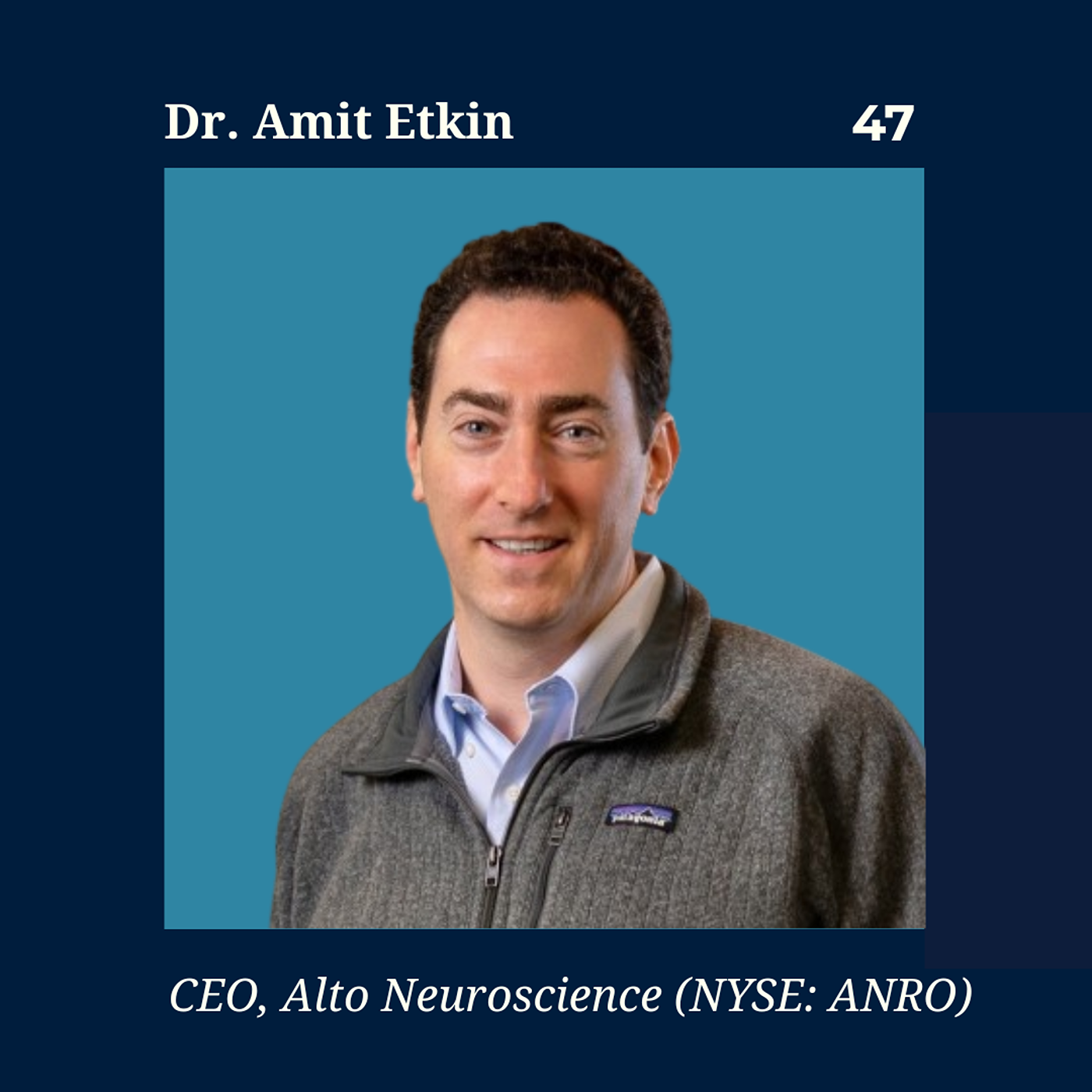
A New Blueprint for Precision Psychiatry | Alto Neuroscience CEO Dr. Amit Etkin
41m 59s
The podcast discusses the limitations of current psychiatric practices, which often treat disorders like depression as uniform diseases despite significant individual variability. Dr. Amit Etkin, founder of Alto Neuroscience, explains that precision psychiatry—using biomarkers such as EEG, cognitive tests, and wearables—can better tailor treatments by understanding each patient's unique brain biology. Mental health disorders affect tens of millions, with profound personal and societal impacts, yet they are underfunded and stigmatized compared to fields like oncology. Dr. Etkin left academia to found Alto Neuroscience, aiming to develop targeted therapies based on a platform that integrates multiple biomarkers to predict treatment response. This approach contrasts with traditional methods, offering a more systematic and effective path to treating psychiatric conditions by focusing on "what you're doing and why it works" for specific patient subgroups.
Welcome to the healthcare theory podcast. I'm your host, Nikhil Rady, and every week we interview the entrepreneurs and thought leaders behind the future of healthcare to see what's gone wrong with their system and how we can fix it. Mental health disorders affect tens of millions of people, yet psychiatry still largely treats these conditions like depression or schizophrenia as if they're single diseases. And today we're exploring this issue and we're joined by Dr. Amit Ekkin, the founder, CEO and chair of Alton Neuroscience, and before founding Alton, Dr. Ekkin was a tender professor of psychiatry and neuroscience at Stanford, running a large lab focused on the neurobiology of psychiatric disorders. And right now he runs Alton Neuroscience, a huge clinical sage biotech company trained on the New York Stock Exchange and has a market cap of 640 million across many, many different candidates in their pipeline, including bipolar, depression, cognitive parents get their variant many, many more, which uniques their precision psychiatry platform, which integrates different biomarkers to make specializations specific for the patients rather than disease. Hi Dr. Ekkin, welcome to the healthcare theory and thank you so much for coming on today. It's a pleasure to join you. Of course, and before we get into Alton Neuroscience, I want to start off with your background. You ran a major lab at Stanford, which is really impressive, focused on the neural bases of different psychiatric and mood disorders, which of course, spans a really wide area. A lot of angles approach these questions. But I'd love to hear from you. What are the major questions and things you're trying to solve that underpin the most severe research at Stanford and your work at the lab? Yeah, so my own history even before getting to Stanford is getting an MD and a PhD and then doing residency, so I'm both a clinician and a neuroscientist. And it's really enriching those two that we focus our work in the lab at Stanford. And so we ask a number of really kind of fundamental questions about how we think about psychiatric disease. So we started with a question of what makes these disorders that we classify in different, if you will, chapters of the DSM or the diagnostic, quote unquote, Bible of psychiatry. What makes them the same or different with respect to the brain? We have classified disease in a certain way, what does the brain tell us? We started to see, for example, that disorders that might seem very different in terms of their symptoms actually share a lot of biology. So then that led us to the next question, which is ultimately what gave birth to alto, which is how do people within a given disorder differ in terms of their brains that might account for things like who responds to treatment and who doesn't, because there's a lot of variability on that front. And it's in trying to answer that question and figuring out things like what kind of data are really informative for that kind of question? Where do you get the most reliable and generalizable findings? What kind of data analytic methods do you want to employ to be able to discover that systematically doing that through a variety of different data sets that we had collected that our collaborators have collected in different contexts started to teach us essentially that in a precision approach as possible in psychiatry, that is, we know there's a lot of variability in response, doesn't mean that biology necessarily predicts it, but it turns out that it does. And that's really the basis then ultimately that we built alto on, but began with academic questions around very, very basic things like how do symptoms relate to the brain and why do most of the time we don't see a relationship between symptoms and the brain. So what does the brain tell us about psychiatric disease? Yeah, I think it's really interesting. I can see a very clear need for precision tools in medicine because thinking about something like PTSD, for example, it's all based on trauma, but almost all of us studies show that almost every individual has one traumatic experience in their life, but only around 10% to get PTSD at one point in their life. So it's why do some people get PTSD and others don't? There's that same question, but for every single disorder, for every single variable in those disorders. So when you have these different confounds, I can imagine a personalized approach is much better than fitting to these arbitrary classifications we can try. But I love to hear, I mean, the C and S base is huge. Almost everyone has probably met someone with things I had a depression, has a family member. And it's been a huge topic in my generation, but I love to hear, even though it's going, don't we know about the space and how big is it really? Yeah, so let's just start with depression. I think that's where most people would be most familiar, but it's important to also note that that's really just one corner of a much bigger space. I'll touch on a few other important places. Depression affects probably 20 million Americans. 10 of those, 10 million of those are in treatment at any given time, which means a lot of people who are suffering from depression aren't in treatment for a range of reasons, things related to access, stigma and so forth, understanding what you have. The impact of depression can be really broad, ranging from kind of mild depression that somewhat hamper to very treatment resistant, very chronic depression, where you may not even be able to hold down a job. That's a pretty wide variety for a very prevalent illness. If you look at other disorders like schizophrenia, not quite as prevalent, maybe half to 1% of the world population has schizophrenia, but it's way more chronic. That is, once you really develop the symptoms of the disease, the base expectation is that you will continue to have schizophrenia in its various forms, impairment and cognition on and off psychosis for the rest of your life. That's an incredible burden to the person and to all their caretakers. Bipolar disorder also, by the fifth of the prevalence of depression, has some solutions, but a lot of things aren't particularly well solved. Then you get to areas like autism, which there's really not a lot of treatment for at all. When you take it all together, psychiatric disorder is a lot of people directly, but also a lot of people indirectly, family members, caregivers, societal costs, disability associated with that inability to hold down a job or to perform fully at a job. Really the economic societal implications as well as the personal health implications are really unparalleled across disease. Yet it's probably the area we understand the least in terms of biology and treatment ironically. That's really interesting. Why do you think that is? I think it's of course, for far more, I mean, there are a sense of hundreds of millions of dollars in this market. For everyday people, I mean, we really care about these issues. I know in early generations, age was a huge issue and in my generation, it seems to be more mental health. But I mean, one idea that I've seen is that for something like depression, for example, it's not just one singular biological thing. For example, there's different symptoms and the actual biology variation person or person. Some can be catatonic, some can be mania. It's really different and unique. In the DSM that we're working with today is kind of a sub-mortio solution for now. But I mean for you, I think it's a little bit more than this issue. Do you think is the reason why these disorders haven't been effective in the understood or solved? And where do you think that actually comes from? There are a lot of different reasons. People talk about stigma. That's one aspect. And by the way, stigma is not just that you have a disease, but even this idea that people have of, I don't want to stay on my drug, even if it's effective, because not me doing this, it's the drug doing this. People don't think the same way about their insulin for diabetes, right? So there's a mindset that influences people even who are in treatment. I think we've dedicated far less research resources to mental health than other areas like oncology. If you look at the prevalence or burden or however you want to quantify it and then the NIH dollars that are put against it, it's a fraction in the health, what it is, other areas. And of course, the brain is complex, but that's sort of a cop out most of the time when people say, well, the brain is the most complex. Organ, we don't really understand the brain. We don't really understand brain diseases. Sometimes that's really just, you know, we haven't really tried hard enough or systematically. It's not that we've tried and failed. There just hasn't been some of those efforts. And this is maybe going back to the way you allocate NIH funding that has been such a driver of understanding any kind of disease that has impacted psychiatric disorders more so than non psychiatric disorders. Yeah, do you think that's really interesting? There's just a lot of different types of stigma. For example, I think some people, they don't like the internalization. For example, they have a drug and then, but they don't want the drug to do the work for them, especially when it's their own brain. They won't have agency over their own solution, their own treatment. So when I kind of compare that with oncology, I think for example, you don't kind of make a drug for all of cancer or all the breast cancer or all of one cancer at once. It's interesting that we do that with depression. A lot of biotech companies have face to face through trials for all of depression or to some extent, they're targeting similar receptors for most people in depression, hoping there's some cause of mechanism that's similar throughout. But I would
be curious, I mean, within these different psychiatric disorders and mood disorders, how do we get more precise and why haven't we got in there yet? It seems like there's a long way to go in terms of. So when you look at the history of oncology, they try to develop, in fact, for a very long time, all drugs and oncology, I mean, they're basically poisons, right? You're trying to poison the tumor and hope the tumor dies before the person dies. They're very crude tools and they were targeted at, say, lung cancer writ large, right, as opposed to a particular kind of lung cancer. It's only in that field basically being forced to find refinements in order to be able to find a efficacy that it developed more of a focus on precision. But I think a better way to kind of frame that is the goal is understanding what you're doing and why it works. When you put it, sort of, most simply, that's it. It's understanding what you're doing and why it works. And oncology embraced that in the early 2000s and that really had a hockey stick function in the 2010s. In psychiatry, we've only begun to embrace it. So it is the secular trend we're going to see. And people may feel one way or another about one kind of measure approach or another now. But if you look 20 years from now and you grounded in that question of knowing what you're doing and why it works or why it doesn't work, then having some index of the organ, the brain, is going to be important. People have called that precision psychiatry, like they've called precision medicine in other areas or precision oncology, specifically within oncology as ways to subset patients based on their biology and design drugs for that subset. But if you're simply trying to understand what's wrong with that person, what can you intervene with and why does your drug work naturally you'll want to subset. Just historically, we haven't come from there. So the DSM, when it was created many decades ago, then really in sort of the 1970s and its most modern form, was trying to achieve a different purpose, which is to at least have everybody use the same language for the diseases. Because prior to that, different schools of thought would lead to their own diagnoses, and that was really unhelpful. Because then you're not even talking about the same thing. But now it's time to move beyond that. The DSM is basically characterization of the kinds of symptoms you could have, its phenomenology. When you move to biology, it's much more concrete. And then the key is, of course, the biology of the patient, as opposed to big groups of patients that you don't know if your patient falls into. Yeah, I think there's multiple levels to that. I can imagine I know the DSM, you have MDD, for example, and they have different subsets, like psychotic features or features of anxiety. They do try to categorize it a little bit, but the categorizing the symptoms and the biology, which makes sense in the clinic. But from my perspective, I think part of that comes from when you go to a psychiatrist or psychologist, they don't have these neurological tools to really understand this. And a psychologist really has to work with what the phenomenology of the disease is rather than biomarkers. So with the oncology, maybe we've gotten a little bit further, we can get a little bit more of the lab, this is hospitals and not clinics. We have this precision in psychiatry, something that you've really focused on there. And I think that's a pretty new, very exciting, very exciting approach. Most of the other, even psychedelic companies or mood disorder companies in the boutique space, haven't really tried to go this deep, but I'd love to hear what was the core insight that ended up making you want to leave academia and go leave Stanford and do your own thing. I know it's a huge risk, but what did that experience look like leaving Stanford? Yeah, so I was a tenured full professor at Stanford at a big lab. So leaving is most definitely a risk, but doing so in November 2019, right before the pandemic, that of course we didn't know was going to happen. That was a whole lot of fun and a lot of new learnings even beyond just starting a company. But ultimately, felt compelled to do that for a very simple reason that we started to see things replicate in our data that we could predict outcome, for example, who would respond to netted press and or not. Or by the way, who would respond to psychotherapy or not? Psychotherapy as a talking intervention is just as biological as a drug that you give to people. But what we couldn't do in an academic environment was develop new treatments based on that. And in particular, develop new drug treatments. And so it was a choice for me of whether to continue in an academic lens and it's really more trying to continue the elaboration of how we do precision psychiatry or take the leap into industry, start a company around this work and around this vision that will actually put new treatments into play. I mean, where we are now with phase two and soon phase three programs is really exciting because that means only a couple of years beyond that, obviously assuming success, we could have new drugs in the clinic that truly change patients care. That was the motivation for starting all to. Yeah, I think because you see almost two types of sciences, it's very interesting. The basic fundamental science that's the initial research in the science and has been commercialized the more practical science. And very rarely do we see a research to do both in their lifetime have that basic science they're exploring actually be commercialized. So I think it's really, really awesome kind of exciting. And for you, I mean, I'd love if you could share. I mean, I think the founding thesis for alternate sciences is really interesting. So but what was the platform built on? What differentiates you guys from the rest of the market? So the traditional approach for CNS for psychiatry drug development is a bit like throwing darts that you take a guess. I think that the dark board is in this direction and I'm just going to throw a dart and hope it lands. And maybe you're even blindfolded while you're doing this. You actually don't necessarily know why it hit or why it missed. It's kind of the approach that historically has, you could say, worked in generating some drugs, mostly failed. And so our lens was, as I was saying before, essentially simple asking using some biological and brain measure, who are these people? How do they differ? What does our drug do? How do we know why it works or why it didn't work? And then how do we target it in the right way? And then to do that, you want to be as close to the organ that you're trying to treat as possible. And so we use tools like EEG or electron-cephalography brainwave recordings that non-invasibly and in any context, a home or clinic, for example, can tell you about brain activity, electrical activity in the brain picked up by sensors on the scalp. We also do things like testing cognitive and emotional functions through computerized tests that tell us about how different parts of the brain are working to accomplish certain tasks and things like wearables to tell you about sleep and activity pattern. And so all objective biological measures that tell you something about what's going on in the brain. That's essentially the platform. So collecting a ton of data, collating a bunch of data from different places, analyzing it in different ways, refining our analytic approach so that we can be very consistent and reproducible in our results. And through that, for any disorder, this is not just mood disorders. We have a program right now and schizophrenia using the same concept, right? Understand what does a drug do? Where are the people to do that for and then line up the clinical effects with that biological aspect of either characterizing the drug or characterizing the people? And if you do this across enough programs, you can also spread the risk across those programs because we have to acknowledge that in this process, which is new, right, for psychiatry, at least, there's going to be learnings. And so we thought hard about what kind of drugs do we want to have in our pipeline? For which kind of disorders? And if you come at this from an engineering perspective, there's actually a very simple concept that underlies all of it, which is, you know, you can't manipulate that, which you cannot measure. You need to be able to have a biomarker that speaks to some brain system that you're then targeting with a drug. But if you have those two in hand, now you can really make something of it. And so we thought about the drugs as targeting different brain systems, distinct from each other that may be useful in different kinds of populations. And you get a real diversity of approaches of drugs, of mechanisms that you employ kind of at the same time across a variety of programs that you're learning a lot as you go. Yeah, and I think also building a platformer diversifies a lot of the risk for the investors too, which I'm sure is a great thing to start with. But one thing I am curious about is that it seems like what the overall market has been doing. They're like, what is this drug and does this work? And those are the two questions that you're answering. Or they're answering. And you've answered the question of who does it work for. And I think that's an important question. But the idea that when you think of it and you could start a business idea, you always wonder why hasn't this been done before. And I think that's an important question here, especially because it seems like you have a strategy that works really well. And a biomarker or people are spending billions of dollars, hundreds of hours to solve. So why hasn't this been done before?
And what do you think you guys are uniquely positioned to make this work? So there's a variety of answers to that question, which I think is a really important one. The simplest, of course, is that the work that became the foundation for our efforts and I think for the field as a whole using precision tools, it was really a 2010's phenomenon and then really an academia. And so first you have to even know how to do it to be able to scale it as a business. But also if you look at the history of the field from an industry perspective, it also explains why it's academia that ended up providing the solutions. A lot of drugs that were developed that are frequently used in schizophrenia and depression by polar disorder were developed in the 1990s and the early 2000s. And things got hard for industry at that point for exactly the reasons you said all camera approaches, throwing things at the wall and they're not sticking. And a lot of farmers, the vast majority of them that were in psychiatry got out. And when that happens, that they're only solution to not having drugs is to basically stop developing drugs because they just didn't want more things to fail. So when you get out of the field, all the people that you had who are your knowledge, who are the innovators leave and then they go elsewhere. And so it's hard if you've lost that in an industry and industry never focus on like that more basic understanding of psychiatric disease biologically as a way to bridge to a precision approach. It's hard for industry to then move in. It has to be essentially a force from the outside, which is in this case academia continuing to work on it in our lab and other labs. And then around the mid to late 2010s things started to really gel in terms of results. So everything looks obvious, you know, in retrospect, I think especially puts a good idea. But there's a history to why things are done or not done that are, it just is what it is, not necessarily for a good reason. But we've got to learn from that and that's what we build on. Yeah, no, that makes sense. I think I had this quote by Steve Jobs and it's that the docs, the dots always like looking back. And I think that's how it almost seems like I'm sure the first time you made that decision, it was like you're leaving a job where you're well respected, it was so obvious. And not looking back at makes a lot more sense, especially because with this approach, you're treating prevalence, the prevalence of each individual disorder. You're treating that in for basically a greater efficacy rate on each individual drug. And that's a little bit of a trade off. So what I'm going to tell you guys, I made so much progress and I do have to hear, I mean, what are the assets you guys have in your portfolio? What are you most excited about? And what is, I mean, where does everything come into place within this overall broader area? Because I know you guys have had five or six assets, which is a lot. And this is quite a few disorders you're working towards today. So I'd love to hear about that. Yeah. So we're right now focusing on four of those. And in phase two and soon phase three trials. And there's a few more assets sort of on the bench waiting. That's a lot. We have work in treatment, resistant depression. In depression is a whole treating essentially people on top of a failed antidepressant in bipolar depression. And in an area of schizophrenia that actually has no treatments at all, which is the cognitive impairment of schizophrenia, which is actually the basis for the disease, even though most people think of schizophrenia from the psychosis perspective. So let me kind of touch on a few and paint where they belong in that world. So all two, seven is a drug combination that increases dopamine signaling directly. And that's being developed for treatment, resistant depression. We know that dopamine is important for depression. That's a heuristic sense of people, I think naturally understand from even lay understandings of dopamine. But we've done a lot of work on biomarkers, up dopamine with EEG, which has pointed to not only this drug, moving that signal, but also treatment, resistant depression as a population, even within depression as a whole that has particularly low dopamine. So there it's biomarker driving the identification of that population. And there's a lot of clinical data behind that dopamine strategy. So we're quite enthusiastic about this. That's a study that phase 2B studies or late phase 2 study that's starting soon. And then we anticipate a phase 3 will likely start by early 2027. So really late stage development as we think about hitting the market. Auto-300 is a drug for depression that we use on top of a failed antidepressant. So it's called an adjunctive treatment. It's actually an antidepressant that was approved in Europe, but not in the United States, for the treatment of depression. But it works in a different way. It works on melatonin receptors and a different kind of serotonin receptor. And there what we did is we knew that that drug has some efficacy in depression, but we wanted to find the right population for it that we didn't know coming in, unlike a dopamine story. And so there we use machine learning to discover out of the EEG data themselves, what is it about people's brain that leads them to respond? Turns out, even though we discover this purely driven by the data itself using machine learning, that actually that biomarker, that characteristic related to how the drug works in the first place, which is very cool, happens, stands, and not something that we count on, but makes it much easier to understand why the drug works. Essentially, that biomarker ended up identifying people with a brain pattern that is opposite of what that drug does to the brain. And then you have the drugs like Auto-101, which is this drug in schizophrenia, where the potential is for the first time to treat this core deficit in schizophrenia that drives disability through their life. That's an earlier program. So that's 300 I didn't mention was a late phase two program phase two B. Auto-101, the schizophrenia program is early in phase two. And we're using biomarkers in a different way. There we're using biomarkers to understand what the drug does with some selection of patients, but mostly like what is a drug doing to the brain? And can we show that by doing that to the brain, it has the potential to be a pro-cognitive drug for schizophrenia? So you can see it all of those, you know, you're using biology in different ways to de-risk a program. And these things build on top of each other and they're independent of each other. The biomarkers are different, the populations are different, the drug interventions are different. And frankly, if any of these works, I think the landscape for patient treatment changes in really important ways. And if we're so lucky to have multiple of them work, I mean, this is why I left Stanford as to be able to do this. Yeah, I know, I think that's really exciting. And also a little bit scary too, because with the FDA, the clinical trials process is difficult. And especially in psychiatry, as Andrews do change over time. And I want to start with ALTO 300 and get a grounding before we get to 207 and 101. So what that one you use EEG, and I mean, the idea behind the research behind that is that you can find a signal as a biomarker that's linked to 5H2C and like dopamine balance. And what you're doing is increasing the neural, increasing the neural noise in those areas, which is what the EEG biomarker is looking for. But I love to hear how this biomarker first found. What was the research going into this? And how did you actually find, again, a conviction to build a whole asset and research program around this? Have there been any human or animal trials that supported the research as first? And what did that look like? Yeah, so here, you know, we started with a drug that we knew had some clinical efficacy, right? So we put it into a phase 2 trial. And where everybody got the drug and the goal was simply seeing, can we predict who responds? And we use machine learning. Now, when you use machine learning on EEG data, which is very rich data, but a lot of different signals, you don't know what you're going to find. But we knew that we've done that before. So for example, we've been able to predict who responds to an antidepressant like an SSRI and replicate it. And that signal is pretty complex. The signal that comes out of the machine learning as is often the case. So you understand bits of the signal, but you don't necessarily understand the why of that signal. That part's okay because at the end of the day, what you're doing is finding ways to identify who responds. And that's a clinical question. And so we posed the clinical question by saying, all right, we found a biomarker. Now we have a separate group of people who got the same drug. Can we replicate, prospectively? In other words, without having looked at or touched that separate data set, can we replicate who responds to that drug based on that biomarker? And we were able to do that. We're also able to show that placebo response isn't predicted by that biomarker. So even if we didn't understand it, that biomarker would be clinically useful. But then because that biomarker proved simpler than the SSRI marker, that there's really one big signal driving it.
We're able to then hypothesize why, then test it in both animal and human data. And then we're fortunate enough to show that, you can essentially create the biomarker, make animals or humans more biomarker positive by doing the opposite of the drug. By drug, one of the things it does is block the serotonin receptor, called a 5-HT2-C receptor. So if you activate that receptor, you make people or animals feel more depressed and dysphoric, and you create that biomarker. So it's a nice story of how the whole thing comes together, but I think we have to also be okay with, you know, using machine learning, such a powerful tool. But AI machine learning is such a big topic in the world right now, such a powerful tool. It'll give us sometimes things we understand, sometimes things we don't. But if you can ensure there's clinical utility there, then that's okay as a starting point for sure. - Definitely, I think we just, it's okay to, and okay not to know that we just don't understand things. For example, in the psychology area, MDMA for PTSD and psychedelics, we've been cutting me in therapy, which is not approved. We just don't really understand much of it at all, or at least how it works. So especially in like phase two trials, it's good to get that progress to know if it works. And I think another area I find really interesting is Alto 101, so schizophrenia, which is the disorder that a lot of us, and our society is mischaracterized and stigmatized. And honestly, it's been difficult. It's a difficult phenomenon, the phenomenology of it is a very difficult experience. So you have a transdemol formulation you guys are using, a little bit different from most, but I'd say the method of action is really interesting. So I'd love to hear, what is the key philosophy of your drug and acid and schizophrenia? What is that end up looking like, and where are you guys at right now in that whole process? - So let me just start by characterizing the patients and so people really understand what the disease means because normally I think the broader population would think of patients with schizophrenia as people are talking to themselves or attending to internal stimuli. - Yeah, no, it's crazy. I think crazy people are thinking of schizophrenia and it's much more than that, it's cognitive. - Exactly, so that's the psychosis element. And it comes and goes and we have, now pretty good treatments at this point for psychosis. What we have no treatment for is the cognitive impairment. Now the cognitive impairment is actually something you see earliest. So if you even go back to home videos of people who then turn out to develops schizophrenia, you can start to see cognitive and social interaction deficits. You see that their grades often dip before they develop their psychotic episode and then the degree of cognitive impairment is massive. They're on average, a standard deviation or standard deviation and half lower than healthy individual with some considerably more impaired than that. So that's gonna influence your ability to take care of yourself and live alone, to hold down a job, to maintain relationships, even to do things like take your medications consistently. And it's persistent throughout life. So if anything, it's gonna get worse, sometimes a side effect of medications actually people would take for psychosis, but it's very little evidence that it's gonna get better throughout life. So you're talking about maybe something you develop in your teens, early 20s, in many cases, through the rest of your life, there are no treatments for that. Like that is a really, really fundamental need and opportunity in medicine. And so what we've done is try to build from the ground up because everything that's been developed for this in the past has failed. So questions like, what in the brain differs between patients and healthy individuals that's consistent that you can use as a target? What kind of biology? What relates to their cognitive impairment? How do different kinds of mechanisms of drugs influence those brain markers, those outcomes? Really just talking about biology first, as a way to then leverage yourself into ultimately treating the clinical phenotype. Also one-to-one is a, it belongs in a class of drugs called PDE4 inhibitors. And that class of drugs actually already used for the immune system. So Otesla, for example, using psoriasis is a PDE4 inhibitor, just doesn't get into the brain. And so what we did is target this PDE4 inhibitor that does get into the brain to enhance essentially pathways important in cognition, in brain plasticity, the ability of the brain to change. And also, as you mentioned, delivered as a patch, so it's a skin patch that you change daily because that class also has side effects that the entire class does around nausea and diarrhea that if you delivered it through the skin directly into the blood, you can actually get around. So you have to solve a bunch of things, right? What in the brain am I targeting? How do I dose the drug to get there? Who are the right people for that? And how can I deliver the drug tolerably? And now we'll see the first proof of concept results on what happens when you do that in a patient group with schizophrenia and cognitive impairment. - Yeah, that's really, really interesting. I mean, I guess from the outside looking in, it's interesting to know that there's so many different micro decisions. The if-to-make one is adding a drug from the method of action, the pharmacology, just making sure it all ends up. And I can imagine that it's not easy, and another thing that I know is that when you have a precision psychiatry platform, there's so many different assets. And people who need these assets, assuming they get approved in everything. But you have limited constraints from both an economic and time standpoint. So how do you prioritize this? And what are your priorities in 2026? What are you looking forward to most of the different assets? Because when you have so much stuff, of course some of us are going to backburn her, but they all from the service level seem equally important. - And so we're in a fortunate position that the cache that we have on hand allows us to pursue all of these programs and see them through these critical inflection points. So over the next two years, we'll be seeing four different phase two outcomes, three of those are phase two Bs, so late phase two studies. And as I mentioned, anticipating starting a phase three as well next year. And so as we think about what happens if any of them are positive within a program, but also across all two as a whole, the density of those outcomes is pretty cool. So be able to learn pretty fast. If any of these late phase two trials work, or into phase three and then you can imagine the time at that point to market. And even with the early phase two program like ALTO 101, you go into a late phase two study pretty quickly. So all of these are pretty mature programs. I think we'd be able to prosecute all of them at the same time, should they all succeed? Obviously the hit rate is usually far lower, so we have to set our expectations appropriately, but I'm hoping really for a very productive 2026 and 2027 with just a huge number of new opportunities for patients that could come of this. - I mean, I'm pretty excited, even with the hit rate being low with ALTO 100, for example, I know you guys are able to pivot a little bit and make sure you find new biomikers. And even working in bipolar depression, now that would affect different individuals. I'd love to hear, let's sit attaching from ALTO neuroscience. If I'm in what would happen for a persistent psychiatry or a psychiatrist who's supposed to be the standard of care, we'll need to happen in healthcare. Broadly, I know you guys are still a few years away from commercialization or anything, but if that was to happen, what would you have to see in order to bear is to get there in the future? - Yeah, so there's a couple of things. So one of course is we all have to think about these biomikers, these tests that you need to run for their scalability. And so that's why we focus on things like EEG, you can even do that in the home, the patient can do that on themselves. A cognitive test is just a web-based interface that you do, things that are inherently scalable. That's where I think we need to focus as a field and develop those tools, validate those tools, and then distribute those tools. I think that we also need a shift in imagination. So you've seen this in other areas, completely unrelated to medicine, right? Take electric vehicles, I think is actually one of the best examples. What are the underlying technology? It's not all that new. And all the Detroit automakers never really pursued it. I mean, they did a little bit here and there on the side, but not in a big way. It wasn't until a outside group test line, in that case, really developed a new class of vehicles, a new approach that the imagination of the world and all the other car makers and new startups changed to suddenly see what's possible. And now we take it for granted that that's a technology that exists and is prevalent. Same thing can happen here. Once the first outcomes from a precision and psychiatry approach prove themselves out, then people's imagination changes. Do you really want to be targeted?
getting kind of at random with a very high failure rate, or do you want to have much more targeted, hopefully higher probability of success, drug development efforts that may then be associated with a higher clinical impact, clinical effect size. And I think that answer will start coming out the same way once that proof of concept happens. It's a mindset change, a change in imagination that I think will then impact many people outside of us, this is speaking not just about what happens with alto, but what happens with the field that has honestly not innovated a whole lot for many decades. So the time is certainly right for this sort of thing. - Yeah, I definitely agree. And from our perspective, you can see, it requires a lot of small players to make those assumptions work from the clinics to the larger industry and different companies. And I'm really excited to see where things go. Not just with all to neuroscience, but this whole idea of precision psychiatry or precision medicine more broadly. I think it's not something, something that people, they, some don't know it exists, some are skeptical of it, but more and more it's becoming an important paradigm in neuroscience and healthcare broadly. So I really appreciate you walking us through that for the precision or perspective of psychiatry. So thank you for coming off today. Really appreciate your time. - And it's been my pleasure. Thanks for listening to the healthcare theory. Every Tuesday, expect a new episode on the platform of your choice. You can find it on Spotify, Apple Music, YouTube, any streaming platform you can imagine, we'll also be posting more short form educational content on Instagram and TikTok. And if you really wanna learn more about what's gone wrong with healthcare and how you can help, check out our blog at thehealthcaretheory.org. Repeat the healthcaretheory.org. Again, I appreciate you tuning in. I hope to see you again soon.
Podcast Summary
Key Points:
Current psychiatry often treats mental health disorders as single diseases, but there is significant biological variability among patients.
Precision psychiatry, using biomarkers like EEG and cognitive tests, can better match treatments to individual patients by understanding their unique brain biology.
Mental health disorders affect millions, with high societal and economic costs, yet receive less research funding and face stigma compared to other medical fields.
Alto Neuroscience was founded to develop targeted treatments based on a platform that integrates multiple biomarkers to predict treatment response and improve outcomes.
The company's approach contrasts with traditional drug development in psychiatry, which has historically lacked biological targeting and precision.
Summary:
The podcast discusses the limitations of current psychiatric practices, which often treat disorders like depression as uniform diseases despite significant individual variability. Dr. Amit Etkin, founder of Alto Neuroscience, explains that precision psychiatry—using biomarkers such as EEG, cognitive tests, and wearables—can better tailor treatments by understanding each patient's unique brain biology.
Mental health disorders affect tens of millions, with profound personal and societal impacts, yet they are underfunded and stigmatized compared to fields like oncology. Dr. Etkin left academia to found Alto Neuroscience, aiming to develop targeted therapies based on a platform that integrates multiple biomarkers to predict treatment response.
This approach contrasts with traditional methods, offering a more systematic and effective path to treating psychiatric conditions by focusing on "what you're doing and why it works" for specific patient subgroups.
FAQs
Current psychiatry often treats mental health disorders like single diseases, ignoring biological variability among patients, which leads to inconsistent treatment responses.
Alto uses a precision psychiatry platform that integrates biomarkers like EEG, cognitive tests, and wearables to tailor treatments to individual patients rather than broad disease categories.
He left Stanford to translate research into new treatments, as academia limited the ability to develop drugs based on predictive biological insights for patient response.
Factors include stigma, lower research funding, and historical reliance on symptom-based classifications rather than biological understanding, hindering precision approaches.
They use EEG for brainwave recordings, computerized cognitive and emotional tests, and wearables to monitor sleep and activity patterns, providing objective biological data.
The DSM standardizes symptom-based diagnoses but lacks biological precision, leading to heterogeneous patient groups and inconsistent treatment outcomes.
Chat with AI
Loading...
Pro features
Go deeper with this episode
Unlock creator-grade tools that turn any transcript into show notes and subtitle files.
 PodcastTranscript AI