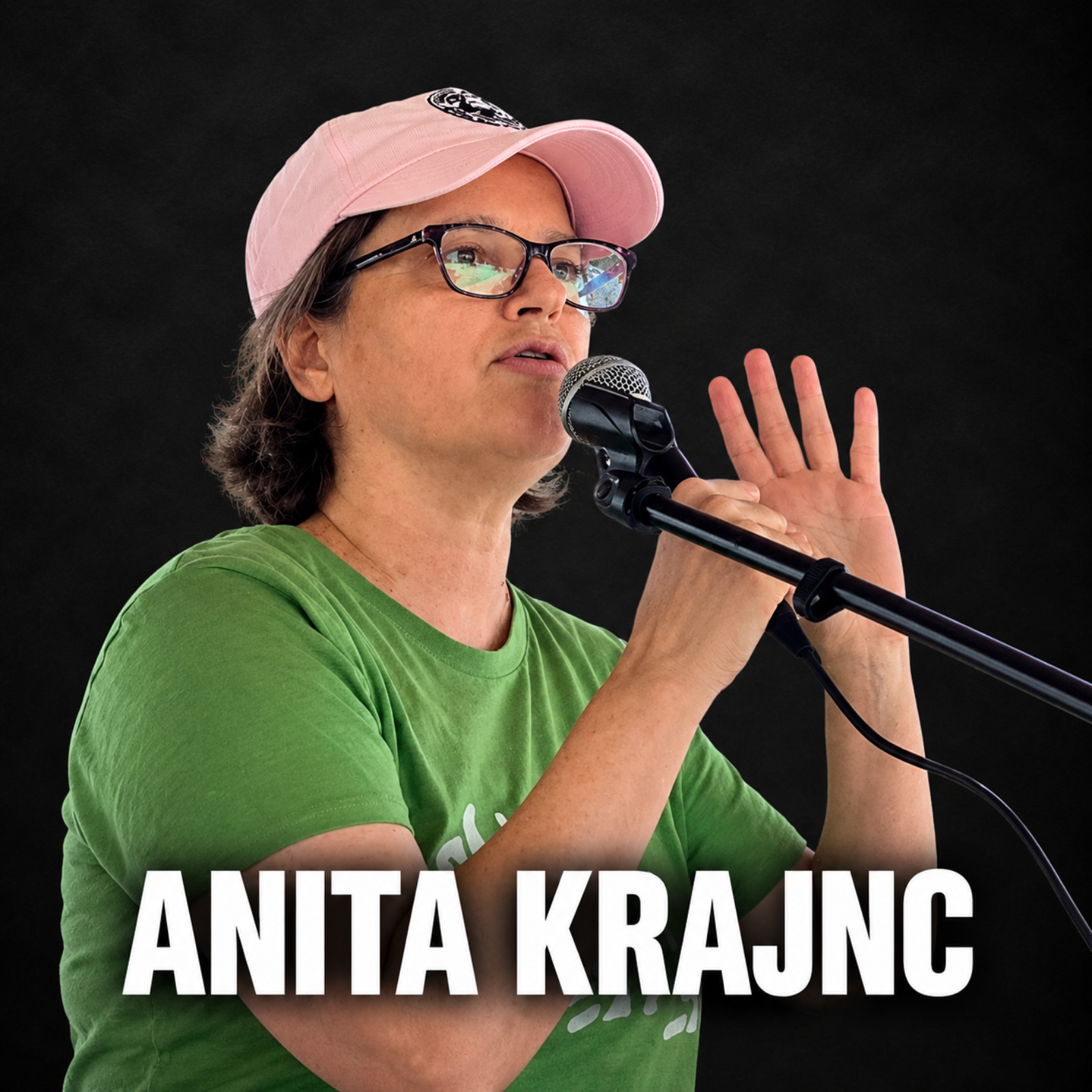
A Fork in the Road: The Future of Animal Protection.
86m 42s
The Vegan Report explores the growing disconnect between animal rights activism and its real-world impact, critiquing the ineffective "cage-free" campaign as a step in a flawed trajectory. Anita Krojneik, co-founder of the Plant-Based Treaty, argues that hundreds of millions in funding are being directed toward welfare tech and cage-free systems, which actually increase animal suffering and environmental harm. A landmark PETA study reveals that cage-free farms face higher rates of injury, disease, and mortality compared to traditional systems. This undermines the moral and practical case for animal protection. The deeper issue is systemic: animal rights activism is constrained by utilitarian thinking, corporate interests (like AI companies and agribusiness), and fragmented institutions. A radical shift is needed—moving from welfare-focused campaigns to a full-scale transition to plant-based food systems, which simultaneously reduces animal exploitation, climate degradation, food insecurity, and pandemic risk. The solution lies in holistic systems thinking, drawing on environmental philosophy and ethics from Tolstoy and Gandhi. Activists must reject the idea of "compromising" moral purity for short-term gains, instead advocating for a moral ascent—up the ladder of ethical responsibility. The report calls for cross-sectoral collaboration, greater transparency, and a reorientation of philanthropy and activism toward plant-based food as the central solution to multiple planetary crises. It concludes with a call to action: sign the Beyond Cage-Free Open Letter, challenge outdated frameworks, and support a unified, just, and sustainable future.
Ready to level up your day?
Then join me and my friends at LonestarCasino.com
That's L-O-N-E-S-T-A-R Casino
where you can experience the thrill of Las Vegas.
No matter where you are,
LonestarCasino.com is an absolutely free-to-play social casino with thousands of games,
daily bonuses, free spins, and jackpots that pop like fireworks.
Hit Puzz on Life and hit Play on LonestarCasino.com
LonestarCasino is a free-to-play social casino, voidware prohibited.
Visit LonestarCasino.com for more details.
Sign up today for an incredible welcome bonus.
Play bold, win big.
Welcome to the Vegan Report.
My name is Ryan, and today we're going deeper into two controversial topics.
The ineffectiveness of cage-free campaigns
and the embrace of factory-forming 2.0 by so-called animal rights activists.
As a reminder, we previously covered these topics in episodes 120 and 125 links in the episode notes.
To discuss all of this, I'm joined by Anita Krojneik,
Anita is the co-founder of the Plant-Based Treaty,
and the founder and executive director of the SAVE Movement.
She is currently leading the Beyond Cage-Free Initiative,
an open letter that, and I quote,
"is calling on effective altruists to pivot their focus area
and the AI windfall funding away from well-ferrous reforms
towards plant-based initiatives that create multiplier benefits for animals,
climate, health, food security, and reduced pandemic risk."
I invite you to sign the Beyond Cage-Free Open Letter.
I signed that letter, not because I don't believe in evidence-based activism.
Quite the opposite.
There is evidence that those campaigns are not helping anyone,
enough evidence to warrant putting a break on the stream of millions funding this style of activism.
In addition to discussing cage-free campaigns,
we also tried to understand what is going on in the minds of activists in this movement
who have chosen to pursue operating advanced forms of factory farms.
And to help us better understand their thinking,
Anita and I looked at an article written by Aiden Kankiyoku
and published on his sub-stack, "Send Castles,"
titled "There is a Pat to Meet Without Misery."
The article has generated quite a bit of controversy.
Anita and I do a good job of breaking it down
and explaining the rationale behind it.
If you're curious, you'll find the link to the article in the episode notes.
But be careful, it's pretty stomach-turning.
As always, share this episode with the vegans you know.
And let's get more people to sign the Beyond Cage Free Open Letter.
Follow or subscribe for more top-provoking conversations.
Thank you so much for listening and for leaving a good review.
It's always appreciated.
Anita, welcome to the Vegan Report.
Thank you so much for having accepted my invitation.
Nice to be here, Ryan. I was truly looking forward to talking with you
because we're going through some strange times.
In general, if I look at the news,
it's worrisome in a strange way where we have AI
and the race for superintelligence.
We have all of those wars going on.
We have talks of alien disclosure.
And now I look at the animal rights movement
and wow, we have some so-called animal rights activists
who want to run factory farms.
And I feel more and more estranged from our reality.
Is this the Twilight Zone?
Do you feel the same way?
I think there is a strong plat-based movement.
There's a strong animal rights movement.
There's a strong climate movement, health,
healthy diet movement.
So I work in that space, so I see a lot of this.
I think what's changed is the rise of AI.
There's concerns about safety across the board.
There is a lot of money coming from AI, you know, inthropy, in particular.
And I think it's really important that we take a holistic approach
and look at helping animals, but at the same time,
thinking about how to transition to plant-based food systems
because that will also help reverse the climate emergency,
the health crises, pandemic risk, and food security.
So I think it's really important to have a systems perspective in times like this
because otherwise it's hard to make sense of it.
Because there's so much going on and it's like we have a fork in the road.
We either go down a path that these are all separate crises and we just
make them all worse or we go down a different path where there are solutions.
There are pathways we can go and improve things across the board.
And animals are key on this planet.
In terms of how we treat them, we'll decide the future of life on the planet.
So in my lifetime, I was born in the late 60s.
There were in the earlier part of the decade in 1960s,
there were under 10 billion farmed animals that were killed each year.
Now it's over 90 billion.
That's in my lifetime and that's unacceptable and the numbers keep going up.
So for me, the key metric is the number of farmed animals.
And as those numbers go up, the number of wild animals goes down.
The climate crisis gets worse.
There are more pandemic risks.
There's more use of antibiotics.
The vast majority, 70% or so.
And we're going to get antimicrobial resistance.
And that's going to be the number one killer by 2050.
More so than cancer.
So like there is a fork in the road.
And the only way to understand that fork in the road is by putting a different lens on.
It's by having a different worldview, which is holistic ecological.
And in that worldview, there are particular ideas or philosophies,
interests and institutions that we have to look at.
And that's sort of is my background, it's political science.
And it's called the three ideas, interests and institutions.
And if we get them wrong, we're going to go down a bad pathway.
If we get them right, you know, we can have paradise on earth.
We're blessed with soul, you know, with nature with so many wonderful things on this planet.
And it's up to us, basically.
I want to get back to factory farming to 0.0 and what it means.
But first, let's talk about cage free campaigns.
And basically the animal welfare crowd
inside the animal rights movement or inside the animal protection movement
to use more inclusive language.
I did an episode on that called I think the cage free guy slide.
And I learned a lot from having that conversation
that the cage free narrative was not as truthful as you would think
that there are lots of considerations that we're not thinking about
when deciding to support this.
What made you launch your open ladder and take a public stand
against the this cage free push inside our movement?
So in September of 2026, we launched the beyond cage free open ladder.
And I've always had issues with welfare in general, not just cage free.
Because I helped start a group called Toronto Pig Save
in 2010 with my dog Mr. Bean and local activists and because we witnessed
transport trucks going to a slaughterhouse and the pigs would look out.
And it was the first it was an epiphany because I saw the pigs as individuals
looking out scared, sad and pleading for help.
And we the first pig I looked up close when I walked up to the truck.
I promised the pig three vigils a week and front of the slaughterhouse.
And we kept that promise until that slaughterhouse in downtown Toronto and bankrupt.
And so when we were doing this vigils, it was so clear that those pigs, those cows,
those lambs, those turkeys, those rabbits, they're all equal.
They're all equal to you.
They're equal to your family dog, family cat.
They're equal. And so it was never our group.
Toronto Pig Save, what then became animal saving went never said eat less meat. It was just it's
impossible to say that when you're in front of a truck and you know every single individual is just
like you and that they have, they deserve rights, animal rights. And so I've come from that tradition
where you know we're always calling for people to do the optimum, which is go vegan basically.
And then we started plant-based treaty five years ago and we didn't call it the vegan treaty,
we called it plant-based treaty because it's something that is more sellable in terms of you know
trying to talk to counselors and institutions and so forth. And the call again was a calling for
the optimum, which is like we need to transition from animal agriculture to a plant-based food system
so that we can live in a safe and just world. It benefits the climate and other planetary boundaries
but also humanitarian issues like food justice, food security and so forth. And so coming from
that tradition like always asking for the optimum and using not just utilitarianism but deontology
or the philosophy of duty and doing the right thing in the present, not just calculating what is the
greatest good for the greatest number but doing the right thing in the present. So coming from that
tradition I've always been critical of or not accepting really of welfare. I didn't think it was
necessary and it slows things down. A lot of people have said oh it's a stepping stone, it's
incremental change. Obviously I don't want to see animal suffering but it's it's not just about
suffering as utilitarians would say and animal welfare, it's about exploitation and and if you
play the golden rule it's you wouldn't want to be in that truck and you wouldn't want to be eased or bred and killed by
you know in a killing facility. So that's where I come from and so I've always been critical
but what changed this year was the realization that entropic was
funding the animal philanthropies with hundreds of millions of dollars and potentially billions
next year or over the next few years and that the funding seemed to go mainly to cage free
and tech sorry welfare technology or welfare tech. I'm sorry and then
but some of it was going to alternative protein as well as it's hopefully some of it was going to
some plant-based initiatives. So I've learned that and then I learned about that recently because
there was this summit in Toronto which you went to as well Ryan the you know the aba summit the
animal vegan advocates summit which was held in Toronto for the first time in May. Usually it's in
Washington and LA but because of Trump and you're making the U.S. a very unwelcome place for people
abroad they've now moved it to Toronto and it's going to be in Mexico City next year. So anyways at
that summit Tracy Rhyman who's the new head of PETA people for the other whole treatment animals
gave a talk on humane washing and she's they also were distributing their white paper on the failure
of cage free housing systems to reduce overalls hand suffering. So in this white paper which is
about 40 pages and has like almost 200 footnotes. PETA which used to be supportive of various
welfare approaches including cage free changed its mind and is now opposed to it because they
do not believe it reduces overall hand suffering. That's even in the framework of utilitarianism
just talking about suffering not exploitation because they found out that they found that you know
on some level nobody wants to be in a better cage you know and it does seem at first glance that
you know much better to be cage free but it is on certain levels like you know being able to turn
around spread your wings nest so you have some natural behaviors but what PETA found was like
you know in some areas it's the same like whether it's just forcing you know chickens
hands to lay that many eggs like 300 it's completely unnatural like in wild you'd be you know 20 eggs
it's the the calling of the male or the killing rather of the male chicks of the
the forced malting and the lighting and there's just so many atrocities that happen but then in
some ways it was worse such as the dust levels are 10 to 15 times large more more so there's
injurious pecking there's cannibalism more cannibalism the keel bones the keel bone on
hands tends to be fractured at 80% 85% in the cage free so and there's more fungal disease and
these facilities are more likely to catch fire in which case you know the entire barn burns down
so so when you look at it overall welfare it's it's not it's not really improved but
and then when you compare that to plant based there's no comparison like why not just promote plant
based food transition not just for the welfare of the hands but for the rights of the hands so
they're not exploited but also for the climate for reducing pandemic risk for improving people's
health people who eat an average of half an egg it's in our report each day like they increase
their chance of like heart disease by you know six or eight percent something like that
so we had a doctor's archesam contribute that part of it she's had plant based Canada
you know there's there's food insecurity issues there's issues of more fresh water use
greater greenhouse gas emissions acidification and on top of that in our open letter we note that
in the UK egg industry study which came out in July of 2026 they found that moving from
battery cages to cage free would require 1.6 million extra hands per year to produce the same
number of eggs because the eggs get damaged and in the cage free so like you're actually
introducing more hands into the system so from our perspective effective altruism
and other sort of funding communities need to need to change the metric to the number of animals
in the system because we got to stop reading you know and killing and slaughtering
farmed animals and as I said at the start of this you know it was below 10 billion land animals
a year in the 1960s and out over 90 billion in the 2020s it's just and we're seeing the consequences
for the animals for for the environment for health for food insecurity for pandemic risk so that's
why the starting point at this fork in the road needs to be worldview we need to get the we need
a paradigm shift uh it's been a for decades people have been calling for this paradigm shift there
was a famous book called turning point by fridge of capra and it was made into a movie called mind walk
with uh live almond just a great actress and and uh sam waterston so i strongly recommend this
beautiful film called mind walk but it's based on the book you know fridge of capra's turning point
there've been so many thinkers like that in environmental studies environmental thought
i used to be a teaching assistant for my favorite prof a rest holding he taught a course on
environmental thought there were books like um where it was called um sorry i just tried to think
of this book that i really like but uh basically it's about world views like uh you know sort of like
just sort of changing the worldview from a cartesian mechanistic reductionist thought
to something that's more holistic and uh ecological systems thinking so you know in environmental
thought there is a long tradition of trying to um encourage people to change that worldview and
yeah the title of the book that i was wanting to uh get ways called the reenchantment of the world
by Morse Berman it's absolutely beautiful book i think you might be from Montreal where you're from
i think it was a professor at McGill um but yeah uh yep here it is uh Morse Berman is assistant
professor in the program in science and human affairs at concordia university Montreal but it's at
you know just a beautiful book in environmental thought about how you know at one time in human
history now there it was mother earth it was there were certain you know i world views that sort of
had a lot a deep respect for um
The role of women and men, it was much more egalitarian.
It was a respect for nature and not seeing humans
as separate from nature and superior to nature.
So there's this long tradition and storytelling.
That is one of the root causes of where we are.
You know how there's a lot of thinking about,
oh, let's do nudge strategies.
It's not enough.
Not just great, you know, land-based by default is great,
but it's not enough.
We also have to change our worldview.
And we need much bigger changes if we're going to get to where
we need to go to stop the climate emergency
and the other emergencies which we're facing this century.
How do you think the animal welfareists, the effective
altruist crowd, has welcomed that white paper?
Because I look at the timeline and I
see when that presentation was given.
There is now like millions of dollars
worth grant from the animal welfare fund
looking for new cage-free campaign projects to fund.
I look at various events, cage-free events,
where people proudly take pictures supporting this campaign.
And it feels like those people are
in complete denial of all of that discussion.
And I wonder because I did not confront any of them.
I know a few of them, but I did not confront them
with what do you make of that white paper?
But have you had that interaction?
So I think-- yes, I've been talking to a lot of people
about the white paper because I went to the talk
by Tracy Reiman of PETA.
And I didn't know about the white paper
until I went to the ABA summit in Toronto.
And I was very impressed by Tracy Reiman's talk.
It was beautiful.
It was like in terms of showing who
hands are as individuals, as mothers in a natural setting,
and just showing the incredible suffering and exploitation
in animal-- sorry, whether they're cage or cage-free.
And the paper came out in January, 2026.
And it's less than a year.
And I think now there's more and more interest in it.
So sometimes it takes a little bit of time.
But I think what I think we also have to make it simpler.
Like I said, it's 40 pages, 200 footnotes.
So what we did in our Beyond Cage Free Open Letter
is we put it into a chart form to simplify it.
And so you can read it in less than a minute
by just looking at the chart.
So I think it needs more infographics.
It just needs to be more talk about it.
I think Tolstoy, one of my favorite authors,
he would say, for some big issues like this,
you either get it or you don't.
And I remember when I was an omnivore,
I thought I was a good person.
I liked animals.
But for some reason, I never thought about food.
And it was only in the university
where when I saw a movie, the animals film that I changed.
And I became vegetarian in the '90s.
And I think it's a topic like climate change.
Unfortunately, it's not on the radar of the effect
of altruism community, at least as we see in the EA forum
or coefficient giving, because it wasn't one of the priority
areas.
So it was like animal welfare, health might be some--
maybe it's security, things like that, AI security,
and things like that, but we're safety rather.
But if climate change is not part of your daily data
or information that you're getting,
it's so easy to treat it like an externality.
And so that's what we want to change that.
And so we're calling for a holistic system's perspective
where you do think of all these different items.
And it is part of your daily concerns.
And what's remarkable is they all
have the same solution, which is switch
from eating animals to a plant-based food system and diet change.
So that's how I see it.
I just see it as, like, we'll get there.
It just like--
just we need to do better at getting the information out.
I think just a lot of people simply do not think about it.
I mean, until PETA did this study, unless you were really
deep into this issue, you wouldn't be thinking about,
oh, this welfare is traded for this other welfare.
Maybe you might improve one thing and make other things worse.
I think most people never thought about that at all.
And so PETA has introduced that in January.
They published this.
And it's a big contribution.
I mean, there were some studies like that already suggesting it,
but it wasn't popularized.
But when one of the largest and oldest animal groups,
in particular, an animal rights group, like PETA,
takes a stand, it's really important for the movement.
And I know the initial reaction was maybe ignore it, move on.
But I think once people learn about it around the world,
from India to Latin America to North America,
I think once people learn about it, I think it's quite impressive.
And some people will still try to argue that, oh,
this one welfare measure, cage-free, is something really
worth backing.
But I don't agree.
I think we need to pivot.
We're facing an animal emergency,
but we're also facing a climate emergency.
And we really need to take a systems perspective
and just go full on, make the main priority a plant-based
food system.
But I also see other barriers that we can talk about.
I see like, OK, I think it's a question
of getting this information out, but also
see barriers with respect to in political science,
we call it the three eyes, ideas, interests, and institutions.
And happy to talk about that as well,
because I think that's a further reason why we're not seeing us
just race towards that pathway that is like plant-based food
systems, which is like such a win-win across the board.
It's like, why wouldn't we do it?
I think the explanation has to do with the three eyes.
I wanted to also bring up the ego question,
because Peter was brave to publish that paper.
They used to support the cage-free campaigns.
And so by publishing this paper, they
admit that they were wrong.
And that's something humans don't like to do.
And there are some activists who devoted their entire activism,
pushing to implement cage-free policies.
So much money was spent on those campaigns from funders.
Like, those all of that big crowd needs
to now confront the fact that those actions were kind of wrong.
And they should now admit that this was not effective
at progressing the agenda.
And so, yeah, ego, I think, is playing a big role here, no?
I think, again, like I said, the story
about when I was in Omnivore.
I was worried about the Cold War.
I thought I was a good person, but then I found out
about how animals retreated.
I couldn't believe it.
So I think it's like, did I reflect?
I regret that until my early 20s, I was in Omnivore.
I really regret that.
I don't focus too much on that.
I focus on, OK, what am I going to do now?
What's the most I can do?
And I think that's the same in this situation.
Yes, there are some costs, like people
have been working hard on cage-free with good intentions.
And OK, well, maybe if we take a holistic systems perspective,
it's not helpful.
And maybe it's not helpful.
If you, even in taking a utilitarian world philosophy,
it's not helpful, according to the PETA paper,
which came out in January.
And it's also not helpful if you take an animal rights
perspective, if you're talking about exploitation of animals.
But then when you take the climate, health, food insecurity,
pandemic risk, water use, acidification,
eutrification, all these different issues,
it's not a winning solution.
It's a loose, loose, loose, loose approach.
But then again, like I said, we all made mistakes in the past.
And once we learned new information, how do we switch?
We don't tend to focus too much.
OK, I was really, really made bad decisions
for 22 odd years, in my case, being an omnivore.
I mean, I regret it.
I deeply regret it.
I'm remorseful that I've caused so much death and suffering,
and. but my focus is just like, okay, what can I do now?
What can I, how can I change things?
And I think that's what we're asking for.
I would, you know, when we launch this beyond cage free,
open letter, that's what we're focusing on.
We're saying, hey, pivot, like let's pivot now.
We have this, if you take a holistic lens,
and that's not easy, this is not just our movement,
that not just the animal protection movement,
you can go to the environmental movement.
They don't take a holistic perspective.
That's why they don't focus on food enough.
So it's just across the board, we have this tendency
to not use complex systems perspective or thinking.
But there's a lot of, there's a history of that, as I said,
and some current work on it that's really important.
And there's a lot of academics and journalists
who are trying to get people to take a holistic perspective.
I'll give you an example, Kate Rawworth.
She's an Oxford economist.
And she used to work for the UN development program,
and then Oxfam for more than a decade.
And she wrote a famous book called Donut Economics in 2017.
She's now vegan.
She's a researcher in vegan.
She says that, you know, you need to, in the donut,
she's trying to challenge classical economics,
we just like endless growth.
So she said, no, you need a donut.
You need a circular economy.
And on the outside, the ceiling is the planetary boundaries,
like climate change, by diversity, land use,
acidification, the ozone layer, phosphorus and nitrogen,
like new chemicals, like plastics and microcount things like that.
And then also, I think it's aerosols might be another one.
But anyways, there's nine planetary boundaries.
That's basically Johann Rockstrom's work from Sweden.
And he's currently at the Potstem Institute.
But on the inside, you have the UN Sustainable Development Goals.
And then in the center of the donut, it's the green zone.
That's like the safe and just zone.
So she has a whole chapter in her book on systems thinking.
And it's fascinating.
It's about how do you balance this drive for efficiency
with, you know, retaining diversity.
And so in the EA community, it's too simplistic.
It's all about efficiency.
But that's not how you have a resilient, you know,
food system or ecosystem either.
So, and then there's another book
by George Mombiet called Regenesis.
And chapter two is on systems.
His first chapter is on soil.
And then the second chapter is, it's a really beautiful book.
It's about, the whole book is about changing our food system
to plant based, and he's also vegan.
And he was the first person to, like in the special comments
on the support for Peter's paper.
He was the first, well, no, he's not the first person.
It's Dr. Crystal Heath, but he's certainly listed here.
He's at the bottom here of the first page.
It says, there is simply no good way
of supplying people with eggs.
The welfare and environmental impacts are enormous.
However, the chickens are housed. As this crucial report shows,
we just need to stop.
So that's his quote.
But he's this, he writes for the Guardian.
He's written many books.
And he has a really beautiful book called Regenesis.
And there's a whole chapter on systems thinking.
And he talks about the standard American diet
sad for the acronyms are sad.
And how there's the spread of the standard global farm,
which is factory farming, spreading around the world,
and how it's making our food system less resilient.
And he says the population crisis is not humans,
which apparently the growth rate now is 1.05,
whereas the population growth rate of farmed animals
is over 2%.
So it goes, that's the biggest part.
You know, that's why I started our conversation saying,
the key metric is the number of animals in the system.
And it's not just growing
because there are more people on the planet.
Even per capita it's growing.
And between the 1980s and 2020s, it grew 50%
from 30 kilograms per person per year
to 45 kilograms per person per year.
That's devastating for the animals.
And for both farmed animals and wildlife,
because the more farmed animals you have,
the more land use there is for animal feed,
and the less wildlife you have.
So we've had a devastating impact on the planet.
And we need, see, that's why you need a holistic perspective.
You can't just talk about all the number of hands
that are cage free and you're sparing them from cages.
No, you have to talk about how the Amazon is being cut down
for animal feed to feed chickens in Europe and China.
Like, that's why you need a holistic perspective.
You have to take all of that into account.
And when you do, it's obvious
that the right answer is, let's fight really hard
for a plant-based food system transformation.
Let's have a just transition for workers.
'Cause the fossil fuel campaigners,
the anti-fossil fuel campaigners,
they're already, they're way ahead of us,
the animal movement.
And that's why I think, in fact,
Walters community, coefficient giving,
all these, they need to include climate change
as one of their areas that they support action on.
And that they need to talk about food and climate
and food and health and food and pandemic risk.
So anyway, so that's where I'm coming from.
So I'm not that critical.
I have no anger, I just see this as,
it's not on people's radars for various reasons.
And it's our job to get another radar.
But then we also have to deal with these three eyes.
Like, we gotta change the philosophy.
It can't just be utilitarianism.
It has to be deontology and systems thinking.
We have to change, we have to address the interests.
We're dealing with these big AI companies
and they have an interest in creating a worker-free workforce
and to work with big egg, like Cargill,
which is already mechanizing the killing at slaughterhouses.
So there is this interest there that we have to address
and say, look, too anthropic and open AI.
We have a bigger interest here,
which is the survival of life on a planet,
not killing animals, not destroying our climate,
not using up our freshwater use for meat, dairy nags.
So we have to sort of address those interests
and the way to address those interests is through organizing
and bringing groups from different sectors together
and creating a big tent.
So of animal protection, climate groups, health groups,
that's what we're trying to do with this open letter.
- Let's talk about factory farming 2.0 now.
I did an episode on that with Sam Tucker-Divis.
He wrote a piece about it.
You are on sub-stack now, too.
Is it recent?
- Yeah, I just got on it because of all this issue.
- Amazing, I need to subscribe.
Your first post was, first article was very interesting.
But for him, this whole push for factory farming 2.0
in this phenomenon of animal rights activists
deciding to run factory farms
is the product of defeatism in the animal protection movement.
We don't believe that we can win.
We don't believe that we can transition the food system
to a plant-based model.
And so basically, we joined the enemy
in an effort to change the enemy from inside
and incrementally, of course, just on the margins.
I guess my first question for you about Dante's,
what do you make of that defeatist attitude?
- I think it comes from the three eyes,
so I'll give you an example.
So it's in the interest of companies like Anthropic
and OpenAI to work with Big Egg
and try to create robots and machines
that breed, confine, feed, and kill animals.
And it's a business and they could create
a worker-free workforce in factory farms and slaughterhouses.
And there's a lot of money coming from that industry.
And there's also this ideology or philosophy
of utilitarianism, which focuses on welfare.
So why not talk about welfare tech
and K3 and welfare measures in factory farms
and slaughterhouses?
Why not talk about shrimp welfare, better stunning methods
and even pay for them, as you said.
And we're fish-stunning.
And because it's coming from an industry
where that's what they know and that's where the business is.
So there's these ideas that are limiting
like utilitarianism, these interests
where we have an oligarchy, just a few companies
that are massive and are working with other big industry.
And then we have institutions.
That are separate, disaggregated.
We don't have holistic thinking with cross-sectoral departments.
All concerned about, oh, let's talk about climate animals.
talk about everything. We don't have that. So the three eyes facilitate and enable that
kind of defeatist thinking. Because if you took all those things away and the hundreds
of millions and billions of dollars, that's about to enter philanthropy came from a rental
company or a being company or an avocado company or a bread company, it would be very
easy to talk about plant-based food transition. So I always look at it as what's the most
obvious and rational thing to do won't necessarily happen until you address the barriers. The systems
barriers, the thinking barriers, the institutional barriers. So in political science we call those
the three eyes, ideas, interests, and institutions. Often, you know, ideas are not enough for a lot
of us ideas are enough. Like we might have strong ideas about animal rights and that's enough to
determine our attitudes and behavior. But for a lot of people, it might be interests. You know,
that's a lot of people think those are, that's probably one of the most important things. But in,
you know, in the Western tradition, institutions are important. For people that believe in democracy,
the rule of law, those are institutions. For somebody like Trump, he's just very self-interested,
where it's just very transactional. You know, it's just very, you know, so that's like in the worst.
That's very psychopathic and sociopathic. But just generally for most people, you know, there's
incentives that come from a system or interests. And so that's, so that's, I'm just trying to be
honest and open and having conversations with co-efficient giving or, you know, not that I've had
conversations on a topic yet, but I just would want a very open discussion saying, look, at the end
of the day, the most important interest we have here is not money or gold or anything like that. It's,
you know, a safe and just planet. And, and if you have a philosophy with that interest,
that respects life or, you know, that respects rights, then that would also influence how they
see things or, and then there's also institutions that I'm calling for cross-sectoral institutions,
where we bring together animal protection people, climate scientists, health professionals,
you know, pandemic experts, food security experts and things like that. But most people have no idea
how threatened we are by climate change and food insecurity. And so I, I beg people to, you know,
please go to our Beyond Cage Free website and not only read the open letter, which is very long,
but we have much longer report. And it has, it shows you in depth how threatened we are,
like our climate niche, you know, where, where we can live, that doesn't seem like the Sahara Desert,
like 20, average temperature of above 28 degrees Celsius is going to shrink as the climate warms.
And there could be billions of climate, like refugees or migrants this century, if we can continue
this warming. And we could cross tipping points like we could lose the Amazon rainforest. We're likely
to lose coral reefs. How tragic is that? We're likely to use glaciers, the West Antarctic
Arctic ice sheet, the Greenland ice sheet. It's just like, if we warm a lot, we're going to cross
more and more tipping points. And so how do we make this part of the daily conversation?
The only way to do it is to have a, you know, a, you know, a holistic systems thinking and
bring people together and have this, this world view. And so, so that, so when you look at our
beyond cage free open letter, it's very ambitious. It, it looks at all these different factors,
it makes the case. And it's new for a lot of people, like it's, it might be a little uncomfortable
for people to see, you know, I posted on the EA forum, but I posted a lot about climate. So I
talked about the animal and climate emergencies, because we're trying to introduce people
to think about these things. Because if you don't, it's just simply not part of your reality.
It's an externality. Like when I was an omnivore, I thought I was a good person. I never, ever
thought about, oh, where's the chicken or the, what, what I thought bent back then was B,
rather than cow flesh. I just thought, oh, I'm a good person, because I'm making steak for my mom
who's, you know, working at a, at a warehouse. And I thought, oh, I'm such a good person. I'm,
you know, I'm, I'm making dinner for, for everyone. So it was completely not part of my thinking.
And I think the same thing is happening here. People are just not, it's just not part of,
they're not just not even thinking about it. It's completely outside the radar. So we're,
that's what we're trying to do. So there's no judgment here. There's no anger, as I said,
but there's no quainting fingers. It's just like, we're just trying to help people
do the right thing, which is in all of our ultimate interest and our deepest interest.
And that's what our project is. When I try to understand what's going on in
the minds of people who are pushing that new model, I, I can't help but think about the,
the article that was written by the sent castle person. I think his name is Aidan.
I don't remember the title exactly. I think it was meet without misery, the title of that article.
And he goes into basically the rationalization of that, of adopting those new
welfareist technologies, at what degree and he goes very far with that. And basically why
we should call it a day as an animal rights activist and
concedes to the industry and just lean in into this new farming 2.0 reality.
And when I read the piece, I can feel, I can't help but feel disgusted. I can help but think
those people went too far. Like they're off the wagon. Like it's over. We can't really reach them
anymore because they are very radical and ideologue in the way they have framed this issue. And
that's kind of a mind prison, hard to get to escape that. One reader of that article said,
this was a thought provoking piece. What a euphemism. I think it's not thought provoking. I think
it's confusing. And I think that's what it does. It confuses your sense of reality,
your rational thinking, your moral compass. Yeah, it's hard to have another reaction then.
Let's just excise that part of the movement. And let's just do things our own way.
Because we can't reach them. But do you still have hope to reach people like this Aiden fellow?
Yeah, I do. I know Aiden. I've met him at the best part of the direct action everywhere,
actions a few years ago. And he was part of animal. I think he was been in different movements.
He was part of some large group now, animal or something. But anyway, I looked at that piece and
I took it very seriously. I spent hours reading it and taking notes. And the way I, when I read it,
I read it from a class perspective. So a lot of his calls to action were about helping AI
companies do their business with big ag. So once you see it from that perspective, it actually
makes sense. You know, if you don't analyze it from, say, a class analysis, it just, it seems
like, oh, is this person psychopathic? Is this person, is this arbitrary? He's just saying shock
things and just trying to mess with your mind? Or, you know, no, it actually made a lot of sense to
me when I was reading it. It was like, there's a ton of money coming. And anthropic is strongly
connected to the big phalanx animal, the biggest, some of the biggest animal welfare philanthropies
and started by some, you know, some of the people that are now in anthropic.
So, so if you're in AI, you're trying to think, okay, look, this is the field I work in. We're
working with big ag. How do we make it better? This is, how do I apply what I know in AI? You know,
what can I do? Oh, you know, maybe we can have welfare technology. Maybe we can, you know,
improve the stunning methods. Why would you talk about plant-based food or farmers markets or,
you know, societies that are mostly plant-based, but they're being, there's astro turf operations
by Cargill. No, you, in fact, want to work with Cargill. The guy who started Mercy for Animals
is now with the Spring Innovation Fund, heading that. And no, he, on his website, he puts Cargill.
There's nowhere on the website that says plant-based food transformation, because that's
there's loads of money there and and there's people on that in that group that also were part
of alternative plan protein but they no there's not they don't think the money's there they they're
making this decision saying no there's more money here so they're going here so if you look at it
from a class perspective uh you know some people have made the decision like let's just work with
that and let's you know and but but if you take all that away and it was it was it was a it was a
bread company or a bean company that had the money this would not be the conversation Aiden would
be writing a different paper he would be writing a paper about we really need to change our protein
from meat daring eggs to beans and lentils and seeds he would write a completely different paper
but he succumbed to this powerful force of interest and um and it's also monopoly or even
oligarchy interest you know these if there's a lot of pressure on these companies
there might there might be amazing people working at these companies but there's pressure on them
to not go bankrupt you know to understand how many hundreds of millions they have to invest in
data centers you know they need to prove themselves that they can create a worker-free workforce which
doesn't necessarily benefit us but that's that's why that's how they can argue that their work their
companies are valuable uh and where are you going to do it um you know who are animals going to
resist and fight back you know when you create machines and robots who who which human being
would want to be bred confined fed and killed by machines and robots this is a total dystopia
uh and that's why we have to step back and and and again look at the three eyes and look at
interest look at ideas because ideas facilitate this like uh utilitarianism makes it easier to have
these bad ideas um and when you lack the institutions like a systemic holistic type of institute so
so there's ways to to respond to this and it's always been in the case of interest it's always
been organizing so you organized people power uh against uh private interest or special interests
and in the at the end of the day it helps everyone when you know you or you know you organized a
five-day workweek or you you know you improve the you improve democracies it it it it just benefits
everybody and so so that's our mission like that's why we're trying to you know yet set up a big tent
you know have lots of different interests come together and you know what can AI do to help us
like can can it help us develop a systems calculator where we develop uh what Patrice Jones said was
a holistic math for animals because right now the way the the way not the quantitative
methods are used are not they're not accurate they're they're treating the so the most important
things as externalities that's not that that's not a real math we have complex systems and we need
um if you read even if you just see if you use quant quantitative methods um it would show
that the the best win-win approach is switching to a plant-based food system
so anyways so that's how I see Aiden's piece like I just see it when you look at it carefully
I I took notes and was going oh yeah this would benefit the the the business I would constantly
saw things that he was saying that would benefit business even he even celebrated he said um
you know for robots uh took over workers that would be a good thing because workers are angry
and robots are going to be more gentle but I would ask Aiden would you would you why don't you
replace one of those hands and put yourself in that situation or you know one of those cows
and have had I live in that window you know that windowless uh warehouse and go to a slaughterhouse
and be killed by a robot like you know that that if you follow the golden rule none of us would want
this this is absolute nightmare you know so so you know I'm just saying like I understand
where he's coming from and I think if you I read it really carefully actually read if we took
me hours because I was taking notes uh and uh I you know I I I can see through it basically um and
um so I do think he can be persuaded because I could just simply point out and look this is
what you're doing and if it was a bean company or a bread company you would be writing a different paper
there is a part of this article substank that I could not make sense of which was he invites the
readers animal rights activists to sacrifice our moral purity and it's like we're some bourgeois
class that is holding into this precious amoral purity that is stopping us from
making progress and he wants us to bloody our hands it's basically word for word what he's saying
I'm not inventing that and I was thinking if you're ready to go that far sacrificing your moral
principles why are you not inviting us to murder every shareholder of thyson and all of the other
animal exploitation operations out there if we're ready to sacrifice our moral principles if the
means justifies the end and so on then why not go there why go into the field of let's turn
animals into brainless creatures and do all of those experimental things to them
and I feel like it's a bit cowardly we it's the week you know animals are weak we can absolutely
do that to them but going against the the those oligarchs out there becoming some kind of
violent militia that's that would mean sacrificing your comfort that would mean standing up
from your desk and having to purchase a gun or something and maybe sacrificing your freedom
and so on and I guess we're not ready to go there it's it's the ranging it's the range
the way of thinking about the world yeah what did what did you make of that yeah I thought that
was one of the most interesting parts of it because I think both of us Ryan think a lot about
philosophy and that really moves us you know and that sort of is central to us and you said
you were very influenced by Buddhism and and that's it's inconceivable to to to even you know
think about what what you know I even was saying and I agree with you that sort of that passage
sort of stuck out to me and I can read it here he said I ask much more from you now I ask you to
let go of your moral purity to take those pristine hands of yours and use them to make a difference in
the lives of animals letting them be stained with blood in the process in fact it's better to think
of ourselves climbing down the ladder leaving behind our moral comfortable sorry leaving behind
our comfortable moral high ground like orpheus descending into the underworld to negotiate
with its ruler for the return of his lost love even brings a love story into it and descending
into hell so I thought that passage I really thought that passage was significant and because I'm
a big follower of Leo Tolstoy so I don't believe in violence I think violence is the worst thing
that the enactment to anyone nobody wants to be subject to violence it's such a horrible thing
war is a horrible thing you know killing animals is horrible and Leo Tolstoy was you know a big
advocate of non-violence and he wrote he wrote an essay or an introductory essay called the first
step and it was for a British author Howard Williams who wrote a book called The Ethics of Diet
which looked at famous vegetarians in history and Leo Tolstoy was known as a psychological
realist like a very one of the most famous realists you know alongside you know Charles Dickens
and others at Bowsack and and when he wrote War and Peace he he went to the battle sites
you know in order to write the book like so he was very you know he did a lot of research
and so when he was invited to write this introductory essay he said well I'm going to go to a
slaughterhouse so he took a train to Tula and the first time it was closed when he went then he went
back and he he was the first thing that struck him was the smell it was unbearable he witnessed he
bore witness that's sort of what you know our group did try to fixate animal safe movements about
bearing witness like going there and being present and he bore witness inside the slaughterhouse
and and then in the essay the essay is called the first step because he said the first step
to being a good person is not killing animals and so in contrast to Aiden he says we need to
take a step up the ladder you know or up the staircase not descend down
And, you know, Aidan's essay is structured as rungs.
Like, let's go down this step, then down this step.
Then let's have, you know, let's sit beside the factory far,
like the Cargill and all these kind of companies.
He didn't name the companies,
but that's what he's basically saying,
which is what Spring Innovation Fund is doing
with Milo heading it.
So, you know, it's just saying,
let's go down those rungs and get our hands bloody.
Whereas Tolstoy is saying,
let's go to a plant-based wood system,
let's start eating animals, let's not kill animals.
And that's what the first step was.
And in it, he quotes, he says,
"All moral teachings set up a ladder
as Chinese wisdom puts it,
reaching from earth to heaven,
the ascent of which can only be accomplished
by starting from the lowest step.
As in the teaching of the Brahmins, Buddhists, Confucians,
so also in the teaching of the Greek sages,
steps were fixed and a higher step
could not be attained without the lower one
having been previously taken."
And in it, he calls for, he says,
"Flesh-eating is simply immoral
as it involves the performance of an act
which is contrary to moral feeling, killing."
So he's against violence.
And so as you can see,
the greatest thinkers are talking about
how do you become a good person?
How do you walk up the ladder?
Whereas Aiden is encouraging us to walk down the ladder.
So he is minimizing philosophy or ideas for interests.
He is so clouded by the enormous money
that's out there for this short term gain,
which would harm animals, the climate, pandemic, all that.
He's putting all of that aside,
training that as an externality
because he's being overwhelmed
by the amount of money that's possible.
So yeah, so he's just scrolling out ethics basically
or throwing out, but he's trying to sell it
as though he's not really.
He's saying, "Oh, get your hands bloody
"so we can tweak welfare."
But as we all know,
he wouldn't replace the position of a hand
or a cow with his own position
because there's a lot of money what he's doing
and he's gonna live a very comfortable life.
And he's working with big ag.
And it's a no-win prospect
because the industry is fundamentally immoral
like it involves killing.
And none of us would want to be on that other end.
We wouldn't want to be the victims.
So yeah, so again, so that's why I come back to these three eyes.
Ideas, interests, institutions.
See how they interplay, you know, what's that play?
You know, what are the interest barriers?
Because Aiden is, there's a barrier.
He's facing this big barrier, which is interest.
So how do we help him?
So I think it's perfectly possible to help all that,
all these situations.
It's not easy, like it's not easy.
That's why I'm thinking like how do we figure this out?
How do we change the interest structure, the incentive structure?
How do we broaden the ideas and the effect
of altruism community, so it's not just utilitarianism,
very narrowly defined?
How do we include deontology?
How do we include systems thinking?
You know, how do we change the institutions
and bring everyone together so that we can have,
we can consider everything, you know,
from all the different experts and all the different,
and by experts, I mean, not just people, PhDs,
but people have worked in the field for a long time.
You know, whether they're indigenous peoples
or gardeners or, you know, Tim, who's, you know,
has done the UK Vegefest for decades.
Like we have all these amazing experts in our movement,
and we have to work with people in other movements
and come together.
So yeah, that's the way I see it.
I see it as, you know, how do we strengthen democracy?
How do we, you know, they are these big questions.
How do we change the interest structure and incentives?
How do we consider all these different factors?
Because at the end of the day,
if we have tipping points and a climate catastrophe,
there's no winner.
And, you know, and Al Gore has filmed
an inconvenient truth.
He said, you know, there's a scale.
On the one side, there's money on gold,
and on the other side, there's the earth.
I mean, which one would you choose?
You know what I mean?
So, you know, there's a famous saying like, you know,
all the gold or all the money in the world
will not buy you another minute.
You know, that famous song by this group,
I forgot the name of the group,
but there's a song about it, you know, dust in the wind,
I think it's called, we're all just dust in the wind.
And, you know, you know, we're, yeah, so, you know,
Al Gore said the same thing and can be true.
There's a theme like, you know, like, you know,
at the end of the day, what matters is like,
we have a precious earth.
And we've got to protect the rainforest,
the Amazon rainforest,
and we've got to protect life on earth.
We've got to protect wildlife.
We should stop breeding farmed animals.
We should have animals go to sanctuaries.
We should support sanctuaries.
We should, you know, all these, there's so many of it.
We have the, like I said, it's a fork in the road.
It's one path or another.
You either go down the ladder, the ladder.
That's another way to say the fork, the fork in the road, you know,
from an idea's perspective, up or down from an interest perspective,
you know, from all those perspectives,
how do we go to one pathway versus the other pathway?
Yeah, it's, again, I feel like if you cross certain moral lines,
then we don't know what's the next thing you're going to think is a good idea,
which is not a good idea.
Like, we talk a lot about how there are too many people out there,
like humans overcrowd here,
and we are the consumption of resources is too intensive, and so many environmentalists,
like good-hearted environmentalists have said that there is a problem of overpopulation on Earth.
The solution to that is not to go down the ladder and think about designing a virus
to kill half of humanity.
That's not where we want to go, but following his logic,
that's where we would go as activists,
and no, yeah, I have to dissociate from that trend and from that perspective.
Did you want to add something about this, or?
I don't know, I just, I just think there's a way to have a conversation,
and I'd be more than happy to have,
had more than happy to have a debate or discussion with Aiden or anyone,
and I think there is a pathway to doing the right things,
and Tolstoy and Gandhi and Martin Luther King,
they didn't dislike the individuals,
or the southern white people, or whoever, or the British, or whoever it was.
They recognized that's the system,
that sort of forces people to do things or incentivizes them,
or shapes their thinking.
So, from my perspective,
we really need to change the system, like there was a Holocaust survivor
that said, you know, to animals, we're all Nazis.
And certainly, I behaved like that when I was like an omnivore,
like I, and I didn't even know, I didn't even think about it.
So, like, so from my perspective,
I like Tolstoy's and Gandhi's and King's non-judgmentalism.
It's challenging, because I know it's easy to be angry,
you know, get upset.
And certainly that, but what we've all,
most people have done horrible things, you know,
and how do we, you know, just how do we move beyond and become better people?
How do we go up that ladder?
And the way we go up that ladder is we have to help other people get up that ladder.
So, I wouldn't dismiss any of these people.
Like, I think it's, you know, it's good to have a conversation.
So, I think, I think also, I think it's useful to read.
Like I read a lot of Gandhi books, Tolstoy, like it really helps me,
because I was doing vigils for like 15 years.
I don't do many now anymore, but I used to do a lot of them.
And it was very grounding to read their work,
because it's very easy to get angry and hateful
and at the injustice, but it's very self-defeating.
Like, it just makes you, I don't know,
like disappointed and angry, and tired, and, you know, it's just not very sustainable,
versus just trying to understand, you know, the systems,
there's problems with their system, human design systems, the three eyes,
those are human systems, and they often act as barriers.
And there is a way forward.
And one of the things we have to aim at is a positive, is a positive tipping point.
And there's a book called Positive Tipping Point, which I'm reading right now,
by Professor Tim Lenton from the UK.
And you know, he talks about Greta Thunberg and other positive tipping points,
you know, just how he start with a couple of people,
then it grows to more people, then eventually have millions of people, you know,
you know, engaged in Fridays, for free.
future and, you know, she really had a big impact on the world as a child, quite interesting.
So that's what we got to focus on. I wouldn't focus on, okay, I hate this or that person
or like, I don't, I don't. I just think of like, how are we going to get those positive
tipping points? How do we persuade people? And, you know, you and I were talking about Buddhism
and, you know, Leo Tolstoy's short story called Three Questions. And the three questions
are, you know, who's the most important person or advisor, this king was asking because
he had, he had to solve a problem. So he's saying, oh, who's the most important person?
And what's the most important time? What's the most important thing to do? And then the conclusion
was the most important person is the person in front of you. So that's very deontological.
So it could be the animal in front of you or the person, you know, you have, so if the
eight is in front of me or a mediator's in front of me at that moment, they're the most
important person. And the most important thing at the time is now. And the most important
thing to do is to be kind or just. And so that's how I see it. And just, yeah, I just
think, there still is a small window as Yohan Rockstrom, the planetary boundary. Earth
scientists says for us to turn this around, to turn the Titanic around. So that has to
be our focus. He said, we have to urgently change. And so we have to urgently change towards
a plant-based food system. And how are we going to do that? That's, that's the mission.
I, you know, that's my mission. We were inspired by support of Burman, who's the chair of the
fossil fuel, non-proliferation treaty. So she's concerned about energy and fossil fuels.
And then that's how we started the plant-based treaty. And so in our case, well, we're really
looking at his animals. And there's this famous quote from another short story by Leo
Tolstoy, which I read to you before we got on air, which you basically said, you know,
all life is one. And when you know, when men treat, when men want to harm others, they
really do evil to themselves. And I think when we harm animals, it's going to bite us
back. You know, we're going to destroy the climate. There's going to be a tipping point
for the main, the Amazon rainforest. The climate niche is going to get smaller and smaller
where we can actually live. More and more of the world would be like the Sahara Desert.
There's going to be conflict. There's going to be fighting over water on, it's going to
be a hell. You know, there's been books like The Road. It was on Oprah Winfrey's list of
books to read. I read, I read most of those books. And that was one of them. And, you know,
it was very dark in terms of, so like I said, there's a fork in the road. You know, where
do we want to go? We have a choice. We don't have a lot of time. That's why I just want
to call fishing giving ace animal charity valuators, navigation fund, center for effective
altruism. I really want them to list, like really listen and put climate, animal rights,
systems thinking, pandemic risk, all of that in a systems calculator and to fund that
and move away from funding, you know, cage free. And the same is true for all the nonprofits,
and a lot of these nonprofits are, you know, dependent on these funds. And so I need all
the nonprofits need to get together and say, look, we really need to focus on plant-based
food systems as the main priority. So how do we, how do we convince all of these different
actors? And that's the project. That's, that's the focus. So I'm not, I'm not discounting
anyone. Like I, I need Aidan's brilliance in campaigning because he's done a lot of
good work, you know, against, you know, Fwagra or whatever it is. All these, you know, a lot
of these, you know, they're wonderful people and campaigners. It's just like you can get
on a wrong pathway if you get overwhelmed by interests and money. And, and we, we just
have to put the money in the right place. That's all, which is to speed up a transition
to a plant-based food system and reduce and eliminate the number of animals in the food
system. Yeah, like I said, I don't know Aidan and I actually never had read his substank before
that piece. So that's not a very good first impression. Yeah. But I think I'm thankful
that he published that because it gives me an insight into the minds of the people who
back this, what I think is an insanity. And I think there is space for criticizing and
even criticizing harshly the ideas that people push while understanding that those are
ideas and they're not what, they're not what constitutes that person entirely, that person
is much bigger than those few ideas. And I think it ties to my Buddhism because in Buddhism
we don't believe that someone is their actions, that we can look at someone, look at their
actions, look at the words and make some judgment on them. Anyway, let's not get into
that. That would be another one hour discussion. But I want to highlight as a last question
what you said about how this is harming us too. Let me read one passage of that piece
that also stuck with me and you also highlighted that passage in your first substank piece.
Let me see quote, we would be designing animals specifically to try inside factory forms.
Being utterly devoid of negative effect for whom every moment lying still in the ammonia
chalked air is pure bliss for whom even the blade cutting into their throat feels like
an orgasm. In the limit, maybe these animals would be happier in factory forms than they
could be anywhere else. Now, you could have a multitude of reactions
from reading that passage. But one of them is thinking all of that technology you're
going to develop into turning animals into this monstrosity, they can also be applied
on humans. And this vision of factory forms and slaughterhouses and animal welfare that
you're sharing could very well be translated into some kind of dystopian, totalitarian vision
of the world that awaits us with those new technologies. We could be the animals in this story.
We could be the victims of all of this. And I'm not sure he was conscious of that, writing
all of that, that us and our children could become a version of that if those technologies
fall into the wrong hands. Yeah, what do you make of that?
Yeah, I mean, that passage, it's disgusting. It's like reading Hitler's mind count for
something. It was very fascist. And it's disgusting. I mean, it's bottom of the barrel.
And it's just, yeah, you know, in a turned life, precious life into something meaningless
like that. I see, I understood his blog in general, but he just wrote in the most disgusting
way. He just made it, you know, you know, so one person I talked to said, Oh, he was just
trying to shift the over to window so that you could write this disgusting lease so that
some of the other things would seem not as radical. But I'm not by that either. I think,
I think this piece was very revealing. And I'm sort of grateful for it because it in the
words of one really major animal organizer or head of a group, he said, this piece by
Aiden was a pivotal moment in the movement. And it was like a warning sign of where we're
heading. So I actually think he did a big service. And particularly because I understand
it as from an interest perspective, he was working with the interest that be, but in a very
myopic way. So I think it's in everyone's interest not, you know, to not treat the environment
and climate and animal rights as an externality. It's going to come back and bite us. And so
I actually think he did a huge favor. I do think it's power. He just went right to the
bottom. He went to the most extreme, you know, fascist kind of position. But it was a warning.
And if we move in the direction of robots and machines, running factory farms, confining
animals, feeding them, giving them deciding how much water and food, which is, you know,
a tenting with precision livestock farming and then killing the animals. How is that not
a fascist dystopia? Would any of us want to be in the situation? So, you know, he, he
did a service to us. So I'm actually quite grateful to him. But I hope he steps back and recognizes
that he was riding in a fascist way. I hope that that I think that's important. I agree
with you in terms of being critical like that. We shouldn't just let people get away with
like it's okay to write that way.
You know, so I do think not that I wouldn't say put them in prison. I wouldn't talk that way as you mentioned earlier
No, you know, I think there's a freedom of expression. I really, you know, I value that but
There should be some boundaries like you should not be promoting hate or violence and
certainly
But he was certainly veering into some dangerous territory for sure if you applied this to any group of humans
It's just it's just utterly disgraceful
So and there was a reaction like I talked to a number of people in the animal welfare and animal rights movement
They were like horrified
By this piece, but that's good because that's they were awakened to where this is heading
They might have you know, they might be receiving money for cage free
But it's more than cage free. It's that they were moving towards
Well-fair tech technology were moving towards, you know
It was
You know precision livestock. I never use the word livestock. I said disgusting white. You know animals are not property
But it's called precision livestock farming, you know, and deciding how much
Food to give broiler chickens because they will they will die if you just give them unlimited food because they get they get overweight
So there's this, you know decide how much water and food to give them and how to how much to starve them and
so that that you know they can
They don't they don't that you know 40% or so whatever die from being you know of weight
So they you know, so AI's playing a role in this. So this is very disturbing. So he's certainly open. So again
Again, it's a fork in the road and he showed how bad it could get which is a fascist dystopia
Versus another pathway we could take by using holistic
Systems thinking and deontology and not just utilitarianism, which is limiting
Use those ideas
Change the interest structure
So that by organizing and putting pressure on AI companies
You know with regard to data centers or with regard to what they invest in like they shouldn't be working with big ag and making factory farming more efficient
No, we should say no to that
They should be helping on a plant-based food transition and we need to create institutions and if we do all this we all win
That's that's you know nobody who's gonna benefit if we go down the fascist dystopia pathway. I mean who benefits
Like you know, there's that famous saying first they came for our for this group and they came for that group
There's a priest that said that about you know fascism
Because that's gonna happen so like so yeah, it's a we live in a very important time and with respect to climate change
We're heading to the 1.5 limit within the next three to five years and that's a scientific target not a
Not a political one and that means that we're gonna hit some tipping points and
these tipping points are
really serious
So we all of us have to work on positive tipping points like how do we do the right thing?
You know move to a plant-based system. So I need I need a thropic I need coefficient giving I need all these groups
I need aid and I need all every all the known profits all the welfare
We need everybody to
To do everything we need everything we could possibly do to go as fast as we can
To ship the fruit system so that it's safe and just for everyone
I'm so glad that you exist any time
It's a team. It's a team. So I should make clear like I just a face of it
But you know we we assembled a huge team. I worked very closely with Robert Grillo
Free from harm and PETA and so many activists in plant-based treaty and animal-saving movement and so it's a team and
Yeah, so yeah, I'm so happy the team exists and our philosophy is expanding team leadership
Definitely yes, and people can
Look at I think in a section of the open ladder website there is you can see which organizations has
signed into and to this so
Yes, definitely it's a team and it's those are beautiful efforts. That's what we want to see
After reading such peace and going down the rabbit hole if actually forming 2.0 and all of that
We want to hear that some people are pushing back against that and we
want to join efforts
To push back and yeah, so it's admirable and I'm so grateful that you're doing that. So thank you
Thank you. Thank you for your podcast and yeah, I really appreciate you interviewing
You know, Sam Tucker Davis that was very enlightening and his factory farming 2.0 was very he published in a day before 8 in sub stack
Oh, and day before so
So he's played an incredible role his life story is very interesting
Um, so we're very grateful to him. You know, and there's so many people that have been amazing and
Uh, just wonderful people, you know that uh
This is lit a fire under a lot of people like uh, you know
PETA indoor is now signed on to the open letter and
Captain Paul Watson foundation and plant-based
health professionals UK and um, there's so many groups and jane volas Mitchell on chain tv
Yeah, they get there's so we're trying to get you know hundreds and it's thousands of groups and you know animal climate health and then
uh more than a thousand experts as our goal and
We already have over a thousand twelve hundred individuals who signed
So, you know, we want to get um, we just want to have this positive solutions oriented
uh conversation and uh, organizing
So that we choose um, the right the the best pathway the optimal pathway for everyone
So, you know, we don't go down the route of the road, you know, that book
Which is like a dystopia
Um, you know, we can have paradise on earth or we can have a dystopia. It's up to us
It's up to us
great parting words
I need that thank you so much for having accepted my invitation and answered my questions. This was an amazing conversation
Thank you Ryan and I hope to see it in person sometime. We're not too far away
Thank you everyone for listening
I kindly invite you to share this podcast with the vegans, you know
Let's encourage more people to take action
Again, thank you so much for caring and I will see you next Tuesday for a new episode
Podcast Summary
Key Points:
The campaign for cage-free farming is ineffective and often worsens animal suffering, as shown by PETA's 40-page study revealing increased injuries, disease, and deaths in cage-free systems.
A growing movement of animal rights activists is embracing "factory farming 2.0," partnering with AI and agribusiness giants to create automated, industrial farms—driven by financial interests rather than moral principles.
The core issue lies in a systemic failure
A new paradigm shift is needed—one that prioritizes plant-based food systems as a solution to animal exploitation, climate collapse, food insecurity, and pandemic risk.
The "three eyes" framework—ideas, interests, and institutions—explains why activists remain stuck in ineffective strategies: powerful corporate interests and utilitarian thinking dominate.
Raising awareness through accessible tools like infographics and open letters is essential to shift public and philanthropic focus from welfare to systemic change.
Figures like Leo Tolstoy and Gandhi emphasize moral integrity and non-violence, advocating for a moral ascent—rejecting descent into complicity with industrial farming.
The solution requires cross-sectoral collaboration between animal rights, climate, health, and food justice groups to build a holistic, equitable, and sustainable future.
Summary:
The Vegan Report explores the growing disconnect between animal rights activism and its real-world impact, critiquing the ineffective "cage-free" campaign as a step in a flawed trajectory. Anita Krojneik, co-founder of the Plant-Based Treaty, argues that hundreds of millions in funding are being directed toward welfare tech and cage-free systems, which actually increase animal suffering and environmental harm. A landmark PETA study reveals that cage-free farms face higher rates of injury, disease, and mortality compared to traditional systems.
This undermines the moral and practical case for animal protection. The deeper issue is systemic: animal rights activism is constrained by utilitarian thinking, corporate interests (like AI companies and agribusiness), and fragmented institutions. A radical shift is needed—moving from welfare-focused campaigns to a full-scale transition to plant-based food systems, which simultaneously reduces animal exploitation, climate degradation, food insecurity, and pandemic risk.
The solution lies in holistic systems thinking, drawing on environmental philosophy and ethics from Tolstoy and Gandhi. Activists must reject the idea of "compromising" moral purity for short-term gains, instead advocating for a moral ascent—up the ladder of ethical responsibility. The report calls for cross-sectoral collaboration, greater transparency, and a reorientation of philanthropy and activism toward plant-based food as the central solution to multiple planetary crises.
It concludes with a call to action: sign the Beyond Cage-Free Open Letter, challenge outdated frameworks, and support a unified, just, and sustainable future.
FAQs
Cage-free campaigns are argued to not reduce overall animal suffering, as studies show increased issues like cannibalism, keel bone fractures, and higher dust levels. The evidence suggests that these systems still result in significant exploitation and suffering, making them ineffective from both welfare and ethical perspectives.
The open letter calls for a shift from animal agriculture to a plant-based food system, arguing that this transition benefits animals, climate, human health, food security, and pandemic risk—offering a holistic solution that addresses multiple crises simultaneously.
Some activists adopt factory farming 2.0 due to defeatism, believing the food system cannot transition to plant-based models. They argue that incremental changes like welfare tech are necessary, often driven by financial interests in large agribusinesses and AI companies that benefit from automated farming systems.
The 'three eyes'—ideas, interests, and institutions—reveal that animal welfare activism is limited by utilitarian thinking, powerful business interests (like AI and agribusiness), and fragmented institutions. These factors create a system where short-term gains are prioritized over long-term ethical and environmental solutions.
Systems thinking helps evaluate the interconnected impacts of animal farming on climate, health, food security, and pandemics. It shows that a plant-based transition offers a win-win solution across all these areas, unlike cage-free or welfare-focused models that have unintended negative consequences.
The article presents a controversial view that animal rights activists should align with factory farming industries to create welfare technology. Critics argue it undermines ethical principles and promotes a dystopian, profit-driven model that sacrifices animal rights for economic gain.
Chat with AI
Loading...
Pro features
Go deeper with this episode
Unlock creator-grade tools that turn any transcript into show notes and subtitle files.
 PodcastTranscript AI