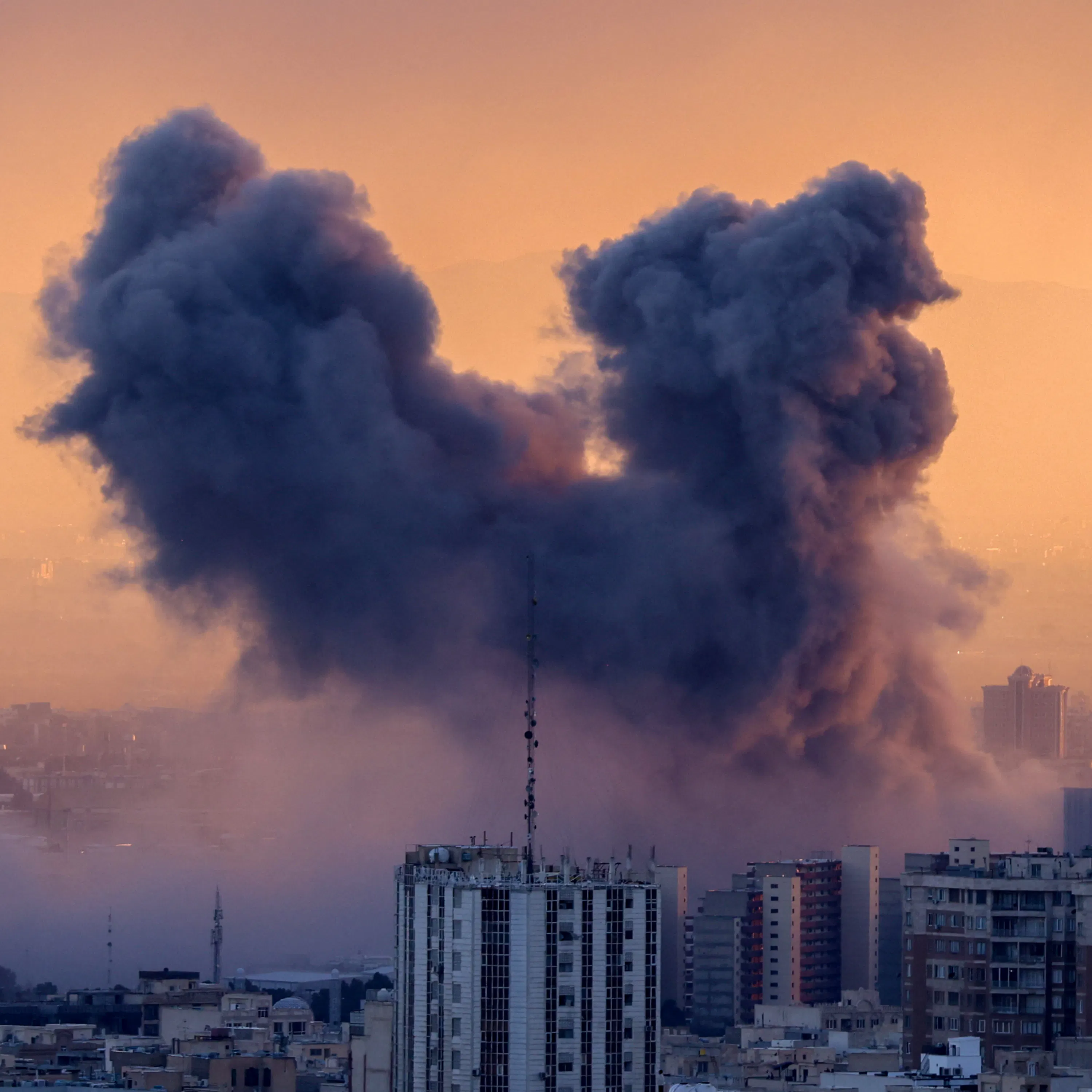
The transcription features a debate on the U.S. war with Iran. Matthew Kroenig justifies the conflict by citing Iran's decades-long role as a state sponsor of terrorism, its ballistic missile and nuclear programs, and severe human rights abuses. He argues that military action is necessary to enforce international rules, degrade Iran's threatening capabilities, and potentially foster regime change, even without UN or Congressional approval, which he views as ineffective. Conversely, Trita Parsi condemns the war as unjustified and illegal, emphasizing the absence of an imminent threat and the failure to exhaust diplomatic options. He criticizes the administration's shifting justifications and argues that the war strengthens the Iranian regime by fueling nationalism, devastates the country's infrastructure, and undermines previous diplomatic successes like the JCPOA. Parsi warns that the conflict escalates regional instability without achieving its stated goals, while Kroenig maintains it is a necessary response to a persistent global threat.
Hi, I'm Dan F. Ron, Foreign Policy's Executive Editor. This is F.P. Live. You're just a hearing rubby's voice at the top of the show. He's away this week, but there's so much going on in the world. We didn't want to leave you without an episode. So we're focusing again on the war in Iran, but our format is going to be a little different. This week we're featuring a debate about the war. Is the Trump administration justified in attacking Iran? And will the war advance US interests in the region? Or set them back? Joining me are two terrific guests with opposing views on the war. Matthew Kronig is an F.P. columnist. He's also Senior Director of the Skokraft Center at the Atlantic Council. He wants advised Senator Marco Rubio, who of course is now Secretary of State, and he also served in the first Trump administration in the Defense Department. If you read his columns in F.P., you know that Matt has been arguing for military strikes on Iran for a long time. We'll put some links in the show notes. And Trieda Parse is the Executive Vice President at the Quincy Institute for Responsible State Craft. He also co-founded and formerly ran the National Iranian-American Council. Trieda has called the war unnecessary and unjustified. Let's dive in. Matthew and Trieda, welcome to F.P. Live. Thank you. Thanks for having me. So before we get into specific points, I want to get a sense of where each of you stands. There's been a lot of criticism about the war, including on our pages, on F.P.'s pages. But there's also a strategic case to make for it. So let me start with you, Matthew. Why is the war in Iran justified? Yes. Well, I looked up justified and definition is, was this done for good or legitimate reason? And I think it was done for a good reason. Iran has posed one of the greatest threats to regional, U.S. and global security. For many decades, it's the world's leading state sponsor of terror, according to the State Department, has the largest ballistic missile program in the Middle East that it's used to attack its neighbors. It's had a illegal nuclear program that President Obama called the Defining National Security Challenge of our time. So it threatens global security. Also the Islamic Republic threatens its own people. It hangs homosexuals, it beats women to death for not wearing the headscarf properly. It just massacred thousands of its own citizens. So removing the Islamic Republic from the chessboard or significantly weakening it for years or a decade, I think, stands to greatly improve regional and global security and the lives of ordinary Iranians. Okay, Trita, let's go to you. You've called the war an unnecessary war. You've also said not a single death can be justified. Give us the case against the war. I think it is utterly clear that this war is unjustified. I really don't see much of a debate on that specific point. The United States should only go to war when it is faced with an imminent threat and when all other options have been exhausted. In this specific case, that is not the situation at all. In fact, no evidence has been put forward by the administration. If you take a look at what Donald Trump himself has been saying, he's been saying that there were now these military strategists, Jared Kushner and Steve Whitcaw have said that they believe that Iran would attack the United States. He did not say that the U.S. intelligence services had determined that an attack was imminent. If you listen to Mark Rubio, he gets even worse. He says that the Israelis were about to attack Iran and as a result, the fear was the Iranians would retaliate against the United States. If that is the case, it means that the Israelis were taking action that endangered the United States. And America as a result should have told these Israelis not to do anything that puts American servicemen and women in harm's way. Instead of allowing the Israelis to decide when America goes to war. The justifications and motivations for this war have been all over the place by the administration. In fact, they cannot stick to a story because they don't have a story. It's starting to look more and more like the 2003 war, but at least the George W. Bush administration puts some effort into the lies that it told the American people at the time. Okay, Trudeau, I'm going to follow up with you. Matthew talked about the threat Iran poses to the region. I think in the past two weeks, we've seen Iran attack almost all of its neighbors, including some of its own allies. It's also attacked shipping lanes. So I want to ask you, can you make the case that Iran is not a threat to the region? The Iranian have the capacity of striking these states, of course, but it's only done so when the United States has struck Iran, as was the case in June of last year, and at is the case right now. I think what the Iranians are doing to these states is extremely problematic, and particularly for the states that have played such a critical role to try to avoid this war. But to say that just because they have the capacity to do so, they are a threat automatically essentially means that the only way the United States would be happy is if Iran has absolutely no military capabilities at all. And that is completely unachievable, and absolutely not something that the United States should fight for. If the United States is concerned about the safety of these states, it should have taken that into account before starting this war of choice. Okay, let me put the same question to you, Matthew, although in a slightly different way, President Trump described Iran as an imminent threat to the United States into Israel. So let's talk about that. Iran's proxies around the region have been decimated by Israel over the last two years, including his bala. Iran's own military capacity was set back dramatically in the June war just eight or nine months ago with the Israeli and American military strikes. I will say candidly, I have not seen persuasive evidence of an imminent Iranian threat to the United States. So let me ask you, what evidence have you seen? I think two points I would make. First, I think Iran's posed an imminent threat to the United States since 1979. And Iran and its terror and proxy groups have killed Americans and they root, killed Americans in Iraq and Afghanistan, plotted to blow up Cafe Milano, a restaurant down the street in Georgetown where my family and I often go. I have active plots to try to kill former US officials, my friends and colleagues, Robert O'Brien, Mike Pompeo, Mark Esper. And so this has been an imminent threat. I think really the question is why has the United States waited so long? I think what we're seeing is the United States has thought it needed to tolerate these threats for many decades. And finally, we have a president who's saying no more. We're going to finally address these imminent threats. Okay. Let me stay with you for a minute there, Matthew. And let's talk about the legitimacy of the war. The administration didn't consult Congress before striking Iran. It didn't go to the UN Security Council for a resolution. It didn't even make the case publicly for war with Americans. If the case was so strong, why not air it out? Well, I think we need to think about the US-led rules based international order that the United States and its allies established 80 years ago. And some of the key principles of that order are not threatening your neighbors, not sponsoring terrorism, not building nuclear weapons, having free market economies, democracy at home. And so you have a country like Iran that's been violating all of these rules and principles for decades. And so if you want a functioning rules-based international system, what do you do with a state like this? And I think it does fall on a country like the United States to enforce the rules. And I think we have seen the United States and its allies over the years enforce the rules against illiberal countries violating them. And so I think when it comes to legitimacy, that's the big point. If we want a rules-based international system, there have to be consequences for a country like this that continually violates the rules. Okay. I see you nodding, Trita, do you want to respond to Matthew? Look, Donald Trump has never even used the term rules-based order. And one of the most important rules and laws of the international order is that you don't attack other countries, you don't start wars, and you certainly don't do it without any imminent threat. And also, you have to actually go through the Security Council. None of these things have been followed to say that this war is aimed at upholding the international rules-based order or international law or the UN Charter, I think is frankly preposterous. At the end of the day, you're asking Matthew to give a justification for why this should be this war. And all we're hearing is that 30 years ago, 20 years ago, 10 years ago, this or that was done. What you're describing is that the United States and Iran have been in some form of a conflict with each other politically, diplomatically. That is not the same thing as to say that there's a justification for taking military action. Because if that is the standard, the United States would be in conflict and at war all the time, frankly, because we constantly have these different type of diplomatic problems with many different countries. What we have here is a decision to actually go to war. Americans are being killed innocent people on the other side are also being killed. There is a bar for that that is much, much higher than to say that we've had problems with the country for 47 years. Okay. Matthew Trita is saying the events you're citing as a justification for the war are mostly things that happened a long time ago. Do you want to respond to that? Yeah, I don't think that's the case. I think Iran still poses a significant threat, as I mentioned. They have active plots out to try to kill former US officials right now. And I disagree that this is somehow normal diplomatic differences that the United States has with many countries. Iran is one of the most evil countries on earth, the Islamic Republic of Iran. It's a card-carrying number of this axis of aggressors working with Russia, China, and North Korea to undermine global order. And so this is a serious threat that Israel also sees, regional countries see. And so,
So again, this threat needs to be addressed. The UN Security Council was mentioned. UN Security Council doesn't work. I think people understand that. It gives Russia and China two of the countries trying to tear down the order of veto. So the UN Security Council has essentially never worked. It has required responsible and powerful democracies like the United States to address serious international security concerns with or without the UN Security Council's authorization. Previous US administrations have gone to the Security Council before attacking another country, before going to war. Why not now? Some have, some haven't. If you look at the record, the UN Security Council has really only worked twice in its history. I'd say with the Korean War because the Soviet Union decided not to attend an exercise its veto and it learned the lesson after that. It's better to show up in veto. And then the first Persian Gulf War is the second time it worked. Otherwise the UN Security Council has been ineffectual. And then on domestic law and going to Congress, Congress does have the constitutional right to declare war. But we see in practice that presidents of both parties use military force without a formal congressional declaration of war. And so I think that has become the standard practice. And I do think this kind of technical, legal debate is missing the forest for the trees. This is one of the greatest threats to global security. And then it's a threat to the United States. And so it's a threat to the United States. Again, I think we're focusing on the wrong issues, immanence, or whatever. I think the real problem here is a wrong has been a threat to its own people and to the world for 46 years. So turn it back to Trita. Trita, what is your solution to how do we stop the Islamic Republic from abusing the human rights of its own people? How do we stop it from sponsoring terror attacks all over the world from trying to kill my friends here in Washington? I think Trump has an answer. I don't think you do. Every time you answer Matt, you give a different justification for this war. You sound just like the administration. You cannot stick to a single story because now suddenly the United States has to go in and defeat this theocracy in Iran because of its repression of its people. That image and that's the need for this person. And then we now have to then also go in and Saudi Arabia. I guess that I know how long the list of countries are going to be that you want the United States to go to war with. That is not how we saw these issues. It actually was a solution. The JCPOA was working. It was certified by the Trump State Department twice as serving US interests that the Iranians were living up to their end of the bargain. The IA certified 14 reports in a row that the Iranians were living up to their end of the bargain. The nuclear that had been taken off of the table as a result. And we had a diplomatic opening to be able to start addressing other issues from their use of various groups in the region to their domestic situation, etc. We had a pathway that was far more effective than blowing up the entire region as we are now seeing is happening. So when you say that I don't have an answer and Trump has an answer, you are saying that Trump actually has an answer. We have not seen any evidence for that or any evidence that there was an imminent threat. We'll be back in a minute with more foreign policy live. Remember, you can catch these conversations live and on video on foreignpolicy.com. Subscribers get to send us questions in advance in addition to a range of other benefits, including our magazine, of course. So, sign up. [Music] Let me move on from the justifications, the rationale for the war. Let's talk about how the war is going. And Trita, I want to ask you, Iran has attacked commercial targets, civilian targets, it effectively shut down, oil exports from the region. And here's my point. If Iran's goal is to counter the American narrative about Iran being a menace to the world, how do these attacks serve that purpose? I don't think they serve that purpose at all. And the very same security council that Matt says doesn't work just passed the resolution overwhelmingly that condemn the Iranians for targeting these different targets in the GCC states that were not part of this war. So I don't think the aim here in any way, shape or form from the Iranian side, is to counter what the US's accusations against Iran are. What the Iranians are trying to do in the manner that they're conducting this war is that they're trying to raise the cost for all states involved or not involved in order to make sure that this war becomes as costly as possible for the United States for everyone else so that everyone concludes that this war was a mistake. It should not have been started. And as a result, the US and Israel worked out, restarted that war in another seven or eight months. As you recall, these railings did attack Iran back in June. At the time Matt wrote a piece and said that, you know, this essentially has resolved the conflict and the issue with the nuclear program. But here we are again seven or eight months later in which the nuclear issue is once again used as one of the pretext to be able to start this war. From the Iranian perspective, they're adamant about making sure that this war ends in a way that it doesn't restart again. Unfortunately, this has now led them to do these attacks. I absolutely agree. We are completely legitimate. Okay, Matthew, still on the question of how the war is going, if the fighting ends today with the regime intact, I think Iran can plausibly argue that it has won the war. Certainly its military capabilities have been degraded. Its leaders have been killed in large numbers. But the Iranian regime was targeted by two of the most powerful armies in the world, the most powerful militaries and survived. Not only survived, I would say actually created a new form of deterrence for a future attacks with its strategy and the Gulf. How would you counter that argument? Well, let's look at how the Trump administration has defined its objectives in the war from the very beginning. And they've said the goal is to degrade Iran's capabilities. It's nuclear capabilities. It's missile capabilities. It's drone capabilities. It's Navy and it is succeeding at doing that as the military has said several times it's ahead of schedule. President Trump has said it'll take a couple more weeks. I suspect what he means there is to go after all the drone manufacturing and missile manufacturing capabilities. And so this is going to significantly weaken Iran's ability to terrorize the region at least for years, maybe a decade. And then in terms of governance, I think that there is the chance still that the Iranian regime falls. Nobody was predicting Assad was going to fall two weeks before he did these things happen suddenly sometimes. And so that would be terrific if there's a better government in Iran that respects the human rights of its people and that is more cooperative internationally. Another scenario is the Venezuela scenario. I don't think the current Supreme Leader is going to last for long. And so at some point do we get down to somebody who is willing to play ball in order to survive. And then finally, even if it is still this evil regime that manages to hang onto power, it will be significantly weakened for many years and less able to threaten the world. So I think Trump could declare in the conflict now or in two weeks and declare it a six.
success and rightfully so. -Treat, I want to ask you about the ability of the regime to hang on to power and to emerge after the war intact. What's your idea about that? -No, I think we have seen quite clearly that this Theocracy in Iran is far, far more resilient than was assumed in Washington. In fact, I think that a key reason as to why Trump thought that he could go to war is because of a narrative that had been solved. On the one hand says that's not, Matthew was saying that Iran is this major, major threats. It's intolerable. On the other hand, it is super weak. All you need is two, three days of warfare and the government falls. It inflows and the country is defeated militarily. We're now 12, 13 days into this war is very clear that that is not the case. I think this is a Theocracy that actually in some ways actually is benefiting from this war. We have seen that they're based, which I don't think is more than 15 or 20% of the population. Actually, had been energized. We're seeing, and the US, as well as the Israeli intelligence is picking up that there's a wave of nationalism that is spreading throughout the country because as much as the overwhelming majority of Iranians would like to see a very different government in Iran, they are not seeing this effort actually bringing that about. They're seeing this effort destroying the country, bombing these salination plans, bombing refineries that makes it impossible for people inside of Iran to even breed in the capital. That is not a war against the regime. They're increasingly seeing it as a war against the country. I think that is a reflection of the fact that Trump very quickly lost control over this war because he the expectation was that the Iranians would be falling very, very quickly that they're much weaker than they are. And here we are in this debacle as a result. Okay. Matthew, I think Trudeau is saying that the Iranian people are perceiving this as a war against them and not just against the regime. Maybe that's why they're not rising up. How do you respond to that? Well, first, I think we should all have some humility and our ability to know what's going on inside Iran in the midst of an ongoing war. I do know that there were many Iranians cheering the night that the Supreme Leader was killed both in Iran and around the world. And then also, what President Trump said in his first address the Saturday morning the war started was that after the bombing stops that this will be your opportunity to rise up. I think that's wrong to say he thought within days the regime would fall. He was pretty clear in his very first statement that was going to be weeks of bombing and that when that stopped, that would be the opportunity. So I think it's two. We're a few days, not even two weeks into this war. I think too early to say that the regime is remarkably stable. Let's see where we are in a few weeks and beyond. Just a small correction, there are Trump did television leaders that this they should not worry about. This will only take about four days. But incidentally, if these regional states who are living next to Iran who have no reason to love the Islamic Republic in any way, shape or form mindful of the very tense relations that exist between them, but the overwhelming majority of them lobbied against this war precisely because they predicted the Boko that we are seeing. They predicted that this would lead to regional instability. They predicted that they would become targets of this war. Trump has admitted that he did not expect the Iranians to go after the oil markets and the matter in which they have been pushing up oil prices. He has admitted that he didn't predict that they would go after American bases in the GCC countries. Very little preparations were made and we've seen how difficult it has been for Americans and others to be able to leave the GCC states as a result of this. This entire plan was based on wishful thinking, very similar to what we saw in Iraq and now we're seeing the result of it. By the way, Matthew, it does seem that Israel and the United States have divergent views on how this war could end. Might end. I think certainly in Israel, the hope is that it ends with regime change, with the fall of the Iranian regime. Maybe the United States could settle for something less than that. How does that divergence affect the end game of the war? Well, first just a brief comment on what Trita said. I completely agree with him that the worst consequences of the war have been due to Iran's behavior, purposely targeting civilians, purposely holding the global economy at risk. Meanwhile, the United States is being a responsible power following the law of armed conflict and going only after legitimate military targets. Does that include the girl school in which 165 children were killed? Great example. Great example. That now has been the proven to be done by the United States and it was based on the fact that it was using AI and as a result, misidentified the targets. I'm glad you brought that up, Trita. The investigation is still ongoing, so we'll see. But it's a great example of if it was the United States, we don't know yet. It was by accident. Whereas Iran does this as a matter of policy and so a big moral distinction between the two. Massive exception, of course, that the war was started by the United States and Israel, which is something that you're constantly glossing over. We don't, that's not something we've glossed over. I think I've addressed it pretty clearly that Iran is the instigator here. It's been breaking the law for years and now the United States is finally laying down the law. So, too, your question, I think there is a difference between the Israeli and the US goal here. I think Israel does have a clearer goal of regime collapse. I think the United States would prefer regime collapse but could also live with a weakened Iran. We'll have to see how that plays out. Let's hope that it's not an issue because the regime does collapse. But if it does, I think this is something the United States and Israel will be able to work out. And part because Israel's number one strategic priority is maintaining its relationship with Washington. And so I don't expect this to be a major source of tension between the partners. Trita, that potential difference of opinion about the end game here in the war. How does that complicate matters? I think it absolutely complicates matters, mindful of the fact that the Israelis are looking for just a weakening of Iran and they do not care about what the implications are for the rest of the region. If you have state collapse, for instance, not just regime collapse, you have a risk of civil war, you have a risk of secessionist movements amongst ethnic groups on the borders. You will have most likely a massive amount of refugees that will flow to all countries in the region and then onwards to Europe. You had about 25 to 30% of Syrians becoming external refugees during that civil war that amounted to about 6.5 million people. In the case of Iran, if we end up in the same type of a scenario, 23 million people. Not a single one of those will flee to Israel, as they did in the Syrian war either. Instead they will go to other regional states and many of them will go to Europe and that will be a major, major hit for those countries. But Israel is rather insulated from this. The US will pay a price for this as well, mindful of the fact that just like in the Iraq war, regional states are deeply, deeply upset that the United States destabilized the region in the manner that it did by going into Iraq. And of course, the American public is deeply, deeply upset in the manner that so many thousand of Americans were sent to die for a lie. And this absolutely did not advance US interests instead have created so many spillover effects, including the very creation of ISIS. So I think that we're seeing once again a scenario in which the Israelis may be achieving their very limited goals because they're insulated from the lot of the consequences, the American people, the people in the region, as well as the broader international community will be paying the price for this just as they did with the war of choice in Iraq. Yeah, okay. So Matthew, Treada is raising the specter of the instability that followed the war in Iraq. Matthew, we can have you address that regime collapse, the impact around the region. What are you worried about? Well, I think the analogy to Iraq and Afghanistan is misleading. In Iraq and Afghanistan, the United States sent in 100,000 troops over through a government stayed for 20 years. I don't think President Trump's going to do that with his peace through strength doctrine. I think he is comfortable with a short, sharp, decisive uses of force, but has always been skeptical of long drawn out military campaigns like in Iraq, Afghanistan and Ukraine. So I do take the president as word when he says this will be three to four weeks. And I don't expect U.S. military involvement beyond that. Treada, I want to ask you about the U.S. alliance with the Gulf States, specifically how the countries that were attacked by Iran, including Qatar, Saudi Arabia, how they might reconsider their relationship with the United States as a result of the war. Well, I think first of all, they will also reconsider a relationship with Iran in some ways. Again, they are absolutely infuriated with what Iran is doing. And they were the ones who, of course, led the resolution Bahrain had the representative in the council, led the resolution yesterday that was adopted by the Security Council on this. But I do think it will also have implications for their approach towards the United States. They have these American bases, 19 or so in the region, many of them in the GCC states. They had it as a way of balancing against Iran as way of deterring Iran, making sure that war would not break out. But now instead you have a scenario in which the United States itself actually started that war. And then once the war was started, these bases did not end up protecting these countries, but instead ended up becoming the targets. Instead of these bases being something that deterred Iran from attacking them, they're actually being attacked because of these bases. Now in the short run, immediately after this war, I don't think much will change. But over the longer run, I think there will be a lot of rethinking in the region about whether they should put all of their eggs in the American security basket, whether that presence of these bases actually add to their security or reduce their security. And with that, of course, again, are the consequences.
of these ill thought through decisions made without any legitimate basis that we are now already starting to see and I think we will see far more of them. Matt is absolutely correct on one point. I don't suspect that Trump is going to go in with 200,000 troops. But that does not mean that the destabilization that can occur in Iran if there is state collapse as a result of the Air War would not lead to similar destabilizing effects for the rest of the region. And again, that is not something that these Israelis are particularly concerned about. The United States should be concerned about that because that will affect ordinary Americans. Okay, Matthew, same question to you. Will the United States pay a price in terms of its alliances with Gulf countries as a result of this war? Well, I think what's been most striking to me is the diplomacy seems to be breaking the United States way when the war started. I think there are many people upset with Israel and the United States. I think after a couple of days, many people upset with Iran. And so we have seen the Gulf states, condemn Iran's behavior. We've seen European and Indo-Pacific allies side with the United States on this, the British changing their mind and allowing the United States to use one of their bases, for example. So I think we'll have to see how this plays out, but if it is successful as I suspect it is in either significantly degrading Iran's ability to threaten the region or of leading to a better government in Iran, the best case. I think that is something that the region, the world and historians will look back and thank President Trump for addressing this threat. Yeah, let me ask you a little bit about countries outside the region, specifically China and Russia. I think the deeper the United States gets into this war. The more there is a sense of rejoice in China and Russia, the celebration, the idea that this is sucking the United States into a quagmire. Does that worry you? I think there's a short term and a medium to long term. In the short term, I think this does reduce America's capacity to address threats in other theaters. We're using a lot of munitions. There is a readiness, train, maintenance and training and other things that aren't happening. But over the medium to long term, I think this actually greatly strengthens the United States hand and puts Russia in China in a more vulnerable position. So one, it removes one of the axis of aggressors from the chess board. They keep losing their friends. They lost Maduro and Venezuela. They may be losing the Islamic Republic. They may be losing the communist in Cuba. So their alliances is getting weaker and smaller. And then if the United States is able to decisively address this threat, I think it could make the region more peaceful and stable and allow the United States to finally prioritize the threat from China and the Indo-Pacific as it has been wanting to do for some time. And I think it's been these constant nagging threats posed by Iran that's been one of the things that have prevented the United States from pivoting to Asia as it's wanted to do for several administrations. But again, addressing the Iranian threat, I think allows us to focus more on the remaining threat posed by China. Yeah, Treada, how do you respond to that question? And effectively, how is this war affecting American interests in other parts of the world? I have to say I'm astonished because it sounds almost exactly the very bad word for word for how the Iraq war was being justified at the time. And this will just usher in an era of euphora and everything will be fantastic and everything will be stable. And we have of course seen enough, gone astound in Libya, in Syria, in Iraq that that is absolutely not the case. It's the same arguments based on wishful thinking. And what the long term effect of that, I fear for the United States is that many, many countries, despite the fact that right now because of economic independence and other factors, they may not say so publicly. But you definitely get a sense when you talk to leaders, particularly from the global south that the United States is increasingly seen as a destabilizing actor because of these wars of choice. Whereas China, which they otherwise may not have much love for in many way shape of form is nevertheless not seen as a country that is willfully starting these wars of choice that leaves these regions with all kinds of unpredictable consequences, while washing its hands of it and moving away. So I do worry that the American credibility as an upholder of security, as an upholder of international law is one of the forces that are needed to make sure that international law has some gravitas and some firepower behind it if needed that that is really being undermined with these wars of choice. And at the same time, we've seen the consequences for the American people with these debacles that have been caused when we have gone to war with no real justifiable basis. We've seen the consequences of Iraq war. I am very, very fearful what this will do for the United States and the American people in the next 10 years or so if it goes in the same direction. Okay, we have just another couple of minutes Matthew, let me go to you and ask unless the situation changes in the next days and weeks it's hard to see how this war would serve the interests of Iranians Iranians who want to see more freedom more democracy in their country. If the regime survives, I can imagine that it will crush dissent even more harshly than it did just a month ago and that might end up being one of the legacies of this war. Yeah, and make a few points first. I think too early to tell whether this regime survives or not were in the midst of this war that will likely last at least another week or two. So let's see where we are at that time. Two, President Trump drew a red line and told the Iranian regime that if they killed protesters there would be hell to pay. They went ahead and killed thousands of their own citizens anyway. And I think we're seeing now that Trump minted there was hell to pay. So I think a future government in Iran is going to think twice about mass occurring citizens knowing that this could be the consequence. So contrary to what TRETA was saying, I think this improves American credibility with some past administrations. I think there was a question about does the United States still have the stomach to use military force? I think now we see that it does. And then since everybody seems so focused on international law, we haven't talked about the responsibility to protect and legal principle, which says that governments have a responsibility to protect their own citizens. And if they do not then outside powers have a responsibility to intervene to stop the human rights abuses. So I think by reinforcing that red line and the responsibility to protect that things could get better for the Iranian people, even if the Islamic Republic manages to hang on to power. Okay, TRETA, I'm going to give you the last word here. I think that we're seeing very clearly that this thing is not going in the direction that the administration wanted the idea that this is strengthening American credibility. I don't think there was anyone serious who had any doubts that the United States is willing to use military force. But people have doubt about is America's ability to actually work for stability to respect international law institutions, make sure that we don't wreck the entire international system, but some of the things that we unfortunately have done against the interest of the US itself. So this is not holding up any of credibility challenges that the United States has. Instead we're constantly being told that the only credibility that matters is whether we use military force or not. This is turning the United States into a country and its only contribution is its ability to be able to blow things up. I don't think that is the vision of America that the vast majority of Americans would like to have or even do have. They want to see the United States as a country that protects its own interests for logistically, but also serves the interests of its own population, rather than constantly going off onto these adventures abroad to achieve un- attainable goals, undefined goals, while we see that things back home are becoming more and more problematic. And that was Matthew Kroning of the Atlantic Council and Trieda Parcy of the Quincy Institute. As always, keep up with the war and with other news at our website. That's foreignpolicy.com. We're also putting some gift links in the show notes to pieces related to today's episode. F.P. Live, the podcast is produced by Rosie Juleen. The executive producer of F.P. Live is Donna Shurn. I'm Dan Efron. Ravi Agroal will be back next week. Thanks for listening.
Podcast Summary
Key Points:
The debate centers on whether the U.S. war against Iran is justified, with Matthew Kroenig arguing it addresses Iran's long-standing threats (terrorism, missiles, nuclear program, human rights abuses), while Trita Parsi condemns it as an unnecessary war lacking evidence of an imminent threat and proper legal authorization.
Kroenig asserts the war enforces international rules by degrading Iran's capabilities and potentially leading to regime change, viewing U.S. action as legitimate despite bypassing Congress and the UN due to systemic failures.
Parsi counters that the war is illegal, escalatory, and counterproductive, strengthening the Iranian regime through nationalist backlash and harming diplomatic solutions like the JCPOA, which had previously contained Iran's nuclear program.
Summary:
S. war with Iran. Matthew Kroenig justifies the conflict by citing Iran's decades-long role as a state sponsor of terrorism, its ballistic missile and nuclear programs, and severe human rights abuses.
He argues that military action is necessary to enforce international rules, degrade Iran's threatening capabilities, and potentially foster regime change, even without UN or Congressional approval, which he views as ineffective. Conversely, Trita Parsi condemns the war as unjustified and illegal, emphasizing the absence of an imminent threat and the failure to exhaust diplomatic options. He criticizes the administration's shifting justifications and argues that the war strengthens the Iranian regime by fueling nationalism, devastates the country's infrastructure, and undermines previous diplomatic successes like the JCPOA.
Parsi warns that the conflict escalates regional instability without achieving its stated goals, while Kroenig maintains it is a necessary response to a persistent global threat.
FAQs
Matthew argues the war is justified due to Iran's long-standing threats, including terrorism sponsorship and human rights abuses. Trita contends it is unjustified, as there was no imminent threat and diplomatic options were not exhausted.
Matthew cites Iran's history of attacks on Americans and active plots against former U.S. officials. Trita counters that no evidence of an imminent threat was presented by the administration, comparing it to the 2003 Iraq war.
Matthew believes degrading Iran's capabilities advances U.S. interests by improving regional security. Trita argues the war sets back U.S. interests, increasing costs and destabilizing the region without achieving strategic goals.
Trita criticizes the lack of congressional consultation, UN Security Council authorization, and public justification. Matthew defends it as enforcing international rules against a state that consistently violates them.
Matthew suggests the regime could fall or be significantly weakened, similar to scenarios in Syria or Venezuela. Trita argues the regime is resilient, benefiting from nationalist sentiment and perceived as a war against the country, not just the government.
Trita advocates for diplomacy, citing the JCPOA as a successful framework that addressed nuclear issues and opened pathways for other concerns. Matthew emphasizes military action as necessary to address persistent threats.
Chat with AI
Loading...
Pro features
Go deeper with this episode
Unlock creator-grade tools that turn any transcript into show notes and subtitle files.
 PodcastTranscript AI