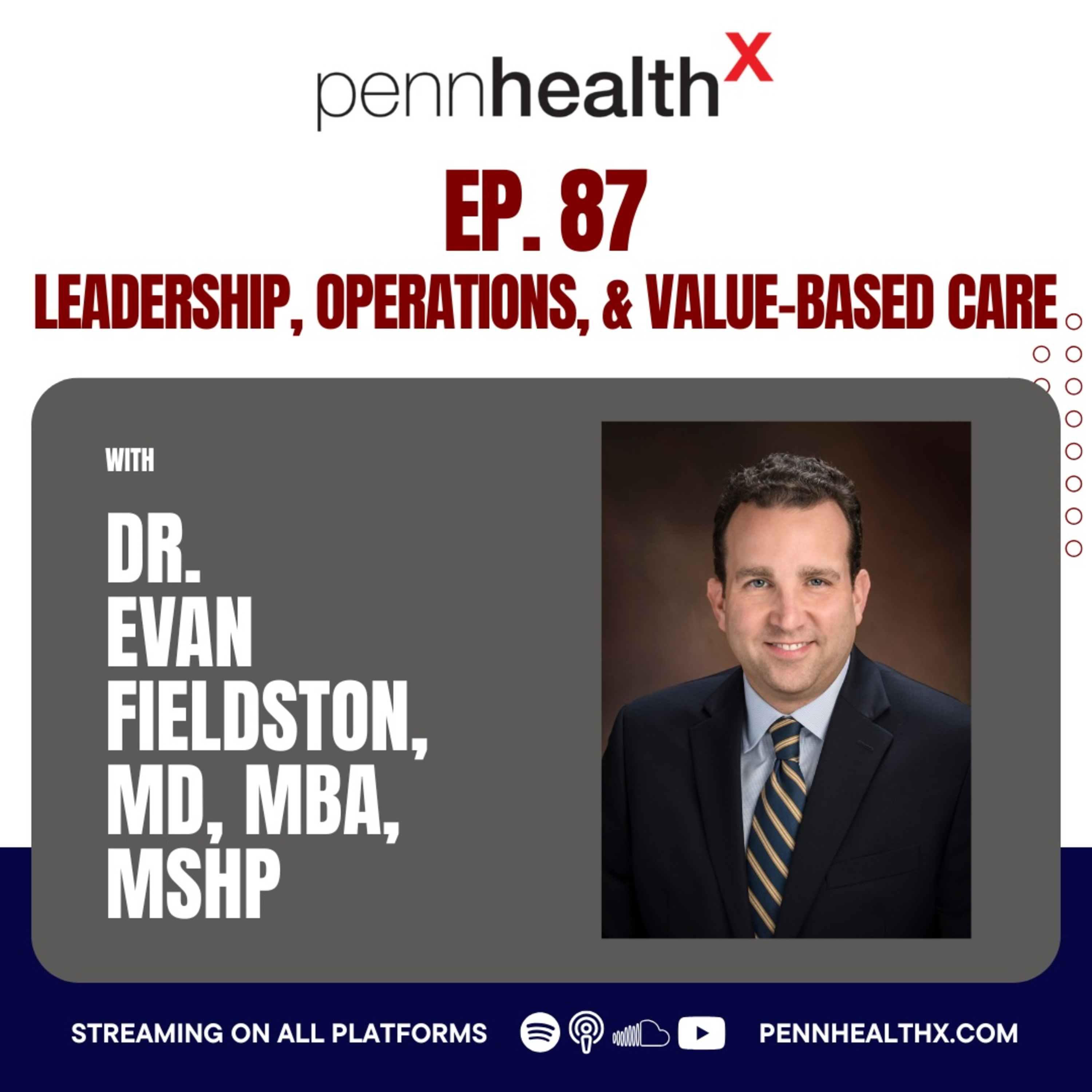
87 - Dr. Evan Fieldston - Leadership, Operations, & Value-Based Care
52m 17s
In this podcast interview, Dr. Evan Fieldston, a pediatric hospitalist and executive at Children's Hospital of Philadelphia, discusses his unique career path integrating clinical medicine, business, and health policy. His motivation stems from personal experiences, including childhood hospitalization and a serious car accident, which revealed systemic healthcare shortcomings and inspired his advocacy and research. Dr. Fieldston emphasizes the importance of evidence-based management in healthcare operations, illustrating this with examples like analyzing hospital census data beyond midnight counts to better match capacity with demand. He clarifies the concept of value in healthcare, defining it as quality over cost, and argues for efforts to "bend the value curve up" by simultaneously improving patient outcomes and efficiency. While acknowledging challenges in pediatrics, where benefits may unfold over decades, he views value-based payment models as a mechanism to align incentives with this quality-cost equation, ultimately aiming to enhance equity and system performance for children and families.
Welcome back to the Penn HealthEx podcast where we explore the intersection of healthcare, technology and innovation. Listen to Ducer Host. My name is Zeyat Hassan. And I'm a Bibykori. Today we're talking with Dr. Evan Fieldston. Dr. Fieldston is a pediatric hospitalist, physician executive and health systems innovator whose work bridges clinical care operations and strategy. He currently serves as the associate chief medical officer at the Children's Hospital of Philadelphia, as well as an associate professor of pediatrics at the University of Pennsylvania, ProMinschool of Medicine. With training in medicine, business and health policy, Dr. Fieldston focuses on how data, evidence and design thinking better performance in healthcare systems. His work sets at the intersection of clinical excellence, organizational leadership, and the thoughtful use of technology to improve value and equity in healthcare. Dr. Fieldston, thank you for coming and joining us today. To begin, can you just begin by introducing yourself in your role here at CHOP? Sure. So first off, I want to thank you for inviting me. This is really exciting and I'm so happy to be here with all of you and your listeners. So I'm Evan Fieldston. My role here is as the associate chief medical officer at Children's Hospital of Philadelphia. And then on the pen side, I'm a professor of pediatrics in the ProMinschool of Medicine. Amazing. To begin, you've trained in pediatrics, business and policy. What led you to kind of a training in those different fields and seek experience kind of concretely there rather than not some people might decide they want to build those skills in the workplace or on the field. Sure. So great question and everybody's career journey is very different. I very literally would say that my career journey began more than 40 years ago in a hospital bed. It wasn't a chopper pen. And I was a child who was diagnosed with juvenile idiopathic arthritis. I was in out of the hospital quite a bit as a child and through my fair share of outpatient visits and all sorts of other things. And that experience really had a lasting impact on me. As I got older, I started to both be really interested in clinical medicine, but also started to have realizations that we had opportunities to improve both the care experience and the experience of care as you can put it. And as sort of my career progressed or training and then career progressed, I saw ways to bring these two interests together. I got very interested in economics and public policy and saw ways to tie those things into my training and then ultimately into my career. I saw ways to combine my interests in clinical medicine broadly and then specifically in pediatrics into issues around quality improvement, system level improvements, connections back to economics and finance. And it was sort of this sort of iterative process of realizing that the connection between the two was both really important and really interesting. And I would say that my whole career has been trying to combine these two things that are of personal interest. And I hope of important impact on behalf of children and their families. I mean, big impact. No doubt. That's awesome to hear a little bit about where this started. We were wondering if along that journey, you mentioned that there were moments where you learned more about economics and system level policy and things that could be tweaked to the benefit large groups of people. Can you talk about one of the earlier moments that you experienced where you learned something new and you realized this is really a way that I can make a broader impact and sort of started your path to where you are now? So that's a great question. I think in many ways they've been layering experiences. So trying to identify a single moment at time is a little bit challenging, especially since some of those stretch back over many decades. What I can say is that as I got older and fortunately was in recovery and then remission from my childhood illnesses, I started doing clinical research in pediatric dermatology. So my childhood illness was with dualityopathic arthritis and I first got inspired to look into that field and there were topics like delays and diagnoses, the sort of utilization and how best to work up different diagnoses. And so at that time it was a little bit more in the clinical research domain. Over time that shifted into what we would now call more health services research. And so recognizing that the structures and processes of care lead to those outcomes. That started to sort of meld for me as I moved through high school and into college. In college I had another personal experience that was very inspiring to me. So my mother and I were in a pretty severe car crash my freshman year. Turned out the driver of the other vehicle was visually impaired and plowed through a stop sign. And during my recovery period I found out that the law and the state that I was in didn't require visionary testing which was unlike a whole bunch of other states. So using that benchmarking data as you know one would call it I actually started a campaign to try to get the law changed that then morphed into my major in college which was public policy most generally health policy more specifically and then writing a senior thesis about health policy as it relates to road safety. Do that was a very personal experience that I turned into this advocacy effort and through that and through my major in college I learned things like health economics like public policy advocacy and so on. As I kept sort of progressing along I saw you know additional opportunities to combine these things when I got to pen which you know I came here from ed school predominantly because I really liked the innovative curriculum at the time and the potential to be able to apply to and you know that moment before getting in hopefully matriculate at work and for the combined to be program and ultimately I was very happy to be able to do that and throughout that period of going back and forth between taking care of patients seeing how things happened at the front line and then being able to apply policy and economic principles management leadership negotiations and realizing that there are ways to scaffold that altogether towards overall system improvement became you know really compelling for me as a career. That's really powerful thanks for sharing those experiences I know that they must not be easy to talk about but it's amazing to hear how they've made you into who you are and they've provided that fuel for like all the amazing work that you do. I just wanted to follow up and you you talked about as you entered med school you were you were excited to matriculate here at the university of Pennsylvania partly because of the education that you could also get not just at the medical school but sort of on the economic side the business side of things can you talk a little bit about that education and like the value that it brought you and what it taught you. Sure so I would say that you know key things are the classroom learning and then you know obviously on the medical school side the clinical learning and then combining that on the business school side was both classroom learning and experience of working with others you know particularly in business school people coming from many different backgrounds and then on both sides of spruce street so to speak I would say I had amazing mentors both physicians and business school professors and some people who sort of crossed the two people in pen medicine at shop and you know throughout the campus who really were very helpful to me in both fostering this blend of topics and being able to look at how I can apply those skills in each place towards improving things. So you know I mean I think as as an example I had a little bit of a different you know MD MBA experience and I think some of my some of my peers at the time I was more oriented towards what we sort of say is the provider side of of the organization and health care delivery and was very interested in being able to work at shop as a for a summer job. I had this fantastic summer experience working in the hospital a great set of mentors in the administration at the hospital. I was tasked with looking at the hospital's approach to children with special health care needs and also the hospital's role in government affairs and public policy having this chance to apply everything I had learned some bringing forward things from college as well as my personal experience in grassroots advocacy and then combining that with more formal training in health economics, health care system design professors I had who had government roles who I could tap for assistance ultimately I you know reached back out to operations management professors over time and so working learning and doing things in this ecosystem of Penn is really remarkable in that regard and was very important to my early training in career and one thing that's so special about continuing to work here is that this environment really fosters a kind of multi-disciplinary approach to to improvement. Yeah absolutely I think that's really helpful to hear and you know inspiring to think about how we're going to channel our education here and potential opportunities in the future for business education. I wanted to go back to your story with the tragic accident that you and your mother in and you mentioned that you used to that experience as leverage just try to campaign for changing all the rules so that idea of evidence-based impact using you know something that we can quantify and using it to make changes but what does that mean in your current practice and how do you apply that in your role at chop to try to make decisions or try to change things that affect patients. Sure so great question and I think that the way I would frame this is that on our medical school side and I think ideally we should be practicing evidence-based medicine right so is this are we using the evidence to drive the best decisions we would want to have the highest grade evidence to drive that decision sometimes we need to have a different level of evidence so sometimes randomized control trials may not exist and therefore we might revert down to some other level of evidence. On the system design side the structures of
and processes we use to deliver that care. There's a concept called evidence-based management. Steven Shortell described this as the infrastructure in which evidence-based medicine is delivered. And that's been a really important theme in my career. And the idea there is that there probably isn't a randomized control trial on patient placement and capacity management. But there are learnings within a health system, across health systems. There are national collaboratives that happen. I was fortunate enough to take part in one during my chief residency year. And from those, you get to learn and try to apply at least the best evidence. And I think sometimes also we need to consider what's the best evidence in terms of processes from other industries. And looking at opportunities to benchmark both structures and processes is really important. So how are teams designed? What are the data and analytic structures in place to guide decision making? What are the measurements being used? And are there complementary alternative measurements to what may be traditional use that give you different insights into what's going on? One early example of this and rather simple was that we typically look at something called average daily census, which is looking at the census at midnight. But for many organizations based off of the peaks and valleys over days of the week and weeks of the month and the impact of weekends and holidays, actually turns out that the midnight census, from which that average daily census is derived, can be closer to the minimum experience than even the median or maximum experience. And if you want to have enough hospital beds to accommodate volumes at your busiest times, you may not want to be guiding that by your minimum numbers. Now, on the other hand, you would have entirely excess capacity if you plan for your peak and that was all you plan for. So trying to use evidence to guide towards a solution that is workable and say, how can we either meet the level of demand we're actually facing or smoothed out at in certain ways? And again, that's this opportunity to use evidence from within organizations, across organizations, and other industries to meet these changes in this operations management mindset. Thank you for sharing that. I mean, it's like, I know you mentioned that it was simple, but it has such profound implications. And like so many times, the smallest of decisions were like adjustments in how decisions are made, whether at the individual clinician level or like at a system level make like huge impacts. Like one thing that like comes to mind is like opt in or opt out for like a generic medication. It's a very simple change, but if you make the default like a generic and sort of like a like a brand name, people use the generic overwhelmingly. So it's like a small change that has massive implications. So appreciate you sharing that. I want to also ask about the concept of value. I think in today's healthcare system, there's a lot of prioritization on like value-based care and providing value-based care. And I'm curious what that means like where you are at chop, what does value-based care mean there? Because in most contexts, people might hear about it in like surgical cases, where there's like a surgical episode or like for a unique adult diagnosis, but at the level of like a children's hospital, which is so so important for the health of like a generation and for like the lifetime of these kids. What does value-based care mean and how do you sort of, how do you keep that in mind on a day to day? So I would distinguish between value-based care as payment mechanism and I think that's a little bit of what you're referring to versus the concept of value and healthcare. And I think we can maybe go back and forth here and talk about both of them. Let's start with the second part of that, the broader frame of value. And ultimately, I think why there's a drive towards value-based payment mechanisms is because in the broader more general frame, there's a sense that we're not getting value out of this healthcare system. So at its most macro level, as you all know, two years ago, the United States spent about $4.9 trillion on healthcare. But we don't think we get $4.9 trillion of benefit out of that. We've identified hundreds of billions of dollars of what's called waste, which would be spending that doesn't lead to improvements and those are manifested in different ways. And so when you think about value, what you're juxtaposing there is the quality of an experience over its cost. So at that macro lens, we can put together this frame of quality of the US healthcare system. And the Institute of Medicine, now the National Academy of Medicine, helpfully provided us this framework of quality is safe, effective, efficient, timely, patient-centered, and equitable care. So if we put that all in the numerator and we say how well is the United States as a healthcare system delivering across those domains, we do an excellent and outstanding job in many of those instances. But at a population level, we clearly have opportunities for improvement and opportunities where we're missing the mark. And so you take that numerator and you say, okay, that's not the quality we're striving towards. And then you juxtapose that with this denominator, $4.9 trillion. And you say, well, for $4.9 trillion, we ought to be getting either way, way better outcomes or experiences of care, or we should spend less money. And at that macro level, right, we compare ourselves to other countries and say they spend way, way less. And yet they have performance that exceeds the United States, at least at the population level. Now I don't wanna take away the fact that plenty of people from around the world, from some of those countries, fly to United States, fly here to chop and pen for very high end care. But at that broader population level, we have opportunities to, you know, less miss that mark, bring that down to the more system level. So value should always be from the consumer's perspective. So now we're not consumers of the whole country, or patient and consumer's the whole country. You're an individual patient, family, consumer, healthcare resources. What is the value proposition for you? Am I delivering high quality care over the cost? What's really important here is not to confuse, and obviously mathematically, value cannot equal cost equals quality, because that's not the value equation. But you sometimes read papers where things get a little bit murky in that regard. And so what's really important there is to say, delivery of very high quality care, very high beneficial care may be expensive, but it can still be high value. And on the converse, something can be very inexpensive, but either deliver no benefits, or even lead to downstream harms. And that is not only low value, it's actually, you know, if it's really harming somebody, it's negative value. If you're expending any resources, and not getting any quality out of it. So a lot of the efforts I would say that we have from a system perspective are trying to maximize quality in that numerator. Oftentimes that inherently leads to cost reductions by doing things in a safer, more effective, more efficient, timely manner, within that encounter itself, it may become less expensive, or over a series of encounters, it may become less expensive. That, I say, is the internal pressure. I mean, one, to do the right thing. And two, it's, I think, a more inviting framework. Several years ago, you may remember this notion of trying to bend the cost curve down. You heard that term. I thought that was a little narrow in focus, because it's really only looking at that cost. And it sort of absolves us of looking at that quality part of the equation. Bending the value curve up really calls upon us to look at both parts of that equation, and say, where do we have opportunities to improve aspects in that numerator of quality, and where we have opportunities to reduce costs? And then you need to have the right frame for that. Are you looking at quality and cost over the right frame? As we then move into pediatrics, we have some challenges in that regard. Some of our most beneficial interventions begin in utero, things like fetal surgery. Those benefits can manifest over years or decades. The ability to capture all of that, economically, can be challenging. There's challenging at the government budget level in terms of the frames that they use for scoring legislation. And sometimes that may or may not help children, given the longer frames in which benefits may appear relative to costs. And then lastly, you know, yes, about value-based contracting. So value-based contracting, I think, is really just trying to apply that to individual episodes for which there's some sort of payment. And saying, we're not just going to pay you for all the services you deliver. It needs to be connected to some outcome, simply doing more and not having any constraints on what that quality part looks like is not delivering value. And so those contractual arrangements are trying to set up a system that says, we need to focus on that numerator and that in order to either drive down those costs or keep the costs stable and pay more attention to the quality outcomes. That's a hopeful framework to think about value, not necessarily. It's not like let's acutely reduce cost. Let's do all of these other things. Let's make sure that the care we provide is effective and evidence-based and it follows protocol. And it's those six factors that you mentioned, like safe, effective, equitable, those ones. Those, we lead with those, then oftentimes costs follow. But that's not the goal. The goal is let's maximize quality for these people. One thing that's really important too is that we do want to make sure we're matching the right level of resource need to what the patients have. And that's also an aspect of quality. [BLANK_AUDIO]
comes through through efficient care, right, is the right match of resources. So, for example, doing surgery that can be done in an ambulatory surgery center in the operating room of a quattenary care hospital is not efficient and is not the right match of resources. Now, one could say, well, it's clinically high quality care. Yes, but it's not the most efficient match of those resources and that ambulatory surgery center can absolutely deliver that care in a safe, effective timely, typically more timely, patient centered, often more patient centered manner. It's typically closer to home and equitable manner. And so if the efficiency of resources, then you say, okay, we move this from this very resource abundant setting, right, to resource abundant setting, relative to what the patient needs to one that's more efficient. We then are better able to match that higher end resource to the patients who really need it. That's whenever a big challenge is as well. And healthcare is trying to disrupt traditions and patterns of where patients went and trying to say, how can we better match the right level of care and capability to what you truly need. So I kind of have a two-part question really, really different to this idea of increasing quality and focusing on that more. So then just, it's greatly reducing costs. So the first one is what are some concrete ways that a system might measure quality? I know kind of from the drug perspective, we might have metrics like quality of just the life years, over the last few years, did this medication improve how long this person lived at a certain quality of life? Obviously that doesn't apply so much for a procedure that doesn't deal with the lengthening of the lifespan, right. So what are some discrete ways that you might be able to look at quality? And then also do have an example of a particular process or workflow that you've seen adjusted that has improved quality for patients just to kind of give a more grounded example for a little bit more of these abstract thoughts. Sure. So it's a great question. And measurement is universe that we could probably talk about for an entire day of a podcast. I'm sure you've looked at that in many places. I think it's really important when we think about measurement from a more general frame is what's it telling you is it telling you something important? So there's often this idea and quality improvement. Are you doing something that smart, specific, measurable, actionable? And that may be important as you think about what you're measuring. What's important to patients? Right. So if we're going to get back to this value framework and the quality part of that, what do patients want? First, they want to be kept safe. Right. What's the first thing we say? Do no harm. Then they want to be helped, healed. They want their condition improved. They want their well-being enhanced. If we are able to, they want their illness cured. They want to go home. So if they're saying in the hospital, they want to go home. And so where does that then arrive in these things? So if you go back to this and say, okay, what is safe care? We have numerous measures in that regard, right? Hospital acquired infections, serious safety events in the hospital, any number of measures of safety. We can measure effectiveness of care. So healthcare systems like pen and chop have numerous clinical pathways. How often is the evidence-based medicine in those clinical pathways being applied to patients? Are we using appropriate medications antibiotics approaches to take care of patients? Those are measurable. Is the care timely? Now that can be a little harder to measure, but we have some information in that regard. There's benchmarking like observed expected length of stay. You want to be mindful that you're matching the right patients to those benchmarks. But in general, you got a sense of, is this patient staying in the hospital as long as one might expect? And are there opportunities for improvement in terms of that length of stay? That's the getting patient's home kind of idea. Is the care equitable? Very important. I would say that no single encounter is equitable. But if you looked at the other five domains of quality, and then did segmentation by different patient demographics, are patients in different segments getting care in an equitable manner? That's important insights. And if it's if it's there are disparities in that, you want to dive deeper into that. Sometimes just addressing the disparity is the way to improve the overall quality. So if one group is getting a different level of care than another, simply attending to the group that's having different level of care moves your needle up for everybody. Sometimes you want to attend to get improvement for everybody by different groupings. And there's different segments of that right. It may be language, it may be race, it may be ethnicity, it may be insurance status, it may be, you know, other forms of ways in which patients present differently or perceive differently and care is then distributed differently to them. So health systems holding themselves accountable to those measures and looking at that is a way to measure that and know that you're how you're doing and where your opportunities are for improvement. The second part of that question about, you know, where have we seen improvements, you know, all over, you know, all over the place. I think that, you know, in in clinical care, that right match of resources to what the patient's needs is really important. A couple of things that, you know, immediately come to mind, colleagues of mine at a chop have done work on antibiotic prescribing and through audit and feedback mechanisms, giving physicians information, having pathways, adapting pathways over time, we've been able to increase appropriate antibiotic prescriptions, decreasing inappropriate antibiotic prescriptions. That's one example. We have examples in shifts of care models. So by changing certain structures and processes of care, we've been able to move patients from ICUs to the floor. We've been able to move patients where they used to have overnight stays to now having day surgery after a procedure. And that was, you know, in the past, when I started, I would say patients in those groupings would always stay over in the hospital. Now it's much more common for a patient to come in in the morning and be back at home at night. And so that's clearly a very patient centered approach to things. You know, I mentioned the MSRA surgery centers before. That's certainly something that chop has built and is an important way of having patients match to the right, the right place of care and taking care of patients closer to home. Very often is really important. We have an observation unit now. And so many children present to the hospital with, you know, relatively brief, but important, medical care needs. And, you know, if they get admitted to the inpatient unit, the structure and processes of those units 10 towards staying longer in the hospital. But if you think the patient needs 12 to 24 hours of care, not 24, 48, 72 hours or longer, the observation unit is a great match to those patients because very quickly as they get better, we're able to get them back home. Those are a few places. We magnify up to sort of system level and design several years ago working with nursing and operational leaders. We looked at our structures and processes for managing the hospital every day. And we moved from what I would describe as an informal bed meeting. It's also very focused on ourselves, how's our staffing and, you know, what's the patient numbers and less about what's called situational awareness and some aspects of safety. And we did a series of improvement cycles, simple structure things like seating charts and scripting. And then we brought in more partners. And what we've evolved over the years is a very organized set of briefings happens three times a day. The 9 a.m. one is the most robust one. And in 25 minutes, you have an incredible awareness of what's going on across the entire child health care system. And you know where there are potential problems. The unit leadership calls in, they look back at what was happening. They look forward to where there are potential challenges. Teams are able to help each other out cross check, right? Supply chain here is where an area is having an issue facilities. Here's where an area is having an issue. Clinical areas here, each other where there might be challenges and so forth. And that's been a really robust process. And from all of that, then everybody else is able to do their best work in a more effective efficient manner. That's amazing. I mean, like you mentioned, whether at like the system level or at like an individual level, it's like those improvements are well worth making and well worth putting the effort into. And one thing that I'm curious about is when it comes to making all these changes. So deciding like where patients can go rather than a tertiary center, maybe somewhere closer to home or getting them home faster. Any one of these changes that require like thinking at a broad level, I was hoping you could talk about how like the technologies of our day are making this process more effective and more like more possible. Whether that be like leveraging big data, like like you got the electronic medical record, I'm interfacing with like insurers using AI in any of those spaces. I know that's a big buzz word, but it's being used everywhere. We're wondering if you could touch on like the role that technology has in making these changes. And then maybe if you have an example that comes to mind, that would be great. Sure. So great question. And I think some important ways to think about this is where there's more descriptive technologies and I can describe a little bit of that predictive technologies. And then maybe very advanced predictive kind of things, augmenting human decision making certainly in rapid fashion, being able to process more data than a human being can process and look at pattern matching and so forth. So on the descriptive front, like many health care mission control centers, ours has many screens that give you descriptive information about what's going on right now in the emergency department in the inpatient units where there
There are assorted needs of patients. That's very valuable from the perspective of situational awareness. We also have some trending data so you can look and see how are things going and we have really skilled people who have wonderful intuition. So for example, we know two weeks after school starts, there will be a rise in viral illness among children. We don't need any AI to tell us that. But there are probably other interesting factors that might play into that. But it is the role of the exact viruses circulating right now. What's the role of holidays and sports events that either increase or decrease those things? Is there information about ambient temperature? Is there anything going on from people looking things up on Google or not looking at those things up that would tell you that there might be more to the story? And so our ability to refine those predictions, I think, will improve over time as we augment our human intuitions with this technology that helps us do that. And of course, your predictions are only good as your descriptive information. So the more accurate our descriptive information is, the more helpful those predictive tools will become. On the predictive front, then there's a variety of different tools with varying degrees of accuracy that can start telling you information based off of the presenting diagnoses or the first 24 hours of care systems may or can tell you how long you might expect the length of state of the well, that can then help you with discharge planning. You might be able to have more accurate estimates of what will the discharge needs of this patient be and start getting that all moving along faster. That way your project managing, so to speak. And so as you start understanding this patient will be ready to go home in three days. Let's have all those pieces in place. We do that in a very human oriented way right now when we take care of patients, we have a column with an expected discharge date, try to have that filled out. We try to work in a multidisciplinary team again. So case management, social work are working with the physicians, dance practice providers, nurses and other therapists and so on so that we can be ready project management at discharge day. But what I am hopeful for and optimistic about is that we will continue to layer upon that greater big data that tells us this type of patient we can expect this kind of length of stay and we can expect this kind of needs at the time of discharge. And so I think that kind of augmentation is really interesting and exciting. There are numerous tools out there from the very large companies aggregating hundreds of millions of patients and their encounters, just small startup companies trying to assist in a variety of different ways with the care that we deliver. Yeah, so I think it's really interesting to think about kind of the speed with which a lot of these new technologies are implemented. If you look out into the non-healthcare world, especially recently, it seems like these technologies are often outgrowing themselves too quickly. And it's a constant cat and mouse. So the release new features that do things that are unexpected and unintended and then claw back and release and claw back. Obviously, that's not a model that was in healthcare. You can't release a feature that ends up having unintended consequences on patients and then clawing it back. So in thinking about these things, how do you balance innovating quickly enough to be able to provide value and provide quality to patients that otherwise wouldn't have existed. But while retaining their safety and their privacy and making sure that we aren't making decisions or jumping to choices that we will eventually have the claw back later. So another great question. And I will share some perspectives. I think that there are many along this front. I may not touch on all of them. I think on the first point, I think there's a clear tension at the very front lines of healthcare delivery in terms of this notion of are we innovating fast enough? And obviously we're in this these amazing academic medical centers that are producing amazing research. And so there's tremendous innovation coming in that regard and that ability to translate from bench to bedside, chop and pen are great at that. Now that said, there are a series of steps that have to happen for that in order to occur. And research has all its very important protocols for making that happen. When you look at operational improvement or quality improvement, the speed of some of those changes, of course, is constrained by there's risk in the environment. I think clearly the idea of trying to do something and claw back is one form of risk. It's a reasonably regulated market. I'm sure you're all aware or service industry. And so there's a number of constraints. And sometimes people might say there are too many constraints, but they are constraints. And we need to figure out the right way to either navigate within that or also advocate towards room to innovate safely in that space. I think those are some important considerations and that can play out differently in different settings. Being very thoughtful, however, about what it is you're trying to do. And so being really clear about what's the problem you're trying to solve. And so not say, oh, this is a really shiny new tool. Let's find a way to use it. Let's not have a solution in search of a problem as the phrase goes, but rather a problem in search of a solution. I think that's really important. I think from that perspective, right, engaging with frontline staff is very important. We say people at the sharp end in the concept of high reliability and each RO's high reliability organizations. There's this notion of deference to expertise sensitivity to operations. So engaging people at the front line, how can we make their work better? What are the problems they are facing and what is the role of technology to help with? And sometimes technology is a part of that solution. And sometimes there's important aspects of what the people and processes are doing. So several of my friends and colleagues who are responsible for a lot of our technology and informatics and so forth will always say, it's important to remember the people where part of this, not just the hardware and software part of this. And I think that's an important aspect of it. If you're mindful and thoughtful, you can bring those things together in the opportunity to do deliberate and mindful process improvement and say, let's try something in this environment. Let's see how it goes. Use plan do study act, pds, cycle type of approaches and learn from from that. If there's an issue of saying, you know, is there some regulatory other constraint engage your friends in regulatory and say, you know, what are really the confines here and where do we have some opportunities to try something different or try something out? We've had examples over time. Many years ago, we had something called innovation units where we charge two units with doing more deliberate, more frequent rapid cycle improvements of a variety of fronts from patient flow and discharge planning, charge education that had impacts on length of stay, patient family satisfaction with the stay, you know, a variety of different things. We've done work around medication reconciliation. There's a people part of that and there's a technology part of that and you know, we keep iterating over time. So being really deliberate about what are, you know, what are your driver of change, driver diagrams? What are your key metrics of success? What are your balancing metrics? So making sure that when you're trying to fix one thing, you're not disrupting something else, which whether it's regulated or not, you don't want to improve something and break something else. And if you're not thoughtful about what you're measuring, you can run into some challenges with that. Overall, those are all very, very helpful things to keep in mind. I mean, change in healthcare from like what we've learned and what I've heard is that if there's a change outside of healthcare and new technology, it takes a considerable amount of time for it to be introduced and like, meaningfully implemented. And a lot of that is for good reason. A lot of that is because there's lots of things that need to be taken into consideration. And so appreciate your response on that. I want to ask about you, you're talking about how like when you are leading these projects, these really meaningful projects and initiatives, it requires a team. It requires people who have different areas of expertise than you, just as others lean on you, you lean on others. That's the value of being in a team. So in your role, either as a team member, but especially now as you're as you're leading projects and leading teams, can you talk about what are some things that you do that like make a team work well and cultivate like an efficient and collaborative culture within a group? And that can be things that you do. Things that you've learned from your mentors in the past, but just for the people listening who could learn a thing or two. Sure. The timeline between innovations or technologies being introduced in other sectors and healthcare. I don't know that we have objective evidence this. I think those timelines are shrinking. I also think it's really important to remember that the healthcare enterprise is tremendous, right? And that there are all in every industry. There are leaders and lagers in terms of the application of technology. And so I would think that in multiple industries, there are some people at the forefront of using some of these technologies in some places that haven't yet. Yeah, true. And in healthcare, that may be the same. So I think that, you know, from our vantage point of large academic medical centers, and I think also from what should be the learning health systems of the United States, learning how to do things and then helping disseminate that is really important. We have the capability to both try things out, iterate on them and refine them. And so I would say, you know, my own experience here is that I think we are relatively early adopters of a number of technologies. And so I think things like AI and intelligent automation.
I think my view, and maybe it's a biased one, is that chop is on the early adopter side and making the more significant investments in that front. Are we a tech company from five years ago? No, but we're certainly not lagers waiting for someone else to take the lead in this. And I think that's important to keep in mind, especially for those of us learning and working in this environment, that really there's a lot of great opportunities to be a part of this leading edge of this change. So the first off, teamwork is the essential of healthcare delivery. And I think that it's really important that we keep that in mind. It's a rare example if not so common that any aspect of taking care of patients is a solo act. And so thinking about that full team experience and how we produce healthcare, how we produce improved health, a care experience for patients, that's really important. And I think honoring, respecting the contributions of all members of the team is really important. There's a notion of top of license work and in some sense, every member of the care team has some form of top of license work and the right mix of those team members is really important. It depends on what your goal is in that encounter or setting and the right mix of people on that team. So then move up to the next level. Teams managing across the organization, our team's leading improvement, working on improvement. I think one, those teams should reflect the multidisciplinary nature of the work being done at the front line. So the voice of all those involved is really important and the leaders of those people. The voice of the patients and the families is very important to listen to and I think that when there's opportunities to engage those voices is very, very important. Over the years, I've always started it's an incredibly valuable part of chop that we have a family advisory council, a youth advisory council. We have what are called family faculty members who can be called upon to engage in projects and initiatives in different ways. And ultimately you're hearing the voice of that patient consumer in a really important way. I think that making sure that meetings and discussions are structured in a way that people can be heard, that there's psychological safety for different viewpoints is important, that you're clear on what the goals are and what everybody's role in that project is really important. Clarity is very important. And so who is in charge, so to speak, who's ultimately accountable for having something come into action or moving barriers out of the way, who's responsible for some more of the tackling that the basic blocking and tackling, so to speak, who needs to be consulted is really important. Maybe they're not at the table for every single discussion, but being really mindful about who's involved and who needs to be consulted, and then who needs to be informed as you're going about the change, and then ultimately when the change happens, there's this construct called a RACI, which is where I borrowed that from and who's responsible, who's accountable, who needs to be consulted, who needs to be informed. And that framework is very valuable as you're engaging in that kind of work. It's also important to know when the conversation should be in bigger settings, and when smaller conversations, even one-to-one conversations need to happen. And that's not to have sidebars, but that's to just make sure that you're really getting a sense of what's going on here, right? Like what are we really trying to do? And then I think I said it earlier, but I have a big value around this concept of naming your goal and identifying your constraints to achieve it. It comes from a construct called the Theory of Constraints. And the analogy, we talked about technology, is what's your problem that you're trying to solve as opposed to having a solution search of a problem. And so being really clear about what your goal is, and then identifying what needs to be addressed in order to achieve that goal is really important. And your team members are your experts in that, and your frontline staff in particular, are your experts in that? - Yeah, definitely. And I think that it's particularly important, obviously, in the setting of a children's hospital, I think everyone deserves an equal amount of care. But I think in particular, treating children is a very vulnerable and high-stakes scenario. So maximizing those conversations, and making sure that, especially the parents are involved in the team as well, I'm sure is, is a very critical part of that. Any unique way versus treating with adults. The adults themselves are often their own advocates. Sometimes, those people have other advocates for them. When you're treating children, they're often not able to advocate for themselves. And so having these stakeholders, like you mentioned, the Racy framework is super critical. I wanted to ask you just a more open-ended question. So we talked about a few different aspects of where your career currently lies and the different things that you work on. I'm curious, if you had to choose one thing that you find most exciting that you look forward to being implemented or working on in the next five to 10 years, well, do you say that is? - That is a great question because there are so many interesting things going on. So the first one, and it's first, so I guess I'll answer your question with one. (laughs) They will have the opportunity for a runner-up. - Sure. - All right. I'll play by the rules. So as you're all aware, and can see coming out of the ground across the street, is a large new structure behind chop. So that's the Robert's Children's Health expansion, which will be our new inpatient tower on the campus. And we're very excited about that. Opening is slated for the end of 2028. - And construction when I got here. - When you got here. - So finishing up, where does it really think? - And so we're very excited about that. It's a phased, a phased addition to the campus, but we're doing some great work. I mean, a lot of things that are aligned with what we were talking about in terms of engaging front-line staff. We have this great mock-up space, and we're doing simulations around equipment and technology, patient family experience in those spaces. So that's very, very exciting. I'm really privileged to be deeply involved in that project and very excited to see that continue to advance. And provide a completely new level of care to the children that come to chop. And then allow us to advance and sort of have other parts of the campus, have renovations and work overtime into the future. - So that's one really important project. The other is that this integration of technology and these advancements in terms of being able to take care of patients as a larger health system. We have fantastic resources across the Delaware Valley. We're using technology to extend top quality and expertise. And really operating at an enterprise level as a pediatric health care system is really exciting. This ability for us to be able to deliver care closer to patients, communities and homes is really important. And so I'm really excited about things like remote patient management, patients being able to gather at the hospital sooner. And then if they have issues being able to detect those sooner, my colleagues are working on this and reporting all sorts of great outcomes as a result of this in different ways. Making great advances, you all know we opened up a behavioral health campus, along with Penn, Art Street and our meeting the needs of children adolescents with behavioral health care needs in a way that we couldn't do before. And so that's very exciting. And as I watched the shift of patients sitting on our campus here in Philadelphia, two or three years ago, we would have 15, 20, 25 even 30 patients who were presenting with behavioral health conditions and who were medically cleared for the next step in their care process. And there wasn't enough capacity in our region to meet their needs. And now we're able to meet their needs. And so now that number of patients who are medically cleared is way lower. That's really exciting because it means we're delivering the care the patients need. And I think as we continue to do that along all fronts and try to be innovative in terms of how we're delivering care, along with what we're delivering is a very exciting part of doing this in the current era. It's exciting to hear kind of through what you're saying, your thoughts on what the next steps are for improving health care and this idea of reaching people closer to where they are definitely is an important part of that. With the new campus on Cedar, actually, we recently expanded our free clinic to operate out of one of the cardiology clinics there. And it's definitely like, it's still within kind of central Philadelphia, but it's definitely away from our current campus in this university city area. And definitely more in the community, which I think is super important. - Awesome. Well, we have one last question for you and then we wanna be respectful of your time. But thank you so much for talking with us to end today for early stage students that are entering health care, whether it be primarily medical students, but anyone that's entering the health field. Could you talk about maybe a piece of advice or some guidance that you would give that you think could be helpful for people at that stage to hear? - Sure. So I think the first thing I'd say is follow your passion your curiosity and look around to
you know, your classmates because there may be people with interest, you know, interest just like yours. And that's a nice opportunity for building momentum and trying to create something at that student level. But then of course, look at, you know, look at your advisors, your mentors, your teachers. What are the resources around you? Ask questions, ask about ways to get involved. You know, at some point in your career, it's important to learn how to say no. But at the student level, I think it's probably better to learn how to say yes a lot and try different things. And if they're not great fits, you know, prospectually find ways to exit from things that aren't great fits for your curiosity and your passion and really learn what motivates you, what excites you. And, you know, is there a way to engage in that on research, quality improvement, some scholarly activity shadowing in some way? And you learn a lot about that activity, whatever it is. But I think also you learn a lot about yourself. There's the saying, chance favors, the prepared mind. And I've often thought about that throughout my career that there were a lot of deliberate steps. I mean, you know, as I said, I didn't happen on to wanting to be a physician leader. I was interested in it. And even if I didn't exactly know what that meant when I was much younger, but there were very important forks in the road where I could not have prepared for them and did not prepare for them. But I, chance favored me being able to do those things. And it was because at various points, I did follow my passion on my curiosity. And I did say yes to different things. And that provided a really interesting set of opportunities that has led to today where, you know, I look back on this journey. And I find it really fulfilling. And then I hope that other people are able to take advantage of that. For those students who were here at Penn, as I said earlier, this is an amazing environment in order to do that. And I think for students and listeners elsewhere, finding that in your own environments or maybe being creative about trying to pull things together that may not exist in the same way they do on this amazing campus is really a valuable thing to think about. Great advice. Thank you so much, Dr. Filston. We appreciate you talking with us today. We learned a lot from you and we're sure that everyone else is single too. So thank you so much. It was great to be here with both of you. Yeah. [BLANK_AUDIO]
Podcast Summary
Key Points:
Dr. Evan Fieldston's career is driven by personal experiences as a pediatric patient and a car accident survivor, motivating his focus on improving healthcare systems.
His multidisciplinary training in medicine, business, and policy enables him to bridge clinical care, operations, and strategy to enhance healthcare value and equity.
A core principle of his work is applying evidence-based management to healthcare operations, using data and cross-industry benchmarks to optimize systems like hospital capacity.
He distinguishes between value-based care as a payment model and the broader concept of value (quality/cost), emphasizing the need to improve both quality outcomes and efficiency, especially in pediatrics where benefits are long-term.
Summary:
In this podcast interview, Dr. Evan Fieldston, a pediatric hospitalist and executive at Children's Hospital of Philadelphia, discusses his unique career path integrating clinical medicine, business, and health policy. His motivation stems from personal experiences, including childhood hospitalization and a serious car accident, which revealed systemic healthcare shortcomings and inspired his advocacy and research.
Dr. Fieldston emphasizes the importance of evidence-based management in healthcare operations, illustrating this with examples like analyzing hospital census data beyond midnight counts to better match capacity with demand. He clarifies the concept of value in healthcare, defining it as quality over cost, and argues for efforts to "bend the value curve up" by simultaneously improving patient outcomes and efficiency.
While acknowledging challenges in pediatrics, where benefits may unfold over decades, he views value-based payment models as a mechanism to align incentives with this quality-cost equation, ultimately aiming to enhance equity and system performance for children and families.
FAQs
Dr. Evan Fieldston serves as the associate chief medical officer at the Children's Hospital of Philadelphia and is an associate professor of pediatrics at the University of Pennsylvania's Perelman School of Medicine.
His childhood diagnosis of juvenile idiopathic arthritis and a later car accident inspired him to blend clinical medicine with health policy and economics, driving his focus on improving healthcare systems and patient experiences.
Evidence-based management refers to using data, benchmarks, and best practices from within and across organizations to design structures and processes that support effective care delivery, complementing evidence-based medicine.
Value in healthcare is the quality of care (safe, effective, efficient, timely, patient-centered, equitable) relative to its cost, aiming to maximize outcomes while managing expenses, not just reducing costs.
Pediatric care often involves long-term benefits from early interventions, making it hard to capture economic value within short frames, and value-based contracting must account for outcomes over extended periods.
He advocates for using evidence beyond traditional metrics, like analyzing peak demand instead of average census, to optimize capacity and resource allocation, drawing from cross-industry benchmarks.
Chat with AI
Loading...
Pro features
Go deeper with this episode
Unlock creator-grade tools that turn any transcript into show notes and subtitle files.
 PodcastTranscript AI