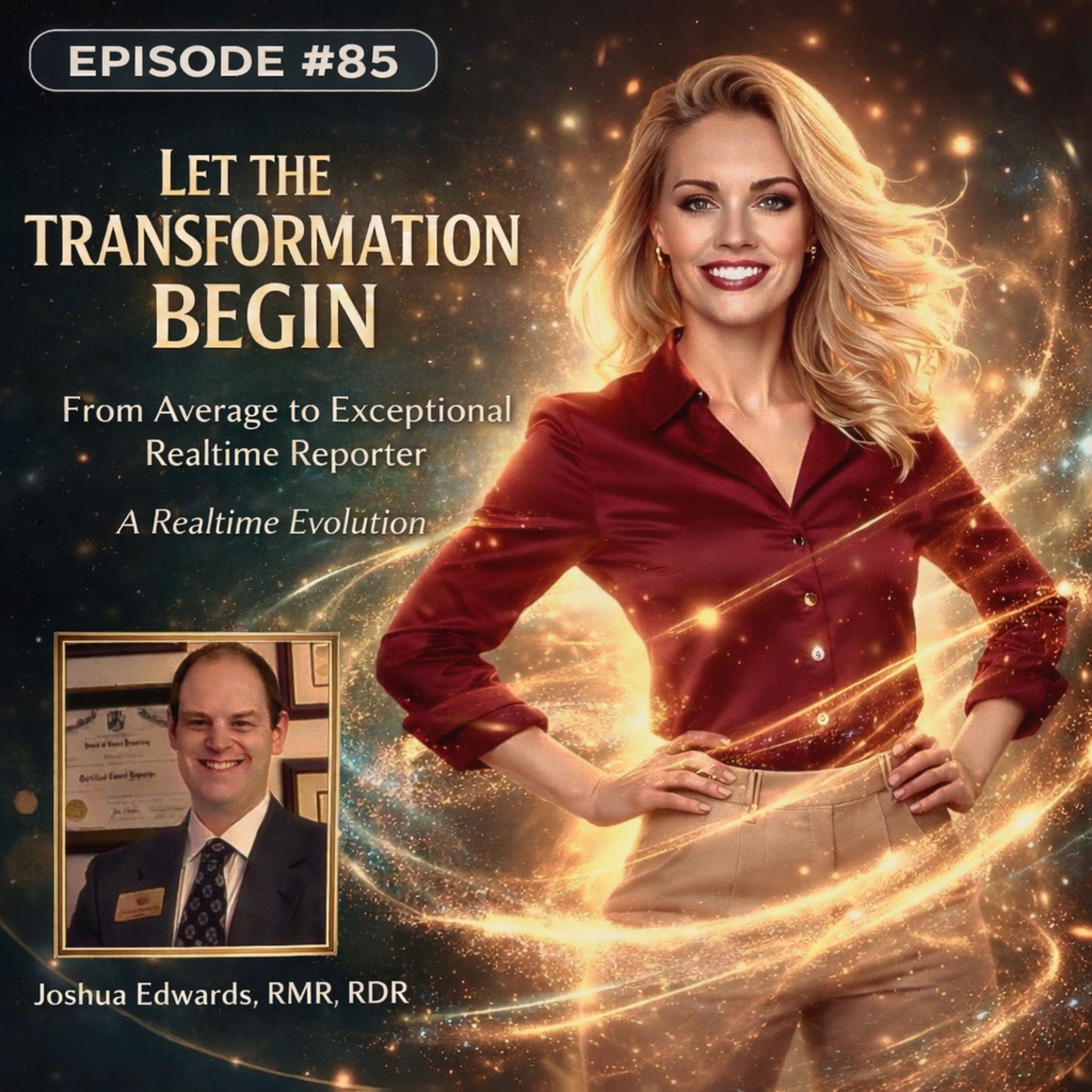
#85 - Transforming from Average to Exceptional High-Stakes Realtime Reporter: Session 1 with Joshua Edwards, RMR, RDR
43m 16s
In this podcast episode, court reporter Bryn Seymour announces her commitment to becoming a high-level real-time reporter by investing $10,000 in dedicated coaching from mentor Joshua Edwards. The discussion focuses on overcoming professional stagnation. Key problems identified include taking on inappropriate tasks like acting as a remote exhibit technician, which hampers reporting and causes frustration, and relying on inefficient manual processes for transcript formatting. The coach advises setting clear boundaries with agencies to avoid non-reporting duties and advocates for automating tasks through tools like macros and auto-indexing to improve efficiency. Additionally, the conversation clarifies foundational knowledge, such as distinguishing between federal and state court cases, to build a stronger professional framework. The episode underscores the need for structure, accountability, and systematic skill development to transition from average to exceptional performance in court reporting.
Court reporters hold one of the most important roles in the justice system. We're entrusted with the official records of the courts, and we also have to run our own businesses, which is not something most of us would prepare for. I'm Bryn Seymour, Court reporter and live-food. And I invite you to join the discussion about the problems we face and the solutions we create on the unique journey of a stenographer. Welcome to the Court reporter podcast. Today marks the beginning of something I've been talking about for years, but never fully committed to. At the start of 2026 this year, I made a decision. I'm no longer going to sit in the middle. I'm either going to quit or I'm going to become a high-level real-time court reporter. So I chose the second one. For years, I've said I was going to do this. I've said that I'd step into real-time, that I would reach the next level, and that I would document the journey. I never really followed through because I wasn't fully committed. But this time I'm doing it differently. So I reached out to some of the top real-time court reporters in the industry, and I made a very serious offer. I told them I would pay them $10,000 for dedicated coaching, accountability, and support. Not just casual mentorship, but real commitment, because I've realized something free advice is not going to transform you. Not at this level. I don't need more tips. I need structure, pressure, accountability, and someone who will not let me get away with staying the same. And Joshua Edwards said yes. He's been my mentor for years, but, and he's already taught me a lot, but this time it's different. This is not casual. This is not optional. This is the execution phase. And I'm documenting the entire process. Not just for myself, but for every single court reporter who feels stuck. Everyone who's just like me, who feels like they're doing everything right. Well actually, I don't even, I don't even feel like I'm doing everything right, but just like feels like we have so much, so much potential, but still are not operating at the level that we know we're capable of. Because here's what it is. Here's, here's the truth. I personally am a strong writer. I write clean. I write well. I'm really good at that. But as a professional, I've been operating at an average level and I'm done with that. I want to be exceptional. I want to be the kind of reporter who can walk into any high stakes job with confidence, clarity and complete control. So this episode is the very first session of that journey. One quick note before we start, this was a real raw call. We had originally started on Zoom and I was sitting in my car charging my electric vehicle and Joshua immediately called it out. He said, "No, this isn't going to work. You need to be in a proper environment ready to go." And honestly, that's exactly what I asked for. I told him from the beginning, "Do not let me get away with my habits. Do not let me stay comfortable. Hold me to a higher standard." So this is real. This is unfiltered and this is the starting point. Let's get into session one. Oh, and just to give you the context. So basically we were on the Zoom call and he said, "No, no, no, this isn't going to work. Let's reschedule." He rescheduled for Monday, but we still did a phone call and that phone call turned out to be exactly what I needed. I needed to just talk through my pain points, my struggles, like what is it that's holding me back? What is it that makes me want to quit? And so we talked through it on the phone, which was great because I think the original plan on Zoom was going to be to actually just dive right into starting like the real time trap. But actually, I still have to review the document. He said me, "But anyway, this call was very necessary and I feel like a lot of us can probably relate." So here you go. This is step one of the journey and we are about to not only talk about the problem, but prescribe the solution to it. Sorry, I just figured it out. That's fine. So auto indexing and more broadly, used to format symbols are definitely on the list of things. But that topic itself is going to be at least one hour and possibly two or three sessions. And even. And even. Oh, wow. Okay. And then even also macros and stuff. Because there's just a lot of things that I feel like, "Oh my gosh, I'm doing all this manually and it's so time consuming." And it's just like, "It makes me hate it." And I can. Oh my gosh, my last one job that I'm doing right now that I'm like working on. I was listening as I was scoping it and I remembered how terrible that job was because they made me the remote technician and they made me scroll around as they were looking at their exhibits and stuff. Like I was the one that had to do that. And I told that. Yeah. You should never, never agree to do that. I know. I think like, you know, if I'm doing this, then we're not on the record. And they were like, "Okay, that's fine." Like, because they didn't know. No, no, no. That's different. If I'm doing this, then we're not on the record, gives them a plausible reason to say, "Okay, well, then we want you to do it." What you need to say is, "I am not the remote technician. You need to have somebody else open the exhibits and scroll through them so that I can create the record while you discuss the exhibits." Yeah, that would have been better. But I knew that they didn't have someone else. Well, that's their problem. I mean, I'm not trying to come down on you hard. I'm saying that it's not the court reporter's job to scroll through exhibits remotely while you're also. I guess I didn't know what was the standard procedure because I've been asked to do that many times in the past and I just never said no if they. Because it's not like all the time, but once in a while they'll ask and I just thought that was something that maybe lower end or less organized agencies do. Well, that's not like an excuse to do something that shouldn't be your job. It's not your project. I know. So, we didn't have a standard procedure for how to avoid that. So, okay, I'm going to give it to you. When you accept remote work and you say, "I'm confirmed for Monday at 9, whatever," please ensure there is a separate remote technician available to handle exhibits. Mm-hmm. I do something similar. It has nothing to do with this, but I can't tell you how many times I've gone to a building in New York City and they don't have my name and security. And I have to sit there and wait for them to call the law firm and for the secretary to add my name and then for the security guard to see me in the computer and then they print me a pass. So now, when I confirm a job in person in New York City, I say, "Please ensure my name has been added to security before I arrive." Oh, yeah, that's a good idea. Yeah, that happened to me that day that you covered the real-time job for me. Mm-hmm. Yeah, it's a first-rate year. It's a first-rate year. Yeah, it's for. Well, I mean, that happened to me because that was such a last minute switch. And I understand that. But it should not have happened to you because you were scheduled for that position, like normal, for getting about what happened with your machine. You should have been in security so that you could show up, pang your ID and they say, "Oh, Ms. Reynolds, you're seeing more, whatever. Here's your pass. Have a good day. It should be seamless." But what happens is they schedule a reporter, they tell the attorneys, "Hey, we got your court reporter," and then they just kind of drop it and forget to put the reporter in security. And then the reporter shows up and you get blank stares from the security. So going back to your situation as the remote technician, you need to insist not, you know, if you make me the remote technician, then it'll be difficult blah, blah, blah. No, I am not the remote technician. Please ensure that you have a remote technician available to handle exhibits. Okay. And then if they push back and they say, "Well, other reporters do it." You say, "Well, I cannot do two functions. I would prefer to have a remote technician. You have to stand up for yourself." I don't care. I would actually decline a job. If they say, "John, you're really being difficult." You know, other reporters have no problem with this. I would say, "Well, you know what? I think you should get you should assign this job to someone else." I would. Yeah, the level of like, I mean, the discomfort, it just felt so frustrating in the job. I was like so unmotivated to be there and it just felt so frustrating and like. It frustrated you. It made you. Yeah, it deflated you. And this job is hard enough without feeling those emotions that were unnecessary to begin with. Yeah. So what I'm trying to do as your coach, I'm trying to give you the tools so that you can avoid that so that you can be a better reporter, a happier person/reporter and be able to do your job without having to feel this weight on your shoulders. Yes. That's what I want to do. So what I'm saying is, cut it off at the pass, so to speak. The next time you accept a remote job for any agency, add that line to your confirmation email and say, "Please ensure there is a separate technician, the exhibit technician available." Okay. And they'll either say, "Okay, we got it," or they'll push back and they'll ask you why. And then, you know, if you want my help with responding, that's fine. But at least put it in there so that you're setting the expectation that you're not going to be the one to do that. I've heard stories of people having to scroll through exhibits and then they say, "Can you open the next page? Oh, can you share your screen so I can see what's on your desktop?" Yeah. And that's like, "My goodness." I would never subject myself to that. That's like, tortured by red hot pokers. Yeah. They had me scrolling through like so many pages.
and going from document to document while they tried to figure out which one it was the correct one, it was just fairly, it was so frustrating. And I couldn't write anything that they were saying, because I told them like, I'm not, we're not on the record if we're doing this, if I'm doing this. So I'm not, yeah, I'm not going to say that anymore. Good, very good. All right, I think we beat that issue down. But there should be a list of those things that those habits that I need to like, I need to break. That's pretty conversation is I'm trying to pick your brain. What are the other habits ignoring the case cat warning that cloud storage is full performing remote technician functions, not updating the spreadsheet or not being the VTM. Yes, just reporting storming, just giving me some more. Yeah, it just they come up naturally in conversation. Okay, not knowing how to use macros, macros, doing a lot of, of automatic things that could be automated doing them manually. And knowing that they there is a way to automate them and that I'm not doing it that adds a lot of frustration and stress as well. I'm assuming that means the index, right? Yeah, that's automatically. The index is really the biggest issue of automation. It's beautiful when you use it. Yeah, also the start page and end pages. And that's a whole other thing that I feel like school never really, I never really understood like the different types of proceedings. And because you know how there's like depositions, but there's also things that have different names like EO and like do I have a separate, I mean, I always just use the same thing, same type of same cover page usually, or just use what I last used that seems similar and kind of customize it. And then I end up doing it all manually and re re typing the caption based, re typing the, you know, even not just of course the case specific things have to sometimes be done manually. But I feel like I'm doing a lot of other things manually. And also a lot of questioning, am I even doing this right? Is this the right page? Is this the right format? And then the appearances? I know that in school they taught, there was a way to make it like the, to kind of automate the people that you regularly work with. I don't feel the need to do that because I don't really work with the same people as often as I would like to. I mean, maybe I will in the future. But at this point, it's kind of like it feels like an extra thing to do to worry about when it might not be necessary. What else? The end pages, sometimes I have to like, my include files are all disorganized. So and some of them I got from other court reporters and it still has like other people's names. Yeah. Like I just need to fix on clean all that up. Yeah, that's these are all issues that are in the document that I had prepared because I know these are the issues that other people have come to me and said, you know, I'm struggling with this. Good. I'm glad I'm not doing this. No, no, no, because that's what happened. People say, can you give me your includes? And then you just get a bunch of files and they say back it up into your restore it to your system files and they're like, what is all of this? Yeah, so many. Yeah, it's never made clear like what belongs where and what goes with what. And yeah, I understand the source of the confusion. It's like there's a, it's like there's a, there's a well in aquifer somewhere that's got poisoned water and that water has been trickling out for years and it's been tainting everyone downstream and nobody can seem to get to that source and fix it. Yep. Love that. I know. Yeah, I think it's paramount importance to understand you said the EUO versus what are things called? Yes, that's okay. And in the January 1st episode that I released this year on the podcast, I talked about how like jurisdictional differences and you know different types of proceedings and all that. I kind of feel like I never really mastered. Well, of course, I don't need to master every jurisdiction. But you know what I mean, like what's really the core concept of that doesn't, it doesn't matter what jurisdiction you're in or like what, you know, those little differences are, but like you, I feel like I want to feel like I've come to a point of mastery of just like the concepts of what we really need to understand. Federal versus state. Okay. Okay. You, this is a gross oversimplification, of course, but for the most part, you're going to take depositions in either a federal court case or a state court case. Okay. Federal is the United States government. Okay, so the federal courts are called district courts. Okay, I know, well, yes. Okay. I know you know that, but I'm just, I'm trying to give you the most simple. Yeah, you never know what I, there might be things that I don't know that are really obvious. So yeah, but just give me the five-year-old explanation. Yeah. Okay. When you get an email from an agency and it says, "Brenner, you available for this job?" And you say yes, and they send you the caption and the caption says, "United States District Court, District of whatever. It could be Delaware, it could be New York, it could be California, it could be Texas, doesn't matter." If it says United States District Court, that means it's federal, the United States government, the United States federal court system. Okay. And you remember the session, I remember the moment that you were in my session in in CRA a couple years ago, and I talked about the Constitution and the the three branches of government. Yes. And Article one and I said, "Leged, legislative executive and judicial, ledJ, Article three, establishes the federal/United States Federal Court system, which are the district courts, the appellate courts, which are called circuit courts, and the United States Supreme Court that resolves all questions of federal law and constitutional interpretation." So that's federal. If it says United States District Court, it's a United States federal court case, and that's as opposed to a state court case. What's the difference? Well, assuming somebody is suing someone, if they're suing under the claiming that the other person state law somehow is going to be a state court case. And so the state is for the most part going to be New York because that's where you live and work. Yeah. But that doesn't mean you wouldn't take the state court case for another state. If the witness happens to be living in New York, and you happen to be the court court order, which is fine, but that that case might be a state court case for any of the other 49 states, it could be Florida, it could be Hawaii, it could be wherever. A state court case just means that the parties are suing and being sued under the laws of fill in the blank state, whatever state it is. And those are both called depositions. The only quirk to that is that in New York, we call a deposition in examination before trial, EBT. It's exactly the same thing as a deposition. Okay. Okay. So you have federal court cases, which have their own set of includes their caption and the appearances and stipulations. And then you have the state court cases, which have their own caption and appearances and sometimes stipulations, sometimes no stipulations. Yeah. And that's another question because the stipulations are always different even inside of New York State, like each agency decides their own stipulations. I don't even know what I just don't even use stipulations sometimes. And then sometimes that's what I'm going to say. I think the stipulations are ridiculous to include in a transcript unless an attorney says, please include the standard stipulations. And that's rare. They've been doing that less and less. Someone did that recently. Or they were like, oh, there's usual stipulations, right? Yeah. So if that was a New York State court case, you would use the stipulations, the standard quotes standard stipulations or the usual stipulations from the New York rules of civil procedure, civil, CPLR, civil practice law and rules. Those are rules that only govern practice of law in New York. Okay. So you would not use your standard CPLR stipulation in a district court case. Why? Because the CPLR is from New York's laws. It applies to the state of New York, but it has nothing to do with federal court jurisdiction or litigation. Now they have their own rules, federal practice, FRPC, the federal rules of civil procedure. So, you know, the law loves these acronyms. So federal has the FRCP and New York has the CPLR. Each state has its own version of that. I can't name them because I don't know them. Okay. Okay. But just if you think of a sheet of paper and you draw a line down the middle, the five-year-old explanation that you asked for, federal on the left state on the right. Hello. Yeah. Did you hear that? Federal on the left state on the right. Yeah, I thought you were going to elaborate. No. Well, all these little nuances go underneath each column. So under federal, you would have United States District Court. You would have FRCP. You would have, you know, circuit court, trial court, circuit court, and Supreme Court. All of these, I'm just saying these, these are all words or entities that fall under that category of federal. And then under state, you would have,
you know, CPLR for New York, you would have the 50 states, you would have steps for each state. - Wow, a document like that would be so amazing to have. - Yeah. - I can create one. - This is very high level, very high level. And that's really-- - But it's like that's the level that I would like to be thinking of because that way I can have a basic understanding across jurisdictions of just like what we need to know and what applies to us. Because I don't think that we have that into our education, like it's not really. There's a lot of things that I feel like, I can't even ask that question because I should know that. You know? - Uh-huh. - So-- - So that would be-- - 30b6 witness? - Yes. - Okay. Do you have, it's the pop quiz. What is a, give me your understanding of what that means. 30b6. - I've heard the term, but I think it's something with like workers' comp or some kind of workers. - Okay, excellent. That's an excellent response. That because that what that tells me is we need to clarify. So 30b6 is a rule from the federal rules of civil procedure. Okay, so which side of the piece of paper would you put 30b6 on? - The side of the federal court. I don't remember who said left or right. - Under federal, exactly. It doesn't matter left or right. You know, state can go on the left and federal can go on the right. My point is 30b6 is related to federal court. - Yeah. - And a 30b6 witness is called a corporate designate most, most qualified to testify on behalf of a corporation. - Okay. - For example, if somebody sues Amazon, Amazon as a company can't talk. So it has to, it has to designate a human being who works for Amazon and who has the knowledge of whatever area that Amazon is being sued for. And then that person would be designated as a 30b6 witness. The witness, the corporate designate. - Okay. - Does that make sense? - Yes. - A designate somebody who is designated. - Yes. So that basically, this is an example of what we would put on this document that we are going to create. - Exactly, yes. - Okay. Okay, cool. So we need, so let's create that document that'll help me to navigate through all the things that I feel like I kind of don't fully understand. - Yeah. - Yeah, okay, good. - All right. - I don't think of anything else off the top of my head. - Okay, going, well, do you mean issues that you would like to resolve? - Yeah, 'cause that, I mean, that sheet covers pretty much like a lot, a lot of the things that I would like to cover. But I know that as we go through things, other things within case cat and with the software and with doing things faster, those types of things will come up, but I just can't remember them off the top of my head. - Okay, no, this was a very good start. Yeah, to disambique you weight, and to disambique some of these confusing concepts. - Yeah, and basically all the things that you kind of tried to teach me in the past, that I just, they didn't really stick with me for some reason, maybe I didn't do it hands on and off or just didn't really write it down, take good notes. I never, 'cause you did show me, you showed me how to do macros for some reason, didn't get it, and then you also showed me some other things, but, so just, so you know, when these things come up and you're like, I thought I already showed you these things, just so you know, to expect that I didn't remember how to do some of the things you showed me. - Well, what's the best way for me to teach you, slash load you accountable so that you start remembering? Because what, what, what, what, what of the strongest ways for people to remember new information is blind review, where you review, you know, a little piece of what you studied before. For example, if a grade student is trying to memorize all 50 states, they would start with the anchor points. Everybody can find Florida, everybody can find Texas, everybody can find California, but not everybody could point out Illinois versus Indiana because they're kind of in the middle and they have the same letter that starts the name. So you blind review new information so that you quiz yourself and you say, okay, do I remember what Josh was said about the 30b6 witness? And the best way to, to figure that out is to explain it to someone from pretend you're explaining it to someone, you know, try to, who's willing to listen to this stuff and say, hey, do you mind if I explain to you a concept? It's called the 30b6 witness and they're gonna say, okay, go ahead and then you say a 30b6 witness is and then you fill in the rest. - Okay, yeah, that's great. So I'll try to, yeah, we can create something like that. It's so interesting that, you know, being a certified, can you hear me by the way I'm driving through kind of a battery? Okay, so that's another thing I was gonna bring up is like, when I study for the, or when a court reporter wants to study for the RPR or for like the certification exam, these are not things that are on there. It's not generally things that we're required to talk about or to understand or to learn. Instead, we're required to study to become a notary, which is like something completely, well, at least in New York. It's the notary test. I've found myself studying for eight hours, like for like a full day to prepare for the notary test. And it just felt like what is this half, like 90% of this, what does it have to do with being a corporate? If I were required to study this stuff instead, it would be so much better. - Yeah, no, totally agree. And that's unfortunate that we spend so much time wasting time. We waste some of it's doing things that are not germane to our job. But in California, I think like their CSR exam covers all this stuff probably, and they feel more qualified. But then in New York, we're just studying this notary stuff. And I think that even the RPR, I remember asking people what to study and how to study for it. And they're just like, I couldn't even tell you, like I don't even know how I passed. Or things like answers like that, or the classic social media, Stephanie and DeNay, they posted things about passing the RPR. And it was like funny, gif things about like when you ask me what to study for the RPR. And it's like, I don't know, I really don't know. Like it was a funny, it was like a funny audio. And it was just like emphasizing over and over and over again. I have no idea what to study for the RPR. So I kind of, I don't know, I kind of gave me the feeling that like even the RPR might be a waste of time to study for. If it's not covering the basics, then we really need to know to understand how to be a good corporate reporter. - Yeah, I mean, I feel that I feel exactly that way. I feel that this job really should be based on your skill. And who cares if you know what a medical term means? If you can write it and you know how to look it up and spell it correctly for the transcript. This job is all about skill and procedure. And if your corporate reporter, your work product is the transcript and if your captioner, your work product is the translation on the screen. It's that simple. - Right. - It's that simple. So yeah, I don't have a good answer for that. It's just, if you want the RPR as a matter of personal satisfaction and pride, you just have to study everything and do your best on the test. - Well, I don't, I mean, I'd rather get the CSR than California, I just studied for the California test. - Well, what are you gonna do with the California CSR? - Well, I just generally wanna be like, I want to understand the things we need to understand to have confidence in navigating through all the legal, like all the different types of transcripts, like what we were just talking about in the jurisdictions and what is the core thing to understand, you know, that type of thing? - Well, that sounds like training rather than certification. I mean, I don't know, the CSR is in California, is notorious for being probably the hardest in the country. - Well, I mean, I think that was hard. - I've never thought maybe it was relevant. I thought it was more relevant, but still hard, you know? - I don't know, I've never looked into it, so I really, I can't answer that. But the stuff that's relevant for our job is definitely at a basic level of the difference in jurisdiction, which is federal versus state. And, you know, if you, you know, we can get into all of the different, like plaintiff and counter plaintiff and third party plaintiff and counter claimant and counter defendant, cross claimant, you know, all these little nuances, they're interesting, actually. I think they're kind of interesting. - Yeah. - But no one's ever going to ask you, like the biggest discussion you'll probably ever have is when you ask an attorney, so which party do you represent when you're getting their appearance? And they say, "Oh, I represent the third party defendant." And it's like, "Okay." And then you note that down and you put it in the transcript. It doesn't really even matter if you understand what that means. - Right. Well, I guess, yeah, you're right. There's a lot of things we don't need to understand, but it could lead to us misrepresenting something if we don't understand it. You know what I mean? - Well, we're not going to misrepresent something. We might just, you know, misrepresent is kind of a harsh term for-- - Or like inaccurately, I don't know. I'm just, I just feel like there could be some, if I guess we need to know what needs to be notated and what doesn't, what, why and why not? Like that type of thing would be great. - Well, okay, break that down. What needs to be notated? Obviously, all of the testimony, the captioning, the-- - Yeah, and then things like, is what's it called in that little paragraph underneath the caption where it says, "Pursuant to notice or-- - Oh, yeah, oh, God, you're bringing back memories. You know, I wasted so much time worrying about that. I just deleted it.
years ago. I have not said pursuant to anything in years. Okay, so that's an example. Yeah, so like what is key to understand what's not maybe if that's your element, we don't need it. Like, when those things exist in our training and then we never we don't really know what it means or why it's fair or how to identify what goes there. It kind of makes it feel like I don't know what I'm doing. Yeah, no, I get that that's fair. The pursuant to thing is, you know, the attorneys know what it's pursuant to and it doesn't matter. So who cares if you put that is pursuant to a notice and it was really pursuant to a subpoena, it's better off leaving it out and not raising an issue. Okay, for the first time in my career, I had an attorney say, oh, I see that you put attorneys eyes only on the caption page and this transcript is actually just confidential. And, you know, I thought it was attorneys eyes only because they had an exhibit that was attorneys eyes only and so, you know, I would like well, that exhibit is going to be discussed. So when they said just make it confidential. All they wanted me to do was change the caption and take out attorneys eyes only right confidential. And I was like, okay, make an issue of that fine. No problem. I'll redo the transcript and send it out. It took you know, two minutes. But I had never been trained to really understand the difference between those two. Yeah, there was an attorney that asked me to make it confidential recently or a few months ago. And so I was like, okay, that's this is kind of new to me. I don't I guess I'll just put that on the and I did a little bit of research to know where to where I should I put that in the transcripts. Should I put it in the header should I put it at the top of the caption or the bottom of the caption or something and I ended up just putting it. I think I did put it in both the caption and the header, but I wasn't really 100% sure, but it was one of those things that I just did and it was fine and I don't know, I didn't much about it afterwards. Yeah, but as long as it says confidential if they asked for the transcript to be marked confidential, you put that on the on the cover page under in the under the caption. And that's it. Okay, so these are things I wish, you know, we're included in some kind of a manual or some kind of like a training guy or the most in the most extreme situation, they will ask for a portion of the transcript to be extracted. And this is where things do get a little complicated, I'll be honest, so let's say you mark several exhibits and they get to a particular exhibit that is highly sensitive and it is attorneys eyes only so they will ask you can you mark this portion of the transcript confidential and bind it separately. So now, let's say the transcript is 100 pages and the portion that they want bound separately is pages 45 to 50. Are you following me? Yes. So you're going to have two booklets at the end of the day, the first booklet is going to have pages one to 44 and then the next sheet of paper is going to be page 51. Okay. Okay. And then the rest and then pages 51 to the end to page 100 plus the rat and all that stuff. The second booklet is going to have its own copy of the caption and it's going to have the highly confidential attorneys eyes only pages 45 to 50. Okay. I'm just giving you the concept I can actually teach you how to do that. Yeah, and I mean, if you know, if this is all like when I bring this kind of stuff up, it's kind of just, you know, if it's not relevant to discuss and if it's taking away from what we really should be focusing on, then, you know, you can also tell me that but, but I would just love to put something together like a reference manual or like a study guide that would be important instead of the notary. You know, something like that forget the notary you have the notary. No, I know, but just the studying part, the preparing part and confidence part. Yeah, well confidence that's why being aware if they say, you know, this part, this next exhibit and all the questions pertaining to it are highly confidential attorneys eyes only, could you please separate it or they'll say extract it or bind it separately or. You know, remove it they'll use some word to indicate they want it out of the transcript, but obviously you have to create that portion of the transcript so your confidence comes in knowing that okay, no problem counsel noted. You don't have to do anything right then and there, but, but when you edit the transcript, you do have to know how to separate those pages and create two files and have the page numbers line up so that. Like I said, pages one to 44 and then 45 to 50 are missing because they're in a separate booklet and then the next sheet of paper in that first transcript is page 51 and then to the end that's another thing that. Okay, so that's this is so interesting like it just feels like in school, we learn how to write on the machine and that's what I love to do and I'm good at but. There's just all these other things like when that does happen for a quarter quarter the first time that there's a whole long list of things like that that they just have to look it up or figure it out on the spot. Instead of you know, it's not fair really right. It's not efficient and it's confusing and it's frustrating and it adds to the I guess the burnout that we experience you know on top of everything that we're already doing it's like. We're trying to figure these things out so it happens a lot but but anyway that's beside the point I guess it's not and I just dwell on these things because I want to be like really confident that I know how to do everything and. But I don't need to dwell on everything. Yeah yeah and I saw you said you wanted to quit twice and that's really sad. I know it's just that it just it's these things that keep coming up that just feel like what is going on in yeah but yeah it's okay. Well that's that's why you reached out so I'm here to help and hopefully I'll make a lasting impact this time. Okay thank you so much I'm really excited so I'm going to review the document and review this call recording and maybe create start creating that document that we talked about and maybe I'll turn this into a podcast episode because I think it was a great conversation. Yeah yeah absolutely I'm happy to help. I can probably do like maybe 50 or 75% on Sundays and there might be some Sundays where I have to reschedule it for a Monday or an evening like a weekday evening but I think we could probably make Sundays work. Okay so evening time not like too late but like five. Or later. Well how do you just debriefing before you wrap up how do you feel about this conversation. I feel like it definitely brought up a lot of good points that I've been wanting to ask about and I also feel like it. It did it may have gone well I don't know actually I'm not sure if it was like rabbit holes that that didn't matter because I brought them up or if it's actually necessary but I'll feel much more confident knowing and understanding the list the once we've created some kind of a court reporters reference manual. And I think that I'm really glad that those things came up even if we don't need to spend time talking about them but just so I had the chance to let you know all the all the confusion that I've been experiencing and you know it's like it's little things but they build up because it just makes you feel like did I miss that like when did I miss that like so if you if you're feeling and asking that question so many times then it kind of just feels like burn like overwhelming you know. It's just like I want to be good at what I'm doing I want to like reach a level of of mastery where I at least understand what I should focus on when I shouldn't and I don't know I just feel so dumb but it's okay. Well I don't want you to feel dumb for sure you're not and you shouldn't feel that way. Yeah I guess just you know in certain things certain areas but let's just we're going to break down the whole court reporting experience you know that's that's what I put in the document we're going to excellent scenographic real time writers are masters of three broad domains hardware software writing skill and then hardware you know I explain what each of those are and that's what we're going to focus on and we're going to make sure that you know each. portion of the deposition okay perfect yeah I'm excited thank you so much yeah absolutely so have a great weekend yes you on Monday let's do let's do the iPad and case view on Monday that's the hardware part like should I have them by then. Hopefully ideally yeah okay I'll try my best okay okay. All right well case view net I can definitely have by Monday but I don't know about the iPads I was going to I was going to try to figure out like what's the best way to get the don't don't I'm sorry I don't need to don't buy like an iPad if you don't have one just do you have some kind of tablet a separate. You know I even a separate laptop or okay all you need to do is have a separate tablet some kind because you're going to connect each one to the router and you're going to. Use a case view net okay to output that's all so yeah don't buy an iPad okay so I'll have an extra device ready and I'll have case unit but should I use.
sure I need case unit yet or do we have a lot to cover before we even get to that point? Well, it's kind of, I mean, I guess to be honest, we can reverse engineer that maybe we should dive into case catalysts before, yeah, I think, okay, that's a fair point. If you want to start with all the case cat stuff like the auto indexing and the captions and the thing, the macros and all that stuff, because those are tools of the trade, you know, those are part of mastery of the software. So that's the broad category, the broad domain number two that I mentioned. And then once once you feel you have that down and you are a solid real-time writer, which is the writing skill, domain number three, maybe then we go ahead and move to the hardware, which is what you need to physically be able to stream your captions to somebody else. Okay, perfect. Okay, yeah, I just talking through that was helpful for me actually. Okay, great. Awesome. Yeah. All right, so save some money for now. Okay, thank you. All right, you're welcome. All right, see you Monday. All right, there you have it. That was session one. And even just that conversation showed me something I've been avoiding for a long time. It's not that I don't have the ability. It's that I haven't been operating at the level I'm capable of. And there's a difference. So this is where it changes. I'm not going back to doing things halfway. I'm not going back to figuring things out on the fly and hoping it all works out. I'm building real systems, real discipline and real accountability. And I'm going to document all of it as I said, the wins, the frustrations, the moments where I want to quit and the moments where things finally start to click. I know I'm not the only one who feels like this. If you're listening and you've ever felt like you're doing everything but still not where you want to be, I want you to come along on this journey with me. If something in this episode stands out to you or if there's something you've been struggling with in your own workflow, I really would love to hear from you. We're not just going to talk about this. We are going to solve it. If you have anything you want to share, please go to courtreportorpodcast.com. And on the bottom right hand corner, you'll see a little green microphone. You can click it. You can leave a voice message up to two minutes long. If you want to talk more than that, just leave multiple or you can send me a voice message on Facebook. I would love to feature you on the podcast. I want to hear from you. So please reach out. Brin at courtreportorpodcast.com. And I'd love to get on call as soon as possible. And I'm the type of person that like, so just jump right in. I was actually just talking to a courtreportor today that I wanted to, that I want to interview on the podcast. And I was like, you know what? I like to just like jump right in from the beginning. No pre-call. There's really, there's nothing to plan out. There's nothing that needs any preparation because every conversation that I have with another courtreportor needs to be recorded. Literally every time I'm halfway through the conversation, I'm like, why didn't we just hit record from the beginning? We're missing all the good stuff here. So please reach out. If you want to schedule your interview, I would like to hear from you and feature you on this podcast. Your voice needs to be heard. Let it out. All right, let's go. See you in the next episode.
Podcast Summary
Key Points:
The host, a court reporter, commits to advancing from average to exceptional by investing in serious, paid coaching.
Key issues discussed include avoiding non-reporting tasks (like remote exhibit handling), automating manual processes, and understanding jurisdictional differences (federal vs. state cases).
The coach emphasizes setting professional boundaries, using tools like macros and auto-indexing to reduce frustration, and building a systematic understanding of legal proceedings.
Summary:
In this podcast episode, court reporter Bryn Seymour announces her commitment to becoming a high-level real-time reporter by investing $10,000 in dedicated coaching from mentor Joshua Edwards. The discussion focuses on overcoming professional stagnation. Key problems identified include taking on inappropriate tasks like acting as a remote exhibit technician, which hampers reporting and causes frustration, and relying on inefficient manual processes for transcript formatting.
The coach advises setting clear boundaries with agencies to avoid non-reporting duties and advocates for automating tasks through tools like macros and auto-indexing to improve efficiency. Additionally, the conversation clarifies foundational knowledge, such as distinguishing between federal and state court cases, to build a stronger professional framework. The episode underscores the need for structure, accountability, and systematic skill development to transition from average to exceptional performance in court reporting.
FAQs
Federal cases are under United States District Courts and follow the Federal Rules of Civil Procedure (FRCP), while state cases are under state laws, such as New York's CPLR, and involve depositions or examinations before trial (EBT) depending on the state.
When confirming a remote job, explicitly state in the confirmation email that a separate remote technician must be available to handle exhibits, and firmly decline if asked to perform those duties yourself to maintain professional boundaries.
Common habits to break include ignoring software warnings, performing non-reporting tasks like remote technician work, not automating processes like indexing or macros, and using disorganized or outdated include files in transcripts.
Automating tasks reduces manual effort, saves time, minimizes frustration, and allows reporters to focus on creating accurate records, thereby increasing overall productivity and job satisfaction.
Stand firm and decline the job if necessary, as performing dual roles compromises the quality of the record and is not a standard responsibility; prioritize professional standards over accommodating unreasonable demands.
Clean up include files by removing outdated or irrelevant content, organize them systematically, and ensure templates are jurisdiction-specific (e.g., federal vs. state) to avoid confusion and errors in transcripts.
Chat with AI
Loading...
Pro features
Go deeper with this episode
Unlock creator-grade tools that turn any transcript into show notes and subtitle files.
 PodcastTranscript AI