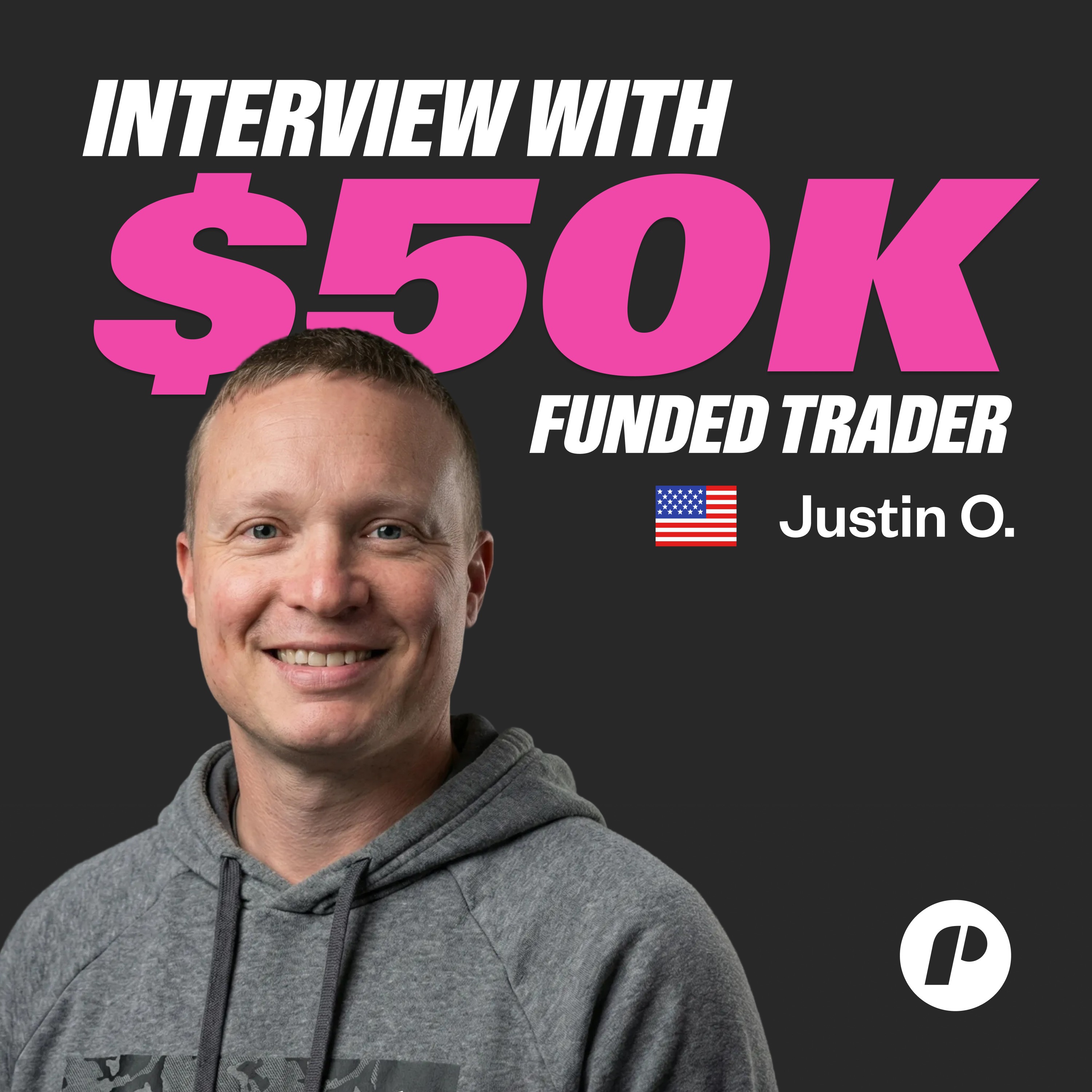
92.8% WIN Rate with Short Term Reversals — Justin’s $50K Winning Setup
from Trade The Pool On Audio
15m 25s
In this interview, funded trader Justin discusses key trading principles and his personal journey. He emphasizes the critical need for a disciplined stop-loss strategy to avoid catastrophic losses, particularly when success can lead to overconfidence. Justin explains that after years of trading, he developed a strategy focused on stocks making intense, unnatural price movements, using a reversal system on a one-minute chart that suits his impatient nature. He passed a Trade the Pool evaluation on his second attempt, adapting to different account structures and buying power. Justin compares trading his own capital with a funded account, noting a learning curve regarding order execution and risk management. He advocates for platforms like Trade the Pool as valuable tools for new traders to experience real-market emotions with limited financial risk, bridging the gap between paper trading and live accounts. The conversation underscores that successful trading requires a personalized strategy aligned with one's psychology and consistent risk management.
You get so used to winning that sometimes you would just let the loser go and go and go thinking eventually it's going to work because you're so used to winning. Whereas you need to have that hard type stop loss number in there otherwise you can really get hurt by it. When you win in so many times it's super easy to become addictive to it, right? And when the the bad trade come or the losing trade it's easier to to blow the account. Yes, very much. You're listening to Trade the Pool on audio. Welcome everybody to another Fender of Trade the Pool today. Justine is with me and you fund a trader of the 50k Flex account. Thanks for coming, Justin. Absolutely no problem. I see the background so good morning. Yes, good morning. So Justin will talk about your account in a second but let's dive into your background a little bit. How long have you been trading for? I've been trading for a long time now probably like eight years or so. If I'm doing my math or I think it's starting in 2017, 2018 something along those lines so it's not something new for me enough. Okay, and so now I understand because you pass the evaluation on your second attempt, right? You have one attempt, fail it and then pass it which is very rare. In most cases we will see guys trading three to five accounts before they actually pass the evaluation so I guess the experience and the knowledge that you can give you that boost. Yeah, there's also a little bit of just a proof of concept and I had to change my thinking a little bit because I still have like a main account that I trade but I wanted to come and try out Trade the Pool as well because of the few reasons I wanted to see if it was a viable option out there for people who maybe can't get a full like US funded PDT account with how the laws are currently and then it provides like the opportunity to trade some stocks that I might not be able to trade just because of the nature of the trading platforms and how everything works and all that. Yeah. So I was actually kind of mad at myself that it took me more than one but I had to change my thinking a little bit to like buying power and numbers and all that stuff so it took me a trial run to get that through my brain. No, you did amazing really fast passing it and tell me a little bit about your trading style and you've been doing it for quite a while. Yeah, I just definitely started with different styles and when I was first learning years ago but I've over the last probably five or five years or so I've locked into what I do now which is just based off of stocks that are making I call them intense moves. They're making moves that are unnatural either up or down in a faster manner than they normally would and then I take the reversal using a 1, 1, 2 averaging system for the hyper-operability bounce back move. Okay, is that something that you do mostly in today or also on swing accounts? I don't do it on swings I want to but I haven't gotten that. I haven't done it enough. I know some of the guys that I trade with they do it on swings and they do very well with it but I'm by nature a much more impatient person which is why I found this strategy which generally works in a faster time frame so instead of trying to adapt myself and change myself to a strategy I found one that is more in tune with who I am as a person. Yeah, that's super important because at the end of the day trading is very individual right? Exactly. So I'm taking you back a few years ago. You're trading different styles. How did you reach to the point when you say okay I'm good with what I have right now. How do you go through what's the path that you went through basically? Yeah, so it started pretty much I think how a lot of people start where if you're going on YouTube and you see all the different traders and you see some of the huge YouTube traders out there and they're doing like the penny stock to the moon stuff and that gets you really excited into it because you see people take like very small-ish relatively accounts and because they're taking these tiny little penny stocks they can take big size and make big money right away but you quickly realize that for 99.9% of people that is not about a viable strategy that's going to work. So from there I moved on to more of a continuation strategy which works for a little bit but I could never quite really get it to be a long-term thing. It was always kind of like 50-50 and then that when the downswing has become it would be hard to get through and then it would be a grind back and I'm just like I'm just trying water here and that's eventually when I was like all right I need to stop just fighting this and doing what the masses tell me I should be doing and I need to find something that I can adapt to myself and how I view things and maybe works a little bit faster because I am such an impatient person and that's how I eventually found what I do now. Amazing. And you mostly trade though one minute chart? Yeah I trade the one minute chart that's more just a function of that's what I started with and learned on and what I've done the entire time since there's not really I don't have like hard feelings or hard convictions of that's the chart you should be using you can use five minute to minute that's just the one that I learned on yeah and that's so I don't want to change that because it I think changed my views of what the chart looks like I think the same move on a two minute and five minute chart would look different to me than it does on a one minute chart so I don't want to take what I know works for me and then try and change it for some reason into something that looks different. Yeah that's 100% once you found your rhythm you got to stick to it and not try to play with it because at the end it's a pattern recognition right time get used to a certain price action and if you get familiar with it on a one minute chart it will be totally different on a five. Right. Sure. All right it just in good stuff I'm going to share my screen and show you guys at home your dashboard. Okay. Let's see how it looks like and what she did. Okay so basically that's it. Like I said before you filled the first one and on the second one you already made it let's look at the one that you passed 50k account $3,000 to the target 6% that's all and you got $2,000 to lose on a max loss will go over your trades in a second but the first thing that comes in my is this one right here right the risk reward is a 0.3 but the success what's that I'm here. Sure. Yeah well that's where a lot of people generally kind of if they see me sometimes they're like what are you doing your your losses can be much bigger than your wins and I'm like well yes absolutely they can but that's built into the strategy because in my opinion that your risk reward ratio isn't a standalone number you have to factor in your win percent with it because and like you said earlier one thing I always say is there's a thousand ways to trade out there and the only one that is the right one is the one that works for you and so if you know your risk reward to win percent ratio you can have like I do the ability to have your loss be substantially bigger than your wins and still win overall because of your win percentage so and it's the vice versa is correct also you get a low win percentage but if your wins are much higher than your losses you're going to be able to win as well I just like winning and don't like losing and I'm in patience so that's why I have this particular model. It's always a tricky one right because on one end you go for a higher success rate with a low risk reward but once you do have those losing trades they could be they could take a lot of the profits that you already make. Yeah but that's also where trade the pool kind of helps a little bit and when people if they try to do a strategy similar to mine if they don't have like a hard stop loss number implemented into their account it may be tougher because you get so used to winning that sometimes you would just let the loser go and go and go thinking eventually it's going to work because you're so used to winning whereas you need to have that hard type stop loss number in there otherwise you can really get hurt by it. Yeah that's very important what you just mentioned it's super easy especially as I said you know when you win in so many times it's super easy to become addictive to it right and when the the bad trade come or the losing trade it's easier to to blow that count. Yes very much. All right looking at your trades I do see a lot of small calves but also from time to time you do have those classic ones like CSIQ or so the other one here. Yeah you know 50 dollar stock but tell me a little bit about that what are you looking for basically why is it small calves but also mid-large calf. Yeah so I don't really care exactly what the price level of the stock is I care more about what move it is making so my scanner is going to show me you know all the price ranges of stocks and it's going to show me which ones are making the intense moves. I'm then going to take a look at it I'm going to look at the range of the move the range that are in the candles how fast this I'm going to look at the daily chart see is it you know breaking out some new highs is
They're earnings today, something along those lines that's making it make this move, or is it truly an unnatural big intense move? And that happens on stocks of all prices. It doesn't really matter. Now, I see it tend to happen a bit more in the lower price ones, because you get those pump and dumps a lot more. I think in the lower price ones, there aren't the big blue chip stocks. And sometimes the blue chip ones, they will do the dumps to the downside more for loans. And they will short. I generally like shorts better, because shorts were faster long, stay longer in my opinion, for the way that I trade. But as long as it's making the correct type of move, I don't generally care what the price is. You just have to then get your sizing right based on the underlying stock price. Yeah, I agree, totally agree with that. You know, you've been with us for a short amount of time, but tell me what you experienced on trade at full compared to trading your own capital. Yeah, I think it was just at first it was because I've been doing my own thing, my own way with my one account for so long. There's a little bit of a learning curve, just because when you change platforms and you have a different type of account, it's going to be a little bit of a learning curve overall and making sure you're getting your sizing right and learning how to use the system and how everything gets worked and gets filled. And one of the things that I actually found that I liked is because of the way that I enter trades with limits, I generally don't have them sitting out waiting. I generally wait until it hits a level with a limit number and then I will hit the button once it gets through that level. And I was finding that I was actually getting a lot of better fills with trade the pool because it wasn't seeking out my individual order, at least for the e-valid, and I had to get a better fill either up or down. A lot of the times, but then you also have to keep in mind when you are going to finish the trade, that's also going to affect how you finish the trade. So you've got to wait for either the bid or the ask to get there. So it's just a little bit of a learning curve, I think, in the beginning to get that and through my head compared to my normal account that I use. - On the level of risk in the capital? - Yeah, the risk in the capital and then how the fills were working because say I have a similar size to count, but it's like a four to one. So essentially the other count is maybe four times the buying power of this one. So I had to, in my brain, get through cutting my normal trade size on that any particular stock into 25% of what I would have had in my regular account. But then at the same time, I was able to trade some stocks that my other account maybe didn't have shares available on or something like that. So it was kind of just a learning curve all over the place in the beginning. - And you basically trying to copy both accounts? - No, I kind of adapted not taking the same stock in both accounts. I kind of went to the super lower price stuff in my regular account and some of the higher stuff I started doing in the trade to pool account just because if there was one that was going to lose, I didn't want to have it lose it both accounts. - Okay. - I was at least had the option if I was going to have a red trade then maybe the other account that I had was going to be green that day and it wouldn't feel as bad. - Kind of split them up like that. - Got it, got it. - Alrighty, any tips or tricks for when you guys it comes to trade a pool and one of the past evaluations? - Yeah, I mean, I would say definitely it's better to start and this is why I wanted to try it and see how it was as well because if you're doing just like a regular keeper trading account, sure it's going to teach you some things but it's never going to have any percent of emotions associated with it where you can do something like a trade the pool account where you're not going to have your full huge capital invested that you would need for your own personal account but you are still going to have money invested in it to buy the evaluation and try to get to the funded stage. So if you're just learning, it's a great way to limit your risk on your capital side while still importing those emotions into your actual trading that you wouldn't get out of like just a picker account. So I think it's really good for that to teach people who are new and to actually experience some of the emotions that you go through when you're trading because it's always a million percent different when you actually move to real money from just paper trading and trying to learn because those emotions take over and it's the hardest part about trading. So when you can have something like this where you do import some of those emotions into your trading while you're learning I think it really helps people. - Yeah, I'm good person. - Amazing, Justin, we're good stuff. I'm sure the guys that just listen will enjoy it. Thanks of course for coming again. - Yeah, no problem. - And for those of you who want to check us out, go to tradethepool.com. Justin, the other guys can watch you. - I'm on YouTube, GDT, Stock Trading, or if you look up Garage Day Trader, you'll find me. - All righty, good stuff. Take care guys, we'll see you on the next video. - Thank you. - Thank you for listening to Trade the Pool on Audio. Visit us at tradethepool.com and see if you have what it takes to become a funded trader. That's www.tradethepool.com.
Podcast Summary
Key Points:
Experienced trader Justin discusses the importance of implementing a hard stop-loss to prevent significant losses, especially when accustomed to frequent wins.
He shares his trading evolution, moving from ineffective strategies to a personalized approach focusing on stocks making intense, unnatural moves and using a 1,1,2 averaging system for reversals.
Justin highlights the value of Trade the Pool for learning with real emotions and limited capital risk, and notes differences in platform execution and trade fills compared to personal accounts.
Summary:
In this interview, funded trader Justin discusses key trading principles and his personal journey. He emphasizes the critical need for a disciplined stop-loss strategy to avoid catastrophic losses, particularly when success can lead to overconfidence. Justin explains that after years of trading, he developed a strategy focused on stocks making intense, unnatural price movements, using a reversal system on a one-minute chart that suits his impatient nature.
He passed a Trade the Pool evaluation on his second attempt, adapting to different account structures and buying power. Justin compares trading his own capital with a funded account, noting a learning curve regarding order execution and risk management. He advocates for platforms like Trade the Pool as valuable tools for new traders to experience real-market emotions with limited financial risk, bridging the gap between paper trading and live accounts.
The conversation underscores that successful trading requires a personalized strategy aligned with one's psychology and consistent risk management.
FAQs
A hard stop loss prevents you from letting losing trades run indefinitely due to overconfidence from past wins, which can protect your account from significant damage.
Justin trades stocks making intense, unnatural moves up or down and takes reversals using a 1, 1, 2 averaging system for quick bounce-back opportunities, primarily on a one-minute chart.
He shifted from strategies that didn't suit him, like penny stocks or continuation methods, to a faster reversal strategy that aligns with his impatient nature, emphasizing personal fit over popular approaches.
It allows traders to learn with real-money stakes and emotions while limiting capital risk, providing a more realistic experience than paper trading without the full financial exposure of a personal account.
He balances a low risk-reward ratio with a high win percentage, ensuring that even when losses are larger than wins, overall profitability is maintained through consistent success rates.
He focuses on the intensity and speed of price moves rather than stock price, scanning for unnatural movements and checking daily charts for catalysts like earnings or breakouts.
Chat with AI
Loading...
Pro features
Go deeper with this episode
Unlock creator-grade tools that turn any transcript into show notes and subtitle files.
 PodcastTranscript AI