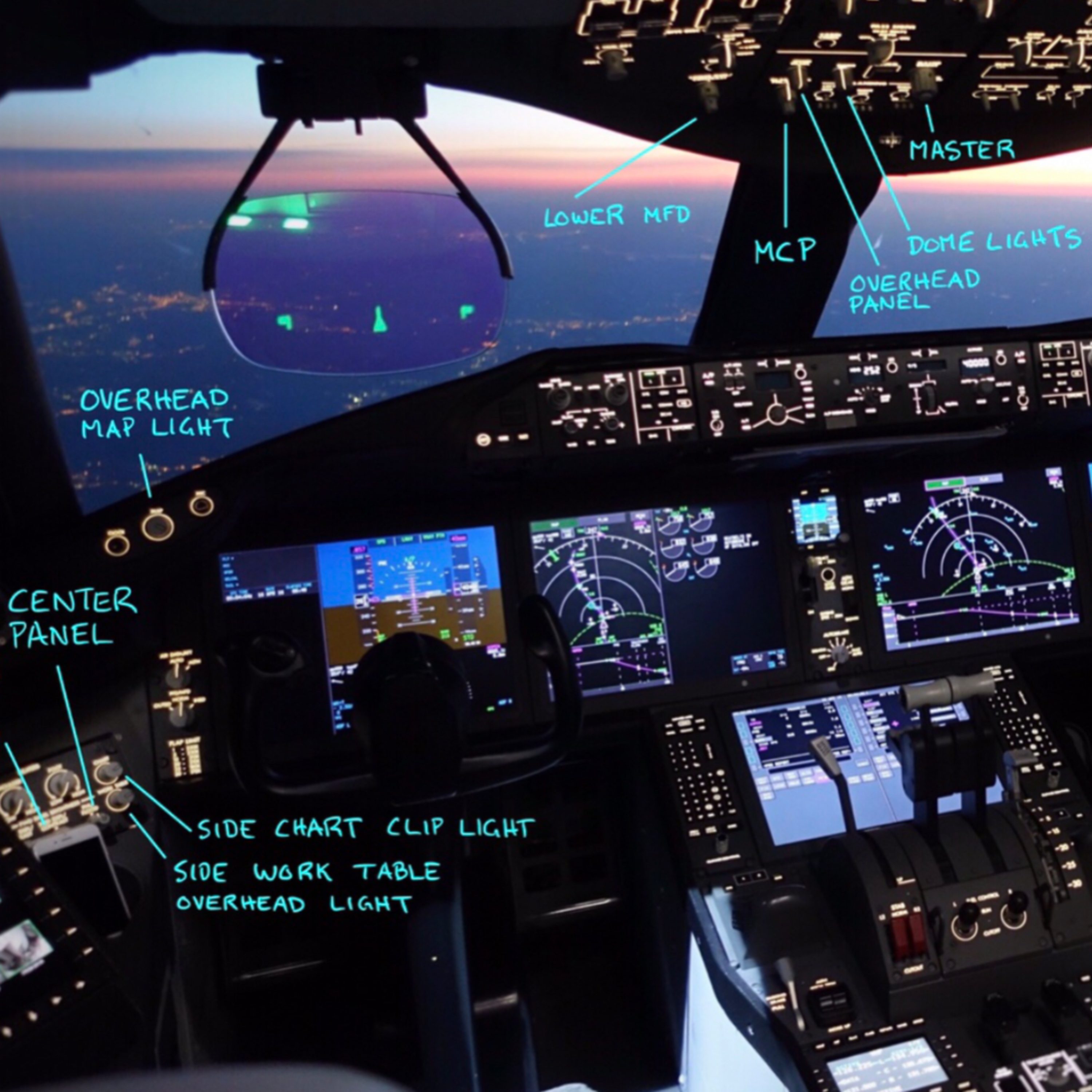
This audio provides a detailed, step-by-step guide to the 787 pre-flight, takeoff, and post-landing procedures, emphasizing standardization and safety. The pre-flight includes verification of electrical power, systems status, fuel, and engine parameters, with both captain and first officer performing dedicated checks. Key actions include initiating APU or external power, setting IRS and flight controls, and confirming FMC data such as engine settings, wind, fuel, and temperature. The before-start checklist ensures all systems are operational and doors are secure. Takeoff flow includes engine start, configuration checks, thrust management, and continuous cross-verification of airspeed, flight path, and engine indications. During flight, pilots monitor performance, glide slope, and auto-throttle settings. The landing phase requires precise control, including flap settings, speed checks, and glide path capture. After landing, the aircraft is shut down systematically, with all systems powered off and a final checklist completed. The content is delivered by a certified 787 pilot with extensive instructional experience, reinforcing procedural rigor and crew coordination. It serves as a vital reference for flight crews to maintain consistency, reduce errors, and ensure compliance with the 787’s operational standards.
787 Quick Reference Audio Standardize Actions, Triggers, Flows, Checklists, Litnays,
Captain, First Officer The pre-flight will not be discussed
on this audio, however, the entire pre-flight is accomplished prior to every flight.
When maintenance has been performed, the pre-flight items associated with the system component,
etc. should be checked.
The pre-flight inspection may be accomplished by one pilot individually, or may be split
between the pilots.
Electrical Power Up Battery Switch On C1 and C2 electric pump
selector off, demand pump selector off, wiper selector off, landing gear lever down, alternate
flaps selector off, electrical power established.
Note, if external power is desired, external power available lights illuminated, external
power switch, switches, push.
If APU power is desired, APU generator switches on, note, prior to APU start, wait 15 seconds
after left CCR is online, Captain indications, 50 seconds from battery selection.
Note, main battery low message may show will blank when charged.
APU selector start then on.
Note, APU battery supports two consecutive starts followed by a five minute cooling before
the third attempt.
Important pre-flight items.
Lighting panel set, IRS selector on, 32nd cycle, if needed.
Status display, check.
Checking for oxygen PSI, 1250 PSI, e-tops, 800 PSI, non e-tops, hydraulic quantity, no
RF or OF displayed, engine oil, 20 quart minimum for all operations.
Parking break set, QRCs too, found below the tillers, emergency equipment, flight deck
forms, check, flight deck door access system, test, check.
Nick, Dara's 4, check status, ICAS, fuel, balance, offset, off, foes, accomplish FMC
pre-flight procedure.
Initial data set, initial data to include engine stash 8, GNX 1B 7-0-9, GNX 1B 7-4/75,
have data, AA7, FMC database, 0901 Zulu, first day in range, and expires at 09000 Zulu on
the last day in the range, fuel, temperature, minimum, jet A minus 37 degrees Celsius.
That is the default setting.
Wind data, load, select.
Full data set, performance data set, offset key, select, slop offset, off.
Pre-flight procedure flow highlights, flight condition, surfaces panel, set, heading reference
panel, set, electrical panel, set, APU selector, start then on, note about APU, APU automatically
starts, loss of 3 or more engine generators, causes auto-inflate start, two starter generators
either used on ground, or engine powered, fuel spar valve, inlet door, CCS, left, AFT, DC
pump, HUD brightness control, left or right, in, wiper, left or right, off, towing power
panels, lights off, CCR reset switches, guards closed, emergency light switch, guard closed,
service in from switch off, oxygen on, oxygen on, light out, window heat panel set, RAM,
air, turbine, unlock, light out, hydraulic panel, set, all of them.
Seat belt, sign selector off, ground test selector, norm, APU fire panel set, note about
APU fire, fire indication, auto detection and protection, ground one loop detects equals
shut down 15 seconds to close fuel valve, discharges the extinguisher bottle, flight two loops
required, cargo fire panel set, engine panel set, fuel jettison panel set, fuel panel
set, all off one pressure not eliminated, any ice panel set, auto, lighting panel set,
broadband comm switch on, ELT switch, guard closed, humid switch on, cargo temperature control
panel set, air conditioning panel set, pressure station panel set, mag compass, check, MCP set
FD, auto throttle, LNAV, VNAV heading altitude flight director, display select panel set, electronic
checklist, check database current, airport map, database, check, EFIS control panel set,
ISFD set, landing gear panel set, IRS alignment check completed, flight instruments check, air
data, ATT source selector, auto, PFD MFD selector, norm, display brightness, all mid position,
IFB left right set, IFB expanded right left electronic flight bag set, EFB power on,
if data load memo message present select on data load page load button select, confirm status
on load button reads complete, if application memo message present select, verify or select
current database, EFB initialization flight select, EFB ident page select, verify EFB database
cycle is correct, false memos messages acknowledge/review, EFB terminal charge select, use airports
from FMS select, loads the origin and destination as entered on FMC route page, oxygen test set,
feedback lever down, reverse thrust levers down, forward thrust levers close, flap lever set
up, bargain break set, stab, cut out switches, guards closed, fuel control switches cut off,
fuel control switch, fire warning lights out, alternate flap panel set, TCP panel, left
right center set, observer audio panel as needed, flight deck door access selector, auto,
engine fire panel set, glide slope inhibit switch below, glide slope light out, transponder
mode selector, standby 2000, oral cancel light out, rudder trim centered, flight deck printer
set, ACP, FO captain set, floor aisle lights set medium, or mid rather, hud's down adjust,
load about hud's required for operation, take off 500 RVR or less, EFO's HUD is never
required, landing required category 1 SA special authorization, and recommended for 4000
RVR or 3/4 mile visibility or less, before start ensure exterior inspection is completed
and accomplished as per aircraft operating manual, volume 1, accomplished captain and first
officers pre-departure check, captain, O2 panel set, mode control panel checked, displays
and bugs checked, fuel quantity, distribution checked, EFB checked, transponder set, rudder
trim 0, first officer, O2 panel set, mode control panel checked, displays and bugs checked,
I cast checked, fuel quantity, distribution checked, auto breaks, RTO, EFB checked, transponder
set, rudder trim 0, accomplished route and legs verification check, note, after receiving
pre-departure ATC or with flight plan conduct check, latitudes under BP3 software rounds
up, under BP4 software, truncate does not round up, route check must expand all half
lat, weight points, legs check must expand weight points, accomplished departure brief,
trigger after fueling is complete, captain call for the before start checklist, first officer
accomplished the before start checklist list down to 10 minutes prior, trigger, approximately
10 minutes prior after fueling to departure, start the APU if not already run, at 10 minutes
prior, accomplish before start flow, captain, seatbelt selector on APU
running AML flight forms checked fuel quantity distribution verify. First
officer AML flight forms note AML aircraft nose number agrees flight plan
release revision number TPS equals flight number nose number runways e-tops
checked lav water slip verbal is acceptable security slip verbal is
acceptable to QRC's below tiller fuel quantity verify first officer calls to
the line trigger after receiving the cabin already report all secure and all
doors are closed with doors auto message note doors auto message lever in
down position armed slide will deploy if door is open automatic disarm if open
from the outside manual equals door close not armed captain calls below the
line accomplish the before pushback flow captain seats pedals harnesses
adjusted on external power disconnected flight deck door closed secure flight
deck door power on EFP PD as required check for steering lockout message hydraulic
pumps auto right C1 C2 right correction hydraulic pumps auto left C1 C2
right fuel pumps on left right center note all pumps on with center fuel beacon
nav lights on first officer seats panels harness adjusted on EFP PD as required
flight deck door closed secure first officer call before start checklist
complete pushback start clearance obtain accomplish pushback operation if
require trigger when cleared to start engines captain call advise start both
engine first officer I cast display ensure secondary engine indications
displayed call starting both engines start one two selectors start fuel control
left right switches run after engine start ensure engine generator lights are
out trigger when captain advises the FOI have salute and ground equipment is
clear and engines are stable start time for three minute warm up prior to take
off accomplish after start flow captain parking brake set captain's call flaps
five or as required first officer flaps set as required APU as required
engine any ice as required recall checked center tank fuel message check I
cast display engine secondary off flight controls checked check for no
steering lockout message note about flight control check trigger wait until
salute and ground equipment is clear just prior to taxi trigger release
parking brake captain call clear left first officer call clear right trigger
after departing the gate and the load closeout is received accomplish the
before take off flow captain take off dead end bugs check flaps set trim check
first officer take off dead ends and bugs checked note wind temperature weight
and one TPS equals take off thrust B speeds flaps load clouds close out equals
fuel on board zero fuel center of gravity FMC MFMS data thrust bugs flaps trim
engine out altitude acceleration height thrust reduction in a DP1/2 captain call
for before takeoff checklist first officer accomplish before takeoff checklist
first officer call to the line trigger no less than two minutes prior to take
off captain take off PA accomplish flight attendants prepare for takeoff push
cabin chime switch trigger when approaching number one position note code
weather cold weather operations 40% N1 for five seconds every 60 minutes take
off position 40 to 55% and one for five seconds accomplish before taking runway
flow note suggested pilot monitoring departure review number one waiting
clearance runway CDU and D departure runway flap required selected indicated
speeds V1 V2 CDU versus primary flight display FMA active arm modes check
altitude as cleared heading track as appropriate route page Sid or departure
CDU for the pilot flying should be on the legs page CDU for pilot monitoring
should be on takeoff page one for V speeds display before takeoff checklist
pilot flying weather display pilot monitoring train display captain call
below the line take off PA completed two minutes prior MCB MCP VSD ND checked
runway lights set first officer MCP VSD ND checked runway
note MCP as appropriate FMA displays LNAV arm VNAV arm or as required one
pilot has VSD displayed takeoff land below 10,000 train displayed one
pilot unless weather required by both runway for departure is displayed first
officer completes before takeoff checklist first officer call before takeoff
checklist complete trigger aircraft is aligned and roll pilot flying advance
thrust levers to approximately 40% and one check engine indications ensure
engines stabilized push toga switch pilot monitoring guard flight controls check
engine indications limits and full thrust after 65 knots both pilots check the
throttle ref appears in both FMAs thrust levers advance to takeoff and one
pilot monitoring verify target thrusts obtained call thrust set both pilots
monitor flight and engine instruments monitor eye cast both pilots cross
check all engine instruments for reasonableness during takeoff roll trigger
prior to 80 knots pilot monitoring check airspeed pilot flying check air
speed both pilots if airspeed indications do not agree captain should consider
rejecting the takeoff trigger 80 knots pilot monitoring call 80 verify hold
displayed FMA pilot flying call check trigger V1 pilot monitoring verify
auto or call out V1 captain removes hand from thrust lever
first officer guard thrust levers correction pilot monitoring correction pilot
flying guard thrust levers trigger VR pilot monitoring call rotate pilot
flying rotate toward pitch attitude note if rotation has not occurred prior to
reaching 2000 feet from the end of the runway aggressively apply max thrust
throttles full forward trigger after liftoff pilot monitoring verify positive
rate of climb on the altimeter call positive rate pilot flying call gear up
pilot monitoring set the landing gear lever to up trigger 1000 feet AFL or NADP
1/2. I see AOA/B.
B, both pilots verify climb thrust, pilot flying call flaps, as required, pilot monitoring
check air speed, retract flaps, retract flaps on schedule, pilot flying accelerate to 250 knots
or approved climb speed, pilot monitoring after takeoff climb checklist, trigger after flap
retraction and prior to reaching 10,000 feet AFL, complete pilot monitoring after takeoff
flow, flaps up, engine any ice, auto, checklist display, APU as required, gear up, auto break
off, accomplish after takeoff checklist silently as workload permits, pilot monitoring call
after takeoff checklist complete, trigger climbing through 10,000 feet AFL, captain
accomplishes sterile chime press and press the cabin chime button, trigger climbing
through the transition altitude, both pilots set altimeter to standard and cross check,
accomplish transition altitude flow, pilot monitoring call transition, pilot flying call
standard, pilot monitoring call standard, trigger climbing through 18,000 feet AFL, captain
accomplishes sterile lights as required, trigger at cruise altitude, pilot monitoring
delay codes as required, both pilots note CDU wins update 5, 11, 17, 23, Z cruise altitude
confirm air speed mock adjust to cost index, step climb enter from flight plan, minimum fuel
temperature checked if polar, pilot flying fuel and center message center pumps on, fuel
low center message, center pump fuel, center fuel pumps off, trigger all items completed,
pilot monitoring call out cruise tasks complete, trigger prior to arrival, pilot monitoring
ADUS obtained, change over report, accomplish, as early as possible just prior to plan top
of descent, while the workload is at a minimum, pilot flying FMS arrival approach autobricks
set, train display VSD set, pilot monitoring, landing performance assessment if required,
landing flap VREF, approach reference page, train display VSD set, recall nodes checked,
one pilot must display train unless weather, one pilot must display VSD take off and landing
below 10,000 feet if operable, trigger after the arrival and approach is loaded in CDU,
pilot flying accomplish arrival briefing, trigger descending through the transition level,
both pilots altimeter set as required, pilot monitoring call transition, pilot flying call
altimeter setting, pilot monitoring call, altimeter setting, pilot monitoring, accomplish descent
checklist, pilot monitoring call, descent checklist complete, trigger descending through 18,000
feet MSL, capplin, captain accomplishes exterior light set as required, trigger descending
through 10,000 feet AFL, captain accomplishes cabin chime switch press, landing PA accomplish
no less than six minutes prior, flight attendants prepare for landing call, trigger initial
approach for all flap settings, pilot flying check airspeed call below flaps pilot monitoring
check airspeed call verified, trigger cleared for the approach pilot flying select roll and
pitch mode verify enunciations on FM pilot monitoring select modes if requested verify
enunciations on FM a trigger final approach course or localizer captured captain calls
fact or loc capture trigger glide path or glide slope alive pilot flying verify glide path
or glide slope indication call gear down pilot monitoring position gear lever down pilot flying
check airspeed call below airspeed flaps 20 pilot monitoring check airspeed call verified
pilot flying set request command airspeed bug to vverf +20 or as assigned pilot flying
select flaps 20 set speed if requested pilot flying arm speed break trigger glide path or
glide slope captured captain calls glide path or glide slope capture pilot flying check airspeed
call below airspeed flaps 25 before landing checklist checklist if final flaps pilot monitoring check
airspeed call verified or pilot flying check airspeed below airspeed flaps 30 before landing checklist
if final flaps pilot monitoring check airspeed verify select flaps 30
pilot monitoring complete the before landing checklist no later than 1000 AFL
trigger final approach fix or order marker captain calls name and altitude fix and feet trigger
1000 feet AFL pilot flying verify altitude landing configuration note landing configuration
descent rate no greater than 1000 foot per minute unless higher if brief vref -5 or plus 10 knots
proper flight path stabilize thrust pilot flying call stable correcting or go around pilot
monitoring call 1000 feet if no auto trigger 500 feet AFL pilot flying verify altitude speed
and sync pilot monitoring 500 feet if no auto stable target sync or stable plus or minus sync or
unstable go around trigger 100 feet above DA DH plus 100 verify or call made by pilot monitoring
trigger DA DH runway environment insight pilot monitoring minimums verify or call
trigger touchdown speed brake deploy pilot monitoring verify speed brake lever full AFT
call deployed or if speed brake lever not full AFT call no speed brakes
captain extends speed brake manually if required pilot flying select reverse thrust
pilot monitoring if no left or right reverser call no reverser left or right engine or no
reversers trigger nose wheel touchdown pilot flying apply brakes if required pilot monitoring
monitor auto breaks if selected call auto breaks off if applicable monitor deceleration
monitor engine indications trigger 80 or 60 knots pilot flying decreased to idle reverse
by taxi speed and still reversers at idle pilot monitoring call 80 60 trigger after the aircraft
has cleared the act of runway accomplish the after landing flow captain call for flaps up
speed brake lever down exterior lights as required first officer select flaps up speed brakes off
whether radar both off engine any ice as required checklist display trigger approximately
two minutes prior to gate rival consider single engine taxi if three minute cool 90 second test
APU running and conditions first officer APU start ensure sufficient electrical power
accomplish after landing checklist silently then state call after landing checklist complete
trigger approaching lead in line for parking or ground personnel and clear of all obstacles
captain call clear left first officer call clear right trigger after engine cool down three minutes
and the aircraft is at the gate with parking
break set, accomplish, shut down, flow.
Captain, parking break set, check message,
see build sign selector off, APU external power as required.
After ground, APU power is established, Captain call engines shut down.
Flight director switch off, emergency switch is off.
Hydraulic pumps off, left center one, center two, right.
Fuel pumps off, engine any ice, auto, if required, beacon off.
First officer, fuel control switches cut off,
transponder, 2000 standby, flight director switch off, checklist display,
accomplish, shut down checklist, call, shut down, checklist, complete.
Thank you for listening to the ZNotes audio series.
Audio and production editors note.
This audio content is compiled and read by a 25 year airline pilot,
qualified on the 787 since 2015.
A certified advanced ground instructor, retired military standards pilot,
instructor pilot, instrument evaluator for both rotor and fixed wing aircraft.
Thank you again for listening to Zman audio notes.
Podcast Summary
Key Points:
The pre-flight inspection is a critical procedural step completed before every flight, involving checks of systems, maintenance status, and pilot coordination.
Electrical power is established by switching on the battery, turning on APU or external power, and configuring essential panels including IRS, lighting, and hydraulic systems.
Pre-flight checks include verifying oxygen pressure, hydraulic quantities, fuel levels, engine oil, and ensuring all flight deck systems and emergency equipment are functional.
A comprehensive checklist flow is followed, including APU start, system panel settings, flight data initialization, FMC data entry, and cockpit instrument verification.
Before takeoff, pilots conduct a detailed checklist including engine start, configuration checks, thrust setting, and flight path verification with cross-checks.
During takeoff and landing, both pilots perform continuous monitoring of airspeed, altitude, engine parameters, and flight controls to ensure safety and accuracy.
Post-landing procedures involve shutting down engines, powering down systems, verifying parking brakes, and completing a checklist to ensure aircraft safety.
The entire process emphasizes standardized actions, clear communication, and adherence to procedures as defined in the 787 operating manual.
Summary:
This audio provides a detailed, step-by-step guide to the 787 pre-flight, takeoff, and post-landing procedures, emphasizing standardization and safety. The pre-flight includes verification of electrical power, systems status, fuel, and engine parameters, with both captain and first officer performing dedicated checks. Key actions include initiating APU or external power, setting IRS and flight controls, and confirming FMC data such as engine settings, wind, fuel, and temperature.
The before-start checklist ensures all systems are operational and doors are secure. Takeoff flow includes engine start, configuration checks, thrust management, and continuous cross-verification of airspeed, flight path, and engine indications. During flight, pilots monitor performance, glide slope, and auto-throttle settings.
The landing phase requires precise control, including flap settings, speed checks, and glide path capture. After landing, the aircraft is shut down systematically, with all systems powered off and a final checklist completed. The content is delivered by a certified 787 pilot with extensive instructional experience, reinforcing procedural rigor and crew coordination.
It serves as a vital reference for flight crews to maintain consistency, reduce errors, and ensure compliance with the 787’s operational standards.
FAQs
The pre-flight inspection includes checking electrical power, setting lighting and IRS systems, verifying oxygen pressure, confirming engine oil levels, ensuring parking brake is set, and conducting a full systems check. It can be performed by one pilot or split between captain and first officer.
APU power is started by first waiting 15 seconds after the left CCR is online, then turning on the APU generator switch. APU battery supports two consecutive starts followed by a five-minute cooling period before a third attempt.
Key systems include electrical power, lighting, IRS alignment, engine oil, fuel quantity, hydraulic systems, flight controls, and emergency equipment. All systems must be verified and set according to standard procedures.
After APU power is established, the captain calls for engine start. The first officer confirms engine indications and ensures secondary engine displays are active. Fuel control switches are then activated, and engines are started one at a time.
Critical checks include verifying fuel quantity and distribution, confirming flight plan data, checking weight and balance, verifying temperature and wind data, ensuring all systems are functional, and confirming ATC clearance and runway information.
After landing, the checklist includes setting parking brake, turning off hydraulic and fuel pumps, verifying engine ice protection is off, shutting down APU if needed, and ensuring all systems are powered off before ground operations.
Chat with AI
Loading...
Pro features
Go deeper with this episode
Unlock creator-grade tools that turn any transcript into show notes and subtitle files.
 PodcastTranscript AI