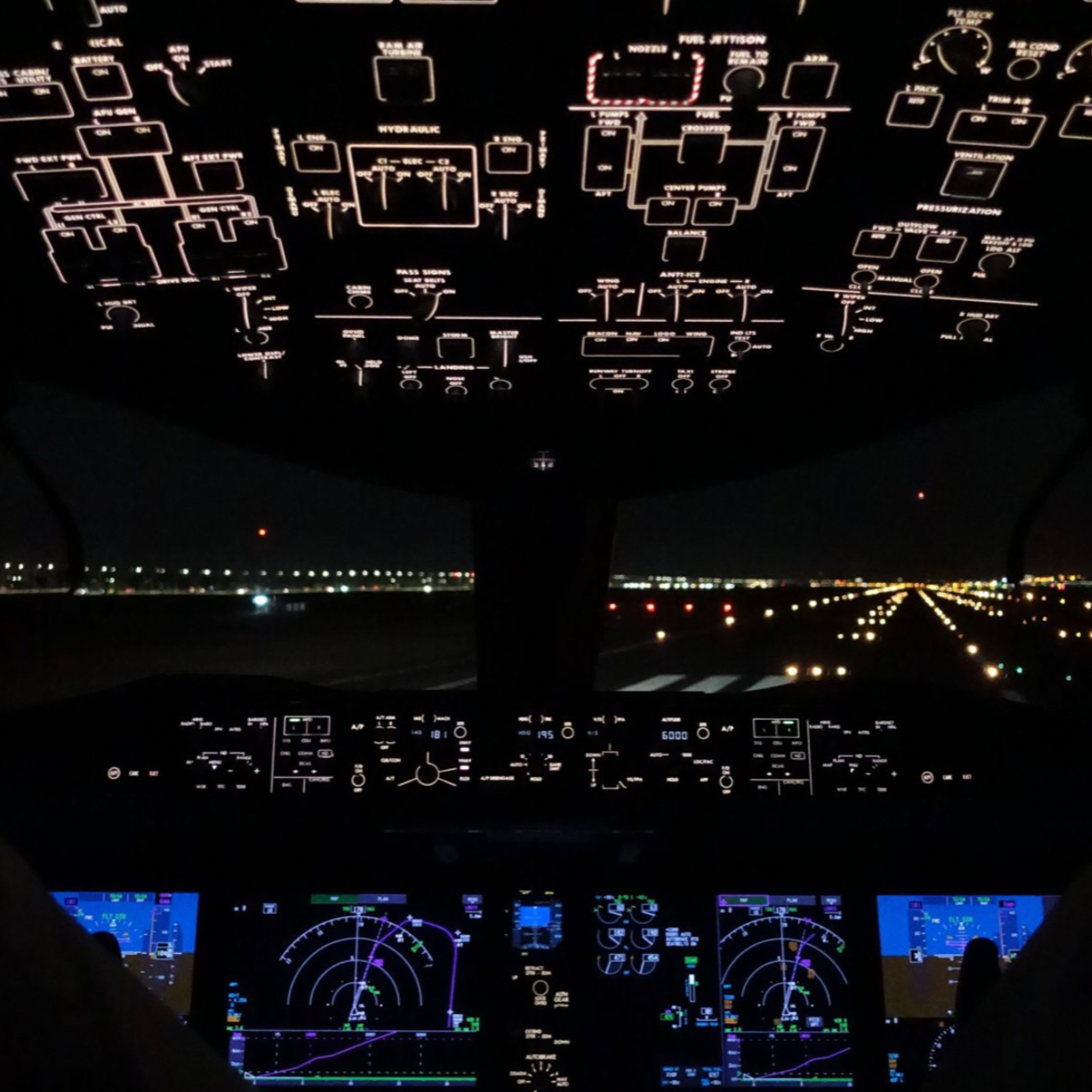
787 Standard Operations (BA techniques and procedures)
24m 53s
This audio series offers a detailed, structured review of Boeing 787 operational procedures, designed exclusively for airline pilots to aid in pre-flight preparation and flight operations. It systematically covers critical phases including pre-takeoff checks, engine start, load closeout, takeoff, en-route flight, descent, approach, landing, and post-landing procedures. Emphasis is placed on checklist compliance, cross-verification of data (such as FMS, TPS, and ICS), and adherence to standard callouts and checklists. Key safety actions like verifying fuel, weight, flaps, and trim are highlighted, with specific attention to non-routine scenarios such as overweight landings, jettison, or loss of braking. Memory aids like "ABC" help pilots manage approach briefings and threat assessments. The content is derived from manufacturer documentation and intended strictly for educational and study purposes, not as a substitute for official manuals. All materials are protected by copyright and must not be reproduced without explicit consent. Pilots are encouraged to cross-reference with official documents and to use the provided website for supplemental resources. The series ensures a thorough, safety-focused understanding of standard and non-standard procedures across all flight phases.
Z-Man, 787 guide audio series 787 audio series multi-topic review.
Content for this series was adapted from company and manufacturer documentation.
All content, opinions and techniques are for reference and study only.
Content for this audio series is not a substitute for company or manufacturer documents or
procedures.
It is for the use of our airline pilots only, do not reproduce any elements of this series
without the express written consent of the Z-Man and Z-Notes audio series.
Please visit the www.www.787studyresources.com website and check out the resource documents for
this series.
Cheers, Z-Man audio productions!
7, 8, 7 standard techniques actions procedures.
Quick audio review, pilot prep.
Use the international guide for boxes to help with actions and select flight forms.
Flight plan, nose number N number.
TPS, nose number usable runways and flaps.
Joke card, fill out.
Plotting chart, and air rep.
General declarations, sign, security slip, sign.
Check for lab water form, OML, nose number, e-tops, MELS fax initial.
FD Pro, load flight plan review pages.
CCI, fit for duty-safe documents.
WSI, review weather select, get briefing.
Comply 3, 65, open pubs. Flight attendant briefing, P-As.
Electrical power up procedure.
Battery on, demand pumps off, accept engines, wipers off, gear handle down, will turn
at flaps, switch in knob off, select two external powers on.
Or APU running will start APU.
Allow 15 seconds after CCI power up to start APU.
Every flight.
I-IU are 30 seconds.
On, no on battery or off-light.
MS, check I-IU info, request, load, activate execute, then select take off runway.
Seat plus transition, approach plus transition.
Star plus transition, and execute.
Technique, route copy then set up the rest of the FMS.
Out of seat pre-flights.
After audio panels and off masks, push, mic check, set 100%.
For crew first flight of day or unobserved flight deck maintenance, check origination
items, eight types of equipment.
Q-R-C-S-2, four wheels locked, secure in overhead panel, livevests, 4, fire extinguisher,
axe, PPE, blue dot, yellow book.
Flight deck door access system, check functions, then turn off.
In seat pre-flight, status page, hydraulic refill, or overfill under 2.
Parking brake, park brake lever, icos, parking brake set.
Overhead panel, seat belt soft, lights test, if PCA, packs off, lower a sec off.
Compass plus card, MCP, set plus lateral nae vertical naeve.
Engine secondary, 20 cord mean.
Cancel recall, exceed.
Boxes, status messages.
Gear down, checklist, reset all, comb, manager master, reset, confirm, company pre-flight,
fuel under 5 cent.
In U.S., selector T-C ligand status, K-O-S-A, send.
Cancel recall messages.
Check list, before start, forward panel, standby instruments, icos, landing gear panel
plus RTO.
Radios radar auto, where the plus T, left, right.
MD status messages, captain quick check.
Fos fuel balance, offset, icos, status messages.
In FO pre-flight, FD switches on, auto throttle arm switches arm.
Lateral naeve arm, if required for take-off, vertical naeve arm.
FNA, auto throttle blank dot check for green roll, toga or hot toga.
Lateral naeve white arm, pitch, toga, vertical naeve armed white.
OFDS mode flight director green.
ASB pointer 13 knots, also check, ear altitude, altimeter setting, flight path vector.
Turing, PFD check bugs, ND check runway.
To do list, prior to before start flow and call for before start checklist.
Clearance, request and print clearance, set squawk.
Select TA, R-Ary check, MCP, icos, FMS, ifs.
Fuel, PFDS, NDS, ACP frequencies.
Later status boxes on the international guide, check off required paperwork, actions.
Rude, legs check, rude, legs, probe distance, root copy, can check naeve rate.
Departure brief, captain, let's do a departure briefing, blank flying, then PF asks, any threats
or concerns?
PM, covers threats concerns, PF also covers threats concerns, then taxi, root to runway,
hotspots, 7, 8, 7 wingspan restrictions, take-eaf runway length per project, call out
Satisepia, departure plan, EO plan, return to runway.
Overweight okay, landing distance, captain.
Brief FBFC roles plus any threats concerns?
APU, check APU running.
Before start flow, aircraft fueled, 10 minutes prior to departure.
Captain, seat belt song, fuel quantity and distribution, check a milling required flight
forms.
FO, cancel recall, note recall, on icos, and then leave messages displayed, checklist
display, fuel kitium distribution.
Check a milling required flight forms.
Captain after to do list, above, do your flow then, before start checklist.
FO, to checklist, CNR, out loud, and less closed loop green, then, to the line.
Before push, cabin ready, external doors closed, confirmed ground ready.
Check external power, no one or available lights.
Carefully check icos for no door messages, plus if any doors open.
ECL sends its show doors ither not green.
Captain, external doors closed.
Hydraulic pump sorto, fuel pumps on, center on only if icos fuel and center, message,
beacon on.
Also check, FD door closed, EFVPED set off.
Seet seat belt pedals, seat adjusted, belt on, pedals adjusted.
FO, FD door closed, guard down.
EFVPED set seat belt pedals.
Captain, check power, when ground ready do your flow, then, below the line.
FO, to checklist, CNR, out loud, and less closed loop green, then, before start checklist
complete.
Select electrical unsynth not tick.
Starting engines captain, start both engines.
FO, starting both engines, note all to restarts.
Both pilots monitor oil temp and oil pressure during start, if necessary, call for QRC, abort
an engine start.
After each engine start, captain check no generator off lights.
FO, no generator off lights, and engine anti-ice on if required.
After start engines stabilized, push complete, icos, shows parking brake set.
Captain, flaps 5 or required by TPS.
FO, set flaps, appeals required.
Engine anti-ice knobs, check on or auto, as required.
Cancel recall, see recall, and then leave messages displayed.
Check list displayed, after start continued.
Salute and ground equipment clear.
Captain, I have a salute flight control, move extremely slow, no rumbles.
Captain, taxi light on, with taxi clearance.
Off run holding short, giving way.
FO, silent checklist, then, after start checklist complete.
See load closeout techniques below.
Trim only look at FMS, never load closeout.
Before take off load closeout.
FMS 2 engines running, flaps set for takeoff.
Captain, takeoff data and bugs checked.
Flaps set, start trim set, only look at FMS.
FO, checklist display.
Takeoff data and bugs checked.
Flaps set, start trim set, FMS if a short taxi.
Do load closeout review FMS set up before taxi.
Check load closeout for flight number, city pair, nose number ok.
Check latest of this to confirm takeoff runway.
Winds, do rate what dry, and RTR ok using the master TPS.
Transfer required, request a new TPS via the come page by entering winds conditions, etc.
Load the FMS manually if required or accept times too, perfect take-eaf pages.
Check FMS thrust info matches icos thrust info and takeoff page 2 altitudes are still correct
and a DP and TPS CO acceleration altitude.
Check master TPS, the only source of correct flaps setting, to confirm correct flaps are
set and loaded in FMS checkley speeds in the FMS.
Check load closeout.
The only source of CG and 0 fuel weight, to confirm both the correct and big in the FMS.
Finally, use the correctly set up FMS as the only source of weights used to check actual
weight again.
And TPSPTOW?
Use FMS Stad Trim as the only source of Stad Trim, to physically set the Stad Trim.
Captain Effort can call out, TPS calls for Flaps X X and Wins, waits, temperature good,
CG, zero fuel weight, V speeds big FMS all set up.
Before take off load close out.
Check FMS, two engines running, Flaps set for take off.
Captain, FMS set up, Flaps Trim Z, all brief before take off checklist.
EFO, challenge and response, and less closed loop green, then, to the line.
Prepare for take off PNO later than two minutes prior to take off.
Captain, flight attendants prepare for take off, at least two mean prior to take off.
Before taking the runway flow, approaching number one position check MCP and ND, if you
need heading selected 400 feet.
No lateral nav selected, technique, MCP, lateral nav, vertical nav, heading plus alt, ND, runway
with a C symbol, terrain or weather, tier only plus mean take off fuel.
Captain, below the line, FO, do last item of checklist, C and R, out loud, then, before
take off checklist complete.
Shine and lights clear onto the take off runway, both pilots confirm entry route.
Captain, shine and lights.
Shine and lights based on clearance, for line up and wait you need 4 lights on, 2 turn,
1 taxi, 1 wing plus logo on.
Ok at night, for clear for take off, there's 4 plus 4 more, 3 landing lights, 1 strobe,
greater than.
Pushed hugger less than 15 knots or auto throttles inhibited until 400 feet.
After take off flow and checklist flaps and slasps up.
Reminder to do is up, up, con, con, last con is continue with checklist S.
PN, APU as required, engine anti-ice knob's auto, checklist display, gear up, flaps up.
Check acres and handles, auto breaks off.
PN, silent, then, after take off checklist complete.
PNPF always be aware of ready for low altitude level offs.
If a famous says vertical nav alt, when clear higher, then push altitude knob to continue climb.
Climbing through 10,000 to full, captain, press chime.
Transition altitude, climbing through transition altitude.
Both pilots set standard and silently cross check 3 altimeters, then, PN, transition, standard.
PNPF, standard lights.
Climbing through flight level 1, 8, 0 or 18,000 MSL technique, captain, exterior lights all of bottom off, except strobe on, wing and logo off.
To increase PNPF, do cruise tasks on ECL in any order, then call complete.
Add relevant wind altitudes on the legs page, then request and load winds, then add step climbs.
Update winds, often, after any reach changes or direct routing, and after 0 5 0 0 0 0 0 0 0 0 6.
Prior to top of descent, reference approach prep, for actions to accomplish prior to top of descent on normal flights or in the pattern, for non-routine situations.
PF brief the arrival, best practice prior to top of descent is to turn seatbelts on and make a prior to arrival PA.
Memory aid spread for approach, A, B, C, that equals a fist, weather, plus approach and use, if jet visibility, ceiling, if required, set minimums.
B equals build it, bug it, brief fit.
Build it, use the check mark technique, CDU, departure arrival, select approach.
Legs step through compare way points, including Mr. Proach point.
Proach 4, if required, may raid, can check again.
Fix, build the circle around FFGS point with 2.
In it ref, lines elect flaps speed, then do a landing assessment, arm speed breaks, set auto breaks.
After you build it you must bug it, remind it to set check minimums.
Look for green on both FMOs, F or CGP, locked yes.
Non-éls, a TPR, authorised, 10 bouquet, pro page 4, RMP, if required and ROI and prediction.
Live safe procedures, brief fit.
And, C equals checklist S, pour for complete any non-normals, review John, do the descent checklist, reread CL notes and complete any deferred items.
Arrival brief, PFR's PM many threats or concerns?
PM covers key threats concerns?
PFR acknowledges those, and adds any additional threats or concerns?
Then PFR covers key arrival, approach and taxi call outs issues actions plans?
PFR briefs the approach chart?
Then PFR?
Captain asks FBNFC, anything to add?
Captain, use this briefing as a reminder to check seatbelts on and make a prior to top of descent arrival peer, or if in the pattern the flight attendants prepare for landing, PA.
Descending through flight level 1, 8, 0 or 18,000 MSL.
Captain, landing lights exterior lights on.
Captain, check seatbelts on normally, confirm seatbelts knob or Dion.
PM, checklist display, start silent descent checklist.
PM, state transition level XXX, if not flight level 1, 8, 0 can enter the transition level in the FMS.
Descending through transition level.
Both pilots set local altimeter and silently cross-check three altimeters, then PM, transition, XXXX and PF, XXXX.
PM, do both pages of the descent checklist, mostly silent, then, descent checklist complete, select CDU.
Descending no later than through 10,000 FL.
Captain, flight attendants prepare for landing and then shine.
Approach CREP, prior to top of descent or in the pattern for non-routine operations.
Cancell recall, descent checklist, hold off on the descent checklist if prior to TOD, but if in the pattern display and complete the descent checklist.
Re-read any notes, complete deferred items, go to page 2 and confirm altimeters, terrain, select defable.
Change over under FIS, request via comb or ask for weather approach.
Flaps V ref speed, note landing weight, select flaps SEP when called for in a non-normal checklist, then immediately do a landing assessment landing up, OPT if required.
Arm speed breaks, and select auto breaks.
Set up the arrive on approach in FMS using double check, set minimums at SEP.
Both pilots do all necessary, ABCBBBATPR actions.
Arrival briefing before the approach, both check to green on FMA lateral nave, vertical nave.
Gear down, when time for gear extension, no later than 2000 feet of FL.
Speed breaks, arm after landing assessment and/or SEP and check speed brake status often.
PF, gear down, typically, approaching one dot on the glide slope or well before a final approach fix.
PN, put gear handle down, before landing checklist display.
PF, check speed breaks arm, arm if you haven't yet.
Normally after gear down, PF calls for flaps 20, however, if too heavy too fast for flaps 20 and you need to slow, go to flaps 15, then flaps 20.
Final flaps, when time for final flaps, weather flaps 20, if required by a non-normal procedure, flaps 25 or flaps 30 and no later than 1500 feet or fix, whichever later.
PF, the low xxA speed, flaps xx, before landing checklist.
PN, to checklist, C and R, but normally it's all green and unsilently, then, before landing checklist complete, PF visually varies.
Before landing techniques, check three altitudes.
Passing any final approach fix or out a marker GS point.
Captain either calls final approach fix and checks altitudes offer an ILS.
Captain calls glide slope 1500, for example, to check glide slope is okay.
This is a reminder for both pilots to check three altitudes.
1. The altitude for the FRF or GS, as per normal operations.
2. Minimum set on both PFDS.
The mist approach altitude set on the MCP, for an ILS set MP altitude at GS capture, for a non-ILS must wait to set past the FRF when 300 feet below the altitude.
Captain technique, use taxi light off to on as a reminder to confirm three things.
1. Ident or R&P if required.
2. Mist approach altitude set.
3. Clear to land PF, normally call out stable, just after the altitude tape indication gets to the white 1000 feet or FL bar on the PFD and the auto call out of 1000.
4. PN, normally stable, target, sync XXX approaching minutes call out any visual references or if none by minimums, then only say go around.
4. After landing flow, when clear of landing runway.
4. Captain, flaps up or technique, leave flaps down for ice.
4. Captain flow, speed brake lever down, landing lights off.
4. Captain, when you leave the taxi light on, that is your reminder to think am I holding short of anything should the taxi light be coming off?
4. After landing flow continued, when clear of landing runway.
4. FO flow, flaps up on command, then auto brakes off, whether radar both off, check both NDS, checklist display, engine anti ice knots.
4. Select on if required for taxi in all even auto, start silent checklist 2 minutes prior to gate arrival.
4. FO, start APU, finish silent checklist, then after landing checklist complete.
4. Approaching gate, confirm correct gate and lead in line must check company pages or confirm with RAM.
4. When gate area is clear, captain, clear left and FO, clear right.
Shot down flow. Parked at gate with acres, showing parking brake set.
Captain, parking brake set, check acres parking brake set, seat belts off, confirmed power, select both external powers on your fable.
FO, fuel control switches cut off on command.
Transponder standby, checklist display, FD switches, yours then captains off.
If ECL is all green, it's a silent checklist, then, shut down checklist complete.
Secure checklist, watch for hydraulic L+C+R on the top of acres, and then hack your clock and wait 3 minutes before you do the secure checklist.
1. Again, wait 3 minutes after L+C+R shows on top of acres, for self tests and temporary status messages to clear, before completing this checklist.
2. Also, wait for door S, to open and comb before looking at, or send in the arrival report, send then wait for scent, before leaving that page.
3. Display engine, to check oil meme of 20 quads and status, to check idraulic, no RF and O2, mean of 1250 PSI E-TOP 800 PSI non-E-TOPs.
4. Technique, FO read and do the secure checklist, out loud, with help.
5. Any pilot can help with the tasks, coordinate communicators required.
6. Capture typically does, or ML, IRS off, but do not turn off until after the comb and the arrival report is sent.
4. A rate check of power and air, A. PUE or PCA are required if passengers are on board, and but switch off.
7. FO typically does checklist and announces, secure checklist complete.
5. Additional notes about, emergency. The call is, may day, may day, may day, the call for urgency is PAN-PAN.
PAN-PAN, PAN-PAN, respectively.
5. Non-routine landings memory aid, going to the John.
5. This stands for, Jettison, overweight.
5. Non-routine, Jettison checklist, fuel dump may be necessary, if landing very heavy on a contaminated and or short runway.
6. Fuel Jettison is not needed when the landing app shows you have a reasonable amount of extra runway, even if you land beyond 1000 feet, which is the non-normal touchdown point.
6. Overweight landing, do will be very familiar with the overweight landing checklist.
6. If landing flaps 20 for a non-normal, then this checklist can be skipped.
6. Flaps 25 is a great choice for landing overweight.
6. Consider landing without auto brakes or with auto brakes too, using minimal braking when runway length, conditions and braking action allow.
6. Non-routine landing checklist, this checklist may be skipped entirely, quickly reviewed or formally accomplished by the captain.
6. Bottom line, captain needs to make two calls inside F.
6. As in Pia, on two calls outside, a TC in company.
6. For most non-routine situations, the captain will start the F of briefing with this is your precautionary landing briefing.
6. Call a TC to arrange for airport rescue and fire fighting, stopping on the runway, and Mr. Proge straight out to 3000 feet MVA.
6. Call a contact company with a 7700 call message including ETA, a short explanation of the problem and if necessary, add a range for tow from runway.
6. The subsequent call alert for the divert message can be skipped if a 7700 message was already sent.
6. Brief non-normal synchronates on approach and any issues.
6. No reverser, no auto brakes, manual speed brakes, etc.
6. Detailed departure proflight, engine and check top acres, then check secondary engine indications, and oil minimum of 20 cord.
6. Cancel recall look for recall on acres in the red boxes or exceed dances.
8. For those who do not know, it is important to take a look at the forecast.
[MUSIC]
Podcast Summary
Key Points:
The audio series provides a comprehensive, reference-based review of 787 operational procedures, adapted from manufacturer documentation and intended solely for pilot training and study.
Key pre-flight, takeoff, approach, and post-landing checks are detailed, emphasizing strict adherence to checklists, cross-verification of systems, and flight data alignment with TPS and FMS.
Critical actions include verifying fuel, weight, flaps, trim, runway conditions, and ensuring all checklists are completed with proper callouts and confirmations.
Pre-takeoff procedures include power-up, APU start, engine monitoring, gear and flap settings, and load closeout to confirm CG, fuel, and takeoff data accuracy.
Non-routine landings require specific checklists for overweight, jettison, or reduced braking, with clear callouts and coordination with ground services.
Both pilots perform synchronized checklists, with emphasis on silent cross-checks, system status verification, and verification of altimeter and navigation data.
Operational memory aids (like "ABC" for approach) and standardized callouts ensure consistency in briefing, threat management, and flight path execution.
All content is for educational use only and must not be reproduced without written consent; official documents remain the authoritative source.
Summary:
This audio series offers a detailed, structured review of Boeing 787 operational procedures, designed exclusively for airline pilots to aid in pre-flight preparation and flight operations. It systematically covers critical phases including pre-takeoff checks, engine start, load closeout, takeoff, en-route flight, descent, approach, landing, and post-landing procedures. Emphasis is placed on checklist compliance, cross-verification of data (such as FMS, TPS, and ICS), and adherence to standard callouts and checklists.
Key safety actions like verifying fuel, weight, flaps, and trim are highlighted, with specific attention to non-routine scenarios such as overweight landings, jettison, or loss of braking. Memory aids like "ABC" help pilots manage approach briefings and threat assessments. The content is derived from manufacturer documentation and intended strictly for educational and study purposes, not as a substitute for official manuals.
All materials are protected by copyright and must not be reproduced without explicit consent. Pilots are encouraged to cross-reference with official documents and to use the provided website for supplemental resources. The series ensures a thorough, safety-focused understanding of standard and non-standard procedures across all flight phases.
FAQs
The series provides a reference and study resource for airline pilots on 787 operations, adapted from manufacturer documentation. It is not a substitute for official company or manufacturer procedures.
No, reproduction or sharing of any content from the series requires express written consent from Z-Man and Z-Notes.
Pilots should visit www.787studyresources.com to access the official resource documents for the series.
Allow 15 seconds after CCI power up to start the APU. If using external power, ensure it is on before starting the APU.
Check the I-C-O-S system, verify door status, inspect overhead panel items (seat belts, lights, fire extinguishers), and confirm all equipment and systems are secure.
Verify flight number, city pair, nose number, and runway. Confirm FMS settings match TPS data, check CG, fuel weights, and ensure correct flap and trim settings are loaded.
Chat with AI
Loading...
Pro features
Go deeper with this episode
Unlock creator-grade tools that turn any transcript into show notes and subtitle files.
 PodcastTranscript AI