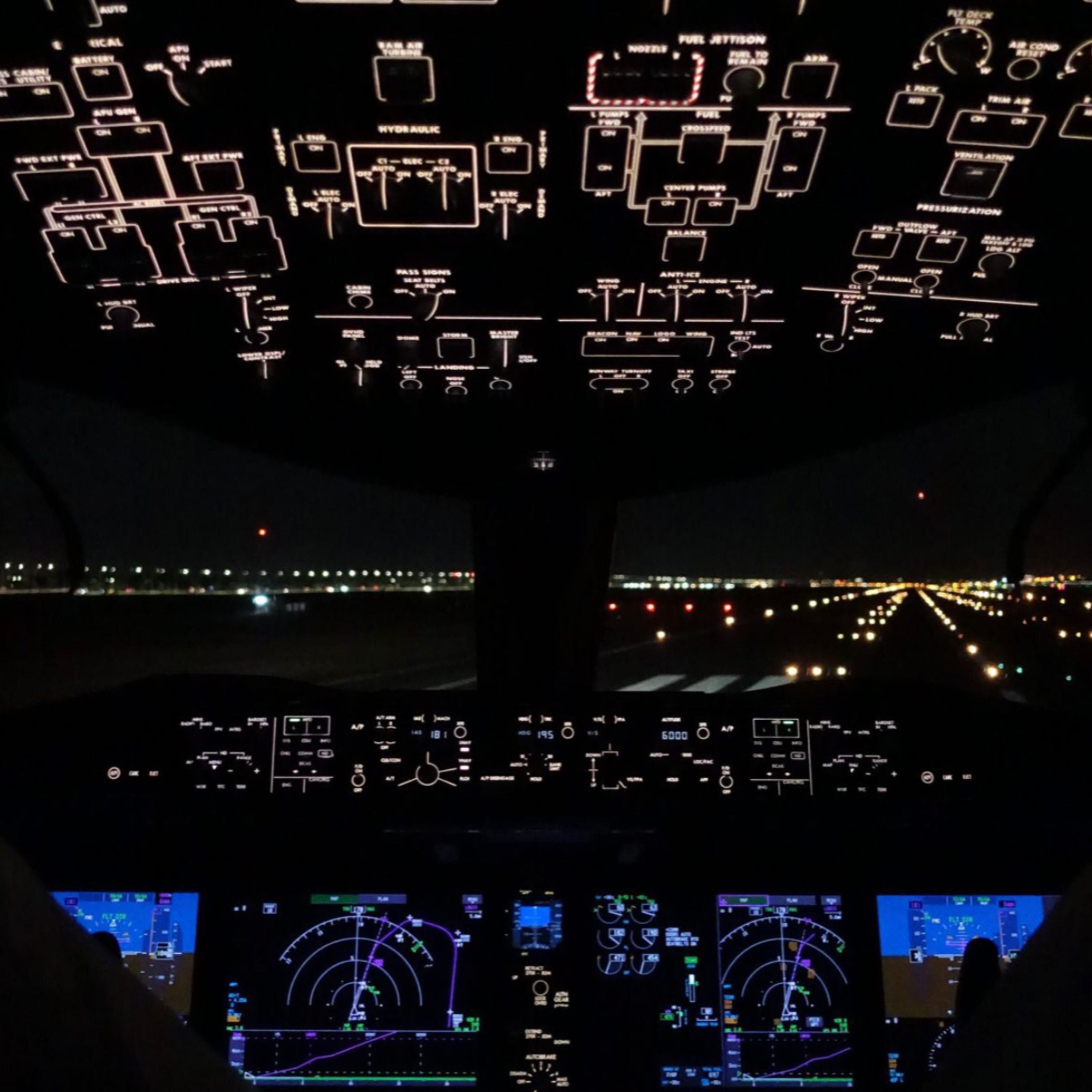
This audio series provides a comprehensive, pilot-focused review of Boeing 787 operational procedures, emphasizing safety, checklists, and crew coordination. Key topics include takeoff legality based on RVR and wind conditions, emergency response protocols such as engine failure and wind shear, and standardized go-around and landing actions. The content highlights the roles of pilot flying and monitoring, with clear callouts, checklist execution, and use of the ECL and QR-C reference tools. Special attention is given to non-normal scenarios like fuel jettison, alternate flap/slat operations, and low visibility approaches requiring autoland or HUD support. Procedures for rejected takeoffs, engine out climbs, and go-arounds are detailed with specific timing, configurations, and communication steps. The series also covers landing fundamentals, including flap settings, flare management, and post-landing actions. All content is derived from manufacturer documents and intended solely for training and study, not as a substitute for official manuals. It underscores the importance of situational awareness, crew resource management, and strict adherence to checklists in high-risk situations. The audio is produced by Z-Man and is part of a larger educational series supported by Anchor, a free podcast platform.
ZMan, 787 Guide Audio Series 787 Audio Series Multitopic Review
Content for this series was adapted from company and manufacturer documentation.
All content, opinions and techniques are for reference and study only.
Content for this audio series is not a substitute for company or manufacturer documents or procedures.
It is for the use of our airline pilots only, do not reproduce any elements of this series
without the express written consent of the Z Man and Z Notes audio series.
Please visit the www.www.787studyresources.com website and check out the resource documents
for this series.
Cheers, Z Man Audio Productions
787 Simulator Training Quick Reference Audio File
Simulator Isms Pilot Flying Consider Throttles at idle at 30 feet.
If flaps 20 degrees, flaps flat issue, consider idle at 100 feet.
Note, during SIM resets do not make data entry or control input/changes.
Apply RMP values are reset after approach and go around, RNAV RMP.
Non-normals First indication of condition, pilot flying call,
my aircraft.
Reference the QR-C quick reference card, first pilot flying, pilot monitoring, confirm
problem and procedure.
Pilot flying will fly the aircraft and handle the radios.
Pilot monitoring will run the checklist, fix methodology, fly, identify, execute, manage
the plan, QR-C ECL checklist use.
I cast priority.
ECL will command most critical first, work from the top down.
Priority is pressure before quantity.
Reference the ECL non-normal menu for un-enunciated checklist items.
Warnings, cautions and advisories that have a box are items that have procedural steps,
notes or other items.
Checklist Green or blue text is silent.
Yes, no, query pilot flying, pilot monitoring confirms.
Reference OK to paraphrase.
Items that have a change in switch configuration read aloud, repeat aloud while accomplishing.
Possibly five checklists to accomplish during an emergency.
ECL non-normal checklist, fuel jettison checklist, overweight landing checklist, non-routine
landing checklist to include hazmat, precautionary landing, planned evacuation with test items,
passenger PA, call to dispatch, normals checklist.
Non-normal white tab is displayed if checklist is required.
Non-normal amber tab is displayed if checklist is active and needs completion.
A note about checklist complete.
State the name checklist complete.
Active add except for deferred items.
Verify if additional ECL checklists need completion, clear iCast queue, all complete.
Quick summary of completed tasks/events manage the plan.
FMS use.
Both pilots must confirm execution of route.
Click key, LNAV-NAV entries, check FMS, confirm, MCP inputs, confirm indications on FMA, cross-check.
Take off.
Memory hint for first officers.
13 to take out, 18 to bring back, 1600 RFRFL minimum, 2.
The Z-Man Z-Nodes audio series is brought to you by Anchor.
In order to remain free, free to you, Anchor supports our efforts.
If you haven't heard about Anchor, it's the easiest way to make a podcast.
Let me explain, it's free.
There are creation tools that allow you to record and edit your podcast right from your
phone or computer.
Anchor will distribute your podcast for you so it can be heard on Spotify, Apple Podcast,
and many more.
You can make money from your podcast with no minimum listenership.
It's everything you need to make a podcast in one place.
Download the free Anchor app or go to Anchor.fm to get started.
Thank you again for listening to the Z-Nodes audio series.
Memory hint for first officers, 1600 to take out, 1800 to bring back.
Take off legality based on observations and limitations.
Reference 10-9A pages, comparisons, limits, FOM-1 take off legality chart, win limitations.
Take off legality summary, RVR runway visibility no less than 5,500 meters or 1 mile 1600 meters.
Required reports touched on zone, controlling, or reported visibility, requirements, daylight,
adequate visual reference, night time, runway edge lighting, or center lights.
RVR or runway visibility no less than 1600 feet, 500 meters or 1/4 mile 400 meters, touched
down zone, controlling, or reported visibility, daylight, runway center line mark, marking,
or rail, or center line lighting, or adequate visual reference, rail REL runway edge lights,
night time, rail, runway edge lights, or center line lighting.
RVR or runway visibility no less than touch down zone, mid roll out, 1000 feet, 300 meters,
or touch down zone, mid roll out, 500 feet, 150 meters.
Any two all available reports are controlling, requirements, center lighting, high intensity
runway lights, and runway center line marking, center line, center lights, and high intensity
runway lighting.
For the 787 touch down zone, mid roll out, 300 feet, or 75 meters, required reports
Any two all available are all available reports are controlling, center lighting, and high intensity
runway lights are required.
A note about a dry runway weights, forecast, light drizzle, light rain, light snow, wet
runway weights, forecast.
This then RVR 4000 or 3/4 mile, heavy rain, heavy drizzle, continuous light rain, heavy
rain, heavy freezing rain, heavy snow, Canadian differences for takeoff, RVR 2600 feet not legal.
RVR 1200 feet, one RVR all available controlling, runway center line markings required,
RVR 600 feet is a minimum, requires touch down zone, plus one, wind limitations, knots,
Boeing 787-8, takeoff component, takeoff and landing, tailwind, 15 knots, Boeing 787-9,
tailwind component, 15 knots, may further be reduced for both by performance requirements.
Demonstrated crosswind, Boeing 787-8, 35 knots, takeoff, 33 knots, landing, Boeing 787-9,
29 knots, takeoff, 35 knots.
five knots land.
Both aircraft wind limitations.
Autoland HUD take off.
Headwind, 25 knots.
Autoland HUD take off tailwind, 15 knots.
Autoland crosswind, 25 knots.
HUD take off crosswind, 25 knots.
Take off crosswind limitations.
Boeing 787-8 dry 35 knots.
Boeing 787-9 dry 29 knots.
Boeing 787-8 wet 35 knots.
Boeing 787-9 wet 29 knots.
Both aircraft standing water slush 25 knots.
Snow wet and dry 25 knots.
Compacted snow, 20 knots.
Ice, 15 knots.
Engine out takeoff.
10-7 page departure arrival, page two.
EO SID review, legs page for takeoff,
enunciated and manual.
Requires an execution and verification of LNAV.
Quick level off after takeoff.
Autopilot auto throttle off.
Pitch flight path vector to the horizon line.
Power reduce.
Call, set altitude.
Flight level change sets speed 250 knots.
Autopilot auto throttle back on.
TKAS RA.
Comply, visually avoid, notify ATC.
Expedited climb, speed interviewing.
Set MMV plus 15 knots.
Select init ref on CDU.
Thrust limit, climb if needed.
Rejected takeoff, not advisory, IKAS.
Reject prior to 80 knots for amber, airspeed, disagree,
amber, master caution, amber, system failure, not a component.
Amber, slow acceleration, amber, tire failure,
red takeoff configuration warning, unusual noise vibration.
Reject above 80 knots prior to V1.
Red fire or fire warning.
Red engine failure.
Red predictive wind shear.
Unsafe or unable to fly.
Captain actions call, reject, idle, auto throttles off.
Reverse and brakes.
Stopped, know it.
No evacuation required.
Call, remain seated, remain seated, remain seated.
Note, stopped with fire, set brakes,
fight fire, consider EVAC.
Memory hint, stop the aircraft, stop the problem,
stop the people.
First officer actions call, deployed or no spoilers.
Call, no reverser left or right.
Call speeds 80, 60.
Stopped call tower.
Note, reject speed, go to maneuvers, operating manual,
QRH, performance in flight, reference brake cooling
chart, flaps and slats, not norm,
correction, non-norm, pilot flying,
my aircraft, amber, message, airspeed, unreliable,
and amber message, flap, slat, control.
Both require alternate flaps mode.
Remember landing with flaps and slats, FMS entry,
VREF for intended flap speed.
Enter the speed adjusted, provided by QRHECL.
Note, make slow speed adjustments.
Requires landing performance assessment
and aircraft will tend to float, limit flare.
Note, select speed intervene at first indication.
Note about the extension and retraction switch.
Extension drives mid-slats, flaps 20, electrically.
Remember, primary is hydraulic.
Secondary is hydraulic if available and electric.
Alternate is electric only.
ECU menu notes, non-normal menu, non-normal flight
controls, flaps slats, cruise flaps system,
failed cruise flaps may increase drag fuel burn.
Normal flaps still available for landing.
Flap, slat, control, alternate flaps system must be used.
Flaps drive, flaps have failed.
Do not use alternate flaps system.
Flaps primary fail.
Secondary system still works, landing with flaps 20.
Slats drive.
Slats have failed.
Slats primary fail.
Secondary system still works.
Normal landing slower slats extension.
Non-normal approach and landings.
Normal descent checklist.
Remember to recall notes.
Recall abnormal checklist notes.
Select tab, give verbal summary, review.
Declaring a Mayday.
Call Mayday, Mayday, Mayday.
Select a non-routine landing checklist.
Non-normal menu, unannunciated.
Consider overweight landing fueled jettison checklist.
Manage the plan.
Declare emergency, git atis.
FMS setup and landing performance assessment.
Memory hint, CDU check.
VNAV, input descent speeds if required.
Departure arrival runway.
Legs check.
Check for GP.
Navrad, no manual tuning, fix.
Circle final approach fix with two-mile ring.
And it ref, select landing flaps.
Brief the approach and missed approach.
Adjustments with tower.
Checkless descent and non-routine landing if needed or requested.
Arrival briefing, threats, unique items and issues.
Arrival and approach briefing.
Airport, approach, page number, briefing strip.
Minnes, weather requirements, runway length, assessment.
Flaps, V-ref, auto breaks, taxi and hotspots.
Fire and crash rescue, evac test items if required.
Approaches.
Cat 1, ILA, sim actions.
Downwind, flaps 1, base, flaps 5.
Approach button, select.
Both diamonds must be open and incorrect orientation.
Approaching 1.on glide slope.
Gear down, flaps 20 at or above 2,000 feet.
Flaps 25 or 30 set ref plus 5.
Call 4, before landing checklist at or above 1,500 feet.
Final approach fix.
Final approach fix, set missed approach altitude.
Contact tower.
Captain call-outs.
Land 2 or 3.
Localizer capture.
Loak capture.
Glide slope capture.
Approach primary flight display indications.
Final approach course, white diamond.
Elnav, magenta diamond.
Correction, final approach course, white triangle.
Elnav, magenta triangle.
Localizer, magenta diamond.
Glide path, white triangle.
V-nav, magenta triangle.
Glide slope, magenta diamond.
Approach instruments settings, visual.
Radial altimeter, zero or off.
Non-ILS.
Barrow, decision altitude or DDA.
Remember DDA is MDA plus 50 feet.
Cat 1, Barrow, decision altitude.
Special authorization, cat 1.
Radial altimeter, decision height.
Cat 2, radial altimeter, decision height.
Cat 3, land 2.
Cat 3, land 3.
Radial altimeter, zero or radial altimeter, DH, if required.
Memory hint, live safe.
Elnav, v-nav.
Set speed.
Set altitude.
Verify Elnav, v-nav.
Is depicted on FMA.
Approach, engage.
Set the mist approach.
Approach 300 feet below Mist Approach Altitude or Glide Path Capture, whichever occurs first.
Passing the Final Approach Fix, Final Approach Point, Glide Path Intercept, Verifying Crossing
Altitude is within 100 feet of Chartered Altitude.
Note about Live Safe.
Clear for the approach, select MCP Minimums DA or DDA.
Check FMA for the Engaged Modes.
Gear Down Flaps 20 at 2 Mile Ring, Final Approach Fix.
Low Visibility Approaches.
Visibility below 1800 RVR, Autoland Required.
Special Authorization of ILS, Cat 2, Cat 3, Autoland Required.
Special Authorization of ILS, Requires HUD.
No matter the visibility, consider briefing potential downgrade from Land 3 to Land 2.
Remember, Land 3 Fail Operational Requires Autoland.
One Autopilot Fails, Land 2 Fail Passive, Autoland.
Another Autopilot Fails, No Autoland, Go Around or Manual Landing.
Two Engine Go Around, Press Toga, Pitch 15 Degrees, Call Go Around Flaps 20, Positive
Rate, Call Gear Up, Set Mist Approach Altitude, 400 Feet, Call Elnav or Hitting Select, 1000
Feet, Call V-Nav or Set Speed, Clean Up on Schedule.
A note about Go Around Flow.
Remember, Toga, Elnav engages above 50 Feet if Toga is selected.
Flaps 20 or 5 if Single Engine.
Positive Rate, Gear Up, Set Mist Approach Altitude, 400 Feet, Hitting or Elnav,
Defy Select, 1000 Feet, V-Nav, Set Speed, Clean Up, V-1 Cut, Single Engine Approach,
Pilot Flying, Call, Myer Craft.
Directional Control, Initially Established with Rutter, Lockfoot, Rotation, Aircraft
will Trim Rutter, Slow Rotation to HUD Toga Reference Line, Then, Mesh with Ball.
Set Positive Rate, Call Gear Up, 200 Feet, Autopilot On.
At 400 Feet, Check 4 Engine Out, Said, If Prompted, Hitting Select or Elnav, Execute
Verify, Pitch, Ball and Vertical Speed, Power, Push if Need, Evaluate.
Use to be Accomplish Time Critical Items, QRC, Feeds, Fire, Engine, Left or Right, Engine
Lee, Limit, Exceed, Left or Right, Engine Surge, Left or Right, Engine, Severe Damage,
Left or Right.
Note, In the Sim, N2 will Indicate Zero.
Engine Fail, Warning, Indications, Red, Engine Fail, HUD, Green, Engine Fail, If Actual
Thrust is Less Than, Or Greater Than Commanded Thrust during Takeoff, With Air Speed Between
65 Nauts and 6 Nauts Prior to V1.
Engine Out, Acceleration, Altitude, Call, Said Speed, Clean Up on Schedule.
At Up Bug, Call, Flight Level, Change, Verify Continuous Power, Engine Display, Press,
Climb, Continuous, Call, Checkless, QRC, E-C-L.
Symbol Engine, ILS, Approach, Pilot Flying.
Pilot Monitoring is Running Checkless.
Contact, ATC is Pilot Flying, Mayday, Mayday, Mayday.
Request immediate return and runway.
Situation Awareness, Aviate, Navigate, Communicate, Configure.
On CDU, Select a Departure Arrivals, Select, Approach, and Extend.
If on Vectors Only, Verify with Pilot Monitoring, Like it.
Midfield Downwind, Slow to Flaps 1, Approach Pay, Set Minimums, and a Quick Review.
Base Turn, Slow to Flaps 5.
Approach Brief, Have the Pilot Monitoring, Brief the Approach, I.E. Briefing Strip.
One dot below Glide Slope, Call, Gear Down, Below, 210, Flaps 20, Set Ref + 5.
ILS Single Engine Approach, Pilot Monitoring, Actions.
Fly, Identify, Execute, Manage the Plan.
After appropriate Checkless Complete, A-B-E-C-A, A-D-S, What's the Weather and Wind?
A- Announce, Confirm, May Day, Request, Crash Rescue Standing By, Fuel Remaining, Compage,
ATC, Emergency Report, and Enter Souls on Board, B-Box, FMS, and B-Breafit.
C-Communicate, Company, A-Cars, 7700, Flight Attendants, Handset, Select, 1-1, Advise
Procautionary Landing, or Plan Debackuation, Estimated Time to Landing, PA to Passengers,
Non-Routine Landing Checklist, If Time Permitting, Fueled Jettison, Consider, Above 5,000 feet,
Minimum Amber Fuel Inbalance, Displayed, Pattern, North Width, Flying, Pilot, No Limits,
Prague Page 2, Totalizer, and Calculation Approximate.
If Equal Fuel Balance, Press on, Landing, Confirm Spoilers, or Call, No Reverser, Left,
or Right.
PA to Passengers, Please Remain Seated, or This is the Captain, Evacuate, Evacuate,
Evacuate.
Remember, Procautionary Landing is defined as a situation when a normal landing is anticipated,
however, as a precaution. Emergency Equipment may be present. Procautionary Landing is
an American Airlines term and is not to be used or communicated with ATC or other external
sources.
Single Engine Go Around, Pilot, Press Toga, Call, Go Around, Flaps 5, Positive Rate, Call,
Gear Up, Call, Set Mist Approach, Altitude, 400 feet, Call, Heading Select, or L-Nap,
Refrequired, 1000 feet, Acceleration, Altitude, Call, Venev, or Set Speed, Last Bug, Clean,
Up, Clean Up, On Schedule, Call, Flaps, and V-Raff 30+80, Clean, Call, Flight Level Change,
Verify Continuous, Check Lip, Note, Follow the Go Around Flow, Flight Level Change
Selection changes go around power to continuous. Single Engine 787 meets or exceeds all required
climb gradients. Engine out during climb, Pilot flying, Call, Myrocraft. Typically occurs
after climb power is established with flaps out in a turn. Pitch and roll, wings level,
pitch down to approximately 5 degrees. Climb power may be sufficient, auto throttle off,
push up good engine, heading select, clean up. Remember, time critical landings 4, pull
up of which there are 2 calls. Engine fail, wind shear, and speed brakes. All items that
require action without reference to a checklist. Engine out during go around, Pilot flying
actions. Pilot flying, Call, Myrocraft. Hud Togo reference line, green dash line,
pitch down to approximately 5 degrees. Call flaps 20 or flaps 5. Positive rate, Call,
gear up. Call heading select, runway heading. 400 feet, auto pilot on, QRC if needed. 1000
feet, set speed V ref 30 plus 80 up bug, clean up, flight level change, level odd at requested
mandated altitude. GPWS alert, pull up, Pilot flying actions. Press Toga, auto pilot, auto throttle off, throttle push, fully forward. Pitch 20 degrees, rotate
and hold to stick shaker. Spoilers retract, note obstacle or train, no config changes until
wind shear during takeoff precautions. Memory hint, max RFD, takeoff, runway, flaps, delay
rotation, select T.O, no D-ray, select flaps 15, consider, consider using longest suitable runway,
increase VR as much as 20 knots, must not exceed performance limit for weight, wind shear landing
precautions. Flaps 25, V ref plus 15, consider, longest
Suitable runway, Vase ILS, stable by 1,000 feet.
Wind shear reactions during takeoff, pilot flying.
Call, my aircraft.
Prior to V1, these indications caution monitor radar display.
Warning, wind shear ahead or wind shear,
wind shear, wind shear, reject.
Note, caution indication monitor radar display
inhibited 80 to 480 knots to 400 feet.
Warning, wind shear ahead inhibited 100 knots to 50 feet.
Wind shear, wind shear, wind shear inhibited to rotation.
Add or above V1, call escape.
Press Toga, rotate normally to 15 degrees,
no later than 2,000 feet runway remaining.
Follow Toga guidance flight director.
Don't change configuration until clear.
Then call for VNAV.
Wind shear reactions climb out, pilot flying.
Pilot flying call, my aircraft.
Pilot flying call, escape.
Press Toga, throttles advance to stops.
Pitch 15 degrees, then follow flight director.
Then call for VNAV.
Note, pilot monitoring, call out radio altimeter and trend.
Wind shear reactions approach, pilot flying.
Press Toga, call escape, autopilot auto throttle off.
Throttles push, full forward.
Spoilers retract, notes.
Do not change config until clear, then VNAV.
Can be flown with autopilot auto throttle on.
Or we'll call go around.
Wind shear ahead can be conducted as a normal go around.
Alert indication summary.
Alert caution, monitor radar display.
Prior to V1, delay or reject the takeoff.
Add or above V1, maneuver as required to avoid wind shear.
Consider using maximum.
Alert warning, wind shear ahead or wind shear, wind shear, wind shear.
Prior to V1, delay, reject the takeoff.
Add or above V1, perform the wind shear escape maneuver.
Alert or indication, unacceptable, unacceptable, air speed deviations.
Prior to V1, reject the takeoff.
Add rotation, rotate normally to 15 degrees, no later than 2,000 feet, runway remaining.
Alert or oral indication, landing, caution, monitor radar display.
Continue the approach if able to avoid wind shear, otherwise execute a normal go around
and maneuver as required to avoid the wind shear.
Warning, go around, wind shear ahead.
Add pilots discretion, either a normal go around or the wind shear escape maneuver.
Warning, wind shear, wind shear, wind shear, perform the wind shear escape maneuver.
Unacceptable flight deviations perform the wind shear escape maneuver.
Evacuation, stop the airplane, out of reverse, set the brake.
Stop the problem, fight the fire.
Stop the people, make PA or choose to evacuate.
Call for the QRC or iPad QRH last page.
FO reads challenge in response, captain does item and repeats the response.
Note, evac command, switch causes beeper, push the master caution to silence.
Quick note about ARF hand signals, evacuate.
One arm, come forward, motions towards body.
While clear, both arms downward V, safe indication.
Stop, crossed arms as wands, crossed in front of body.
Dual engine failure, set air speed above 270 knots, required for windmail start.
After APU start, 100% FO screens will power up.
That 1000 in altitude window MCP will show which airports within green range arc are within
range.
Unannunciated checklist, engines, center hydraulic loss, amber hydraulic pressure system center.
Flaps slats are active, but slow, plan accordingly, use flap handle.
More amber flaps, primary fail and slats, primary fail.
Land with flaps 20, do not float, limit fair, flare.
Use alternate gear extension checklist to lower gear, manually deploy spoilers, may or may
not have nose wheel stirring, may need a tug slash toe.
Leave flaps out, do not clean up after landing.
Landing basics, review FAA and ICAO landing correction, holding speed, limitations.
CDU hold page, access legs page for holding fix, add or enter if needed.
Enter required holding page entries, altitude EFC, etc.
Confirm turn direction and radio prior to execute, radio on fixed page if needed.
If a mess will compute clean holding speed, slow to cross at that speed 3 minutes prior.
Hold at present position, hold, next hold, present position, 6R.
Hold at a point not on legs page, hold, next hold, enter fix, exit hold, exit hold, select,
turns back to fix, then continues on or out.
Switch to stall recovery actions, pilot flying pilot monitoring, recognize and confirm
the developing situation.
First indication of stall, buffet or sticks shaker, pilot flying, my aircraft, initiate
the recovery, smoothly apply nose down elevator to reduce the angle of attack until buffet
or sticks shaker stops.
Continue the recovery, roll in the shortest direction to wings level if needed, advance
thrust levers as needed, retract the speed brakes, do not change gear or flap configuration
except during liftoff if flaps are up call 4 flaps 1, complete the recovery, check airspeed
and adjust thrust as needed, establish pitch at, attitude, return to the desired flight
path, re-engage the autopilot and auto throttle if desired, pilot monitoring actions.
Charter altitude and airspeed verify all required actions have been done, call out, any
omissions trend toward terrain contact, set the flaps lever as directed, monitor altitude
and airspeed verify all required actions have been completed, call out any omissions trend
toward terrain contact, and take off engine failure, loss of thrust after v1 actions and
call, pilot flying pilot monitoring, trigger engine failure or loss of thrust, pilot flying
my aircraft maintain directional control, trigger vr, pilot monitoring call rotate, pilot
flying rotate to take off attitude, trigger after liftoff, pilot flying verify positive
rate on climb of climb on the altimeter, pilot monitoring also verify positive rate of
climb on altimeter, pilot monitoring call positive rate pilot flying call gear up pilot flying
use the following climb speed to the tps engine out acceleration altitude, if the engine
failure occurs below or after v1 but not above v2 maintain minimum v2, if the engine failure
occurs between v2 and v2 plus 15 maintain speed attained at time of failure, if engine
failure occurs at a speed greater than v2 plus 15 increase pitch to reduce airspeed to
v2 plus 15 pilot monitoring monitor engine and flight instruments, note verify engine thrust
is at takeoff thrust setting until aircraft is in clean configuration and obstacle clearance
is assured, trigger at tps engine out acceleration altitude pilot flying accelerate in command flight
retraction on schedule pilot monitoring on command retract flaps, trigger aircraft in clean
configuration and v2 plus 30 plus 80 pilot flying verify continuous thrust pilot monitoring
also verify continuous thrust, call pilot flying call for appropriate checklist pilot monitoring
on command accomplish the appropriate checklist end.
Thank you for listening to the ZNotes Audio Series. Audio and production editors note.
This audio content is compiled and read by a 25-year airline pilot, qualified on the 787
since 2015. A certified advanced ground instructor, retired military standards pilot, instructor
pilot, instrument evaluator for both rotor and fixed-wing aircraft. Thank you again for
listening to Zman Audio Notes.
Podcast Summary
Key Points:
Pilots must follow checklist procedures using the QR-C and ECL, with pilot flying handling the aircraft and radios, while pilot monitoring runs checklists and manages the plan.
During emergencies, priority is given to critical actions—pressure before quantity—and checklists are executed in order, with ECL non-normal items guiding the sequence.
Takeoff legality depends on RVR, visibility, wind conditions, and runway markings, with minimums varying by configuration and runway type.
Engine failure or wind shear requires immediate action
Landing procedures emphasize flaps and slats management, with alternate systems available in failure scenarios and clear guidance on flare and touchdown.
Non-normal checklists (e.g., fuel jettison, overweight landing) must be initiated with proper communication and verification, including QRC use.
Situational awareness and cockpit coordination are vital, with clear callouts, monitoring, and adherence to flight rules such as aviate, navigate, communicate.
All procedures are based on manufacturer guidelines and are for training only—not a substitute for official documentation or procedures.
Summary:
This audio series provides a comprehensive, pilot-focused review of Boeing 787 operational procedures, emphasizing safety, checklists, and crew coordination. Key topics include takeoff legality based on RVR and wind conditions, emergency response protocols such as engine failure and wind shear, and standardized go-around and landing actions. The content highlights the roles of pilot flying and monitoring, with clear callouts, checklist execution, and use of the ECL and QR-C reference tools.
Special attention is given to non-normal scenarios like fuel jettison, alternate flap/slat operations, and low visibility approaches requiring autoland or HUD support. Procedures for rejected takeoffs, engine out climbs, and go-arounds are detailed with specific timing, configurations, and communication steps. The series also covers landing fundamentals, including flap settings, flare management, and post-landing actions.
All content is derived from manufacturer documents and intended solely for training and study, not as a substitute for official manuals. It underscores the importance of situational awareness, crew resource management, and strict adherence to checklists in high-risk situations. The audio is produced by Z-Man and is part of a larger educational series supported by Anchor, a free podcast platform.
FAQs
Pilot flying calls 'my aircraft' on the first indication of a problem. The ECL checklist follows a top-down priority, with pressure before quantity. Critical items are addressed first, and un-enunciated items are found in the ECL non-normal menu.
Prior to 80 knots, reject with idle thrust and autothrottles off. Above 80 knots, reject if red warnings like fire or engine failure exist. Reverse and brakes are applied, and the aircraft is stopped. No evacuation is required unless fire is present.
A white tab indicates a checklist is required. An amber tab shows the checklist is active and needs completion. These are key visual cues for pilots to track checklist status during operations.
Minimum RVR of 1600 feet (500 meters) for touchdown zone, 1000 feet (300 meters) for mid-rollout, and 500 feet (150 meters) for the go-around. Runway edge lighting, centerline markings, and high-intensity lights are required.
Press Toga, pitch to 15 degrees, call 'Go Around,' set flaps to 20 or 5, call 'Gear Up,' set mist approach altitude to 400 feet, and perform VNAV at 1000 feet. Clean up on schedule and maintain continuous power.
After V1, the pilot flying maintains directional control, triggers Vr, and rotates to takeoff attitude. After liftoff, verify positive rate, call for gear up, and maintain minimum V2 or accelerate to V2 plus 15 as required.
Chat with AI
Loading...
Pro features
Go deeper with this episode
Unlock creator-grade tools that turn any transcript into show notes and subtitle files.
 PodcastTranscript AI