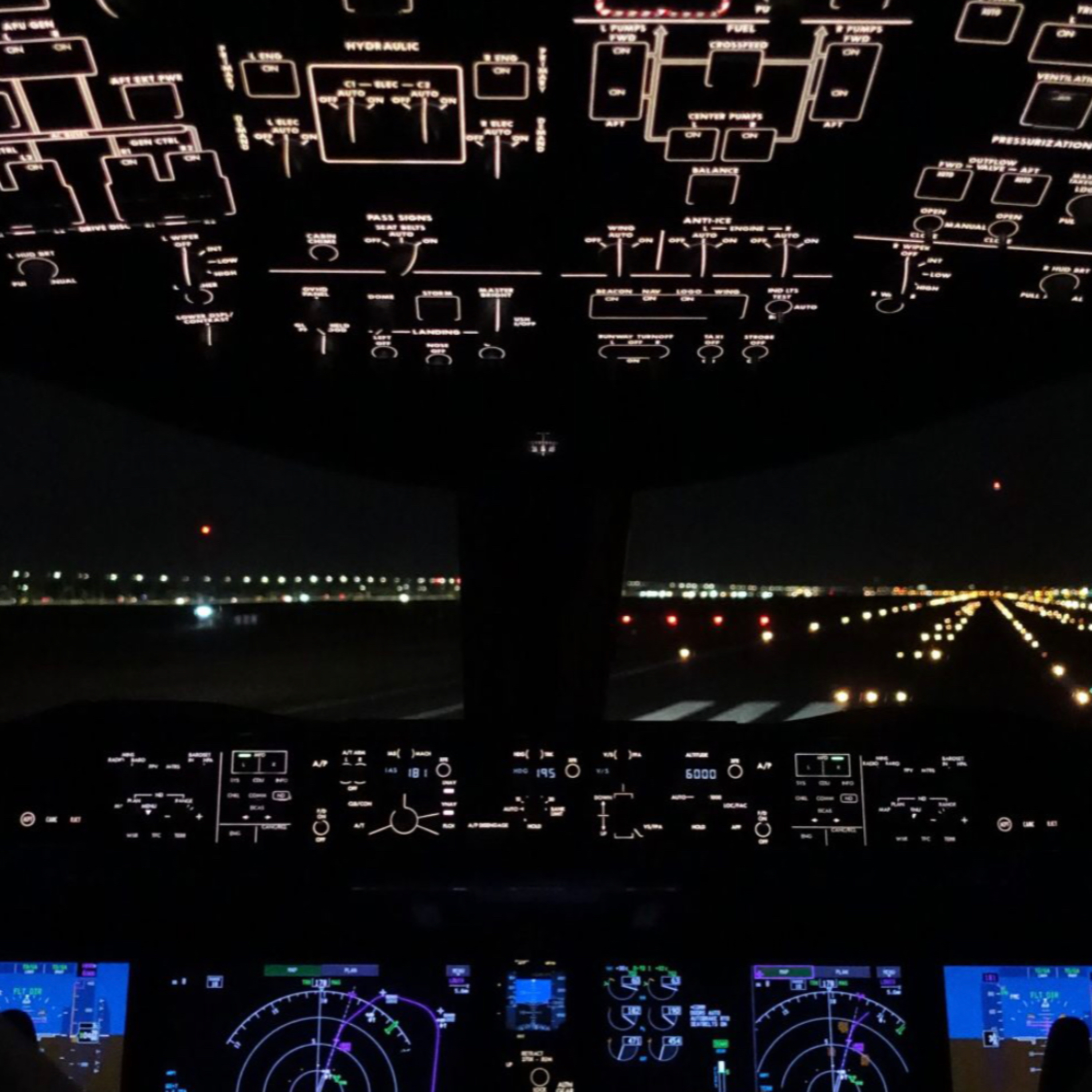
The ZNode Audio Series 787 Progressive Functions provides a detailed, step-by-step audio breakdown of the Boeing 787’s takeoff, climb, and approach phases. It outlines how automated systems activate in sequence—starting with engine start, hydraulic pump engagement, and flight control initialization at key airspeeds like 30, 40, and 50 knots. As aircraft gains speed, critical safety systems such as anti-ice, wind shear detection, and door locks engage, while caution alerts and voice warnings are introduced at specific thresholds. Toga switch actions disarm navigation modes and return flight control to manual settings, while engine thrust derates are managed based on takeoff parameters. Post-takeoff, systems deactivate progressively: wind shear warnings cease at 1,000 feet, and T-CAS and caution alerts are disabled at various altitudes. Climbing systems apply fixed derates (5% for Climb 1, 15% for Climb 2) based on takeoff derate values, with thrust gradually increasing to cruise by 30,000 feet. Approach begins with glide slope and final approach course displays, and landing systems activate with gear warnings, speed brake cautions, and radio altitude cues. The sequence ends with detailed checks at 50, 100, and 200 feet, including final descent and runway alignment. The audio is narrated by a certified 787 pilot with extensive experience and training, offering a realistic, pilot-centered insight into 787 operations.
ZNode Audio Series 787 Progressive Functions
A production of Z-Man Audio Series 2020, 787 Progressive Functions, taxi out engine start.
Engine start plus 3 minutes, all demand pumps stop running, take off.
Take off thrust set, all hydraulic demand pumps start to run.
30 knots, manual rudder trim inputs are zeroed, 40 knots, flight control lockout is disengaged
if it was engaged.
50 knots, HUD ground deceleration scale is shown if deceleration is sensed, if not previously
pushed, toga switches are inhibited until 400 feet.
60 knots, flight control system attempts to maintain 0 yard, 65 knots, engine fail warning
in the PFD HUD, primary flight display HUD becomes available indicated airspeed.
Toga reference line is shown on HUD 75 knots, anti-ice actions, anti-ice detection begins,
an automatic win, wing, anti-ice is available indicated air 80 knots.
Intriguing system actions, caution lights, sounds, and eye-cast advisory message inhibit
begins, indicated airspeed, new predictive wind shear system caution alert inhibit
begins, indicated airspeed, entry door handles lock to prevent door opening during flight.
Pushing toga switches disarms LNAV and VNAV.
With flight director switches off, the flight director will still engage if toga switches
are pushed, indicated airspeed.
35 knots, RTO actions, RTO auto break is armed, speed break lever will move to up if thrust
levers are closed.
100 knots, new predictive wind shear system warning inhibit begins, indicated airspeed.
V1 minus 6 knots, indicated airspeed, engine fail warning inhibited, engine thrust eye-cast
amber caution message becomes available instead.
Note, this message is shown for either of the following two.
The thrust is more than the commanded thrust.
The thrust is less than the commanded thrust, displayed above 6 knots prior to V1.
If the engine is producing higher or lower thrust than what is commanded and is not correcting,
replaces the engine failure alert system, red engine fail on primary flight display from
6 knots before V1.
The engine, indication thrust command arc becomes filled amber.
V1, new eye-cast warning lights bell siren inhibit begins.
Initial climb out, weight off wheels, elapsed flight time timer start at 50 feet, new predictive
wind shear system warning inhibit ends, HUD flight director guidance queue appears, LNAV
engages if armed, pushing toga switches removes any derate and puts roll mode back to toga.
Caution lights sounds eye-cast advisory message and eye-cast communication alert inhibited
ends.
Redder trim indication blank when gear up for 10 seconds or 60 seconds after liftoe.
400 feet, VNAV engages if armed, pushing toga switches removes any derate and puts
both roll and pitch mode back to toga.
Caution lights sounds eye-cast advisory message and eye-cast communication alert inhibited ends
or 20 seconds after liftoe whichever occurs first.
New predictive wind shear system caution inhibited ends, new eye-cast warning lights bell siren inhibit
ends for 25 seconds after liftoe.
600 feet, T-cast TA inhibited ends, 800 feet, status queue inhibited ends or 30 seconds after
liftoe if that occurs first, 1,100 feet, T-cast RA inhibited ends, 1200 feet, T-cast
descend RA inhibited ends, predictive wind shear system, system stops issuing new cautions
and warnings, 2000 feet, center demand pump stops, first flap retraction speed error tape
is displayed, flaps up, left and right demand pumps stop, climb 10 minutes after takeoff
ILS auto tune inhibited ends, a note about derated thrust climb, two fixed climb thrust derates
climb 1 and climb 2 can be selected on the thrust limit page, the percentage of derate
is 5% for climb 1, 15% for climb 2, the derated climb
thrust is maintained until reaching 10,000 feet where the thrust then increases linearly
to an altitude to achieve climb thrust by 30,000 feet, in cruise the thrust reference defaults
to climb.
Additionally, use of an assumed temperature reduced thrust takeoff or takeoff derate affects
automatic selection of the climb derate, if the takeoff derate percentage fixed derate
plus assumed temperature method is less than 5% than climb is selected, or greater than
or equal to 5% and less than 15%, then climb 1 is selected, or greater than or equal
to 15%, then climb 2 is selected, 30,000 feet, general electric engines ice crystal anti-ice
function ICA becomes available, cruise 20 minutes into cruise above 25,000 feet, humidification
system operates when humid switch is on, and until one to one and a half hours prior
to landing, halfway or 400 nautical miles to destination landing altitude on the primary
flight, or PDF, altitude tape changes from departure runway to destination run, 150 nautical
miles from destination or 50 nautical miles from touch top of descent or FMC in descent,
ILS GLS MPS approach reference data appears on primary flight display, ILS GLS auto-tunes,
descent, 28,500 feet, general electric engines ice crystal anti-ice function ICA terminates,
approach 25 nautical miles from mist approach point, final approach course pointer is shown
on the primary flight display, aircraft positions 60 degrees within final approach course, glide
path pointer is shown on primary flight display, max 6,000 feet above field, aircraft position
within 60 degrees and track 90 degrees to final approach course, 2500 feet, radio altitude
shows on primary flight display and HUD, rising runway symbol is shown on primary flight
display, 2300 feet, predictive wind shear system starts to scan 2000 feet, center demand pump
starts to run, wind gear is down also, 1500 feet, reactive wind shear warning enabled,
1450 feet, T-CAS increase descent RA inhibits begin, 1200 feet, predictive wind shear system
enabled for warnings and cautions, 1000 feet, T-CAS descent RA inhibits begins, T-CAS
RA inhibits begins, ND changes from traffic to TA only, left and right demand pumps start
to run if not already started by gear selected 800 feet, config gear warning, red if thrust
levers closed and gear not down, and I cast communication message inhibits begins, status
queue inhibits begins, speed brake extended caution enabled, note about config gear warning,
a landing gear is not down and locked and one of these occurs below 800 feet, radio altitude
and a thrust lever is at idle, or the flaps are in a landing position, note about speed
brake extended, amber caution message, the speed brakes are extended and at the same time
one or more of the following occurs, the radio altitude is between 1500 and 800 feet, correction
15 feet and 800 feet, the flat lever is in a landing setting, thrust lever is not at idle,
this message is one of three caution messages that are not inhibited below alert height
on an auto land, the other two are amber autopilot, amber auto throttle disconnect, further
this caution message should not be confused with the oral time critical warning that
occurs during rollout on landing or a rejected takeoff when the speed brake has not deployed,
that message is not on the i-cast but rather on the primary flight display and HUD accompanied
by the master warning light and the oral speed brake, speed brake 400 feet, tcaste a voice
alert inhibits begins.
New, predictive wind shear caution alert inhibit begins.
HUD Flight Path Acceleration Symbol is removed if decreasing performance wind shear is
to 300 feet, HUD runway edge lines are shown if in decluttered mode.
Land 2 or land 3 displayed and 200 feet, master caution light beeper inhibited for all messages
except for amber autopilot, amber auto throttle disconnect, amber speed brake extended, rising
runway symbol moves toward the airplane symbol.
At 70 feet, HUD glide slope reference line is removed.
At 60 feet, HUD runway edge lines are removed.
At 50 feet, new predictive wind shear system warning alert inhibit begins.
HUD Flight Director Guidance Q disappears.
Standing, new predictive wind shear system warning alert inhibit ends, 80 knots, new predictive
wind shear system caution alert inhibit ends indicated airspeed, 75 knots, eye cast communication
message inhibit ends indicated airspeed status Q inhibit ends or begins rather indicated
airspeed, master caution light beeper inhibit ends indicated airspeed.
At 70 knots, entry door flight locks are unlocked.
60 knots, center demand pump normally stops.
40 knots, left and right demand pumps normally stop if reversers are stowed.
Rutter and stab trim indication is shown on eye cast.
30 seconds after weight applied on wheels, elapsed flight time timer stops.
At 25 knots, HUD ground deceleration scale is removed.
If a go around is initiated.
At 50 feet, elnab engages manual flight.
200 feet elnab engages automatic flight.
600 feet, t cast TA voice alert inhibit ends, 800 feet master caution light beeper inhibit ends.
900 feet t cast RA inhibit ends, 1200 feet t cast descend RA inhibit ends, 1600 feet t cast
increase descent RA inhibit ends.
Thank you for listening to the Znotes audio series audio and production editors note.
This audio content is compiled and read by a 25 year airline pilot, qualified on the
787 since 2015.
A certified advanced ground instructor, retired military standards pilot, instructor pilot,
instrument evaluator for both rotor and fixed wing aircraft.
Thank you again for listening to Zman audio notes.
Podcast Summary
Key Points:
The 787’s engine start and takeoff sequence includes automated system activations such as hydraulic pump engagement, flight control lockout disengagement, and HUD display updates at specific airspeeds.
Critical safety systems like anti-ice, wind shear detection, and door lock mechanisms activate progressively from 30 to 80 knots, with caution alerts and voice warnings introduced at key thresholds.
Toga switch operations disarm navigation modes (LNAV/VNAV) and restore flight control to manual "toga" mode, while also triggering system derate and thrust management changes.
Engine failure alerts are modified post-V1, with amber caution messages replacing red engine fail warnings if thrust deviates from commanded levels, and thresholds are defined at 6 knots before V1.
Post-takeoff, systems deactivate warnings in stages
Climb derate settings (5%, 15%) are selected based on takeoff derate methods, with climb 1 or 2 chosen depending on the percentage applied.
Approach phase systems activate at defined distances and altitudes, including glide slope, final approach course, and radio altimeter displays.
Landing procedures include gear warnings, speed brake cautions, and vehicle-level alerts, with critical warnings only inhibited during auto-land scenarios.
Summary:
The ZNode Audio Series 787 Progressive Functions provides a detailed, step-by-step audio breakdown of the Boeing 787’s takeoff, climb, and approach phases. It outlines how automated systems activate in sequence—starting with engine start, hydraulic pump engagement, and flight control initialization at key airspeeds like 30, 40, and 50 knots. As aircraft gains speed, critical safety systems such as anti-ice, wind shear detection, and door locks engage, while caution alerts and voice warnings are introduced at specific thresholds.
Toga switch actions disarm navigation modes and return flight control to manual settings, while engine thrust derates are managed based on takeoff parameters. Post-takeoff, systems deactivate progressively: wind shear warnings cease at 1,000 feet, and T-CAS and caution alerts are disabled at various altitudes. Climbing systems apply fixed derates (5% for Climb 1, 15% for Climb 2) based on takeoff derate values, with thrust gradually increasing to cruise by 30,000 feet.
Approach begins with glide slope and final approach course displays, and landing systems activate with gear warnings, speed brake cautions, and radio altitude cues. The sequence ends with detailed checks at 50, 100, and 200 feet, including final descent and runway alignment. The audio is narrated by a certified 787 pilot with extensive experience and training, offering a realistic, pilot-centered insight into 787 operations.
FAQs
All hydraulic demand pumps start running after takeoff thrust is set. Before takeoff, they remain off until the engine starts and the aircraft reaches takeoff conditions.
The flight control lockout is disengaged at 40 knots, allowing normal flight control inputs.
The HUD ground deceleration scale appears if deceleration is sensed. Anti-ice detection begins, and wing anti-ice becomes available at 80 knots.
At V1 minus 6 knots, engine fail warnings are inhibited. If thrust is higher or lower than commanded, an amber caution message appears, replacing the engine failure alert.
Pushing toga switches disarms LNAV and VNAV. It also removes any derate and returns roll and pitch modes to toga.
Entry door handles lock at 80 knots to prevent door opening during flight.
Chat with AI
Loading...
Pro features
Go deeper with this episode
Unlock creator-grade tools that turn any transcript into show notes and subtitle files.
 PodcastTranscript AI