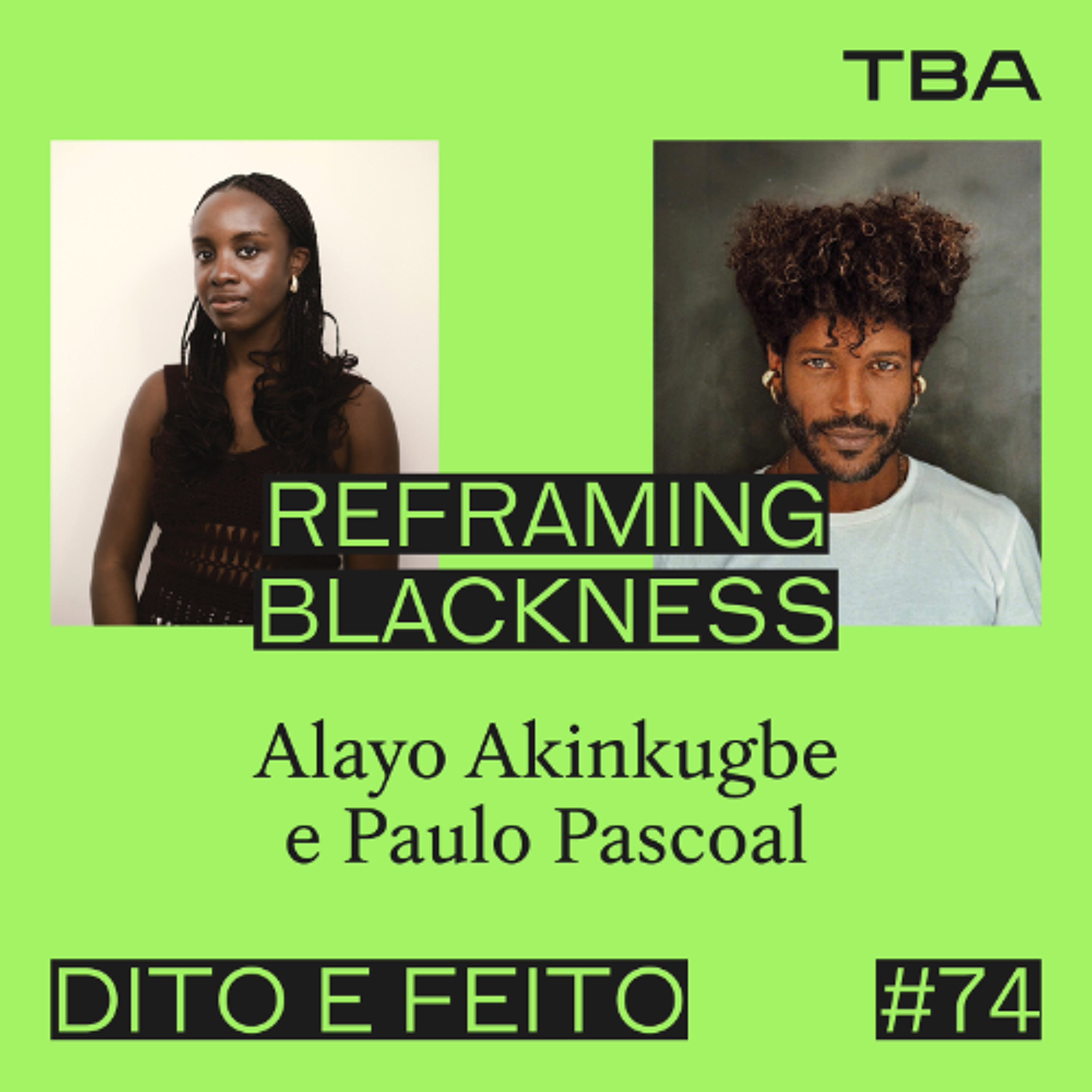
#74 Reframing Blackness – Radical Imagination: Alayo Akinkugbe com moderação de Paulo Pascoal
37m 49s
The podcast "Dito efeito" by Bairro Alto theater is characterized by its irregular publicity and format. Alayu Akin-Kungbe's presentation at the TBA conference delves into "Reframing Blackness - Radical Imagination," challenging Western art history from a Black perspective. Themes from Alayu's book highlight the role of Black artists in art history, inspiring contemporary artists to respond and reimagine canonical artworks. Artists like Barbara Walker, Cain de Wiley, and Naudline Pierre address the absence of Black representation in Western art history through their work, reshaping narratives and emphasizing the importance of inclusivity and diversity in the art world.
Transcription
5544 Words, 32692 Characters
Hello, this is the "Dito efeito", a podcast produced by the Bairro Alto theater, where
speaking is a way of doing and vice versa. The publicity of the podcast is irregular,
the format is also. Sometimes it arrives close to the show, sometimes far away and others
still do not know everything. Call me Lisa Rodrigues and I am the programmer of the TBA discourse.
This episode is broadcast until October 7, 2025, on the conference day of the art historian and
writer Alayu Akin-Kungbe on the TBA. In this conference entitled "Reframing Blackness - Radical
Imagination", which takes place in the scope of the discourse programme that, over the year 2025,
is processed by the theme of Radical Imagination, Alayu, creator of the online project Black History
of Art, presented his book, recently released. "Reframing Blackness - What's Black About History
of Art?" Through paintings, drawings, text critics and his own experience, Alayu led us through the
history of Western art, running the codecs and occult conventions and racists,
to in a second moment transfer white gaze, the bright perspective of history, and re-enact the
Western art history from another look, from another place, opening space for a black gaze, a black look
about the art history. Upon his presentation, Alayu was talking to Paulo Pasqual, actor, author and curator,
who also made the mediation between the audience and the guest author. Let's listen to it.
Hello, good afternoon, welcome, welcome and welcome to the TBA. Today we start the last cycle of the
programme, we continue from the theme of Radical Imagination. All the discourse programme
in 2025 was focused on this theme. We programmed assemblies, conversations, performances, podcasts
and many meetings. Okay, thank you. We know that the floor does not always show fertile,
but we also know how to germinate, even in concrete. Hope is also resistance, imagine other
possibilities of existence, show yourself an urgency. Although we live for a long time,
although for sure it is necessary to continue to imagine. Solidarity, such as imagination,
will be radical or not. We do not forget Palestine, Sudan, Congo and all the occupied
oppressed and occupied. Hope is also resistance. Welcome everyone, I'm Melissa and I'm the
programme, the discourse programme here. I've just started with these few words in Portuguese
to share the tone and feeling that we'll guide this last cycle, that we programme around radical
imagination. It's a reflection on the urgency of hope and on radical solidarity and radical
imagination as ways of staying awake and connected in times of genocide and whitewashing.
Thank you Alayu, thank you Paulo. Alayu is a writer, founder of the Black History of
Art and the presenter of the podcast, The Shared Gaze. Writer of the book, Refaming Blackness,
What's Black About the History of Art, which we are going to learn today. Paulo is there,
who will then join us here. He is an actor, author and curator, with more than 20 years of career in
theatre, television, radio and cinema, focusing on activism, cultural policy and experiences
in formative arts. Now I'm going to pass the word to Alayu, please. Thank you for setting
my invitation. Thank you for inviting me.
Hello everyone, thank you very much for coming. I'm so happy to be in Lisbon, this is the first
time I've spoken about my book in Portugal and the second time I've spoken about it outside of the
UK, so I'm really, really pleased to be here. And thank you Melissa for having me. My name is
Alayu Akinkube, I am the author of Reframing Blackness, What's Black About History of Art,
and I run the Instagram platform, A Black History of Art. I want to give you a bit of context for
the book before I delve into the themes. So everything began for me when I was studying in
Cambridge in 2020. I was taking a bachelor's degree in history of art and I loved everything
that I was studying and I was very, very passionate about art history. I had studied it at school
and I knew it to be very Eurocentric, very white and at the time I didn't really have a big problem
with it because I was enjoying it all. From the Italian Renaissance to Dutch still life paintings,
English landscapes, abstract expressionism, pop art, everything was interesting to me.
In my second year at university I realized that I hadn't learned about any black artists at all
in the first year and that first year course was meant to span all about history from ancient Greece
to the present day. I took a paper on contemporary art from the 1980s to the present in Britain and
the US and it was taught by Dr Amy Tobin. I suddenly felt a very deep connection to what I was learning
because we covered subjects like black representational space and we learned about artists who are
widely acclaimed but up until that point they had remained out of my degree. We learned about
household names like Isaac Julian, Martin Sims, Glenn Ligon, David Hammons and the feeling of
recognition and kinship in their art really deepened my love for the subject of art history
and that is what brought me to the realization that no black artist had been included on the first
year of my course. So because it had taken a year and a half into the degree for me to finally learn
about a black artist I didn't want to leave university having only learned about those
few artists. I started posting on Instagram these short snippets with captions to self-educate for
my own personal research about black artists and sitters curators and thinkers. I noticed
that lots of curators and art world professionals would engage with the page so I felt like I could
be on to something that was important. COVID suddenly hit and everybody was on their phones
and the following of the page began to grow and in May 2020 George Floyd was murdered and that
changed everything. There was extreme attention given to the page and there was a peak in interest
because of the resurgence of the Black Lives Matter movement. It's slightly sinister but the
intense popularity of the page was ultimately rooted in a tragic event. From this Instagram page
has stemmed a career dedicated to platforming the work of black artists past and present
and shedding light on the black artist models and muses that have too long been unnamed or excluded
from mainstream art historical narratives. I started the podcast A Shared Gaze in 2023
and it's a series of conversations with black artists. My aim with the podcast is to be as
global as possible in the discussion to not present blackness as a monolith because blackness is
everywhere and it's experienced and responded to differently in various contexts around the world.
Black gazes was a column that I was writing on another magazine for two and a half years.
It is a series of interviews with contemporary artists and designers like
Howardina Pindell, Christina Kimese, Candy Wiley, Samuel Ross but also art collectors and art
enthusiasts like Venus Williams. Finally my own book reframing blackness came out in July.
It's really a combination of the past five years and it examines the relationship between
blackness and western art history through five lenses. Museums, the curriculum, feminist movements,
muses and exhibitions. For that final chapter on exhibitions I interviewed the brilliant curators
Antoine Sargent, Echo Eshin, Denise Morel and Koyokour who was due to curate next year's Venice
Biennale but sadly passed away earlier this year. Her vision for the Biennale will be realized next
year by a team of curators that she had appointed before she passed. So for context I wrote the
book with the intention of opening the discussion of the role of black artists and muses in art
history to a broader audience making it part of mainstream discussions in the way that my
Instagram page has functioned. This talk will focus primarily on the themes which come up in
the first and fourth chapters of my book. The first chapter which focuses on western
temple-fronted museums and galleries considers the way that artists have responded to these
kinds of spaces and the works we expect to find within them. The fourth chapter which informs the
second part of this lecture considers the impact that muses and artist models have had on generations
of modern and contemporary artists. So the first chapter of my book is called Temple of Whiteness.
The title is a quote from an interview John Aconfer gave to Art 21 a couple of years ago.
He describes loving going to the Tate Britain while growing up but it slowly dawned on him
that it was a sort of temple of whiteness. He goes on to say that the very thing that you love
may well be the same thing that is keeping you in a state of discomfort about your your place
in the culture. I found that analogy fascinating and apt for describing such museums which can
be found across the Europe and America and cities of cities in much of the so-called western world.
They do literally have a temple structure a column they have columns they're raised up by
stairs and there are large imposing buildings that communicate importance. They're often old
palaces and they have similar architecture to official and government buildings. Think of the
U.S. capital capital or Buckingham Palace etc. These kinds of museums don't look much different.
John Aconfer then went on to represent Great Britain at the Venice Biennale last year. His
commission Listening All Night to the Rain was a series of films and this image is of the facade
of the Great British Pavilion and here again we have an art space which mimics an ancient Greek
temple with a colonnade pediment that triangular shape on the roof etc. The position of Britain's
pavilion is such that you see it from at the top of the hill from the entrance to the Giardini of
the Biennale and you can see that imposing temple structure from a distance. John Aconfer has been
part of two national pavilions Great Britain and Ghana. In our podcast episode for a shared gaze
he talks about how he really thought about this location it's elevated etc and it's a temple.
You'll notice that the screens at the front kind of interrupt the facade but also they crucially
block the natural entrance. In order to access the exhibition you had to enter from the back
of the building and the exhibition began in the basement. It was interesting to see how he disrupted
the usual flow of this structure reducing the authority of the architecture by forcing the
audience to disengage with the broad staircase and to enter and exit via the rear of the building.
That leads us to the question where does black blackness fit into this into spaces like this.
In these kinds of spaces we expect to find certain kinds of paintings in which blackness
appears in the background or on the margins of the compositions. I find that when I personally
am in these spaces my eyes fit to the black figures in the paintings trying to spot them to
understand the role that they've been given by the artist. This question of where blackness fits
into a western art history is one that many contemporary artists grapple with by responding
to and in some cases reimagining specific canonical artworks. This is Patricia Kersenhout's
Guess Who's Coming to Dinner 2. It's an ongoing series that she began in 2017. In it she reimagines
Judy Chicago's canonical The Dinner Party. The installation takes the form of a monumental
triangular dinner table honoring black women and women of color across history.
It initially featured 38 embroidered names but it has since expanded to include up to 60 women
with their names appearing on table linens and tunics suspended from a bamboo frame.
The tableware is hand-blown glass is hand-blown glass inspired by pre-colonial West African
and South American ceramics. They encourage communal eating and they symbolize collective
experience and shared histories. Kersenhout organizes the woman into three thematic categories.
Warrior Queens and Divine Spirits, Slavery and Colonialism and Colonialism and Contemporary
Revolutionaries. The figures honored include Fumilaya Ransom Kutty, Tara Norera and Saint
Josephine Bakita, woman whose legacies have been largely erased from dominant narratives of history.
By mirroring Judy Chicago's triangular table Kersenhout symbolizes symbolically invites these
women to join the original dinner expanding who is deemed worthy of recognition and remembrance.
So this is Judy Chicago's Dinner Party which Petrisha Kersenhout was responding to
and it features 39 women but only one of these women is black and it's Sojourner Truth the activist.
All of these pages have a vulva design except for Sojourner Truths which has three heads a
totally different part of the body. The substitution of a head for a vulva has been widely read
as emblematic of the misrepresentation or denial of black female sexuality within
western feminist iconography. The poet Claudia Rankin in Among the Undressed responds directly
to this imagery interpreting the displacement of the vulva by a face as a metaphor for the ongoing
denial of the womanhood of black woman by the leaders of white feminism. Together Petrisha
Kersenhout's installation and Claudia Rankin's poem redress the limits of Chicago's feminist canon
and assert the presence complexity and agency of black women within feminist discourse.
This is a work by Barbara Walker who is a British artist whose practice explores themes of race,
history and erasure particularly how black figures are marginalized in official narratives.
Barbara Walker draws from canonical works Renaissance Baroque and Neoclassical where
black figures are included often as servants slaves or as secondary characters. In her series
Vanishing Point Walker brings the marginal black figures into focus. In certain works she uses
blind embossing to recreate the compositions of canonical western paintings such as this one
but brings our attention to black figures in the work by drawing them and owning them in graphite.
In this example Vanishing Point Seven by Titian which she made in 2018 she recreates the composition
of Diana and Action by Venetian Renaissance painter Titian. All but one of the figures from
Titian's painting are faintly visible in Walker's work with their silhouettes embossed into the white
paper. They appear ghostly quietly protruding from the flat surface. The black figure in Titian's
Diana and Action is painted on the far right in front of and in the same hue as the tree trunk
camouflaging in the role of an attendant attempting to shield the new Diana from Action's sight.
In Walker's work the black figure is rendered in graphite against white paper
and is therefore the most visible of the figures in the composition. By shifting the gaze the viewer
must reckon with her presence giving us no option but to regard the figure who has remained in the
shadows for centuries. Cain de Wiley is a very well known artist based in New York
and he's known for inserting contemporary black subjects into the visual language of European
old master paint portraiture. Wiley directly references Jacques-Louis David's Bonaparte
Crossing the Alps a grand heroic image of Napoleon on a raring horse. Instead of Napoleon
Wiley paints a young black man found through street casting in New York posed in the same
dramatic position as Napoleon. The figure wears modern streetwear camouflage pants a white bandana
and timberland boots contrasting sharply with the historic composition. The alpine landscape is
replaced with a decorative red and gold pattern filled with silver sperm motifs adding humor and
symbolism. He playfully critiques the hyper masculine bravado of historical portraiture
especially works which glorify conquest and power. The painting is housed in an ornate oversized
frame emphasizing themes of prestige authority and legacy and questioning who is granted such
treatment. This painting Cain de Wiley's is now part of the Brooklyn Museum's permanent collection
the painting confronts traditional museum aesthetics and histories from within.
Wiley's entire practice asks who gets monumentalized who is seen as heroic and who belongs in these
grand historical narratives. This is the painting which is actually on the cover of my book and
it's by Barkley Hendricks who was a pioneering african-american painter known for portraying
black subjects with realist portraiture. The painting is called Lodi Mama and it depicts a
regal black woman with a large halo-like afro presented in a gold leafed arched panel that
mimics religious iconography. The format of the painting draws from Byzantine and Renaissance
altarpieces typically used for saints or the Virgin Mary. He's recasting a contemporary black
woman as divine and sanctified. By using gold leaf and a tondo style arch Hendricks asserts
that black figures deserve the same reverence and grandeur historically reserved for white religious
or royal subjects. The title is drawn from Nina Simone's 1967 song "Blues for Mama" but also
of course the phrase "Lodi Mama" alludes to the mother of Christ and he's drawing a deliberate
parallel between the figure and depictions of the Virgin Mary. The sitter is actually
Barkley Hendricks' cousin Kathy Williams and her afro functions like a halo inviting veneration
and elevating her to the status of a sacred or saintly figure. The painting supplants traditional
white religious imagery like the Madonna or Christ with a black female figure, reimagining
spiritual icons through a contemporary and culturally specific lens.
This is a work by another artist who's based in London and her name is Rosa Johan Udo.
She is a contemporary multidisciplinary British artist known for exploring black identity,
performance and cultural history with satire and research-based practices.
Her exhibition Star Power centered around the figure of Balthazar, the often depicted as black
mages in European nativity scenes as a symbolic lens for examining black representation in western
art history. The exhibition featured these vivid collages that recontextualize classical European
depictions of Balthazar. Rosa Johan Udo reclaims Balthazar's image from a passive background
character to a commanding star. The title of the exhibition Star Power played on both the
majorized journey being guided by a star and the cultural concept of celebrity, suggesting agency
and visibility for historically overlooked figures. She overlays and integrates Balthazar into
compositions in ways that amplify his presence. He is no longer a side character but the protagonist.
These paintings are by New York based painter Naudline Pierre who creates oil paintings that draw
on the grand paintings and altarpieces of national art museums and religious buildings.
Her works evoke a similar sense of extravaganza to a monumental baroque altarpiece or a mythological
scene but they are made anew through her use of vivid often acidic color palettes,
flattened perspectives and of course the repeated appearance of black figures.
In an interview for Bomb Magazine Pierre explained how with her paintings she redresses
the absence of black figures in western art history. She says, "I've always been drawn
to history paintings, paintings of myths and religious iconography. I can't help what I love.
Art history, the way that I and most other people have experienced it,
has been western and male dominant. Walking through a museum gallery looking at beautiful
paintings that don't all include someone like me except in the shadows of an adoration of the
magi type painting or from a fetishized voyeuristic viewpoint is a complicated way to experience art
history. To see grand angelic scenes with subjects that look like me was and remains my desire.
To create a pedestal and then put someone different on it using some of the same tools
from the very works that I'm influenced by and excluded from is an exhilarating experience."
The painting on the left is a clear example of Naudline Pierre putting someone different
on a pedestal. It echoes the composition of alter pieces which show the transfiguration of Jesus,
a biblical scene commonly depicted in religious paintings. In such images Christ appears to shine,
exuding rays of light on a mountain top. In Pierre's interpretation of the scene,
a black woman's nude body supplants the white long-haired male figure that is typically used
to portray Christ in paintings of the transfiguration. I should also point out that she uses her own
face so in a way all of these paintings are kind of self-portraits even though she sees the figure
as an alter ego. The fourth chapter of my book focuses on sitters and muses and I wanted in this
lecture to think about the way that contemporary artists are also responding to the figures in
the paintings and not just the paintings themselves. By responding to canonical artworks,
many artists have been influenced by the people within them, the black artist models and muses
who often go unnamed or unrecognized. Many of you will be familiar with Manet's Olympia
and I want to draw your attention to the lesser known study of Laura who is the woman who is in
the role of a servant in Olympia. This portrait of Laura is the only artwork where she appears
alone. Seated with a closed mouth smile, gazing downward to the right, she is dressed in a white
off-shoulder garment adorned with a necklace, earrings and a head tie. Although the title
Lenegress doesn't mention her by name and only references her race and gender, the portrayal
feels more like a personal portrait than a generic study of a black woman. Elements of Laura's
individuality come through. There is warmth in her gaze and joy in her expression, making her appear
humanized rather than objectified as in many of the other paintings of this period. Laura has
become a very important figure for many black artists from the 20th century onward. Although
she is not the primary subject of Manet's Olympia, she stands out as one of the rare
black figures depicted in a painting that is firmly established in the western art canon.
These are two examples of artists who have responded to Manet's Olympia
and tried to recenter Laura in their work. In Joe Baker's birthday, American artist Faith Ringgold
replaces the figure of Victorine, who is the white woman who is reclining nude in Manet's Olympia,
with a portrayal of African-American performer Josephine Baker. Ringgold also reimagines the
role of Laura, who was in the background of Olympia, by substituting her with a reproduction
of the white maid from Henri Matisse's Harmony in Red, which you can see on the right of that work.
This creates a reversal of roles between the black and white woman seen in Manet's original
painting. Mickalene Thomas, also an American painter, depicts a black woman reclining on a
sofa in a vibrant, patterned living room, with a bouquet of flowers casually tossed on the floor.
Dr. Denise Morel describes it as "a unique update of the 19th century flower-bearing black woman,"
noting that this modern-day odalisque lets her bouquet fall away with casual confidence.
It feels as though this woman in Mickalene Thomas' painting is a reimagined version of Laura,
now granted the freedom to take center stage and recline rather than serve.
These two works share a common goal, to bring Laura out of the shadows and re-envision her
in a new context, approached through the unique perspective of black woman artists.
How did you feel about what made you choose his image?
I actually didn't have a choice, which if anyone has published a book,
they keep the authors separate to the designers, maybe because there's likely to be a clash,
but I do think that this image very much represents a lot of what the book is about,
reframing, reimagining, responding to Western art history in a way that maybe centers blackness
or presents it in a different way to which it's been presented before, and so I'm really,
really happy that we ended up with this, and I think, yeah, it's quite symbolic of what the
book is trying to do. It's also a very, very beautiful painting, which is useful when you're
trying to get people to pick something up, but yeah, it speaks to the whole point of the book,
which is re-looking, re-imagining. How have artists responded to this erasure?
Why do artists want to create these images that venerate black figures?
Is it because of the role that black figures have been given in the past?
So yeah, I felt that it was very symbolic ultimately of what was inside the book,
and I'm really pleased that it ended up on the cover. It was a long process to get there.
Obviously, because of all these contingencies that we've been facing for so many years,
we also become sort of victims of not being able to see ourselves, because sometimes we are there,
but we don't see each other. We don't chose each other. That's a consequence of the system.
My question is, nowadays, how do you reimagine, I think the subject suggested by Melissa,
the curator of this talk. This is the first edition of the last season, is that right, Melissa?
Yeah, and we've been making this question many times. How do we
radically reimagine things? I think, yeah, because it's a reimagination, more than imagination.
Many people have imagined before us, so I think we're just giving it a new
updated sort of contemporary version of what imagination is. How are you doing this these days?
I think, obviously, the period that we're in right now in the world is very, very difficult,
and actually the easiest thing to hold onto is your hopes for what you hope will happen
and your hopes for where we might go after this kind of very dark, terrifying political period,
and I think that's sort of the purpose of all of this. I feel like I was seeing
the world as it was, and I was seeing my degree and the subject of art history as it was,
but the idea of what it could be was extremely inspiring to me, and so that's why I started
doing this whole project, because for me it was fulfilling. It's about my hopes and
what I would like to see, what I'm interested in, what would I want the world to be, how would I
want people to envision art history, what might it look like if we were to focus on blackness
and to not push it aside. So, yeah, I think it comes, that sort of radical reimagining,
it definitely comes from inside. Yeah, it's like, it very much felt like, it felt like a click when
I suddenly started learning about the work of black artists, maybe because I had only, I knew
what I was being exposed to, I knew what I thought art history was, and then suddenly I was like,
oh wait, this is incredible, and I want to know more, and I want to keep going, and yeah, kind of
answers your question. Because actually like recreating tradition for us blacks in Europe,
for example, right, because I think you mentioned earlier the tradition, but tradition for who?
Yes, exactly, tradition. We definitely need to create new forms of tradition that we also feel
included. And the purpose I actually talk about, even the idea of blackness being one that's very
different, difficult to pin down because of how multiplicitous it is, and how ever-changing it
is, and how there's very different experiences of blackness in different contexts. And the reason
I actually chose to focus the book on western art history, as opposed to say African art,
was because it's within western art history that blackness has been othered, and blackness has
been marginalized, and blackness is constantly being reconsidered, and constantly being debated,
and it is also, I guess, about reframing whiteness. It could be called reframing whiteness,
actually, but I guess the reason I chose to call it reframing blackness is because I wanted to try
and center it as opposed to centering whiteness. I find it interesting because there was a code,
it's called the code noir, and it was actually like a 60 page with different chapters on how
navigators and explorers back in the day would have to behave or treat the people that were
enslaved at the time. And in these 60 codes, they were very precise on the way
black people would act, play music, dress, behave, so there was a whole list of things that were
prohibited. So when we think about the reframing of blackness and why we always bring the blackness,
it's because when we don't bring the blackness, we actually become invisible, and sometimes,
and we often, I think we're, this generation is really recalling again the power of identity,
and a lot of us are very exhausted because sometimes you want to create art without
having the need of being black heart. Centering your... Centering. But it's so needed because it's been
600 years of the other movement, so I think for now it's really important that we state and we
identify these matters. I also think that that draws attention to another kind of issue that
a lot of black artists has been facing in these past five years is, okay, do I have to attach my
identity or my blackness to all of my work? What if I don't want to make work about blackness or
it's not about race? How much does it need to feed into my work? How much does it affect the way
that people view my work? How much does it affect what shows I'll get and what shows I won't get?
And what if I just don't even want to talk about blackness? I've had spoken to so many artists
who are just uninterested in talking about my race, and it puts me in a box, and I think that's,
yeah, sometimes... I think the system is always reconfiguring itself as well, and I think maybe
since slavery we've been at the bottom of this pyramid, but for example now what's going to happen
with Palestinians, they're going to be the next black people, for example. Let's see, because this
is how the system always regenerates and discriminates, right? It's true. I don't think
the artist is obliged to fulfill a certain pattern. I think it's important, but everybody's free to
choose to be or to work in whatever work for themselves, yeah. I think all of these examples
responses to, I guess, the struggling, the marginalization, and the way that the Western
world has framed us, and these are all artists who are, I guess, grappling with or trying to address
this difficult history, but I think what you're saying is really important because it's like
there's a lot more than that, and maybe we can look even further back before Western civilization
and take inspiration from what was being made then. I think that happens a lot more on the
continent than it does maybe in Europe or in the diaspora, and that's actually why I ended up not
writing about focusing on Africa or focusing on Nigeria where I'm from, because I felt that
the conversation was different, and the way that races thought about is different, and it almost
seems like a sort of marginal consideration when it comes to Nigerian art history, for example.
I don't want to say all of African art history because I can't know all of these 54 countries'
histories, but yes, I think that's really important, and I think it does happen. I think a lot of
artists look to a past that's before colonization, before any sort of Western intervention in our
lives, and use it to reimagine the future. You see so many artists, contemporary artists right
now in Nigeria, who are using traditional methods to create contemporary work. I think that there's
a strong sense that people are very rooted in history and culture, and they're trying to imagine
something new using these old techniques and being inspired by things that have absolutely
nothing to do with Western art history. Go to nature. True, the real source.
Have any final considerations? Any recommendations? I mean, I think this is making me think a lot
more about imagining, holding on to hope when things are very difficult. These are all considerations
that haven't come up in other talks about my book, and so I guess, yeah, it has been kind of inspiring
to be here because I feel that the audience has like a strong sense of like community and hanging
on and relying on each other and not just trying to less of a sense of doom that I've been feeling
in London, for example, and that makes me really feel positive. And yeah, I guess keep imagining,
keep holding on to hope. That's what I'm concluding from the conversation that we've just had with
everybody. Thank you and see you next time. Thank you.
Podcast Summary
Key Points:
The podcast "Dito efeito" by Bairro Alto theater features irregular publicity and format.
Art historian Alayu Akin-Kungbe presents on "Reframing Blackness - Radical Imagination" at the TBA conference.
Alayu explores Western art history from a Black perspective, challenging conventions and racial biases.
The discussion focuses on themes from Alayu's book, "Reframing Blackness," examining the role of Black artists in art history.
Various contemporary artists respond to and reimagine canonical artworks to include Black representation.
Artists like Barbara Walker, Cain de Wiley, and Naudline Pierre address the absence of Black figures in Western art history through their work.
Summary:
The podcast "Dito efeito" by Bairro Alto theater is characterized by its irregular publicity and format. Alayu Akin-Kungbe's presentation at the TBA conference delves into "Reframing Blackness - Radical Imagination," challenging Western art history from a Black perspective. Themes from Alayu's book highlight the role of Black artists in art history, inspiring contemporary artists to respond and reimagine canonical artworks.
Artists like Barbara Walker, Cain de Wiley, and Naudline Pierre address the absence of Black representation in Western art history through their work, reshaping narratives and emphasizing the importance of inclusivity and diversity in the art world.
FAQs
Reframing Blackness - What's Black About History of Art
Alayu Akinkube
Realizing the absence of black artists in their university art history course inspired Alayu to start studying and posting about black artists.
The first chapter focuses on western temple-fronted museums and galleries and how artists have responded to these spaces.
Kehinde Wiley
Barbara Walker explores how black figures are marginalized in official narratives by bringing them into focus in canonical western paintings.
Chat with AI
Loading...
Pro features
Go deeper with this episode
Unlock creator-grade tools that turn any transcript into show notes and subtitle files.
 PodcastTranscript AI