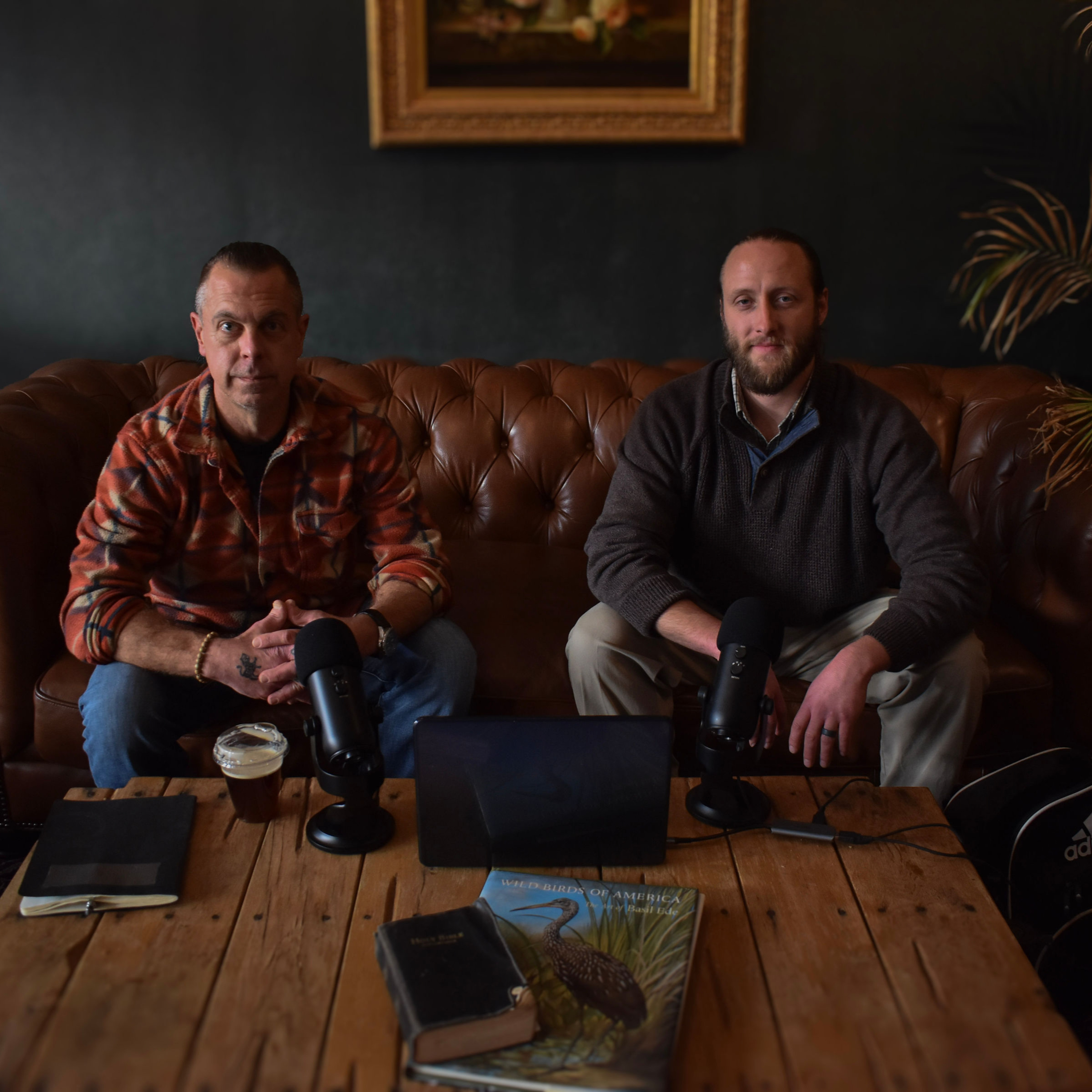
Welcome to episode four part three of the Birds Words podcast. Our guest today is Rob Gray.
Rob has served 23 years in the United States Army. He is a special forces green beret and army
ranger. He deployed seven times at the height of the wars, spending approximately 40 months
total deployed to combat zones. He retired as a lieutenant colonel in 2020 and is at 100 percent
disabled veteran. In 2021 he was paired with a golden retriever service dog named Plato,
like the philosopher. From the America's vet dogs with the help of the U.S. So-com warrior-care
coalition program. He's the proud father of four sons. He has a master's degree in theological
studies. He's currently pursuing a second master's degree in clinical mental health counseling.
He's also a graduate of the University of Alabama in Tuscaloosa, where he received his commissioning
into the army. He moved to Florence, Alabama in 2021, splitting his time between here and Oregon,
until moving back here permanently in the summer of 2023 to be near his four sons. He loves the
outdoors, playing soccer, and doing yoga, hiking, and taking Jeep trips with his dog, painting,
riding, and plays piano with a local band. His journey of faith has been with him since childhood.
He served as a men's ministry director in two churches. He's an ordained deacon and led a pastoral
search committee in his previous church. His faith has sustained him throughout his life not only
through his career in the wars in Afghanistan and Iraq, but through other more personal wars here at
home. He's a strong advocate for veterans in children's mental health and is equally passionate
about ending veterans' suicide topics, which we'll get into later in the podcast. This is seven
years with Rob Gray. Oh man. Rob and I were discussing how to lead into a heavy, potentially episode.
And what we started looking for is an illustration and a parable to help to break the ice moving
forward. And I remember a time I was with my friends and I was young and I was a tree climber.
Have you ever climbed these trees? I love climbing trees. I'm not surprised with your
background and career. You probably like doing stuff like that. Well, I was standing with my
feet on one branch and my hands on the other about chest high. I didn't realize this tree was dead.
The bottom the bottom literally tore out. The bottom branch went and it swung my feet directly
out in front of me with the perfect velocity to break that upper branch. How high of worry?
High enough. I mean, I was probably six feet in the air and I didn't weigh I didn't weigh a
lot, but my back hit the ground and my friends thought I died. I was choking for air later on
back and they were looking down at me and they started to run inside and I could tell them the
stock because the only thing worse than falling is telling anybody you feel. I was chilling.
Don't tell. Don't tell. You know, I thought I was dying, but I think that can be similar because
what we're going to be talking about is how you have a good life and you may have found yourself
in this situation. Got the breath knocked out of you. Challenging things happen to you and you're
actually doing something that a lot of people wouldn't want to do. It's talking about it.
So, let's get into it. Yeah, I agree. Here we are at the, we've gone through the prelude so to speak
and now we're getting down to the continuity gritty, understanding the why if we can even discuss
understanding the why, but within God's sovereignty. I think that's the that's the point today to discuss
why things happen to bad things happen to good people. Why do things happen in general? How do we
navigate life? You know, as a believer in God and you have a family of a career, you have your
health, you have a relatively good, good stable life and like you say, the branch breaks, you slip
on ice and something happens and you you have to navigate that and both in this life. It's
virtually. Yeah, and I like it because we've been saving playtos down here by the way.
I like it, like it's contribution. But one of the things that I appreciate, you know, we've been
saving a lot of this talk for this episode and potentially if it rolls into another. We talked
a lot about your career building up to this and now here we are and we're trying to have a big
spiritual emphasis and and breach these topics that we care about that are challenging and affect
so many people. I mean, that's I would argue in this life. You know, Christians are going to face
some form of challenge. Absolutely. I mean, we're told that. Yeah. Yeah. It comes with the
that comes with your faith. It comes with just navigating the world in general.
So we're going to cover some heavy topics but we're going to cover topics that I think people,
I think you want to hear it because deep down when you are struggling with this,
you want to know that other people have felt the way that you feel sometimes
and you as the listener. We feel that way. We have had pain. We're about to discuss it.
And so as we discuss it, we also want you to know if you stop listening halfway through
we're moving towards God's sovereignty and the hope that we have in Jesus Christ being the gospel.
It's not even though we might wait through some tough waters. We're not going to stay there.
But we are going to cover those topics. So let's start in Belgium.
Yeah. And let me just, if you got that too again, man, I guess it's it's nerves before before
doing this. And we talked about a lot. And you know,
yeah, Belgium is working it's difficult. You know, these these past seven years,
the reason I'm doing this is because I want to try to give, you know, give hope to people that struggle
with or struggling with or have a loved one struggling with some of the same things that I'm
encountered. And I want to be very clear up front. We're going to talk about things like depression.
We're going to talk about stigmas for veterans, particularly special operators. We're going to talk
about fathers and fatherhood and being absent from your children. It's the best way to say it. We're
going to talk about what I turned the loss of the will to live, clinically suicidality, suicidal
ideation and intention, co-occurring conditions that come come from many years of deployments over
and over for a lot of veterans. There is a suicide epidemic. There is a suicide crisis
in this country with the veteran population, especially with the special operations population.
There's even studies now that that talk about and indicate that there's generational suicide,
that the children children that have parents that commit suicide are more likely to commit suicide
themselves and there's been studies within the veteran population that clearly begin to show this
trend and that's horrifying. So we're going to talk about mental health. We're going to talk about
isolation. We're going to talk about substance abuse and all the things in the context of faith.
And these are, I believe, possibly difficult topics to be discussed by Christians.
Divorce is a very taboo subject, I think, within churches where there are people that are not divorced.
Certainly depression, co-occurring conditions that cauldron of
depression, isolation, substance abuse, wanting to just check out, wanting to just hide
from the world embarrassment. And no one is exempt. We have biblical examples. We've talked about
that. We have Elijah, his first kings, that after defeating the province of Bount,
Jezebel's coming after him, and he ran away, sat down under a tree. He said, "God, I want to die. I
take me now." I mean, he just had a massive victory. And then he ran and sat down under a tree,
and said, "Take my life. I'm no better than my ancestors." And first kings, 19th Job,
you know, and well, throughout Job.
typically in chapter three, you know, he talks about the loss of the will to live.
And then Jonah, certainly the book of Jonah, tremendous lament.
Jonah 4.3, "Now Lord, take my life, first better for me to die than to live.
We have laments of David when he is in hiding, when he is on the run."
So, you know, depression and without going so far as to say,
your suicidality or suicidal ideation within the Bible, biblically,
by I think pointing to those passages that are simple and in phrase and phraseology.
Yeah, conceptually there. Conceptually.
But they encompass the absolute exhaustion at life.
You're mentally, physically, emotionally and spiritually exhausted to the point
that you just, you would rather pass from this life.
Even Christians encounter that. Even the greatest prophets encounter that.
In biblical examples of that.
And so how do we talk about that? You know, why don't we talk about that?
I mean, it is a tragedy, anyone that takes your life.
But, you know, depression and, you know, there's different degrees of depression,
but major depression disorder, treatment, resistant depression,
certainly compounded by multiple major life events happening.
Happens as Christians too.
And when a Christian brother or sister, you know, a child,
you know, hits somebody. How is that treated by the church?
How is that treated by, by community, you know?
Do they become an outcast simply because they're dealing with the human condition that we have?
Do we feel like some struggles are more noble than other struggles?
Sure. Right. Exactly.
Which it was a shame because that, to me, that kind of ties into a level of pride and arrogance.
It's like we have this box of things within the church that might be okay struggles.
That's going to mean, is it not like summer, socially?
Level one, level two, level three. Yeah.
Yeah, it's like here's this box of our very particular struggles that we have.
Well, that's one we're not going to talk about.
Why? You know, why don't we talk about it?
And it's notable that you're willing to talk about it because with it comes a level of pain
and hurt and frustration and navigation through these deep spiritual principles.
So I appreciate you being willing to talk about it and shed a light on it
because I think acting like it doesn't exist is one of the worst things we can do.
I mean, if this podcast is not for everybody,
but if nine people have ten, listen to it and don't really care about the topic,
but that one person who's sitting in the dark isolated alone struggling to hold onto their faith
even, and that's good enough for me. It's for those.
That's what I'm talking to because that is where I went through for many years.
And the path of healing, we'll talk about that too, and making it to the foreside.
That's the hope that I want to give to people.
Yeah. Well, I hope that we accomplish what we set out to do, and in Belgium,
give me a background. What's going on? What are you doing? What's the family situation?
Well, so we just left Estonia. I think you made the great point that all of these things
kind of coalesced in Estonia. The physical injuries ran out. The undiagnosed PTSD, TBI,
you know, the shadows of the marriage, so to speak.
And I was approaching the end of my career, which was, what was your role right now?
We became the J7 director of the, for all NATO special operations exercises and training
across the NATO commands in Europe. And it was at a very critical time. It was right for Ukraine
kicked off. So a JCO director in a multinational headquarters for European special operations,
forces, a pretty significant responsibility. And I had planned to retire from there. We had
talked about retiring there and staying there as civilians. We enjoyed Europe. The family did,
but there were other things in the background occurring that I did not know at the time.
And so we got there in 2016.
That summer, and thanks had already been occurring in Estonia that were, I would call them indicators
in warnings, so to speak, that not only for myself, but that the marriage was probably on its last leg.
Yeah. You're in this country. You have a major role. You feel your family shifting a little bit.
There's obviously some struggles that were going on behind the scenes. Were you able to
live a normal life at this point? Were things starting to come to the surface?
Was it in the public eye? Was it mostly private cracks? How does that look?
I would say everything is coming to the surface within the family.
There was a lot of distance between my wife and I. I think the children noticed as well.
I did the best I could at my job, but there was too much distance and
things recurring that had occurred throughout 15 years of marriage.
In the fall of 2016, I began to see a therapist in Belgium at the Native Command of the American
Therapist. And within a couple of months, she said, "I need to diagnose you with PTSD."
You can't do that. I said, "I can't diagnose me with that." No, I don't.
And she said, "It's been very clear since the first three or four sessions."
And potentially more. That was just a black X. Nobody back then wanted that stigma as I was viewed.
So you saw that career implication that if you were diagnosed with this,
you would absolutely be separated distance, not thought as highly of.
Sure. The conversation is still not matured enough within the military community to begin
to acknowledge it. Hey, it happens. And if you get diagnosed with it, let's get to the treatment
you need. It was viewed as essentially career killer. And nobody really wants to believe that anyway.
But she was right. And she did. And then I got screened for TBI. And I came up very positive
for TBI. Let me ask you this. Did you suspect you might have it or were you completely oblivious
to the possibility of you having it? Because she said, I mean, clear as day. You walk in,
are you, are you trying to hide this from yourself? Do you think something might be up?
You know what? I can, I can definitely say I understood hypervigilance back then. I could
understand not being as organized mentally. I could not organize as well mentally.
I honestly thought it was nightmares and dreams though. I thought it was flashbacks, nightmares
and dreams. You're jumping on the floor at the sound of a bang of a car, you know, backage or
something like that. And you know, we're screened anyway. And I didn't really struggle with anything
that had occurred. I mean, there's some horrible things that occurred by carrying no shame. You know,
guilt, parents, but there really no shame. There's there's there's collateral damage. But I didn't
really understand all the implications. Yeah. Yeah. So we might, we might have this perception in
our mind that it looks a certain way. I don't check this flashback box. But then, you know, we've
mentioned the body keeping the score, the score before that book and talks about how it can manifest
itself in different ways. So if you had known there might be a couple different criteria there,
you might say, oh yeah, maybe not this one, but definitely this one. We start to hear this test.
You start pushing the scores because, you know, it's a one to five. You're like, oh, I'll make
that one a two and seven four. Because again, you're you're you're you're you're going to minimize
everything to the detriment of yourself. So that's interesting. So when you took it, you left, you left
the office. I mean, how do you feel after that? After the official diagnosis? I didn't feel good.
She, you know, she said, well, if I don't put that, I'm going to put severe anxiety. I said,
that's worse. Anxiety. You know, you know, don't, who has anxiety, man? Yeah. I don't have
any anxiety. I'm going to what I do. And you just, you're you're you're blind to it. If you don't
understand it. And and what you also understand is the what is having physiologically to the brain,
either. And and that came, you know, they're being screened for, for TBI's. And then that combination
that a lot of veterans deal with PTSD and TBI's where the print drawn cortex has slowed
you got damage possibly to various neuropathways.
Your amygdala is in full, you know, red mode,
all the time.
There are physiological things that occur.
- I can say that great book by Dr.
- Not for good as I'm too, but yeah.
- Yeah, from his Dutch body keeps the score.
It does manifest in the body.
- Yeah.
- And going unchecked, you know, those broken parts,
and your body and your mind, you know,
only your worst.
And so anyway, yeah, they diagnosed with TBI as well.
It sent me to seven week, program at Lansdoll,
the Lord, she was hospitaled in Germany
with six of the green braids,
and we went through seven week TBI, TBI,
I don't know, resident thing where they tried to,
yeah.
- Helping some positive way.
- There's like a series of-- - Yeah, yeah.
- Okay, and so that was all also
as soon as I got to the command.
So I get there on the J7 and then by March,
that's only six, seven months later,
I'm going down for a seven month micro-treatment, Lansdoll.
Honestly, I never moved back in the house after that.
When I came back, my ex-wife and I then married
to a strained, I should back up a little bit
and the fall of 16 mentioned that I did,
and I'll say this is neutrally responsible,
I did finally get something medically documented
in injury that occurred.
Same type of injury I've been staining for about 15 years.
I got that medically documented
and that was important.
It's important to this day that I did.
It's something that people don't like to talk about,
especially men, but it does occur.
Even the guys are special ops guys.
It can occur to anybody.
Power came back on by the way.
- Yeah, it did, it did.
Hey, going out doesn't stop us.
- No, I didn't.
- We have a rightful story.
- We're too annoying to be disappointed.
- But, I love it.
But that happened too.
- And that would come into play many years later
to demonstrate that there was a pattern
and with other people.
And so it was a very, very difficult year, 17.
When I came back from landstall,
I did not move back in the house.
I had elbow surgery on us down there.
My elbow rebuilt, just putting off coming back to be honest.
It took three weeks of rebuiltative work down there,
work on the arm.
I came back and I was bouncing Ben breakfast
and I knew what was happening.
I was going downhill.
There was a lot of very active social life
by my spouse, to the boys were in school,
to the boys were home schooling
and left alone for sometimes days on end.
And I could have been breakfast for five days here.
And then it was two day gap in the seven days here,
for about 10 months and try to move back in in January.
There was a reconciliation of sorts,
but it was simply too much.
And.
- Yeah.
And just to clarify, and you're being
from what I perceive, very modest,
you've had some medical diagnosis
that put a significant strain on you.
There's some things happening within your family
that's not right.
And you are very much hurt by all these things.
Your world is being just ripped apart
right in front of your face.
- It's so mentally, what's going through your mind?
- Yeah, spiritual drift is something
we kind of mentioned in the other episodes,
but in a stoning, we had found an international church
and it was a very small speaking community there.
Very close to the pastor and his family,
but thanks for referring over there.
And by the time we got to Belgium,
we were going to church at all.
I mean, I can remember going to church as a family
in the very beginning, the entire family,
all six of us, four boys.
And then over time, it was just myself, my older sons,
and trickle down at just myself, my oldest son,
and then trickle down at just me.
- No.
- And so, already feeling alone and isolated spiritually,
not living in my own home, keeping all that secret,
from work.
As a significant Jacob director
in multinational headquarters.
And bouncing, paying out a pocket
to bounce Ben breakfast and hotels
and slept in my car a few nights, just because there's a gap.
And knowing that she was out with other people
some of those days at a time.
And just in hindsight, to be honest, going back,
again, not to be petty,
but there has to be context to the collapse, so to speak.
- Yeah.
- And so, I did come to find out in 2018
that she had been in a two-year relationship
with the Danish man from Stonia.
They had planned to essentially lay their spouses
in the summer of 2018 that two-year plan had been in place
for two years since we moved to Belgium, and I had no idea.
And then there were other things in front of me there.
And so, all these things, and that came to light
in May of '18.
And I was, I did not know how to talk about it with anybody.
I did not know it was happening.
I was crying out to God, okay.
Whatever purpose, whatever plan you have in this,
let's wrap it up and, you know, get back to you
and save the family and let us be an example
of how love ever comes, all things.
- So you were in a mental space,
or maybe even a spiritual space to even try to restore
the family at this point?
- I had been giving forgiveness since at least 2005.
- Wow.
- Just for the shadows.
And as far as the medical documentation since the first year.
- Yeah.
- So, you know, that was actually foreign to me.
I commuted the marriage.
And so,
I was from Believer in
and forgiveness and restoration.
Not even so much, I mean, certainly accountability,
but it just needed to stop.
And, you know, where is God in that if it continues?
- Yeah.
- I didn't know what to do.
The bottom line is, I did not know what to do.
- Well, sometimes we are people in general,
especially from what I gather from military personnel
is very tactically trained to carry out certain objectives.
But how trained are you to prepare for a situation like that?
I mean, every Christian doesn't sit to a class.
It's a, it seems like what I've heard some call it
as the school of life.
You go through life and there's experience
and we learn these things.
That some people go through specific instances
and things are really tough.
And you went through some of those tough things.
And I also wanna highlight that too,
is that if one person had a healthy career and family
and they had, they were just diagnosed with PTSD
and they felt that threat of their life, their health,
their career, that alone is enough to put an enormous weight
on someone alone.
To have that and then have a family
that you're seeking reconciliation for
for something that happened to you against your will
and your wants, that alone is an enormous thing.
So all of these things are hitting you
at this crossroad at a massive transition in your life.
And that's a lot.
So do you feel like you had the adequate coping mechanisms
like you, right?
100% no.
(laughs)
And there is no book for it, you know?
And what you're also talking about
are, you know, come through the little secrets.
You know, the skeletons of the closet?
Yeah.
I mean, how we were a church-going family
for most time we were at Fort Bragg.
Again, kind of drifting from the closet.
church is certainly the first indicator I would point to for people in
crisis you know when you see other families that were strong in the church
begin to drift because everybody's got things that they don't want to talk
about everybody does and yeah that's why yeah maybe guys giving me this path
I mean I never thought I'd be sitting here having this kind of conversation you
know and and disclosing and I will disclose eventually you know my struggle with
suicidality or the loss of the wealth of the world but but well that's a good
preface right there and I want to piggyback on that too because when when you
meet people throughout the world throughout life you might catch them on the
lowest point in their life you might you might catch them on an absolutely
terrible day and one of the things that I want to highlight is I would say if
you put a lot of the people in the same situation that you were in a lot of
people would respond the same way and would not have the coping mechanisms but
also when we talk about the healing journey navigating through that is a
process and not just at one time of it and bro really you're one yeah yeah
in this episode it's called seven years and this is your one yes and the other
thing too as I close up this thought is you know when you look at people we
have no idea what they've been through on the surface and things may look
fine things may look okay but when we interact with people we have no idea
what is going on behind the scenes behind the mask behind the uniform behind
the day-to-day job that we have to do scars a carry this car's a carry and and
so I think this might highlight a little bit of that too cannot look down on
anybody cannot judge anybody it's a good reminder good reminder yeah so it was
extremely difficult and as I can't kind of look outside of the home it it was an
obvious secret it was not a secret to anybody around me and you know at work
you know I worked later I would drink more with the international guys to
sort things and eventually the command got involved and decided to curtail my
assignment by one year for the three years and they knew about the active
social life for nationals outside of NATO families and families there on you
know US government you know official orders or diplomatic orders as we have
been on and they knew about my conditions you know Virginia State TBI you know
the mother's not home she's got other things going on and so we're supposed to
move in the summer of 2018 to Tampa Florida to you know assignment to U.S.
Socom at DeMiglia Air Force Base and so an RFO request for orders was cut as
early I mean that decision made in February March of 2018 and so we're
supposed to to leave roughly in June and again you know I did not know what
was about this two-year plan I referred to and that ended up collapsing in May
when they met in another country vacation he broke it off essentially and she
turned to a backup plan to come here to Alabama is the only way to say I mean
it's it's a very bizarre story I'm trying to to be but it's my story I don't know
how else to tell it until factually to explain how I got where I got but with
orders to Tampa he'll decide that she and the children to fly out first I would
fly about 90 days later you know to do a transition they define somebody to
backfill me I do a handover there's some other other things going on they
prepared to leave we all went to the Belgium to zoo together a couple days
before they flew out we were talking about getting the house to Tampa and Disney
World and XYZ and you know we we get a therapist there a merit service and
trying to work through things and so come is gonna take care of us and I mean
help I needed and bring back a very broken family and long story short they
flew out on government orders it was very 13th 2018 13 to 14th and landed in
Tampa and never checked in a bigger for space never checked in well that has to
be not has to be troubling to see to see it mildly to say because I asked the
army the next day so okay I'm trying to contact with them they don't have
phone jet you know can I and because we're a broken family the family
actually programs involved in Belgium family actually program was involved at
the dollar for space and I won't say a lot about those programs other than it was
a fab-to-fap handover it was a US taxpayer dollar you know funded PCS
movie permission station with orders to Tampa yeah and what I heard from you
is it doesn't doesn't sound like without being too hard on any program or
anybody it didn't adequately handle the depth of in in the breadth of the
situation let's just say the family actually programs is not centered on the
family and the most vulnerable people within the family are the children and so
the children what they were going through experiencing was never taking into
account yeah everything's focused on the the you know the so-called adults two of
them were were completely broken completely broken marriage that everybody knew
about and so yeah so the next day I'm I'm calling fab saying hey they get
they're okay they get their safety get checked in because they had lodging they
had run a car they had the housing office where you go they're gonna get
medically do medical intakes etc never checked in she simply disappeared and so
the army for about three days began to just say well we're waiting to hear
back and I said wait waiting for what so I began to call Tampa and I began to
call the security police down there that ran the gates I said do you have a
record of my wife's ID carbings scanned even on the base at the gate coming in
like we had no record for and so nobody knew where she or my sons were the army
didn't know I called her father he didn't know no one knew where my wife
yeah and so this is in line of a come in a military situation like the even
elders wise in the Bible have qualities that they actually it affects the
husband's role as well yeah right yeah so so I guess my question is are there
certain there are certain responsibilities placed on the wife or the mother
of a military man's you know family or wife like for example would that have
been a big problem her not checking in or was it expected with her being you
go to Sam because I knew exactly we say because yeah yeah there are certain
expectations of especially officers wife yeah there's also the the basic human
expectation of yeah you're married to someone and the government knows you're
both broken you need help or sending you back to and you agree to it and you
sit there and you you take on they say we're gonna get your jobs the dental
assistant and she had that line and she goes oh okay that's great thank you and
well yeah we'll go to the house we can't wait to get to Tampa in the background
she's on plan number two now it's a dangerous thing fell through yeah so but she
doesn't scan her card is that a red flag to anybody we reflect everybody
that's where I want to make sure everybody and so after a few days to get your
point yeah the answer I got back was well she's a civilian and we can't control
where she goes or what she does hmm and I went so you're saying that you lost my
four sons they're like nope you're still married she's your wife they're
probably with her probably really you flew my kids back whether you knew about the
broken condition yeah I've told you everything that was occurring and you still
a lot of it happened like this and now you're telling me that you know I got to
find my kids myself like we we don't know
they don't know and she had a range for a man from here to meet her in Tampa and to take
her and my sons in while he's in you are aware I only discovered this about three months
later in my search for my sons right are you still in Belgium at this point you don't
Belgium at this time you haven't even made it back to America you made it back to America
no and you find out that your four kids they just feared are has have missed the checkpoint
and there's a different plan in place for her and you're in the southern country and you
don't have a clue where they're at in your wondering where is my family that's correct
nor do the army and they wouldn't even indicate that she told them what she was doing because
she had it because she she played the game of yeah I'll go to Tampa yeah we're gonna
get the job and so essentially what it was was parental deduction by the law and if
you need the definition of parental kidnapping the DOJ Department of Justice definition
of parental kidnapping that's what it was this is another one that's kind of difficult topics
man that can't believe I'd ever be saying I'll out but a topic that has happened before
that does and it goes on to children and it affects a lot of people it affects a whole
lot of people yeah and so in that's documented it's in court records now well let's let's
talk about that for a minute so you're so you're headed back to America all of this that
we just prefaced what is going on do you feel like as a guy and as a veteran you were treated
any differently or maybe your side wasn't heard was there a stereotype I can certainly
say as a man in especially as a green beret and a combat vet that I was stereotyped as
me well he could be dangerous so she did begin the fear narrative yeah I'm scared of him
because he is a green beret and a ranger he's a combat vet he's got PTSD now I'm scared
nothing ever happened nothing ever occurred and I go back to 2016 the fall 16 when my
kind of spiders and stingles I said you know I should probably go get some of the stuff
medically documented because I just kind of feel like and you know that that really is what saved
me documentation down the road yeah and and yes I was I was stigmatized as potentially dangerous
and so she must have left Tampa because she I said then where's the divorce what divorce
you become you know where's the divorce paperwork never came I imagine it's it's a uphill battle
like that's an easy card to play mm-hmm like you you take someone who's been fighting for their country
all of these things are documented these things are open air knowledge that people know about
your family disappears in your words uh and in the in the written law according to the DOJ I think
you said parental abduction yep and then there's this little card that's pulled out of the pocket
euro rambo yep yep you're you're a you're a terrifying um you know you're a terrifying killer
so to speak and and he's never done anything do you have a speak ticket he could do something could
he he has a potential that that is how again if we go into the more taboo subjects and we talk about
the topic of uh you know men's custodial rights fathers rights you know the man can can a lot of
times and there's there's times when men are hard horrific your husbands or fathers yeah well
anybody can be yeah anybody can be mothers too and women too and you know that stigma did come out
well he's he's got always qualifications he would combat a whole bunch he's he's got these diagnoses
and he he could do something and yeah but everything else is is is is not considered okay the guy
the guy is served honorably he's he's he's got a lot of people have written letters or that would come
to write letters of recommendation to include pastors general officers you know high-ranking um people
PhDs you know across the board and yet that exciting narrative the rambo narrative is more
sensational to the people that are chosen aside do you feel like that the weaponized stereotype of
the military personnel is a common car to play it very much is and that's that's part of what fuels
the suicide epidemic yeah and that is exactly um what fueled my descent into the absolute
darkest place I ever could have found myself yeah yeah having these things sit about me and eventually
when the divorce did come and just for the record I divorce her from North Carolina once I got back
to for brag um but it it didn't matter because now that narrative is shifted into you know the court
system and you know I was like was rambo within the court system and it just perpetuated yeah well
you have your footing on the battlefield were you prepared for what was about to happen on the
the struggle figuratively speaking of the battlefield if you're a family in the court system
no I was not but you know you probably want to know how I found my kids yeah yeah so so one of the
most terrifying thoughts I could ever think about would be where's my family and so so at this
point you still don't know we're here families that you don't know where your kids are at
no for more than 60 days no and nor did her parents now for the first 60 days and and
you're very clear that she did not inform anyone to include fat or anybody else um this plan
had been in place for about two months prior to her going um after the Danish plan kind of
fell apart so I figured either Georgia somewhere in Tampa it wasn't for Fetch to think Alabama because
she had been in touch with her um ex-high school boyfriend from I don't know 20 some years back
and uh it eventually came to discover that my my my kids were in uh I've started school in
Florence, Alabama and so at that point I kind of went wow okay that actually happened
wow that's a real thing and so I needed to confirm that to to be able to go to my command and uh
and discuss keep back to the stage as quick as possible because I found my kids was anybody else worried
was anybody else worried that your family is missing and it bells and it was a disaster yeah it was
it was a disaster now now the command and in my commander um phenomenal man fat was doing everything
they could uh yeah we we have no responsibility she's civilian you know etc and so I need to get
confirmation they were here and uh you know to tell a um sort of of how that occurred um I had to do
that kind of without without a whole lot of help and so I contacted a retired buddy and um
and uh his contracting overseas and said hey I need a guy to uh to do a thing about five days
and talked to my brother um you know he's using the FBI and within 24 hours of talking to him
he put the word out he vouched for me and guy came back to him and said yeah I'm happy to
to help out um and so then I synced him and my brother up and they worked on a week that they
could both drive down here again and for intense purposes you know prove that they were here and uh
or or that they're okay anything that they're okay that they're alive that where they are
anything I mean yes yeah and and so your main mission in life at this point is I need to find
my family and make sure they're okay or well at least your kids yes yeah I need to find my kids
100% I mean you know if I went fall for my country for for many many years yeah why would I not do
everything in my power to to find my children who disappeared and you know possibly live in
in a reputed drug dealer's house yeah and so that's exactly what I did and uh in our community
the special operation community is very strong um and like I say asking a guy to uh to find
a guy to do a thing uh having within 24 hours and you know your reputation's all you've got
within the community. And so this guy drove down from. he was out of DC, he was out of
Langley, and he took. he took leave. And my brother didn't want to know his name, or
he wasn't anything else, and so he was crossroads, and so we set up. And we put on the
counter, be five days, and I guess that was. I came back in November, so it was late September
early October. And I had to get down to Germany to stay with another buddy to run the op, and
to do it from his sounds, not from my place of the Belgian. And so we seek this thing out,
and we operate it over essentially secure columns, and my brother and crossroads drove down
to Florence, Alabama, myself and Rainbow Brightness ran the op from Germany. We had helped
from Lucia Brock in France, and a couple of Jiveburg teams that we had also volunteered
to pitch in once they heard about it, and they came down here for five days, and they
sure enough, they confirmed that, yeah, this guy, this is a guy who runs a drug rehab
place with his mom, and they've got all kind of, you know, significant 501C3, you know,
tax issues, and there's a lot of shading this there, and your kids are living in the living
room, in a tent, the youngest boys, and it was a pretty bad situation. I mean, let me just
be real, you know, soft vanilla about it. It was a bad situation. And so I called another
buddy of mine, a Colonel down at Fort Rucker on about day four, day three or four, and said,
"Hey, man, old family friend and his wife have been friends with my wife. My brothers
have been Florence, Alabama. He found my kids. I like for you to drive up with him and take
them out to dinner, and have a conversation with him. And he dropped what he was doing,
and he drove up there the next day. And so, you know, great people came together to confirm
my kids were there, and so my brother, and this, this full Colonel, day four, went knocked
on the door, and my son's injured the door, and went, "Wow." And they went to dinner and
had a conversation.
I bet you've had an enormous weight. They just fell off your shoulders. Things are
still terrible, but I bet just knowing they're okay went a long way for you.
I did. It's just denoing aspect. And again, there's a lot more details now than the op-ramp,
but it was. Well, if any parent has ever lost their kids in a shopping center, you know, they're gone
for all of 40 seconds. And I mean, it sends your heart through your shoes. And so, how
many days had you not seen them? There's been no contact, I mean. So this is over 90 days. 90 days, three months. And you're every one of your kids are missing.
Yes. And they were told not to contact me, you know, that they were now in hiding with
this new guy that they never met, never heard of. They thought they were moving to Tampa
too. And they didn't, they didn't realize that this plane had been in place either. Nobody
realized this. I mean, this was seven years ago, man. And only until recently, until only
about a year, December 2012, or 2023, did it come out that this plane had been in place
before she ever left Belgium with this guy. And now it's known. And so, when you talk
about the kind of hurricane spreading effects, when to a tornado, to a storm, to a hurricane,
the cascading effects actually have hurt choices and decisions, but now begin to intersect
with all these other people's lives. It wasn't just mine. That was in chaos. And, yeah,
so I, we printed everything off and I went back to my three-star commander, back to Belgium,
to the office call with him. And, of course, he knew the situation. And he knew what was
going on. I walked in and said, "Sir, if I'm my kids, I'd draw the Pagodon's desk." And
to his credit, "Great man." He listened to me for about 30 minutes and went, "What?"
And he stood up. He's three-star commander, okay, of all NATO special operations in Europe,
Navy SEAL. Picked up the Pagodon's desk, just like an operational summary packet. Stormed
out of his office, walked in the chief of staff's office, slammed the door. The two of them
walked out of the building. He didn't come back for a day and a half. The three-star. I'm
sitting in his office still. It's like, you know, his aid, you know, he's a lieutenant
Colonel, too. He walks and goes, "Rob, what'd you tell him?" I was like, "I just told
him I found my kids, man." Give him a packet. He's like, "He just led us to cancel everything.
He's not coming back." And then he didn't come back the next day either. And what came
to find out is that a number of phone calls were made between general officers, you know,
that, "Hey, this is a disaster. This is not a good situation at all." Fat failed
this family. Full stop. And so my orders got changed from U.S. Socom and Tampa, because
I didn't need to go Socom anymore to Fort Brighton with Carolina. And so there's a lot
more in the background, but that's the bottom line. And so I got orders cut within 10 days.
I was on a plane back to Fort Bragg within two weeks. I mean, it was a nasty affair, man.
And I'd still have another, I got back on Veterans Day 2018 and wouldn't retire until
March of 20, because now I'm, I'm stateside. And, you know, she's got the kids down there,
I filed for divorce, and I came down here to see the kids. And that, the same show. It's
denied seeing them. Yeah. And that's. So you're in this new court battle. You found your kids. You've been drugged through this
awful situation, even mishandling of this, of these circumstances, and what's happened
with your family. You've experienced all this. There's a two-year affair and plan that's
going on behind the scene. You've had a stereotype put on you that's often put on many
military personnel, this Rambo narrative, potentially dangerous man. Your family's ripped
apart, and you're trying to balance this hurt and conflict that you're going through.
You've just been denied the right to see your kids? Yeah. Just factually speaking, once
I came back to the States, she then shifted, as I said from the military to the family
court system, we got a protective order and sit again. I'm scared. He's a grimber, he's
a veteran, he's got PTSD, et cetera. Never done any violence, but he could. And so, and
it's very humiliating to say, but a protective order was issued against me by the court
at a 10-day temporary, I was supposed to have a hearing within 10 days, that 10-day temporary
protective order lasted 18 months. I did not get a hearing, and I came down seven times
to hold court with my family, and we were denied holding court. I didn't hear my children's
voices, get a text, get a visitation, nothing for 18 months.
Well, I want to briefly just mention this because it's something that happens to people,
specifically men too. I received some training on domestic violence, and one of the things
that can very easily go unseen is the female on male violence. And oftentimes there's this
idea that women cannot do violent things to their husbands, their loved ones, and partners.
And it's absolutely not true. And the training on this was to be very careful about ladies
who manipulate the system, so to speak, and play the victim card. And again, this is an
anti-women or anti-male anything. This is about being the purist form of an investigator
to find out the truth and to avoid discrimination stereotypes. And referencing the easy card
to play, there are a lot of them.
men who find themselves as the victim of these crimes.
Accusations.
Yeah.
And in the fact that even if the male might be the victim that a lady could seek out a
protective order against someone while they might actually be the victim, you can,
you can unfortunately, a lot of times people know the law better than we do sometimes.
I've heard that said before.
People who think that way and live that way, they know which buttons to push, which hot
topics and key words to say and how to act and unfortunately it can work sometimes.
They can't work and good people can find themselves in these situations and so I just wanted
to say that that if you're a guy, you can be the victim of domestic violence too.
That happens to men in the church.
That happens to police officers and military personnel.
That happens.
It can happen to anybody and so if you're that person, you know, documentation is a big
part of it, knowing your rights is a big part of it, just because you're a guy, it doesn't
mean that you don't have rights, so just wanted to say that.
Yeah.
Again, very challenging to sit here and have this conversation.
These are facts though they're on the record.
It did occur and as I talked about, you know, I had a document in Belgium medically.
It has since occurred, you know, here with our new partner and his children also on the
record and there's no validation, there's no satisfaction in discussing other than to
say that, you know, the, again, the true victimization when, well, those kind of things are not
digested or not processed or not actually investigated.
And they mentioned also just factually, you know, three-guard human items have resigned
over this case over in the span of our five plus year divorce.
This is very, this is very hard to talk about.
It's not something that, you know, I'm excited to talk about, but it does happen.
You know, you brought it up, your words, female, male, interpersonal violence does happen.
And it happens to people, it happens to people that would blow your mind.
That's the thing with me is, you know, I know people that it's happened to obviously.
And it's, it sounds like this mystical unicorn creature is so real.
It's something that people honestly do with.
Yeah.
And it's a very ugly topic, you know, I'm not, I'm not, I'm not saying it's not.
But you know, in a rest record, surface as well, from college.
And it happened way back then.
And so, the impact on, again, we're talking about now, not just our marriage, you know,
our family unit.
It's now happening in this new arrangement she has.
And there's other people being brought into that false narrative of, you know, the army
was used to get back to the States.
The army was used to get the plane flight, to stamp it, whatever, and then the backside
plan was to get here and that worked out and these people have been sucked into that
narrative.
And again, who suffers?
The kids.
The children are the ones who suffer the greatest.
So let's talk about something that's, that's going to surface is in this next episode,
this next episode, identity.
Let's briefly recap kind of where we're at before we move into the darkest valley of
your entire life.
Your professional soldier eventually will be 100% disabled.
Parent, husband, headed for a divorce, you're transitioning to civilian life alone.
Three identity you had almost was wrecked.
You were estranged from your kids.
You didn't know who you were.
Most likely embarrassed, ashamed and probably felt like nobody cared.
That's, that's pretty accurate, yeah, that's very accurate.
So what was the next step for you before we wrap up with some closing thoughts?
So they say with that protective order being extended for 18 months without a hearing.
I take that back from November until December, so 13, 14 months, but when you back up the
Belgium, about 18 months, but that protective order 13 months without a hearing.
I wanted to 2019, and the depression just, it, it just hit me.
I wanted to die as we opened up, you know, in the beginning, I had no one did care.
No one listened, no one looked at the facts and went, wait a second, this is, there's something
really wrong here.
I began to drink more ultimately that year 2019 until I retired in 2020.
It was a daily struggle with the loss of the will to live.
I was at U.S Army Special Operations Command, back at Fort Bragg, they took care of me, you
know, to their credit, they got me to 30 day rehabs, you know, on next duty as I was medically
retiring, and I did that three times the next year, year and a half until I retired.
I was, I was on literally life support, I had no will to live in the battle, the struggle
was daily.
Well, this is quite the challenge that you've been through, and it's a challenge that people
can find themselves, people can find themselves disappointed and hurt.
If you would have had four options on a test, you probably wouldn't have picked this option
for your life.
And this also goes back to people that we encounter, you never know when someone's having
an awful day.
Yeah.
That option's diving on the test.
It's not, yeah.
It's just diving all about.
Turn the page over.
It's in the bottom right.
And so, yeah, you wouldn't have guessed it, but it's where many good people find themselves
is in tough and unthinkable situations.
So as we close, this next, this next episode is going to talk about not just the valley,
but coming out of it.
What to do if you find yourself in a situation, if you're struggling with hurt and conflict
and pain, maybe depression, all these things that have been discussed, these heavy topics
that are relevant today, where do we go from there?
Yeah, the spiritual implication is going from suffering to redemption, but never losing
your faith.
That's right.
You know, trying to hold on to God, yeah, asking God why, why, why is this happening?
But never rebuking God, never leaving your faith.
And that's, you know, that's the message you give to others.
Yeah.
I'm excited about the spiritual concepts we're going to talk about.
They're, they're real, they're tough, they're exciting.
So we'll see on the next one.
You just finished listening to episode four, part three of the Birds Words podcast.
And we want to encourage you that if you need help, hang on and utilize every resource
that you have available, reach out to someone that you trust, and also take a look at our
description section for any additional resources that we add so that you can check them out
as well.
If you have anything you'd like to share with us, send us an email at
[email protected].
Thanks for listening and don't forget to go check out the next episode.
 PodcastTranscript AI