When your team gets comfortable and performance slides, that's leadership drift. Here's your reset.In this episode, Em and I give you 7 Ways to Reset your leadership standards, and get your team back on track.Leadership drift doesn't announce itself. It creeps in slowly and quietly until one day you realise your team isn't performing the way it used to, and the uncomfortable truth is that they were following your lead the whole time. Missed deadlines, blame culture, broken commitments, slow decision making…these aren't team problems. They're leadership symptoms.Em...
Transcription
8150 Words, 44162 Characters
When your team gets just a little bit too comfortable and performance starts to slide, it's most likely your fault. It happens to all of us and it's called Leadership Drift. In this episode, Emma and I give you seven ways to reset your leadership standard and get your team back on track. Welcome to the No Bullshit Leadership Podcast. In a world where knowledge has become a commodity, this podcast is designed to give you something more. Access to the experience of a successful CEO who has already walked the path. So join your host Martin Moore, who will unlock and bring to life your own leadership experiences and accelerate your journey to leadership excellence. Hey there and welcome to episode 389 of the No Bullshit Leadership Podcast. This week's episode seven ways to reset your leadership standard. In the lead up to our March cohort of Leadership Beyond the Theory, Emma and I are running a free webinar series this week. It's all about how to recognise the telltale signs of declining standards in your team and what you can do about it. In this episode, we're giving you access to day one of the webinar. Absolutely hot off the presses. We had almost 500 people join us live, but we want the thousands of leaders in our No Bullshit Leadership Podcast community to have access to it as well. We really hope you love this conversation as much as the live audience did. So let's get into it. Normally when you go into a new role as a new leader, particularly in a new company, you'll find that there are some things you want to reset and change because people get it about habits over time. And so you're going to want to address those when you come into a new leader. And a lot of this is about stamping your mark about your own expectations. But if you've been in a team for a long time leading it, you'll find that you just have leadership drift. And this is what we're going to talk about today. Things just go on the slide. Now your team's already telling you whether or not you're a good leader, they're just not using words. But if you're watching and reading the play, you're going to know pretty easily whether you're doing the right thing as a leader and they're doing the right thing as a team. Their messages are just so clear. They are plain as day. So you'll start to see symptoms like misdeadlines. And that's not because the deadlines are overly ambitious. It's because people stop caring about whether or not they hit the deadline because near enough is good enough. You'll get complacent attitudes about a whole range of things in the team. And quite often this is also linked to an entitlement mentality. So you'll see that creeping in over time. There's blame and excuses. It's always someone else's problem. It's not our fault. We didn't have any control over it. And for anything that goes wrong, this is the standard fear that you're going to get served back to you. There are lots of broken commitments. I know I said I'd do this, but I did something else instead. You very rarely have people say to you, "I know I said I was going to do this, but I didn't bother." Or "I got distracted," or "I didn't feel like it." They'll normally say I was doing something else that was more important, which sounds so much more tolerable. And then slow decision making. You know, that sense of urgency just disappears over time. So this is what drift looks like. And it happens in every single team. And this is why my experience tells me that if your team is not going forward and improving all the time, it's not staying where it is, it's actually going backwards. So we're going to talk about that over the next few days. If your team isn't performing at its full potential, the problem is most likely you. You're partially. Oh, I know. But almost everything that goes wrong in a team can be traced back to leadership, either failings of leadership, sins of a mission where you don't do the things you're supposed to do, or you're just too loose with how you lead people. And they just grow like weeds and things just get out of control. Everything on the upside can be fixed by better leadership. There's no problem I've ever seen in any company that can't be fixed by better leadership, better decision making, stronger accountability, better capability and talent. Everything can be fixed with decisions and actions that you take as a leader. So many of you will know me. Some of you know me probably better than I'd like you to. But for those of you who don't, and being exposed to me the first time, I just want to give you a little bit about why you should listen to me. I had a 30 plus year career as a corporate executive here in Australia. And I was able to get roles across many functions and many different industries. So I worked as a technology executive as a CIO, a head of strategy, a CFO, and a head of sales and marketing for big companies. And eventually became a CEO of company called CS Energy. And I worked across industries like mining, insurance, rail transportation and of course energy. So if you look at my crowning glory, my time at CS Energy, I had a five year contract there as CEO. And that was a place where leadership drift over a lot of years had taken it to a pretty ordinary place. When I turned up there of the hundreds of millions of dollars of revenue, the earnings before interest in taxes, the EBITDA was only $17 million. Five years later, when we posted our final annual report under my leadership, it was $441 million. So that's an earnings compound annual growth rate of 125%. Now I'm not bragging about that. Most of that work was done by other people. What was different was the fact that I set a different standard. I created different capability and shifted the culture so that it could become a performance culture instead of an engineering culture. Because that was what it was when I turned up there. You don't get results like that by not leading people the right way and by allowing standards to be lax. And so I did that over a period of five years. I learned a hell of a lot in the process. And at the end of it, Emma came to me and said, "Dad, you're destined for more." And so that's when we set up this business, your CEO, mentor. And since we set up in 2018, we've had two and a half thousand alumni go through our leadership program, leadership beyond the theory. And these alumni aren't just people who put a title on their LinkedIn profile. They are going from strength to strength. They're getting promotions and bigger jobs and a better career outlook because they're leading for performance. And this is the big difference with what we do. Our podcast, No Bullshit Leadership, eight million downloads across 150 countries. And when we published my book in the US in 2021, it went to number two on the Wall Street Journal bestseller list. So that's some of the reasons why you should listen to me. But I also want you to know why you should listen to Emma because she's the CEO of our company and she runs it out of Sydney. Yeah, so, you know, as Marty said, I'm the CEO of your CEO, mentor. I'm also Marty's daughter, which means that even though we work together professionally, I still get the odd opportunity to embarrass him with old family photos. Do you like that one, Marty? I can't believe you couldn't find one with less jeans, but that's okay. Now, it's my job to get everything out of Marty's head and put it into your hands. Everything we teach today comes from the mistakes we've made and not theory that we've read or listened to on podcasts, although I do know a good leadership podcast if you're looking for one. Now, by the end of this session today, you will know exactly why your team can't outperform your leadership and the invisible ways that leaders are lowering the bar while thinking that they're doing the right thing. Now, fair warning, if you are doing this right today, might make you feel a little bit uncomfortable, but that is the cost of raising standards, my friends. And I know that you are all up for it. Fantastic. Thanks, Em. So, just a little bit of roadmap over this couple of days. Today's about resetting your standards. Tomorrow, we're going to talk about accountability, because this is the number one lever for performance improvement. So, we're going to talk about resetting your accountability and the accountability levels and layers in your team. And then finally on day three, how do you turn this into a system? How do you systematise it so that it is repeatable? It is predictable. It is consistent. Yeah, I'm going to start this one with a bit of a confession. So, about eight months ago, I was busy. Our team was growing really fast and we had a few key members on leave. The complexity in the company had increased and the pressure was honestly higher than ever before. And it just gave me less margin for error. So, I was on a call with client and they were describing their people problems. And I gave them the framework that we teach all the time and leadership on the theory. I said, "Chris, you know this, but I'm going to say it again. Every team member needs absolute clarity on three things." Number one, what are your expectations of me? Number two, how am I performing against those expectations? And number three, what does my future look like here? And as I said the third one, I had a realization that just made me feel a bit sick in my stomach. I did a quick run through in my head and I realized that my own team probably didn't have that clarity. They were a strong team. I had a lot of trust in them. And I would probably describe them as self-motivated performers. But subconsciously, somewhere along the way, I probably told myself, "You know what, they've got this. I couldn't relax on my leadership with them for a little while. While I maintain the speed of the deliverables that I've got to achieve for the business." But look, if I'm being really honest with myself, they won't put me in the wrong place.
forming to their fullest potential. I wasn't challenging them, I wasn't developing them, and leadership just felt harder than it needed to be. Not just for me, but for the people reporting to me as well. And that is really when I realized that I was suffering from leadership drift. So I essentially got so busy with the work that I just let my team keep doing their thing without maintaining that strong leadership. And while they couldn't name it, everyone could feel it. So I committed to a leadership reset. Something that would draw a line in the sand explaining why I was changing and what they could expect from me going forward. And Marty, I want you to pop to the next slide because this is the email that I sent to the whole team. It's a different story. By the way, we've got, so by the way, we've got team members on the call here. So you've seen them all nodding furiously when MCDs use the leadership drift. I was trying not to nod him because I'm polite, but yeah, no, Mariana isn't even on camera because she's in the want you to see a nodding. Hopefully people are just focusing on the content, Marty. And so this is a direct cut from the email that I sent to the whole team. And I'm kind of starting in the middle here because there was a lot that had to change in me behind the scenes to be able to get to the point where I could write this email. But we're going to cover that over the coming days, but I just want to show you in real life what my leadership reset looked like to my people. And here's the exact email I sent. I'm not going to read the whole thing, but I've highlighted the parts that I think are really important. So the first piece, I haven't provided you with the clarity you deserve. That's on me. I realize my people don't have this clarity either. So acknowledging how they might be feeling because you're strong. I relied on that. So I'm explaining why I let it happen. That ends now. I'm drawing a line in the sand. And as you can see, I've written, you know, over the coming weeks, here's what changes. And this is what you can expect from me moving forward. If I really wanted to break out of that plateau and really drive value out of my people, which you guys know, we talk about that in leadership and beyond the theory all the time, if I wanted to be able to push the company forward, I needed to take it seriously and change my behaviour. So there you go. All the dead cats are out on the table feeling a little vulnerable. But let's dig into what leadership drift is, Marty, and what to do first once we've got that awareness. Fantastic. Thanks, him. So the thing about leadership drift is that it's not an event and it's not dramatic and it's not something you can see easily and say, Oh, hang on a minute. There's a bit of drift. It's just so slow and it's insidious and it just creeps up on you. And like I said, if you're not going forward, you're going backwards. Make no mistake about that. So don't expect to see anything that is in your face because you won't see it. But there's a few signs you should be looking for sure. You've got to be reading the play all the time as a leader and you've got to be looking at the culture and the way you're people are feeling and the way they're performing, not just on a team level, but on an individual by individual basis. And this is why we do one on once. And so one of the first things you're going to notice when you're in leadership drift is that there's less clarity all around. Like people think they know what they're doing. If you've got your plan, you've got your work program, you've got your KPIs, you'll get on with it. But the thing that I found with doing one on once religiously, and this is increasingly important for performance turnaround, is that every single conversation you have is an opportunity to clarify and reinforce what you're trying to achieve. Because it's so easy for people to just drop back into their old habits, all the way they've done things in the past. So one of the signs is less clarity. Talking one on once, you start to skip one on once. Everyone's busy and you just say to yourself, ah, I had a one on one just a week ago with you. I don't need to do it again. And then you start to lose that momentum and rhythm that you get from your leadership meeting cadence. You start avoiding hard conversations. Once again, you're busy, you don't want to confront people. And the better you know your team and the closer you are to your people and the more familiar you are with them, the more reluctant you're going to be to pull them up and have a hard conversation because you want to be liked. So you've got to have that respect before popularity, mentality, all the time. Sometimes you stop rewarding performance and start rewarding effort. Because in the absence of really strong performance, what are you going to look towards? The people who are diligently twiling away, you know, if you do what David Brent said in the office, you'll walk fast with a frown on your face and carry a clipboard. That'll do it. But just start rewarding the wrong things. And if there aren't results and performance, then you're talking about completely the wrong focus for your team. You start rescuing instead of developing. So you stop telling people that they need to step up and meet the mark and do the job the way it's supposed to be done. And you just roll your sleeves up and get it done because it's easier than the hard conversation. It's easier than leading them to do the job they're supposed to be doing. And overall, you just get decreased effectiveness. Like after five years at CS Energy, I'd say some things that people would have heard me say a million times. And they might not have done it overtly, but I could feel them rolling their eyes at me. And in my head, I'm going, guys, if you were doing it, I wouldn't have to keep talking about it. And that's where the frustration creeps in. So you'll see that decreased effectiveness simply because you can't get people to pay attention all the time. And the longer it goes, familiarity breeds contempt. So if any of that sounds familiar, just stick a thumbs up in the chat. It'd be great to see because I think these are extraordinarily common situations that we all face as leaders. Lots of thumbs up happening. That's what I like to see. The chat's blowing up with them. We just go it. We just go it. We're just really good because this is this awareness piece. This is the first piece of the puzzle of the three days. So it's fantastic. Yeah, it's incredibly important. So I want you to do a quick self-check. When was the last uncomfortable one-on-one you had? Just think about that. Write it down if you want. You don't have to face up. This is a one-directional seminar. So I feel like I want to ask for volunteers, but I won't. We're short on time today. Who are you protecting instead of lifting up? Is there someone in your team who's not doing the job, but you're overcompensating for them? You're overfunctioning because it's easier than leading them to the performance bar you want to set. And what results are you tolerating now that really would have pissed you off a year ago? Yeah, there's a seriously good reflection points, Marty. I think the thing is that once I saw the leadership drift, the real question became, so how do I actually reset my leadership? And not in a way that felt weak. I wasn't admitting to being a terrible leader because I hadn't been terrible. I just simply dropped the standard that I'd held myself to and I wanted to lift that again. I think as well because my team was so used to me being quite hands off, I needed to reset without micro-managing, without blowing up trust, or without swinging too far in the other direction. So, Marty, I want you to share with everyone here today what you shared with me. Let's get super practical. Where do we start with a leadership reset? Where do we start with anything? The tone, the pace, and the standard. Now, there's a story behind this, right? As a CEO, I was out on a Saturday night of the social function and someone asked me, you know, Marty, what do you do? And I got in my deepest voice and said, well, I'm chief executive of a major energy company. And you did not. And she looked at me and said, yeah, I know that, Marty, but what do you actually do? And that actually struck me quite hard because I started fumbling around for explanations and told us some of the things I'd done in the last few months and some of the challenges we were facing. And just looking at a face, I may as well have been talking so hard, healy. None of it registered with that. So I went away and over the next couple of days, I really thought about, well, on the CEO, I've got all these super talented experts reporting to me. I've got teams of great people. What am I actually doing? Like, why am I here? And how do I add value? And it didn't go anywhere near in Poster syndrome. However, it did make me think about what my specific role was as the leader of that company. So I define the tone, how do we behave? What do we do? What's acceptable here? Do we challenge each other? Or do we just go quietly and have a bitch and a moan around the water cooler? What do we do in terms of the way we treat each other? How do we collaborate? Do we have respect? Can we harness the talents of the people around us? The second thing is pace. As CEO, everything was too slow for me. It was, it felt excruciatingly slow. So I had to find a way to set the pace because in case you haven't noticed this already, no one is moving faster than you. It's not going to happen. You're the one that sets the pace. Everyone will want to move slower and you'll spend a lot of your time trying to increase that pace. And the third thing is the standard. You've got to set a higher performance bar. And not everyone's going to like that. And it's hard to do because people will push back all the time until you're all the reasons that you can't do it. So you've got to be absolutely relentless about setting the tone, the pace,
and the standard. So a leadership reset isn't about doing more, it's about being deliberate about the things you do and being very explicit and very open and very targeted with where you're putting your time and energy and the things that you're making important to the team. When we talk about the tone what you tolerate is what you teach. I did a podcast episode ages ago called The Talented Jerk and sometimes you've got people who are you know they're pretty good performers in their particular field but they're terrible to work with. No one likes working with them and they are a cultural cancer for your team. So if you tolerate that type of behaviour you're telling people that that's acceptable. It's not so much what you say when it comes to tone it's what you don't say. So you've got to set a positive tone first but you've got to be really really ruthless about stepping on those cultural behaviors that aren't in line with what you want. How do you reset tone? Here's some practical actions. First of all you've got to call it out. Okay you've got to call out the fact that you've not been on the ball and M's spoken about this as she was fessing up about her drift earlier. I realized that I've been less deliberate than I should have been about my leadership. Now this is the one thing that helps because you're taking accountability for the drift. It's easy to look at a team and go "Ah my team's hopeless" but just remember every single problem that happens in your team, every failure, everything could be traced back to something that you either have done or haven't done as the leader. So the first thing is take accountability, call it out and be open about it. The next thing is state the non-negotiables. Okay so I've been a bit like here. What is important? What is it that we want to focus on in the coming weeks months and year to make sure that we get back on track? So you've got to be able to give them real clarity around what good looks like, whether it's behavioural performance. And so the tone is all about "Okay, misdeadlines don't get explained away. You don't talk to people like you did in that meeting. There's a whole range of things that you can do that just set up a very clear picture of the sort of team you want." And then of course stop rewarding effort. There's so much that said for busy organisations. If you're focused on busyness, that's what you'll get. You get people running around like chucks with their heads cut off doing stuff that may not matter at all. So whatever you do, don't reward effort. Just remember what it's measured gets managed, what gets rewarded gets done. So you've got to make sure you reward the right things. And I'm going to talk you about monetary rewards. I'm talking about just being able to say, "This is what I'm after. You've done this really, really well. Thank you. Keep going. That's brilliant. You're on the right track. That's a reward." Let's talk about pace. Like I said, everything happened too slowly for me. I couldn't believe it. And so people would come with an estimate and they'd say, "Okay, we're going to deliver something in a certain timeframe." And I would say, "It's too slow." Now I bet you've probably heard that before from bosses. So the trick is to not be irrational. The trick is to be unreasonable without being irrational. So what can you do? Always challenge that first schedule you get given. You know this yourself. You've created schedules and deadlines and targets for yourself. How do you do it? You work out how long you think it's going to take and then you double it and then you add the number you first thought of because you want to give yourself a bit of buffer so that if things get hard or if problems arise, as they always do, you've still got some breathing space. So when someone brings a schedule, I challenge it. I just go, "It's too slow." Now they expect me to say that. But what they don't expect is, "Okay, I understand that with the resources you've got and with the things you know about this problem, this is how long you think it's going to take you." But let's just put that aside for a minute. What if we decided we wanted to do that faster? If we thought it was important enough to invest some more in to make that happen faster, how would we do that? What would we do to increase the speed of this deliverable? And this is just a shooting the breeze sort of conversation. You send them away to do a little bit more analysis and they'll come back with something. And in my experience, 80% of the time, there was a way to increase the speed of a deliverable without spending any more money or committing any more resources. People just hadn't been creative enough in how they thought about it. And that is a massive tool for changing the pace. But of course having said that, you want people just to be cavalier and just go bouncing off walls. You don't confuse speed with recklessness, right? You've got excellence over perfection. You want to kill the perfectionism that's going to hold you back because that's just slowing you down and it's causing you issues way beyond your point of diminishing returns. But you still want people to be excellent. So you've got this excellence over perfection mentality and there's some phrases that you can use. We need momentum. So just be ambitious about speed. Faster doesn't mean sloppy or I still want a high standard of work. You want to give your people permission to move faster in an environment where they're not going to be crucified if they don't deliver, but you want them to get that sense of speed and they know where they stand. And you can't do this without removing some of the decision friction. So in other words, you've got to make it easy for people to get things done. If they have to kick decisions up the line all the time and if you become the bottleneck for decision making, then they're going to sit there waiting. They'll sit on their hands when they should be delivering stuff. So the decision should be pushed to the lowest possible point they can be. Now we've just cut across a couple of the really core concepts from leadership beyond the theory and we spend large bunches of time talking about how physically you get this done and change the team culture to make it not just acceptable, but something that people embrace. And then there's the standard. The standard you walk past is the standard you set. So it's not my quote. It's not an original. No one could really trace it back to its original owner, but I just find this to be so true. Every time you walk past something that is below the standards you're expecting, you're saying that standard is okay. People are getting the cue from you that because you're letting it go, I guess it must be all right. So it doesn't matter what you say, it doesn't matter what you tell people the standard is. If you don't enforce it, it doesn't exist. The standard is what you allow to happen. It's not what you say should happen. So every day you're setting two standards, you're setting behavioral standards and performance standards. So the behavior is about how people interact, how they communicate, how they conduct themselves in a group meeting, how much they contribute, whether they're allowed to be passive aggressive and speaking in the shadows and highly political, or whether they're playing with a straight bat and being honest, all of that's just behavior. And then there's performance standards that are all about results. What are we getting? What quality is it? Is it fast enough? Is it actually delivering the value that we expect to to? Because this is all about value. No matter what you say, value comes in many different forms, but no matter what you say, a leader's job is to create the most value possible with the resources that you've been given by your organization. That's it. Now, the one thing about behavior is you can't set up rules. So, you know, yes, yes, you might have a code of conduct. Yes, you might have a few other things in your company, but this isn't what's going to change your culture. The culture changes based on the way you encourage your team and enforce the interactions in that team. That's what's going to make a difference. But as you get into leadership drift, sometimes you're just going to roll off that little bit. So what you are absolutely adamant about a year ago, you know, now you might just let it slide because you've got other fish to fry. And that's the thing that's going to stop you from keeping the behavior at a high level. But the minute you give that an inch, someone's going to take a mile. So this is one of those things you've got to be fairly fanatical about. And I also am very mindful of the fact that behavior is a choice. Now, if someone doesn't perform, I go, gee, okay, they need a bit of work. I wonder if they have the capability and the intellect to learn how to perform and do this properly. And I want to see them do that. And I'm going to help them do that. Do they need training? What sort of support do they need? Can I coach them a bit more? I'm always looking for a way to improve performance. And I'll give people time to make that improvement, to make those lips. They've got to make me halfway, but they get a little bit of grace for that. Behaviour is a different. Behaviour is a choice. So if I've got someone who's behaving badly, I don't muck around. It's a case of, here's the behavior. This is why it's unacceptable. It can't go on. You have to choose to do that differently. If you choose not to, then either you've made a deliberate choice to not behave the way we need to in the culture, or you have so little awareness of your emotional reactions that you're not capable of being a leader. So either way, it's not good for you. Let's do some behavior resets. First action. Pick your three behavioural non-negotiables. What are the things that are most important to you? So for example, one of the things that was super important to me in the corporate world was the behaviour of contributing fearlessly, like fearless, robust challenge of thought and ideas. This is how you unlock value. You can have a no as arc of diversity.
two of everything in your team and it makes no difference unless you can harness that. Unless you can actually bring out those unique perspectives and experiences and opinions and viewpoints. So one of the things for me was really important is you've got to contribute. If you're on my team I expect you to contribute. I don't care whether you're an introvert. Like let's learn to do this because we value your opinion that's why you're on the team and if you're in a room you're in a room for a reason and I want you to be able to contribute that. So that's an example of a reset of a behavior. The second action that you can take is to stop walking past the little things. If someone's rude or dismissive in a meeting don't let that go. Don't just put it down to you know, Marty can be a real dick when he hasn't had enough sleep or his second coffee. Don't make excuses for Marty. Right? Marty's got to be pulled up not in public unless it's really bad but generally in private just after the mid it'll arm around the shoulder. Hey Marty mate that's not on. You've got to you've got to pull it up otherwise it will continue and sometimes people don't even know they've done something because they're not really really well connected between their physical and their emotional state and this happens all the time as I'm sure you're aware. If someone's avoiding contributions they're staying silent we've spoken about this you know just say to them afterwards you know hey you know I know you've got some thoughts on this the group would have really benefited from you putting those on the table and having the discussion. Someone brings an excuse instead of evidence you know hey so you may have heard me say for those of you who know me well I might just be getting old and grumpy but every single time I hear an excuse doesn't matter what's coming out of someone's mouth the only thing I hear is the dog ate your homework that's it all I can do you know I did the dog ate your homework did it there's no excuses you either do it or you don't do it all right the other behavior that I absolutely hate is someone playing fast and loose with the truth saying something's done when it's not done telling you that you know they've done something they haven't you know telling you they didn't do something they did do and you know they did it so you know someone playing fast and loose with the truth is fairly fatal with me over time so you know some of the common phrase you can use well hang on that's that's not how we speak to people here or that answer's just an excuse let's try and stick to the facts please or you know if you commit it to this team you've got a contribute when you're in the room so these are the types of very very simple sentences you can use very practical very easy very non-confrontational to someone that you can say with a smile on your face and not offend them but still get the message through don't try to replace culture with rules rules don't work culture works so it's what you talk about enforce and model as a leader that's going to make a difference thanks him over to you I was like you probably need to have a drink of water soon it's probably talking to glass I just sleep I was going hard no no it was good it was good it's very valuable and for anyone who needs to drop off feel free to drop off you'll have access to the replay obviously typical mid-mati we just try and put too much value into these little short sessions but yeah I can probably another five ish minutes will be good so the next thing that we really want to focus on is resetting the performance standard you've probably experienced that performance standards are typically where people lie to themselves everyone says that they want high performance but high performance is hard it takes energy discipline and conflict tolerance and most teams are quite honestly just average teams in average organizations and the reason for that is pretty simple because the standard has usually been set by the weakest performer the standard isn't what your best person does it's what your worst person is allowed to get away with and I just want to say that again the standard isn't what your best person does it's what your worst person is allowed to get away with so some practical ways that we can reset the performance standard start by resetting what good actually looks like your very first job is to strip away all the excuses in the vagueness when you've had that leadership drift you get a lot more comfortable coming up with justifications for why your people aren't performing I've said all these in my head you know they're really trying their flat out they mean well they're just doing their best but none of that is performance so do I get my homework it's okay my homework so you've got to reset by defining outcomes again what does success look like in this role in measurable terms what is the minimum acceptable standard and if you can't describe the bar that you're setting you absolutely cannot enforce it now the second action here is that you've got a set targets that actually stretch your people so you know you would have heard Marty talk about the Yerks Dodson effect performance targets should be hard to achieve they should actually be difficult not unrealistic obviously but they need to be a stretch because people will always be happy to go slower than they call it even your best people and if your targets are safe your team is going to optimize for comfort so the reset move here is set standards worth aspiring to and explain why they're changing what is the burning platform why does this matter now why is average no longer acceptable I think if people don't understand why they are absolutely not gonna buy in all right I just want to finish off talking about scoreboard discipline because I found it so important and it didn't really occur to me until I was much later in my career as an executive that this was an absolutely critical piece that without this you're really going to struggle to get consistent performance out of your people you get performance in a patchy way like sometimes they'll rise to the occasion sometimes they won't and different people are great and different people aren't but if you want consistent performance excellence it comes to a scoreboard discipline so get the measures that tell you the facts right you don't want to you know want to be like you know quantus where the CEO can make you know hundreds of millions of dollars while the company sort of floundering a little bit that's a mismatched KPI so the incentives have got a line up with what performance actually looks like so make sure that happens and you know if if the indicators on the scoreboard say performances poor and you'll have milestone indicators to let you know whether things are on track then you shouldn't let someone talk you into the fact that things are okay you know so I always say things like okay I want to see some evidence about that I know you've told me things are on track but how would I know for sure now some people might see this as a lack of trust but the show me don't tell me is a really important thing that if you've got a close relationship with your people they will be okay with like I say all the time if your people trust and respect you there is nothing you can't say to them this is one of those but but also you know when people are spending me a year and I've got a really really awesome bullshit detector that I developed over the decades I always say look I'm really interested in where we are right now I don't want to hear the story about how our future is going to magically be better I want to know how things are now and how we got to where we are and then in that case what are we going to do to improve so you need to go down a layer when you send strifton and I've released your podcast episode not so long ago just about going through all of the layers and calibrating information that you're getting from your direct reports because there is a sanitization effect as information comes up to you so you can't always trust what you're getting from your direct reports particularly if you're running a business with or a team with you know three four five six layers sometimes you got to get below that just to calibrate the information you've been told and get a sense of where you are and as soon as you start going down the layers and calibrating which you should probably do all the time you'll see if there's any drift and you'll see the disconnects so we're just going to figure out seven rules of thumb for successful reset I'm going to do the first four in first thing for reset is be ambitious you know no one gets inspired by weak standards high standards will make the team materially better as long as they are achievable second thing is only set a standard you'll stand by there's no point in talking it up and saying oh we're going to be different we're going to do this and we're going to be such a high performing team and then the first time you get to make a hard decision you avoid it it's not going to happen that's I'm going to get that's only going to get you branded as a hypocrite third thing no exceptions for individuals you know but but Marty's such a nice guy and and everyone likes him and he runs the footy tipping comp and he's been here for long time he knows where the bodies are buried no that's not good enough you don't make exceptions just because Marty is a nice guy if you want performance Marty's got to meet the minimum acceptable standard of performance it's all there is to it so this is going to be critical in your reset because if you decide that Marty isn't good enough to be in the new team it's not the fact that Marty goes that makes a difference it's the fact that everyone else on the team sees that you're serious about performance and that's what makes the difference number four tactic communicate relentlessly you can give a speech that Martin Luther King Jr. would have been proud of and still not move the needle because it's only one speech and two hours later people are just worried about what they're going to have for dinner so you've got to relentlessly communicate these things over and over and over until you're almost choking on the words because that's what people require M over you so you got to know the common excuses you know we have to pick our battles it's not that big of a deal
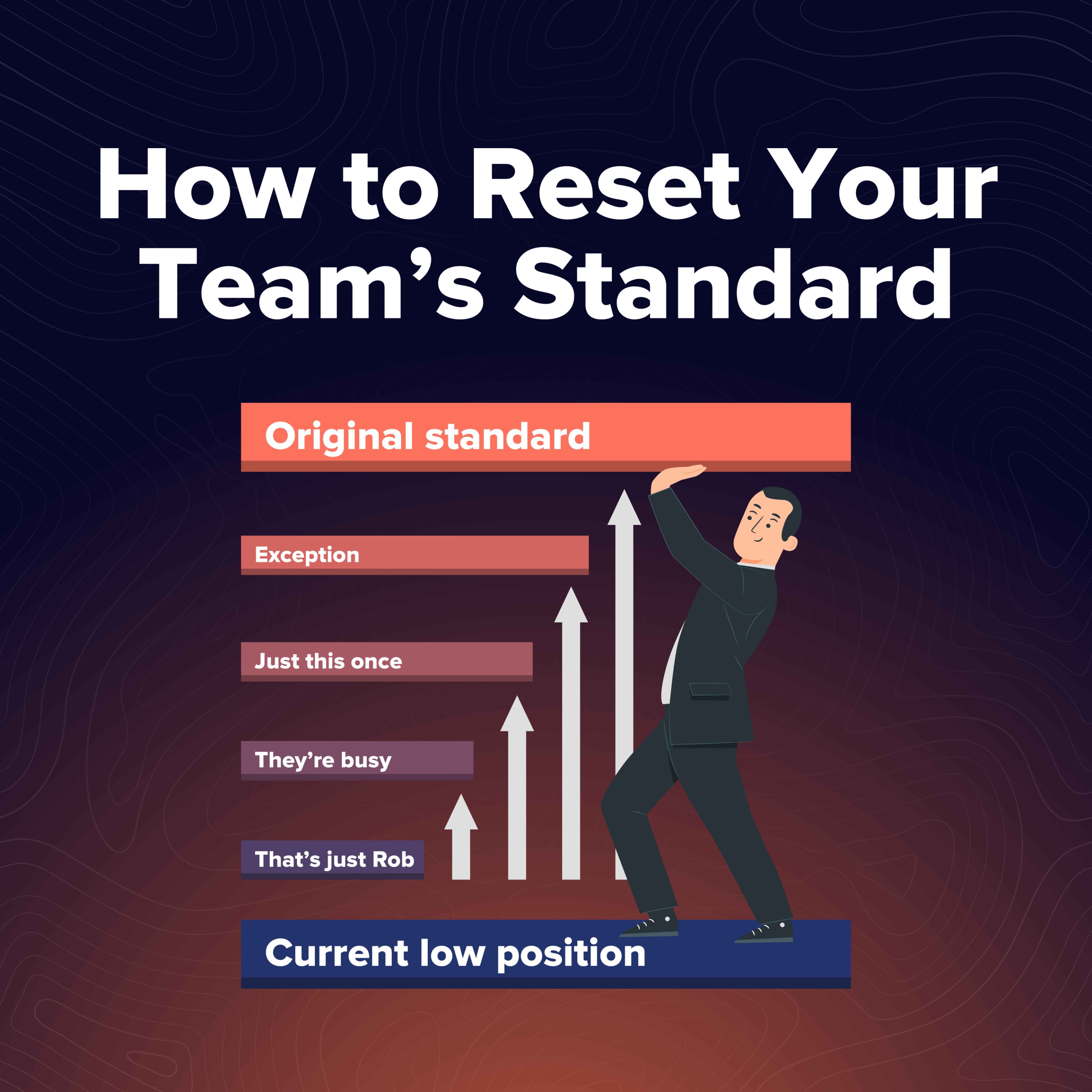
it's just taking longer than expected or that's just rob. Those phrases are red flags for drift. Number six, you got to watch the scoreboard because you know measures matter. If the numbers don't move the standard isn't being met. And finally you need to demonstrate that you're serious. If there are no consequences there is no standard. Sometimes you need to make a call and yes that includes an up or out mentality for the people who refuse to meet the bar. So look here's the punchline today. We have absolutely smashed a lot of information in the last 40 minutes. Resetting your standard is not an announcement. It's not an email. It's not a new set of rules. It is the daily discipline of not walking past what you said mattered. And the reason this matters so much in leadership drift is really simple because the moment you drift the bar doesn't stay where it was. It drops every single time. So before we wrap today I just want to tell you about tomorrow because this is where everything that we've covered today either works or falls apart. Today you've learned how to identify leadership drift and how to reset your tone, pace and standard. But here's what happens next. You reset the standard. You communicate it clearly and then oh yeah someone doesn't meet it. So maybe they miss a deadline. Maybe they deliver some power work. Maybe they push back and they tell you how the new expectations are unreasonable. And in that moment you have a choice. You can let it slide. You can tell yourself that they're still adjusting. Give them more time and avoid the uncomfortable conversation. Or you can hold them accountable. And here's what most leaders don't realize. Your ability to hold people accountable is the single biggest predictor of whether you're promotable. And this is why we have a whole module in leadership on the theory all about accountability. It's not about her nice you are. It's not about how hard you work and it's not even about how smart you are. It's whether you can drive performance through your people. Because as Marty always says, leadership drives culture and culture drives performance. And if you can't create a culture of accountability you will never lead at a higher level. So tomorrow we're going to show you exactly how to build that culture of accountability without becoming a micromanager or destroying trust. It's called reset your accountability tomorrow. And I am telling you right now that if you only show up to one session this week, make it tomorrow. Because accountability is where leadership gets real. Marty, thank you so much for your time this morning. I will see you the same place, same time tomorrow. And thank you so much everyone for coming along, getting involved. And we went a little bit over time. But I think you'll agree it was probably very worth it. And hopefully we see you all tomorrow. All right, so that brings us to the end of episode 389. I really hope you enjoyed it. But as I'm sure you know, listening is easy. Leading is hard. That's why we created leadership beyond the theory. Our flagship program that turns inside into action and action into results. This is where we unlock the secrets of elite leadership performance and give you the tools you need to keep your team on the track to high performance. I'm looking forward to next week's episode. What does senior leadership teams actually do? Until then, I know you'll take every opportunity you can to be a no bullshit leader.
Podcast Summary
Key Points:
Summary:
Chat with AI
Loading...
Pro features
Go deeper with this episode
Unlock creator-grade tools that turn any transcript into show notes and subtitle files.
 PodcastTranscript AI