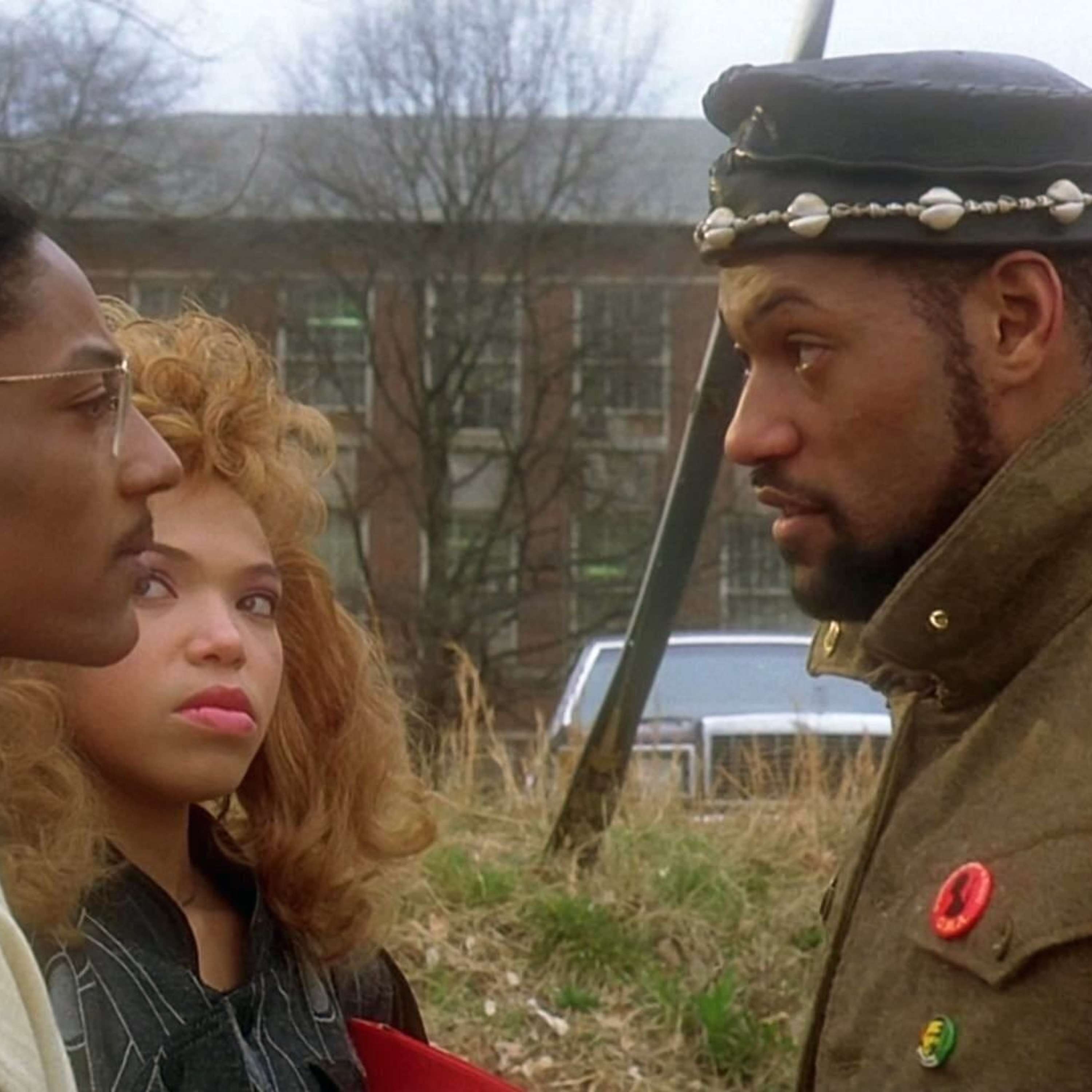
The analysis argues that Spike Lee's "School Daze" is a critical interrogation of Black masculine identity formation, positing it as inextricable from misogyny. The film's opening, highlighting Black historical struggle, sets a stark contrast to the depicted campus life, framing viewer engagement through ethical disappointment. The central conflict explores how masculinity is performed and asserted through the subjugation and objectification of women, most brutally in a fraternity-sanctioned sexual assault. This act triggers the film's iconic "Wake up!" cry, serving as a moral alarm against this pervasive dynamic. The film deliberately complicates identification by revealing that even the politically conscious protagonist, Dap, bases his identity on using women for credibility, undermining any simple moral anchor. Instead of offering solutions, Lee employs an interrogative mode. A key Stevie Wonder musical performance asks if authentic selfhood ("I Can Only Be Me") is possible within these toxic dynamics. The concluding, intensely intimate standoff between two male rivals suggests that exploring non-exploitative male intimacy may be the necessary, unanswered question for envisioning a masculinity divorced from the hatred of women.
In my previous piece on school days, I was interested in setting up the conditions of the film, that is, the kind of ethical and political, even memorial imperatives that guide us or should guide us as viewers in the film. That long reflection that Spike Lee starts the film with, long reflection on black resistance, black excellence, black beauty, and black possibility. And it sets for me two things in motion as we view the film. One is the inevitable kind of cynical disappointment, like how could this place have devolved into what we're watching, given the context Spike Lee has just set for us. But also something like the imperative or the ethics and politics and morality behind the final scene and the phrase that occurs across Spike Lee films wake up. Because wake up is not just a call, right, an ambiguous call or a rooted call. It's something that's animated by moral force. And that moral force is really in the opening credits. Everything from the middle passage up through the civil rights movement. So when we arrive to the body of the film school days, we're in a position to really be disappointed, I think, disappointed in a parental kind of way and an older observer kind of way to be disappointed at the kinds of values that are being embodied, debated, fought over, literally and figuratively across the film, to ask really about mission college, what is the relationship of what's happening at this college to a sense of mission. I think there are lots of ways to get at the core meaning of the film and what this notion of wake up means. There is, of course, extensive treatment of a student and administrative conflict of the local politics and values of fraternity and sorority life versus political activism, especially related to South Africa and Voking in a vague way, but not in significant way, a transatlantic sense of solidarity and black meaning. But for me, what I want to talk about here is not so much those pieces of the film, I do think there's so much more to be talked about with Lee and school days. But what I'm especially interested in in school days, because I think this is a theme threaded across his entire work, but especially these early films up through Get On The Bus. So really like a eight to ten year period. This is the question of the formation of black masculine identity. Now there are, of course, also questions of the way the women in the film negotiate between each other, similar sorts of meaning around womanhood or femininity or however one would want to put it. But I think Spike Lee's real depth across the film is his exploration of a notion of masculinity. A conflict that structures the film is between Lawrence Fishburn's character DAP and Giancarlo Esposito's character, fraternity, head, Big Brother Almighty. And in that conflict, we see, of course, what I had just said, a conflict between, you know, local sort of clubby values around fraternities and a transnational vision of blackness and solidarity and politics in DAP. But for me, that's a conflict that staged less as the ultimate story of the film in very much more as a way of saying, look, there are two visions of the kinds of values students have at this college, male students have at this college. But what's unique, what unite to cross those values is the sense of the formation of their own masculinity. In its starkest form, of course, the, you know, I would say the peak scene, what really triggers DAP to burst out of his room and meet Big Brother Almighty in the quad, you know, face each other and say wake up is when Spike Lee's character, half-pimed, sexually assaults Tisha Campbell's character. And that assault is not an assault just as a random act, but rather a staged and manipulated act that's a part of the fraternity system, part of the fraternity system that is signaled early on in the film when the fraternity asks their sorority sister group to clean their house to get it ready for a party. And while the women object and make faces about it and feel some kind of way about it, what that scene is less about the reactions and less about the demand and more about the dynamics that that sets in motion and understands then to be the conditions under which Giancarlo Esposito's character would basically understand his own girlfriend, who's also the head of her sorority, understand his girlfriend to be a piece of property that he can then buy and sell and trade for whatever he wants. In this case, for Spike Lee's character, half-pimed formation of masculinity, for his realization of what we might call in quote marks or maybe without quote marks, his manhood. In that scene, which has grew some minute for me calls for content warning for my students, that's not explicit, but the conditions under which it happens, the way the men cheer and laugh at the humiliation of the sorority sister and the way they praise and tease their fraternity brother is for me more explicit and more grotesque and more traumatizing than where they to mimic in some way or stage in some way the assault itself. That sense then in which it's not simply that Spike Lee's character in having sex in a forcible way with a woman comes to his own sense of masculinity, but the way his masculinity is formed in a group of men, a group of men who buy and sell in this case women in order to be men and in order to assign to others their sense of masculinity. But that hyperbolic, hyperbolic in the sense that it's an emotional element of the film that so exceeds other emotions in the film I would say, that hyperbolic, intense scene is not alone, it doesn't stand alone, it's part of a wider arc that then I think we can look backward across the film and see. There's a scene where Dappin and his friends are driving back from going off campus to eat chicken and all they can banter about is women and at one point the driver of the car I believe says, you know, you guys are just so obsessed with women, sleeping with women, don't you have any other interests and the derision they lay on him for that is played for humor, but I think it's only played for humor to draw us in as viewers, like did we laugh at that and what does it mean to look back at that as a kind of sublimated version of what Half-Pine does, right, a sense in which the half-pine and his fraternity brothers do, which is to define their own masculinity to one another through the use of women's bodies and the use of women as sexual objects, as vessels for their own self-actualization, which is so deeply tied to misogyny that we can't even separate their own masculine assertion from their violence against women. We can also see this in Dapp, who I know that he in some ways has been read and talked about in my students often identify him as the moral center of the film, and I really push back against that, and I push back against that, not in, you know, his, you know, interests in South Africa rather than local issues, right, which absolutely comes out in that scene where they're at the fast food place, and they run across some African-American folks from the community, other men, they have, you know, almost come to blows in the parking lot, and it has its own dynamic to it, which I think is really interesting, right, where, you know, DApps sort of makes a statement against the N-word, like none of us are that. When Samuel Jackson's character says, really memorably for me, you know, it doesn't matter how educated you are, you are just like us, and we're, right? And so I think at that moment we're led to believe, as in other scenes, that DApp is the sort of moral center as a character of the film, but I actually don't think that's true. I think we get diverted when we see DApp as that touchstone for the film, because every Spike Lee film has a moral anchor, and discerning that moral anchor I think is part of the puzzle of watching his films, but we have to remember this scene, and I play it for the students, and when DApp is laying in bed with his girlfriend, and she says this thing, it's very quick, but it is so almost overly articulated that I think we have to understand it to be the center of the film, to be, you know, among the centers, if not the center of the film. When she says, you know, DApps, sometimes I think you only love me because I'm dark skin, and that gives you credibility for your politics. Now we know from the film that DApps own assertion of his manhood, of his masculinity, in the presence of other men, is around his politics, that it's his righteousness that makes him a man. And so there's this interesting moment where she highlights for us, and maybe just brings out into the open something we hadn't noticed, but Spike Lee wanted us to notice, because it's absolutely staged this way, that he too is participating in this idea that one only builds a sense of masculinity on the backs of women, right, and I mean on the backs in terms of violence, right, of shoving down, of subjugating, of degrading, of objectifying. And so Spike Lee's film is, for me, a long meditation on the formation of masculinity, as inseparable from misogyny. I think we can also rethink some of the critical appropriations of the film, or critical commentaries on the film. I'm thinking in the Spike Lee reader that Paul and Masoud put together, there's a few pieces in there by feminist critics who say that the film is deeply misogynistic. And I think that absolutely, there are a number of scenes that are misogynist, obviously the scene where Half Plank commits sexual assault, and the men cheer it, is absolutely misogynist. But my question is, are there scenes that are saturated with misogyny? But why would Spike Lee make scenes so deeply misogynist? Is it that Spike Lee is making a normative claim about the sort of role of women, as objects to be sort of traded for masculine bonding and self-realization? Is it that he simply rebels in that, finds it humorous, finds it acceptable? Or is this a critical moment where he's trying to make men look at themselves and say, how would you define your masculinity? How do you understand yourself as a man? Is it always in relation to the subjugation and hatred of women? I think it's the latter, and I think this is born out both in the composition of the film. The fact that the way that the sexual assault scene leads immediately to wake up, it leads immediately to that moment of, we are asleep, we're in a nightmare, and we need to wake up from it. What is that nightmare? It's triggered by that sexual assault, and it's blatant misogynist. I mean, DAP is so enraged by it, right, that he doesn't want anything to do with his own cousin, and that's some kind of statement to make. But I also think that that scene requires us to review the whole film, and to ask about all these moments where masculine identity is asserted in moments of abjectification and subjugation of women, and so the wake up, I think is also for us as viewers, if we watched it, and didn't notice, or simply found humor or observation in this treatment of women, and that what we need to wake up from is this idea that, not this idea, this fact of living in a world where masculinity is only understood in relation to the subjugation of women, that it is masculinity in that way, is inseparable from misogyny. There's something really important also about the wake up scene, I think it's most famous for just the shouting wake up over and over, right, and you can say wake up and people will always think of school days. It does recur in a number of other Spike Lee films, but it's really the school day's moment. But as the women are coming out filmed, coming out in this sort of three quarters slow motion, coming out of their dormitory, this is really important backdrop to it. It's not even a backdrop, but it's a detail that one has to notice, that the name of the hall they're leaving is Sojourner Truth Hall. And so for me, there's this interesting idea that Spike Lee is playing with, a proposition he's giving us that is extremely distressing, which is that, this is my reading of the film, is that this relationship between masculinity and misogyny is a form of slavery, right? It's a way in which subjugation of women is not simply to be understood as just treating women poorly, but he ups the stakes when the women leave Sojourner Truth Hall, right? That there's a question of where is the underground railroad? Where is the emancipation path? Where's the path of freedom from this dynamic? And for me, part of that is the interrogative moment of Spike Lee's films. He's always leaving us to ask and is himself always asking a question and leaving us with the question. And that's why his films for me are interesting to talk about, because he proposes a series of questions, and in the case of school days, poses that question in extremely distressing and unnerving and enraging terms, and then asks us to ask questions, right? What is that path out? Because the stakes have been set really high that is now associated with emancipation from a certain form of slavery. And then I look to the film and I say, not what is the out, what is the solution, but where is the moral anchor of the film? Because DAP is not the moral anchor, right? That moment when his girlfriend says, you only love me because I'm dark skinned and that gives you political credibility. That's our moment to say DAP can't be the hero, why not? Because DAP, very much like Big Brother Almighty and Half Pine, is forming his masculinity on the objectification and subjugation of women. There are simply tools to realize his own masculinity. So if DAP is not that center, and I don't think, and this could be a critique of the film, right? In terms of alternative narratives, we may think we're better or may wish Spike Lee had taken. He does not create a woman in the film who could then be that. Now that would be an inch, I think that's a really interesting criticism, and it's when I teach this, I often have extended discussions like, what if he had a different kind of woman in the film? Right? A third character who's not the sorority girl or the non sorority girl, right? That conflict right around hair, around color and so forth, what if he had a third kind of woman as a moral anchor? Well that's interesting, but that's not the way the film unfolds, and so it's a hypothetical. The film is what it is, and so where is the moral anchor in the film? Well, and this is something I'll mention over and over again across these voice note podcast pieces, is that you have to look to the music, and you have to look always if he has a Stevie Wonder song, it's going to be the Stevie Wonder song. And there is a Stevie Wonder song in this film at the talent show, where a character who we don't see elsewhere, and it's a song and a performance that has no place in the wider arc of the film, where he sings, he sings, the character sings as part of the talent show, I can only be me. And this Stevie Wonder song, and it's a beautiful rendition of it, I have to say, I think it's exceptionally well performed and super compelling for that reason, just aesthetically it's nice to listen to, and the performance is staged really simply but really powerfully, but it goes beyond that. And I think that, I think Stevie Wonder is always the anchor, the moral anchor of Spike Lee's films, and maybe of his own thinking and life. But this idea in the film, right, of, you know, it's just the refrain, you can only be you as I can only be me. And I think that part of where we have to go with an assessment of where the film resolves itself, ethically, morally and politically, is not in a big vision of this is blackness, this is masculinity, this is femininity, this is whatever class, this is color, this is hair, it's never going to come with those imperatives, but it comes, I think, instead, again, to the interrogative, or the question of the interrogative, to this question, how do these dynamics around the formation of masculinity make it impossible for a man to be himself, for a woman to be herself, and absolutely the gender binary is all he's working with. So that's why I'm staying there. That you can only be you, I can only be me is this moment of, for me, it's in the middle of the film. But if it was at the end of the film, it would in some ways sort of logistically be better placed because then it would tell you, go back and watch everything about this film and ask, is anybody ever able to be themselves, or is there something fundamental here that's blocking the notion that you can be you and that I can be me? The formation of an identity that is truly tied to something essential about who and what we are as individuals, but also in the case because it's school days, it's in HBCU, it's a spiky film about being black, right? Is there a way to just be yourself as a black person in the dynamics of the film sets out? And the answer is obviously an emphatically no. And when it's the answer is no, and it's a film about masculinity, I think that it suggests the opposite of what many critics have said about the film in saying that it's a misogynist film or that it has sexist depictions in it, right? And I think the depictions are often sexist, often have misogynist kind of undertones to it. And I think it's intentionally there to get us to this question. You cannot be you as a man if being you means doing this to a woman, objectifying, subjugating, manipulating, and using in order to create your own identity, that's not being you. That's being a misogynist, right? That's being a model of masculinity that is not only cruel to women, but alienating to self. And so there's this really interesting moment, and this is the last comment I'll make. This really interesting moment at the very, very end of the film where Fishburn and Esposito face each other. And the students always catch it, but they're often afraid to say it, so I say it. And it looks like they're going to kiss. Spike Lee does everything deliberately, but they look like they're going to kiss. And there's an erotic kind of encounter there that for me is really important, not because Spike Lee is trying to say something about same-sex love or eroticism between men. But rather that, you know, what's missing here in the film, and you know, for him, I think thinking about masculinity broadly, is there an intimate relationship between men? How do men relate intimately? And you see Fishburn and Esposito come up to the cliff, up to the precipice of that kind of physical intimacy. And they look at each other so longingly. It's a beautiful scene. I absolutely love it. It's one of my favorite moments in a Spike Lee film, the way they look so longingly at each other. It's fantastic acting and staging. But in that moment for me, I think Spike Lee is suggesting that if we want to actually begin to answer the question, what is masculinity without misogyny? It has to start with intimacy between men. What is that intimacy between men? What does intimacy between men look like? We don't really get that until get on the bus. Get on the bus is an hour forty-five something minutes of intimacy between men. And it may have flaws, it may have shortcomings, but it's the beginning of exactly what he promises at the end of school days, which is to ask the question, what is masculinity without misogyny? Well we can't even begin to ask that question without asking the question of what is intimacy between men without women. What is that intimacy of man to man and men to themselves as men? Right? So it's not just Esposito and Fishburn, it's two distinct subjects in the world, but also the way men talk to themselves about their own identities. And in the end, I think what that's after, whether you like it or not, whether it's conservative or radical, I don't really care. But is this idea of being you? Like what does it mean to be me? What does it mean for you to be you? That requires an intimacy of self-to-self. And if you watch that scene, it's beautiful song, beautiful performance of it, but it is absolutely isolating of the singer. And when it isolates the singer, we get a sense of feeling, a feeling of what that intimacy looks like between self and self. And then the film concludes with the intimacy between men, the kinds of conversations that think about masculinity outside the boundaries and outside the work of misogyny. And in that moment, I think Spike Lee's film becomes not only a radical film that upsets all notions of masculinity, but one that has very real promise and opens up a very real horizon that other films explore successfully and unsuccessfully for sure, but explores how do men form their masculinity without misogyny? How do they form intimacy of self-to-self as a man, and how do they form intimacy between men in order to think identity without misogyny? (gentle music)
Podcast Summary
Key Points:
Spike Lee's film "School Daze" uses its opening credits to establish a historical context of Black resistance and excellence, creating a deliberate contrast with the film's events to provoke viewer disappointment and critical reflection.
The core thematic exploration is the formation of Black masculine identity, arguing it is fundamentally and inseparably linked to the misogynistic subjugation and objectification of women, as depicted in key conflicts and scenes.
The famous "Wake up!" call is a moral imperative, triggered by a graphic sexual assault, urging characters and viewers to recognize the nightmare of a masculinity built on violence against women.
The film complicates easy moral readings by showing that even the seemingly political protagonist, Dap, defines his masculinity through the instrumental use of women, challenging viewers to find a clear ethical center.
The resolution is interrogative, not prescriptive. A pivotal Stevie Wonder performance of "I Can Only Be Me" poses the central question: can one be their authentic self within these oppressive gender dynamics? The final, intimate face-off between male characters suggests the path forward may require redefining male intimacy without misogyny.
Summary:
The analysis argues that Spike Lee's "School Daze" is a critical interrogation of Black masculine identity formation, positing it as inextricable from misogyny. The film's opening, highlighting Black historical struggle, sets a stark contrast to the depicted campus life, framing viewer engagement through ethical disappointment. The central conflict explores how masculinity is performed and asserted through the subjugation and objectification of women, most brutally in a fraternity-sanctioned sexual assault.
" cry, serving as a moral alarm against this pervasive dynamic. The film deliberately complicates identification by revealing that even the politically conscious protagonist, Dap, bases his identity on using women for credibility, undermining any simple moral anchor. Instead of offering solutions, Lee employs an interrogative mode.
A key Stevie Wonder musical performance asks if authentic selfhood ("I Can Only Be Me") is possible within these toxic dynamics. The concluding, intensely intimate standoff between two male rivals suggests that exploring non-exploitative male intimacy may be the necessary, unanswered question for envisioning a masculinity divorced from the hatred of women.
FAQs
The film is a meditation on the formation of black masculine identity, exploring how it is often inseparable from misogyny and the subjugation of women.
'Wake up' serves as a moral call to action, urging characters and viewers to recognize and reject the nightmare of a world where masculinity is defined through the oppression of women.
It acts as a critical trigger that exposes the misogynistic foundations of fraternity culture and directly leads to the climactic 'wake up' confrontation, forcing a reckoning with these dynamics.
Despite his political activism, Dap also builds his masculinity on the objectification of women, as highlighted when his girlfriend questions if he loves her only for her dark skin and the political credibility it provides him.
The song serves as the film's moral anchor, posing a central question: can anyone truly be themselves in an environment where identity, especially masculinity, is built on subjugating others?
By having the women exit Sojourner Truth Hall after the assault, Lee metaphorically links the subjugation of women to slavery, raising the stakes and asking where the path to emancipation from this dynamic lies.
Chat with AI
Loading...
Pro features
Go deeper with this episode
Unlock creator-grade tools that turn any transcript into show notes and subtitle files.
 PodcastTranscript AI