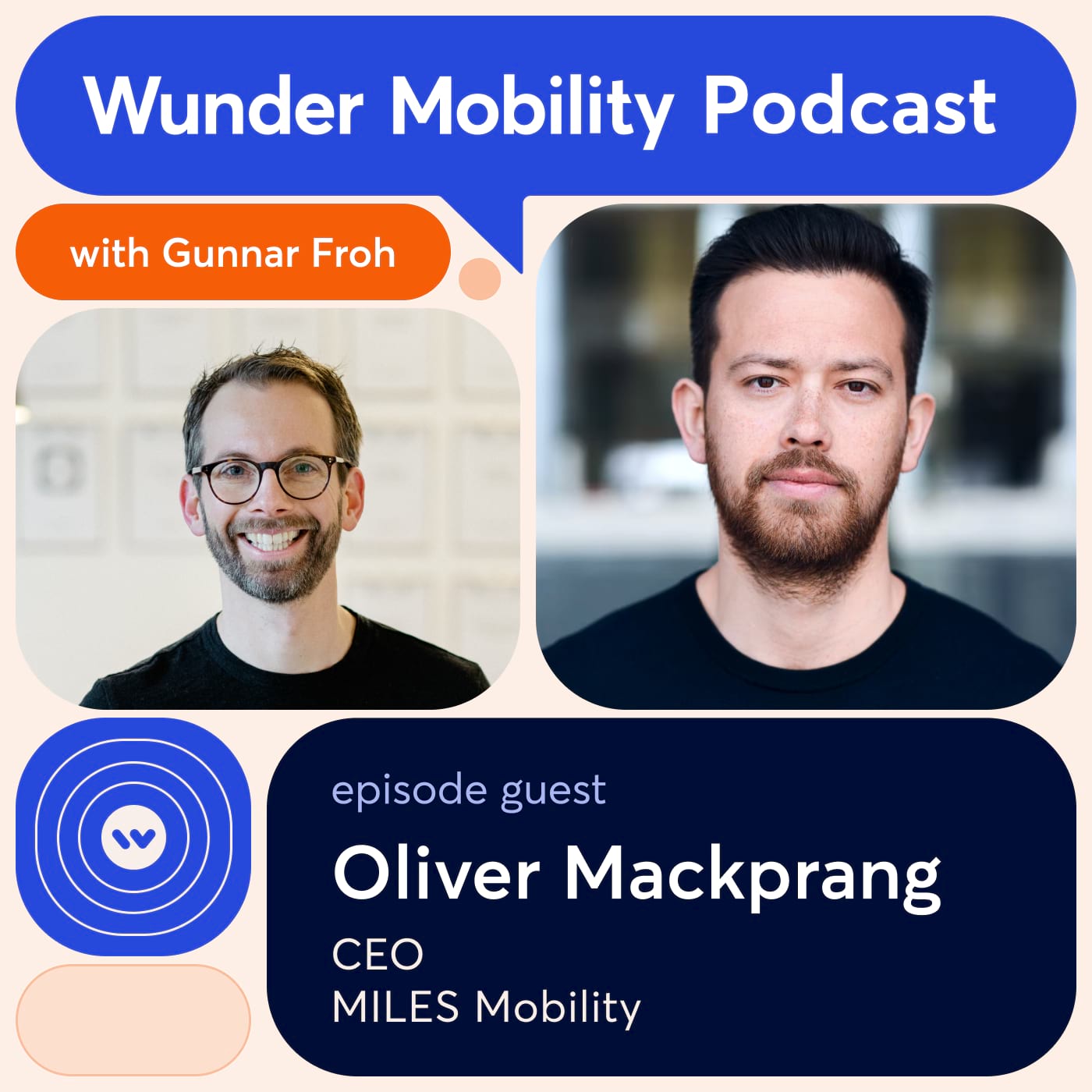
In this podcast interview, Oliver Macprung, CEO of Miles, discusses the company's position as Europe's largest free-floating car-sharing service. He highlights current priorities, including scaling the business, enhancing customer offerings, and addressing geopolitical concerns impacting technology and supply chains. Macprung attributes Miles' success to a seven-year journey of continuous iteration, focusing on operational improvements, fleet management, and pricing strategies. Despite a visible presence in German cities, he notes the market potential remains vast, with Miles serving only a fraction of private car owners. The company has evolved significantly since 2019, increasing operational complexity, integrating advanced technologies, and electrifying its fleet to improve efficiency. Key innovations involve expanding use cases—such as subscriptions and commercial vehicle rentals—to better compete with private car ownership. While airport usage is minor in revenue, it's crucial for customer experience. Macprung observes that although car-sharing, rentals, and subscriptions are converging for users, regulatory and financial distinctions persist. He also emphasizes the importance of fraud prevention and damage control, learned from past challenges like those in Belgium, underscoring the unique operational demands of the car-sharing model.
Hi, my name is Gunner Frohn. I'm your host on the Wundermobility podcast. Alright, welcome back to the Wundermobility podcast. Today I'm super happy to be here with Oliver Macprung, the CEO of Miles Hi Oliver. Hi, Gunner, thanks for having me. You are running Europe's largest free-floating car sharing feed and maybe before we go into a bunch of history and the details, tell us what's most on your mind right now, what's taking most of your brain time as CEO of Miles at the moment. I think that at the moment, obviously as CEO of a growth focused company, it has a lot to do with kind of scaling the business, looking forward towards the opportunities, how to improve the proposition towards our customers, but I think what you're asking is like what's out of the ordinary and I think ironically I would say like a lot of the geopolitical issues at the current stage. So, something, you know, where is your tech stack run? Yes, AI to some extent, but just generally like your tech landscape, your, where does it run? Also supply chain to some extent. I mean, we have a lot of European brands in our fleet, but you know, we've always looked towards expanding that. I think at the moment, the honest answer is a lot of geopolitical issues are, are maybe at the forefront, what would not have typically been the case in the past years. We're recording this in English because many of our listeners are maybe not speaking German presumably. If you are a German living in Germany in a city, might as well, you really ubiquitous, you have kind of enormous market share in car sharing at the airports, Hamburg, Munich, Berlin, like rows and rows of cars in the city streets everywhere. How did you get to this seemingly dominant position or do you have a dominant position in your space right now? So, I think that it's been kind of a long, long track record of trying to do, you know, two decisions or do two things correctly and only make one mistake out of three. I mean, it's been like a huge learning process and iterating at a very, very intense speed over the time. You know, there was a time when we were focused very, very heavily on day-to-day operations. I mean, with the interaction, with the physical asset, there was a stage where a lot of our focus was on fleet financing, there was a stage where a lot of the focus was on certain aspects of the pricing. I mean, all of this obviously happens hand in hand. It's not like, you know, one year you only do ops and one year you only do customer pricing, but at the end of the day, it's been a long road of iteration and ensuring that you kind of make more correct decisions than you make mistakes. And if you do make the mistakes to allow them, but to correct them quickly as well. So, it's been really, you know, I've been here for seven years almost. It's been seven years of continuous iteration. And I think that that's kind of allowed us to think outside the box, you know, sometimes, but also in other times to leave things alone that are working. Describing this journey as a long road of iteration where you are allowing for mistakes, you always want to correct quickly, but I want to go back to the sort of assumption behind the question, the dominance in the space, it can feel like if you are basically curious about cashing looking around on the road and cars everywhere, but how do you even define your space or your industry? And do you feel like you've hit almost a certain maturity where there's not much room to grow in these existing cities? Or how do you define your market? Yeah, so I think that it's always the question of what's the perspective you allow, right? So, I mean, if you would take a city like Berlin, for example, we have a couple thousand vehicles on the road here in Berlin. However, there are over 1.2 million privately owned cars. So, you know, we don't even have 1% of that market share, you know, yet you described our position as a dominant. So, if I just move the needle of comparison, it's all of a sudden, we are irrelevant. There's so much room for growth. However, on the other hand, we know that over 25% of the population in Berlin use us every year. So, you have a quarter of the population using us. So, depending on which metric you choose, at times you are the dominant player and at times, you know, you have a blue ocean to still grow into. And I think that depending on what part of our business we look at, it needs to take an honest reflection of, you know, how much improvement is there, how much growth potential is there, and how much of it is actually more saturated in terms of both operative performance, but also, yeah, potential to grow. So, I think that's, you know, yeah, we tend to take a sober look at these different things. You mentioned you've been in this world for seven years, so about 2018. >>19. >>19. >>19. So, in 19, you joined. And to an outsider, it can feel like cashing is very much the same as it was 2019. We had an app, you can see a car on the map and so on, but what has changed since then, from your perspective, knowing the details and behind the scenes, what were the most important changes to how you do your business today compared to how it was 2019? >>I think it's almost done like a 180 in terms of operational complexity. Yes, you know, the proposition is the same, like you open the phone, you choose a car and you drive off into the sunset, but I think that a lot of the things, especially I think this is what I think any industry can kind of relate to is how the sausage is made, that in the background the processes have, you know, developed really significantly. I mean, I can start from simply the vehicles. I mean, there's been like a huge jump. There's been also a bit of, you know, back and forth around the EV discussion, right? So, you know, how much do you electrify the fleet, how much do you do a lot for combustion still to be there, the size of the vehicle, the type of which you finance the vehicle, the type of OEM and the residual values that you take into account. So, this is just everything that I've just mentioned, maybe like a brief term to. It's just the type of asset you put on the road. Then the complexity increases towards the technology that you utilize, you know, to present the offering to the customer. There's a bunch of digital services that you can utilize and how you, you know, patch these together, be it, you know, CRM tools, pricing engines that you, that you can either build yourself or purchase on the market, fleet management, utilization, you know, there's a whole bunch of different things that, you know, you can take parallels from other industries like the airline industry and yield management all the way to proximity measurements. So, there's so much, you know, continuous aspects that you can look into it. Also, as you grow as a company, you know, marginal improvement becomes increasingly important, you know, if you have like 100 vehicles, you know, improving a decimal is not as relevant as if you're going to have, you know, 17,000, 20,000 vehicles and all of these decimals like our mind-blowing. There's been quite a significant amount of change all the way from, you know, the vehicles who put on the road, the way that which you offer it to the customers and of course, the internal processes that you have as well. What do you think is over this time to the most important innovation? Are you guys implemented? That's customer-facing. I think that clearly it's the, like, we want to replace private car ownership, right? And as we basically, you know, I would say 2008, 2010, like the beginning, I think, of free-float cautionary in Germany, what you were replacing was this like 15-minute trip, this 10-kilometer trip from A to B, but they offer is relatively straightforward. And I think as you kind of, there's so much additional benefits of a privately owned car. So it's not just like a short trip, maybe it's, you know, keeping the car for a couple of hours. Maybe it's doing a longer term rental, you know, driving on vacation with your family. Maybe, you know, it's driving to a different city. Maybe it's driving to the outskirts of the city. Maybe it's utilizing a larger car because you want to move some stuff. So, you know, a private car has a lot, a lot of benefit. And for us, I would say that the, you know, the biggest advancement that we've made is, is kind of being able to cover more of the use cases that are privately owned, a car could fulfill. I think that there's still a gap that we need to close, but we've matured quite significantly, you know, I think you can do a lot more with our offering today than you could six years ago. And how come because of the entity, because of that reliability that you almost always have a car there? I think that's like, for example, for me, in the day to day, the most, like a big difference, or because of your pricing packages or whatever, what makes it possible now to cover more use cases that were so attractive some years ago? What's the key difference? The irony is that it's all of it. It depends on the type of user you are, right? So, I think that to some extent, we've actually, I think, spoiled the customer, which we're happy to do. But at the same time, I think that, you know, the density aspect that has kind of reached the level of absurdity where it's like, unless it's like right in front of my door, I'm not willing to walk to the next corner. That's a bit absurd because you wouldn't find parking in front of the door either. You should be willing to walk like a block. Like once, like half a block was a reasonable. But at the same time, it really depends on who you are and what use case for fulfilling, right? So if you, and for the listeners, not aware of the cities we operate in, so if you're on the outskirts, but we had to go to the outskirts of the city or go to the suburbs and leave the proximity of this style.
of downtown of the city centers, only then were we even viable. So for some of our customers, it was simply us offering our service at your doorstep. So that changed. For other customers who maybe are self-employed or have family nearby cities, it was actually us changing the packages so that you could actually take the vehicle for a day or two or three or four or whatever. For other customers, it's about the LCBs that we offer. So the light commercial vehicles, the transporters, right? So for some customers, it's about like, I need this occasional large vehicle. And so the question is really, what is your specific use case? And depending on who you are and what your lifestyle is, you know, that I think has things that we've adapted, have a different significance. And last but definitely not least is also we have a subscription offering in terms of miles of a while. So maybe you have a family, you want to two kids and all of a sudden this aspect of, you know, having a dedicated car for a period of your life has reached a certain relevance. Yes, we have this offering now. So it really depends on your specific lifestyle, your unique situation. And I think all of the above have helped this gain foothold within our customer group. - It's really interesting here. Basically, how are you talking about like, covering additional use cases to gain more foothold in the existing customer group? And how unfortunately there's not the one silver bullet, but like these different dimensions. So you require certain density where the pricing has to make sense there for packages and then business area has to be large enough to catch other use cases and so on. And now you are finally it makes sense. I imagine for a lot of very recurring users who then end up in those also, we have different tiers of subscriptions in a way. If you're ready to pre-commit more, you will have some advantages. And can you talk a little bit about just like a little segue to the side one specific use case in like the related industry in rental, like classic classic station-based car rental. I'm a lot of the business especially the margin. I guess it's driven by airports. That's something everybody notices if you're touching a German airport now, like my sister with hundreds of cars. So of course your private companies, you don't wanna share numbers, but how big is the airport use case become for you? Is that also similar to car rental, a very important thing or not? - Not at all. So it's relevant definitely, but it's not like the rental companies. I mean, in some of the rental company, public filings will find like 70% of the revenues and other airports. It's nowhere near that for us, yeah. It's still single digit, still single digit revenue relevance. - I really. - But nonetheless, it's extremely relevant because even if it's just single digit, I think most of our users have that case at least once a year if they fly that they'll use it. So you need to have that top of mind. So it's not as relevant, I would say, from a revenue number, but definitely from an experience perspective. - You also mentioned the subscription and you launched that as an additional product within your tenure a few years ago, I think two, three years ago, right? And how important is this for you guys relative to your core or initial product, the free-floating cashing? Are you both a cashing and subscription company or do you not even consider them separately? How do others who are maybe also in the space have to imagine this, how you are thinking about these two different areas? - So it's definitely relevant to us and it's an area that we would like to significantly expand on in the future. We've had a lot of success with our approach so far. I think that we do things very differently from other subscription businesses. But what we see is that there's a clear demand from our customers for this product. And so, I mean, as I mentioned at the beginning, we wanna do two things right at least for every three decisions we take, right? And if you have customers basically asking for something proactively, it would be negligent of us to not offer it. And I think that this is one of the things that fit very well into our product portfolio and you've been able to build on it quite significantly. - In what sense, as far as you can share, would you do something differently in subscription business from pure play subscription companies by having vehicles travel between two fleets? Basically the core assumption or how is something different? - Yeah, I think that's like the obvious win is that, we have a fleet that's suitable for cashing and subscription, which to be fair, it's a huge benefit to us because we don't have this pressure to sell the vehicle, to match it to a customer as highly. But at the same time, we are not as I would say flexible in the diverse acquisition. So if someone came with a brand that you've never heard of and the vehicle was pink, do I really have a willingness to put that into my car sharing fleet? Probably not. So we would not acquire the vehicle at a high volume where it's a sell it in a subscription model. So there's benefits, but there's also limitations in there. So most of the vehicles you would acquire for subscription would have to also make sense in the cashing case. So these fleets can complement each other. - Yeah, it definitely makes sense just from a risk perspective. - I would like to talk on another side a little bit, the kind of blurry lines between car sharing and then you have bay packages and you have a subscription product and then the classic car rental and see, is it, does it still make sense to look at them separately and talk about them as separate players? Because you've sort of really grown tremendously in the cashing space and you mentioned all of my into 20,000 vehicles or so. Maybe it's a little bit even more by now, but like all and then and similarly for the subscription players, I think maybe like a fin has about 25,000 cars or so. But then the classic car rental companies 6 has 190,000 cars and 300,000 if you count the franchise. Partners, but I feel like from an end user perspective, like commercially, it's blurring a lot. Do you see these becoming one or do you feel like these businesses are run so differently? It's different industry. No, I think that there's a lot of overlap. There's a lot of overlap. However, there's also, at least speaking for Germany, there's a lot of regulatory separation and also the way in which the businesses are valued. So I think that the customer is more willing to put these, to mash these than I would say the back office and a bit likely is. So I mean, we already mix the car sharing and the rental quite significantly at miles. The subscription is still, I would say, from the experience, probably the most segregated product, but we would hope to merge it in the future. However, if I look at the way that we purchase the vehicles and the way that we finance the vehicles and the way that our partners and banks assess the model, also from an insurance perspective, from an included services perspective of fueling and roads at parking and all these type of things, there's still a very separate, both from a regulatory environment and also from a pure business backing perspective, if that makes sense. So a bank that gives us vehicles is very keen on understanding, are you putting these in caution or are you putting these in subscription? We obviously have partners that do both, but the question still arises, what exactly, what part of the business am I assuming risk to? Also, in terms of what the customer that we offer the vehicles to, it's also a bit different. So yes, it's mashing, but I would still say, from a regulatory perspective, there's different requirements and different ways that it's looked at. I would say it's probably similar to maybe chemical industry, there might be a certain thing that they produce, that they provide for medical or for things that are edible, and there's things that they provide the same content for something that's maybe enters a manufactured good. It's the same thing, but it's not the same thing. The way that they produce it, the way that they quality assurance and the way that risk is assessed, is different. So I think maybe that's very off the cuff comparison. OK, so you're saying it might look quite similar from an end user perspective, but the companies producing these, especially at scale, will have some different skills. It's not so easy to offer both necessarily. And that kind of leads us a little bit over to also a key challenges of car sharing, because I think it's interesting, so a sample size one, but you guys had an international expansion at some point, and then you retreated from Belgium to focus on the Germancy's because of, according to the press, there was a lot of trust and safety problems there, more of an realism, more other problems and so on. How important is this aspect in running car sharing, fraud prevention, damage detection, this whole, who do you let your service use, who are your customers? Is that also a key element of why you are now successful and some lessons learned from the Belgian experience? Absolutely. I mean, every operator will say this. I mean, it's relevant in the rental game, with a much more clear attribution. So I have at least in traditional rental space, you have a dedicated employee handing you the key, theoretically walking around the car with you, and then you as a customer return the car, and you're basically responsible for everything that happened in the meantime. Versus for us, they're roadside handovers. We are not there in person, the customer rented, and then there's a bunch of, mostly anonymous rentals that occurred before we see the vehicle again. And so there is a social responsibility, let's say, and simply the way that the vehicle is treated, and which we cannot attribute is simply baked into the price. So many damages, scratches, scuffs, and so on. It just becomes part of the communal cost. And so there is this aspect of probably the better that a society treats our product, the better we can know the better the service, the better the price that we could offer. And it's not only about damages, it's also some people, the cleanliness of the vehicle, all these things that happen when there's social use. So it plays a large role. Was there any kind of key insights or learnings from the last years in this domain that you think, oh, we should have started this earlier. Now we are seeing, we get better user behavior, or we see less damages than before. Yeah, absolutely. And I mean, this again goes back to this continuous iteration. I mean, there are, I'm not going to bash the different German cities, but--
There's German cities that treat our cars better. The country, this ratio is better in certain cities than it is in other cities. It's also about the vehicle, to be honest. So vehicles are also prone to different wear and tear. So different materials wear differently, tear differently. It also has to do with the cockpit configuration. So how much close spaces you want to add, glove compartments, it's everything. So can people forget things easily in the car? And also there's a bit of learning and you iterate consistently here. But cities you can't basically change unless you abandon them. Vehicle types you can. Of course, influence which one you're buying. But is there something that you were able to do in your product or in your user flow to reduce the-- You just need to take the time to do these things and also set up the learning in a way that, you know, it's not reinforcing your biases, but it's actually something that's actionable. So I'm certain that in the airline industry or in the public transport industry, there's a bunch of testing and experience around what type of fabric looks the best on the seats doesn't wear and tear bad. Like continuously looks good after eight years of 10,000 people sitting on it. And so the same applies to us. Like what's better? Leather, fake leather, fabric seats. Like everyone has an opinion, right? So over time, you've gotten much more opinionated, let's say, much more granular in what configuration you want. Yes, and also not only on the seating, but also on the interior of the car. So what configuration also has to do with the-- not only with the configuration of dirtiness and kindness and wear and tear and wear and use. But it also has to do with the tech stack of the car. So does the customer actually value a navigation system? Whereas everyone on their own anyway and have some navigation app anyways. So it also comes to these type of aspects, like how do you stack the vehicle extras? Would be nice to hear a bit about your experience with EVs, because you have a lot of EVs in the fleet. Much more than people think, I think. And what's kind of some of the drivers behind there what challenges did you encounter, but why are you-- how are you also leveraging this having a lot of EVs? So first of all, I think that that is your opinion because you live in Hamburg, where we have the strongest-- I almost always only drive EVs on my license, too. So yeah, Hamburg has our most prominent EV quota that we have nationwide. So which is great. I mean, the city incentivizes it. We use EVs because of that. So it's our ambition, definitely, to be on the forefront of drivetrain technology. And EV is-- it's here to stay. I don't think anyone's making that argument anymore. However, EVs been challenging from different perspectives. Again, going throughout the whole value chain, I think Germany has experienced like a lot of flip-flopping from a regulatory perspective around EVs. So subsidizes the position not subsidized. Yes, no, maybe. Spontaneous changes. Then there's also the aspect of where is it produced, who's manufacturing it? How does that kind of play a role? What's the different-- residual value of the different providers. So it's not only about the purchase price, but also how price stable are these assets over time. There's a lot of different things pushing it and these operational costs. And I think that's something that definitely we've become much smarter around is the operational cost of EVs. While traditionally, I remember like 2021, people were comparing the QLWAT hour cost to what fuel cost and saying, like, oh, EV is going to be so inexpensive. And now the cost of energy in Europe has just gone through the roof. So driving 100 kilometers on a combustion engine, driving 100 kilometers on an electric vehicle, you're not really saving on the production of electric on the cost of electricity versus the cost of fuel. On top of that, you have this aspect of the energy distribution. So where can you charge the vehicle at what cost, at what pace? Obviously, we're a transportation company. And of course, so uptime plays a large role. So if I have to-- if I have a baked in downtime of charging the vehicle, that's just completely different. But at the same time, they have less maintenance. I don't just want to bash. So electric vehicles have less maintenance issues than combustion engines have. So there are offsetting factors. But it's not like EVs are super for the margin. It's something that you need to learn operation. And there's operational complexity that comes with it. So I think that there's definitely a strong future for it, but baby steps. You don't want to bet the house on that. So it sounds like you believe EVs are the future, but at the same time, when you compare the cost of running and EV and car sharing versus the combustion car right now, EVs are still more expensive. I would say that car is quite well. I think that there's definitely a future. But for us, it's also about not making a big mistake on something like that. So we have a significant portion of our fleet being electric. And I think we will continue to do that. And it'll be expanded. But there's not this sweet spot of, yeah, this is it. Now you just like 10X it, 100X it. We haven't found that fleet composition yet, the right EV that can be levered that way. I think you talk often about the mandates that city put in different areas and they charging for parking. And it's quite different city by city, how much they're charging and so on. And in some cases, staying with the topics of EV, they have an opinion about that and trying to make arrangements with the players who are active about how much EVs will you bring. We would love that. And what can you get in return and so on? What's the model that you have seen over the years that you like that's successful? If you could choose, how would you like to see a city set themselves up towards a free-floating operator like you? I think that there are things where we have really good conversations around this aspect. And I mentioned at the beginning of this podcast, like who's our competitor and our competitor is the private car. So we would like to offer something that is as compelling and as reliable, as inexpensive, as comfortable as a private car. So that's our core competitor, the private car. So when you speak to a city, that's who we benchmark ourselves against. So when the city says, or if a city would, as I mentioned, we don't have yet, says we would like to compel you to have 100% electric vehicles. The question is, will are you compelling the private citizen to have 100% electric? Are you expelling combustion engines from the city center? Well, no, obviously they don't, because they would be voted out of office. Well, then I don't understand why would you burden the sustainable mobility approach higher than you would burden the private car. And this is the discussion that you need to have. So it needs to be an honest debate about these type of things. Right? For example, when they had the off-plane, right? So in Germany, you would get a state subsidy if you purchased an electric vehicle. The exception was corporate fleets. So the private citizen would receive a benefit, but the corporate fleet would not. And so they want us to electrify the corporate fleet. So the business fleet, yeah, but that's, again, they're incentivizing the private car ownership, which all cities could agree upon that they want to reduce private car ownership, but they're incentivizing it. And this is like a whole debate about local law, like state law versus, federal, it's, you know, oftentimes the city can't mandate something, or can't change something that's not on the federal level. But for me, the honest discussion about this is, okay, if you want us to do this, like these are the real constraints that we have. And it needs to be like an honest debate about what we can do and what the city or the local community can do. Can you name some top constraints? So basically if a city wanted you to be all electric in a few years, what would you ideally like to ask a family to turn? In Germany, taxes is actually on, right? Which also means like to, it was a shy on, yeah, which means like you're supposed to, you know, incentivize the, the correct thing. So if you were to ask us to electrify 100% of our fleet, I think we could argue and show what the added costs to our operational business would be. And not only that, but also that to which detriment or to which disincentive it would have towards the user. So if you had a 100% electric fleet, you also need to consider your questions from the beginning, which what drew up our use cases and every single aspect where someone would like a combustion engine would then be killed by definition, right? So if there's any use case you could come up with, where a combustion engine would be preferred, we could no longer be able to offer it with a 100% electric fleet. And this is an honest conversation that you need to have and saying, now you could go on to say, but that's not the problem of the city. That's your problem as an operator that, you know, that's fair. You can make that argument, but that's like where I push back and say, yeah, but why would you allow them to still have this privately owned, which is something that you're trying to deter? But the aspect that's beneficial to the city and sustainable for mobility overall, that's the one you're penalizing. So for me, it always has to do with, you know, what is the status quo? And the status quo is what applies to privately owned cars, whatever applies to privately owned cars, that's what I would like to apply to us. And if you burden us or the burden, the model with added, you know, social responsibility, then I think that it needs to somehow be baked into the operational complexity that you're adding to us. That's that's the best of our opinion here. Yeah, I think in some ways, the city is kind of designing a user experience of its citizens. And for me, for example, living in Hamburg, you mentioned, we are kind of lucky now to have so many evs from you, but the use experience of living in this city is much better.
because there is kind of mobility at a fingertip with a car almost always just down the block and then really reasonably priced. And you can, if it's not convenient by public transportation, you can go straight line wherever you need to go in the city really relatively cheaply. And I think having that availability is like basically not a public service but it's like a life quality aspect for people how they experience their city through the week. So I think they want that there, they want EVs sharing EVs available on almost every corner, every other corner, I think should be an objective. And then what does it take as part of the overall mobility strategy? But that's also leading me towards the end to like another related topic, future topic that I think you've also already at least thought about teleoperations and autonomous vehicles. I mean, in the end of the day, as an end user, I would like to have a car at the end of the block. I mean, it's not necessary for you to park one there. You might just be able to get one there in the future quickly. So do you think that's like how many years down the road when realistically could car-sharing cars be relocated with teleoperations? Is that something you need to worry about now already or you let somebody else make the first mistakes and then go and learn from them? - Yeah, I mean, sure. I was there, I think in most cases, prefer to be like a fast follower than necessarily the first one through the gate with exceptions, I think there's aspects where you need to lead. I mean, I have maybe an unpopular opinion on this topic. So I think that teleoperations is just a middle step. Like the end game is fully autonomous vehicles. So how much of your core business do you want to add the complexity of teleoperations when you know in a couple of years later that you're gonna have fully autonomous vehicles? So I think most of us would be well advised to prepare for autonomous driving. Now, if you believe autonomous driving is 50 years away, then perhaps teleoperating is a viable step in between. I think that for car sharing, at the moment the unit economic stone makes sense. You have this aspect of retrofitting the vehicle as no one delivers the vehicle teleoperating ready. And what are you really saving? I think that there's a whole bunch of aspects that I could get into what the complexity is and why it doesn't benefit our business and the kind of the user hand over and all these like, you know, needy details that kind of make it difficult. Maybe I think a bottom line is this. If it were viable at the moment, I think ride hallers would be the ones who apply it. If you can do this safely, I don't understand why there's not like all the uber and bolts and whatever, like they would just make this vehicle teleoperated. The most expensive aspect of ride hailing is the person in the front left seat, the driver. So if you can break down that cost from the minimum way that you have a Germany to the minimum wage of some other country with decent internet connection, that's what you could leverage, right? And you could do this, you know, for the whole value chain, because for car sharing, it's what you just mentioned, it's only the relocation. So it's the part of the value chain that would be beneficial through teleoperating would be the car that you want is currently one kilometer away. You're not willing to walk around a kilometer so I have someone teleoperated to within walking distance to you. You could then make it an upsell and offer to drive the person as well, it could be up to them based on how much they want to spend. - Yes, but if it was that case already, I think all of the taxis and ride hailers would already be teleoperated. And something stopping them from doing this and their whole value chain is based on this. But if they can't do it at, you know, cost, I think it doesn't make sense for us especially. And there's a whole bunch of other areas of application, you know, there's platooning for the transportation of commercial goods you could do this if we out of on or over the highways and just have the last mile to the factories be operated via tele-driver, to teleoperated driver. So if all these businesses, you know, that have a much more much higher pressure on the cost of the driver, if they can't and aren't investing heavily in it, I have a whole bunch of reservations behind it and I don't want to like, you know, I'm sure that there's a lot of businesses that have built their, you know, the braced funds and so on and so on. And so I don't want to like bash on them. But it's my current view is I don't think that it has a medium term future with car sharing. - And you said it's not so impactful, maybe better way until AVs are available, like full AVs. Although in reality, I think AVs are also often teleoperated, right, they have way more has big car centers in the Philippines and so on and every few minutes somebody takes over for a moment. But that's probably few more years away until they are at a certain scale or is it? So what's your timeline for AVs to be on the road that it impacts your business in Germany? - I mean, there's a couple hundred thousand trips being done a month, right? So I think we just need to look at the United States and how far they are when you're saying it's correct. So I think I really hope that, you know, before the end of this, you know, before the end of the 2020s, we'll see like more at scale operations here in Europe. I think Europe, the bottleneck, as always, is regulation. I definitely think that there will be a large commercial test by the end of this 10 year cycle. - What do you see Myles' role in that in the future in a few years? - So I think that we have, you know, a different, there's different aspects that we would aspire to. I think one of the operator clearly, I mean, no one operates the amount of vehicle that we operate in the city. I think, you know, besides public transport, they operate buses and larger vehicles if you need passenger cars, we're clearly the largest operator in the cities that we're in in Berlin and so on. So if you consider this fleet being autonomous, we can deliver an SLA that no one else can deliver. So if you have like, you know, 10,000 robot axes in Berlin that at the beginning know, we'll have issues, we'll have maintenance, we can be there at time. We can deliver that because we simply do it for our current fleet at a very, very high level. Then there's this aspect of historic demand, user base, 25% of the people in the city already use us. We have a lot of data around demand, hotspots, projected areas drop off. So that I think is one word goes hand in hand. And lastly, I think this is where you kind of need to melt it, is when it becomes like a transitionary period. So let's imagine that within a certain district of the city got full autonomous vehicles. At the beginning, it'll be like a very condensed, very well mapped area of the city. So you have a service that kind of is autonomous within like a constrained hexagram or within a constrained part of the city. So you want to offer a service that's only kind of offers A to B ride within the city or do you want to offer a service that's kind of a hybrid model. And you can drive yourself beyond this or not. I think that that's like, especially over the beginning on the starting years where we can offer like a very, very impactful benefit to these operators. Amazing. So that's taking us almost to the end. We have to jump off here soon. But basically, Oli Markpang on the long road of iteration trying to get at least two out of three things right in caching. Something's clearly working. If you are like ever coming to Germany, you can't ignore them in the cities. And thanks a lot for sharing from your experiences and for the outlook and for basically making sure that caching gets to some sort of mainstream here in Germany. So and if you are from the industry and you want to continue the discussion on if and how Taylor operations and AVs might show up in caching or not. And when we have a meetup on this happening on March 26th in Hamburg, that Oliver will also be there. And please check out our website at www.vonomobility.com to see the details of that. Oliver, thanks a lot for your time today. - Come on, pleasure as always. Thanks for having me and see you in Hamburg then. - See you. - Ciao, ciao. - Ciao. (upbeat music) (upbeat music)
Podcast Summary
Key Points:
Miles is Europe's largest free-floating car-sharing service, focusing on scaling, improving customer propositions, and navigating current geopolitical issues affecting tech stacks and supply chains.
The company's growth is attributed to a long, iterative process of making more correct decisions than mistakes, adapting operations, fleet financing, and pricing over seven years.
While appearing dominant in cities like Berlin, Miles sees vast growth potential as it holds less than 1% of the private car market, with expansion driven by covering diverse use cases (short trips, long rentals, subscriptions, commercial vehicles).
Significant behind-the-scenes changes since 2019 include increased operational complexity, fleet electrification, advanced technology integration, and process improvements to enhance efficiency at scale.
Key innovations involve expanding service offerings to replace private car ownership by addressing various customer needs through density, flexible pricing, and subscription models, though airport revenue remains a small, experience-focused segment.
The lines between car-sharing, rentals, and subscriptions are blurring for customers, but regulatory, financing, and risk-assessment differences keep these segments operationally distinct for companies.
Fraud prevention and damage management are critical challenges in car-sharing due to anonymous, roadside handovers, lessons learned from past international expansions like in Belgium.
Summary:
In this podcast interview, Oliver Macprung, CEO of Miles, discusses the company's position as Europe's largest free-floating car-sharing service. He highlights current priorities, including scaling the business, enhancing customer offerings, and addressing geopolitical concerns impacting technology and supply chains. Macprung attributes Miles' success to a seven-year journey of continuous iteration, focusing on operational improvements, fleet management, and pricing strategies.
Despite a visible presence in German cities, he notes the market potential remains vast, with Miles serving only a fraction of private car owners. The company has evolved significantly since 2019, increasing operational complexity, integrating advanced technologies, and electrifying its fleet to improve efficiency. Key innovations involve expanding use cases—such as subscriptions and commercial vehicle rentals—to better compete with private car ownership.
While airport usage is minor in revenue, it's crucial for customer experience. Macprung observes that although car-sharing, rentals, and subscriptions are converging for users, regulatory and financial distinctions persist. He also emphasizes the importance of fraud prevention and damage control, learned from past challenges like those in Belgium, underscoring the unique operational demands of the car-sharing model.
FAQs
The CEO is focused on scaling the business and improving customer propositions, but geopolitical issues, tech stack location, and supply chain concerns are also at the forefront, which is unusual compared to past years.
Miles achieved its position through a long process of continuous iteration, making more correct decisions than mistakes, and quickly correcting errors over seven years of intense learning and adaptation.
Miles defines its market by comparing metrics like vehicle count versus private cars (showing huge growth potential) and user penetration (e.g., 25% of Berlin's population uses it annually), balancing dominance with untapped opportunities.
While the customer-facing app experience remains similar, operational complexity has transformed significantly, including fleet electrification, vehicle financing, technology integration, and internal processes to support scaling and marginal improvements.
The key innovation is expanding to cover more use cases of private car ownership, such as longer rentals, trips to suburbs, light commercial vehicles, and subscription offerings, making the service more versatile than six years ago.
Airport use is relevant for customer experience but accounts for only single-digit revenue, unlike traditional rentals where it can be 70% of revenue, highlighting a different business model focus.
Chat with AI
Loading...
Pro features
Go deeper with this episode
Unlock creator-grade tools that turn any transcript into show notes and subtitle files.
 PodcastTranscript AI