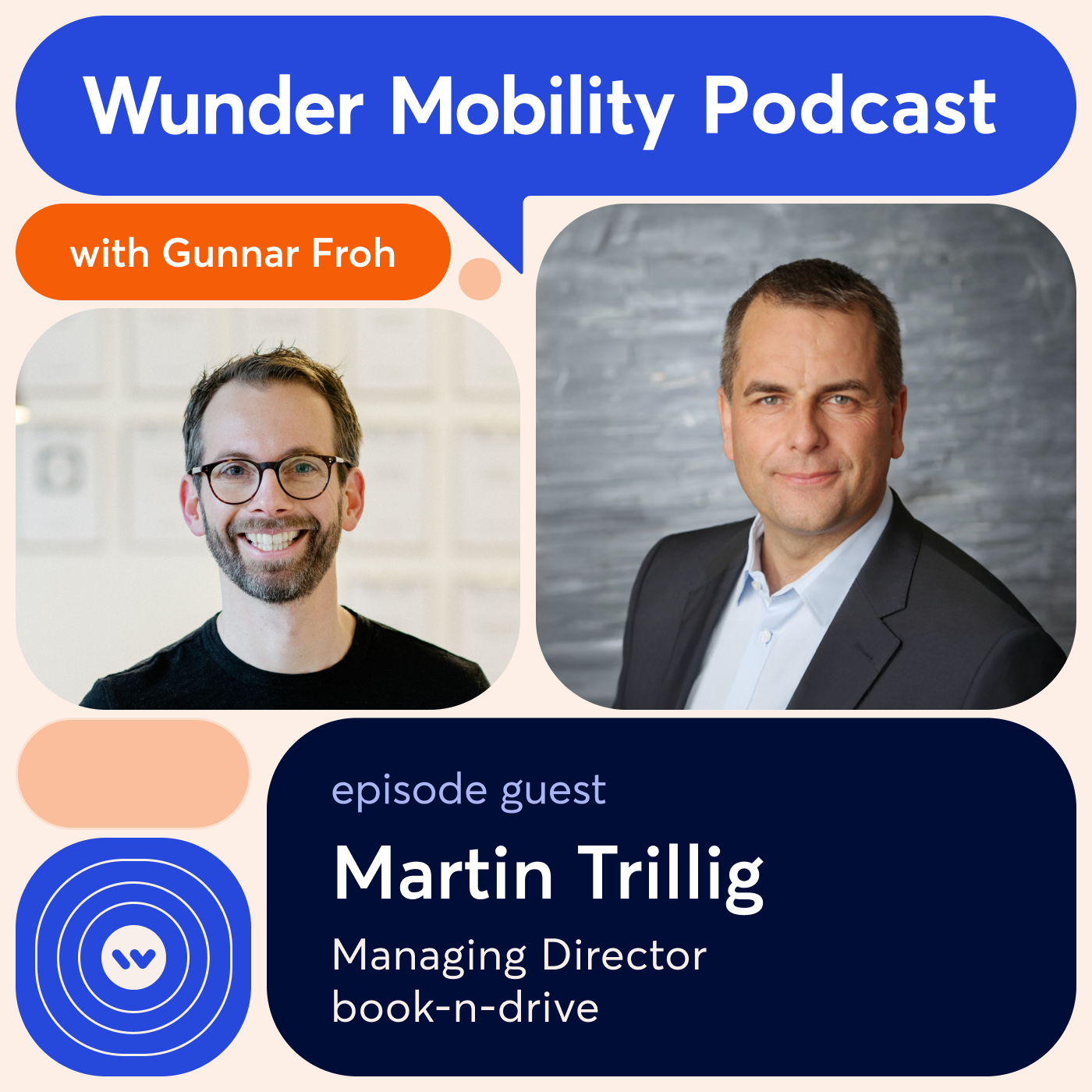
#65 Martin Trillig, Managing Director of book-n-drive carsharing
42m 53s
In the WunderMobility podcast, Martin Trillig shares insights into his journey with Book and Drive, a leading car sharing operator in Germany. From its humble beginnings in 2004 with 70 cars to now serving over a thousand cars and 90,000 users in the Frankfurt area, the company has focused on making car sharing more convenient and cost-effective. Strategic partnerships with city-owned housing companies and utility providers have been instrumental in providing parking spaces and customer access. Operational challenges include managing costs, preventing fraud, and ensuring customer reliability. Book and Drive's main competition comes from users' own cars, with efforts to enhance efficiency and cost management. Techniques to reduce fraud and damages include customer screening and monitoring car usage, with collaborations with Bosch leading to innovations in car monitoring systems.
Transcription
6825 Words, 36198 Characters
Hi, my name is Gunnar Froh and I'm your host on the WunderMobility podcast.
Welcome back to the WunderMobility podcast.
Today I'm with someone very experienced in shared mobility in Germany, running one of
the largest car sharing operators in Germany and in the industry for over 20 years.
Welcome to the podcast, Martin Trillig.
Thank you, Gunnar.
Thanks for having me.
I would like to start out with your personal background a bit and find out what made you
arrive at Book and Drive in 2004 more than 20 years ago.
All right.
That's so long ago.
I barely remember.
Of course I remember.
I've been a customer from Book and Drive before and back then I've been in investment banking.
I somehow slipped to investment banking while being a student and then ended up with an
80 hours work week while studying and I said, "Okay, that's not going well."
So I've been searching for a full-time job which would be like then a half-time job for
me from this perspective and thought, "Okay, which industries probably have some headroom
for improving and being more professional?"
And because I never wanted to own a car, I already have been a customer of Book and Drive.
So I thought, "Okay, Book and Drive car sharing, there could be some potential."
So I contacted the founder of Book and Drive, Udo Mielke, sent him a short presentation
and I said, "Okay, now you're having 70 cars.
Just compared it with other cities like Karlsruhe, which is still the capital of car sharing
in Germany."
I said, "If we do it well, then in a couple of years we could have 300 cars."
And then we talked on the phone for two hours and it was just a question of when I can start.
Amazing.
And you just mentioned this starting point 2004, 70 cars.
So let's fast forward to give people also maybe from outside of Germany the perspective.
Right now you are running a thousand plus cars with about 90,000 users in the Frankfurt
metro area.
Also cities close to Frankfurt but like central Germany, right?
It's mainly Frankfurt area.
So just for the people that are not living in Frankfurt or around Frankfurt, Frankfurt
area is like a very vibrant area with a lot of signs and banking, insurance companies
and a broader area where roughly 3 million people live.
In the cities, the cities themselves are quite small with Frankfurt, roughly 760,000 inhabitants,
Darmstadt, Wiesbaden, Mainz, 200,000, 300,000.
So this is mainly where we operate.
And can you give us an overview of how the product offering evolved over those two decades?
So it's number of cars but also in terms of other products you're offering, how you're
running the business, how has that changed?
Well it started that if you wanted to become a car sharing member, you had to place a deposit
which was like a huge barrier to get into car sharing for many people.
So one of the first things is I argued with Urumilke and said the deposit is more or less
it's not for our safety, it's for financing the car.
Financing is not the topic of the customers, not the task of the customers.
The customers should use the cars.
So let's skip that part and make the model more open.
It always has been station-based and some years later we added a station-flexible and
free-floating offering, we call it Cityflitzer, but still we are mainly station-based operator.
So our aim is to provide a car sharing car to those people who would like to use a car
once in a while but don't want to own one.
What role does your shareholder structure?
Let's say you have two big interesting shareholders in the company.
What role does this also play in your day-to-day or in running a station-based system in a
city like this?
Right, that's a quite interesting story because I think the challenge is facing everyone who
is trying to scale a company and in the beginning when I started at Book and Drive I knew okay
we are having 70 cars, we have some customers that use the cars but we are not really having
a lot of money to scale.
So I knew I have to find people that support us and help us to grow and so I've been looking
for partners that could help us to find spots where we can place cars or who could help
us to connect us with customers and so housing companies play a big role in Germany because
after the Second World War the cities have been totally demolished and the cities took
over and started to build apartment buildings and these apartment buildings are now operated
by public owned housing companies.
That's maybe a little bit different to other countries and so there are in every city there
is a housing company that is basically city owned and I reached out to those companies
and said okay this is our model and this is a service for your renters.
Would you like to cooperate?
We could provide cars and one of those companies it's called RBG Frankfurt Holding, that's
the biggest housing company in Frankfurt with think 55,000 apartments then reached out to
us and said okay it was roughly 2011, said now we are cooperating quite a while and we
would like to have a share in the company together with another big utilities provider
in Frankfurt, Mainuwa AG, which is also city owned mainly and so it ended up that these
two companies bought a share in Book and Drive in 2012 so they both own 33% now in Book and
Drive.
Each right?
Each yes.
This headline is really interesting.
City owned housing company as a shareholder and then a utility provider but could you
also share how they are collaborating with you on a practical level?
So if other people in elsewhere in the world basically are running different sharing systems
like what can they hope to get from a partner like this practically speaking, would they
assign parking lots to you on their properties over a certain time or at favorable rates
or in specific places where you otherwise wouldn't have access or do they allow you
to target their customer base directly?
So practically it's very simple.
We need space to place our cars so they provide us with parking lots that we rent and we place
the cars there and on the other side they allow us access to their renters and so we
can communicate with them via their channels.
There is some information about car sharing in every house in the entrance area where you
can see okay this is car sharing and so that's the practical thing what we are doing.
For me it's much more than that because if you build a partnership then it's always a
relationship that you want to build.
That means you need to have not only shared interests also shared values what do we aim
for together and how do we address it and how do we communicate and it's super important
to understand what is the problem of your partner and how can you maybe add something
to help him solve this problem.
We are far from solving every problem of RBG or my NOVA but RBG for instance is building
houses and in Frankfurt we are mainly talking about not building new houses but building
new apartments on the top of existing houses so we call it nachverdichtung.
You enhance the density and at the same time it's not possible to provide as many new
parking lots so not everybody is able to own his own car so they try to rent out new apartments
to people that come with their own car but they cannot bring their own car because there
is not enough space and there we are stepping in and say okay we create a solution.
You can rent this apartment you don't need to own your own car because there's cars already
available around you so that's the benefit that someone like RBG has from book and drive.
So it's at a minimum some cross selling going on do you also bundle products somehow that
you that they would say this building has certain hours included or with this the other
partner utility provider you have an eco friendly powered contract and then there is something
included or are you mostly on the marketing level cooperating with them.
It's mostly on the marketing level.
I think it makes a lot of sense to talk about bundlings.
If you have the right let's say infrastructure to support this bundles and I'm very looking
forward to do those bundles but right like in the last decade we mainly focused on marketing.
And when you think a little bit about the operational challenges along the way to organize
this kind of fleet in this many users I think in terms of auto magnitude public information
correct me if I'm wrong but you have about 50 people I'm in the company now maybe about
10 million revenue so there's a lot of work to be done every month.
What were some of the biggest challenges in the last year and how did you address them
in terms of operational challenges to make the service running available.
All right so let's look a bit back into the history of book and drive before founding
book and drive our founder who had a workshop for cars which was like the main service provider
for book and drive for the longest time after we retired and I took over management together
with Andy Hornig my colleague would also close the workshop which means we had to completely
restructure the whole company built a new fleet management team find other providers
and let's say at the end we did a whole reorganization of the company and so that was beside Corona
the biggest struggle in the last years.
I think right now the challenges are to cope with the rising costs one side that the costs
are increasing every quarter and at the same time it's not that easy to increase the prices
so we have to constantly find ways to be more efficient to manage the not only the cars
but also the customers better to see which customers have a bigger risk profile and hopefully
keep them out of the fleet before they produce big accidents these are the kind of stuff
we are dealing with.
So rising costs while the price can't really increase there's competition who's the main
competition or alternative from your users perspective is that really your own car like
other sharing providers or public transportation all of the above who do you feel is like the
main competition for you?
It's our own car.
If we just see like a city like a city of Darmstadt which has roughly 160,000 inhabitants and we
provide I think something like 200 something cars and 5% of all citizens are registered
at Booker Drive which is super nice I love it.
At the same time there are roughly 80,000 cars, own cars in Darmstadt which is the picture
is clear.
We are just scratching at the surface of what is relevant and what is possible I would be
happy if we one day would have a market share like a single Volkswagen model in the market.
Interesting energy.
So competition from their own car and rising costs on the other side you need to maintain
profitability.
It's not like you're raising sort of one round after the other you're operating profitably
and what were sort of the biggest cost drivers you mentioned fraud already maybe trying to
identify user profiles to keep out before the damages cost that seems to be a main one
of the big topics right which are the other big topics to keep costs in check in addition
to fraud or damages.
Okay, let's look at the cost structure of the company.
We have payroll which is like maybe 20% or a little bit less and maybe 15% and then the
rest is mainly cars like leasing or depreciation, maintenance, repair and the station costs
like the rent for the lots that we rent for the cars and of course gasoline or energy.
So the biggest part of the cost structure is fixed costs as heavy and on the other side
mostly all the revenues are variable just in the nature of the business and because
most people don't know what does the own car actually cost they compare like the leasing
price per month and say okay I pay for my car 150 Euro but that's not the whole truth
because you still have to insure it to pay for gasoline to pay for the parking lot whatsoever.
My father did a couple of years ago a nice calculation he's now 89 years old and he
owned Opel Safira which is like a van and he's not driving really a lot so but then
he kept track of his costs and then he looked at it and said hey Martin I'm paying 750 euros
per month for my car even I'm not using it a lot so yeah that's what it is because every
once in a while you go to the maintenance and then big surprise this needs to be repaired
and I compare it if you go to the shop it's like you go to the dentist the dentist tells
you oh there's something I have to you never say no let me look first you just trust them
and that's that's like if you go to the workshop with your car they tell you listen that's
happening and say well how much is it yeah and people like to forget it about it's in
our nature we like to not think about the things that hurt us and at the end we bought
a smaller car for my car for my dad and and two years ago no three years ago they sold
the smaller car and now bought a bicycle like a dual bicycle and my dad and my mother they
both happily drive with a bike with electric power to the supermarket next village it's
so funny to see definitely a lot of mental accounting going on maybe could have been
cheaper to take a taxi every time no you want to stay fit he wants to be honest he don't
want to rely on taxi my sister always offers him no but what's the the the main message
of it most people don't do this mental accounting they don't know what is the price of the cars
they see oh I'm taking a car and I drive 10 kilometers and I have it for three hours and
I have to pay 33 euros so that's so expensive because three times 33 is 99 it's almost the
leasing rate so no it's you cannot compare this and so fixed cost structure on the one
side variable costs on the other side customers that have wrong led idea of what a car really
costs that is like the the in a way poisoning mixture we are dealing with but on the other
side of course there are a lot of smart people that exactly know and funny thing is that
the more the better educated people are and the more someone earns the less motivated
the people seem to me to own their own car and that's something I also seen in in Frankfurt
like the people with the highest income growth is the smallest cars and I had one customer
from from damshat he died two years ago but he was an entrepreneur very very very successful
and how did I come to know him he wrote me an email said you all have to be fired because
your website sucks and this is not so okay well if someone is screaming at me in an
email then he wants to tell me something and he's going to be real so I called him said
okay let's talk I visit you and you give me all what you you think is wrong and we had
a very nice long talk and he told me and said well I have a plane I have a motorbike I have
a Jaguar that is in the in the garage there I don't want to own a car this is why I'm
using caching that's that's so with the with the with the educated people with a good income
or a good status they have no problem using caching just like many of the people that
somehow cling to the car because they I don't know it's a psychological thing definitely
still something to overcome and yeah because not everybody's sort of doing all the calculation
and keeping track but it's more you do what you always did or yeah what's like an emotional
decision when you look at the cost that you said the revenue side is quite variable the
cost side it's mostly fixed you mentioned people costs actually not so much of the total
maybe more 15% of the total and then there's the car itself and rent for the for the stations
do you have a feeling for like auto of magnitude for damages or fraud or percentage of total
cost it's also roughly 10% even that another 10% yes did you find some ways to reduce this
in the last years what's the technique that maybe not everyone's using yet that you found
works for you what's the best liver basically to reduce the money lost in fraud all right
that's yeah I'm sorry I cannot provide you a secret sauce because it's just like a lot
of fine tuning in in all the things you can control and you have to first you have to
establish a culture of reliability and you have to make sure that customers are aware
that though when they rent a car they are reliable for the car and then second thing
is you want to be transparent and and and make transparent if something happens to the
car you get an information so this is why we invest a lot of time and also in corporations
with Bosch Kavalu and others to get a better picture what are the customers doing with
the cars is there an accident whatever third you want to have a very good look of who's
your customer just cannot let everybody come in and use the car as he wants it's a good
example is is we I think it was three years ago someone sent us a video from YouTube it
was a YouTuber who was renting cars from different car renters also book and drive and then I
don't know going to a supermarket parking place on the weekend and thrifting with the
cars it was cool just it hurt to watch those videos and and it was very famous back then
and had a lot of traction and it took us quite a while to figure out who is and at the end
he paid for all the damages so so it's always possible but my my biggest fear is that someone
like this guy is is like flattening the the tires there's no profile next customer is
taking the the car ending up in an accident and we didn't know it and so so what we would
try to do is we want to have a good picture what is happening with the car so you mentioned
that you have to be careful not to let everybody everybody in everybody use the car you remove
the biggest hurdle sort of in the beginning when you convinced everyone there to remove
the down payment but what kind of hurdles do you have in place now like would you manually
inspect or look at take a look at each profile and that's signing up or do you filter in
a certain way and then you do it how do you keep any kind of aid or what thresholds do
you have in place so there are mainly two things first we we don't let every customer
use every car if we have a young customer we don't let them drive the the big electric
cars that have like super mctorque and and they are too fast it's it's we just say okay
if you want to to drive like a Volkswagen id3 you have to be at least 25 sorry because these
cars are racing cars it's it's it's simply not possible to limit them these are racing
cars and and on the other side of course we are screening all new customers so first identify
them who are we dealing with just scoring like the credibility of course but after they signed
in we also try to to monitor the usage like we have smoked detection in in almost every
car now and if we see that people are not compliant with the basic rules like don't smoke
in the car we remove them from the system because if you are not complying with basic rules
then you're probably not complying with other rules too and you mentioned a Bosch collaboration
before that you've also published in the past and there are like videos about it so you basically
collaborated with them on a detection hardware piece of hardware that's inside the car and that
you are deploying basically to the almost entire fleet now yeah yeah that's that's a couple of
years ago we we invented together with Bosch it was a very nice workshop we had here in in
Wiesbaden Bosch came to us and they actually wanted to sell us another product I said that's
not solving a problem for us because back then we still had the workshop and said about this
could be a problem like exactly that that crash detection and so on and so Bosch started to develop
a solution and we've been working with Bosch for quite a while now we will probably change to another
system just because we we see in comparison it's a better fit for us can you already mention
do you mention Carvalu yes we are operating with inverse inverse is is cooperating with Carvalu so
it's all integrated in the cloud box we are very happy with with inverse and in the Carvalu
corporation and we we aim for improving this integration even more and that's also just
so people understand not just smoke detection but basically crash detection right I'm sensing
tiny movements yes damage detection to how do you basically insert this into your workflow then if
there's presumably a damage detected does the user get any notification about it are they asked to
sort of document anything or how do you practically work with this information right now we are not
in real time so right now we we get the events and then in the in then later we we contact the
users and say okay what happened but we are aiming to to get closer to real time but this is just in
the doing okay so on the cost side now we were diving deep into this fraud topic you also mentioned
the car itself and the parking lot you sometimes when you talk to people from the car rental industry
you have not car sharing but car rental much bigger fleets in a way sometimes also an older
industry more more established to some extent and they have some skepticism about you know
the ability of car sharing operators to buy and sell at the right price and sort of do this whole
fleet management what do you mean with buy and sell at the right price because for car rental
companies I guess their their profitability their outcome is driven a lot by when they buy and which
cars they buy at what conditions and then sell again they have a shorter holding time too so they
have the skepticism that maybe like are you getting not you specifically book and drive but car sharing
operators in general are they getting anywhere close to the terms that car rental companies are
getting buying from those are not only in volume but also the models that are in oversupply at the
moment like what what role does this yeah purchase capability in a way play for for you from your
perspective for book and drive buying the right cars at the right price or not so much because
you actually keep them for a long time I first think that that car rental and car sharing are
very different business models like car rental is holding the cars much shorter three months maximum
six months and for for the big OEMs car rentals are also a distribution channel so they produced
secondhand cars or used cars in a way this is why depending on the OEM and the programs
the the car rentals get massive discounts on the on the cars and something like 40 right
I don't know the numbers and I've heard but I don't know so so but it's not only the discount it's
also there are so many goodies that an OEM can give you like are you selling the car at the end
it's it's I just give you an example we we we a couple of years ago we we leased cars from a
German OEM and then said okay you take this car I think we took 200 of this and and said okay we
would like to sell you this model too and we said no thank you it's it's okay this model doesn't fit
too much in our in our fleet it's a little bit not what our customers expect from us and they said
we would like you to take this model into the fleet so yeah thank you no so no we would like to
okay tell us the price and they they they give us a leasing rate for I think it was one year
of one euro per month I said okay well let us think about it of course we took the cars
but at the end I mean it doesn't fit in and so knowing that this being a part of the OEM
as a distribution channel creates a different business model for the car rentals they are
turning faster of course car sharing itself is dealing with other problems and at the end we
have to provide the right cars to to our customers there are car sharing operators that own the cars
for six years book and drive aims to own the cars for three to four years so that and we say car
should not have more than a hundred thousand kilometers for a car rental that's not possible
I think and you own the cars for three to four years so you do have the resell value risk basically
yeah partly partly we buy cars we we also lease cars it depends sometimes leasing is more
profitable and sometimes buying is better I would like to talk a little bit about growth
potential that you see you have I assume because you have these two shareholders that
have this big presence in the Frankfurt region that you are also geographically focused there
but I'm not sure maybe break me if that's wrong if you would also expand is it geographic expansion
or is it more within those markets more market share by reaching more people or also by maybe
adjacent products like subscription or charging stations or some other caching
station-based caching providers in germania do we so core of book and drive will always be we
provide cars for those people who would like to drive a car but don't want to own one so that's
the core and there is there's so much dynamic in the market like what about autonomous cars
autonomous services in the future and at the end I think in the future there still will be people
that want to drive a car but don't want to own one so we are constantly searching for
better ways to provide exactly this to the customers we are focusing on our region Frankfurt
Hein Main I think it's it's big enough and there's a lot of potential in that I know it's it's it's
it's tempting to to say okay let's grow beyond but I think it's also good to to recognize your
roots and understand here we have those two shareholders that expect us to grow on our own
pace profitable they don't want to invest a lot like it's it's not a model with a hockey stick at
the end we we try to grow in a reasonable rate and grow profitable with our own strength and
there's enough to do in in Frankfurt Hein Main and it's your assumption the the task is mainly to
get more car owners to this realization and into using the existing car sharing product or do you
think you should more launch additional products for for your existing customers I think we should
explore more what are the the products that our customers need so that's like station base station
flexible what we are offering right now is not the end of it it's there's much more to come
also you know it better than me since how many years we are discussing mobility as a service
and the the the connection to public transport and so not so much happened since then and I think
it doesn't mean that that it's not going to happen but we just have to work on it and so we have to
find what the customers expect from us and how do we deliver deliver it and how do we connect
better to other services even though book and drive is now over 20 years old and it's not
necessarily the time anymore when every week a new operator is popping up we also at one of
the mobilities still meet people every month that are launching in the space sometimes in Germany
sometimes outside of Germany and I wonder what advice you would give to someone who's now kind
of on a with a green field so they haven't ordered any vehicles yet they haven't chosen
you know they are their their routines yet what advice would you give to someone who's now launching
a car sharing service in 2025 my first advice is to keep it simple the model keep it as simple as
possible and focus on one core value second is go api first always okay api first interconnectivity
and and choose your partners wisely so that you you're able to grow with your partners so it sounds
to to someone you kind of a little bit abstract but I think I know what you have in mind behind
it is basically api first because you want to read you want to have a flexibility to integrate
new solutions as they come up right like if there's a good identity verification tool coming up or
fraud prevention tool you want to be able to test this and maybe deploy it not be boxed into a certain
I'm set up right it's kind of yeah yeah just look I mean you and I and wonder and book and
drive we've been talking in the last years we are constantly in touch and so so I understand
quite well the the development of wonder and I really appreciate what you're doing you're doing
extremely good work thank you and what I've seen so also the onboarding of go go urban with bojan
now your co-CEO congratulations great guy thank you yes it's really he's really very good and so
you all know the complexity of the game how complex the sharing is and and
we all had like a decade ago or longer we thought okay like shared mobility with people
sharing their private cars right hailing with private it never happened yeah because of this
complexity the complexity that and and so with book and drive what I experienced in the I still
feel book and drive as a startup I'm sorry it's it's it's yeah we established in a way the company
but still my my mindset is the ever learning ever evolving startup and and we are constantly
looking okay how things are it's very dynamic and there's no okay we we've done it like this always
no no no no it's we always try to find ways to do something better and we are operating on a
on a legacy platform but we integrated external service to identify customers to to onboard them
we we connected crash detection and the telematic system so being flexible and being able to move
and and and adapt to different situations is super important this is why I say api first
and yeah keep it simple because complexity complexity will hit anyway it's and then take
care about the details but because it's because it's the details that at the end make the difference
right you said you said before when you described industry this asset heavy you didn't say low
margin but was kind of implied the cost is going up the revenue you can't really increase the price
so the details really matter and there's constant iteration and I agree and we are also I think
surprised in a way sometimes people are asking me there's not from the industry but more like
friends or family there you know you launched something some years ago and like what are you
still working on why are there so many people working for example because we have to really refine
and and go into the last details to make the service go around and then in the end of the day
for me the big question mark remains about the adoption what you also I kind of said wish we
had kind of a penetration like one of the Volkswagen models for example in yeah in Darmstadt
how how to move from yeah still a kind of early adopter more or less customer base
who's maybe you know thinking a lot about this and really analytical about it to being more the
easiest choice the obvious choice is like that that you kind of land in as a at least a new person
getting moving to the city for the first time or having a driver's license for the first time I think
there's definitely still a lot to do and that's a combination of technology but also marketing
and messaging I would say yeah you gotta tell a story better the story be be simple so that people
can explain it to others yeah that was the big advantage of the OEM car sharing operators when
they started in the market so they had a very simple story hey you rent a car you pay only by
the minute but then they didn't get the details right that's my perception of the situation
I remember like the someone from from a big car sharing OEM operator when they started in
Frankfurt he said Martin you know it's a big OEM they can hit you hard so okay come
at the end yeah Frankfurt was the the the the worst city for them and now they are not present
anymore and we've seen so many coming I think at least five or six different operators in the
last 10 15 years and it's the details that matters and better keep it simple better have a story
that's easy to tell to your buddies awesome cool it's a great insight and hopefully it will help
some people along the way because yeah I hope more people are launching into this and yeah also
reaching the milestone I think you've been there for a longer time of being profitable but for
many people in the industry now that they're running their operations they are close to this
point and maybe reaching it right now in mobility in Denmark it's kind of a bit comparable in terms
of sizes now reached profitability miles they are a bit more secretive about it but I think this is
yeah keeping it simple while also focusing on the details is definitely what I think more and more
of us are discovering that it's necessary and then hopefully with a kind of shift in consumer
attitude where they are actually driving to simplification they don't want to make appointments
for their you know for their car and kind of have someone to look after in that we lower the barriers
while also sort of weeding out the bad behavior and the fraud then hopefully this will become
much more mainstream and eventually you mentioned the advent of autonomous speakers that's really
really interesting but almost like for another episode where already now the first car sharing
providers also in Europe are using a tailor operations you know to relocate cars but on very
small scale and very new but maybe what does that do to our cost side like you mentioned the big
points there are the cars and the parking spaces so maybe we don't have to necessarily rent in
the most desirable location or have the same fleet size if we can more reposition vehicles
more easily yeah I think that's gonna be a good one for for also the viability of the product
and we are looking forward to doing more on this and then I think eventually it would be like an
upsell it's like you gain access to the car and you can drive yourself or pay a bit more per hour
and it will drive you and then this kind of merges with you know other public transportation or
ride hailing offerings in a way it's less clear the the distinction but the core capability that
you've built up over 20 plus years basically of providing a service profitably basically managing
these assets most importantly and dealing with those requests will I think be the same skill
even if the car is now able to for an upsell take over as the driver I think it's yes book and
rifle is profitable since since years and how many years did you roughly no since I'm a managing
director it's okay it's not it's not since the last two years all right because you've already
before it was up and down and and since I'm managing director it's constantly profitable growing
but I also have to admit it's a constant fight it's a constant fight to stay profitable it's not
easy and this is why I think we always have to stay very humble very humble it's it's not like oh
no we are the ones no we have to be very humble because the challenges are immense and we have to
be very vigilant and and see we have to manage costs we have to see what the customers really want
and provide it to them and we have to to cooperate with others because alone we are not moving
anything it's a recently I actually bought a book from a I think it's Thomas twates
industry industrial designer who would tries to try to to to produce his own toaster because in
Hitchhiker's book of Hitchhiker as a Hitchhiker through the galaxy he read that we are not even
able to to make our own toast so he said okay let's I'm an industrial designer let's try to
build a toaster so he did everything he had all the information and all the tools and and at the end
so he tried to do his own mining he tried to refine his crude oil to produce plastic
and at the end he acknowledged that he's not able to build a simple toaster so this is our world
is built on cooperation we have to understand that it's great reminder this is yeah famous last word
so I was going to say yeah this is also why I'm whoever wants to reach out to me I'm very open to
share experiences I'm very open to new ideas and to learn I'm super curious super nice thanks a lot
thank you for taking the time today Martin and even the invitation at the end it's very nice to
catch up with you yes all the best thanks
Podcast Summary
Key Points:
Martin Trillig, a veteran in shared mobility in Germany, discusses his background and experience with Book and Drive.
Book and Drive started in 2004 with 70 cars and has now grown to over a thousand cars serving around 90,000 users in the Frankfurt metro area.
The company has evolved its product offerings over two decades, focusing on making car sharing more accessible and efficient.
Book and Drive has strategic partnerships with city-owned housing companies and utility providers, which play a crucial role in providing parking spaces and access to customers.
Operational challenges include managing rising costs, preventing fraud and damages, and ensuring customer reliability.
Competition mainly comes from users' own cars rather than other sharing providers or public transportation.
Cost structure includes fixed costs like payroll and station rent, with efforts to enhance efficiency and cost management.
Techniques to reduce fraud and damages involve establishing reliability culture, transparency, customer screening, and monitoring car usage.
Collaborations with Bosch have led to innovations in car monitoring and detection systems.
Summary:
In the WunderMobility podcast, Martin Trillig shares insights into his journey with Book and Drive, a leading car sharing operator in Germany. From its humble beginnings in 2004 with 70 cars to now serving over a thousand cars and 90,000 users in the Frankfurt area, the company has focused on making car sharing more convenient and cost-effective. Strategic partnerships with city-owned housing companies and utility providers have been instrumental in providing parking spaces and customer access.
Operational challenges include managing costs, preventing fraud, and ensuring customer reliability. Book and Drive's main competition comes from users' own cars, with efforts to enhance efficiency and cost management. Techniques to reduce fraud and damages include customer screening and monitoring car usage, with collaborations with Bosch leading to innovations in car monitoring systems.
FAQs
He contacted the founder, Udo Mielke, with a proposal to grow the car sharing service.
The company shifted from requiring deposits to a more open model and introduced station-flexible and free-floating offerings.
The shareholders help provide parking spaces and access to customers, contributing to the company's growth.
The housing companies provide parking spaces, while also allowing access to their renters for communication purposes.
They focus on cost efficiency, managing customer risk profiles, and ensuring reliable and transparent car usage.
The main competition comes from users' own cars, as many people still prefer owning a car despite the car sharing service.
Chat with AI
Loading...
Pro features
Go deeper with this episode
Unlock creator-grade tools that turn any transcript into show notes and subtitle files.
 PodcastTranscript AI