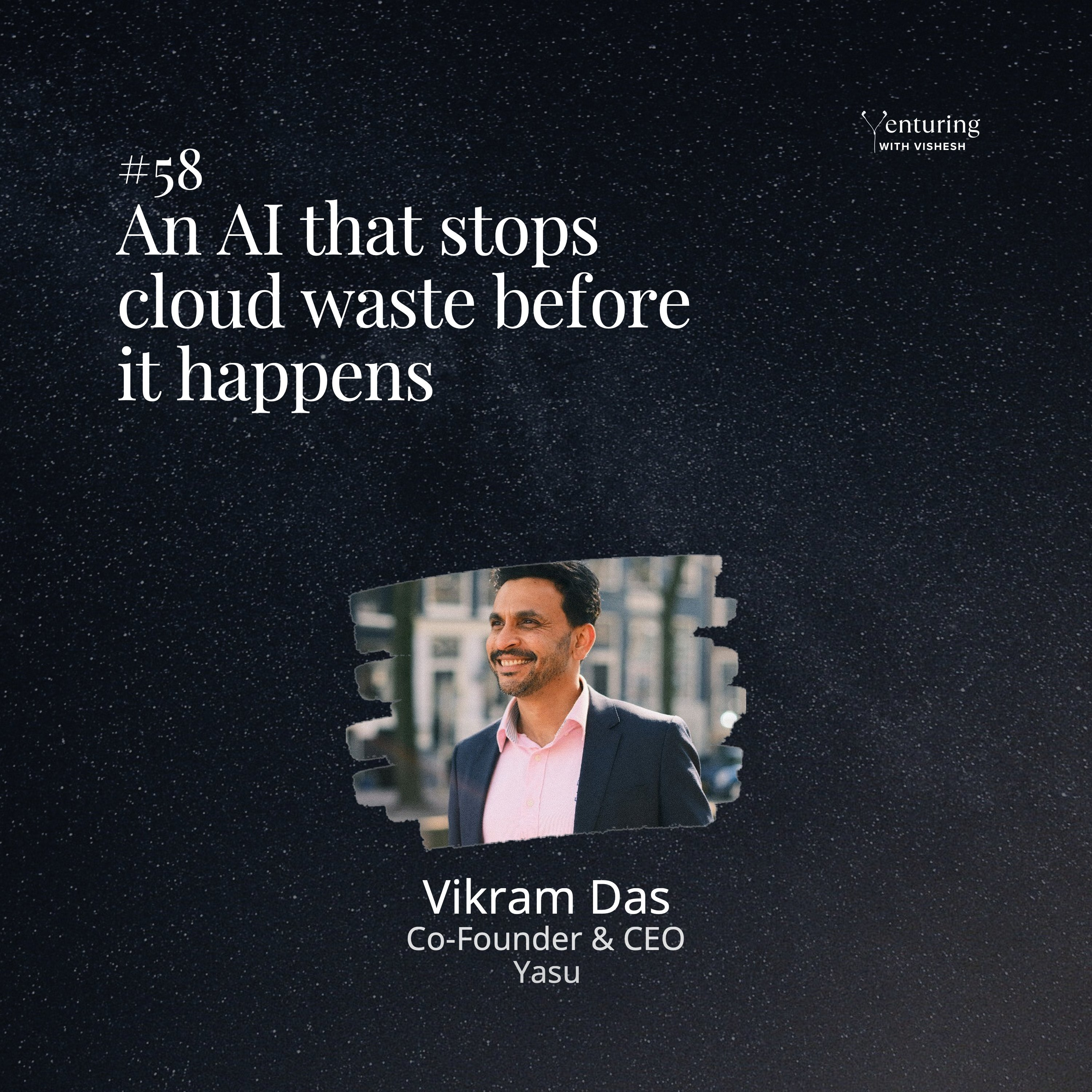
#58 Cutting 512B Cloud Waste | Fundraising in Q1 2026 | Challenges for Desi Founders in Europe | Vikram Das
from Venturing with Vishesh
52m 26s
The discussion centers on cloud inefficiency and the entrepreneurial journey of Vikram Das. A report highlights that 20-30% of cloud spending is wasted, representing over $500 billion annually, with many users unhappy about cloud management complexity. Vikram, after two decades in tech including roles at AWS, left his corporate career to found Yasu, an AI-driven cloud optimization startup. He joined the Antler accelerator to find a co-founder and validate his idea, eventually partnering with John after several pivots. Yasu aims to reduce cloud waste by integrating directly into development pipelines, such as GitHub, to provide real-time cost and performance feedback before deployment, rather than relying on reactive dashboards. Vikram believes AI can democratize cloud management, making it accessible beyond engineers, and sees the current AI trend as both a bubble and a transformative shift akin to the internet's impact.
and there was this garden report which said 20% of all clouds went as wasted. You know, Trillum plus dollar market that's like $512 billion wasted every year. And we've spoke to hundreds of people who have been using cloud in the recent. And 77% of them said, "Hey, I'm Visech, your host. I'm a 5x founder and CTO. Still building, I also help founders like you ship faster and fix what's slowing you down. More at Visech.space." I'm joined by Vikram Das, the co-founder and CEO of Yasu. Vikram spent two decades in the industry with stints at Cognizant and AWS. He went from closing $50 million cloud reels for AWS to walking into a room of 70 strangers in Amsterdam to find a Dutch co-founder he'd known for weeks. And they recently raised a little over $1 million to solve the exact problem he helped clear. In this episode, we talk about what does it take to build an AI cloud engine. Finding co-founder love and losing it, challenges of being immigrant founder in Europe. Some of his learnings from their fundraising journey through all the public talk and more. Hey, hi Vikram. Thanks for joining me on the podcast. Hey Visech, good to be here. Good to see you again. Awesome. Yeah, same here, same here. Another rental founder, uh, Angela Rellum. So you've spent a good 20 years, uh, right? building, um, a corporate career and then walked away when you had like your twins and teens. Uh, what made you walk away and in the last six, nine months, have there been moments where you felt like I've made a terrible mistake? Yeah, only every day. No, I'm just kidding. I, you know, part of the journey. But I think it wasn't like, you know, people I took this was something that was in plan. It was in plan for a while. So I've been thinking about doing something on my own for a while because my biggest problem is I have to go a bit back like my background is my dad was in the army. So we moved around a lot. Right. And she was like the one constant thing that we had. I grew up in different parts of India, the part of India that my parents are from. I did never live there. So it feels weird to say that's that's where I'm from, right? And that continued through my corporate career as well. Right? So there was a time that when I was working in a consulting firm where in five years I'd been in five different countries, living in five different countries in five years. For me, it was, I felt like it was something that was going to happen. I just needed to pace it. I needed to plan it up there. It's not that easy, especially if you have, you know, kids around you, a family around you, you need to plan it. And if to me, it wasn't that tough for decision because, you know, in my mind, I was pretty well prepared to say, okay, yeah, this is it. You know, my I'm moving out of corporate and doing the start of thing. And so when you when you decided to say, walk away, what was your, what was your family's reaction? I was surprisingly positive. Because I think my wife had seen me talk about starting on my own for years. And she was probably so fed up of the fact that I've been yapping about this and trying to do it as a side hustle, trying to do it on weekends, you know, trying a lot of things which I visited really go all in because even in the corporate side, I never took jobs which were like nine to five, you know, it was always quite intense. So, you know, like my wife, the way of, you know, she, I don't think, you know, without her, I would have started maybe in a way because your family has to be on board. This is such a crazy journey. I think founders get a lot of credit for, you know, for saying, okay, hey, I did this. I don't think it's I, you know, without your family's backing, without, because when you go through those emotional ups and downs, they are definitely going there. So when I talked to the way she was like, yeah, you know, if not now, when I want to do it, you know, well, and not not more of like, why do you want to do it? I mean, she knew the reason where it was coming from. So, pretty supportive of that side, you know, got a pretty solid support system. You joined Antler. How did you come across the program and did that give you the flexibility and did the Antler program give the confidence that you needed to take that lead? I think so. I think it, you know, like as a first-time founder, your biggest challenges, where you start, you might have ideas, you know, but how do you convert an idea to businesses always a challenge? I mean, you're an antler, I love yourself. So, I knew about Antler. There was another antler alum from Melbourne who had gone through the process, had pretty good feedback about the process. So, he had told me about it. So, I knew a bit of Antler. I knew people pretty close to me, he had gone through it. So, I understood, you know, the structure was kind of, you know, it made sense for me and there were two things I was looking for, you know, to step out. One, I was looking for a co-founder. So, I didn't have a very mid co-founder. And Antler, you know, gave you an opportunity to get that, at that time, you know, you don't know whether you're going to get one or not. And second is, you know, this entire thing of how do you take an idea and actually make it a business, you know, in a particular way. So, this is, let's also be clear, right? This is a very specific way of running a business, which is VC-backed. Doesn't mean this is the only way, but this is a, you know, slightly high-octane version of running a business. And, you know, from what we know now, like, when we, when I got it, I was like, yeah, you know, let's try. But this later, I realized, yeah, and you would have heard these stats during your antler time that only 3% people, you know, get through, I think 0.3% get funded. So, you are in a pretty small group in that sense. But, yeah, I must say the Antler, okay, it did help, you know, make that decision last year, sir. I suppose to maybe it would have been a few more years. I could have done it this, you know, eventually, like, you know, your two years time. It's just when this happened, the opportunity was right, you know, so kind of it. And so, you met John in Antler, your co-founders. How did that happen? Yeah, that's pretty interesting. Because, so, John and I both met at Antler. Both of us, John is also someone who's experienced. He's got like 50-naudial, so, if experience, you know, mostly as an architect, developer, consultant, you know, freelancing, that's what he enjoyed doing. And then he wanted like a space of his own, you know, he's been a farm-wing engineer with multiple other startups. What happened? During the Antler time, we actually did not really connect on a business site. You know, I had a couple of ideas, but it was like, you know, you're also trying to shape up those ideas. So, there were a couple of things where, you know, a lot of technical founders in our batch and, you know, they were looking for someone else to come up with the idea. And a lot of non-technical founders, and I'm probably in the non-technical founders, although I'm from a tech background, right? We had different ideas, you know, so I had, so I tried like a three-four different ideas, like V1, I was trying something on warehouse management. Because you're like, yeah, idea is idea, you know, let's try it. Realized in a few weeks, not only do I have zero passion for that area, understanding of that space is so poor that every call fair is like, oh, shit, I didn't think of that, you know, then I tried something in the sales side of things because it was obvious, you know, sales is one of those spaces. Like, like one of the things which made me also jump as that, you know, if you've been in tech for long enough, they've been somewhat more of these escals that we call it that have happened, you know, which have leapfrogged everything that we have seen before, you know, in my mind, Cloud was the last one, mobile was the prior one. So, they've been few really big deep switch have happened, a social is another one. And then AI hate you, you get that sense that this is different, you know, there's not just another tech. So for me, it was clear that somewhere in the AI's, you know, hype, which is a, I mean, it's an interesting question, I don't know whether you have a perspective on that, like one on AI itself is this view, the number of people who ask me or I see talk about is AI a bubble or is that really, is that the real thing? My response is it's both. There is clearly a bubble. I mean, if you see that, you know, the, flywheel of open AI or a girl, you do feel yeah, there's a bit of a bubble there, you know. But it's also so powerful that you know that it will touch most skill jobs. Will it take away jobs? I'm not convinced. I think it will make them more productive, you know, that's what I'm betting on with the as well. But yeah, I mean, what's your perspective on bubble? Bubble no, I think yeah, I think it's there are obviously going to be some winners, but the massive correction is due. I think that's my position. And you can already see the panic, you know, I think this week alone, I think oracle tank what some obscene number in terms of stock value, right? They just don't have, it's just not feasible to for them to fulfill the contracts they've signed. So, you know, yes, you can book revenue, but if you can't fulfill them, there, there are no revenues coming in. So yeah, I think there's going to be a correction. And you know, once few people start having doubt, people start dumping stuff. And so I believe that's probably going to happen in the next three to five months. That's what I believe. No, a fair enough and it does sound right? But, you know, if you remember the dot com bubble, it was a similar kind of thing. Everyone said, hey, I'm going to put everything on internet. There was a good correction. But before, you know, internet and post internet, life has not been the same. Like, yeah, nowadays we don't obviously a lot of younger folks would be like, what have you been before internet? What is that? You know, folks who have not heard that eeey modem sound, they're like, what are you talking about guys? But I mean, that's my view that, you know, things will change in a different direction.
can see the power of AI in a lot of place, both negative and positive. I mean, there are a lot of things that folks have not thought through. But yeah, that was a good trigger for for me to say, okay, hey, man, either which way this is this is a cycle you don't want to mess. That was an impetus to move to Atlas as well. So I was trying so for me, the main thesis was something to do with AI. And then I tried warehouse management. I see, I've got to understand the domain a bit. So immediately to the domain that I understood which is sales, then realized, oh my god, everyone has thought of exactly what I'm thinking of. You know, there's just too much happening there. And then I found out team or not found a team. There was another CTO who had a good idea. And then I joined them and we went through if you remove the antler process, we went all the way through IC. But gut feel wise, I didn't feel that, you know, the chemistry was right. So before the IC kind of decided, no, I don't want to do this. Took a month off, literally went to the Himalayas. So I was in Uttarakhand, I was in Tharmshalla, I spent time with amongst some of my most beautiful memories are from that time because you like you suddenly have quit a job. And you've gone through this process with nothing to show for it. Yeah. And then you're like, okay, how much do you really want this? Do you should you go back to corporate? You know, you got to take a step back. I mean, I was just trying to run with it instead of saying, okay, let me take a step back. Came back down from the Himalas and then said, okay, yeah, it's still something that that kind of is burning. So I want to do something in the area. And that's when the idea of initial idea of Yazoo was like, it was something that I had for a while now. You know, how do you make the vague cloud management and cloud computing has been done and managed by clients? How do you make it more easier for people to use? You know, there are a lot of tools which are there in the market, but a lot of them also are quite complicated. So you need to need like a cloud engineer, you need to be fairly tech to use those tools. And you know, my initial thesis was that, okay, you know, with AI now, that should not be the case. So that's when I said, okay, you know, put some slides down, went back to Antler, talked to them, hey, I've got a different idea. Would you guys still be talking to me and they were like, yeah, you know, they're extremely supportive that way. And I went through maybe three or four different CEOs and John, in the meantime, had joined another Antler funded startup already. So he was already working. And we decided to do grab a coffee because we both kind of like each other's why we always had like a great conversation about anything other than work. Right. And you're drinking the coffee. I told him what I was thinking was like, hey, what if I join you, you know, so I dumped the CPU that I was talking to at that time. John dumped the other startup, you know, and joined and we both kind of, you know, said, okay, let's kind of bother. So we were outside the code. And we just do, you know, so cohort was long done and tested by that time. Right. You know, and then we kind of, you know, took the idea, took it to the market, talked to enough people to build a conviction of, okay, it's not just the two of us thinking that had a pretty decent storyline, went back to Antler and you know, they, they, they, I said, yeah, this makes sense. And they kind of funded us early this year in Jan. And the rest has been history. Yeah. So so it wasn't like a straightforward thing met someone at Antler, joined, it was more of like a roundabout thing. Right. And so you, after the IC, basically that cohort was done and you went back. And so did you, did you have to go through and be a part of another cohort or this was completely outside? No, it's completely outside because you've been to the cohort, you've gone through those things. Yeah, you've got the, they are, you know, constant ICs which happened. So once we kind of got together, we had, say, hey, would you be okay, if we pitch? So we did the entire similar thing, right? Initial discussion, then pre IC and then eventually IC and then, you know, yeah. Just to expand on for people who don't know what an IC is, ICs and investment investment committee. If you have tried to raise money, you should already be familiar with the term, but it's not that's IC. And so Antler agrees. Can you expand a little bit on what Yasu is and how do you save save money on intra and cloud engineering efforts for companies? And do you do this? What kind at what stage can someone as a startup or a business utilize Yasu? Yeah, no, this is this is my favorite part, right? That's why I get to plug Yasu. And, uh, we exist, right? So like, you know, listen, cloud is not a new thing. Let's be honest. Oh, yeah. In a sense, it's been there. We don't even think about cloud as like tech. We are like, yeah, it's part of part and parcel. Like we don't think about mobile. But one thing which has been persistent is the fact that, you know, there's not been great cloud management tools. If you look at the hyperskillers themselves, those tools are extremely unattractive. You know, people don't get up every morning thing. Okay, I want to learn everything about a AWS or a Azure. They get up every morning saying, I want to build my product the best way I can. You know, and for that, I want to use cloud. You know, it's like plumbing. I don't want to know about it. It should just work, right? And if you talk to, you know, folks, they, when they still love what cloud has to offer in terms of innovation, you can quickly rapidly prototype, bring to the market, what have you? But they just hate how complex it's gotten over years. Uh, you know, and especially when it starts hitting your, uh, volatility immediately. So most people have this suspicion that they are osvending on cloud. And there was this garden report which said, you know, 30% of all clouds vendors wasted, you know, trillion plus dollar market. That's like $512 billion wasted every year. And we spoke to like, you know, hundreds of people who have been using cloud in the region. And 77% of them said they, they really are and happy with the way their cloud is getting managed. They also feel they can save. But it's so complicated that, you know, if we are going to prioritize the product as opposed to using, you know, what the provider has, right? So that got us to think that, okay, why is that the case? You know, because it's not like there aren't tools in the market which addresses problems. So they are, you know, people who have been doing it and we realize that there are two things which, you know, because of the legacy nature of things, they have been doing in a certain way and everything is slightly incremental to the previous one, right? But it creates two gaps. You know, what what we like to call as prevention gap and an intelligence gap. And what I mean by that is most of the tools that if you look at it, right, they kind of try to address this problem once you have deployed things. And they say, okay, I'll let you monitor what happened by that time it's late because you've already put it in production. There's inertia once things are custom-free thing for anyone to change anything. Big re-factors. Yeah. Exactly. And the second is, you know, intelligence gap. Like, most of those these tools, if you look at it, like, including the hyperscale of tools, they are so dashboard focused. Like people love dashboards, you know, in excess and in these tools. They don't just do it. They just don't use it because you're asking a question and the response is dashboard, okay? I'm famous here because my lights are going off. So that's the other problem that we saw and both of them, like, you know, very clearly could be solved using AI because you have this complex data set. So you needed something which can insist, like, you know, billions of records and get intelligence from it because you want to do it in their business context. And you should be able to talk to your cloud. You know, if you have a question, even as a CFO, why should you have to go to the T just ask your cloud, you know, what would be the spend, you know, whether the spend is increasing, what are the trends that I'm seeing? What happened? Because you have questions, you know, you're looking for insights because you have a question, not that you want to dashboard to stick in somewhere. But the second thing, which is the more important thing is we help prevent cloud waste. So we hook into your GitHub or your repository and when you make a change to your infra, we let you know right then and there, what is the impact of that change? And that's a very different way from what everyone else in the market is doing because in this case, now, it's not that developers don't want to know, right? There was a start recently, I think GitHub crossed one 150 million active users and 30 million of them are building on AI. You know, and a lot of these AI services are very easy to spin off nowadays, but they can get super expensive. Right. And again, I don't agree with the fact that depth don't care about cost. It's just that is too complex and cumbersome for them to know. So we let developers know at that point, you know, what's the implication so that they can take meaningful and cost-concilic, you know, architectural choices, you know, if they know, hey, if easy to, you know, 3x large is not what I need for the kind of usage that I have, they will go for a smaller instance instead of their largest instance. Otherwise, like there are 700 different types of compute instances. They're not going to go through 700 this day. They're like, okay, this is a default. I'm picking that, but guess what? Picking a default in 90% of cases is too much for you. You know, this goes for AI models, this goes for computes, it goes for a lot of a lot of these things. So that's how, you know, we think we are doing different in Yazoo. It's a market which is kind of, you know, getting bigger by the day. Like, you know, I read recently that Microsoft and Google clocked in 555 billion in, you know, in backlogs. You know, 55 billion that they have locked in backlogs. That means people have committed to spending so much on Azure and on GCP. Cloud was supposed to be paper use, you know, pay as you go. It was never supposed to be a lock-in 100-mill, but it's somehow become a locked-in thing most companies now are locked in.
for a few years. - Yeah, well, I mean, that's also because of the pricing probably they have pay as you go, which is can get expensive. And then if you get dedicated instance or you do lock in, you get discounts. Like how do you guys, do you guys help people get around that? - No, we give you a better cost visibility. So not the answers not yet. You know, we have a list of start-up, maybe at some point we go around that, but they are ways to go around that, but that's not what we are focused on right now. Our focus is say, how do you make like this smart AI cloud engineer, which a lot of companies don't have the luxury to keep all the time to keep. If you can get that smartness of AI cloud engineer which helps you stay on top of your cloud cost and be on because if you, you know, cost is just the first one that we are targeting. We are looking at security compliance in those kind of things, you know, later down the line. So yeah, you know, so our pictures that hey, you can get AI cloud engineer, like an expert AI cloud engineer for fraction of a cost of an intern, you know. And that's a power of AI. I think that's what we will see. You are seeing it in sales, you're seeing in customer support, not too much in cloud yet, but my bet is, you know, anything which has a large amount of data, which needs to be digested, which is being done by consultants today, can get increased by these AI systems. - Yeah, I was gonna say there are a lot of consulting companies that specialize in AWS or Google spend saving. - Exactly. - Yeah, and I have not seen, at least I have not seen the whole, hooking into GitHub and preemptively saving cost approach. So yeah, that's interesting. - You could have buried Yasu anywhere. How did you end up in Amsterdam? First of all, you know, from Himalaya to Amsterdam. And why not Amsterdam? - Yeah, great question. - This is, Pira, I've always felt that, you know, there's a big part of luck and destiny that happens. Like there is this BCN AC with life, you know, not the whole Christ, but like before children or after children. After children, a lot of your decisions are driven not just by your own desire and ambition, it's also driven by which is a good place for us to raise our kids. So when we were moving out of India, we had a couple of choices and one of them was Netherlands, you know, and from what we saw Netherlands was like, you know, it had a lot of advantages for us to, you know, get our kids here. It just felt like a very healthy environment for our kids to grow up in. So I must say that this start of happening in Amsterdam was a result of us being here because of our kids. Having said that, I think in hindsight, it's been a really solid place to be, you know, it's still not Silicon Valley. Like I just say, you know, having lived in the US for a few years and spent time with the kids there, there are things which could be better. But it is improving. I mean, the desire and the hunger is improving every year, every month that, every event that I've gone to, you know, there's serious hunger which is there. There is this, I think this is me about, you know, you know, goes on vacation five months in a year. Yeah. But you don't see that in the start of the community. The hunger. Yeah. You do see people are hungry. I mean, there's peaceful, I mean, there's space for every person in Europe. There are people who want to have, you know, great work-life valence, have those couple of months of vacation and there's space for that. But if you want to grind and have a start-up ecosystem, I think that that's the space which is getting created. It's still a little bit nascent for Indian origin founders. I must say, you know, I mean, there have been a lot of times when I'm the only Indian origin founder, which is sometimes strange because in tech, you have a lot of Indian origin folks. So you don't have too many people that you can, you know, look up to you don't have a certain dollar or you don't have, you know, a big tech guy that you can say, "All right, you know, this guy has come from Heather Bar and gone all the way." So it's, I can follow those footsteps. So the first generation once will be us. We will try to do some of these things and see how it grew. It's talk home or Sweden at the kind of companies that are coming from there. Have you had a chance to talk to founders from that ecosystem? I know Angela has a code there as well. And how do you compare the two for that matter? Other Europeans start up ecosystems in compared to Amsterdam? Yeah, no, I think it's an interesting question because, you know, we say Euro, but Euro is not a country, you know? It is, you know, 26 different countries which have come together. So every ecosystem is a little different. Every country is little different. Laws are different. The encouragement that you get from organizations is different, right? London where you were, you know, like, I guess it's also grass is always greener on the other side. Like I was like, "Man, I wish we were in London." This seems to be unlimited fun there. And everything is so much easier there. You know, Netherlands has its own barriers, Sweden has its own barriers. But they are, I mean, like I said, right? I mean, they are things which I do think that some countries have gotten right. Like in London, there's a tax rate that you get if you're investing in a starter. Right. You don't have those kind of things in the Netherlands. But there is a government body which is encouraging start up. So it is slightly different way, right? Yeah. Yeah. The bigger numbers are still not coming in. I think one of the biggest gaps still in Netherlands and Amsterdam is preceded funding is probably one of the toughest to crack. Just the nature of the beast, you know, in the country that you're working like while we say PC, the first question people ask you is, "Okay, what's your fraction? Have you hit 100k?" If you're hitting 100k, you shouldn't call it PC, right? PC, it by its definition, again, you know, I'm assuming folks who are listening to it are in the start up vehicle system, is you have founders who have the background and you have an idea which has been validated from a problem perspective. It may not be that you know the solution yet. The bar is much higher, you know, and that goes across, you know, I think, you know, if you're pre-revenue, pre-product in a market, you know, in your own, it's relatively more difficult. Yeah. Yeah, nobody's going to fund you because of your aura. Nobody's, yeah, you know, to make it worse, I mean, pre-revenue, pre-product and Indian founder, you're three-stacks. So, in terms of, you got this pass through, you know, joining Antler as well, but being a desi founder or Indian founder in Amsterdam, what are some of the challenges you see? Let's say somebody else hears you, what are some of the things they can learn from, maybe yours, Jeremy, on how to, you know, make this easier for them. I think there's, I think there's, there's a couple in, you know, if I think of it, right? The first one is I think the cultural differences between Netherlands and India are quite vast. In India, we grow up thinking that, you know, we've got to be humble. We kind of underplay sometimes what we have, and we are taken by, surprised by dust directness. I mean, dust directness is real. If you're being here for some time, it doesn't, like, it's the opposite of maybe the British indirectness. You end the conversation thinking that everything went well, and you're like, okay, why, why, what's just happened? I mean, why, why, why, why, why are we getting this rejection note? That's folks will tell you on your face, which I think is like, I've been in the Netherlands for almost 10 years. So I find that to be refreshingly good because you, it becomes more efficient, you know? Right. But for folks coming from India, sometimes it can feel personal. It feels like someone is attacking you. But I think for most people, the intention is not to attack you. For most people, they feel, you know, culturally, they've been told that, hey, it's better to be direct. So, you know, you have to adapt to yourself as opposed to, you know, thinking what, what's there, right? Having said that, there have been instances where, you know, being a desi founder of Hurtz, for sure, especially in the commercial role. In tech roles, maybe not as much, but in commercial roles, it is, it can be sometimes a disadvantage. So we were asking for a loan from a bank here, this was that time we did more recent, another round. And the committee, which was there, had this commercial person who could not believe that a non-dotspeaking, you know, Indian or Asian person can be the commercial person. He just couldn't believe that. You know, come what, maybe we were throwing data at him, we were, you know, throwing a lot of stats at him, we were telling that he, I'm not just someone who's just passed out from the college. I mean, they will serve pedigree that I have. There's a background that I have across multiple organizations. But his mind was so clear that, you know, and eventually we didn't get that loan, which was so shame, because I think that's sometimes a mess, you know, when people carry that kind of biases, right? Having said that, violence, for every one of those folks, I've made maybe 90 folks who don't care. Yeah, I mean, I think, I mean, as a, as a migrant, I think you have to be willing to be growing a thick skin and accepting that there are going to be folks who are going to outright reject you because of, you know, your background. But at the same time, there are people everywhere. Now, so the first check that we got in this round was from, you know, what you would consider as folks who, so I was pitching in this really small event. It wasn't even one of the large events, like a local event in the place that I love it. You know, I just feel every pitch has got, you know, you just pitch, doesn't matter. And they heard me pitch there and they reached out to me off-line. And they were like, they've been the most supportive investors that we've had. And they come from a very similar background to the person.
other person who said I don't see how a non-doch person can become a chef. So I think it's very dependent but like I said you should be adaptable like one of the things is that you have to unlearn. A lot of also we grow up also with a lot of American way of selling because we dealt mostly with a lot with maybe American customers, and lifting US war. In Europe I think it doesn't always work. So that's also the challenge with Europe. Every country has a different one to it and to really sell in a different way, understand the local sensibilities are different but once people buy into you they do support you. And so do you speak Dutch? No my Dutch is pretty poor. That's one of my biggest drawbacks and regrets here. Because I've always been with the English speaking companies. Languages something you know my kids go to our school, their national languages become Dutch, my wife speaks Dutch. So I'm literally the black sheep of the family right now. But that's my biggest regret that I should have picked up Dutch a long time back. I mean I do understand it I can hold a small conversation but not fluid. But yeah that would be one tip man. I mean don't be me like learn the language. You get on learn the language. Yeah even if you don't know the language if you use a few phrases it goes a long way in Europe. Anywhere actually. Even in parts of India right if I go to Tamil Nadu or you know Karnataka and I speak of few words I think people light up. Yeah. And so what's been the biggest mistake you see other Indian or migrant founders make or making when they're trying to build in Europe. Honestly they're not too many Indian origin founders are not enough not too many but they're not enough Indian origin founders who are there in the Netherlands. I think the first step is I feel and I'm talking about tech founders you know. Yeah. Indian origin folks who are in the non tech kind of founding business you know and they're like restaurants and all that that's kind of booming right now. Right. But tech founders I think they're not enough. So the first thing I would say is you know folks who are like we have this innate desire to do something different and do more. I meet so many people who want to do it they don't just take their steps. So even before you know like hey founder mistake I think people should just trust a cut up it more you know and say okay you know you've got to take some risk as long as it's calculated the thing through it I didn't do it like overnight I mean I did it after think about many years. One would be that I think this face for you know Indian origin founders to do something. The second thing is communication I mean I don't know where you know like especially tech founders I feel sometimes want to hide behind something else right. Underneath what they've done. Be confident I mean this is you know there is something you know I don't like the face fake it till you make it I really don't like it but you do need to project that you know you have to shed that humbleness and all of that right. Third I would say it's like you know reach out like the biggest mistake I personally have seen lot of tech Indian founders make is not too network like you know enough like really go out top to other people there's nothing wrong in saying I don't know. Sometimes I feel I don't know I mean I don't know whether if you see that too. I don't know whether did we grow up thinking you know we are all know it all like we find it very difficult to say I don't know. Yeah yeah it's not the know it all I think it's the whole you know we culturally we defer to our elders and there is this notion to kind of accept what the elders in the family are kind of directing you or nudging you. And so yeah that and given the whole education system we have and the focus on studies and a set path it's not that people feel they're they're know it all but I think people have a hard time asking questions and they're more worried about the outcome because that's how they've grown up they've always been focused on the outcome which is the numbers or grades. Yeah. And so for example at a networking event a goal would be to network and probably meet as many people as possible whereas if you look at a Western networking they will actually be enjoying their time enjoying the conversation being extremely curious and all and learning from people's experience and the conversation which probably we are not so used to nothing that you know you can't train yourself or other hunt trains on the habits you will learn as a kid but yeah I kind of agree I think networking is probably one of the key founder skills you need to master. We've reached the section I call never get a cold email these are things that help people get to know you better. First money you've spent on the business so far. So purely from a risk assisted basis. I think starting a startup like I hear this from so many people who think that doing a startup is man I'm going to be a millionaire in a year and if you really run through the numbers I think this is the worst way to make money. If you have a stable job you're guaranteed in five years to make a certain amount and a decent amount as well and tech doesn't pay bad. Start a business like you know the odds are so stacked against you although I must say that's you know I know your question was mistake I don't think this was a mistake but it's the most expensive way to go about life I feel you know to get to know things. Yeah yeah until you start making money a lot of money goes out for sure. Yeah but it's not even when you start making money you know you have to have like a really good exit and you still need to hold a large amount of your company together for you to actually make I've met founders who have had multi like $50 million in sales I mean nothing you know because they diluted so much by then right so it's so there's so many things where you will not end up with a big part of core. Yeah and if that is your main reason to join a startup I think I at least feel if you concern numbers the math will not add up. Yeah yeah there's a lot of overfounders. Yeah there's a lot of I think I can be classified in one of them. One tool you can't live without. At this point man the AI tools lots of them. I feel like they are third co-founder, Claude for example for me you know all these AI tools which sounds weird to say have their own personalities and different people like different things for me it's been Claude that's like having a third co-founder you know the amount of automation you can do the amount of thinking you can do is remarkable in terms of using any of these AI alums. Yeah yeah I love 4O, GPT 4O I think for especially strategic and brainstorming it was and writing it was very good but now they've just I think opening is I don't know what that was. I mean my money is on that's the first company that's going to go bust not the first company like when when the bubble burst they are in trouble. Well I mean you already have Corvive I don't know if you've heard of Corvive. Yeah. Cloud like the data center provided for all the high-pricates. I think they they just had a lot of internal folks sell off and they're calling it insider trading or whatever so yeah I think that's probably going to kick the domino because they they're not even making money to pay interest on the debt they have raised for the capex. Yeah I will tell you a book or podcast or a person that has changed how you think as a founder. No great question because podcasts I think they are there are some incredible postcards. If your early stage founder for me vice is still the vice-by-combinator podcast really do make it very practical like you know sometimes you listen to it's like yeah that's exactly what I'm going through and most of them have a happier ending so you're like all right so I will also reach that you know billion dollar valuation right so vice-y podcasts are great book I would say like for me which is a different like I love biographies I love a lot of tech entrepreneurs biographies but chew dog because I'm also runner I get that kind of hits me differently but there's a girl that fill light went through in setting up Nike and what here to go through I mean that is so relatable although in a completely different era and completely different field you know I just think you know chew dog is for me both like a great one. Nice interesting I've actually not read chew dog that definitely recommend definitely recommend what's the port or community do my great founders need that doesn't exist right now in Amsterdam to the universe what would you ask Amsterdam to have I think this like I'm not part of any Indian founder community here I know in Berlin Berlin is one of the you know up and come start up I I really admire what's happening with this startup so I know in Berlin few people folks have started they're doing well Netherlands still doesn't it would make sense because a lot of us would have similar kind of struggles I can imagine. So we recently fundraised and it's a two-part question one is you know what worked for you and to give in all the talk about the bubble and you recently the whole bubble talk.
factor fundraising these days and what did you have to deal with in terms of the bubble pressure if anything? So yeah. No, that's a great question. Let me start with the second one first. Sure. But just to lay the context, right? So we did a pre-seed close. We were over subscribed. We wanted to do extremely small round two, just move quickly, do hiring, increase our go-to market. So we raised just little over a million dollars and we had another, you know, income investments, which were there, which we were in the position to say no to because we didn't want to value it also that much. So there's always this balance which I'll say. Yeah. And at the back of my mind, like that question was definitely there, that, you know, man, if the bubble bus in the middle of this, we have done, right? But it's not just us. It's also the investors are thinking that, you know, and that does lead to a higher level of scrutiny. So you need to be prepared like, you know, this in my mind, at least the day, if you're, you know, a first time founder or, you know, if you are doing something which isn't immediately like, yeah, this guy is sending a rocket ship to the, to Mars, right? It's, it's, they are very picky. So we see it's a very picky. Right. You see it's also go-by-by. You know, so you need to stand out. I mean, you need to figure out a way to stand out. The bubble has definitely made it more difficult. I don't know whether it's just a European thing, but I've heard from my US friends as well. I have folks who are running startup and Silicon Valley. And gone are the days when you could, you know, raise 10 million dollars in the US just on the back of an idea and three slides, you know, now people really want to see that. Okay. But tell me more, right? I mean, unless you're like a Elon Musk or something, right? I mean, if you don't have that kind of very pretty, right? So, yeah, so that was your one question. But otherwise, you know, what was the learning? Yeah. Yeah. No, I was, I was actually talking about those two AMA that, you know, called me recently. And I have these, you know, seven things that work for us, you know, what are the seven things that kind of really work for us? So seven things I would, I would do if I was fundraising today. The first and maybe an obvious one, but sometimes we forget is that you run the fundraising process like you like a sales process. I suppose to a networking event, you know, and I didn't realize that that's not how normally people run it. They, you know, like I had a CR, I had a prospect list. I cracked every single thing. I saw what time was there, you know, who are the active? Where are they on the list? Who's my champion within that VC? You know, so literally like a sales process, you run the fundraising process. It's not just a networking. It's not just a, oh, it's great that you know, such and such venture partner. I am connected to so what? That didn't give you anything, right? So think of it as a sales process with the end result being money in the bag and the connects our bonus, but the goal is not connect the goal is money in the bag. You have to be a little bit ruthless and that a lot of founders use a CRM to run a fundraise, but they actually don't do what you are suggesting, which is don't just use this a sales system, but use the whole deal flow. Exactly. Exactly. So not just maintain a contact list, but actually use the deal flow. Yeah, absolutely. Right? The second one to me was like, yeah, you know, cool is dead. No one is picking up cold calls, you know, because of the market, you know, I had zero success reaching our goal and I also didn't do too much of cold. I always look for, you know, warm and throws. Thankfully, other founders are great way to go for those warm and throws because they have credibility and you know, the good thing with founders is that they are often willing to help each other. Right? So, you know, don't do cold to warm and throws, you know, wherever possible. The third thing that, if it's which you hear about, but I, you know, in our case, for example, we saw that again, happen is for most real. These, you have to feel if this is a big thing that we are going to mess out on. If I don't comment, I'm going to mess out on a big opportunity. I'm going to mess out on these guys who are going to kill it at some point. So, you have to create some kind of a form of, you know, and you have to, you know, that brings me to the next one, which is you have to compress the cycle. If you're running your cycle for six months, you're out fundraising. You know, that six months is too long. Like most people say, yeah, six to nine months is take. I agree. It will take that time, but don't call your, like what I did, for example, I had a lot of coffee chats. I didn't say I was raising. I was just having coffee chats. When we started raising, we already had our first check and I had five hot leads. So the time to close for me, like technically was one and a half months. Right. Now, in practice, it was six months, you know, but you know, you want to compress the cycle so that there is urgency created. Like any say cycle, if there's no urgency, no, it's buying it. And so what was your approach to scheduling those coffee chats? So I reached out to a lot of them saying, hey, I would either like their perspective. I want to talk to them. I had some thesis, which I want to run. I'd done some background on their website and said, hey, I'm trying to do something. What do you see in this area? Right? And, you know, just have a conversation with them about what you're building, what they're saying in this area, you know, how you're seeing your fraction. And then subtly tell them about, you know, land them with talking enough about Yasu, but not in the sense that, hey, this is what I'm raising. Are you in? And you tell them that, yeah, I'm going to raise, but, you know, right, not now. You know, and you will get a view of whether they are interested or not. You'll definitely get the signals. Right. Yeah, makes sense. I think we're at number four. Right? Oh, we are at number four. Yeah. Now, but keeping, you know, just to, yeah, maybe fifth one is, I think this is the other thing a lot of people grapple with. I did that. You know, so by the way, this was my first fundraising. So I'm saying a lot of these where I made mistakes as well, not that I was annoyed all on day one. That maybe isn't no. Yeah. We like you isn't know. You know, we would want to see something more isn't know. You know, and that that's the only difference between sales cycle and this is that, you know, VCs are very polite in saying no to you because they don't know where you are headed. I mean, they're like, okay, this guy's become the next big thing. I don't want to press them off. So they hardly ever will someone say, hey, it's a hard no like hardly ever will anyone say a hard no. They will always say, oh, you know, we do only CZC plus even that if you go on the website and they see, pre-seed and they're saying they do only CZC plus that's a no, you know, and you have to pass through it. So until it's actually us, it's a no. But I like to say, hey, maybe isn't know. A lot of people think maybe and if the VC keeps giving you homework after homework to do, you know, that's a no. And you need to kind of, you know, see whether you want to continue going down that path. Next, I think we have five now. No. So next last two. So the first check, I think it's the toughest one. Right. Because everyone's like looking at each other. Who else is coming in? The first guys are the greatest guys who, you know, I mean, to credit to them like our first backers were guys who really came in early. They believed in us. They sat in little needless office with us. You know, they got to know us as people, you know, and they liked the angle that we were building. We showed them the product. They said, hey, we had, let's forget about the slides. Let's see the product. Talk to them about our go-to-market. We said, what are we looking at? Why is this like the next big thing? You know, and we had a, we generally had a good conversation with them, right? And but yeah, I mean, it did help. So, you know, the first check, try to get that come what made because after that, it does become easier. Yeah. Yeah, I make sense. Yeah, especially and the larger the round goes, the more important who the lead is. It comes for sure. Exactly. And like I stayed away from all the dilution metrics, those kind of thing. I think, you know, like again, they see founders have normally seen a very good at numbers. So, you know, that's one last one, which is their, which is again, obvious one, but they don't like hustle like hell, you know. And hustle means different things like being events, like I said, right? The first check, one of the checks game because I was in a smallest of small event, you know, in a local area here, I'm pitching there. So, you don't know where who's going to hear you take every opportunity where you can pitch your product, which you can talk about it. You know, don't hide behind just LinkedIn and offline modes. Online is like in person is always great. I'll give you an example. There was this VC that I wanted to meet up like I was really convinced that they would be a great match for us because their thesis was very light to what we were doing, you know, on infrastructure, on productivity using AI. So, there were a lot of check marks and in our stage, but that person wouldn't respond to the warm intervals and follow up and I was like, so good with that. This is the VC that I want to have in the realm. And so what I did was I set up a AMA, ask me anything and I invited them for that session in a different context, but I was looking for an expert who can talk about, you know, this domain about how we see, you know, how do we see the AI think layout, especially in both the automation, what have you, right? And I got that person for the AMA and then we said we got to know each other. So it had nothing to do with, you know, what I really wanted to do.
talk to that person. But I set up a goddamn AMA, got 40 people to come to that AMA because I wanted to meet one VC. And that sounds very weird. It sounds like too much work to get to meet one person. But you know, like to me, it's like you've got to be shameless. You have to hustle like you know, your life depends on it. So yeah, I mean, it was offline AMA or in person in person. Okay. Yeah, I won't do offline AMA. Great point. Like I know in person. I think wherever you can do in person, you know, which is also sad sometimes, but there is a huge advantage of meeting people shaking hands, you know, sitting together because you get a chance to also move each other a bit more and you're not constrained by that. No, this was in person. We actually hit it off really well. I'm still in connect with them, you know, WhatsApp even also. Yeah. Pitching wherever you can, especially if it's a relevant audience, I think is a great way because then you're pitching once, but you know, multiple people are hearing you versus one on one networking, probably is a lot more time consuming. And then people who are listening to you can come in bound because they know, say, yeah, good tip. These are awesome. And so where can people, you know, find more about Yasu and if they want to follow your journey, you know, is there a blog or do you write software? How can people get in touch with you? Yeah, I would say LinkedIn is still, you know, the main medium for us right now. There's a blog that we are coming up with. We are refreshing our website as well, just to kind of, you know, make it really relevant to what we are doing. But LinkedIn would be the best option to coach a few founders as well. I'm always up for, you know, folks who want a bit of help because I think there were so many founders who helped me that you have to pay it forward. I don't make sense. Well, it was a pleasure chatting. Thank you so much for joining me. I had a good time. This was awesome. You know, thanks for having me. Looking forward to having more chats and listening to other founders who go through this process. All right. Thank you so much. If you found this valuable, you can subscribe to the show on Apple podcasts, Spotify or whatever your favorite podcast app is. See you in the next episode.
Podcast Summary
Key Points:
Cloud waste is a significant issue, with reports indicating 20-30% of cloud spending is wasted, amounting to hundreds of billions annually, and many users are dissatisfied with cloud management.
Vikram Das, co-founder and CEO of Yasu, transitioned from a long corporate career to entrepreneurship, driven by a desire to build something independently and capitalize on major tech shifts like AI.
Yasu is an AI-powered cloud management platform designed to prevent waste and simplify cost control by integrating with development workflows (like GitHub) to provide real-time insights and recommendations, addressing gaps in existing tools.
Summary:
The discussion centers on cloud inefficiency and the entrepreneurial journey of Vikram Das. A report highlights that 20-30% of cloud spending is wasted, representing over $500 billion annually, with many users unhappy about cloud management complexity. Vikram, after two decades in tech including roles at AWS, left his corporate career to found Yasu, an AI-driven cloud optimization startup.
He joined the Antler accelerator to find a co-founder and validate his idea, eventually partnering with John after several pivots. Yasu aims to reduce cloud waste by integrating directly into development pipelines, such as GitHub, to provide real-time cost and performance feedback before deployment, rather than relying on reactive dashboards. Vikram believes AI can democratize cloud management, making it accessible beyond engineers, and sees the current AI trend as both a bubble and a transformative shift akin to the internet's impact.
FAQs
Yasu is an AI-powered cloud management tool that helps companies prevent cloud waste and simplify cloud infrastructure management. It addresses the complexity and inefficiency in cloud spending by providing intelligent insights and proactive cost-saving recommendations.
Yasu integrates with GitHub or repositories to analyze infrastructure changes in real-time, showing developers the cost implications before deployment. This allows teams to make cost-conscious architectural decisions and avoid unnecessary expenses.
Vikram was motivated by the significant cloud waste in the industry, citing reports that 30% of cloud spending is wasted annually. He saw an opportunity to leverage AI to simplify cloud management and make it more accessible beyond just engineers.
Vikram met his co-founder, John, through the Antler startup program. Although they didn't initially connect on a business idea, they later reunited over coffee, shared their vision, and decided to partner after both leaving other ventures.
As a first-time founder, Vikram struggled with converting ideas into viable businesses and finding the right co-founder. He also experienced emotional ups and downs, emphasizing the importance of family support during the entrepreneurial journey.
Antler provided Vikram with a structured environment to explore startup ideas, connect with potential co-founders, and learn how to build a VC-backed business. It accelerated his decision to leave corporate life and pursue entrepreneurship.
Chat with AI
Loading...
Pro features
Go deeper with this episode
Unlock creator-grade tools that turn any transcript into show notes and subtitle files.
 PodcastTranscript AI