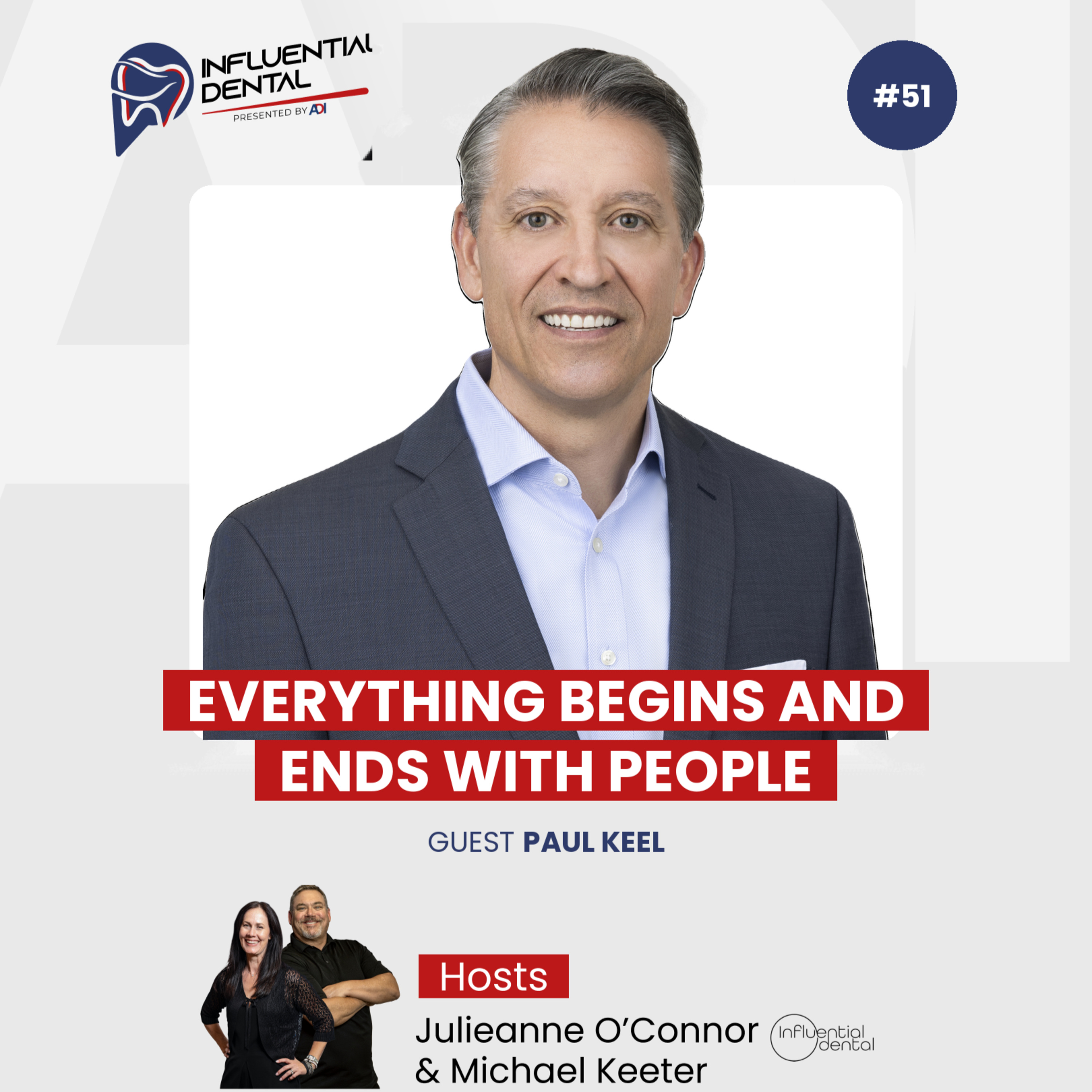
#51 Everything Begins and Ends with People | Paul Keel, CEO of Envista
from Influential Dental
43m 48s
Paul Kill, CEO and President of Envista Holdings, shares his journey from 3M’s healthcare and dental operations to leading one of the world’s most influential dental conglomerates. Central to his leadership philosophy is a "people-first" approach—where culture, values, and psychological safety drive innovation and sustainability. Envista operates across 35 brands through a unified "scan-plan-treat" framework, leveraging digitization, AI, and integrated digital workflows to improve clinical efficiency and patient outcomes. Rather than inventing new technologies, Envista focuses on translating real-world clinician insights into practical, commercial products. Paul stresses that true innovation stems from listening to customers and clinicians, not from technical breakthroughs alone. He highlights the importance of a growth mindset, humility, and team diversity in leadership, noting that the best leaders are continuously evolving. Environmental and technological shifts in dentistry, such as AI and digital diagnostics, are accelerating, but Envista’s long-term strength lies in its deep customer relationships and patient-centered values. Paul reflects on his legacy as one of authenticity and continuous improvement, emphasizing that being true to oneself and listening to frontline users is key to enduring success. His leadership style—rooted in collaboration, transparency, and real-world experience—offers a compelling model for leaders in both dental and broader industries.
(upbeat music)
- Hello and good afternoon.
This is Michael Keter with Infoential Dental
with my wonderful co-host, Juliano Conner,
and we have a special guest today
which I'm very much looking forward to
and have a history with one of the companies
that I have Mr. Paul Kill represents at Envistico.
But before we start, Juliano, how are you doing today?
- Amazing, thank you so much.
I'm so excited.
I'm thrilled that we have Paul on the show today.
Paul Kill, thank you so much for joining us.
Infoential Dental is really all about bringing us
some of the most influential leaders in the world
in the dental space to hear their journeys
and to all of our listeners,
we're so excited about this guest today.
And so Paul, thank you for joining us.
I'm very flattered to be included
and grateful to be a part of the podcast.
- Well Paul, before we get started,
you have a long history being in many industries
outside of dentistry.
For those that don't know Paul Kill,
you should know them as the chief executive officer
and president of Envista Holdings Corporation,
which has many companies in Paul and you listed
because there are many,
that probably a lot of our listeners don't know.
But one that I know, dear to my heart,
is what I got started dentistry is Noble Biocare.
And I shared that with Paul shortly before our podcast
and our friends of Infoential Dental and Julie
and as a K.O. for them as well.
But can you tell a little bit about yourself, Paul,
and how you got to Envista Co.
And so our listeners can hear a little bit more.
- Sure, but I've been kind of in and around
dental for 20 something years.
I started out in 3M's dental business,
actually just up the road from where Envista is now
headquartered in Bria.
3M's orthodonic business used to be headquartered
in Pasadena, California.
So that was my first kind of introduction
from an operating perspective to dental.
Prior to that, I was the strategy and M&A guy
for 3M's healthcare business,
which is now called Salventa.
It's a separate publicly traded company.
My mention that because I've been familiar with Envista
to the second part of your question for 20 something years,
when I was the strategy and M&A guy,
I looked at most of the companies
that now comprise Envista.
And then when I was the president of 3M Unitech,
I went up against the orthodonic business here,
which was no easy task.
Till I've known what a great company this is for decades.
And then maybe four years ago,
you know, some guys on the board gave me a call.
I was leading a public company in London.
And they said, do you in Suzanne, that's my wife,
ever want to come back to America?
Do you ever want to come back to Southern California?
Do you ever want to come back to dental?
And of course, somebody gives you those three questions.
You get, yes, yes, and yes.
Next thing you know, here I am.
- Love it.
Okay, so you know, I'm always jonesing to go to London.
But yes, Southern California is a treat, no question.
Now do you get the opportunity to live close
to the headquarters then?
- Yeah, headquarters in a little town called Braia,
a little bit north of Anaheim.
And most people, you know,
hockey or baseball fans with no Anaheim.
So we're 10 miles up the road from there.
And my wife and I live in a suburb of,
I don't know if you can have suburbs of Braia,
but I didn't count it to Braia.
- Love it.
Well, you have been one of those people
who's kind of been known to really make your leadership
all around people first.
And so we're kind of curious.
This is a huge topic for us.
All the time we're being asked to talk on these topics
like case acceptance and to all these different things,
but really leading with the people first philosophy.
Tell us from a leadership standpoint,
what does that really mean to you?
And how is it that that's kind of been a structure
part of your career?
And how has that kind of led you?
- Yeah, I mean, I guess I would say,
well, people ask them, what do you mean by people first?
I mean, I mean, I mean, it quite literally,
everything in every company I've been in
begins and ends with people.
Over a sufficiently long period of time,
people in culture are really the only
sustainable competitive advantages.
Whether you're working dental, Medtech, industrial,
whether you're an orchestra, a sports team,
any short-term advantage, typically erodes.
If you don't have strong people and even stronger culture,
that's the solidifying force that propels
organizations across decades and longer.
So maybe just to bring that to life a little bit,
from the first idea that'll lead to a new product,
we're an innovation company.
Those first ideas almost always come from the field.
You know what Michael used to do?
I'll talk into dentists.
All the ideas come from the clinic.
The translation of that idea into a commercial
izable product, that's all people that translate
that kind of idea into a physical appliance,
figuring out how you're going to make this thing
in a cost-effective user-friendly way.
That's all engineers.
How are you going to make the world aware of it?
As a marketer, on and on to all the customer surface.
It all begins and ends quite literally with people.
So that's what we mean by, you know,
everything begins and ends with people.
Yeah, and I think you've demonstrated that really well,
actually, and it's interesting because I'm often
out there speaking in the field and I tell people,
even bad ideas can turn to good ideas.
So it's really important to start with psychological safety
with your people and make sure that they're
able to get ideas on the table.
And so it's interesting because when you talk about innovation,
I think people forget sometimes that the people
who are really matters, so I appreciate that answer.
Thank you so much.
It's exciting to hear somebody who's at your level
who's really built their career heavily on that concept.
Good, yeah.
Yeah, and Paul regarding that because obviously,
Invista is a very dynamic company.
I don't even know today how many business units you have,
but from other names, like Nobel-Biole Care Dexas,
Implant Direct, OEMCO, or Scoptic, and many others,
tell me how you're able to lead
with that people first among a very diverse
and a large global organization,
multi-billion dollar organization.
Yeah, I mean, of course, leadership
is not about coming up with ideas.
Leadership is not, I suppose you guys are recording this.
It'll come back to haunt me.
Leadership isn't even about completing the task
that lead to value creation.
The value creation comes, we like to say at Gemba.
That's a lean term for where the real work gets done.
Value here gets created in our customer clinics,
talking to the customers,
understanding their objectives
and creating those solutions that make their life easier.
Value here gets created in our factories around the world
who find a way to always make the products ever higher,
quality, ever lower, more effective cost for our customers.
It happens in our warehouses
in our customer service facilities
who when things don't go right, they make it right quickly.
So the job of leadership is not to do any of those things.
The job of leadership is to create an environment
where those things get done in a collaborative,
sustainable, efficient, fluid way.
So the higher you get in an organization,
the more you have to navigate that transition
from doing things yourself,
being a sole contributor to leading through others.
And it's as difficult and as easy as that, I guess.
- So, okay, so I'm a huge people person.
Obviously, we have to have a lot of technical skills
and we grow throughout our careers.
But one of the things that we see as one of the biggest problems
with clinicians is actually the people part of it
where they're taught these technical skills,
but not really how to lead people.
Is there like one or two really tactical tips
you could give to people who are maybe tuning
into this podcast or curious, like how do you do that well?
And are you having fun while you're doing it?
'Cause some of them are burning out trying to do it
and feeling like they're failing at it,
even though they're really not.
It's just the people are dynamic, right?
So what are your thoughts on that?
- Yeah, I mean, in some specific clinical circumstances,
there are direct protocols that everybody can learn.
But for the most part, being an effective leader
of people is about flexibility.
Every two people are different,
every interaction between two people are different.
So there's an infinite number of interactions
and different dynamics that happen.
And then you add to that to all the different clinical
situations that can arise.
So understanding that it's a very diverse set
of experiences you're gonna have,
what you can focus on is building common foundational
elements that allow people to respond
to that varied degree of circumstances.
So you can focus on values, making sure people
that you hire share the values of the organization,
and then doing things that continually reinforce
those short list of really important values
that you can all align around.
There are behaviors that you recognize as integral to leadership.
You make them visible, you have people understand how to get stronger at them, you practice them.
And then in our case, you measure people on them.
Every single non-production employee in Envista, when we get rated at the end of the year,
our rating is equal parts of the what?
You know, what did you perform against quota?
What did you perform against P&L?
What did you perform against your factory cost?
And the how?
How did you behave in delivering those?
So you can work on that.
Your values, you can work on fundamental connective tissue around things like information.
You can, if you're an oral surgery clinic, you can make sure people understand more broadly
the clinical intricacies of doing a single tooth restoration or a full art restoration.
And then people are better connected to those different circumstances that can arise.
They understand the clinical context of what they're trying to do.
So you can't work through every possible interaction that people are going to have and prepare for it.
You know, it's not a Broadway show where you can practice your lines.
But you can get aligned around those foundational elements that help people respond as things arise.
Yeah, no, that's great to hear, Paul, and knowing, again, the investor company for many years
and working within it, I'm glad to see where you're going.
Obviously, the stocks moving in the right direction for your shareholders,
which I am one of, to be full disclosure, so thank you.
But also regarding them on the people, because I've always found that at least in my interactions,
but you're also a technology company.
And I want to go on to lie a little bit, because as Joanne said, we are about people first.
But obviously, the technology can be daunting for some.
And also can be energizing for some, especially a manufacturer that is a world leader in that technology
that brings that full circle.
So can you address a little bit about the kind of the technological revolution in dentistry now?
And where it's going with you and Envista?
And what does that mean for dentistry as a whole under customers?
Yeah.
All right, so I mean, this is, of course, a broad-ranging conversation.
We could spend the whole hour just on technology in dental.
But again, maybe starting with the foundational technology platforms,
most things in dental center around two different platforms.
There are material science platforms.
What chemistry do you use to create a dental composite?
And then there are digital technologies.
How do you convert the clinical ecosystem into math that can be shared, manipulated, built on?
The second one is probably more interesting for the audience.
People, you know, are more familiar with digitization.
And that often gets clustered into three categories of technology trends.
You know, the first is taking the analog and making it visible.
You know, what people call digitization.
Easy example for people, you know, who've been in and around dentistry for a while.
Go back just 20 years, 90-something percent of all patient models.
You know, a component of almost every dental procedure was a plaster model.
A hundred percent of all patient records, which every patient has every procedure has,
was stored on paper just 20 years ago.
Today, I would guess 90 percent of both of those are digital.
All patient models are done digitally now.
And all patient records are digital.
You know, Julian, I know you're familiar with Dexas.
So you'll know they have about 50,000 pieces of equipment in service around the world.
They're installed based.
Those 50 pieces of equipment generate 500 million digital images a year.
That's 10,000 digital images for every machine.
And just the scale of that gives a feeling for how rapid this digitization has been in dentistry.
The second category, of course, everyone wants to talk about.
Importantly is, you know, you can't have a thoughtful conversation about technology
in anything today without talking about AI.
Almost every dental procedure has the same three steps.
Well, we phrase it as scan plan and treat. There's a scanning step up front,
the diagnostic step.
It might be an intraoral scan.
It might be a 2D x-ray.
It might be a 3D x-ray.
There's a treatment planning step in the middle where the case is designed.
And then there of course is the therapeutic step at the end where the care is actually delivered.
And AI now exists across all three of those.
AI very, very active on the diagnostic step.
Very highly penetrated already in 2D x-rays.
These are things like early careies detection, periapocole, translucency.
All of that is automatic now through through math.
The treatment planning part also very, very quickly penetrating how AI is for that.
You know, used to be a couple-hour procedure.
Michael Mose implants well for a surgeon to take,
capture all the anatomy of the patient, then design the case.
It could be, you know, an hour or two after the clinic is closed.
Today you can go from a patient in the chair with a CBCT to a full digital treatment plan
in about five minutes.
That is all just math.
And then the treatment piece of that, all of the customized dental appliances out there.
A clear aligner, a custom lingual braces, certain lab products.
All of that is made possible by some core IP that was originally developed way back in the early 90s.
Wasn't called AI at that time.
It was a doctor named Craig Andreiko, who some of you might recognize the name.
He was the CTO of Bornco.
And he filed the first patent for both digital treatment planning and custom orthodontic appliances.
Those two technologies combined give you all of these other custom dental
appliances.
So that's the second category around technology that's super important.
And then the third I would point to is the integration of the two.
Now, going across those three steps, the integration of the care continuum,
that's always been the job will always be the job of the clinician.
They just used to do it in their head.
Now they do it through software platforms, through connected ecosystems,
which not only makes it possible for them to do in an organized way,
but it allows them to collaborate across clinicians and across sites.
Because only one person can work on a stone model at any given time.
An infinite number of people can work on a digital model at any time.
The same time that a clinician is designing an orthodontic case, there can be a digital designer
in Costa Rica, making or digitally making the clearer liner for that doctor in real time on
the same model.
You guys are all familiar with this and your own kind of work that you do.
So those would be the three technology trends I think worth noting,
digitization, AI, and then the integration of clinical workflows.
I want to circle back on this in a moment and just, you know,
I definitely want to talk to you today about where you see things are headed with all of this
that we're talking about. But before I want to, I kind of want to switch tracks.
So a lot of our listeners want to know the story behind the human who has
risen to such a high level of success, which you have in your career.
And you've worked with like the most iconic brands, some of the companies you've worked with,
you're working with one now currently that that were personal supporters of, of course.
And we are everything from our magazine to our podcast.
We talk about mindset and we talk about lifestyle and we talk about some of these topics that are
a little bit outside of the realm of clinical as well. And so for our listeners,
I'd love to just kind of broaden the view on who who is Paul Keel.
And how do you bring mindset into everything that you're doing?
How does it keep you grounded? How does it lift you up? How does it help you to sustain a very,
very busy and important schedule where there's a lot writing on your shoulders?
Because, you know, you hear so much from these, these great leaders about how they're expected to
have all the answers. Do you have all the answers? And what's the story here? Like, what's your
personal story here? How do you end up in this position? Oh, wow. I mean, we could go a lot of,
a lot of ways with this. But I would tell you this, in your question, you talked about mindset.
And I think my answer would would center around mindset. In particular, something many listeners
will be familiar with a growth mindset. The woman who's typically credited with turning this,
this thought into research is Professor Carol Dweck. She's a psychology professor at Stanford.
It's called a growth mindset. And as a hasty generalization, her view
is that people genetically,
the distance from what you would consider
the most talented person to the least talented,
genetically is very, very small.
But the difference in people's ability to grow
and continuously improve can be very, very great.
And it's people who have that growth mindset.
Some of it has genetic elements,
but a lot of it is behavioral and how we were raised.
A lot of that determines where you come.
And so, you know, thinking your world's folks
who you respect for achieving something,
maybe they're great parents, maybe they're great siblings,
maybe they're great business leaders,
maybe they're great coaches.
I think many of those people ended up there
because someone challenged them early on,
stretched their growth mindset,
said you can do more than you're doing today,
you could do this tomorrow,
and then you can do something more.
And it's folks who had those series of expectations raised,
most of us raised, most of us delivered, what's asked of us?
It's the asking that that that makes a difference.
And you have to do it in a constructive way.
If you do it in a destructive way,
it shuts down a growth mindset.
It causes people to feel insecure
and makes them question their ability to grow.
But if you do it in a positive way,
it accelerates your ability to get better.
You know, for kind of a quantitative people in the audience,
the simple way I think about this is the equation for a line.
Why equals mx plus b?
Why is the dependent variable?
That's the outcome.
For this conversation, it's whatever you achieve
around your, you know, your personal list of ambitions.
b is the growth mindset.
That is the slope of the curve.
We can all make our curves steeper
if we can learn more quickly,
be more open to feedback,
be less defensive about areas that we need to get stronger.
And then the b is, you know, that's luck.
We have born on second base, you know,
do you have the socioeconomic means
to get the training you need, those sorts of things.
But the most important factor in any line is that m.
That ultimately determines the y.
The outcome is how steep is your curve.
So we go a hundred ways with your question,
but I think growth mindset is at the center
of certainly most of what I've achieved in my life.
I know different than anyone else.
I have five siblings.
All of them are very successful in their own way,
but completely different ways.
Two of my siblings are math professors.
Exact same genetic material as me.
I can't do what they do.
I don't think they could do what I do.
It's because of our theories of experiences
that led us to where we were.
I just want to know if you don't have a lot of in our lives.
We both have, all of us got a lot of in them.
I'm curious if you're the middle child first board,
like where do you fall in there?
Well, my siblings would say I'm six out of six
in terms of SAT scores.
I'm five out of six in terms of birth order.
Okay, okay, got it.
Still a middle child somehow.
There's a book in there, right?
Yeah.
So Paul about that mindset, that is so refreshing
because I agree and to be challenged
and I've been challenged around my career.
I'm challenged by Julian and I appreciate her for that
because I can't always grow and stretch in.
We all can regardless of your CEO, the president,
or whoever we all can grow, a sales rep or what have you.
You'd mention a little bit about your siblings.
I guess I want to dive a little bit deeper.
Obviously, if you want to talk about it,
you don't have to, about maybe a mentor you had
or a mentor you've had that have been influential
in your life, your parents, or whoever that may be.
I guess I want to go back to a child, Paul Kiel,
or kind of what was that tipping point for you
on maybe a few mentors or coaches or people
that you had in your life.
And that were important to you and really had you think
about that, Emma, really had you on the trajectory
that you were going to be on.
Yeah.
I mean, certainly learning has always two components to it.
There's a transmission component.
There's receiving the coaching or the education.
And then there is the reception point.
Do you hear it?
Do you do anything with it?
The second part goes back to the growth mindset conversation
we just had.
I was fortunate to have a number of very good teachers,
very good parents, very good siblings,
but nothing spectacular.
You know, I grew up in a middle-class family
in rural Minnesota with immigrant parents.
I don't think my personal socioeconomic situation
was unique.
And then I had a series of really good coaches and bosses.
But it's funny, just a few weeks ago,
a couple of my kids were in town.
My very first boss out of college, Brooks Gackler.
He sent me a note and said, "Hey, Paul, Jean and I,
"that's what I've seen.
"We're going to be down in Laguna Beach.
"Do you and Suzanne want to meet for dinner?"
And I said, "Well, you know, two of my kids
"and one of the boyfriends is in town.
"Is it okay if they come?"
And Brooks said, "Of course."
And so my kids said, "Wait, wait, wait, wait.
"You are still friends with your very first boss
"out of college, 35 years ago?"
Yeah, I'm very good friends with my third boss
out of college.
The boss I had at 3M for the most years
remains a super good friend.
And I think that is because this two-way street
of mentoring, you gotta have a great mentor,
but there's a lot of good information out there
that comes our ways.
Our way, it's the reception part, be open to it.
Most people don't give you feedback
out of nefarious intent.
It's usually given out of good intent,
they want you to get better.
It's having that flexibility, that humility,
the joy of learning that allows you
to receive it and do better.
It's interesting.
So for our listeners who can't see
who are maybe not watching this on video behind Paul,
he's got these posters that have to do with confidence
and improving lives and values
and all these incredible things
that obviously speak volumes about
who you are and what matters to you, right?
So I love everything that you're sharing.
I think it's so interesting.
And I think it's especially interesting
when you have somebody who almost comes across
and I never would like to judge anybody,
but you come across a little bit serious,
like very intentional about the way that you speak
and the way that you present things.
And it's very methodical and systematic
almost in the way that you approach your answers.
And so it's interesting
'cause then there's this other side, right,
which has everything to do with, like, I don't know,
these other personality pieces or components.
And so I, you know, I'm just,
it makes me curious like how you go about hiring,
what you're looking for.
Are you looking for people similar to you?
Do you look for people completely different than you?
Like, what is that experience like for you
when you're surrounding yourself with people?
Obviously, you build tight bonds with people
and that says a lot about how you build trust.
So, but I'm curious about the,
how you bring people into your circle.
- Yeah, well, this job was a good exercise in that.
When I joined Invista, whatever, two and a half years ago,
there were a number of openings on the senior team.
The CFO role was open the head of two big president roles,
both implants and ortho were open,
and then a number of kind of second layer jobs.
And so we thought a lot about the team
that we wanted to build.
And no different than anyone else with a hiring decision,
you know, we thought about it along the three axes
that we all think, you know, think about hiring somebody.
You think about it around a skill axis.
You're hiring a CFO is what we did.
You need somebody who knows accounting, you know,
it's kind of a basic skill you want to have in a CFO.
Second thing is you think about it along a behavior
or a personality perspective.
Some people like Myers-Briggs,
there's a more approachable version of it called insights
that I like it translates them into colors.
And then you think of it along an experience axis,
the kind of three dimensions of picking a person.
Do you want someone who worked in Medtech?
Do you want someone who specifically worked in Dental?
Do you want someone with global experience
or, you know, single country experience?
And then I have learned that I try to hire people
who check different boxes for me.
Just by factor of your title, you know,
you put CEO behind a collection of skills, experiences,
and behaviors, it carries a lot of weight in a room,
you know, because it has that big title.
So you have to balance that with a lot of other people
on that spectrum so that you get the full composite
of experiences, behaviors, and skills you need to lead a company.
And that's what we did.
There's a couple people who are, you know,
typically like me on the management team,
but the vast majority, I think, if you're met with them,
you'd say, oh, these are pretty different people than Paul.
I have seen nothing but positivity since you've come on.
By the way, you know, I have known a lot of people
for a ton of years in this industry
that were where the company left came back to them.
company since you've come in, really, really incredible humans who are so loyal. And so I love
you don't see that I'm sitting here writing note skills experience personality traits and insight,
you know, and I wrote down insights. I want to check that out. I haven't actually experienced that
particular one, but but it's you've you've had already in a very short amount of time a pretty
profound effect on this company. And so I don't know if that's because you came in and brought in
these people or was there something in particular that has led to these shifts that we're seeing
that it's palpable, you know, there's a definite impact that you're having. And so do you can
you put your finger on what that is? Is it the people around you? Is it you? Is it something else
that's shifted? I'm just curious. It's it's it's awesome. Yeah. I mean, we certainly have an
intuition of what we think needs to be done and, you know, but there was a logic to the actions
we took. And so I would tell you three things we believe very strongly. First, is we believe that
dental is a sacrilegly attractive industry. We think that it has structural foundational elements
that make it a great place to do business. We can get into those if you want. And so when when I
joined in 2024, because I'd been in dental for 20 something years, I believed that the air pocket
in dental growth following that record year in 2021, when we all went back to the the dentist,
I believe that air pocket was temporary, temporary. Many folks thought, okay,
dental has been structurally changed by COVID and by DSOs and by digitization.
We don't we I think my management team to a person would tell you, no, we believe dental is
structurally attractive. Second thing we all believe, even those of us who came from the outside,
is that indista is a very coherently organized portfolio. Very smart people
spent a long time assembling this portfolio. And it's a good collection of assets. That's a second
thing that I think has contributed. And then the third, maybe the piece that we added or reinforced
is that good businesses like in Vista in good industries like dental can be better managed.
You can spend more time focusing on people. You can convert good intention about people
into real processes and real activities that demonstrate your commitment to people. We're
fortunate to have grown up in Danaher. Danaher has a lean management system. They call DBS,
the Danaher business system. We have that. We call it EBS. You know, in the kind of the chaos
following the big post COVID run up, we kind of got away from EBS. So we establishing that pillar
of our culture was very effective. And then we're a publicly traded company. Our CFO likes to
talk about the say do ratio. It's important what you say. You have to be thoughtful on what you
commit to with shareholders. And of course, the do is super important. You have to do what you
said you're going to. These are all management systems. There's no great insight or creativity
and what a well managed company looks like. Most of us had the experience in one or more of those.
I had the experience in three very well managed companies. So good company and a good industry
well managed ought to result in improved performance. And that's basically what's happening.
I can see what they hired you. You create a place of, it feels safe that you're going to create
predictable outcomes based on things that have been done before. And it doesn't seem like there's
a mystery to it. You're so straightforward about it. I really appreciate that. So, sorry,
Mike, go ahead. No, I was going to say, Paul. And I agree with you. Dentistry isn't the
gold major dentistry. Even when I started way back when my first and all job of noble bowel care,
it was about 18 years ago. And then it was still the gold major. I think it's only going to keep
rising with the innovations in the industry. Obviously, you know, the demographics with the
baby boomers and everything else. So, dental definitely is a space to be. Also dentistry and dentist
are now first line in the healthcare field because obviously the mouth connecting to all other
types of disease and humans. And the fact is you do have an X on portfolio. And obviously being
a publicly traded company, I know you can't break any news here. But I'm sure as someone that
wants to add to that portfolio, I'm sure you continue to look for other companies around that.
Talk a little bit more about the same Vista as whole. How many companies you have within the
portfolio for those listeners or people that are watching that don't know? Obviously, you're growing
out at a rapid rate. But tell me about, you know, the companies in general and where do you see the
growth coming with that? We have 35 different dental brands and we cluster them around four
operating units. And the four operating units follow that same architecture I mentioned earlier,
the scan plan tree. So, we have a diagnostic business that you guys referenced earlier.
Dexas is a well-known brand in that portfolio. Many of our businesses do treatment planning.
There's a big treatment planning part for orthodontics, of course, big treatment planning part
for implantology. Dexas also has a software business that automates some of that treatment
planning. DTX is the brand for that. And then of course, we have multiple appliance or therapeutic
brands. Make a lot of different orthodontic appliances. We have a consumables business,
composites immense endodontics, et cetera, implants. All of those fit that scan plan tree.
So, that's the guiding logic for the portfolio. And I believe in it. I think it's distinctive
in compelling. Yeah. So, I have been especially speaking for Nobel Biocare for, I don't even know
how many years. And the number one thing that I get asked to speak on is case acceptance, right?
And treatment planning, some of this is always a high demand topic, if you will. And I
generally get called out to talk about the people side of that, right? And you handle all of the
stuff that supports it. Very obviously, there are a lot of technologies we see popping up all over
the planet right now where people are trying to come into the space using AI to develop products
very, very rapidly. I have no concerns for this company holding their home with all of that as
much as people are saying that the playing field is leveled. There is something about the historical
value of a company and an organization that backs up what is coming. So just looking at the future,
I'm given everything that we've just sort of discussed so far. And I know we don't have a lot of
time left, but can you give us some idea as to how it is that you guys are kind of approaching
the future and what's happening and popping up all around and how it is that clinicians can go
about feeling confident that this is the safest place to play right now and stay, if you will.
Yeah, well, I mean, I appreciate the question. And yes, we are proud of our heritage.
You know, the company goes back 135 years. The first major dental company in America was called
Curred Dental. And that's still an important part about Invisda. And while I would say yes,
Invisda clearly is an innovative company, I think the dirty little secret is we don't invent
anything. What we do is work with our clinicians who tell us what problem needs to be solved. And then
we work collaboratively to address what's in their head. So dental implants, which Michael
Mosewell, the famous story that was invented by Dr. Brenimer. What we did was turn his idea into
titanium screw that, you know, Acia integrated and allowed him to treat a patient for what he was
trying to do. Fixed wire orthodontics were developed by Dr. Larry Andrews. All we did was make the
braces and make the wire for what was in his head. Self-ligated brackets, another great example,
Dr. Damon famous ran he invented the idea of moving teeth with lighter forces. We didn't invent
that. We invented the products that translated his clinical insight into an appliance panoramic
x-rays. That's Dexas. No, we didn't come up with panoramic, the idea of panoramic x-ray. We created
a device that would create a panoramic x-ray. So that mentality on customer-led innovation, we think
works over time. As long as you're close to your customers, as long as you have the humility to
listen to your customers, they will keep giving you ideas. And if you can keep translating those into
commercializable products, you ought to be okay. So that's our view. You know, I wouldn't be a good
guy to run SpaceX, but I'm a decent guy. You know, I love him to let Mike jump in here,
but really quickly, first of all, the humility with which you deliver that message is clear to me
because you're not taking credit for anything and yet you're listening and that's that's huge
for any company, I think. So Mike, go ahead, you were going to ask something. Yeah, now regarding that
in the conditions, you know, listening and again, being involved directly with conditions for
years on the clinical side now. I'm on the mindset and coaching and side of
the business. It all matters. And it needs to come from their mouths. And then you'd also
talk about earlier listening to your, you know, field team where your mid managers as well,
you know, kind of the feet on the ground. I think that is so refreshing. And I'm sure the audience
and the dentist and the dental professionals that are listening are going to appreciate that. So
who knows? Paul, you probably get some calls on people that have more ideas for you. But that's
good to hear in a dynamic space where a lot of people, Juliana, I go out into offices are uncertain
and the team members are not sure. And there's obviously a lot of turnover in the dental space
at the dental offices because of unfamiliar with technology and so on. So I think a partner that
truly can lead and have that relationship with their customers is going to be on that cutting edge.
The question I had, and I know we have a few more minutes is legacy. And we talked a little bit
about brand, right? The brand of the investor brand, the companies with them brand. Talk about the
legacy, I guess, that you would like to leave. And or that you would like to leave for investor. However
long you plan on doing what you're doing. And, you know, what does that look like for you or
be thought about that? You know, the Paul Kill legacy and or the legacy of the companies that you
you lead. You know, across the many varied roles that we've talked about on the podcast so far.
I think what I've learned and it kind of goes back to that great Oscar Wilde quote, you know,
be yourself. Everyone else is taken. So where people mess up is trying to be a different kind of
leader than they they really are. And you're going to get better over time. Yeah, you know,
there's so many mechanisms out there to help you keep getting better and better. And so that's
what I try to do in each of my roles. I hope that I'll be better in this role tomorrow than I am today.
Yeah, I have no intention of ever leading an investor, but if I did, I would hope I'd be a better
leader in that job than I was. I hope I'm a better leader for investor than it was at Smith.
And that's kind of kind of what makes me tick. Love it. You know, I think we're all evolving,
right? And so I really just can't express how much we appreciate you being on our show today.
I always like to be mindful of people's time. And we agreed we would go 45 minutes. And so we're
going to wrap this episode up. But with complete gratitude, I thank you for being on our show today.
Michael, thank you for this wonderful podcast. Paul, thank you. Thank you for being here. And
how can people reach you if they do want to reach out? Is there a social media place that you
like to send them? What's the best place for people to reach out? Oh, I mean, I'm an easy person
defined. It called the investor switchboard. They'll they'll put you right right through. So,
you know, I'm pretty visible in the general community. Incredible. Yeah. What I'd like to say,
again, yeah, thank you, Paul, for being on this. Obviously, we look forward to continually working
with the brands and more of the investor companies as well. You're always welcome on any of our
platforms, whether it's in our magazine, which I think we intend to do a feature on you in our winter
magazine. So I'm just throwing that out there. It is willing. Well, I kind of heard some people
close to Paul said he's willing. So I'm just throwing that out on the table. Thinking of,
I want to say a quick shout out to your team who has coordinated all of this also shout out to
American dentals to who were in collaboration with on this podcast, shout out to Sprint Ray,
some of our other friends out there who have been just fabulous. All great people. We work
with closely. Yeah. So thank you again. And we really appreciate it. And to our listeners,
thank you so much for tuning in and giving us your attention and your time today.
All right. Thank you. Pleasure. All mine. Thanks, guys.
Podcast Summary
Key Points:
Paul Kill has over 20 years of experience in dental and industrial sectors, beginning with 3M's dental and healthcare businesses, and joining Envista Holdings as a return to his roots in Southern California.
He champions a "people-first" leadership philosophy, where culture, values, and employee psychological safety are foundational to sustainable innovation and long-term success.
Envista’s global operations across 35 dental brands are structured around a "scan-plan-treat" ecosystem, integrating digitization, AI, and clinical workflows to enhance patient outcomes and operational efficiency.
Innovation at Envista is customer-driven—clinicians identify problems, and the company translates those insights into scalable products, such as dental implants and orthodontic appliances, without inventing new technologies.
Leadership success stems from humility, active listening, and building inclusive teams with diverse skills, experiences, and personalities to foster collaboration and resilience.
Paul emphasizes a growth mindset as central to personal and professional development, noting that experience and feedback, not innate talent, determine long-term achievement.
The company’s legacy lies in deep customer relationships, trust, and continuous improvement, rooted in its 135-year heritage and commitment to translating clinical needs into practical solutions.
Future growth in dentistry is driven by technology adoption, digital workflows, and AI, but sustained success depends on staying grounded in real-world clinical needs and maintaining a people-centric culture.
Summary:
Paul Kill, CEO and President of Envista Holdings, shares his journey from 3M’s healthcare and dental operations to leading one of the world’s most influential dental conglomerates. Central to his leadership philosophy is a "people-first" approach—where culture, values, and psychological safety drive innovation and sustainability. Envista operates across 35 brands through a unified "scan-plan-treat" framework, leveraging digitization, AI, and integrated digital workflows to improve clinical efficiency and patient outcomes.
Rather than inventing new technologies, Envista focuses on translating real-world clinician insights into practical, commercial products. Paul stresses that true innovation stems from listening to customers and clinicians, not from technical breakthroughs alone. He highlights the importance of a growth mindset, humility, and team diversity in leadership, noting that the best leaders are continuously evolving.
Environmental and technological shifts in dentistry, such as AI and digital diagnostics, are accelerating, but Envista’s long-term strength lies in its deep customer relationships and patient-centered values. Paul reflects on his legacy as one of authenticity and continuous improvement, emphasizing that being true to oneself and listening to frontline users is key to enduring success. His leadership style—rooted in collaboration, transparency, and real-world experience—offers a compelling model for leaders in both dental and broader industries.
FAQs
It means everything in a company starts and ends with people. Strong people and culture are the only sustainable competitive advantages, and value is created in clinics, factories, and customer service through collaboration and psychological safety.
He focuses on creating an environment where value is created at the ground level—like in clinics and factories—by empowering teams to collaborate, solve problems, and innovate, rather than doing the work themselves.
Digitization (replacing analog models and records with digital formats), AI in diagnostics and treatment planning, and the integration of clinical workflows across global teams via connected software platforms.
Innovation starts with clinicians who have real-world challenges and ideas. Envista listens to these insights and translates them into products, showing that customer-led ideas drive sustainable innovation.
He believes dentistry remains structurally strong and will continue to grow, with digital tools and AI leveling the playing field, but long-term success comes from listening to clinicians and translating their ideas into products.
He believes personal success comes from a growth mindset—being open to feedback, learning quickly, and continuously improving—rather than innate talent, and that this mindset is key to long-term achievement.
Chat with AI
Loading...
Pro features
Go deeper with this episode
Unlock creator-grade tools that turn any transcript into show notes and subtitle files.
 PodcastTranscript AI