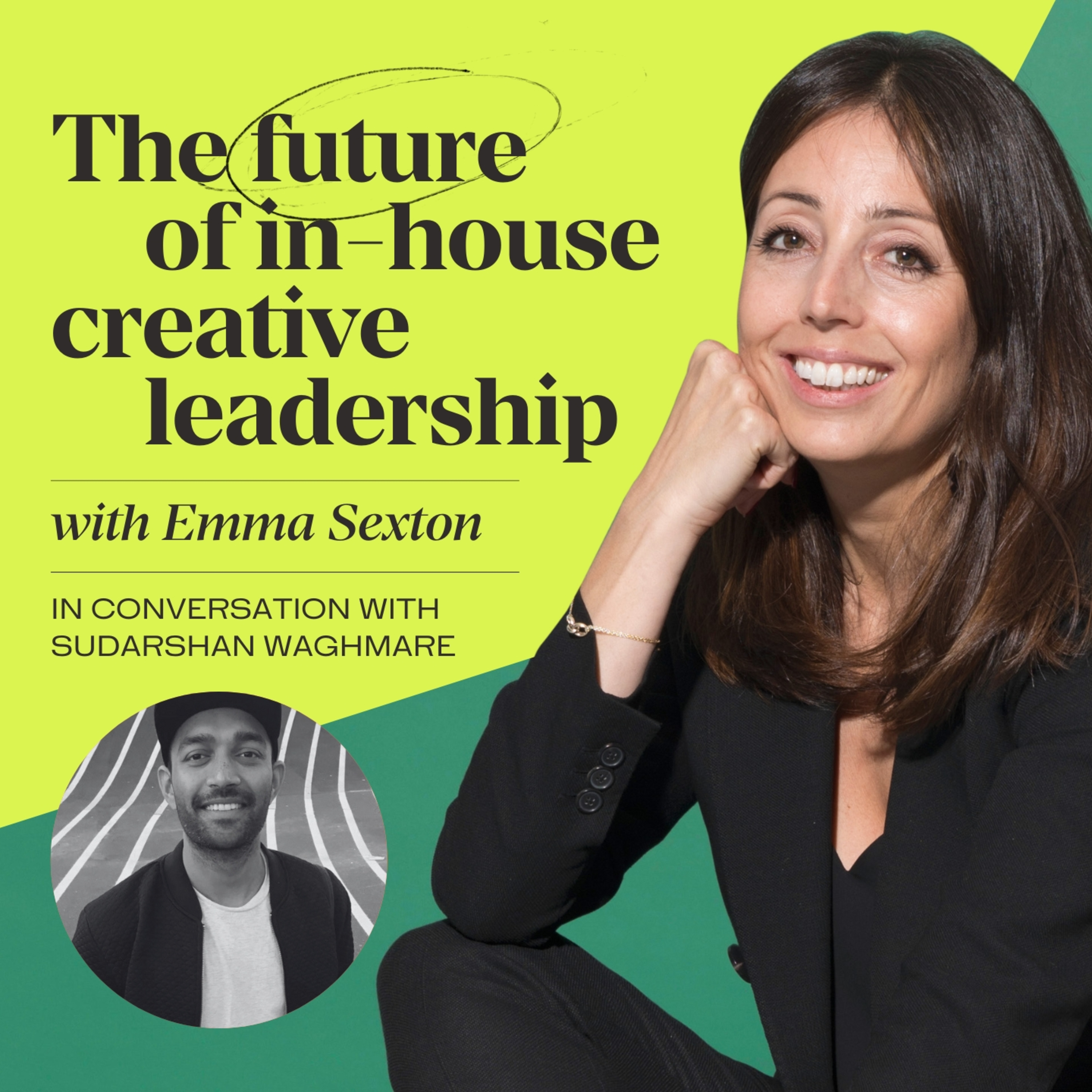
50 Sudarshan Waghmare, Creative and Brand Director
from The Future of In-House Creative Leadership
73m 26s
This podcast episode features a conversation between host Emma Sexton and Sudeepa Marry, Global Head of Brand and Creative at BitPanda. Marry discusses his transition from a 15-year career at prestigious advertising agencies across multiple continents to his current in-house role. He highlights key differences: in-house work shifts the focus from pure creativity to measurable business impact, involves deep immersion in a single brand rather than multiple clients, and requires collaboration with diverse internal teams. Marry reflects on the challenges and rewards, noting the steep learning curve and the satisfaction of directly influencing a company's success. He describes BitPanda's growth as a European investment app and the evolution of its creative team, emphasizing the importance of fostering a creative culture that aligns with brand goals. The discussion underscores the value of experiencing both agency and in-house perspectives for holistic creative leadership.
Welcome to the future of Inhouse Creative Leadership, brought to you by the Inside Out community, the professional home in house creative leaders. I'm your host Emma Sexton, join me as I speak to our community members, award winners, advisors and industry experts to deep dive into how to elevate the role of Inhouse Creativity to the highest levels of business. In this episode I'm joined by Sudeepa Marry, the global head of brand and creative at BitPanda, where he leads the company's global brand strategy, creative direction and visual identity. Now Sudeepa has literally worked all over the world for some of the top ad agencies and he's now been at BitPanda for four years, but he wanted this episode to be a bit different because he had some questions he wanted to ask me. So as well as our usual format where I ask Sudeepa has background and his leadership and the role set up at BitPanda, he flipped the tables and asked me some questions, but what involved was a really great discussion with Sudeepa and the things that he's thinking about, which I'm sure you as a listener will be thinking about too. So we had a great discussion on Inhouse Creative Leadership, the differences from working in house, what things might look like in five years time. So it's a bit of a longer episode, but I think there's so many takeouts and it was just a wonderful conversation. So I hope you enjoy this one. So hello Sudeep, thank you so much for joining me today. Emma, thank you so much for having me. This is my first podcast and it's always interesting conversation that we have had in the past and I really wanted to have that recorded so that more people can also become part of this conversation. Yeah, me too. You're right. We've had some really lovely conversations, so I'm excited to get talking to you today. But let's start how I always start the podcast, which is just nice to get a little bit of a background into your career journey and what's kind of led up to where you are today. So do you want to start with that? Yeah, of course. It's a little bit of a journey. I kind of explained it to my friends as well. These are happy accidents that keep happening throughout my career and that's what ended up here. That's what I would summarize it as. I studied Bashar of fine arts in Mumbai, in India, where I'm originally from and from then on, being part of this artist group, you are open to all doors. The possibilities are endlessly. You can do whatever you want. And that mindset is something that has been carried over from me from that point on till today. After that, I worked in for the last 15 years on different continents. I did Miami-Aid school. I worked in the US, then I worked in Europe for a while. Europe in the sense like I work in Paris for a bit before coming to Hamburg at such. And I've been working in Hamburg, Germany in different agencies like Service Plan, Colorebe, which is now Accenture. And after having done most of these agency things, because I always felt like the reason for me to leave India was to perceive creative pursuit like as a young guy in like a completely different part of the world, expecting or rather hoping that the creative landscape would be completely different somewhere else. And that led me to working at Droga in New York, that led me to working at BDC in Paris, that led me to settle down in Germany. But what I recognized was that after having worked at all of these places, that the core principle or the core life of a creative is basically the same. It is just full of rejection. It's just full of every day pursuit of like getting that great idea, recognize, realized by the clients and you know that pursuit of that one big idea or that one big thing. I was listening to your earlier podcast with Andy Pearson, like he also talks about like this big ideas and that was a pursuit. And it was really fun to do that because in that particular journey, I learned a lot about how marketing works, how advertising is, where are my skills, what are my strengths as a director, then as a creative director. But after doing this for almost 15 years, that's when I realized like, okay, if I really want to, I always felt and this is something that I said in my interview at my like my job as well as like as a creative working in an ad agency, you're always the outsider. So you get the brief for a brand, somebody trusts you with their product with their entire brand and then you come up with your creativity and that creativity leads to maybe it does well most of the time. Thankfully, it has worked well for the client. But whether it does well for the client or it does not, the benefits or the, say the nuttyler, like the pros and the cons, both of them are with the clients and it doesn't impact me much as a creative who put his heart and soul in creating that aspect of work, thinking about ideas for weeks, like working very hard to craft it in the best way. And I felt like, okay, I really want to experience that responsibility and that led me to my first job at the client side, where I've been at BitPanda for the past four years and it has been a journey. Like I feel like working as a creative who has spent over a decade in advertising and then just four years on a client side and especially something like BitPanda, which is a very, very energetic, very young company, like everybody is so ambitious and so driven, you learn so much. Like I feel like everything that I learned in advertising in 10 years, like that's the same amount of things that I've learned in the last four years at BitPanda. Well, I think you're the first guest I've had on the podcast that's had the experience that you've had in terms of the agencies that you've worked with, the countries that you've traveled to. I don't think I've spoken to anybody who's got that breadth of experience. And I think it's also really interesting because you know, you've worked at some of these top agencies, like you mentioned Droga 5, it's very easy to go in-house in your first in-house role and just be like the big know it all. And I just think you haven't, like you just said, I've learned more in four years and I did in in 10 years. I mean, when you started BitPanda, did you go in with this sort of just open-minded, or do you feel like you went in with some agency swagger? Absolutely agency swagger. Nobody can take the agency swagger out of a creative. But you are quickly humbled by your surroundings because you immediately realize it's not just about creativity, the focus. So, funnily enough, like when I was working at the agencies, having one all creative awards, like in every single possible way from ADC to DNAD and all of these things. But like that creative pursuit of having the good creative completely changes when you are on the client side because the focus was like, okay, it's impact driven, like how do I make an impact? It's no more is the creativity, the driving force, it's more about the impact. And then suddenly I always wanted to, with an effort, thankfully I won one last year. And that is, for me, was the highlight and the culmination of the last three years working at as a client because you suddenly get a check mark, the same kind of things that you have experienced for the past decade as an agency, as a creative that there is an acknowledgement from people that, okay, there is something functioning. And the same thing that happens when you have work that has created an impact. And this switch, it's fun, it's not easy, but at the same time, it's, I think it's kind of gives you that new way of looking at the same job, like it's still marketing at the end of the day. You're still talking to the same audiences, you're talking to the same people as you were as an advertising agency guy and same person as you're a client in-house leader of a team and talking to the same community or the same people. And you hear, I get to see because we have like analysis of like how the campaign is working, whether I'm getting the traffic that we are expected to get on a certain campaign or not. And how that directly leads to revenue, that how that impacts the company, how that impacts the product. And there is so much more that as an agency, you're oblivious to, or you, you know about it, of course, but like you don't take that into consideration when you're creating. There are good points and bad side to it as well. Is there anything you miss from being agency side? Oh, so many things. So many things. Oh, yeah. Because there's a lot of creatives who are looking to make that leap in-house. And, you know, I don't know, and I'm a big believer, like the grass is always green away, you water it, isn't it? But there are differences in-house. So I think it'd be interesting for anybody listening who's thinking of going in-house and has had such a stellar agency career like you, like what are the, I don't know, what did you learn really quickly? What are you missing from agency side? Oh, I think one of the major thing is that when you get bored of a client, you can switch to another one. When you're working in the client's side, when you get stuck. So like an agency life, you can take a pause, you have multiple clients that you're working on. So you have a way of, you know, stopping something, clearing your mind. I call it smelling the beans. I don't know if you know this, like when you're between perfumes, you kind of smell the beans so that you clear it out and see the next one. So that's what we used to do at the agency video.
a stuck with one of the briefs that you have something else in the pipeline, you work on that and you jump back again. But this option or this luxury, which now I realize that it was such a luxury to have multiple briefs. But now we don't have that. Like here you are stuck with the same product, the same client, the same brand. And it's not stuck, but like it's a different kind of a problem that you need to solve. So you have different parameters to work with. And this function of the agency is something that I miss a lot from the agency side. Yeah, the jumping around and you know the pitching much as you you were really hard. There's something fun isn't there there. But I guess when you're in house, you're then going in deeper. So arguably there's probably different problems to solve with your creativity. Or you can you can work on crafting and improving your creative in terms of the impact. Right. Absolutely. And also like the group of people that you're surrounded with, right? There's a different mindset of people that are like if you are all creative in an agency, there is a different you're in a sink in a different way. But in a in a brand side, you're exposed to so many different talented people from different areas. You have to actively work on sinking with them, understanding their problems where they're coming from like what are their restrictions? Why can't we do this? Where we are not. So you have to be understanding enough for different departments and you're working with a completely set of you're working with a set of people that have a completely different mindset. And this is something that you have to get used to. And it's really for me, I think it's more beneficial that way because I learned so much more outside of my area of expertise than what I did at an agency, especially when you moved from one agency to the other. Yeah. And I think actually if you have been in house and then you go back to agency side, would you say if you went back agency side now, you'd be a much stronger creative? Yes, definitely. I think because like I said, when you are responsible for the impact and you don't want to compromise on your creativity, I think that gives you a really nice mixture of making sure that you live up to both those standards. And that will definitely be the case. But I feel like the agency, the agency world right now is in a place where it is kind of shifting as well. Like we were discussing last time as well. There are a lot of variables that are changing and I myself don't know how the marketing world is evolving. I'm very curious to see that myself. But yeah, I think it's I think everybody should experience both sides of the story so that there is an understanding for it that I would definitely recommend to anyone. Yeah, totally. I totally get that. So tell us a little bit about the set up first, just a little bit of explanation about what BitPanda is for those who don't know. And I'm interested to know how what was the setup of the creative team when you joined and what is the kind of the setup now? Yeah, that is a huge, huge change right now. And it's a so starting from the top, BitPanda is one of Europe's biggest investment app. In fact, yesterday itself we launched one of the biggest campaign for stocks and investment like made makes bitpan. So earlier we were only focused on investment in crypto and like digital assets. But now with stocks that it has become one platform that you need to invest for basically all your investment requirements. And BitPanda is the only European player in the market because the other top two say be it our competitors, they come from different parts of the world like the USA or from China and all of those things. So from the regulation perspective, from the product perspective, from what we are offering like having investment app under the regulation of the European Union, I think that's a huge, huge task. And this is something that kind of attracted me to BitPanda as well because not every company can get through all the requirements because I know from from your past, let's say, from being part of the European Union, you know how strict the regulations are here. And this is where I felt like BitPanda stood out. And when you have a really good product, I felt like my job as a marketer or leading the brand and the creative team there was much easier because if the product is already good, my job is to basically transfer that knowledge, transfer that information to the masses. And when I started, so it was basically, like I said, like most of my career movements have been accidental. So I was very happy working as a freelancer, enjoying my time, but being an Indian at heart, it's not very easy to we have we come with the guilt when you have too much of free time. So that's what happened to me. And I was like, oh my god, what would happen if I don't have a client tomorrow? It was not the case. I had enough of clients. And I started applying on LinkedIn. I ended up with like this very, very nice job description, which spoke to me directly like an art director who has these kind of experiences, who they want to lead a creative team with a fast moving internal teams and all of these things. And I started a Will Rust, who was my ECB back then. Really amazing ECB who has done some amazing work. And he was working for BitPanda already. And I was like, okay, there is this guy who is so accomplished so much and who has done such amazing work. I would want to learn from him. And also he gave me that trust that I can also work at a client. And because if he comes from a huge experience from Ogilv and all of major agencies, it's such. And he had created a setup. So when I arrived at BitPanda, he had already created a very amazing setup of four or five copywriters. There were like a very specialized, there was an in-house production team. There was our directors from different kind of setup. I was supposed to lead the creative in that particular setup. And it was a really different feeling altogether because there were ambitious goals from the company. Because at that point of time, BitPanda was also someone who was not as big as they are today. And they wanted to make that mark. And so overall, the energy in that particular setup was amazing. It was always driving. It was always ambitious. And it was a really big team. But also I could see that BitPanda very early on were investing in creative because you don't hire a heavyweight ECD like that. Unless you are serious about your brand and creativity and you value it, right? Otherwise, you're like, "Oh, just hire a freelancer to do me a logo and create some assets." So that's super interesting. Absolutely. And I think this speaks volumes about our leadership at BitPanda. So our founder, Eric or Bitar, CCO Dominic. So these guys are very, very young, very passionate and they know marketing and advertising. So in order to get good creative, they need good creatives at their disposal. And I think this is where the setup started. And from that point onwards, there were a lot of changes in the team and so on and so forth. I have a very lovely bunch of people that I kind of treasure a lot. I think it's like, so going back to being a creative in a brand side, I think you need to create that space for yourself, especially as a leader or the creative lead. You want to protect your people and you want to bloster this creativity amongst them as well. And this becomes challenging when the people who are in your team, they don't look at it that way because they are also working for a client. So if they are not coming from an agency background, it becomes very difficult to create that space for them. And this for me was an interesting bit. I hope I managed to do that with my team because they are producing some good creative work. And I think the, I was just talking to them today morning and they have created such such a space that I learned today from them then the other way around. Like every time we share something that they have learned in terms of a new tool that they're using or they are doing something else, like we used to have a briefly session. It is my fault now because we got dried out, but we used to have how the fuck are we going to do that? So it was basically a presentation of ideas that we would just put ideas in there which because we all work for the client, it's not nobody needs to approve the creative as such. But what was the point was like how are we going to get it done? And that was a whole presentation. And this is where we tried to bring that creativity and anybody and everybody can throw in ideas into it. Like, and we just have a big bank of stuff that we can later on look back and like see if there is something that we can use from there. And so this was a very interesting switch for me. And I think again, going back to when you your question of like how is the setup today? I think the setup today has evolved from a lot of these back and forth because for me being very honest, like being part of the client for the first time, there was a lot of learnings that I also had to manage. Like, okay, understand the product and also transfer that knowledge to the team, get that creative output from them and deliver on those impact creatives that have been happening so far. So he was journey. And then what would you say is different about the team now to where it was four years ago? I think the team now is more, I would say when I started, we were all actually all the creatives at that point of time roughly on the same round apart from couple of them who have been there for a long period of time. But all of these guys, they evolved in that creative atmosphere. And today, when I give approvals or when they share any creatives with me, I most of the time I don't even have to go to
deep into it because they have understood the kind of mindset. We are all in sync to a certain extent that we know what's coming and how that needs to be tackled and that takes time. Like this is not something that you can skip or accomplish within a year. It takes more than a year or two to basically get molded in that atmosphere. We all own the bitband of brand in such a way that I don't need to look at a creative or a feedback that one of my team member is giving because we both have the same mindset towards our next time. So the difference is the creative team fill deeper in the brands more immeashed in the brand rather than perhaps a separate department. Right. Yeah. That's super interesting. And that reduces the reliability on more people because now I need so I call them my brand warriors because they are like the or the brand guardians. So they kind of protect the brand in different areas which I can't be everywhere. So these are the guys who are basically making sure that we protect the brand. It's consistent everywhere. And that's the difference that I see from we were a team of I think 15 when we started and now we are a team of seven or eight depending on like so we have external. So we have people who basically left the team but still work for us as an external. So it's again a very a very cozy atmosphere to trust each other was the biggest achievement I think that we have created as a team at Bitbandom. Yeah lovely. And also just that sort of the smaller formations of teams but actually the amplification of creative. I'm coming across I don't know I feel like the industry has always been obsessed with size where the agency's side or in house I feel like there's a lot of talk about the size of your in-house team. And I'm like actually no no no it's the impact of your team. The size is totally irrelevant. During where we've got 150 15 or three people the impact that you're having on the brand can be really significant content. So always always like I love working with a smaller group. It's always like I said like that sharing of that mindset happens so much better in a smaller environment. But and this is where I'll come back to you. I have some questions like you mentioned at the start of the episode as well like because I want to know more about these things from you as well which will come to it later. Yeah and you want me to go into that now you want to know? Yeah. Yeah. If you don't mind like so let's start like how you started with my background like I think for the listeners as well I think it would be very nice to know a little bit about you all is because we spoke about it a lot there are a lot of similarities between our backgrounds to a certain extent from the agency life and what you're doing today. So please give us a little bit of about how your journey has been so far. Yeah I love that you think there's some synergies because I really have not had the breadth of experience or the global tour that you have for I'll take it. I'm a practitioner. I trained as a graphic designer. I think I've always been a bit of a hustler really in terms of you know I did a lot of work experience and I didn't do a degree basically because the work experience I was doing I realised that everybody was starting to use Apple Macs and the Unis that I was looking at and we're not even Unis actually it was my local college were you still using PCs and I was like why am I going to spend another three years at this uni when I'm going to come out and actually everybody that I've done work experience for is already using the Apple Macs so I kind of made it my mission to get a junior design role which I got mainly through the work experience that I'd done so I'd made some networking and contacts so you know but I was in my local hometown of Ipswich in Suffolk which is not very glamorous but I knew that I wanted to get to London so as soon as I could earn enough money to pay rent in London I was I was out of there but my first job was an events agency and it was not very glamorous but we were working on some brilliant brands like Sony Play Station and I was doing all the branding. The police station was like decline to work with. It was decline I've been to a PlayStation party, Sorge Merckyre there that was a life highlight but you know I learned very quickly you know working especially in the events industry like you have to build a lot of resilience in terms of you know the timelines and all of that and bringing to bring you to life stuff at events and then I went to agencies branding agencies really and then I did when I was 27 I did an MA in design management part-time because I really felt like I was missing something as a creative and I very much look back now and I can see that I was a make it look pretty creative and I didn't really understand clients feedback I was like but it looks amazing and they'd be like well but we know we need to communicate this and this and this and I was like oh my god they're ruining my design what's happening here and then I did the MA in design management and I was like oh my god this is fascinating because it started to give me some of that business understanding and rigor and I came out of that and I was like oh my god I've just got this different lens on everything I'm doing and then I left the agency and I you know I was really quite ambitious about my career study like I always I don't know I've always been quite determined to do things and I took a role at a company called Lexus PR which were a PR agency and I headed up their design team and they had a couple of PowerPoint people really but they had some great brands and I turned that team into a standalone agency for the company so we were a separate division and because I could see the opportunity of all the clients that we were working on like they were working with top consumer clients top B2B clients so we would do all the work for those and then we would start to build our own our own clients and I got to say I loved it because it was like being an entrepreneur but with no risk so it was fun and then I took another couple of roles in house one was at added value that were part of Cantar so they were a market research company and that was another side to creative that I hadn't understood before and I was their head of expression so I was sort of joke job title but that was all about looking about creativity in the business and I unlocked creatives that they told me were kind of you know these are people who are just doing PowerPoint and some video editing phenomenal designers and we started you know designing products for the company we were creating additional revenue lines but this point I'm like where's the external validation like I need something to to help me with my conversations in house and we were never going to win a D&AD campaign award like there were no awards for the work that we were doing so that frustrated me I then went to the mind gym as their creative director and that was a different remit but very much for me all about the psychology and we were doing all the branding and campaigns for their big learning and development so I've got this really broad generalist view of creativity in all its forms and then I set up my own my own business and that's when I set up the they were the in-house design awards because I felt like they needed to to exist so I am yeah I am a creative by trade and I've hustled my way into the industry but I think I've always felt kind of excluded by the industry and then when I went in house I was told well your career is kind of done now Emma you know and I'm a little bit of a I don't know for me that puts fire in my belly because I'm like don't don't make me the undertook very so I think there are a lot of similarities first of all because that was the same pursuit that led me from Mumbai to Germany Hamburg right now but at the same time one of the things that you said was very interesting is I feel like now I see why you saw the potential in something like the inside of community also the inside out awards that you're talking about so I was also part of the jury for the inside of awards like once you invited me thank you so much for that but there I already saw and now when I understand more about your backstory that this is where it comes from so it's very interesting and I would really like to know what is it that motivated you to start this inside of community because when you started this and like we discussed like we know this from a past but I would also like to know how did you see the potential because at that point of time the landscape was very different and today it is more that there are a lot of like I recently heard that 80% one of the reasons by the agencies are like kind of collaborating together and merging together and all of these things because there are multiple in-house agencies that clients are building today but when you started this community that was not the case so what motivated you? Yeah well I think you know when I when I sort of finished my career in-house I set up my own agency so I had my own B2B branding agency for over 10 years so our clients were Google, Snapchat, Silicon Valley, Bank and you know but my agency was set up in what I think you know is the way that all agency models need to set up now which is this what I call spiky and spoky although we weren't spiky enough really but a very small core team and then our network of freelancers and I had a whole community strategy around our freelancers so they felt part of the business but when I first set out I thought I was going to do consultancy to in-house teams and overflow design work so the awards were half a passion project because I felt like they needed to exist and half are kind of a marketing thing because I thought I might do some consultancy but really they started as a category in the fresh award so the fresh awards were a UK wide awards and I just said to Paul who runs them I said Can I have a category for in-house?
I'll run it. I have my judging panels. They were like that for two years before they became independent and really the awards were just sort of like running alongside My business but my business just sort of went off in its own direction and inside out became its own thing and Sarah Who's my business partner now started running them for me really now? I shut down my business in 2022 quite dramatically and that's a story for another another day But I then found myself kind of kicking around really and I was like well the awards are great Maybe they can give me a little bit of income. I feel like they should exist But I felt really disconnected from in-house and I was like surely the problems have changed Surely things are different and you realize actually No, they're not so it started running some events our breakfast club that we still run now and really that was a way of me Getting some insights from the community like what did they want or how should I shape the Awards good customer insight and I've got a question for you about your your coffee shop Oh, yeah, when you're working the coffee shop to get it get customer insights. We'll come back to that in a second and Really we sort of we accidentally built a community really and then because I was suddenly free and kicking around and I was like Oh, I guess I always I always wanted when I was in house what inside out is now I felt like there was nowhere to go was an in-house creative and the whole industry was just ignoring me and you know many others in house But I felt very disconnected from the creative industries So I think I'm just building what I always wanted to exist and but now I'm super excited about it because I really feel like there's some tectonic shifts happening Yes, and now Everything's kind of aligned to my purpose. I'm really passionate about creativity and business I mentor at Kings and Imperial at their entrepreneurial institute. I know how Brands is a lever for your business and I know that you need creativity and design to deliver on that So I think if I was going to sum up my point of view in one Easy sentence is that business is need brand more than ever like brand is your only differentiator on a global stage now How do you create brand brand is emotion? It's The sum of all the parts not just the marketing not just the advertising is every single facet the business How do you create emotion? That's with creativity and design and that needs leadership So for me I have a purpose about democratizing Design and creativity in business because it's a business lever and it shouldn't be seen as this Smoker mirrors and then secondly now I have this whole community of people who can who can mobilize on Activating that too. So Yeah, there's lots of facets to it. That's amazing. I think the community has grown so much like I Every time when I see your podcast and like all the people from the last two years Like it's everybody like even for the award for the inside out of wards There were people from like really Accomplish really talented people who are working in house which honestly speaking had I not been part of the inside of community I would have never known these people existed and That itself was a driving factor for me as well that oh, okay, so I think You answered this question very well last time and I kind of reflected back on that like one of the reasons why I'm also part of the Inside of community is because like it's not that on a daily basis I get something but when I need that support when I know like okay when I am stuck in terms of how do you do this because I Did not do any in MA in say for example business or I don't have that business experience But as a in-house creative leader you need to know a lot of business aspects as well and When you need to find those answers, I know where to go to so there was like a bunch of people that I can ask questions or Post it on the board like hey, I have this thing how do you go about it and that kind of I mean that kind of helps me to a certain Exiting doing my job today somewhere your purpose has been realized like you are successful at that right now Thank you, but I think everything you're saying there is exactly the ambition city, right? It's like I Like I guess for me I have this unique experience now, right where I've been a creative on the tools I've been agency side. I've been in house. I've run my own agency as well So I feel like you're right you kind of need a combination of all those skills And I think that helps me kind of curate and direct and nudge and know who the right people to bring in because You know, I know the conversations you need to be having in the boardroom Do you know I mean that and I'm not so is positioning myself as an expert But I certainly am a curator and I know the people that we should be bringing in to give you that breadth of experience But it is the business skills and I wanted to go back to just a point in an early conversation I that I had with the UCD that I was really a stand-out moment for me was when you told me about you wanted to get closer to Customers and that business knowledge I wonder if you could share the story about what you did when you joined bit panda yeah, so So the main head office for bitpan and my majority of my team So we are scattered across Europe, but most of them are in Vienna and I work from Hamburg and Coming from the ad agency side, so what I mentioned at the beginning right like you have a lot of creative people and you are in sync And there is a lot of input and exposure of like what's happening in the creative world and how are people doing plus you have different brands so you're exposed to or rather you're forced to look at different aspects of your audiences and try to come up with insights and For me, it became like when you are working for a client Everybody is your kind of target audience So how do I keep my creative gear spinning? How do I know what's happening? I didn't want to be the guy who's out of touch out of sync with what's actually happening with different people because we as humans tend to attract similar people then you create a bubble and you are stuck in that particular bubble of People with same mindset and I wanted to break through this and So what I decided to was like work on the weekends as a barista Like because I have a coffee shop right next door to my house and I always go there and one day the guy was basically overwhelmed with Like all the clients that were there and I was like, hey, do you need help? And he's like yes, and I started helping him and it just turned out into like a weekend geek for myself Wherein I kind of started making coffee. It was fun. I love coffee. So I like very cliched advertising Who wears a hat and loves coffee? Yes, like check check check But it gave me so much of Interesting perspective about a managing stress like it's a it's not an easy place like where do you work in a coffee shop? It's like especially on a Saturday morning Sunday morning. It's a drive. There is a bunch of people You need to be on your pace. You can't take a break like and all of those aspects help me in I never realized this but I kind of gave me that Strength and transfer that understanding and like dealing with that stress in terms of other aspects of my daily business with daily job and Not only that I got exposed to people I had a guy who was basically a 40-year-old 50-year-old guy who had sold his cafe and who was working as a barista in this particular cafe So he had a completely different perspective because what happens is there is a rush period of when everybody comes in and there is a pause period And then there is another rush period So in that pause period you get to connect with like all these part-time jobbers who are students from 19-year-old who are basically just graduating school They ask me about like oh you work at bitfan. So what is investing? Like you know like why do you need to do this to somebody who has had a business did not go well Sold late now working here the kind of mindset that he comes from so there was On a every weekend basis. It was my reset button Like I get a completely fresh set of problems to solve from a completely different perspective Which is nothing to do with what I've been doing in the past decade like it is absolutely a different world altogether And that helped me like coming back to my regular world on Monday morning starting my daily life with a fresh mindset And it worked out very well for over two years three years that I did this But now I feel like okay, this is enough like now I have enough I have learned enough. I need to do something more There are a lot more things that I still need to learn and yeah, that was the whole story that I told you last time But I think that's a great takeout because I mean, you know That's exactly what I'm doing with the community Why is that I have so many conversations like this and it really is about deep listening and finding what you need and I I think that is a takeout Not just for in-house creatives. I think it's for anybody now is It's so easy and I see it all the time with the work that I do at Kings and Imperial where They're pitching and selling their ideas and you can just be so in your own heads And you've got all your knowledge and you really don't take the time out and it's design thinking right in terms of you know As creatives we learn about design thinking and understanding who that end user is But I still think we can make a lot of assumptions or get stuck with our own ideas like I said earlier in my career You know I thought why ideas were great because I had no idea What my clients were thinking or doing or what they needed so I do think that's a good takeout for my conversation So no absolutely and for me what was essential was what I learned is at the end of the day when you call somebody a creative or It doesn't matter what you are called at the end of the day
you're solving a problem. So, and the how you're solving it with what you're solving it, that changes. So, as a creative, you're solving a business problem as well. At a client side, you're still solving a business problem. So, there are a lot of similarities. It just that the way you approach that solution depends on the skillsets that you learn from. So, I had this conversation with one of my colleagues from BitPanda as well, where he said like, "I'm not a creative." I was like, "That's not true." Like, maybe you might not be called creative, but you are solving a business problem in your way, in your department, in, for your purposes. And it's very similar to all of these things that we're talking about. Like, at the end of the day, certain mindsets that you come up with, they apply whether you're working in-house or where you're advertising. And that doesn't change. If that's what you are kind of honing your skills towards solving a problem, then you can work at any place, like even at a coffee shop. Yeah, yeah, tightly. Now, it's a good advice, a really good advice. Well, isn't your question or my question? My question, my question, my question. So, just going back to something that you touched upon in terms of having conversations with different in-house creative leaders. So, what I think people would also like to know, and especially me, and this is something that I also pitched to you that I would love to know from you that you have spoken to so many different creative leaders so far from small companies to like giant, giant, so PWC to like all of these big companies. What are the similarities that you have noticed? What are the changes that you have noticed so far? If you can give us a summary of like how these conversations have evolved in your perspective? Yeah, definitely. I can definitely give you some patterns and themes. I think one thing is clear is that there is not a single model for in-house teams. It's where I find the industry conversation about in-house agencies and being lead agency like a tiny part of the conversation. I'm interested in the full breadth and width of what being a creative insider business can be. So, I think if I was going to, I did I did have a think about this and sorry, I've got a few things for you. So, one, I think there's definitely ego versus being an entrepreneur. I think what you said earlier about going in with that agency swagger and slightly being in our own agency heads is that that is a recipe for disaster. And I think that there can be a real miscommunication. There's a baptism of fire that I see heavyweight agency people go through when they go in-house because they forget that you're like you said, creative is not front and center impact is creative is about serving that impact, serving the business. But the ones that get it can be humbled by it like you have been. But they seem to be the ones that have this sort entrepreneurial aspect of it. The fact that you wanted to go to the coffee shop, that for me, you know, with all the business studies that I've done, that's an intrapreneur skill, right, to really, it's also a design thinking one, but to really want to understand what is the problem that you're trying to solve and being really tenacious about that. That's entrepreneurialism. So, I think ego versus intrapreneur is something I see the in-house teams are thriving or the leaders are thriving versus the ones that might be struggling. I think and that also leads me on to another point which is about being a creative adventurer versus staying in a creative cave. So, I think it's very easy to stay in your bubble to create your own unique culture to cut yourself off from the business because as a creative you don't identify with the company, the values, the corporate culture. And I think being a creative adventurer and, you know, talking to other people across the business, you know, connecting with the CFO, you know, really making time. Again, it's understanding all those different perspectives rather than staying in your bubble. I also, the creatives that tend to do the more interesting work because, you know, teams can stay at that kind of reactionary level and I think it does depend how much the leader is willing to be the creative explorer, the creative entrepreneur. I think it's not about in-house agencies and I don't think it ever has been about in-house agencies. I think that the industry, that's what they know is what a lot of creatives know. But, and I think, you know, we're seeing a bit of a backlash on the agency model, but, you know, I'm very, when I first started talking to people, because I hadn't been in-house for so long and the industry was talking about agencies, I was like, oh, that must be right. And I think I sort of sat back and had all these conversations and then I became, I had a hypothesis, basically, that I was like, I don't think it's about that. Let me see. And I now, I'm super confident in that point of view now. And I think it's actually we're moving into a time where seeing yourself as an agency probably will do you a disservice. But equally, I don't think it's a one-size-fits-all. So that's what I would be mindful of is a creative going in and being very clear how they're going to build their team. I don't think you know, until you know the business. Is it a B2C? You know, what kind of brand is it? Where are they operating? Who are their customers? Where are their customers' eyeballs? That helps you to decide where your creative team might be, might be structured. I think something I've observed, especially through the awards, is Inhouse Creatives are the most rigorous. And Inhouse Creatives at Charities are some of the best creatives at delivering ROI that I've ever seen. And they tend to be the teams that don't get recognised because they don't have budgets to enter awards. That's why we have free categories. But the case studies we've had from charities have been exceptional. They have the minimum budgets. They have the maximum impact that they need to have. And the deep insights, because often they're dealing with really tricky sensitive subjects. So they have to have really deep empathy in audience understanding. So Charity Inhouse teams are overlooked, but they are some of the best creatives. And I think lastly, Tenacity is a bit of a battle. I think it can be really difficult inhouse because the whole business, unfortunately, partly because I think the creative industry has done a disservice, partly because there's not a single business book that I've read that helps you understand creativity, design, brand, that you're in a company that really doesn't get what you do. I think those people get what HR does. I think those people get what the finance team does. Creatives, everyone's like, I don't know what the hell. And I think that there's a, you have to have a tenacity to help the business understand that. And it has to come from us. And I think a lot of people are like, well, why should it be us? The business should understand. The reality is they don't. There's no education that they're getting. Like, I don't know, I'm always a sort of a self-agency person. And I think it always starts with me. So I'm a bit like, well, and that's, I think that's my goal within sight out is how can I give these in-house creative leaders more of the business acumen to help you have more influence and persuasion. But tenacity is a big thing. No, that makes complete sense because like, what are you discussing? So I've been a teacher at Miami-Aid School for the past seven years. I've taken a break now. But when I talk to like what I mentioned to you as well, because the like what you mentioned, the landscape is changing on a daily basis, having places of information for people today, like more and more from agency setups and everybody is discussing about how they do not need, say, entry-level jobs or juniors at such. And I ask myself the question, like, as a student today, like, if you don't get a job, if you're not a junior, how are you supposed to, you know, go forward? Like, how are you going to gain those experiences? And it's very important to have the tenacity and the mindset already to a certain extent with every creative today, then what it used to be in the past. Like, you are, you need to be able to mold yourself according to your surroundings, wherever, whatever that might be, because earlier, there was a very different way of looking at a creative, looking at the agencies. Today, it is completely different way that we look at somebody who can deliver on creative things. Let's call it like not call it creatives, but like, on creative solutions, so to say. And for me, it has been a very interesting situation right now to transfer this. And like this conversation with you or what we are doing today as well, I feel like there are not many places where these things are being spoken about. And I hope like more and more people get some information and they are well informed and then plan their career steps accordingly, because the career steps that you took for example, and like the career steps that I took, somebody who's studying today, I think they have a much bigger, I would say, or other more broader options than what it was for us back in the days. Yeah, totally. And I also think that they're not, they're not starting from zero. I feel like when I started my career, I didn't know anything, like I didn't know how to put a presentation together. Like now, I just think people are not starting, you can google it, you've got chat GPT as your sidekick. So I feel like there's where it took me, I have a theory that it takes 10 years to master anything, right? 10 years to be.
be really good. I feel like it took me 10 years to be a good creative. I feel like it's taken me 10 years to really be a good entrepreneur, although you're always learning. But now I'm a bit like, "Does it take you 10 years?" Because now there's knowledge that I only gained from reading, listening, talking, waiting for the right people to shape me. And now I don't need to, no one needs to wait for that. But I think it's the signposting. I think that's what the MA taught me, was actually, sometimes you just don't know what you don't know. But once you've got the signposts or the rough map, then you can accelerate your career. So I think there's, where we were sort of, you know, blindly going out, I feel like now people have much more, it's easier to get the signposts. It's easier to know what my skill gap is. So I'm optimistic about this next generation because I don't think they need the nurturing in the way that you and I did it because they've got a lot of that. But what I think they need is the signposting, you know. Very optimistic outlook. That's true. Well, yeah, you have to be. If you run business, you have to be optimistic. Absolutely. It completely makes sense. Well, where should we go next? So one thing that I want to ask you in a very simple way. So what does like this is like a very typical interview question. Like I find it weird. But I think like I want to also understand two or certain things and maybe you touched upon it. But like what is the reason for what what what success would look like to you with the inside out community? You know what? I think. Wow. In lots of ways with there. I think really I just want inside out to be a sustainable business because there's so much more that we could do. You know, like I'd love us to have a bit more budget to pay for some really kick-ass speakers. You know, just to really fire us up. But I feel like to me, it's ticked a lot of boxes already. Like we help people every day. The fact that your you know success is what you've said on in this conversation of how inside out is helping you. That's a huge success measure. I think for me really it's just about being a sustainable business. And you know, the more members we we have the better we get because the more insights we get, you know, obviously the more money we make, but the more money we make means we've got more money to invest in the right stuff to deliver on what we want to deliver. So in a lot of ways it feels success where it is now, you know, because I just feel like I think Sarah and I would both say this. We just feel like we're of service and there's nothing better than feeling that because that's all we in Sarah to do. We just spend all our day going, what do our members want? Who's all right? What do they need over there? And I think that, you know, that's having run an agency, so D and also having started lots of other like little businesses. This is the most fun I'm having. So this is success for me. Oh, it's on ice. Yeah. I'm happy. But yeah, a bit more sustainable, you know, I'd like to invest. We could do with a bit more team time, you know, there's, I mean, there's always more to do. But that would be, that's the next success level. But I'm pretty happy where we are. But, you know, there's always more work to do. It's amazing. I think one topic that I wanted to discuss with you as well is, so which we touched upon. So we touched upon, when you talk about in-house creative leadership, I think we spoke a lot about the creative side of things. But like, I really want to ask you a couple of questions about the leadership side of things as well. Because for me personally, getting into as a creative leader in a brand side of things came with its own set of problems and like modifications that I had to make in my own leadership style. And this is something that another reason what I understood and learned, especially during the insider awards and all of the other creative leaders who are leading teams on the in-house side of stuff, where I could get some insights of like, how do they cater their leadership? How do they modify their leadership as a creative director from an agency side to a creative leader in in-house agency? So let me start with the question for you. Like, how do you see this? What is it that you have learned from your conversations with other creative leaders? What kind of creative leaders have they been? Do you see the changes from their leadership style in-house creatives? And when they, as you compare them to the leaders when they are at say agencies like? Yeah, I think it's interesting. I think we're coming into a really lovely era of leadership, which is authentic leadership, which is, you know, I've grown up in the world where being alpha was the one dimensional leadership style. And I think, especially being a woman, I've always struggled with that. And, you know, I have conversations with people who are like, you know, I'm leading my team, but I don't feel like I'm the loudest in the room. And I really think we can move away from that alpha. I think you can have soft power. You can really influence people with good boundaries, good communication, understanding people. I don't think you need to be the loudest in the room. I don't think you need to be the ego to get that done. And I think also in terms of creatives is, you know, I think in general the industry, you know, we are individuals, strong personalities. I think we're now in a near-away, you've got the permission to be your authentic self. And then there's some skills around that that help, ie, the boundaries, you know, the psychology. But I like to think that we're in a near-air and that's certainly something we encourage inside out, you know, the work we've been doing with Julian Davis. And, you know, we're looking at creating an accelerator. We'll be really about how do we help you be your authentic self? Because I think you can't, you can't be a leader if you're trying to be something else. And you can't have the tenacity, like you're just going to get burnt out, you're just going to be exhausted. So I certainly think, um, authentic leadership is the key. And I think we could do with a bit more of that agency side. I think the ego from agency side has come between it because we've had to sell something, but sell something without the rigour behind it. So there's a little bit of, you know, there was a time that when I was in my career where the agencies were the taste makers because our clients weren't seeing what we were seeing. But now, like my mum has a great eye for design because she's on her iPhone, like five hours a day. She's looking at beautiful design in a way that we, most people were not. So agencies were the, were the taste makers. And now I think that that's all, that's all changed. So, but it has been dresed, like everybody knows what good and bad is and everybody has to be good in order to sell. Yeah. So we need less ego to sell in a creative because arguably we now have the data, the tech, the tools, the deep insights, you know, the test and learn when you look, you know, you mentioned Andy Pearson from liquid death, you know, they are experimenting. They're using social first. Gary Vs just come out with Chuck Media where they're going to basically test and learn on the socials. If it works, they amplify it. You know, so I don't, or do we need the ego to sell in an idea now? I don't know if we do. No, no, no, you're absolutely correct. And that resonates with me as well, like because this is something that I had to also learn and find that authenticity that you spoke about. Like I think that word resonates with me a lot because I mean, it could get very tiring if you're trying to put up a face and like how much are you putting into that, you know, facade that you're building for yourself. And it is so much easier to be authentic. So when like, and I think it's a space that you create as well. So at BitPanda, I feel like it's not just me as a leader of my team, but also my manager, also my director, the kind of trust that they have in me that I can be vulnerable and I be authentic with them. Like, hey, I don't know how to do this or I don't know how we going to achieve this in this particular timeline. And like that authenticity kind of makes a lot of difference in any kind of team on, especially in today's leadership role. And that absolutely, that's very well said. I think that it was very well captured because I was like, Oh, yeah, that that that that kind of, you know, clicks. And I can verify that from my experiences, what you were just saying, like, it's absolutely true. And going by the new, the new creatives, the new team. So our team is growing every day. Like I'm hiring a couple of people now. We've just like the teams are growing and the people who are coming in, they also come in with a lot of knowledge themselves. So I cannot be, there is no way that I can have an ego of saying like, I know more because I don't like it's honestly not. It is, yes, I have a few more years of experience as compared to these guys, but working with them and understanding and giving them that authentic feedback, me being myself, like, okay, this is where I know and I can give you a reason for it. And this is where I don't has helped me in terms of navigating this leadership changes from a creative side to the inhouse side as well. Yeah, I think you know, you think you're right there. Is that being that I think we're all at a stage now where we don't know what's going on because of AI, like we're all at the same start. But you're right. I mean, I do also think there's another thing to add when you're in a house leader, which you don't have to have agency side as much or there maybe you do with your client.
is the journey to delivering and building creative trust, because it's the creative trust that you have within the organization that unlocks and helps you shift from being that service provider to being really consultative, really having an impact, being invited to into the different rooms. And I think that that is definitely a crucial part of being in-house. Absolutely. And I experience that every day, like the good role, like what I realized from the agency side of things to the client side of things was that the, the for a client or for any brand, it's not important who solves the problem. It's for them, it's like, as long as I'm getting the problem, my business problem solved, that's what matters for any business. And that's how it should be. Whether it's an agency, whether it's an in-house for that, it's, it's depends on where you get the most impact from. And right now, I feel like if there are more people who are creatively trained, who are part of a brand, they can deliver much better impact at the moment. But also, I think there is a different side of things, from a client side as well, that the mindset is also changing. The expectation from agencies is also very different. Like when I look at the agencies that we would like to work with, those that we have worked with in the past, they have all delivered amazing creatives, they have all delivered on really good stuff that have helped the brand a lot. But the understanding that me and my team have off the brand itself. And secondly, like majority of the speaking, I think if I'm being very honest, is the mindset of the leadership? What do they want exactly? Is something that we understand it so much better? And it's difficult to translate that to a third party who has not been on a daily grind to translate that product understanding and the leadership understanding, which makes it very difficult for an agency to be on the same level as any in-house team to a certain extent. Yes, the craft skills, absolutely. Like I think the in-house teams still lack a lot of craft that on agency side of things, because you have been doing that for years and years and years, you are so much better at delivering on that quality of that craft that expecting that from an in-house team is still a little bit of a challenge. Yeah, although AI, I think, is going to be a great level of there, isn't it? Yes. But you're right. As an agency, you cannot get close enough to clients. It was one of my biggest challenges when I was running my agency. It was like, I can't, I just can't nail them down to the time. There's information that they just can't share with me or won't share with me. And it is very difficult. It's very difficult. I'm very interested in how the agency model is going to shape because you still need external perspectives, you know? Yes. It is difficult. It is very difficult. And what you mentioned about AI is also something that I feel like it's a leveling ground to a certain extent because it's the same tool that is new and it is available for both sets of groups. Yeah. And it's about who makes the most out of that usage. And like, efficiency is one part of it, but like the output and the craft and the quality of it is where I think the difference is going to be going forward. And arguably, if you're in-house and if you have that mindset of insights, there's going to be a rig, right? You know, the art of AI is going slow to go fast and the slow bit is the brief, the input, you know, the steering it. So, yeah, it's certainly interesting. I hadn't thought about how much AI will level on the, will level on the craft eventually. It already is doing that because for me, like, I feel like I am the junior artist now when I look at what my team is providing me with using AI tools because I'm like, how did you do that? Like, I would take five hours sitting on Photoshop, like crafting small, small pixels by hand and like, there is somebody who can just type in a prompt and like get the same result. And it's impressive to see the same quality that is expected is being delivered at like such a quick pace. But yes, like what you mentioned, the difference there is the inside grid. Like, what is this quality being delivered upon? Like, what is that actually creative? What is that messaging? What is that strategy? Where are we coming from? So, there are a lot of questions that the AI still cannot answer to a certain extent, but at the same time, the execution and the craft things is like getting to an extent which is amazing. I'm excited about it and at the same time, I worry for creatives like myself who are trained in that at old school ways of like, so my exams where I studied my bachelor fine arts from Surgejian instead of applied arts in Mumbai, we did our four year fine arts program wherein we get a brief just like what we do at agencies. But here the caveat is that the answer to the brief is always on a piece of paper with a pen and a brush. So, if you need to write copy, you need to write it with your rotoring pen, like, like, go down with your hand and like, you're not allowed to use any computer gadgets, you're not allowed to use any tracing paper and you have to create that same print ad that you would do on a computer with hand. So, that teaches you a lot of different skills. So, I am right now feeling like, okay, I have all of those skills, but do I need it now? Like, how much do I need it right now? Because if somebody can just create a prompt and five minutes and deliver on a really good quality, then my skillsets are obsolete by the time. No, because you know what good looks like. You know what good looks like. True, true, true. And that makes a difference, true. Yeah, and not just taste though. I'm always in wary of using the term taste, but it's like, you know what good looks like and you also know what good looks like that is going to deliver on the impact and on the brief. And I think it really is about this AI sandwich, right? AI is speeding up that middle bit. And yes, you and I have spent a long time learning the tools to do that middle bit. I mean, I don't know about you, but I feel like 80% of the stuff that I was doing in that middle bit, I'm quite happy that AI is taking that because that's not the creative. Creative always felt like 20% the thinking, the strategy. I knew what the output was going to look like. It then just takes decades to get the skills to be able to get it there. But now you know what good looks like. That's irrelevant that bit in the middle now. Absolutely. Yeah, thank you. Thank you. I'm up for making people. I appreciate it. Yes. On a daily basis, I think I'm facing this fear that we all creatives have. It's just like, how's the industry? So it's not just talking about in-house or advertising, but it's also about creatives themselves, right? What is the role a creative going to play, say, five years down the line? And this brings me to my last question, like, if I may. Today we are discussing, we spoke about in-house and agency leadership. We spoke about creative, some both sites. We spoke about AI. If we were to do this podcast in, say, three years or five years time, what would be the topic that we would be discussing? That's a good question. I mean, no one can predict the future. But here's some stuff that I think I know in my-- I'm 50 this year, city. So I've had 50 years. I've had 30 years in the industry. I've had 15 years as an entrepreneur. I'm obsessed with psychology. There's some things that don't change, right? Human beings, human behavior, business fundamentals, right? So the way that I see it, even the stuff that you're talking about, AI, I can see that you're thinking about all these tools that you've learned and all these things that you learned that are now obsolete. But in my head, if you're an in-house creative leader, it's about direction and nudging. So for me, I think we'll be talking about more and more entrepreneurial skills, because your team might all be AI agents, right? Because they're doing that bit in the middle. And they might be. You might be a team of one, and they're all AI agents. But as a leader, your goal is to know what good looks like, to match that with the-- it's entrepreneurial thinking, right? You create a product or a service that solves a problem, and you have to know what good looks like. So for me, I think it would be about entrepreneurial skills. I don't think that will change in five years time, because I think that they're fundamental. They've been around for years. You can read business books from entrepreneurs 100 years ago, and there's pretty much the same principles, because you're-- and then it's-- yeah, it's knowing what good looks like, and you'll probably be leading on some AI agents. Hopefully lots of AI agents doing the boring stuff, and you'll still have your lovely team of seven or eight people, and you'll just be having a really lovely time. Yeah. But that's an interesting perspective, because I might say, I don't know. Like you said, we don't know how to predict the future, but I completely agree with you on the fact of the entrepreneurial side of things, because if the tools like AI, for example, are letting you accomplish whatever you're thinking about, what you're aiming for at a faster pace, that means that you're left with more time to come up with new problems to solve, and that leads to the entrepreneurial side of things. So I completely agree with what you just mentioned. Yeah, I also think it's an exciting time. I think we're going to need creativity more than ever. And I can totally see brands going to need creativity more.
than ever because brand will become the main thing, not just the one key advertising moment. It will be the brand world that you're creating, but also it's going to free us up. I mean, I'd love to have a chat with somebody like you and five years time and you're like, "Yes, I've got all these AI agents doing the work." And then I spend most of my week in my coffee shop with my family. I do these art projects now. Like, your creativity is unleashed in a way that can't be right now because there's so much doing admin operations. Like, I like to think that maybe that's the world we'll be in a five years time city. This will be amazing. It will be interesting. No one can take it. Well, let's create that future. Let's create it, you know. Let's make it happen. That's the way. Again, thank you so much for the optimism, Lord. And this has been a lovely conversation. I'm like, I really, I feel like it's not just something that I could share about myself, but I also like the fact that all the information that you were able to share with me and this is, I hope like people who are listening would also be of the same mindset that there is something new to gain from this. Yeah, totally. And I think it's been really actually interesting because you've given me a lot of perspectives. I think a lot of our listeners will be thinking about, you know, if you're thinking them, there'll be others thinking them. So it's been such a wonderful conversation. I always like to round up the podcast with a bit of a takeaway. Like what would be your one useful takeaway for any in-house creative leaders like you listening to the podcast today? I think everything that we, so the similarity is that we came up with the entrepreneurial spirit of solving problems irrespective or regardless of whether you're doing that in-house at an agency or whether you are at like any place that you wherever you're working or in what you mentioned right now, like in five years time, whether you're doing that with an AI agent team in five years point, there is certain aspects that still stay common. And I feel like I learned that from our conversation that certain things no matter what changes, like your perspective, your outlook towards those can stay the same because you're at the end of the day solving a problem and this stays consistent throughout regardless of your surrounding regardless of your whether you are running a community of creative leaders or whether you're running a brand new creative team and an investment firm, like BitPanda, it still has similarities together that you are trying to resolve something in your own ways and that's my pick out from our conversation today. Yeah, totally, is that what you do stays the same, how you do it is always going to radically change. Exactly. Exactly. Thank you so much, so the, and also for having the idea to interview me as well, is I've really enjoyed the conversation. Thank you so much. You're welcome Emma. Thank you so much. I'm Emma Sexton and you've been listening to the future of In-house Creative Leadership, a podcast brought to you by the Inside Out community, the professional home for In-house Creative Leaders. Sign up for our free insider membership and start accelerating your In-house Creative Leadership journey today, just head to www.theinsideout.community. Join me next time for more insights and conversations on the future of In-house Creative Leadership. Thank you for listening and don't forget to follow or leave me a review.
Podcast Summary
Key Points:
Sudeepa Marry transitioned from a 15-year agency career at top firms like Droga5 to becoming Global Head of Brand and Creative at BitPanda, seeking greater responsibility and impact.
The shift from agency to in-house work involves moving from a creativity-driven focus to an impact-driven approach, with deeper immersion in one brand and cross-departmental collaboration.
In-house creative leadership requires protecting and fostering team creativity while aligning with business goals, a process that takes time to develop shared understanding and brand ownership.
BitPanda has evolved into a major European investment platform, with its creative team growing from a specialized setup to a more integrated, brand-savvy unit under Marry's leadership.
Summary:
This podcast episode features a conversation between host Emma Sexton and Sudeepa Marry, Global Head of Brand and Creative at BitPanda. Marry discusses his transition from a 15-year career at prestigious advertising agencies across multiple continents to his current in-house role. He highlights key differences: in-house work shifts the focus from pure creativity to measurable business impact, involves deep immersion in a single brand rather than multiple clients, and requires collaboration with diverse internal teams.
Marry reflects on the challenges and rewards, noting the steep learning curve and the satisfaction of directly influencing a company's success. He describes BitPanda's growth as a European investment app and the evolution of its creative team, emphasizing the importance of fostering a creative culture that aligns with brand goals. The discussion underscores the value of experiencing both agency and in-house perspectives for holistic creative leadership.
FAQs
The Inside Out community is the professional home for in-house creative leaders. The podcast host is Emma Sexton.
Sudeepa Marry is the global head of brand and creative at BitPanda. He leads the company's global brand strategy, creative direction, and visual identity.
Agency work focuses on creativity and multiple clients, while in-house roles prioritize business impact and deep product knowledge. In-house creatives work closely with various internal departments.
He misses the variety of working on multiple clients and briefs, which allows creative breaks and fresh perspectives, unlike the focused, single-brand environment in-house.
BitPanda is one of Europe's biggest investment apps. It allows users to invest in crypto, digital assets, and stocks, operating under European Union regulations.
The team evolved from a structured setup to a more synchronized group deeply aligned with the brand. They developed shared creative processes and ownership over time.
Chat with AI
Loading...
Pro features
Go deeper with this episode
Unlock creator-grade tools that turn any transcript into show notes and subtitle files.
 PodcastTranscript AI