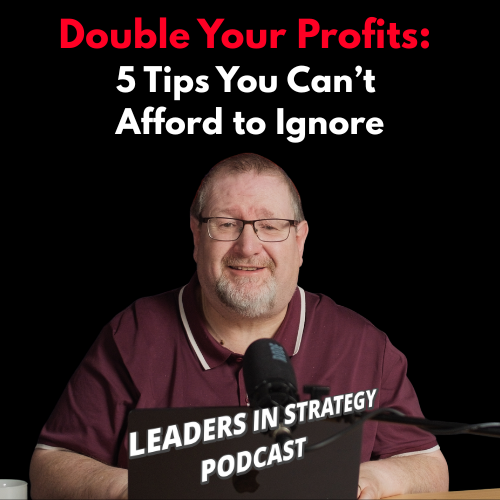
5 Leadership Lessons Most Business Owners Learn Too Late
13m 10s
In this episode, Mike Harris shares five top tips for business leaders to drive growth and profitability. First, he emphasizes hiring and retaining top talent, noting that a business cannot succeed without a strong team; this requires investment in recruitment, training, and creating a culture where employees want to stay, making your business the industry’s employer of choice. Second, he stresses adaptability, as change is the only constant in business; leaders must stay aware of shifts in technology, regulations, and customer preferences, and pivot quickly to maintain a competitive edge. Third, leveraging technology is crucial, regardless of industry; using tools like AI, data analytics, and automation can streamline operations and enhance customer experience, drawing on examples like digital twins in construction and Steve Redgrave’s focus on performance improvements. Fourth, open communication is vital, involving both talking and listening to clients, staff, and stakeholders; this builds trust through transparency and using various channels like one-to-ones, town halls, and social media. Finally, he advises taking calculated risks, not avoiding them; this means analyzing potential outcomes, planning mitigation, and having a plan B, as exemplified by his own success, which appeared improvisational but was deeply strategic. Harris concludes by setting homework: review these tips, select one or two, and turn them into three-month action plans, possibly through team workshops, to drive tangible business improvement.
The balance is taking calculated risks. In other words, managing those risks effectively. Look at the risk, analyse what could go wrong, put in place actions that deal with that. Also look at the opportunities that can sit with it and put in place the actions to make sure those opportunities actually happen. I'm Mike Harris and I help businesses to successfully grow their turnover and profit. In the last year alone I have helped dozens of businesses at least double in size and I work with small, medium and large businesses including startups and multinationals. As you know my day job is advising clients on how to improve their business through strategy and approaching them on how to become better leaders. I often get asked what are my top tips to these clients. You know the advice that they pay thousands of pounds for. Well, I don't tell them but I've decided to share this advice for free. That's right for free. So welcome to the next episode in a regular mini-series on which I will be sharing my not to be missed top advice. Here's another five and if you stay to the end you'll learn how to get exclusive advice which will catapult your career to new heights. Hello and welcome to all your leads and strategy. In season four, as you know we're providing top advice for business leaders. So today I'm going to share more top tips which I give to my regular clients. So the first of these is higher and return the top talent. Without your team there is no business. Many people will tell you your team is your greatest asset and we discuss this on previous episodes of the podcast and I will put a link in the description below where you can have a look at an episode that we had in season three where we debated whether your employees are actually your greatest asset. But anyway that's a bit of a digression. As you grow your business you will need to recruit the best people possible. You'll need to make sure they have the right capability and you create the right capacity. So investment in recruitment, training the people within the business and most importantly creating a culture where people want to stay and grow is essential to how you scale your business. To do this you need to look at how do you become your industries employer of choice. In other words how do you make it that everybody wants to work for your business as opposed to your competition. And if you can do this really well you'd also be looking at how do you encourage people into your industry and work for your business as opposed to other companies in other industries. The second is bear adaptable. Change is inevitable. I would say the only thing that constant in business is constant change. So therefore you need to be aware of it, you need to be thinking about it. We've spoken the last episode about the importance of continuously learning and that really does apply here. So whether it's technology or regulation change or maybe changing customers preferences it's essential that you're adapting and you're able to take those things on board. Just look at AI in recent years it's a great example of how the business territory is changing how you need to stay ahead how you need to incorporate it. So overall be agile be ready to adapt to these sort of changes. Leaders who can pivot quickly will stay ahead of their competition. This episode is sponsored by Strategist Consulting, Expert, Business and Leadership Consultancy for everyday businesses and professionals. What if the key to your business's next growth phase isn't a mystery by the proven process? Is your business at the ceiling with Croffit's flat, daily chaos and scaling up feeling like a risky leap? You're not alone and you don't have to solve it alone. Strategist Consulting is your partner for structured transformative growth. Led by Mike Harris, a proven strategist and project manager with expertise in scaling businesses, bid management and delivering results. We provide clarity through our call service, the Business Review Workshop. This isn't just advice, it's a deep dive analysis that delivers a clear actionable roadmap. We identify your bottlenecks, uncover hidden opportunities and give you the precise steps to move from stuck to strategic execution. Visit www.Stratigist Consulting.co.de right now and transform your business trajectory. So the third tip is linked to the previous one, which is leverage technology. Whatever your industry is you've got to look at how you can use technology and in particular emerging technology. In my industry construction this has meant embracing digital twins, robotics, AI and data analytics. Streamline your operations and the improved your decision making. So a good example of this and we've spoken about it on previous podcasts is Steve Redgrave, the famous Olympian. And whenever he looked at the next Olympics, he was always looking at how did he improve the performance of his athletes. He had this phrase, does it make the boat go faster? So they were constantly looking not just at the performance of the individuals, but also looking at what changes in technology were coming in as far as the boats were concerned. So it may be a change in the design of the oars. It may be a change in the design of the boat itself. It might be changing the material that the boats have made out of. Anything that improved their performance and the same applies to your business. You've got to leverage the most up-to-date technology to see how you can improve productivity. And then also how do you improve your customers experience? So that might be digital, that could be social media, but it can also be a bit like Steve Redgrave with the boats. It can also be things that are more linked to products and materials that are available. So don't ignore transformation in technology. So thought is open communication. It probably seems obvious, but I see a lot of businesses that are very poor in communicating, both internally and externally. And the best way to build trust is by communicating. And when I mean communicate, I don't just mean talking. This isn't on one way straight. This isn't just about you telling others what you're doing or what you want to do. It's also listening. A big part of communication is listening to others whether that's your client, whether that's your competition, whether that's your staff, whether it's your stakeholders, etc. And by combining that, listening with the talking, then you can get proper open communication. So in doing this, share your successes and challenges, let people know what you're doing. This will build trust and it will build understanding and utilise all the forms that are available. So that could be social media, but it might also include one to ones with your clients, some of your staff, holding road shows, holding what I call the town hall meetings where you're talking to a large audience, could be business to business meetings with your clients, etc. And I think that visibility, actually the one to one that face to face communication is the most important of them all. And the last one for today, number five, take calculated risks. So risk management doesn't mean risk avoidance. I see a lot of people who think I'm going to manage the risk by not having any risk at all. But the problem with that is the business doesn't move forward, it doesn't grow, it doesn't develop. It certainly isn't bringing in innovation because innovation means doing things that maybe others haven't done before. So they avoid risk and the business progresses and changes very slowly and often is left behind by their competition. However, taking risk is also, doesn't mean taking the risk recklessly. It doesn't mean just doing it and crossing your fingers and hoping for the best. In other words, managing those risks effectively, look at the risk, analyze what could go wrong, put in place actions that deal with that. So when you're implementing something that could appear to be risky or you're taking the chance and something, you're doing it based on calculation, you're taking a calculated risk. So an example of this is that I was talking to somebody that I know very well and they said that there was a perception of me when I was in business that I was very good at improvising and actually reacting to events really quickly and I was extremely lucky that when I reacted to those events, it always seemed to pay off and therefore I had a reputation for this success and being able to improvise. However, the truth is, I don't think I was improvising at all. What I was doing was looking at a head, seeing the opportunities that might be there, risk assessing it, spending a lot of time planning it. So when the opportunity actually arose, I was really well placed to take that opportunity and put in place risk mitigation that allowed me to effectively manage that decision. So what appeared from the outside world that I was ad libbing it, maybe even winging it, the truth is I wasn't in improvising. It was a very calculating
planned set of actions which meant I was able to effectively manage those risks and I always had a plan B so if it wasn't quite working I could switch to that. Now from the outside world I can see how that may have looked as if I was just going with the flow and taking the opportunities. So remember make sure that you're looking ahead identifying risk and opportunity and putting a plan together so that when you actually come to it you're able to effectively manage those risks. Now for ongoing support join our new Patreon community, subscribe for exclusive content from the leaders in strategy podcast down loadable resources like our annual business plan checklist and access to a full business course. As a member you'll get discounted rates on one-to-one workshops which has to have your business questions answered and featured in special monthly podcast episodes. Let's strategize and let's execute. Join our Patreon now and become a leader in strategy yourself. So that's it for today. I hope that all made sense and in summary tip number one higher and retain top talent, create a culture where people want to stay and grow. Number two be adaptable changes the only constant in business leaders who pivot quickly stay ahead. Three leverage technology, automation, data analytics, AI, they can all streamline your business and can help improve your customers experience. Four open communication remember to listen as well as to talk but be clear honest and build trust internally and externally and then lastly take calculated risks. That doesn't mean avoiding the risk it means identifying it early and managing the risk. As you know I like to set homework and today's homework is this review those five top tips identify those which will benefit you most take one or two of them and apply them both to yourself and to your business and then turn them into action plans for the next three months. I suggest you hold a workshop involving key members of your team that will help you actually get a much broader view on these items you may consider an external facilitator to help you with those workshops and if you do you know where I am and how to contact me if you think I can help. Let me know how you get on I'll be really interested to hear how these top tips have benefited you and your companies. And just a quick reminder where you can find us you can watch us on the leaders and strategy YouTube channel. Listen to us and Spotify Apple podcast, Amazon Music, Podbean and Pod Jaser and of course we upload every episode onto my LinkedIn page and also onto the strategies consulting website. So that's it for today I hope you enjoyed it and you come back next time well we'll have another great episode with a special guest looking at top advice for business leaders. I'll see you then.
Podcast Summary
Key Points:
Hire and retain top talent by investing in recruitment, training, and a culture that makes your business the employer of choice.
Be adaptable to constant change (e.g., technology, regulations, customer preferences) and pivot quickly to stay competitive.
Leverage technology, including emerging tools like AI, data analytics, and automation, to streamline operations and improve customer experience.
Foster open communication by listening as well as talking, building trust internally and externally through various channels.
Take calculated risks by analyzing potential issues, planning mitigation, and having a plan B, rather than avoiding risk or acting recklessly.
Apply these tips by turning them into action plans, involving teams in workshops, and seeking external facilitation if needed.
Summary:
In this episode, Mike Harris shares five top tips for business leaders to drive growth and profitability. First, he emphasizes hiring and retaining top talent, noting that a business cannot succeed without a strong team; this requires investment in recruitment, training, and creating a culture where employees want to stay, making your business the industry’s employer of choice. Second, he stresses adaptability, as change is the only constant in business; leaders must stay aware of shifts in technology, regulations, and customer preferences, and pivot quickly to maintain a competitive edge.
Third, leveraging technology is crucial, regardless of industry; using tools like AI, data analytics, and automation can streamline operations and enhance customer experience, drawing on examples like digital twins in construction and Steve Redgrave’s focus on performance improvements. Fourth, open communication is vital, involving both talking and listening to clients, staff, and stakeholders; this builds trust through transparency and using various channels like one-to-ones, town halls, and social media. Finally, he advises taking calculated risks, not avoiding them; this means analyzing potential outcomes, planning mitigation, and having a plan B, as exemplified by his own success, which appeared improvisational but was deeply strategic.
Harris concludes by setting homework: review these tips, select one or two, and turn them into three-month action plans, possibly through team workshops, to drive tangible business improvement.
FAQs
Hire and retain top talent by investing in recruitment, training, and creating a culture where people want to stay and grow, aiming to become the employer of choice in your industry.
Change is the only constant in business, so leaders must be agile and ready to pivot quickly to stay ahead of competition, adapting to technology, regulation, or customer preference changes.
Use emerging technology like AI, data analytics, and automation to streamline operations, improve decision-making, and enhance customer experience, similar to how Steve Redgrave improved boat performance.
Open communication involves both talking and listening to clients, staff, and stakeholders, sharing successes and challenges to build trust, using various forms like one-to-ones, town halls, and social media.
Risk management doesn't mean risk avoidance; it means identifying risks early, analyzing what could go wrong, and implementing mitigation actions, ensuring you have a plan B, so opportunities are taken based on calculation.
Review the five top tips, identify the most beneficial ones, apply one or two to yourself and your business, and turn them into action plans for the next three months, possibly holding a workshop with your team.
Chat with AI
Loading...
Pro features
Go deeper with this episode
Unlock creator-grade tools that turn any transcript into show notes and subtitle files.
 PodcastTranscript AI