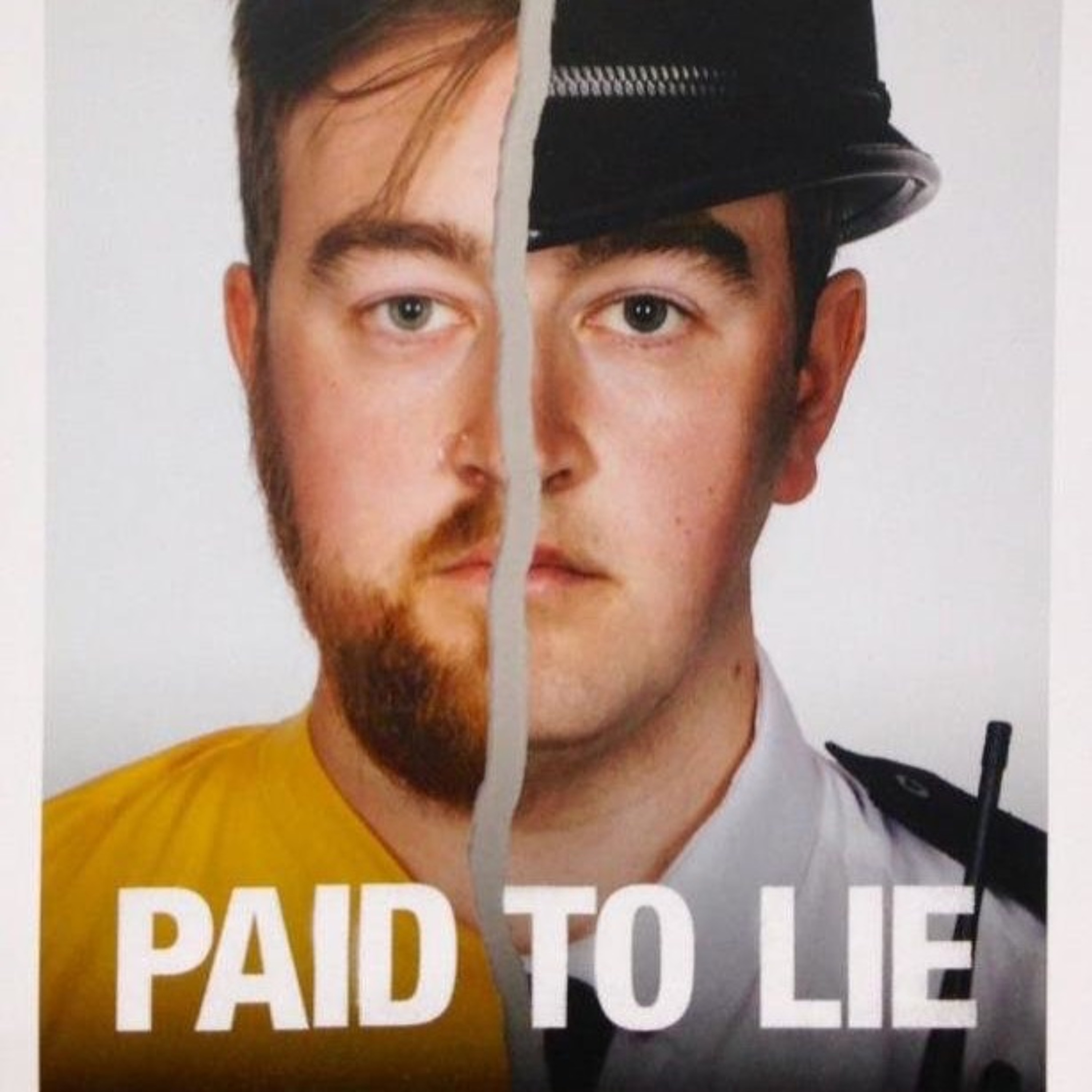
The transcription delves into the dark world of undercover police operations targeting protest movements by adopting deceased individuals' identities. These officers manipulated activists by forming intimate relationships to infiltrate social networks and instill self-discipline within these groups. By using deceased children's identities for cover, officers found a sense of security in their false personas. The operations were not only about gathering information but also aimed at inducing paranoia and disengagement among activists. The story explores the blurred lines between life and death, revealing a sinister side to state control and its impact on social movements. The tactics employed, from deceptive relationships to creating an atmosphere of constant surveillance, shed light on the state's efforts to disrupt and dismantle activist spaces, turning them into realms of suspicion and disengagement.
Transcription
2966 Words, 18423 Characters
From preventing climate change and defending animal rights, to fighting for global justice
and national self-determination, activists and revolutionaries the world across often
position themselves on the side of life, but what happens when the life of a movement
itself becomes the target, what happens when the dead walk amongst us?
This is the story of a series of undercover police operations which upended the orders
of life and death. A story in which agents of the state targeted the vitality of protest
movements by donning the identities of the dead and toying with the lives of their victims.
This is the story of life, death and betrayal on the river Thames. This is the story of
the unliving. From the University of Warwick and orders and decay, this is Ollie Sons and
Nichols on the unliving. Close your eyes, picture a scene for a moment. It's an ordinary Thursday,
you finished work and headed home to enjoy the barmy summer evening. It's still warm
outside and the shadows aren't yet long. You make a pot of coffee and carry the paper
with you out into the garden. Peace and calm fill you. The birds begin to cheer up their
evening swell and a bee bumbles its way towards you from the underbrush. Languid, you reach
across for the paper and begin flicking through its pages. And then your breath catches. A
cold spike pierces the summer calm, casting an icy grip that radiates from your core up
into your throat. For staring out at you is the picture of a man you once knew from what
feels like a lifetime ago, someone you once told yourself you were in love with. Nobody
has seen nor heard from him in over two decades, and yet here he is, looking out at you like
ghosts from the past. Imagine the pain of discovering years later that someone who mattered
to you was never who they claimed to be. Imagine if it turned out that they were someone else
all along. Unfortunately, we don't need to imagine. From 1968 to 2010, at least 12 women
and an as yet unknown number of men were duped into entering long term romantic and sexual
relationships with undercover police officers working for the Metropolitan Service. Each
and every one of them was targeted because they were involved in various forms of activism.
These officers, known by the false names and identities they adopted, would later disappear
from their lives. Amidst the wreckage, some even left behind the children that they'd
fathered whilst undercover. It's only now, many years later, that we're beginning to
piece together the fragments to understand the true scope of what really happened. From
the earliest reports by British journalists in 2010 to the ongoing inquiry now due to
publish its delayed final report in late 2023, a dark history of subterfuge and manipulation
has begun to emerge in which agents of the state worked for decades to penetrate, monitor
and repress social movements in the United Kingdom. This is the story of these operations.
The question at the heart of this story is why? Why did these officers invade the lives
of their victims and what did they seek to achieve? Deeper than this, however, is the
question of what these operations can tell us about the nature of sovereignty, its attitude
toward social change and its vital investment in the continued reproduction of public order.
Ours is not a ghost story, nor a tale of the paranormal, although it may contain many of
these tropes and motifs. Rather, ours is a story of the infranormal, of that which lies
hidden beneath the normal, within the familiar, uncanny, swarming, abject. If the traditional
ghost story is about that which invades our experience of normality from elsewhere, this
is instead the story of what is buried deep beneath its surface.
So how did we get here? Well, let's begin at the beginning. In 1968, the Special Demonstration
Squad, or SDS, was established within the Met, carrying out operations until its dissolution
in 2008. Alongside it was its sister outfit, the National Public Order Intelligence Unit,
or NPO unit, which has now been absorbed into the Met Specialist Operations Directorate.
These were the bodies out of which the majority of these undercover officers operated to target
social movements. To understand how and why we got here, let's set the scene.
1968 is often seen as the culmination of an upswell of public radicalism, both in Britain
and abroad. In London, a pitched battle occurred at US Embassy in Grosvenor Square on 17th
of March 1968, in which approximately 30,000 protesters gathered to demonstrate against
the UK government's support for the Vietnam War. Scuffers broke out, stones and firecrackers
were cast, and mounted police armed with battalions charged with added crimes. All together, over
130 people were injured, whilst estimates put the arrests at around 300.
To the authorities, caught flat footed and increasingly alarmed, these upsurges of radicalism
were a key turning point. The shock, not merely the unexpected force with which public desire
announced itself, but the more fundamental threat that within each demand was articulated
a new vision of reality, a new public order, a new form of life.
As the then Chief Inspector of the Metropolitan Police, Conrad Dixon wrote shortly following
the Grosvenor protest, "The climate of opinion amongst extreme left-wing elements has shifted
to active confrontation with the authorities to attempt to force social changes and alterations
of government policy. Indeed, the more vociferous of the left are calling for the complete overthrow
of parliamentary democracy and the substitution of various brands of socialism and workers'
control."
What was at stake was no longer simply the quelling of particular movements and their
specific demands, but as Jeremy Bentham emphasised in A Fragment on Government, the reassertion
of that fundamental element upon which top-down conceptions of sovereignty are taken to depend,
the habitual obedience of the populace to the sovereign superior will. Not only did
the people need to be reminded who was in charge, but the state needed new techniques
of pacification which would allow it to identify and stem public unrest before it could blossom
into these competing visions of life. Ultimately, what was called for then was a new technique
of policing, a new means of mapping, understanding and acting upon the populace that could locate
the pulse of the body politic, identifying its moods, its desires and its tensions before
these could coalesce. And thus, from the depths of British statecraft, the special demonstration
squad and national public order units were unleashed. Hold on. This may have been a beginning,
but it wasn't THE beginning, surely? Indeed, the SDS and MPO units were themselves offshoots
of the so-called Met Special Branch, which traced its lineage to the surveillance and
repression of the Irish Republican movement of the late 19th century, and the paranoiac
hunt for domestic dissidents who appeared too sympathetic to Marxist Leninism in the
1920s and 1930s. Recalling Amir Césaire and Hannah Arendt's prescient comments on the
so-called boomerang effect, we need not dwell too long on how colonial oppression came to
be re-imported from the peripheries back to the Metropole. That's a story for another
time. What matters for us here is that the SDS and MPO units were revenants, born of
a darker time. Their modus operandi? Infiltration. So, what is police infiltration? To answer
this question, let's turn to the experts. My name is Michael Lodenfall and I serve in
a number of different roles. Chiefly, right now, I serve as a postdoctoral research fellow
for the Center for Cyber Strategy and Policy at the University of Cincinnati and Cincinnati,
Ohio in the States. So, how should we understand police infiltration? Well, infiltration serves
as one tactic and one strategic framework within a larger field of oppression. And infiltration
is simply, you know, police, intelligence agents, private corporations, individuals misrepresenting
themselves in order to gain access to spaces in which they wouldn't otherwise have access
to, specifically for the purposes typically of mapping social networks, exfiltrating information
and disrupting those networks. Okay. So, if the British ruling elite of the 1960s envisaged
the upsurge of popular radicalism as both the articulation of alternative forms of life
and as a vital existential threat to the existing sovereign order, there nevertheless remains
to be explained today. Why is this the story of the unliving? How do the concepts of life
and death help us make sense of what happened here? To answer this, let's first consider
how these operatives went about their work. The most egregious and shocking element of
these undercover officers' conduct was their manipulation of activists, often forming
sexual and romantic bonds in order to bolster their access to and social capital within
the spaces and groups they sought to infiltrate. This was not only manifest in the more immediate
and major forms of manipulation they engendered, such as deceiving activists into sleeping
with them or forming relationships with them, but also in the slow and minor forms of violence
that these operations entailed, the abuse of trust, the spurning of libidinal investments
and the forcible and unjust distribution of shame, angst and suspicion. These all played
out on the canvas of activists' effective lives. In his 2014 book, Encountering Affect,
Ben Anderson offers a basic definition of affect as "the body's capacity to affect
and to be affected". Such affectivity may be examined at the level of the individual
body or the collective body, but is never entirely isolable to either, because affects
necessarily circulate between both individuals and collectives. Affect is often associated
with the more commonplace idea of emotion, insofar as we may experience affects, such
as passion or greed, but it's not simply another word for emotion. Indeed, a prominent
school of thought holds that affects are akin to a preconceptual datum, which, whilst
experienced in their immediacy, are only afterwards evinced and rendered legible to us, once clothed
in the language of emotion. Hence, alongside affects such as passion or greed, we can also
talk of affects in terms of moods, zeitgeists or atmospheres. What's essential is that
affect is a) an always-already relational appness to move and be moved by bodily forces, whether
or not we are aware of them, and b) is inherently and inescapably tied to our capacities, constituting
our contingent inclinations and limits, and impelling or suppressing us in a number of
ways. For Anderson, affective life is simply the name for the varied and heterogeneous
assemblages or networks, backgrounds, organizations, through which affects come to flow and congeal.
Leftists, which would be inclusive of anarchists and communists and Marxists and all sorts
of folk, tend to operate in a horizontal structure. So they tend to avoid bureaucracy and hierarchy
as much as possible. If you're talking about groups that are engaging in street protests,
you know, active groups, not NGO groups, we're talking about typically people using the affinity
group model and an affinity group is what the name implies. It's a group of people who
share affinity. These affinity groups are linked to one another at a regional, national, international
level through informal ties. Maybe they know each other, maybe they're friends, maybe they
have the same, you know, political framework. So in order to have these groups operate safely,
it is based on a high degree of trust and a high degree of kind of secondary and tertiary
trust. In other words, I know everyone in my affinity group, I trust them, and one person
in my affinity groups knows one person in another affinity group, therefore these two
affinity groups trust each other.
In this respect, the concept of affectivity, when applied to these horizontal, trust based
organizational networks that left wing movements tended to adopt, offers insight into the ways
in which undercover officers worked to hijack and instrumentalize the affective lives of
those belonging to these movements. For in each case, the officer's access to these
spaces involved not only passively predicting and navigating the moods, desires, and sensibilities
of the activists they encountered, but also came to depend on intervening upon and managing
these affects for their own purposes. In so doing, the affective lives of these collectives
would take not only as object targets, but also as object instruments, as tools for sovereign
agents to use in the accomplishment of their tasks.
This wasn't the only form of instrumentalization that these state agents engaged in, however.
The manner in which undercover officers first constructed their identities invoked a particularly
macabre practice, what was, in essence, a form of ritual necromancy. In order to avoid detection
and confound suspicion, officers would pour through birth and death records held at St
Catherine's house in London, looking for children who had died some years before. These
deceased children would then become the basis of their undercover personas, with significant
personal details such as names, dates, and places of birth, all serving to legitimize
their false personas. As former SDS officer turned whistleblower, Peter Francis said,
"You go to St Catherine's house and you're looking for someone of a similar age to you
who died, starting at age three or four, and up to age fourteen or fifteen. You have to
use people. You end up using a lot of people." The tactical justification for this ritual,
inspired by a Frederick Forsythe novel in which an assassin adopts the same ruse, was
that the existence of official documents would lend credibility to officers' stories and
provide some degree of cover should suspicious activists begin digging into their backgrounds.
Even if the paper trail that activists found proved to be contradictory or confusing, the
thought was that a contradictory paper trail offered better cover than no paper trail.
More fundamentally, however, this dark ritual also seemed to have had a performative function
for the officers in question, helping them bring their fictions to life. According to
one unnamed SDS officer, "Your choice of name was of fundamental importance, because
on that would rest your whole identity, sense of security, confidence, and ability to do
the job. You're feeling vulnerable right from the first day. All the work you did before
you started the job, you felt paid off, because you felt more comfortable, more confident,
and stronger within that identity." The adoption of these macabre personas was far
more than a simple technique of craft designed to allude wary activists. It also worked at
a deeper level to offer these officers themselves a sense of ontological security, a stable
foundation upon which their personas could rest, and a sense of continuity in their performances.
From the moment they adopted these names and began to inhabit them, these officers became
the unliving, neither truly real nor entirely fictional, both living and dead.
If the story so far has been about how these officers infiltrated social movements, we've
yet to really consider why. What were the goals and effects of this ghoulish practice?
One fascinating theory is advanced by Professor Lodenthal in his 2014 paper When Cops Go
Native, Policing Revolution Through Sexual Infiltration and Phenopticism, based on his
reading of Michel Foucault.
The idea that Foucault proposes is that there is a change in nature of power and repression
from kind of public punishment to privatized self-policing. As statecraft matures, it attempts
to reduce the amount of juridical violence, monarchical violence, while increasing the
level of social control. But in Foucault's model, he describes his kind of shift from
the monarchical to what he calls disciplinary power. Disciplinary power is the power in
which we self-police. He uses Jeremy Bentham's model of Panopticon. Now again, a Panopticon
is a very long story short. A prison in which a guard in the center can see every inmate,
yet the inmates cannot see the guard. How does this relate to what we're talking about?
Any time an activist hears that another activist group was infiltrated or so-and-so was arrested
based on information when undercover, it has this self-disciplinary effect. It reminds
the activists that they exist within a Panopticon of policing. It reminds the activists, even
if it's not true, they remind the activists that they're under constant surveillance.
It reminds the activists that someone's always watching.
This is an attractive reading in its own light, suggesting as it does that the scope of the
SDS and MPO units' impacts were not limited either to the passive collection of information,
nor the simple repression of these movements, conceived of in purely negative terms. Instead,
it indicates that alongside such probative and directly prohibitive functions, the undercover
operations also had a more indirect, productive, and sinister effect. The proliferation of
a certain form of positive effective subjectivity amongst activists, characterized by atmospheres
of paranoia and a gradual self-disciplining that encouraged oscility and disengagement.
On this reading, then, the control becomes increasingly internalized, a newfound element
of the group's effective life. Although Professor Lothenthal suggests in his paper that he thinks
it unlikely this was the founding intention of these policing operations, perhaps we could
close by venturing one step further. If the disruption of the orders of life and death
has so far characterized each step of the story, is it such a stretch to imagine that
the death, or gradual necrosis of these movements themselves, was, or came to be, one of the
state's core goals in undertaking these operations? What if the purpose all along was not simply
to chart and pacify these activist spaces, but to turn them into inhospitable death
escapes, realms whose effective life was characterized by an overwhelming paranoia,
suspicion, and disengagement, zones not of effective life, but of the unliving?
Podcast Summary
Key Points:
Undercover police operations targeted protest movements by adopting the identities of deceased individuals.
Officers formed romantic relationships with activists to gain access to social movements.
Infiltration aimed at disrupting social networks and instilling self-discipline among activists.
Officers used deceased children's identities for cover, leading to a sense of ontological security.
The operations had a dual purpose of information gathering and inducing paranoia in activist circles.
Summary:
The transcription delves into the dark world of undercover police operations targeting protest movements by adopting deceased individuals' identities. These officers manipulated activists by forming intimate relationships to infiltrate social networks and instill self-discipline within these groups. By using deceased children's identities for cover, officers found a sense of security in their false personas.
The operations were not only about gathering information but also aimed at inducing paranoia and disengagement among activists. The story explores the blurred lines between life and death, revealing a sinister side to state control and its impact on social movements. The tactics employed, from deceptive relationships to creating an atmosphere of constant surveillance, shed light on the state's efforts to disrupt and dismantle activist spaces, turning them into realms of suspicion and disengagement.
FAQs
The officers sought to infiltrate and disrupt social movements through manipulation and surveillance.
They used details from deceased children's records to construct believable personas.
Activists experienced manipulation, abuse of trust, and a sense of constant surveillance.
To gain access and control within the groups and spaces they sought to infiltrate.
Undercover officers manipulated the affective lives of activists to achieve their objectives.
Chat with AI
Loading...
Pro features
Go deeper with this episode
Unlock creator-grade tools that turn any transcript into show notes and subtitle files.
 PodcastTranscript AI