[Music]
Hello, this is Winden podcast from Kosa in Varberg.
My name is David Kalitski, and here I try to answer some of the questions I have about Swedish surf.
The question of the day is, how do you build boards?
This is the fifth part of this series, where I place stupid questions to smart boardsbuilders about their techniques and thoughts about shaping.
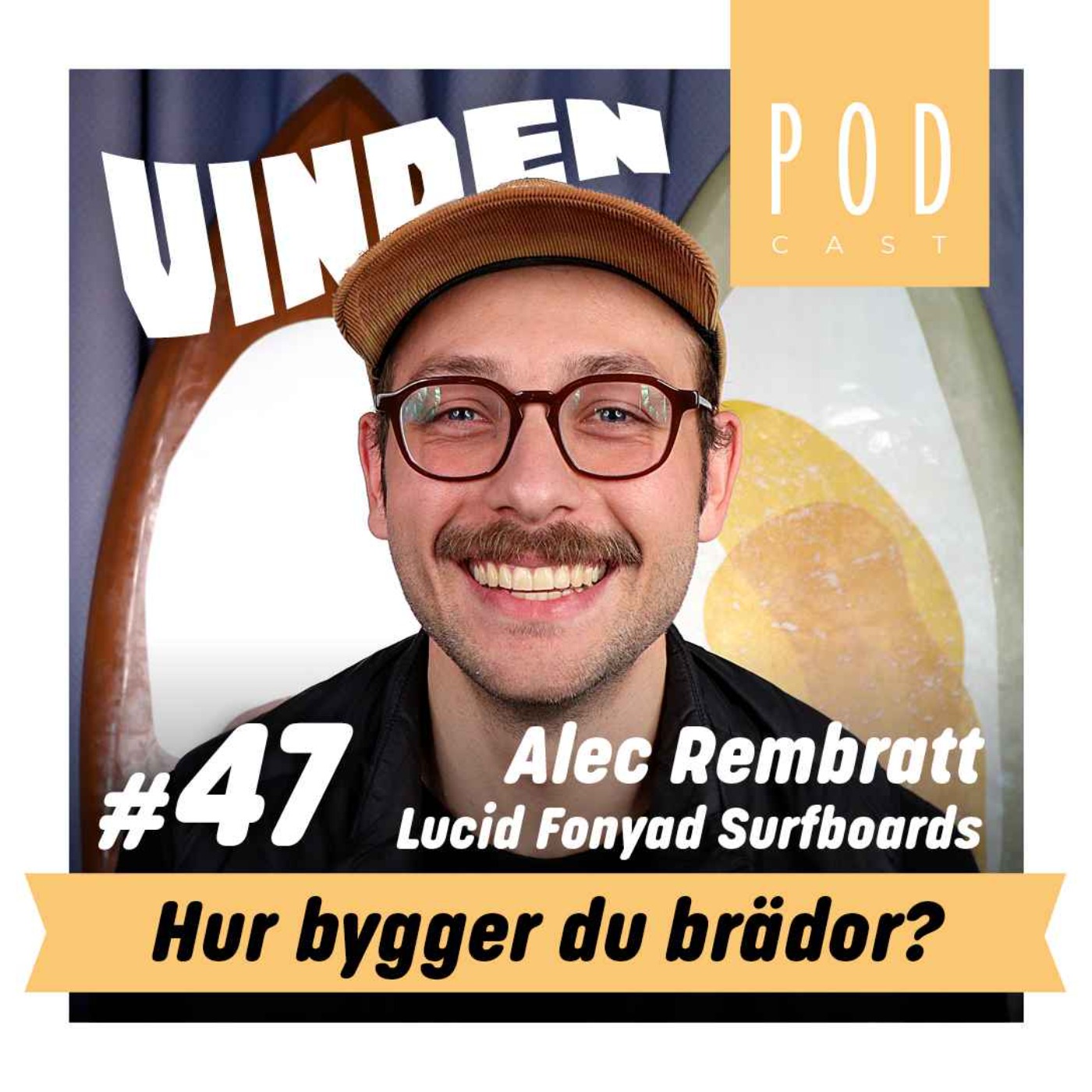
Today, Hathuren has come to the rescue of Alec Rembratt, and his creations that go under the little challenging name Lucid Fonyad surfboards.
Aleks Brädor looks like a mix of something that stands out towards the wall, the longest in a surf shop in Lukairea,
and something that hangs on the wall in a weird gallery in Österlen, which they also made during the fall.
Just this mix of retro fish and fine cleaning, I thought was exciting, so I invited Alek to have a look at the boards.
And talk a little more about how he goes on his way to the shaping studio in the outskirts of Malmö.
And that's the story, I've recorded that before Stormen Amy is supposed to be added, it's coming here, take care!
[Music]
Welcome to Varberg, and Winden podcast.
Thank you so much.
How's it going?
It's good. The sun shines both here and inside today, so it's nice after a long week to finish off with a bit of sunshine.
Yeah, I was hoping that we could surf together up here, but the waves were coming towards you instead, in Skåne?
Yeah, at Gnozsen, Valdeverktien, and turn straight towards Satt.
Exactly where we were supposed to go.
I got a bad idea that I had to get away from the waves.
Yeah, but I thought I'd have to climb in before I go, otherwise it would feel too bad.
Yeah, I appreciate that you took the time to come here.
Was it a good surf yesterday?
Yeah, I think it was. We surfed at a very expensive spot that we've been to for many years, so it was a fun surprise to get a bit of a revenge for the first time in a few years, and I feel that I still have it.
Great. Were you many?
No, it was just me and a friend.
Oh, nice. Were there longboard waves or shortboard?
No, we surfed with fish. It was nice with a push actually, it was fun.
Yeah, great. It's always nice when you visit a spot like that, with a positive attitude.
Yeah, really. I never knew that you could expect something like that before or later.
Was it the first spot you looked at, or did you burn around and check a lot of places?
No, but we looked at a very close spot at first, just because it was close, but we decided to try our luck a bit further up.
But there was nothing left today, it was too small.
I don't know, I haven't been able to check it actually.
No, it's the best. It's hard to get out of the waves.
Yeah, really.
But it was nice here last week actually, then you should have been here.
Yeah, I should have been here, but I didn't have the tendency to be there. It shouldn't be there sometimes.
But you live in Malmö, right?
Yeah, right.
Then you were born and raised in Malmö.
No, I was born and raised in Osby, which is located in the northeast of Skåne.
Okay. So you moved further away from the waves?
No.
Not really. My Skåne geography isn't so good.
No, but Malmö is pretty good, actually, for all the places in Skåne, I would say.
But that was about as far as possible. In Osby, at least one and a half hours to two hours to the surf.
I don't know, they are in their respective areas of Skåne.
But that's kind of a difference, right?
Yeah, a bit further up.
I lived in Malmö in a short time.
There was very high quality on the surf when you got away, but there was a lot to drive.
Yeah, that's true.
When I surfed and lived in Osby, I got used to driving a lot of cars.
Sometimes there was a big decline, so I don't know, I got a bit tired of driving, actually.
Yeah, great.
And you counted it?
Every hour per lap.
Yeah, actually, you have to remember that.
We're going to dive deeper in your beautiful breads, which are behind you.
But I usually start with a surf personality test, which is called the wave choice.
So you get two alternatives and you have to choose one, it's not that hard.
Right wave or left wave?
Right, I think.
Are you regular?
Yeah, I am.
At first I thought I might want to say left, but I think you're right and I don't know if we're going to be honest.
Yeah, I think you're right.
Longboard or shortboard?
Right now, shortboard.
Right now.
We're going through 30 minutes and we'll see if that's the same thing.
And you blend a bit?
Yeah, I like the whole thing, everything together.
Is it when you're shaping both long and short?
Yeah, I agree.
Good. Beach break or point break?
Beach break, I think.
Then you still have the luxury of getting close to some pretty good points.
Yeah, but the thing is that a beach break is not, I don't think it's as sensitive.
It's absolutely, on a good day, a point break is better, I think.
It's mostly the same thing, but a beach break is still a bit more all-round.
It can take more people and it can still work on a little wonky prognosis.
A point can be pretty sensitive.
How wonky was it yesterday? Was it a beach break?
It was quite strong and very strong.
It was almost like we were a little tired, we came up on the water, but it was worth it.
It was worth it, because when you came out it was really good.
What's your last name? Moronsurf or Kvällsurf?
Kvällsurf.
You said that you weren't going out in the morning.
I've really come to realize that I'm not a morning person on those fronts.
You have to take care of the last lights in the afternoon.
Yeah, or afternoon surf, I'll be right there.
It's a good one, too.
I'm pretty sure it's Kvällsurf.
Let's take a little more advanced here.
Let's see how it goes.
Kötta onshore waves in Kattegat, but you have to drive quite often.
Or drive endless east coast miles for a few people, glassy offshore.
Right now I'm going to drive often to Kattegat for onshore, actually.
Do you want to get to know how many waves there are?
Right now, a little more in the frequency.
It's photogenic.
It's good that you have three zones.
It's nice with Malmö, that you have about the same distance to everything.
So the distance is very wide.
Where do you often go, west coast or east coast?
No, it's east coast and east coast.
Okay, this one is a little apropos to your shaping.
Do you have a robust DIY pearl with a sherma-like rim?
Or do you have a robot shoes with a CNC core with laser edges?
Do you have a CNC sword in your hand?
No, I don't.
It depends on whether the robust DIY pearl works well or not.
I think that's what...
But if I have to choose...
I work with the robust DIY pearl, I think.
Is there a risk that there will be a pause if it doesn't work?
Because it's cool.
It's just for me.
If a brand works really well and is a super cool pearl.
If it's for myself, if it's a CNC sword or a headband for hand,
it doesn't make a big difference.
Is the result oriented?
I don't know, if a CNC sword is the best brand, it can be really good.
It's not going to be underestimated.
One last question.
33,27 is my exact volume.
Is it more or less?
Or is it less or less?
Yes, really.
Is it as tricky as me with this volume?
No, I personally feel that many people don't think of volume in a meaningful way.
Because volume is very relevant and important.
But it's more or less what the volume is.
What number does the volume correspond to.
It depends on the brand.
Yes, exactly.
Because it doesn't say that much about a brand's shape and properties.
About how much volume it has.
It's what the volume is that matters to me.
Yes, I agree with that.
I don't say anything about volume.
It's probably because I don't have much depth in it.
But I need to know everything that is in the way.
Yes, I agree with that.
It's just complicated information.
It doesn't say anything in itself.
I don't think so.
What do you even expect when you make your brothers?
No, I have no idea how much volume my brothers have.
There are those who ask.
And if they really are super interested in it,
I usually show them that I can compare them.
But they actually have a certain volume.
And decide what you want with that information.
Because you build it from scratch by hand, right?
Yes, exactly.
So how much volume it feels.
It doesn't feel even worth trying to appreciate.
Because I don't think I could have done such a good job then.
No.
Do customers come to you with an order on the exact dimensions?
No, it's quite rare.
As it is so often the case now.
It's just a general idea.
Of maybe being out after something special.
And it's quite grateful to get that outcome.
Because then you can start early,
or start from scratch with what you want to come up with.
And go into the depth without having so many frames to relate to.
More than the rough idea of me being out after this.
And then it's not always that you come up with something.
And then I don't usually be so interested in it.
And go on because it feels important.
That it feels reasonable and right for both of you.
Do you have any dates to start with?
Maybe not necessarily.
But a quite as deep as possible dialogue.
It feels important.
Otherwise it just feels average.
And maybe.
It's fun to have a thought and an intention.
And a bit of trust in what you do.
And that goes on both sides.
I know that I have always had a hard time taking criticism.
Regardless of whether it's constructive or hard.
How are you with such clear instructions?
Or do you want to create something yourself?
Without someone putting yourself in?
Both, actually.
I do very hard on my thing.
Almost completely wrong.
But then there's a lot of ground in perspective.
Because...
It feels like there are a lot of people who keep up with breadwinning.
Who can also validate it at a high level as much as possible.
All by themselves.
And I don't know, I just think it feels like a very strong.
And very funny tool to help others as well.
To improve what you do.
It's just increased information and increased source of knowledge.
And experience.
I do my concept quite hard.
And quite uncompromising on my own thing.
But I really think it's super fun to hear.
Both good and bad about the breads.
It has to be hard too.
And feel exactly what it is that I'm differentiating from our waves.
Yes, that's true.
It's hard to judge what a breads actually does in Swedish waves.
Because the waves are all over the place.
So it takes very specific days to really see what a breads are doing in the water.
I think so.
Have you shaped as long as you surfed?
Almost.
Almost.
I've only been surfing for two years now.
I've always liked to create things.
To implement creativity in the most way I can.
It didn't take that much because I felt like it was okay.
So as soon as I started to create something out of it,
that it was possible to do it by myself,
I got so sold that I started with it right away.
So...
When did you start surfing?
It was maybe in 2019.
Yes.
And then I was in Australia.
Same here.
And I was completely unaware of surfing.
But I was in Nusa.
And I was there for a few months.
And then it was quite hard to avoid.
It was more just to keep myself social.
Everyone was talking about surfing.
Yes, exactly.
I think most people can relate to that.
When you've had a taste of it, you never stop thinking about it.
But then you started surfing with longboard.
Yes, exactly.
T-Tree.
We were mostly in Granite Bay.
Which is a little north of T-Tree.
In this national park.
I don't know, it was a bit more underground.
And it worked a bit more like a prognosis, I experienced.
Or prognosis.
In the swell direction.
So I think that was why we...
It was also longer to go.
It was the fruit world promenade.
Yes, the one I've done was...
Yes, you've been there too.
It's nice, but far away.
Yes, it's very far away.
Especially when you've been surfing all day and completely exhausted.
It's a cool place. Hard to find a better place.
Yes, it wasn't so good to start there and then come back to Sweden.
And try to continue there.
It was a change.
You didn't go up?
No, no, no.
I've become a bit of a samanist.
So it went pretty straight when I came back.
So I couldn't stop thinking about it.
And then you lived in Osby?
Yes, exactly.
Did you find a gang there and started?
Funnily enough, I actually had friends who surfed or a friend who surfed before.
So I didn't know about it.
And then I came home.
Naturally, we got in touch again.
One led the other.
And now most of them surf that I associate with.
So I had some friends before, but...
Many have just come after.
But it's relatively fresh then, like six years?
Yes.
It's a good development.
I think I've followed you on Instagram for a while.
And you called yourself a friend.
Surfboards in the beginning, is that right?
Yes, that's right.
It started as a fun thing.
I was going to try to do it a bit wider.
And then, in the beginning, I was like, "Should I call it something?"
Or should I put a logo on it?
And then it was a bit like a joke.
That it's a friend spread.
I thought it had something to do with it.
I got a bit confused when you changed it.
But you can still understand that you...
No, I decided to do it, because it sounded like a weird, ironic name.
So I got to find something else.
And now you called it a lucid phone, did you see that?
Yes, it was really an on-point.
It's really not a real word type.
It's just full-time, unintelligent creativity.
But yes, that's exactly how I was going to use it.
There's no reason for it, except that there's something to be said about it.
Or what is a lucid?
A lucid is when something is super clear.
Something that is completely clear.
And I don't know, there was some thought around that.
That something would be very intentional, and also completely meaningless.
Okay, I get it.
You tend to talk about lucid dreaming, right?
Yes, exactly.
I don't know if that's what it feels like.
But it's not that state that you go in when you start to heal?
No, maybe. I'm not really sure about that.
But they have, I don't know what to say, a little flow in the aura, the brothers.
I think that's cool.
They really have their own expression.
I don't know, maybe they do.
How have you been on your way from the beginning?
Were you very traditional brothers at the beginning, and then you started experimenting more?
No, I've gotten tired of it now.
When I started, the first brothers were pretty all over the place.
You can think about their first brothers.
There was more, just an idea of what you'd like to have and surf at home.
And then I've said that maybe it's been a little more the same idea.
It's going to be things that I gravitate towards myself.
But I'm starting to follow the rules a little more, maybe a little more.
Did you do some research at the beginning, or did you test it?
It wasn't so good research.
It was more just looking at outlines.
And try to learn what different foils and rail shapes do.
But otherwise, no, I've been trying a lot.
And the more I try, the more research I get interested in what to do.
I really become a nerd when I look at it.
And I can't stop thinking about the difference between a full rail and a foiled rail in exactly the same shape.
How to compare it and what to do after you get to the end.
It's completely distressed in between.
Is that what's a little bit of a twist?
Yeah, you have to be a little quick to go into detail and go deep.
Did you build yourself or your friends?
Yeah, but I built a group that was just a fun experiment.
See if there's anything that can fly.
And then we were a group of friends who surfed on them.
And I always thought it was fun to involve my friends in my building.
Just because it's fun to share that experience.
But it's also much easier to get to things when you have more tools.
And take your skills, your personality, put them on the same things.
And get to something completely different to others.
So I've always thought it was very fun to involve my friends in that.
How many have you done?
No, I haven't kept the count.
I know there are many who do it, but I don't have any.
But on a whole hundred or twenty?
It's still under a hundred.
But quite a lot then?
Yes, but it's just me becoming a part of it.
So how often do you eat a bread at the factory?
It can vary a lot.
Some months it's three or four.
Some months it takes three or four months before I make a bread.
No, it comes in lumps. It's not so consistent.
But have you noticed that it's starting to spread a bit,
that you get orders even without your friend's credit?
Yes, but among other things.
It's a very complicated thing with bread orders.
Or it's actually not so complicated.
But how you want to relate to it can be quite complicated.
And that's what has changed quite a lot for me anyway.
But absolutely, you notice that there are more people who seem to be new.
And it's really fun for you.
Then it's almost like there are more friends who are with me in the same way.
Or for me it feels like that.
In which way is it complicated?
Is it that many people talk about wanting to have it,
but that it has never been good?
Yes, I have said that, but it has probably started to stop thinking about it.
But no, it's clear that you get to be new,
without being interested in it.
It's quite a wide range of money.
And you don't know what it really is.
It's crazy to be a little more modest and maybe.
But it's even more to go back to this, to do your thing uncompromisingly.
Yes.
You have to make a bread to someone else and they have to give you something that feels nice and valuable.
Then it feels quite important that they are really out after something that I know that I myself am familiar with.
To understand myself.
I don't want to compromise and do everything super custom and get out there.
If we don't have experience and knowledge and understanding before it.
No.
So I do what the breads are doing.
When it seems interesting, it usually works pretty nice.
But I don't know.
It seems important to be able to see yourself in the mirror, to get out to people.
Maybe it's good to drive with an open card.
Is this my style?
Yes, actually.
Take it or leave it a little.
What is your style?
My style.
Do you have one?
I am very interested in weird breads that work very well.
Good taglines.
I really like to explore things that are not conventional.
You could say that.
But at the same time.
When I start doing what will happen.
The fish shape for example.
I absolutely don't want it to be a fish.
I don't want it to be a twin biscuit or a mini Simons.
I have this concept with a short, wide twin.
I have really worked a lot around letting it be a fish.
Because I have been curious about what the difference has been.
But I have also noticed that a fish works very well.
A good breeder to refine.
We have been looking forward to this.
This is a very typical fish at first sight.
But if you look deeper, it has quite a lot of details.
It was fun to hear that.
It has a lot of ideas with this side cut model.
That it is a very, very common fish.
With a little rod that is not usually found in the recipe.
No.
It is inspired by Ryan Birch.
With the side cut.
What does it do?
I think it is easy.
I am so bad at summarizing things.
But I think it is easy to say that.
It allows you to make the fish more performance oriented.
Without breaking the traditional dimensions.
Because this is a bit of an introduction compared to the other.
They are both a bit of the same concept.
But this one is a bit more frantic in my opinion.
This is the two breeder that you have bought.
Your newest breeder?
Both are 5-6 cm.
And then 20 cm and 3/4 cm in width.
And then probably 2.5 cm.
The traditional things or the properties of the fish are fast and catch a lot of weight.
Yes, you could say that.
And with this little side cut you add a bit more surf of more vertical.
Yes, exactly.
For me, the side cut is a tool that makes me have a very wide wide point.
The width can be dimensioned and proportioned as a very typical fish.
You can keep the wide tail that helps to generate speed.
But between the tail and the wide point you can make it a bit more capable of going rail to rail.
Something that I felt a lot yesterday, for example, was that for me it is about being able to set the rail in a swing and then really push as much as possible.
And there we also experience that the side cut helps when you want to turn or straighten out after a very powerful curve.
Then you don't hold it, but just throw it back.
It feels like one of the weaknesses of a traditional fish.
Exactly.
That it becomes tight.
Yes, exactly.
Most of the time I think that a traditional fish is just positive stuff.
But the negative properties of a fish, like the setback,
are also something that I have tried to block the boat with a little twig or a little twig.
But it becomes a little like a medium on a snowboard between the legs.
Yes, exactly.
So that is not where I have got my inspiration from.
It is definitely Shapersom, Mackie and Birch, who have planted the Fröna.
But I think that the snowboard design has been far ahead, so I think it is.
Cool.
And when you look at this front, it looks like it has a super deep concave between the legs.
Yes.
And that is simply, it is flat to single concave.
In this way, if you do it a little crooked and to break the curve in the outline,
it feels like a flat boat with a concave tail is just a proven design.
So I do not feel that I want to do it so crookedly.
No.
And then you have Jumbo-Fenor, let me say.
Yes.
Glacier Fener?
Yes.
Is it difficult?
It is.
Yes, yes, it is.
But I prefer to do it, especially for Fembok.
Because it is also that it will complicate the whole idea.
And I do not know, this is a Fentemplate, which I have now, which I have tried quite a lot.
I have done some of the variants, it felt like it had a bit too small fins.
It is also a nod to quite traditional design, as the classic sandeco fish have.
It is still a bit uneven here on the back, but I usually go almost straight down, right?
Yes.
It is a bit of a taste, maybe.
It is really, there are so many variants on Kilfena that I do not know if I should compete with it anymore.
I saw a clip on your Instagram, you talked about that they are failed, just like the both sides.
Exactly, they are also failed on the inside.
It was a good comparison, I think, with that when you are on the rail, ideally, the few times you do it,
it becomes like you are, you explained it better than you are now, but the only twin-fena becomes like a single-fena.
Yes, exactly.
So that you can rotate around it more effectively.
Exactly.
Yes, I experience that it feels a bit, it feels still, it is like, close, not close,
but like you practice well, like a performance spread.
But maybe at the same time, the relationship, the movements are connected and are more connected, like a single-fena.
Not because I want a fish to feel like a single-fena,
but it becomes a bit of that sensation when you are on the rail.
It becomes a bit like a single-fena without the drag.
Yes, because they are not so deep.
Interesting.
It feels stable when you put it on the rail.
It feels very important to me that a fish should feel like a single-fena.
Does it stick out?
No, because I would like to be able to press a fish on the rail as hard as possible.
Without it feeling like it should slide out.
I have experienced that it helps to have a double-foiled keel.
But it is also depending on which science you choose to look for the most, so it is not objective.
But then it is quite important that they are almost completely parallel.
Yes, I say that completely parallel.
Because it is foil-loaded, it becomes a little wobbly still.
Even though the fenas are parallel, the fish are also thinner back here.
Yes, yes, yes.
That is something I do not think about.
But did you surf that one yesterday or that one?
I surfed that one yesterday with my friend Robin Rose.
I got to spend some time on this one.
And then there were quite a lot of beach break waves with quite a lot of force.
Yes, yes.
Not a huge wave, but still a little.
And they were shooting well in a little distance.
Yes, I think so.
And I think a lot is about being able to get out of the volume in the rails.
It is another thing that I have.
Get out of the volume over the rails?
No, sorry, fill the rails.
Fill the rails, yes, exactly.
Interesting, but how do you do it so that there will not be a boat that does not go over?
You take away the volume on other places and make them small enough.
In any case, a fish.
It helps a lot to dare to go down in size.
And it is much easier for me to dare to go down in size.
Because I also shape it and fill the rails with volume.
But it has been such a big choice for me to be able to go down in size.
To raise a fish and not dare to go down in size
makes you often try to overcompensate in another way.
To put in smaller fins that make it possible to control the width of the tail, for example.
For me, it is very important that the fish is as small as possible to feel comfortable with.
Because then you can also fill it with volume in the rails and be able to push it properly.
If you think about it, for me who hardly can make a ding, without it becoming a clad chaos.
Then it is like this. I understand very little how to get a fish from scratch.
Especially the lamination. It feels like a nightmare.
What is the hardest thing for you? What is the most difficult thing to do?
In the entire process?
Yes.
I think the most difficult thing is to get a result that can hold the same standard as expected.
So everything.
Everything is connected. A good lamination is very dependent on a slat shape.
And a good finish is very dependent on a flat surface.
So you can't get a perfect polishing, for example.
But you can't get it if the surface is wobbly in the shape.
So everything is connected.
I don't think I am an expert now, but when you look at the finish, it feels like the over part of the home-building bracket.
Thank you.
You could say they are in a shop.
Thank you.
They also have a bit of a beak nose, I like that.
It is something that I have been struggling with quite a lot.
If you go back to how you spread out the volume.
Then I come to that part of my own experience, but also some feedback from people who have surfed the evolution of this fish design.
And I have had a problem with pushing the volume too far forward in the nose.
Where I have had really thick beaks that have made it feel almost difficult to paddle the width.
Because there is so much volume in the nose that it doesn't really go down in the face.
So something that has been very central when I have shaped the beaks has been to spread out the volume in the rails and put the weight everywhere else where you don't want it.
So to put the deck rocker has been something that I have tried to focus on quite a lot with the beaks for example.
Because a beak nose makes it much easier to split the volume and spread it out.
So that the beaks become a little more forgiving, but it can also become too much, really.
The deck rocker feels like a component for the fine tastes.
Maybe a little bit away from the part of the deck.
I think it is underserved how much you can manipulate the split of the volume depending on how you make your deck rocker.
Because if you are going to see from the side the deck rocker profile,
then it is the deck rocker that ties together where the volume actually is at length in relation to the underside.
And I mean, it has taken a lot of effort for me to learn or start to understand how to find a nice sweet spot where the volume doesn't feel like it is on the way.
And deck contours can really be the key to that.
Have you ever used such a concave deck?
Yes, they have.
In the nose at least.
Because it is an effective way to get rid of the volume where you don't want to have it.
And I don't want to have the volume far in the nose.
I just want to get rid of it completely.
But still here between the media and the rocker?
Yes, when you paddle, they say so.
Exactly. But I don't know, I really think that the rails are the ones they have at home.
At least in a fish.
So thick rails, short, a little bit of, let's put it that way.
Faced deck.
Yes, exactly.
I have really been really excited about what I want and don't want the volume.
And tried to push it so that I have full control over what I place and take away the volume.
So it's really fun to experiment with and try to move forward.
But it has taken a lot of time.
Yes, it's so strange with bad luck.
Do you think so?
Yes, I have something that I haven't even done yet.
But most of the time I have actually done it and tried to come up with it afterwards.
But that's what I want to take with me next time.
Yes, it's really fun.
But the side cat takes away a little foam too.
Or do you notice that much?
Well, the rails are foiled in relation to the side cat.
Not for that thing I would say, but it takes away width.
Where you don't want it.
And it's the same thing about not having much tension with what you take away and what you fill with volume.
That the side cat is that I want width here, but not here.
But I also want this one.
Yes, that's right.
But you don't just fish, do you?
No.
You also do a part of the middle and the farthest.
What's the funniest thing?
I haven't done it in a while.
But both shaping and surfing gliders is something that is very close to my heart.
They are incredibly fun.
Because it's such a big moment to build.
And it's also a very big moment to surf.
So gliders is one of my favorite types of boards.
10 foot plus almost?
Yes, I have one that is 13 foot.
But I did that just to push it a little and make it sound a little bit.
But you learn a lot about pulling it to unwanted levels as well.
So you can then take with you back to the perhaps a little more reasonable levels.
How much weight does a 13 foot spread?
Well, now it weighs quite a lot because it has been with me for a few years.
Do you think it's a little water?
Yes.
But no, it's trusty.
But shit, I'm so bad at weight loss.
But it's heavy at least?
If it blows so much, it's really hard to carry it to the car.
And then up on the roof as well?
Yes.
But it's hard to get a 13 foot spread symmetrically?
Can I think about it?
Yes, that's it.
And then you put it on ASYM from the beginning?
Today I would say that I have learned to take a lot of safety measures.
But when I did that for example, I was definitely not so careful with symmetry.
But it was also such a small difference that I couldn't take the water.
But also asymmetry in relation to symmetry.
So I haven't done any more symmetric variation of that or less symmetric.
It's just what it is.
You have done a few with flit asymmetry to spread as well?
Yes, exactly.
I've seen that.
Is that even a conical hole that you don't want to go too deep into?
No, it's not like that.
When I started to try and do that, it wasn't the same as before.
Maybe that was just for testing.
I have done a flit-based spread that is fully asymmetrical.
But that was just because I was interested in the idea that I wanted to have more length on the rail
on one side than the other, just for the stability it would track.
Which might have been a bit of a weird thing to say about a flit-based spread.
But today I'm dealing with asymmetry that is very concentrated in asymmetry.
Because it's not so advanced or it's not so strange.
Maybe it seems to be.
It looks flimsy without any sense, doesn't it?
Yes, really.
It's more about spreading in a flit-based way.
If you feel that it's fine on one side, but it feels like something is missing on the other side,
you can just reject what's missing.
Then you have a flit-based spread that works more in its entirety.
If you feel that you need it, but I haven't really felt it yet.
But if it's a flit-based spread, it doesn't feel the need to do the asymmetry.
No, it's a flit-based spread.
It's not that warm in the clothes.
It hasn't been that much, mostly just on the floor.
And because I've missed a flit-based spread sometimes in my quiver.
So I don't know.
It's something that I've researched at least, let's say.
Flit-based spreads.
But it's very fun, and they're also incredibly cool.
Have you done, if you say, regular performance spreads?
No, not that much, actually.
But I've started to gravitate to it more and more.
I think it's going to be a spaghetti and meatball thruster pretty soon.
To me personally.
Because it's also something that I think I've longed for, always after a new sensation.
Which maybe in general would be the least exotic sensation.
But for me, it's just been out on a really flummy expedition in bread design.
For me, it's exotic, but a completely normal thruster.
Well, it's like a blank paper, so you can get a bit of a cut off there too, I think.
Maybe with the shaping too.
Well, I don't think it's a completely normal performance spread.
In my head it's not boring or plain in any way.
It's just another type of design.
As long as you go after it, it's exciting.
I can still feel that I haven't found the right word for my thruster model.
I have a few, but I don't feel any of them are completely neutral.
They all have little quirks.
That's nice too.
Yes, absolutely.
But it would be fun to have someone who just says, "This bread feels just right."
They just surf.
Well, that's what's right in a shortboard.
That you just have to feel like a extension of your feet, completely timeless.
And especially where the feet are, I think.
It's great that it doesn't react in the same way.
Maybe 5 cm, or a bit more maybe.
But that's great.
But I can't think of another.
You also have to try to learn what you like and surf.
What kind of bread is the best?
I don't think I need to surf as much as a person who fits into a shortboard.
But for me it's just fun to experience, explore and learn from.
And also try to find the right way to surf.
And that's the way a certain design might want you to be.
Because it's a bit like coming across with a bread and then being able to surf in a way where you can express yourself.
Or develop your own qualities in how you surf.
It's super fun to find this balance.
It's pretty much what you're saying.
And not force the bread.
You think it's going to be able to do something it's not built to do.
Or the weight for that part.
But try to relax a bit.
Especially here.
A bread can't show so much of its own qualities all the time.
When you surf in Swedish conditions.
The weight doesn't always allow the bread to show what it can do.
In the same way as it doesn't allow the bread to show what it can do.
Or I like to say it to myself sometimes.
The difference in the bread always works.
No, the difference in the weight.
A turn on the bread.
So you get a nice lid.
You also make this motive.
Is it resin?
Exactly.
It's pigmented polyester.
Nice.
Very random but it's nice.
resin panels.
There are so many ways to make a bread visually.
But I don't know, there is something very simple and exciting with some abstract resin panels spread on a bread.
For me it really doesn't have to be a compromise between appearance and function or sustainability.
I just like to try to go all in on all of the properties.
Is it a bit heavier than the others?
Yes, it does.
But it doesn't have to be a compromise.
I don't think it needs a bread.
It doesn't need to look too bad to work well.
No.
I think it's very fun to implement as many things as possible to a bread that makes it feel special.
And feels nice.
So that you get tagged on the surfboard.
I saw you had them on a kind of art exhibition.
Then they weren't even grown up.
Then you were like shit, you don't want to be alone.
Just hang on the wall.
Yes, it's a paradox with a high-polished bread.
It takes so much longer time to be able to make a bread if it has to be high-polished.
And stand and fight with the job.
You know, you always think that I'm just going to pinch it down with wax and stamp on it.
I mean, I don't know.
It looks nice out there a week ago.
Exactly.
And it has to do with this pep in front of the surfboard.
It's advanced.
I'm not sure I can argue with all the other things.
No.
What do they call this? Leash loop?
Yes, it's a leash loop.
It feels like a real...
Now you're done with everything and you have to lay three days on the ground.
It's actually in the middle of the process.
I've laminated.
I've done a few things.
I see it more as a step in the process.
I haven't done so much leash plugs or so much with it.
It's just always felt more nice and useable.
And it also becomes uniform.
It fits in really well, but do they hold better?
I think, generally speaking, that leash loops hold better.
Because it's laminated all the way in.
If the leash loop had to go off, I would take the whole laminated and tail off as well.
Instead of a leash plug that can still jump out if that's enough.
A lot of drag force.
So I would say that a leash loop holds better.
Cool. It looks very handcrafted, nice at least.
Yes, in that aspect too.
I actually think it's nicer with leash loops.
It would destroy the whole look if you had a plastic plug here.
Yes, maybe. I think so too.
Cool, do you have a name for this model?
They are almost the same, it was a bit different in the tail.
Yes, they are not...
I'm not entirely sure that I can call them the same type of shape.
But they are the same template.
Which is just manipulated in different ways.
But yes, I have started calling it Hurls.
Hurls?
Hurls Sidecut.
And it's a nod to Michael Hurley.
Who is an American and American artist.
He has great sense of humor.
I often refer to him as Bob Dylan, if he was actually cool.
Just a really fluffy guy.
So it's now or is it old?
Yes, a really old guy.
With his album cover, he is a really fluffy guy.
I think that if he had a surfboard with me in some of his covers,
it would be a Sidecut Fish.
It's all wobbly and weird.
Do you draw a bit to the retro and fluffy stuff?
Yes, I think so.
I also draw in the music as well as surfboard.
That's something that's fun.
I also think that it's meaningless to try and find the sound.
But it's a lot of fun to try and make your own interpretation
on proven design.
The classic favorites that have happened throughout the years.
Everything goes in circles too, with a wide design.
Especially when it comes to a more niche wide design.
I think that it was a day when long twins exist.
Everyone wanted a twin in the middle.
And now I think that it's a bit of an transition stage.
I wouldn't be surprised if shortboards become super trendy again soon.
Like the banana chip that I had in the beginning.
Yes, or maybe some spin-off on it.
Something that goes in circles all the time.
It's really fun to sometimes hook up with it and see what it's like.
And sometimes it just goes a completely different way.
Is it hard to find a balance between
copying and lending too much and still doing your own thing?
No, I don't think so.
Because everyone is doing their own thing.
I think that there is, for me at least,
and my outcome point is that there is a very low balance.
I would have an original idea.
It's even better to focus on trying to make your original interpretation
if you think it's important to be original.
Because everything has been done.
Everything that you can think about in a broad design
has already been done at least once, I think.
There are a lot of things that are new.
You work with antique material on this as well.
It's P.E.U., right? Opel ester, Trestringer.
So you don't have high-tech?
No, I don't have any specific design.
In the beginning I only did my own thing.
I tried to push the design
with the material for as long as possible.
I think it's very fun to try to go into the craft
and try to pull it to as high a level as possible.
And there I have so little gravity in traditional designs
because it's standard than today.
Isn't it easier to work with, what's it called?
Opel ester, Trestringer.
It depends.
It's not necessarily easier.
Yes, it's easier, but perhaps less forgiving.
But if you just understand how it works,
then it can almost be more forgiving
because then it's more predictable.
The epoxy can be pretty unpredictable.
If you want to reach the number 3,
Opel ester can be 1+1+1
while epoxy can be 1+5+1+2+0+3.
You can reach the same number, but epoxy is different.
Both are good in their own way.
You said you can make three pieces a month.
If you order a bread out of you,
you have to give it a day, right?
Yes, but it's not always like that.
Sometimes it's still as long as it is
just because you don't have time or resources
or desire to do work.
It's only been a very long time
and then there's nothing at all for a day.
But it's fun to keep it simple.
But yes, you really have to take your time
and it's important that there are no obstacles
that need to be taken.
But do you get the hours you put in again?
Or does it become a plus or minus thing?
It becomes plus minus zero with an extra minus.
But you don't do that.
If you wanted to earn money on it,
you would have put it on the card.
Because there is no money to earn and build bread.
There is no money to earn on an industrial, global level.
For material,
the high-end and top quality products
in the world for hand are not big marginals
that you have to work with.
All of them are like a passion project in a way.
It's when you feel you want to introduce science in the machine
that I think they can also build some marginals.
If you are not, for example, Ryan Birch,
who can take Japan prices for his breads.
I was a little surprised.
You shouldn't have become perhaps,
but his standard line that he launched,
it was still up to $ 2,000 to $ 2,000.
Then you wonder if he was really ready to go there.
He really has a possibility to take the money,
but it's fun for him.
He has built a stable foundation.
Thank you for that.
He has inspired the end to Malmö in his shakes.
Absolutely, that's what I think.
Speaking of getting paid for things,
what does it cost?
It's very important to know
what you want to include.
A similar one?
A one like this with all the properties and all the things in it.
$ 9,000-$ 10,000.
But it's also because of all the extras.
This is what I did to myself with really bells and whistles.
Then it's really all extra moments with glazed iron and resin panels,
glazed fiber caps in both ends,
high-polished tin on both sides.
It's everything you can think about.
I've put on extra moments for myself when I did these.
That sounds reasonable.
You see how much work.
Yes, that's it.
It's really important to feel what you want to have.
You shouldn't feel that it's really worth it.
That's what I really want.
I want everything, this extra.
Otherwise it's not worth it.
And I pay so much for it.
If you're more careful with the money
and want more expensive meatball bread,
how low can you go without going back to building it?
It's very difficult not to go back to building bread.
I don't know.
When it comes to building bread for other special people
that I don't know,
it's really important to have a foundation that is worth it
for these people.
For example, to invest in the most reliable material
in the form of glass fiber and polyester or epoxy.
I've heard that it's in US blanks
because it fits well with the material.
And investing in the best materials
makes it possible to offer the best possible material.
It can also be subjective about what is best.
But in what I try to do, I try to invest in the best I can.
In any case, it's well tested.
But do you order a gang?
I try to do it, otherwise it's very expensive in fact.
When I try to keep it as few orders as possible
because it's more sustainable in all aspects.
But there are still things to be done in Europe, right?
Yes, exactly.
Do you buy at home or where do you keep it?
No, I rent an equipment out in Loma
against a guy who has his company on that area
that I managed to get a foot in.
So there I have the opportunity to stand up and dive
and get the entire area and smell composite material and plastic.
And I'm very grateful for that.
Because it has been difficult to find a place like this,
especially when I moved to Malmö.
To find equipment where you can really contaminate
and shoot down as much as you need to to make your own equipment.
That's gross.
It's fucking hard to work.
I'm looking forward to have a tree prepared with some kind of line or something.
Yes, if you're interested in that.
How do you see the future for Lucid Fungal?
Do you want to continue to be on this little friend level
or is there something you want to do more?
What's nice about it is that
I talked with my friend Robin yesterday
with the Swedish surf community, for example.
That the density here at home is so...
There's so much fun and interesting
and engaging people.
If you look at Per Capita in the Swedish surf community.
So I think it's just fun that
for me, when it comes to getting ready for other people
I also see it as getting ready
for people that you're familiar with
and know.
It's like a community.
A community doesn't stand a chance.
It's just fun that there are so many people
who engage in things that you can create together.
That's what I hope for.
To be able to stay on a friend level
even if it's on a community level.
I don't understand that very well.
It sounds like you're going to keep up your day job.
Oh yes, oh yes.
It would have been very stupid not to do that.
I wouldn't think it was impossible
because it would take a lot of hours.
Unpaid hours.
No, I'm going to Sweden in a month.
But it's worth it, because it's my hope.
It's something I've been able to overcome.
Yes, nice. I'm going to do 10K.
And then I'm done.
Labels and Wilson.
I don't really recommend going to Alin.
No, maybe it's too much.
What are you going to do?
You're going to be asked a lot of times
if you really get along with each other.
Fiber in your body after all that extra
because you want a very special spirit
that feels special to you.
It's important to look at your own needs.
As long as you're just a member
of the group and come to something yourself,
you don't have to worry about making a difference.
He did everything with blended sauce breads
or plain import breads.
You have to look at your own needs
and what you think is worth it.
There's no right or wrong there.
It can be expensive sessions too
if you come out 20 times a year.
Yes, really.
On the other hand, do you want to have something good
to surf on when it's time?
There are many aspects that I know and overthink.
For me, having a bread that feels extra
and special does a lot for me.
It also makes my approach feel
that there's an extra layer in my knowledge
when I surf.
It's a bit more of a problem-solving type.
You're more open minded to how a bread works.
It's hard to argue for,
but for me personally, I think it's worth it.
We usually cut the bag with a little toy
that I call "always never".
I say three spots and you have to choose
one that you want to surf forever,
one that you can surf once and never again,
and one that you don't have to care about at all.
The first alternative is "Alte Kosa Beach"
where we play.
It's super flat today.
It actually worked here when I was a child.
Every time I have a skonning,
I always get "Kosa Berja"
because it's quite famous down there.
And then we talked about "Nosa".
What's your name?
My name is Granit Bay, where you surf the most.
Exactly.
Or we surfed in the beginning,
but I would say that we surfed the most in T-Tree.
We take the whole national park.
The whole national park.
We can start with which one you want to leave.
Do you surf often at Kosa Berja?
Yes, I do.
Or as often as I can.
I might be lucky to live in the unknown
and choose Kosa Berja.
Even if it's the opposite of that.
You've never been in the water before?
No, I've never been in the water before.
But I know what I've missed.
Otherwise, I choose Kosa Berja.
Yes, that's right.
And then I think the national park will be one time.
And then I'll never be there.
And then I'll have to stick to my trusty.
I'm not going to claim that it's home spot,
but the closest home spot.
That's why I'm going there.
I really like that.
It's nice to be home in Skåne.
Skåne is always Skåne.
Yes, it is.
It sounds like a good choice, I think.
Yes.
I don't know, when I lived there, I only had a fish.
When I lived in Malmö.
So I drove Kosa Berja for my little fish.
It was hard, but...
Yes, it's not as often as it is.
I don't think so, anyway.
How about a longboard community there?
Yes, I usually have the most fun on bigger beaches.
But it's nice.
Yes.
It always works.
Or it always works, at least.
Well, great.
Thank you so much for coming here and showing the equipment.
They are really cool.
And I wish I had a little more cash.
But if you want to see more on them, or know more,
you can turn to Instagram.
Yes, that's Instagram, I would say.
It's pretty active.
Lucid von Jad.
Yes, surfboards.
It doesn't mean anything.
Exactly.
Very important to understand, it doesn't mean anything.
Well, we hope that there will be a little more wind on this side.
And on your side too.
Yes.
Or on your sides.
I will sit here next time, it's really windy.
Otherwise, we will take you in Skåne.
Yes.
Thank you very much.
Thank you very much.
This was Winden Podcast.
Follow us on social media.
That's called "1 Winden VBG".
If you have any questions or suggestions for a guest you want to see and hear here in the studio,
you can e-mail us to
[email protected]
or send us a message.
See you soon, until then, take care!
 PodcastTranscript AI