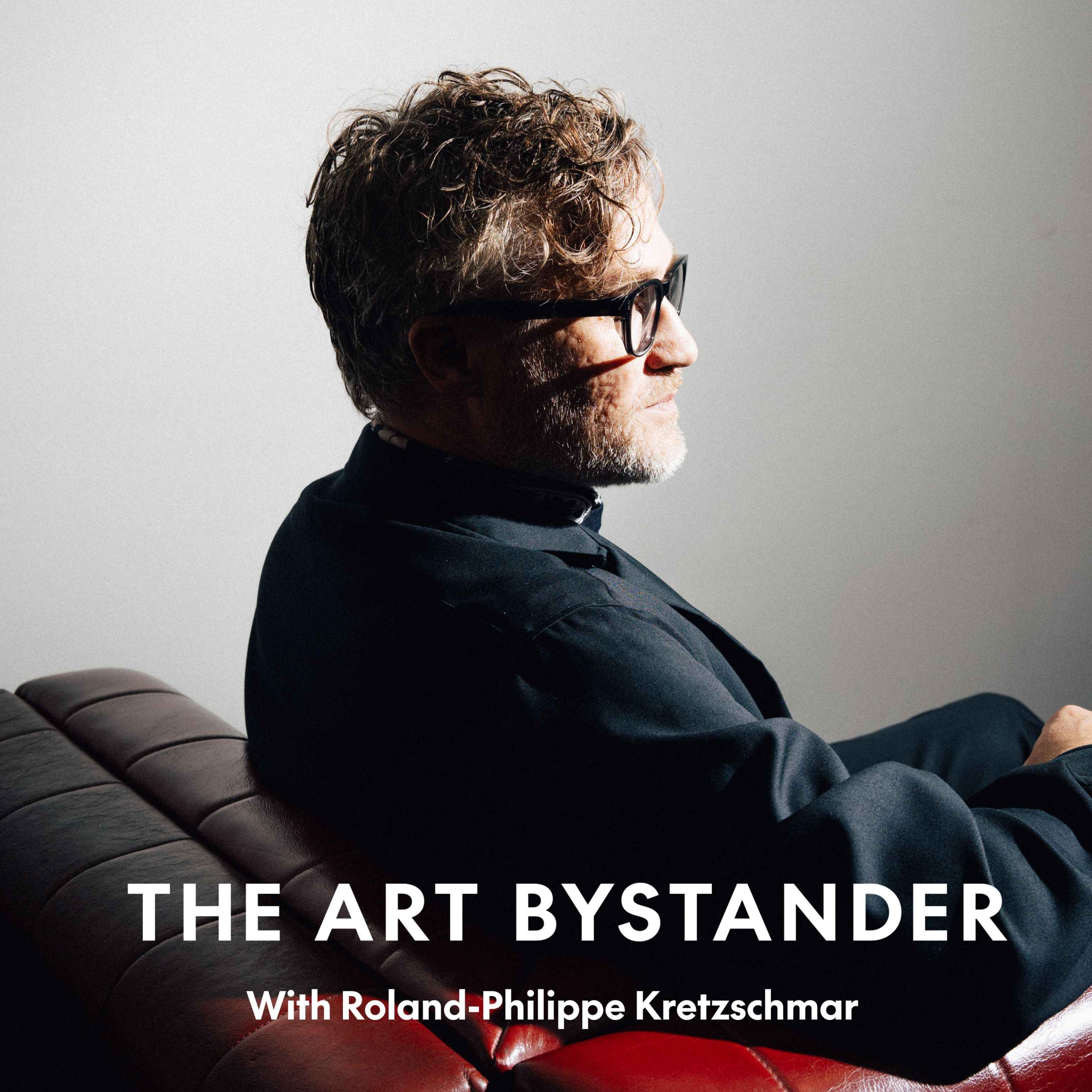
The transcription features an interview with Art Daddy, a new art and culture platform launched in summer 2023 by a journalist, critic, and educator. The creator, who studied performance art at the School of the Museum of Fine Arts in Boston, uses the account to combine rigorous reporting, satire, and cultural analysis, often described as the "TMC of the Art World." The platform, active on Substack and Instagram, examines power structures, personalities, and contradictions in contemporary art, driven by a desire to address media layoffs and create space for long-form writing. The creator distinguishes Art Daddy from predecessors like Hildi Hilfenstein's Gerrard Gugosian by emphasizing their journalistic and educational background, focusing on long-form essays alongside memes. The "daddy" trope is used to play with gender and objectify middle-aged men, while the account's approach is influenced by performance artists like Sophie Call. The creator has engaged with figures such as Jerry Saltz and Leo Brody, often using humor and dialogue to navigate criticism, and views the account as an extension of their artistic practice. The interview highlights the absurdity of the art world, balancing serious labor issues with humor, and the creator's ongoing exploration of success through shaping discourse.
[Music] Welcome back to the Art Bystander. This is Roland Flipp Kretschmar and I am recording this mid-summer 2026. It's heatwage across the globe and I'm joined by Art Daddy today. Basically, Art Daddy is a new based art and culture reporter, critic, educator and artist who has spent more than a decade covering the contemporary art world. Their writing has appeared in the art newspaper, L, art news, art net news and numerous other publications while their teaching lectures have taken them to universities across the United States. Before entering journalism, they studied performance art at the School of the Museum of Fine Arts in Boston with a minor in women's studies. That background remains essential to how they approach Art Daddy not simply as a media platform but as an extension of their artistic practice. Across Substack and Instagram, Art Daddy brings together rigorous reporting, criticism, gossip, satire and cultural analysis. Often described as the TMC of the Art World, it looks beyond official narratives to examine the personalities, power structures and contradictions shaping contemporary art today. And with that said, Daddy, welcome to the podcast. Thank you for having me. I'm excited to be here. We were speaking before. It's my first official interview with anyone. So that means something, I think. Well, it's just a moment where you adopt me because, you know, literally my father, he passed away when I was in my mid-20s and he was an artist and so maybe you can adopt me as you are the Art Daddy. I mean, I'm actively looking for an older European man to adopt me, so maybe this could be an official. But I know you're an actual father too. So we're always looking, we're always looking to do the most for our followers. And I'm so excited to have you on the show. I mean, auto-curiosity and you actually commented this very briefly. I mean, you said it's your first conversation with media. Why did you decide to do this with me? Because I'm also literally like a middle-aged white man in Europe, the typical person that you would kind of criticize or examine or or, you know, why did you agree to do this? I think twofold, I think at this point, my following is got to the point where press is just inevitable. I am a person in the media rating, so I think I just felt comfortable at this point doing an interview. You are the target demographic. I'm not going to lie. So it seemed like, maybe an all-branch, but I think part of what I do, part of why I started the account, part of what I've always kind of done in my own work as a writer and just an educator is just kind of thinking beyond a narrative, trying to poke holes in something. And I think we work in one of the most absurd industries that there is. So if it can't be funny, if it can't be, people can't laugh at themselves. I don't sometimes often see the point. I mean, there's very serious things happening in the industries well in terms of labor issues, which I'd love to discuss at some point across museums, particularly in the US. But how do you approach that in a way I think is often humor? And I hope people think it's funny. I mean, I joke all the time about hitting my weed babe and writing in my apartment in Brooklyn and there are just observations I make to my friends and other people. And I've just used the accounts to just kind of have free reign. So it's still crazy to me that as many people are into it as they are, which I love, but I just I feel unhinged all the time. And just to kind of clear this out for the listeners who might actually not know you yet, but they might know he'll the Hilfenstein, who passed away unfortunately a couple of months ago. She was a guest on this podcast, actually one of the first guests. She was an artist primarily, but also she had a big meme account called Gerrard Gugosian and she of course also then ridiculized and made satire of the weirdness of the art world. But to my question, what would you say is the main difference between what Hilded did with Gerrard Gugosian and what you do with art, Eddie? I think Hildi was incredibly important in paving the way for accounts like mine. Me and Miss critique I think became more invoked because of her using that format to think about larger institutional issues of power, misogyny, just sort of things happening in the industry. She started and I think in like 2019 and was anonymous up until like maybe it was 2018, she started the account, but she had like a good two or three year run where people didn't know who who she was. And I know that Kenny Shactor famously outed her and I think they made peace at some point over it, but I think that really kind of helped other accounts do what she was doing in a way to be able to call things out. I know she did own a gallery in LA at a certain point. She was an artist that was a part of her practice. I think for me, the main difference between what I do and what she was doing is also my approach. I mean I am a journalist, I've been embedded in this industry for over 12 years. I also am an adjunct professor. I've taught for about the same amount of time if not longer. So I think I'm really thinking about it from the power structures I'm working within as she was, but I think my perspective as an educator and as a journalist has really become sort of top of mine in terms of how I approach it. So I think that would be kind of the main difference. And I also think that hers was very mean driven. I do make memes, but I think for me, the real work happens on my substock. I'm really interested in writing long-form pieces and essays and things that I started the account because I just, A, there's a crisis in media, right? You and I were just briefly talking about media layoffs and I see it all the time as a freelance writer with budget constrictions. So just not having enough places to be able to actually write and having good ideas and not having the space to do it in. So I wanted to give myself that. I'm just also like feeling like I'm screaming into the void all the time. So I think that was sort of the emphasis for my creating the account, but also like being aware of other people in that space. Like her and Art and Power. There's like a bunch of others that I think are doing similar, but just kind of have different approaches in terms of like methodology or how academic or not academic they're approaching it through. Before we kind of go deeper into power structures or the art world, you said yourself that you're an artist. I do have a background in our Iowans Art School like over a decade ago focused on performance art primarily. Went on to do grad school and not art capacity like community space things, but I do think that my account is basically my studio practice. I mean I don't really think about myself as making work really, but I think I am doing something through the account by having an alter ego, by kind of exploring the things I'm poking fun at through through our daddy, which I think is like daddies are a bigger cultural trope. So like everywhere. You are everywhere. So I think for me it was playing with gender and also kind of thinking about what is a daddy and trying to create more of an inclusive inclusive space. So daddy's not necessarily being a gender specific term, although I'm constantly posting middle-aged men. I do think it's funny to objectify them in a world where women are so objectified. So I think that's sort of part of how I thought about it. I'm just kind of thinking about artists like Sophie Call who have been like a huge influence for me in just sort of thinking about how she approaches art and people. I've always kind of had her in the back of my mind in terms of the account. And some of those early performances where she follow people around and just sort of document things and I feel like my early impetus is with the account or a lot of that. I was going art fairs and taking photos of like just attractive people and like people watching and posting it on my personal social media profiles and then it just grew from there. So it have people watching, have just having a very particular perspective on things. I'm speaking about Sophie Call in the pre-talk to this conversation. I mentioned I was at Louisiana earlier this week in Denmark and there is actually an amazing Sophie Call retrospective ongoing there. I did admire her work. Unfortunately there were too many people in the museum. So it was like impossible to kind of relax and take in her work because you need to spend quite a lot of time and reflect and pause and read and study and kind of you. It's not something you just look at, right? So unfortunately I had to kind of rush through that part. But I agree with you. She's amazing. When did you know that you are an artist? I don't know if I ever knew that. I think growing up, I'm from New England originally from Connecticut. And I think I grew up making my parents encouraged it. But I
I think I just always thought about the world differently. My parents were artists, but they took us to museums and we looked at art, but it wasn't my grandmother painted and owned an antique shop in rural Connecticut. So I think being around like relics from the past, I was always really interested in as a kid. So just kind of being around that and that sensibility and just being interested in stories and sort of, I don't know how things came to be. I think kind of maybe affected how I think about the world. I'm sure it did. I guess when I thought I was an artist with a capital A, maybe it was probably when I got to art school. Museum school has had sort of like this bigger mythology over the last like 40 years, you know, various people's people have gone there. And I think it was just art school like 15, 20 years ago is a different thing than it is now. And also just sort of like this bigger professional
ization of the art world too. But I think maybe college is probably when I first thought I was an artist. And thought I could actually make it in this industry. I don't know, I still don't know if I've made it or what that what that even means. What does that mean? I don't know. As long as you feel that you are close to your artistic practice. I mean one way you you've made it, but on the other hand, most people would say that you only made it when you earn money doing your practice. But I mean I personally don't agree that's kind of when you've made it as an artist. From the instant you have acknowledged that you are an artist and you actually you practice your art, you've made it. In my view, but I think it's like an impulse to make something or to just approach the world in a different way or just kind of how you think about things and an output of something, whatever that may be. I mean I never intended to be your writer. It was actually I wasn't a bad writer in college, but it was something I kind of struggled with. And then at some point in grad school, someone was like, you need to, I was doing a lot of work on tattoo culture and thinking about like the history of tattooing in the freak show. And I was doing a lot of that work undergrid and documenting myself getting heavily tattooed throughout that process. And I still am pretty tattooed. And it's become more and more in like the last 20 years, but just thinking about like the tattooed female body over 100 years ago in the United States being a very fetishized like space to look at, right? And there was an objectification of that through dime shows and freak shows. And then this is also like the rise of tattoo reality television with LA and Kat Von D. Miami Inc. and just kind of thinking about that in a modern context like this was sort of a new version of the freak show. And I do feel like we still get that with housewives and reality TV. And I'm always referencing those those points to and in popular culture, but I do think that there's something about that. So I think documenting that process for myself and sort of thinking about how my body changes in certain spaces. And tattoos is, you know, historically being looked at as like deviant or bad or wrong. And now having a different connotation, I think has sort of pushed something further. And that's sort of where my art practice and writing sort of collided and became something, something bigger over time and realizing like I had a point of view and something I wanted to to shape and think about. So I think maybe for me, it's like shaping conversations and being successful and being able to kind of shape a discourse is sort of lately how I'm thinking more about success for myself. And when did you start art daddy as a project? Let's call it. Like officially, I officially launched it in the summer of 2023. I was at a press event for the Water Mill Art Center in the Hamptons. And it was me and a few other journalists. There was an open-apparel spritz bar. We had several. And I was just talking to a couple people about my idea for this account. And there are two people that I'm friends with still and what I'm closer to now. But they were both just like you have to do this. The art world would love this. This is so funny. And I was kind of hesitant because I just, I didn't know, I didn't know what I was doing. I still don't know what I'm doing. And I just thought, I'm like, let me just, I don't know, like it's kind of insane and it's funny, but I don't know if anyone will think it's funny. And I think it was low stakes like I didn't really give a shit. So I'm like, let me just, let me just put this out there and see what happens. And you know, it didn't really blow up until like the last year and a half, which is fine because it gave me like so much time to like fuck around and and re, like I early art day, like early art daddy days were really feral, like real, like it's still still feral, but it was like I wasn't really hard with some people I probably could not go hard with now. I just, I just, I just, I'm shocked I haven't been sued yet if I'm being honest. Yeah, you're based in the US as well, right? So in Europe we can see pretty much what we want without being sued, but yeah, it's different to Europe. It's different. So yeah, well, it'll be three, like the at the end of the month, I think. Okay, so I'm 48. I'm white male, divorced, remarried, have two teenage kids and work with art. So I'm like literally exactly. Exactly. Your demographic, right? My demographic, although when I look at the a lot of white middle age men do not follow the account. It's like mostly women or like whatever Instagram tells me is like the, I mean, I guess it makes sense though. And mostly my audience, according to Instagram is US based. I mean, they're like London Harris, but not not as much. And I do make a lot of, it's like a very, I mean, I live in New York City. So it's very New York centric. Yeah, but maybe I'm not mirroring your follower base, but I'm at least exactly the type of person you would kind of make you kind of. And you get photographs if I saw you at an art fair, probably. Yeah, but I mean, I don't feel, I don't take it personally at all. You know, I just laugh, I understand the humor. I think it's great. It's needed. I understand also kind of the, I think I understand, you know, from my limited perspective, kind of the challenges or the power structures in the art world. But some of the men that you have actually made fun of throughout the years. And some you do more than others. We will go back to that later. Do they reach out to you like today? Ask you to stop or I had an instance early on. This is like early, art daddy days like two summers ago. I went a little hard with someone at an auction house. And we had a correspondence. And then that we, I haven't really written about them or made memes about them since. So they reached out. And I just was like, okay, this is cross the line for someone. Let me just leave it there. I do think that there's like, there is a trolling element to what I do like clearly. But I think I own that I try to. But of course, if it feels like it's not fun for the other person, if people do reach out, which I haven't had that many people, I think some people just don't pay attention, which is fine. Then I think I reconsider like how I'm approaching it. Because I think I think it's funny, but to be on the receiving end of it might not be so much depends. I mean, it needs that compliment as well, right? I mean, I'm kind of thinking about Leo Brody from Love is Blind. Him and I had this whole narrative arc. I went really hard on him when he was on that show. It's the Netflix TV series Love is Blind. You may know the premise. I don't know if your other listeners may or may not. So basically you don't meet the person that you're interested in. You speak in pods. You don't see each other until you both decide that you're you're interested and then you basically meet at the end at the aisle to get married. Crazy. Yeah. I know. I know. But you're interviewing an anonymous article. So it's like the day and age we live in. So Leo got a lot of flack for I think it was maybe partially how he was edited, but he, you know, it's Netflix TV series. So he's an art dealer. He's based in New York City. His family own an art advisory. He inherited, but they were from the DC area originally. So when I first saw the show, I was kind of like, who the fuck is this and what is going on and just him being like, I have so much money. Why don't you know, let's talk about art. I was just I was like, this is perfect. Fought her for like what I'm doing and thinking about. And he's younger. He's like early 30s. But he reached out to me at some point. And to this day, I don't know who told him who I actually am in real life. But we've become friends. Like I've hung out with him multiple times. He's been lovely and like passed my resume along to people. Like we message often. So and I he was someone I was, you know, really opinionated about and making fun of. And we've sort of come to an agreement. But he also he thinks it's funny. And some people may not think it's funny. So he kind of took it to be more of a compliment than some other people may have. So I think it's maybe a personality thing. Yeah, I think it is. And if you're comfortable with your in your in your own skin, I mean, yeah. So who is on your head list at the moment? I mean.
And I think it's pretty obvious. Although I've had a full, not full, I recently remit Jerry Salts after the House of Criticism. From year last month, I met him and I met Roberta Smith for the first time. And I love her work. Yeah. Huge influence on me. And I think so many people in the art world, and I just remember buying the New York Times every Friday living in Boston and reading it as a way to understand or sort of know what was going on in the art world. And I missed that because it's media and everything is so different now. But Jerry was also somehow coming for a while. And him and I had a conversation about it. And he gets it. And I'll still come for him if he posts something, I think, as ridiculous. But I think the fact that, of course, he gets it. He's been in this industry for so long with the fact that he gets it. And the fact that he's like this is needed was really important for me to hear. And he was a great supporter of Hildes' work as well. Yeah. I think being able to kind of navigate that and recognize being a middle-aged older middle-- he's not even middle-aged. He's like 75. He's not middle-aged anymore. That's not even middle-aged. It's an older white man in our industry and being able to recognize that, I think, is important. But I'm Magnus Ratch, is someone I find. Let's speak about Magnus. What's the problem with Magnus? I mean, what's your problem with Magnus? That's just important. But, speaking about this, he may or may not comment. I have looked at his work. He is currently an adjunct at the-- he's in the MBA program at Yale in the business school. He is an art economist, as people know. But I think my current issue with him is sort of how he approaches what he's talking about and also sort of the bigger amputus behind it. He recently relaunched his app, Magnus, where you basically take a photo of something and you can get the price of it. And it was problematic when it was first launched in 2026. I know that there were allegations of data scraping. And I think Leo DiCaprio actually gave him seed money for it. So now the app's been relaunched here in the States. And just the way that he's gone about it, I think, is a little tacky. And it just-- there just seems to be such a disconnect between the way he thinks about the art world and the realities of it. One of his biggest sticks lately is going around and trying to find artwork for $1,000. How do we arrive at $1,000? A, what are we thinking about in terms of the conditions in which artists are making work? How are they pricing the work? What does that mean? Where are the artists based? I just have so many questions about how we've arrived there and just sort of that being a benchmark for something, but also what about the lived realities of artists on the art world currently? And I know that may not necessarily be the things that he's interested in as an economist, but I feel like these are the things that influence the art world and people that make work and how things are priced. Why do you think he does this then? I mean, the relaunch of the app, I mean, I don't really know why it came now. And I-- I don't know why. I'm not opinioning today's conversation. I'm going to be neutral, neutral like Switzerland, my birth country today. But I'm also a bit hesitant towards the app. I'm going around and trying to find art at $1,000. Yes, I can understand your view that the approach could be questioned, but the reason why I think is maybe applicable, because I think that's a general challenge today that many people struggle to find great art at a great price. And that has not to do with the value of the artist. It's kind of if you're an emerging artist, if you're a young artist, I mean, you are typically overpriced because of the market dynamics, right? Isn't that good that he's trying to find another perspective? I'm just trying to kind of reason around. But I feel like he needs more context around that. I'd rather hear more about the artist that he's featuring at the price point. How did we arrive at this methodology? What I understand making work that can be affordable on people being able to afford good art, good as a subjective thing. And we can talk about that too in terms of taste. But what does that mean? For him, how do we arrive here? I've read that he also own a gallery at one point. He's put out a few books like How to Collect Art. Like, how to be a successful artist? It's some of the things that-- How to Collect Art is actually a great book. I must say, I mean, I think it's a very well written book. That's my personal opinion. But of course, it excludes a big chunk of the art market. There's that. I just feel like there can always be more, right, in terms of how we're thinking about it, how we're approaching it. But I think that there's a lot missing for me in terms of how he thinks about whatever he's doing. And I know that there's an accessibility thing. I think that people that probably come to his account are not necessarily art world insiders. And I do think it's important to demystify that. And I think that his approach is very digestible. It's similar to Jeff Majitt, someone that I'm coming for constantly to for different reasons. But I think that people need more context. I mean, but I also am thinking about all that time as a writer, as a journalist. Like, I want to give people as much context as possible. And I try to-- maybe not all the time in the content I'm putting out for our daddy, because I feel like there's kind of an implied knowledge base. But when I'm writing for wider audiences across different publications, that's the thing that I'm thinking about. And also something I try to stress to students as well. If you can't answer who, when, where, why, and how, your audience will get it either. And I feel like sometimes those things are missing for me when I'm looking at Magnus' content. And I just-- I'm always asking why. It's not about the challenge, like, with social media today, that there's not enough time, let's say, to actually go deeper, because people don't have the patience. So-- and if you do, like, a reel on Instagram, I mean, you have, like, 30 seconds, a minute, too. And that's it, right? But if you would-- I mean, I don't know. I'm just thinking loudly here. If you would meet with Magnus and speak to him, he would probably be able to answer your questions, right? I mean, I guess-- I hope so. We have a very smart person, so I don't-- Haven't, man. I don't think that's the issue. I think it's more of the more in the approach for me. And I also just think that-- it's also the problem with art influencers in general. I think that it's to your point about attention spans. But I don't-- I want to get in the weeds with something. Like, I want the complexities of something. I just don't want to wash down to, like, the basics. I don't need everything boiled down to, like, your top three things in 30 seconds. I understand that's how social media works. And it's partially why I'm here with this interview. But it's also just, like, I think that's also the crisis in art criticism and media, too. Like, people are not wanting to spend the time. But I also think it's slightly generational. I notice it with my students not being able to have the attention span. To be able to read longer form articles. I have a hard time getting through academic texts with them when I have to teach that. And that's something that, when I was in college and graduate school, you have to struggle with. Like, getting through it was part of the learning process. And people just want to skip ahead with those things now. And I think that's part of the problem being able to-- I don't know. The hard you see long format-- long format text exploding, like, sub-stack. The platform is booming. It's typically long format texts. I mean, so there is a counter movement to this, right? There is. I just think media in general in the US has been taking a huge hit for so long, like, Massly Offs, just people not wanting to pay for things. My sub-stack was free up until a month and a half ago. I was like, for free for two years, which is what I have to do. And now I'm trying to go all-peed. And there's still that tension of, like, two people want to pay a buck a month for this, because I think it's valuable. You have a lot of paying subscribers? Not as many as I'd like, but it's growing. I have almost 2,300 subscribers, and I started it from nothing. So that's something. I am making money off of it now. I wasn't in the beginning, and I never set out to make money from this. That wasn't the point. But just getting emails from editors saying that they're weaving publications I've been writing for for a while is scary. So it's like, how do I compensate? But also, how do I continue to do the things that I want to do and be able to make the content and write and have people be engaged? And do people even want to read a long-form essay? OK, let's make a plug for ArtDaddy on Sub-Stack. Hey, $8 a month. If you can afford a cold brew, you can afford the $8 month for the ArtDaddy Facing. And what do you get? I put out pretty much a weekly long-form article. It's a combination of, for a long time, I was doing the weekly Daddy Wrap Up, which was recurring bits in it, which one was called Tell Your Dad. And I would do a roundup of all of the gossip of the week. And then sort of just different art stories that were out there for the week, art headlines. And then there would be a few things I go a little bit more in depth with, sort of depending week. Last week I did just more
like here's a mid-summer kind of recap of where we're at. I went to Spamoni Garden in Brooklyn which is like very old school joint and deep deep graves in Brooklyn. I ate amazing pasta. I saw like seven-year-old Italian man. I took photos, wrote about that. I wrote about Magnus's latest article about gender indecuality in the art world which I took a deep offense to and I have like advanced degrees in gender politics and gender studies. So for me that was one thing I can go a little bit more long form with. So it's kind of like what I'm ranting about that week but also driven by what's happening in the industry that week as well. So that's what you get in the art. Okay, so for all the listeners subscribe to Art Daddy on Substack. Thank you. So let's circle back to Magnus quickly. Oh, so yeah he released together with co-authors a study that was published in Nature about what and why did you rant about it? It was five authors on the paper. One was a woman. It was just looking at the price points. Oh, and he actually submitted. I think it says on the the article itself. I think it was submitted like 2022 maybe 23 and it just came out. So he was looking at price points in auction houses and just sort of like industry wide and doing a gender analysis of it. And again it's this is where we're getting a little into the weeds about meaning particular but it's also like academic approaches. I think it's a valid question to look at the breakdown of gender and price points in the industry. It's a huge point of contention like we see it all the time. But I don't think the the methodology and sort of the way that it was approached. I think there could have been a little bit more room for our historical analysis kind of thinking about feminist interventions into this space. And again this is me with the humanities training kind of thinking about this. I'm not an economist. I don't train I don't claim to be. But there's a whole can of scholarship on these things and people have made interventions into these spaces. So why is that not part of the conversation? And then I feel like there could have been more space made for non-binary LBPT Q trans artists sort of part of the methodology as well. So if you want to read it it's it's out there. You can download it for free on the journal nature. So you read it and you criticize the approach and also to my understanding at least you also question magnus is how authentic or not he is. Well it just seems like it feels like a lot of like performative feminism right now. Like I feel like a lot of people are just kind of dropping in things about feminism or women because it feels like I don't know why right now. Feminism seems to be trending in the art world with with older men. So I just question why now and what's going on? Like what's that about? And you're you're acting like you author the whole thing. It's five people. You co-authored it. And also why are we asking these questions? Like the way that he is approaching like gender inequality in the art world it's like he woke up and kind of this thought occurred to him like oh my god there's inequality. Like we've known this for dead we've literally known this for decades. Like thank you for this groundbreaking thought. And then I think he had it was something in the New York Times that referenced his real that he made post-bosal. He was going around trying to price every artwork at Bosal this past. Which I think is I mean it's hard to do in general unless you have access to those PDFs right because not most galleries or if you walk up to them are just going to give you that information. I get it because I'm a journalist. So how are we getting this information again? Be like what's the important? I was motion phrase app. I mean that was like it was that too. I mean I saw him at the European Art Fair in New York in May walking around with people trying to do do the app. Like like every 10 minutes on the app like on the hour. He was like taking people through with it. Like I was with a friend and we kind of figured out that that's what was going on. And then he he like went out and was giving people 50 bucks to try to identify an artwork and it was sort of tied to the app. So this app has been around. It's just a relog. So I think he like wants us to forget that this happened 10 years ago. And of course I it's part of my job. I like do the digging and just the context again for me. I just want people to have all the information. He'll probably do an interview about me next. Who knows we'll see. But that's maybe we can all end up on the same panel. That's interesting. I don't think he would agree with that because it would probably feel liability but I'm open to it. That will happen with with Hilda right. I mean she ended up on panels with with a lot of the people that she had on. Yeah. I mean her and Jerry. I think like Jerry Salton heard did a panel I think two years ago in Miami at the Perez Museum. And I think that you know they came to an understanding. I think it's possible. We'll see Magnus and I have yet to I've seen him. We've we've been in the same spaces but I've never never introduced myself and don't don't plan on it anytime soon. Okay next time. So let's go on. So another person that is very frequent currently is Jeff Majin. So what's I'm okay. So who is Jeff? I mean for the listeners who don't know who is. I don't sometimes know of Jeff knows who Jeff is. From what I've been able to piece together on Google he he was a former poker player who started collecting our maybe like five or six years ago maybe seven and has become very opinionated and has a big social media following over the last say like two and a half three years. Pretty active TikTok as well called Magic Nation and it's just his whole district is like walking down a street in New York City making these breathless reels about whatever like occurred to him that morning like you know the World Cops going on and Argentina beat France is that right. And Argentina beat England. Whoever won that day he like made a real about it and brought it back to art. So it's things like that and like I don't understand your thought process. It's just sort of like stream of consciousness trying to make a point and then my other kind of bigger issue with him in particular is that his whole kind of brand seems to hinge on not being an expert yet he's making all of these points and taking up all of this time on reels to kind of position himself as an expert while he's a motini's fucking this idea of like non-authoritarian kind of ideas about the art world and non-gay keeping which I do think is important but I think it's in the delivery and I don't need like a middle-aged white dude who is barely in my industry and collects art telling me what it like what the issues are like what the thing is. Isn't that right again coming back to the day an age we live in the challenge with kind of influences in general like you can claim any topic and become an influencer and after two three years of real making you basically are an expert but at least perceive that as an expert. I mean I do think that there is a plug for like self-education and like self-taught artists is like a whole field of our industry right like outsider artists that's a huge thing so I'm not saying that's bad or wrong or anything I think that's important in vital but I think the thing that goes really like self-for-me with Jeff is that he's calling himself a cultural theorist he's calling himself a writer yes he is a sub-stack I don't think he's updated it in months he has one byline and art news that he wrote like back in September I don't even think he has an advanced degree in cultural studies which is fine but to claim that title cultural theorist is sort of positioned yourself he's been called that on an art logic panel. I deep rage Google these things so it just for someone that has worked in academic and non-academic spaces and I've worked for those titles I have three graduate degrees one is in cultural studies one is in performance studies and one is in gender studies in gender politics so for someone to kind of claim that space as someone that's an openly queer feminist individual it just really grates me and I think that there's so much space taken up by so many white men in this industry like makes space for other people or at least you know interview someone that could benefit from your platform right that could kind of like talk more about that topic that you don't know as much about but you're kind of putting it out there like you do know I don't know this is when we actually get to the core of this whole discussion that because what you're describing is clearly the I mean that the system is broken and not only the art system but you know the way the world is constructed is of course broken and I'm not an expert on any of these topics I cannot claim to I can't claim anything really and I think you know because you know I am a
white middle aged man, so I'm privileged, you know, just by existence, right? Even if I, if I'm not you know, wealthy, even if I don't have like a big power position, just by being a white man in today's world is a privilege. There needs to be people like you that challenge the system, questions the systems, fights for changing the system. But one thought that is, probably, typically white middle aged male thought is, is this, I mean, is the jealousy in it that, you know, it's so easy for us. Yeah, you know, because it's so easy. I can claim anything and I will succeed and then it's so much harder for minorities or even women or not minority. I mean, it's, I mean, for me, I don't think it's necessarily, it's not about jealousy. I mean, people have like said that in my DMs are like, are you jealous of Jeff? Like, you don't have the same following. I don't give a shit about any of that. Like, like I said, for the beginning. The following, but of like, for example, you know, you said that you you have worked long and hard in the academic world and, you know, he's claiming titles that he doesn't deserve, etc. And that's what I mean, it greets me. It's also just like, it's the higher education system here in the US. Like I've taught, I've been an adjunct professor for like 12 years and every time I started in the university, I, you basically have to start over in a way. I didn't pursue a PhD because it just seemed like an already done like three three, you know, programs. I just didn't want to continue to do it. And there was a point where I was like, I have to figure out what I'm doing. So it's kind of working within broken systems and I'm currently teaching on a couple of CUNYs. I famously quit, like online back in December. I think I may have to go back just given the way the state of the world and trying to have to pay my bills. But even just the way that adjunct systems work, right? Like, if you don't have a PhD or tracked in a certain way at CUNY and I think other state universities, you're either after a certain number of years, you can apply to be an associate adjunct professor, an assistant adjunct professor. But even trying to get a tenure track job now, it's so impossible having, and I have friends that are, have pursued PhDs, they've done fellowships, they've done things. So even thinking about someone like Magnus who I think has done well for himself outside of an academic context, right? He has a huge following. He's published books. He's crossed over in that way, which I think is great. I don't even think he has a tenure track job. He may be at some point, but I think as far as I know, he's an adjunct as well. So like, it's a real struggle. And like, those systems are failing constantly. And I think it's a failing system too, also in the art world. And I've covered labor for the last five years. That's something I actually really wanted to talk about too. Thinking about unionizing efforts in museums here in the US, right? It's been a thing in Europe for some time. And it really only seemed to happen in the United States during COVID with a lot of museum staff being overworked and underpaid for so long. People needing advanced degrees to be an assistant curator or just even having an administrative role and then making $55,000 in your living in New York City or your living in LA or your living, you know, you can't afford to live on that. So having unions and being able to kind of fight collectively for better healthcare, better pay, just better working conditions and sort of what that means. I think that's, you know, another sort of bigger equity issue in our industry. And I think it directly ties back to galleries closing, the economic constraints of things, people not being paid enough, you know, so just kind of thinking about the interconnectivity of those things. So I think to look at an artwork and say, you know, let's find something for $1,000, right? That's great. But what are the bigger kind of systems and conditions under which people are working and dwelling under and sort of what does that look like? Then it just being a really good sound bite. So those are the things I'm interested in, I think are important and like affect my day to day. Do you think the system is changeable in that regard in the US? I hope so. I mean, I know right now the Los Angeles Museum of Contemporary Art, their staff is trying to get their first contract. They announced a few months ago and it typically takes like 180 days to even get to that point. Even sometimes longer, I think, to just to get the institution and the union sort of at the same table and then the hammer out of contract can take over a year because you have a whole process with organizing and then you have to go through the bargaining process to get the first contract. I think the Whitney Museum, they organized three years ago, they just got their new contract in the last six months to six to seven months, I believe. So there's different stages that different museums are at. So I think it's a positive step forward. The Metropolitan Museum of Art recently organized. So they're in the process of beginning the bargaining process for their first contract as well. I know that there were huge strikes in London. I think in December, a lot of staff at multiple museums, like we're on the picket line because of just working conditions and paying everything. So I'd like to think that there are kind of bigger systemic changes being made, but then it's also tied to I think in some ways philanthropy and money being spent and the boards of museums who sits on them, like Leon Black is still a member of the Museum of Modern Art, Board of Directors and he is, you know, Epstein files, right? Like he's been in them. There's just been a lot of sort of questionable things about people and power, but what does that mean and how does that trickle now? So I'd like to think so, but what are the bigger conditions under which these things are happening? Yeah, I'm thinking from a European perspective looking at the US, of course. I mean, personally, I'm not representing every European on this topic, but personally, I feel sorry about what you have to go through during the Trump years. But I'm also thinking, like, the way that the state is not taking care of art and culture and has never really done in the US. I mean, and that has been the case in Europe. I mean, in Sweden, France, UK or many other countries in Europe who have had basically the state owning museums, subsidizing, you know, and investing and because it's been part of a wider program of educating the population on a variety of topics, including the arts. And in the US, the system is different, right? I mean, you talk about philanthropy and private investments in the world of culture. We don't really have that in the same way in Europe because the state has taken so much responsibility, which is changing. Yeah, that's why I'm asked if you see something, you know, like a positive change in the future because from my perspective, I cannot see how the system would change in the US, unfortunately, without being too negative about this topic. No, I know. I think it's also just to shift in the market and I think it's a shift in the way the way people are spending money. And I think that the way that institutions and nonprofits looked at legacy and people investing, like Agnes Goon, like, gave so much money to so many people. And then she died. And then it's like, what's next? And I've had conversations with people in different cultural institutions. Someone I know from Alvin Ailey and my neighborhood in Brooklyn, her and I were talking about, you know, what happens when that 90-year-old millionaire that's contributed all of this money for decades dies, like, what's next? What does that look like? And I think we're seeing it, there's a trickle down effect too because I feel like we've seen it in auction houses too, right? These huge estates that their family doesn't necessarily want to take care of or think of art as an investment, they'd rather offload it and just get the money for the artworks, which generational, I don't know, but like, what does that next sort of collector look like? How do we invest in culture and the arts and sort of where does the money come from? I don't know, but what does that look like in terms of attitudes about art and what's important and what's not? And I do think that plays in sort of the bigger political healthscape that we're living through right now, just censorship of museums and artists and you know, there's not really any federal funding for these things. There was the budget before was not great. And now there's like, basically not one. It's just a really bad state of affairs here. I do think that there are not profits doing great work. You know, I have artists friends that are in the studio every day continuing to make work, friends that own galleries here in New York City, like smaller, mid-tier galleries, not the house or in worst of the world, like trying to make a living. And I think those are where I see positive changes, right? Like people throughout that I know through what they're doing and just like continuing to just get up every day and do do that. So just kind of be able to share what they're doing with the world and make art and create experiences for people. So I think that's, and it sounds really hopeful, but I think that that's, I don't have a template for what that could be, but I think that's sort of where I
and we both kind of feel a little bit better about things temporarily as we deal with the state of things. I mean if we flip the coin on this topic, and I know this is a complicated topic to dissect. We also criticize like the top of the let's say hierarchy, at least publicly, that's what you could see like on your account, etc. But when I speak to you and when I kind of did research on this, it feels to me that you're criticizing the whole system, not just the top of the system, right? Yeah, I think that's fair. I think it's like how I navigate through it because of covering our enlabor because of being an educator in the system, having friends that own smaller and mid-tier galleries and seeing being at art fairs and writing about millions of dollars worth of artwork that is like the sum of my student debt, which is not a thing in Europe, it's a thing here in the United States. So it's like the dichotomy of being able to have access to those things and look at it and write about it and talk about it with people and we're all kind of on the same page, but my day-to-day reality is I'm not going home to a Joan Mitchell, right? Like yeah, I'd love a daddy to buy me a Joan Mitchell, but am I going to meet one at the art fair? No, probably not because I'm media, but that's fine and I think there's inherent humor in that, but what does that look like for everyone else that's at Basel and you're like cosplaying like you're an actual collector, but you're not really or like you're just there to people watch or you're just someone like me that just happens to be there because I was able to get my press pass because I'm writing about it, you know what I mean? It's not imposterous and sometimes I just feel like I'm cosplaying my way through this whole thing because it's so funny to me that I'm able to get the access that I have. I mean I literally called my account, my platform, the art bystander because I was literally a bystander up until a couple of years ago. I was not working full time in the art world and you know, as I said in the beginning of this conversation, my father was an artist so it kind of came with birth, but it was not a given that we work with art at all actually on the contrary. I think in my family, my father was seen as kind of the black sheep, you know, like don't be an artist, you know, but I still feel pretty much as a bystander, even if today I'm probably not, I'm probably much of an insider, but I think what gives me energy every day is just I just love art, you know, it's a complicated system, it's unregulated, right? I mean that's also the challenge, there's no regulation in the document. The mark, it's the most widely unregulated market that there is in the world, but the irony is for me at least in the US, there's so many stipulations around trying to get funding for certain things for artists here, right? Like, but there can be back, backhand deals with millions of dollars of work and then they're sitting in free ports and like Abu Dhabi or something. But then people don't want to talk about the human rights violations and sort of what that looks like when it's brought in or when there's an art fair or when when things happen there, right? Like those are the things that I think need to be part of the conversation because I think it's important and it matters and it's not just a matter of money moving and assets moving and the artwork, of course the artwork is important, but I think about the art world holistically and sort of how again all of these things are interconnected. But the art world has become entertainment, right? Yeah, for sure. Yeah, I do think I think in COVID when auction houses put a lot of money and this has been written about in like the times and other places in terms of like the lighting value and the like restaging of the the auctions themselves, like it took on a whole new level and I'm still waiting for for Bravo to kind of get in on that and get Phil's Kawa. She needs like an HBO series. And speaking about art world entertainment, New York Times, where we just need to speak about Mark Spiegler and his article and. Oh, yes. So yeah, Mark Spiegler, he was global director of art, Basel and basically built the current system that way, you know, of modern art fairs, a system that he then criticized in his New York Times articulates. Yeah, I think that there's a lot there to talk about and I think his biggest grave is obviously with the collectors and the gallery model being broken, but I think thinking about how he's kind of approaching it, I just wish that there was more of a conversation around. Again, like he's not going to really think about labor in this way, but I think the labor that the invisible labor that happens behind art fairs in general to even get a fair up and running, right? But like the collectors themselves and I think it kind of goes back to the conversation we were having around philanthropy and the kind of collector that goes to a fair like this and sort of how people are a collecting work right now, be what the market is doing and sort of where things are at financially. Things are not great financially globally right now, which obviously impacts the art world, but it just seemed it felt productive to me and I do think it's more complicated obviously, but I wish there had been more time spent around kind of thinking about why and the conditions in which these things are happening under and sort of what what do different kinds of collectors look like and sort of what might be driving at that. But in the pre-talk to this episode, it seemed to me at least that that article really annoyed you, yeah I do think again it was like the biggest omission for me was not even thinking about the labor component to this, right? He talks about pace and he talks about galleries closing and he he announces like yes the gallery system is broken it's like no fucking shit like this has been going on for like yeah long time over a year now, but prior to that, right? Like there was all of this pandemic money in the US and a lot of galleries I think used that money to expand to LA. We saw this with like the whole and other galleries that open spaces there and then had to close them because there wasn't enough money, closed spaces out in California and then have been sort of downsizing and I think pace was the one last month that got the most headlines because it's the first time that a mega galleries had real headlines that are financially being financially impacted with what's happening. But the whole pace thing is also interesting too because a year a year and a half ago a year ago, there were rumors that pace and sotheby's might be merging or having some kind of business deal and it was always a rumor but it never kind of took form and then we have the layoffs, right? 50 people were laid off, 50 artists were let go. I think that's the bigger headline, right? Like what does that mean for those artists? I had a couple of those artists in my DMs. They're like please don't please don't out me but I was one of them or you know just what do they do now, right? What does that look like for them? But also what about the people that are laid off? And I think that's the biggest kind of this has happened at so many galleries like Fleming Poe and pace obviously Steven Friedman, you know, Meyer like unexpectedly closed 2023, 24, right? In LA. But isn't it the point again coming back to the financial system? I mean the art market is not immune. You know the crisis, the global crisis but it feels to me that some of the headlines were like oh my god you know there's a crisis. I'm like yeah there's a crisis everywhere, the layoffs everywhere, the restructuring everywhere and you know AI impacts everyone etc but it's it feels to me sometimes that the art market or you know like in you know in general feels that they are kind of immune to that. They're operating in a different system which is I think it felt callous to me too like to your point because it's affecting everyone and it's affecting how people are collecting right? There's been a huge shift with works on paper the last like eight months to a year people have been talking about people are spending it seems like based on auction trends right like contemporary artists are selling but there's a boom in old masters now right? People want a sure thing um not that a basket always isn't a sure thing but like where are you gonna get the most return on your artwork and and what does that mean for you and what are you looking to collect? So again I think it's how are people spending their money? How is the one percent? They're not everyone is insulated from this but I do think that there are a lot of what gets not written about in the headlines are the people the mass layoffs those 50 people at peace and other gallery workers that they find out about their job being terminated you know they there's no lead up then what what do they do? What are they supposed to do right? So hopefully they're getting severance I don't know how the artists were handled at peace in particular but I know with other galleries like with certain ones closing abruptly some artists didn't get their work back right away it took months. Yeah I don't know if some of some other gallery workers received severance um you know but this one's I think everywhere in society that's my point again that this is not like unique to the art world this happens everywhere.
- Right. - I mean, I don't say that makes it better, but it's. - I mean, it's perspective, but it's also, I'm in this industry, it's a thing that I care about. I care about workers, I care about labor rights. I have, you know, this is, this is my livelihood that's tied to these things. So it's what I think the most about, sort of what does that look like for people? Like, okay, but now what? So what's-- - But if you speak about like a bigger macro trend, like the gig economy, there's a, you know, we can debate about as well for hours, but it's a fact, especially in the US. Many people freelance nowadays, or forced to freelance, or whatever. And, but I think there's also a generational shift in how you want to live your life. Like, many young people want to be free. They don't want to be full-time employee. They want to be able to travel, control their own time and work with different assignments or projects or clients. And I think the art world needs to go through this shift as well. Like, many artists that I speak to younger artists, they don't want the gallery. They don't want to be represented by one gallery. They want full independence, full freedom. They want to, let's say, shop around. They want to be able to sell directly to a collector. Or, so isn't this just reflecting the bigger change in society? - I think it's partially that. I think it's also how people are approaching social media. I think it's how artists are thinking about their practice. I think people are more global than they've ever been before in other generations. I think it's also like a shift in ideas around work and labor and like what that looks like, capitalism. I think there's just like a huge push for a more kind of global approach. So, I mean, of course it's all part of a bigger system, but I guess it just comes on to the individual at the end of the day, what the person wants. - So before we wrap this up, there's one last person, and Klaus. - Oh, I love Klaus Weissbock. - Yes. - Who doesn't? (laughs) - We love him. - Yes. - He posted a bunch of photos. I can't remember exactly when they're from on his Instagram. Are you talking about the Klaus contemplates? - Yes. - Oh yeah, oh, he posted all of these photos, and I think it's him. I don't think he's photoshopped in them. It's like him in his quintessential Klaus uniform, and he is just like out in nature. And these are treasure trove, and I launched a back in June as like a summer series that I'm doing. So I pick one photo a week, and then I add a caption. That's meant to kind of look like those inspirational, like wildlife photos you see. Huge fan, we love him at The Are Daddy, and I love that photo series. So hopefully he doesn't sue me, and that's been a really fun one to do, 'cause it's just like, I was like waiting for someone to do something with it. There's such good photos. (laughs) - But his team, or he has not reached out to you about this? - No, not that specifically. There was maybe like a year and a half ago, two years ago, I made like a starter pack for Halloween, where I had like the like Klaus, and I had like all of the different kind of things that he has when you think about him, because white hair and his shirt and his pants, and I made memes about it, and he reposted it, but that's the most contact that we've had. I would like to have more contact with him. - Yeah, no, he's amazing, and he's extremely well respected in Dark World, for good reasons. So, do many of these kind of, let's say, leaders of the artwork, let's say, the day follow you? Can you see that? - Simone DiPiri follows me. His girlfriend, Carol, follows me. Adam Lindeman and I have DMed a lot. He, I have done a series I haven't done as much with lately called Seven Questions with the Art Daddy, and he was the first on it, actually. Yeah, I'm surprised. There are some bigger people following me. James Cohen jumped on the bandwagon early on, but I did this series last summer, where I put him on motorized scooter, and I thought it was really funny. So yeah, there's a good amount of art world insiders that follow me and think I'm funny, dropping me. So, I appreciate it. Thank you. - You are funny, but you're so serious. I mean, you approach serious topics, important topics, and I think this is also why I personally respected Hildea lot, because she had the same kind of approach. At the end of the day, she only cared for artists, the humans, and you do the same, right? I mean, you come across also in this conversation as extremely human centric, which is, of course, what we need more of in this world. - Well, thank you. I think, like, for me at the end of the day, it's about the artwork and people and the industry, and I don't know, just doing what I do, and if people like it great, and if they don't, then that's okay. There's probably another account for them. - So this is gonna ask to any listener out there, organizing art fair panel discussions, or similar, or planning for the next big publication of the art world, please invite the art that is to your panel as a writer. Their voice is needed. - Thank you. We can talk about labor, we can talk about weed vapes, we can talk about magnets. - You can talk about with magnets about magnets. That would be ideal. - I'm scared. He's gonna hear this, and it's gonna be, I'm not really scared, but bring it magnets. Let's go. - And full disclosure, I mean, I have deep respect for all the people mentioned in today's episode and conversation with the art daddy. So this was the art by a standard with me, Rola Flipkatchmar. I was joined by the art daddy, a New York City-based art and culture reporter, critic, educator, and artist, who has made a significant impact, I would say, on the discussions that we have currently about the art world. - So thank you. - Yes, thank you for the first big interview. Hopefully, people will find it interesting or valuable or think I'm even more unhinged after the interview. (upbeat music) (upbeat music)
Podcast Summary
Key Points:
Art Daddy is a new art and culture platform by a journalist, critic, and educator with over a decade of experience covering the contemporary art world, blending reporting, criticism, satire, and cultural analysis.
The account, launched in summer 2023, grew from a personal impulse to address media layoffs and create a space for long-form writing, using humor and an alter ego to examine power structures, personalities, and contradictions in the art world.
Art Daddy differs from similar accounts like Hildi Hilfenstein's by emphasizing a journalistic and educational perspective, focusing on long-form Substack essays alongside memes, and playing with gender through the "daddy" trope.
The creator's background in performance art and tattooing influences their approach, viewing the account as an extension of their artistic practice and shaping discourse around art world issues.
The account has engaged with figures like Jerry Saltz and Leo Brody, often navigating criticism with humor and dialogue, while maintaining a critical but sometimes playful stance.
Summary:
The transcription features an interview with Art Daddy, a new art and culture platform launched in summer 2023 by a journalist, critic, and educator. " The platform, active on Substack and Instagram, examines power structures, personalities, and contradictions in contemporary art, driven by a desire to address media layoffs and create space for long-form writing. The creator distinguishes Art Daddy from predecessors like Hildi Hilfenstein's Gerrard Gugosian by emphasizing their journalistic and educational background, focusing on long-form essays alongside memes.
The "daddy" trope is used to play with gender and objectify middle-aged men, while the account's approach is influenced by performance artists like Sophie Call. The creator has engaged with figures such as Jerry Saltz and Leo Brody, often using humor and dialogue to navigate criticism, and views the account as an extension of their artistic practice. The interview highlights the absurdity of the art world, balancing serious labor issues with humor, and the creator's ongoing exploration of success through shaping discourse.
FAQs
Art Daddy is a media platform on Substack and Instagram that combines rigorous reporting, criticism, gossip, satire, and cultural analysis of the contemporary art world, often described as 'the TMZ of the Art World'.
The creator, known as Art Daddy, is an anonymous art and culture reporter, critic, educator, and artist with over a decade of experience covering the contemporary art world, having studied performance art at the School of the Museum of Fine Arts in Boston.
While Hildi's Gerrard Gugosian focused on meme-driven satire, Art Daddy emphasizes long-form writing on Substack, leveraging the creator's background as a journalist and educator to explore power structures in the art world.
Art Daddy started in summer 2023 due to a crisis in media and a lack of outlets for writing, wanting to create a space for personal expression and satire after being encouraged by friends at a press event.
If someone reaches out and feels targeted, Art Daddy reconsiders the approach, as seen with an auction house figure; some subjects, like Leo Brody from Love is Blind, have become friends after embracing the humor.
The creator studied performance art at the School of the Museum of Fine Arts in Boston and considers the account an extension of their artistic practice, influenced by artists like Sophie Calle.
Chat with AI
Loading...
Pro features
Go deeper with this episode
Unlock creator-grade tools that turn any transcript into show notes and subtitle files.
 PodcastTranscript AI