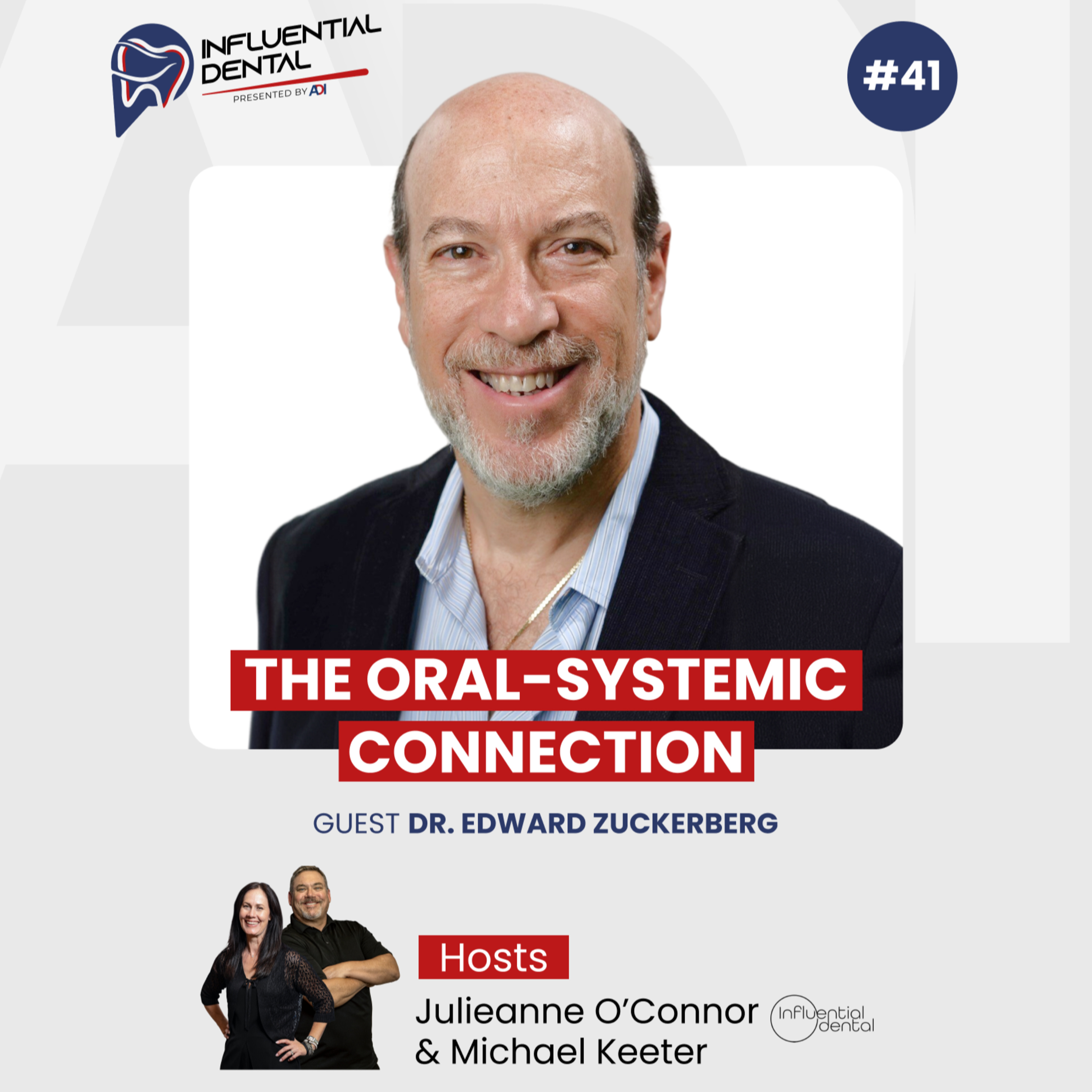
#41 The Oral-Systemic Connection with Dr. Dr. Edward Zuckerberg
from Influential Dental
58m 23s
Dr. Edward Zuckerberg, a seasoned dentist and early technology adopter, shares his career journey and current mission on the Influential Dental Podcast. Starting in New York, he integrated tech like the IBM PC XT and intraoral cameras decades ago, which led to a second career in lecturing and advising dental startups. After moving to California in 2013, he focused on giving back, eventually joining Reviewer as a venture partner in 2021, where he evaluated over 200 companies and delved into cutting-edge dental science. A pivotal moment came when he learned about Porphyromonas gingivalis, a bacteria whose toxic proteins can cross the blood-brain barrier and contribute to systemic diseases like heart disease, diabetes, and dementia. This revelation transformed his perspective, positioning dentists as essential primary care providers since oral inflammation often roots chronic illness. However, he notes that many dental offices still lack conversations and testing around this connection. Leveraging his famous surname, he feels a responsibility to educate both professionals and the public, using media appearances and lectures to raise awareness. He also supports companies like Viome, which offer oral health tests and cancer detection, though he laments that oral cancer survival rates have not improved since the 1970s. His ultimate goal is to drive change by emphasizing the oral-systemic link and encouraging proactive, whole-body health approaches in dentistry.
(upbeat music) - Hello, my name is Michael Keeter. Welcome to the Influential Dental Podcast presented by American Dental Institute. We have a phenomenal guest on today. And before we get to Dr. Edward Zuckerberg, I want to introduce my wonderful co-host, Julio Conner, how are you doing, Julien? - And fantastic, thank you so much. So excited about our guest today, 'cause we go way back. We've shared a few stages together, but he is amazing and everyone will know who he is. This is who you introduce him, or those of you who are just listening. Those of you who are watching, you can see him already. So, hi, welcome Dr. Zuckerberg. So nice to have you on our show. - Hey, great to be here. Wonderful. I'm just gonna jump right in because there's plenty to talk about and look forward to the next 45 minutes on to really look at your journey, Dr. Zuckerberg. When it comes to starting back in New York, coming out to the West Coast, innovation, your early adopter. But before you get started, Julien, do you have an initial question to you like to ask Dr. Zuckerberg? - Yeah, well, I'm just excited, 'cause you are such a contributor to this industry, right? And I've been in the dental space about 15 years. You've been in a lot longer. And for those of you who think you recognize the name, but maybe don't know, Dr. Edward Zuckerberg. And do you go by Dr. Ed or Dr. Edward, or what do people call you out of curiosity? - Most people just call me Ed. - Okay, well, I always say you earned the name and it's such a famous name for such obvious reasons. But you are actually, in fact, the father of Mark Zuckerberg. So for those of you who are wondering if that is true or not, that is absolutely the case. But when I first met you, honestly, I think when the first time I met you was either in Orange County or Camarillo speaking, I don't know, I wanna say for some big groups of dental professionals. And you've always been a massive contributor around everything that has to do with social media to AI. But I bet right now what you're working on is transformational for this industry. Can you share a little bit of your background and how you ended up here and what you're working on? - Sure, it's been a pretty circuitous route. My technology is talking to me through my glasses. So I'm just gonna lower the sound on that now. - Nice, everyone has spy glasses now. - As you're speaking, my oldest daughter is running in 50 mile race in Arizona, which is insane. And yeah, she's certifiable, certifiable, but she's also amazing. I mean, to run basically 10 marathons consecutively without sleeping for several days is unbelievable. - How does anyone do that? How does the human body even endure that? - It's a long story. You know, she goes all in when she jumps aboard on anything, but she's got quite a support group and they're all chatting with her on WhatsApp right now and every message comes through on my glasses. So I think I'm actually gonna shut the glasses off. - I love it. I essentially did a marathon. I essentially did a marathon going to Coachella a couple of weekends ago, but I walked it for what it's worth it. I could hardly walk at the end. So I commend her and it's no surprise. All of your children are overachievers, right? So what's the story there? - They all, I don't know where they get it. You know, each one's different in their own way. And I think my wife and I, they're the product of having an incredibly insightful mother who happens to be a psychiatrist by trade. And you know, my wife and I, both the products of growing up being smart kids in New York and your parents want it only one thing for you when that was to be a doctor. And so here we are, but you know, and it's worked out great, but we both kind of felt like we didn't want to channel what our kids became and we wanted to basically expose them to as much as they could and feed their strengths. And you know, thinking that you probably spend more hours of your life working than doing anything else. So it should be something you really passionate about and enjoy and that's a great road to being successful and being happy. So it's worked out for me really well. One of the best decisions I ever made was to set up my practice in my home, which enabled me to be present for the kids growing up and also benefited some of the changes in the world that I've helped bring about because being an early tech adopter, I mean, I had an IBM PC XT in my office in 1986. My first intraoral camera, the ACU CAM, a couple years later in the late 80s. And in fact, almost 40 years later, the guy who built the first intraoral camera, Fidentus was pitching to me ultrasonic periodontal probe. So that's where I am now and it's kind of cool, you know, having closing that loop up. - Yeah, that, that, that is amazing, Dr. Zuckerberg and started interrupting you, but you've had such a story to history, I mean, practicing industry and you still practice part of time, right? I see that you're still practicing part time in Cupertino a little bit. - Yeah, yeah, I do, you know, in 2013, we made the full move out to California, even though all four kids were there, it took having our first grandchild to get us to really bolt. And you know that-- - Very, how do you say stay inspired to continue contributing in this industry when you could go be retired, you know, a hundred times over? But how is it that you stay so motivated? Because every time I talk to you, again, you feel like this, or you express that you feel an obligation to this industry to really serve them and it's impressive. So what is it that keeps you-- - No, I think I, the first thing I did after 35 years of practice in New York when we moved to California was enter a phase of giving back to my colleagues, what knowledge I had accumulated. You know, I wasn't gonna teach anyone dentistry, but I was really good at integrating technology, you know, really understanding the marketing and running a business and stuff like that. And that second career, so to speak, was kind of jump-started by Dr. Howard Farhan of Dental Town. He reached out to me, we didn't know each other, but he called, called my office in the summer of 2010. He was like, I don't know if you know how at all, he's very out there. Right, Howard was like, hey, you're a dentist. And I go, I'm a brilliant guy, but you just cemented it. You know, how'd you figure that out? Anyhow, he was trying to become friends with every dentist in the world on Facebook. And he said, your son's site won't let me have any more friends. I have 5,000 friends and they won't give me anymore. And I'm like, Howard, it sounds like you set up your page, which should be a business page as a personal profile. You know, back in 2010, Obama was the president. I said, go look at Obama. He's got like 8 million followers. He goes, I want that. I go, okay, so let me find out. You know, I found out that we could convert his profile page to a business page. He lost all the content on the page, but all his friends became followers of his page. He was thrilled with that and he convinced me to write an article for Dental Town as my office need a Facebook page, which appeared in the September 2010 issue. And it went over really well and they said, you need to write something else. People want to hear more from you. And I said, well, I'm not going to really teach, you know, anyone dentistry and I don't know what else I could write. The dental journal. And finally, we settled on an article on integrating technology and the dental practice. And after that, I started getting calls to lecture, calls to advise tech startups in the dental industry. And around that time, shortly after that, May 2011, our first grandchild was born. He just had a birthday Friday, he's 15 now. We since have 11. So we have, and more after him. - Yeah, King Gras, by the way. - Yeah, it's yeah. - Yeah, and your family has really grown since I even knew you before. - Yeah, it keeps us hopping, it keeps us hopping. Essentially, the move to California helped. I didn't really want to start a new practice again after 35 years. You know, I've maintained, you know, as Michael alluded to, I've maintained connections with colleagues here. And I do have a few patients that I call my primary, you know, that I take primary care of here in in Cupertino, California. But primarily from 2013 on, I was lecturing to my colleagues, you know, out of basically what I could teach them best and what they wanted to hear. I mean, they wanted to hear social media. I'm not really, you know, a social media expert at the time. - No, but kind of an obvious choice given your son. - I'm not. - I mean, I, yeah. - And, but really most of what I did was integrate in technology and teaching about technology and telling them about some of the,
interesting dental startups that are coming on the horizon. And that basically carried me through until the pandemic hit. In 2020, I had about 20 speaking gigs throughout the country and the world that obviously were all canceled except one that I did early in January before the pandemic in February. And I turned to doing some webcasts and things like that from home and continued consulting via phone calls with my companies that I was advising. You know, most of which were in tech, dental tech, you know, like robotics, company developing a robot to do crown preps, smart toothbrushes, AI interpretation of digital X-rays. You know, I go back in that field even before companies like Overjet and Pearl and whatnot. And so that's the kind of work I was advising and helping bring companies along on. And I got involved in 2021 about a year into the pandemic with Jeremy Krill and reviewer partners. Jeremy is someone that I had met on a number of occasions at dental meetings. You know, we'd both be on the program and keep bumping into each other. And we both were advising a bunch of startups in the dental industry. Jeremy being half my age with a little more go getter. And yeah, we both know Jeremy is a very good guy. We just saw him a couple months ago where I actually last month on a dichama meeting. Jeremy is a very good man and a nice guy. We're going to have to give him our podcast as one. I think he's also going to contribute an article. But yeah, Jeremy is a good person. Yeah, a great guy and extreme. Probably the most knowledgeable person around about dental startups. But Jeremy asked me to join reviewer as a venture part era. And it was like, you know, pretty much what I was doing, but on steroids. So we had a backlog. We had a sore through at that time in 2021 of over 200 companies that we needed to do diligence on. And the thing I loved about that was I got to work with a bunch of other top dental industry KOLs and collaborate together and share our ideas about companies, you know, whether we thought their ideas were viable, what needed to change to make it work and things of that nature. If a company had FDA regulatory, we had FDA regulatory experts. If a company had a chemical, we had chemists. So anything that wasn't in our real house, we could bring in experts that helped us evaluate companies that review would consider investing on. And a lot of the companies wanted me as an advisor, even if reviewer didn't invest. So the portfolio of companies that I advised kept growing relatively early into the cycle. I met a company called Keystone Bio that had a monoclonal antibody to eradicate a bacteria peogen devalus. Now my knowledge base about the bacteria peogen devalus in March 21 was probably about what the average dentist's knowledge is now, which isn't much. You know, we were taught in dental school that it's one of the bed bugs in your mouth and gum disease. And that's about it. And the way the mouth is connected to the body wasn't really explained in much detail either. What they told us was that when you had gum disease, your gums were inflamed, bad inflammation locally meant that the local capillaries were dilated and meant that bacteria could go from the local gingival tissues into the bloodstream where they created havoc running through the body, but really not a whole lot of detail. And it wasn't until that phone call, which I think was scheduled for a half hour intro, which I finally got off the phone a couple of hours later. And I'm really hold onto my chair. It was really life changing. I mean, five years ago, I was contemplating, maybe this is the end to my dental career. This pandemic thing looks like it's going on for a while. I don't see myself going out lecturing anytime soon, meaning people in person or whatnot. You know, I was 66 at the time, 65, whatever. You know, and 30 plus 35 plus years of full-time clinical and another dozen years of lecturing and giving back, you know, maybe it's done. But after that call, I just had to read everything I could get my hands on and learn and become as much of an expert on pigeon devaluses I could because I learned that, you know, dentistry is not just about the teeth. Yeah, absolutely. I don't suspect that it was more, but no one really could put the puzzle together. And this one-backed theory of pigeon devalus is just, it's amazing. I mean, there are literally a few hundred people that do nothing else in their life, but study pigeon devalus and get together at a conference every couple of years for PG people. Now I can't walk into a room with those people and really, you know, hold a conversation with them about the level that they're on. But if you put me in a room with dentists, I probably know more than any other dentist does about pigeon devalus and how it's toxic proteins or ginger pains as we call them. So, to calculate throughout the bloodstream, cross the blood brain barrier, interfere with neuro-toxic pathways in the brain and lead to dementia, diabetes, heart disease and a bunch of other systemic maladies. So, really high level, give us a bottom line, I guess. And tell us, what are you trying to accomplish by educating people right now? What's the goal that you have? How can listeners contribute in the help and what do they need to learn? You know, just give us a, whatever, 10,000-foot view or bottom line on what we can do with this to support you and what you're trying to accomplish with this. So the big goal here is that there's enough evidence out there to indicate that all these diseases that affect mankind, heart disease, diabetes, dementia, cancer, arthritis, they're all inflammation driven. And most of that inflammation comes from roots in the oral cavity from peridonal bacteria. It's incredible, right? So the dentist is really probably the single most important primary care practitioner in the treatment of patients. You know, right now people with heart disease, you know, diabetes, whatnot, they don't even think of dentistry as the root of their problem. They go right to the physician, get prescribed the treatment, you know, pills, statins, whatnot, medications for diabetes, whatnot. Nobody's really looking at the mouth as the cause and hey, you know, what's going on here and what's a more proactive approach to treating a whole body health and preventing disease? Yeah, I'm hearing that more and more on the community. I know Julianne as well, talking about more people see their dentist on a regular basis than their primary care or definitely their specialist, right? And if you see your dentist twice a year, that should be what you're talking about should be the foundation of your overall health and they can refer out from there. So I'm hearing a lot about that in regards to the amount of just an elder on the head, on the dentist. But isn't it crazy to you, Mike, that people are not testing and they're not, they're not doing saliva tests. They're not doing some of these foundational pieces. The conversation is not happening in dental offices nearly as much as what it needs to be. It's not it. And this is where I get to thank you for having me on today because what, what I realized I needed to do was drive awareness and what I've been doing in the last five years and I really feel, even though I'm 71 now and I've got all these great travel opportunities, my son for my 70th birthday got this megyat that, you know, we get to go on a few times a year, which is just an out of body experience. And if you're a little too busy, Mike and I are looking for an experience right now. I'm 64. I could be a personal bodyguard, but now that's amazing. But I see we're going with that. I mean, you have a lot to give back and this is, this literally is, is, you know, and also because of my son, the name obviously has recognition and doors seem to open for me that don't open for other people like anyone I want to speak to any newspaper I want to be interviewed by any magazine I want to, you know, get a story and I can get those doors open and can be there. So I almost feel it's a responsibility that I have to use the combination of my knowledge and the power of my name that opens doors to be the driver in educating both the profession and the lay population. So what I've been doing the last five years, in addition to lecturing to colleagues professionally wherever I can via podcasts like these.
the live lectures which I can only do so many per year. I also like to get featured and discuss you know in lay person publications because it's critical to explain to the public. I think the public ultimately has to drive. Yeah. You know anything, I'm sorry Dr Zuckerberg what I was going to say is anything we can do with our platform and how we can't together the influential dental obviously our podcast we're out here talking to the most influential people in the world regarding lifestyle mindset and this proves to it we also have a magazine called Influence. So anyway that we can help support you and your cause obviously you've known you three years as well and the companies that you affiliate yourselves with that are so far domain that are doing some amazing things as well and Julian can speak on that as well. You know we all have families, we all have parents grandparents and those things that really can benefit from this and our children as well. So anything we can do through our platform you know count us in to help support that message because I agree wholeheartedly with with what you're doing Julian. Do you have anything to share that? I mean right now I try and tie everything I do to revolve around awareness and therapy to the oral systemic connection. So the companies that I advise and that I spend the most time with now are companies that are actually working on treatments and technologies to eradicate the bacteria stabilize the despiatic oral microbiome but one of my roles in pet the chief dental officer for the biome. Viome had been strictly a gut health company for a while but a couple of years ago they rolled out oral health pro with cancer detect oral cancer is something else I'm very passionate about. When I did my residency in 1978 at the Brooklyn VA hospital I and the other residents and some of the attendings there were charged with developing the protocol for the head and neck examination for the entire federal dental services. Army Navy at OS, Jales and prisons, public health, Indian reservations, VA hospitals, you name it. And I was doing you know head and neck examinations and oral you know oral cancer screening on patients back from my early days in practice in 1979. You know back when patients you know used to look at me when I was before I picked up and explore in a mirror I'm feeling their neck up and they asking some of them ask me if I was the sexual pervert you know and now if a dentist doesn't do that they say what about the oral cancer exam right you're going to check me for that so we've come a long way but big but 1978 the five-year survival rate for moral cancer was 50% 50 years later the five-year survival rate for oral cancer is 50%. We've got some incredible technology that allows us at the time that we whack off someone's half someone's mandible and dissect half their neck we can also take a chunk of their tibia from their leg pre-fit it with implants that we've scanned from the combbeam scanning and and basically at the same visit that their mandible is removed we can graft in part of their leg bone as a new mandible with teeth that are in occlusion when they wake up so we've come a long way with incredible treatments but we're not finding the cancers earlier which is necessary critical part to increase the lifespan of people diagnosed with oral cancer that's where vion comes in. Yeah it's interesting. Yeah I just featured was a saving face in our magazine right? Correct. And I have been talking about this topic because you know which is of course you know involves several people who have had these types of surgeries and they're speaking about how it's not being found early enough and it's all in the detection and the understanding about how things are being done right now and how far behind we are in terms of detection because the conversation's not happening still even this many years later and why why is that right? And so when going back to your point about driving it. I know why you're not talking about that but you know I mean there is a test available now. Vions oral health pro with cancer detect there's a bunch of salivary diagnostics out there on the market. Vions is the only one that has a reasonably priced total oral screen that not only screens for gum health carries susceptibility bad breath and its causes of salivary dysbiosis but also a screen for squamous cell carcinoma of the mouth and throat with a 96% sensitivity. So why it's not being used religiously? You know we live in an age where when the dentist says I'd like to do this and the patient goes is it covered by my insurance? Right. Yeah. You know right now you know when I started dental practice almost 50 years ago dental insurance helped me because my colleagues weren't accepting it. I started a new practice. I was taking everyone's dental insurance and in six months I had I built a full-time practice up from scratch. You can't do that now and now there's so much competition that every dentist clambers to join every PPO they can with the net result that they are essentially employees of the insurance company. When I moved to California in 2011 I had an associate that I offered to sell my practice to and I showed them the actuarial numbers. He was a great associate. He was actually taking home about 300,000 a year working for me as an associate which means he was making me money too and I had my accountant draw up the numbers. He could buy the practice from me. He still draw over 300,000 a year and build equity in the practice and he told me he couldn't see through signing his name to more paper that he was already 400,000 in debt from dental school and college and I'm like so you're going to work as an associate for the rest of your life and he said I guess so. So that's why we have three proliferating because of that the burden. I hate to. Today cringe if I tell them that like three-year dental school education and why you cost 20,000 and the first practice I bought was 5,000 all in. Right. The change is the money. I want to pivot for just a minute because a lot of people tune into our show because they really want to hear a little bit about your personal background, a little bit of your personal journey in addition to the clinical which we do a lot less of but it's so interesting and I agree with you just going back to I think this has to be driven by the patients. I think we have to understand that just because insurance doesn't cover your walk around the block doesn't mean it's not important to take it right and so we need to definitely be having these conversations more and more and there's a handful of things that I'm seeing are not being implemented fast enough in my opinion but I would love to to really quickly first of all just going back to the technology conversation. You know AI since even just since you and I spoke shared stage way back has changed so much right and so from a technology standpoint I'd love to know besides this particular product which you are trying to get people to have more awareness about and some of the the responsibility in it. What are you seeing that's happening on the AI front and where do you think people need to be paying attention out of curiosity and how is that affecting you personally and then we'll go and then we'll come back to your personal journey a little bit more if you're open to it. Well AI across the board is affecting everything whether people realize it or not. I mean even if you even if you look at salivary diagnostics which I which I just mentioned in bio every salivary sample that bio draws on a patient or receives a salivary sample out has about over six trillion nucleotides of data which are mostly polluted with data that we don't need that's clouding us from getting to the real stuff. And of all that data there's maybe 30 pathways that were interested in and without AI and machine learning weeding out all the garbage of salivary diagnostics that we have available to us today would not be used. So let's just say AI is everywhere. You know even things that don't have anything to do with oral systemic like transcribing notes from a practice. There's a company I work with then scribe that has a little microphone that they put in the laboratory and it hears everything the patient says here's everything that doctor said and uses AI to filter out all the excess garbage and create perfect soak notes that has all the relevant data. You know of course there are some changes we have to make like if the patient doctor why are you here today patient. I've got a
pain over here. Well, over here means nothing to a microphone. So the dentist would then have to help it along with the hygienist by saying, I see you're pointing to the lower left part of your mouth. So there is a learning curve to implement it, but we're getting incredible soap notes that save incredible amount of time. But beyond just creation of the soap notes, the treatment that was recommended during the visit becomes searchable and storeable. So now patients can be tracked for whether they have gone ahead and done the work that was recommended to them. So it's an incredible value add for the dental office. Working with images, you've got obviously companies like Overjet and Pearl that are deciphering the data that dentists might be overlooking, pointing out things and also making it easier for patients to see and understand the work that's needed in terms that they can understand. Okay. I have a quick question, Dr Zuckerberg. You can finish your fire real quick and then I do have a follow up question to that. Yeah. And then, you know, one thing that has really mushroom since I left practice for the most part full time in 2013, I didn't use condium in my practice. It was a tool that was in its infancy when I retired or, you know, tone down my clinical practice. But nowadays, the scope for usage is beyond just, you know, implants. And the few times that I've had a look at 3D images, you know, they're not intuitive to look at. And one of the companies I work with is company called Velmany. And Velmany takes 3D cone beam images. This is AI on them to create 3D images where the patients can see their whole skull, their mouth, whatnot, and really understand the cone beam images, you know, in a way that, you know, yes, we need the practitioner to understand things and there's a lot of information that we can never get before like curvatures on canals and, you know, how close we are to nerves when we place an implant. But we can't forget that the patient component of understanding the needs for their own work is what ultimately gets the patients to say, yes, and help the practitioner convert necessary treatment to accept the treatment and reaffirm their bottom lines. Right. Yeah. And I know I met many a couple times, the CEO of Velmany. And I think you and I heard some others read an event in Florida a couple years ago and saw the technology firsthand with the glasses and so on, which is pretty amazing. As a fall to what you'd said throughout, you talked about when you practiced the dentist coming out today with high debt and so on and so forth, my question to be for you is, if you were, what is your advice to dentists that are graduating dental school now? As relates to everything we've talked about or if it's a young doctor, Ed Zuckerberg, coming up to practice now, tell me about that journey on how that would be the same or different today versus, you know, 20, 30, 40, 50 years ago. I think it's an amazing time to come out as a new dentist now. I think they have to not fall into the trap of just accepting a job. I think they need to focus on, you know, realizing that dentists and there are a few new dental schools, Toro in Westchester County in New York, among others, that focus on educating dentists that they are physicians of the mouth and that the mouth is, you know, part of the body that needs to be treated. And so embracing the medical part of dentistry will allow the new dentist to to establish long, the kind of relationships that I had with my patients where patients were in my practice for 35 years, where their kids were patients of mine, where their kids grew up and got married and then brought their kids into see me. You know, when you don't get that kind of joy, unless there's trust and rapport and a feeling that you're the practitioner that really cares about them as people. It's easy to get ahold from that now. I agree with you too, and Julian, you were saying that as well. Oh, hardly, it's about trust, it's about those relationships, it's about what you're doing for them as people, not just filling space or, you know, cleaning a gum. Today's generation are really focused on longevity. You know, I see, you know, my own daughter, I asked her what, you know, what she, she's actually my youngest daughter is in venture capital. This is the one that just had her her second child in January. And not only is she want to live to 100, but she wants to be skiing when she's 100. And so this generation doesn't drink as much or at all, but they're really focused on health. And so they're, they're ready for the message that dentists should be giving to them about their mouth and about how their mouth is their, you know, their portal to up most and I guess I agree with you entirely. And I think it's, it's fascinating because I really think that with AI and some of these technologies, if people come into this out of the gate realizing what an impact they can have on people's health in this industry and dental, which has been really taken for granted relative to their impact on medical, you know, and the long-term ramifications on people's health, I think it's going to shift a lot of things with our, our humankind. But I'm sure this is now I'm going to go another direction again. I'm sure everybody asks you what's markup to because we're all thinking, okay, what does he know that we don't know? And so I'm here's looking at your children coming up, you know, from another perspective, having been guided by you and just been so successful already, what is it that they're contributing and or what are you seeing and learning from these younger generations right now that you think people might be missing in the industry that maybe they're not they're not listening or whatever else. You know, I think they're always trying to be a step ahead and look to the future. So I mean, I know the predominance of the work Metta is doing now on a development basis is in AI and they have been for a while, you know, I think Metta was accused whether rightly or not that they were slow transitioning from computer-based social media to mobile-based social media. And I guess they they don't want to make that mistake again, but it's it's harder to it's easier to be proactive, although more expensive than it is to try and follow and copy the next greatest thing. It's a lot easier to be the trend center and the leader. Obviously all the big tech companies now putting a lot of money in AI and, you know, really looking to revolutionize everything we do. Well, what I think is what you're doing and others in your field is to like I said help people live better, longer, more productive life through the world, calving. I grew you know, the dad and things I've seen as well. So what you're doing, I think is more important than a lot of the AI and some of these other things because again, no one's going to be able to enjoy the AI and all those things if we're not healthy and we're not having productive systems. So I really don't know where to put it. Well, I'll go sit hand in hand. You got to do it with the AI. Well, with with the AI, but if you don't, the bugs are they're going to cause it whether the air or not, you know, the bacteria and what I'm hanging out things are causing, you know, early or cancers and other things as well. But what I was going to say with that is don't Dennis, don't sell yourself short on doing what you're doing. Like you'd said about bringing innovation out there, whether it's through AI, whether it's through early detections on everything else. And I agree with you, it's time for dentistry. I've been in it almost 20 years now. It's a great profession. I've seen surgical restorative everything else. And I do think it's the cornerstone of the health moving forward. My question is I know we do have some time left. And I know we've been talking pretty heavy here, but I know earlier conversation, you talk about your family or grandkids. You know, I want to know what doctor at Zuckerberg does for fun. And fun and on your off time, if you have any off time. And then also I want to get into, you know, our podcast is called influential. Then all we have a magazine called influence. So maybe a little bit about your family, we do have fun. But then let's talk about influence and legacy and being influential on what that means to you personally. Okay, that's a lot. We have a whole lot of podcasts. We just do one question that I've always been passionate about photography. Okay. Nance dates for its underwater. You know, when I got a camera when I was 18 or 17 when I graduated high school and when I was in my residency in the BA hospital, the perio attending told me take advantage of this year. You're never you're not going to be ever under any time pressure here. And when you get into private practice, it's going to be boom, boom, boom, boom. He said, first thing I recommend is get a camera and photograph and
everything you do. So I got really competent in 1978 in intro or photography and developed quite a library of all kinds of or pathologies and procedures and stuff like that. So and that actually got me into macro photography. So I love taking pictures of insects, flowers, when I when I scuba dive under what do I love? The little guys like the little shrimp, new to branches and stuff like that. Cool. They're a lot more fun and easier to shoot than you know chasing a shark or something like that. But I love photography. Love photography. The other thing that takes up a lot of my free time is bridge. I play contract bridge. I mean I've done that for 35 years. I play, I teach, I compete on a national and an international level. It's incredibly stimulating to my brain. It's probably the time that I my brain works harder than anything else that I do. So I I love the challenge. I love the puzzles. I love the mathematical aspect and the gamesmanship and I find that it really helps me stay sharp and also gauge whether I'm going at all. Right. Well, I do in the competition. Did you decide to do that because you knew it was good for the brain or did you just like pick it up and start playing and you had some fun? When I was in college I started playing hearts and spades and we played for like light friendly steaks like a penny a point and I was really good at it and I like always earned lunch money and I never had a page for my own lunch because I always made a couple of bucks you know which was all lunch. So fun. And then when I was in dental school the faculty played bridge. We played hearts during lunch and I guess the faculty lost the bridge player in my senior year and they drafted me and another guy to fill out their table and taught us the rudiments of bridge and I think it was about 1988 or so that my wife enrolled us in class at the local JCC five weeks to learn bridge and after that I started playing and I really enjoyed the competitiveness of it as well. So yeah I was hooked. I was hooked. So my mother in law plays bridge and it does not matter if we are in town for the most important reason under the sun. It has to work around the bridge schedule and she's kicking butt all over earning you know winning whatever four dollars or something and I'm like okay so we shut us down for your four dollars. Yeah you pay to play but you know we don't play for money. Anyway when are these days I am going to learn. Yeah I would say I read about 25% for entertainment, 25% for news, and about 50% bridge. That's what I love it. Now what about influence? So when Mike and I formed this company it wasn't because we were thinking oh we're going to go be influential. We just thought we wanted to lift up the most influential voices who were really doing good things in the industry and giving back. And so you're definitely one of those people you absolutely rank them but what does it mean to you? And yeah I mean you come from massive influence right and I think you brought it and then you're sounding became more influential. So what is that like done to your life and what does that mean for you? You know I never looked at myself as an influencer so to speak. I mean I realized in the beginning I got a lot of speaking gigs and people wanted me because of the name and figuring that there was some mojo there and people would be come out to hear me because who I was. I think the eye open for me was my friend Justin Moody who's you know a woman respected implantologist and lecturer and implantology. Commence me to come out and speak at a South Dakota dental conference probably about 10 years ago and to my surprise in Rapid City South Dakota there were like several hundred dentists there to hear me speak. Yeah and it was phenomenal and during my talk I don't know I guess I kept mentioning Mark this and Mark that and whatnot and in the end in the Q&A one of the guys in the back raised his hand and said you kept referencing this Mark person who is that. So my wife was in the audience started laughing hysterically and I did see it and it was like my moment where I said they're actually here to hear me not because my name is Zuckerberg. I've heard you speak by the way you're an excellent speaker obviously everyone can hear that here but I've seen you on stage you're also really entertaining and that was something that I really loved about hearing you speak is that you made us all laugh you were a lot of fun you were super grounded and down to earth we also know Dr. Justin Moody which we're most excited about his winery that he's creating have you been to it yet? I didn't add that wine is another one of my passions too. Yes okay same for all of us. I need wine to be now together and they have a new winery and in Napa that I'm looking forward to visiting later this year I've already tried some of the wine and it's incredible. It's excellent. Yeah. But going back to this legacy thing you know in 2020 you know about a year into the pandemic and I remember having this conversation with my wife like I think I'm done you know and and I'm okay with it. I'm okay with focusing on no more dentistry for the rest of my life. You know what what do people remember about me you know they they had some really brilliant kids you know that contributed a lot to society and I'm great with that and the phone call about Pigeon Yourvallis that I had five years ago that caused me to embark on this new passion and new new journey to really affect changing the industry has made me realize that I have the potential to really help affect change in that way and and I don't do it to establish my own legacy that you know that what I would be known for but just to be part of contributing you know as one of the people that move the needle to really move dentistry you know in line as primary care or physicians of the body. Yes so one thing that I really admire about you is you really genuinely are that person you've never I never even in fact when I heard you speak I don't think I've ever heard you say Mark's name I don't think you were out there touting it you were literally just they're contributing and really gifting people with knowledge and and information and so I really admire what she's done with your career I'm absolutely impressed that you don't just throw in the towel and that you keep caring so I think I mean it's it's phenomenal because you could you could absolutely step away if you wanted and just go spend time with your 11 maybe soon to be 12 grandchildren we'll see right but yeah so what next for you I'm more of the same I mean I think I've I think I've gotten to a point where while it is difficult I'm managing work-life balance you know you know we spend about four or five weeks a year on my son's boat and as you can imagine it has a great starling connection so I could still be working I can still do great work from the boat if I need to but mostly that's you know just unwind time where's that where do you guys go where do you spend time we just we just came back from Galapagos nice wonderful amazing incredible and your whole families in California is everybody out here three of my kids are in California and one has my oldest daughter the one who's running right now somewhere in Arizona I'll be there Thursday and Friday this week and Saturday to watch her cross the finish line which will be amazing Mike you should go out and support she moved back to New York about 10 years ago with her three kids and her husband and she has her own media company and she produces Broadway shows she's one I think last time I counted the three or five Tony Awards producing Broadway shows she's been on Broadway doing the part of Regina in Rock of Ages she's you know she was always passionate about music and singing as a youngster and she never lost that so that's great and her other three kids and eight of our 11 grandkids are here in California nice nice I love that Mike go ahead you you had something that that was amazing and as we're wrapping up Dr. Zuckerberg I do really appreciate you and the people that are watching and hearing us hopefully they're motivated to carry on the torch I know you're not done yet but obviously you need more help and to get the awareness out and what you're doing on the forefront I think of demonstrate and the medicine you know crossover I mean this is I this is a group effort obviously there's only one of me but you know I bring in people who are passionate about this topic people like I don't know if you I assume you know who Shay O'Diado who's always lecturing about you know health and nutrition and not so much you know how to do a you know a great restoration no more more of that practice philosophy and making changes is necessary I mean I've aligned with progressive deans of dental schools
like William Genobley at Harvard and Michael Ready, you know, who are both big believers in driving change in the and the oral systemic connection, policy leaders at the ADA and whatnot. So, you know, I try and play a role wherever I can. You know, I love getting out there in the trenches and meeting new people last year. I did the keynote at the AACD for the ADC for dental consultant, CD is cosmetic that this was the, you may be doing both. I lecture frequently doing webinars for AOS for the American Academy or all systemic health. You're tight with Dr. Mike Zubiak. Do you know Dr. Mike Zubiak, he's from Camarillo, actually, with Camarillo's mouse and-- - These are the AOS. - Yeah, but I think he's the new president of AOS, isn't he? - Okay, I don't think I've met him. - Okay, yeah, we'll introduce you at some point. - He's very involved with AOS and Mark Cannon and I are well connected. - Yeah. - Yeah, but I, you know, I love being out there in front of colleagues, ADA foresight. If I did their keynote in October, 2024. No, the message is nothing, you know, it's both enjoyable, but also scary to me when I'll lecture to like 100 dentists about Pigeon de Vales and how it directly influences dementia and dentists walk out of the room hearing this stuff for the first time. And I'm like, this information is out there. It just tells me there's so much more work to do when dentists today are still just hearing about it for the first time. - So why is this not, and it's similar to mental health for dental or how to run a business or how to, you know, how social emotional skills? Why isn't this especially being taught in schools before people are graduating? Is it just because it's so newly discovered or why do you think this is not being implemented more in the school environment? - It does take a while, as you know, for anything to filter down through the mainstream, but there's no doubt that it should be an essential part of the curriculum and is starting to be introduced more and more. So I think that's something that's easy to do. I think that, you know, whereas Pigeon de Vales was just mentioned as a casual name drop years ago, I think there's much more information being imparted upon students now. So, yeah, I think those changes that you can see I think what I've recognized and through another partnership that I have with a company called Cloud Dentistry, I've realized that educating Higiennis is probably a more effective means of getting patients to understand the oral systemic connection than dentists. Dentists are in and out. They don't have the time to sit there and talk to patients about this kind of stuff, but the Higiennis are gonna do everything they can to motivate their patients to do the best for their own oral health and the Higiennis that I've spoken with, including my own personal Higiennis that Cupertino dental group are just eating this material up and loving to, you know, get as much as they can on it. Most of the best speakers now on salivary diagnostics and, you know, the oral microbiome are Higiennis. - Yeah, definitely. Well, we know Cloud well. In fact, I think we're gonna have Trey on the show if he'll join us as well at some point here soon. But here's what I would offer you. If you have any other incredible people that you're partnering with that are, you know, influential and great speakers that would like to be on the show, definitely we'd invite them to be our guest as well to continue to spread this message. It is so much an honor to have you on our podcast genuinely. I really just can't tell you how much I appreciate you being a part of this, my huge shout out to American Dental Institute for being our co-collaborators on this podcast. And where can people find you if they wanna learn more or they wanna follow you on social or whatever the case might be? What's a good way for people to connect with you? - So they can find me on LinkedIn, homelessDRZ. They can find me on Facebook, obviously, a painlessDRZ. And my website, painlessdrz.com. So that's the catch word. You know, that was kind of born out of convincing my psychiatrist, wife to leave her practice in 1996 and come work in our office in the house full time. - How cool is that, sorry. - We really focused on making the dental experience, one that was enjoyable for patients and comfortable for dental phobics of all kind. And it obviously worked because I used to hear over and over as they left. That was painless, Dr. Z. And so, the catch phrase, "port when I developed, when I opened my website in 1996." So painlessdrz.com is where I'm found. - Do you have to ask people, this is just another topic because I personally did this to you where, and I had so many people who knew that I knew you who have asked me for a favor. And do you have to ask people to like back off with the favors on helping them to fix things with their Facebook page or whatever else? - I'm not even kidding because I literally just tell people, no, I'm not calling that favor. I didn't once, I'll never do it again. But you did, you helped somebody bring back an Instagram account that was, you know, was such a high profile account that got shut down over, you know, blood or something. And I always appreciated you for helping them. They were a client amount, but they're very high profile. - One of the problems of growth, you know, on a cross all the meta apps, I think there's, the number of staggering, I'm, you know, I think it's over three billion people are using a meta app of some kind, even WhatsApp, Instagram, or Facebook around the world. You know, being a public company, they answer to stockholders and stockholders want them to cut costs wherever they can. So we've seen in the news that there have been layoffs, you know, over the years. And, you know, they're hesitant to lay off engineers, the most prized, you know, employees they have. So unfortunately, a lot of the layoffs that occur in customer service, and a lot of the customer service work is replaced by AI, you know, you see that not just in social media, but everywhere. I mean, you virtually can't get past a bot or, you know, some kind of AI chat bot to get to a live person anymore. So I feel people who, you know, struggle and aren't getting the results they can. So when people do reach out to me, I try and help them, but, you know, I have limited bandwidth, you know, I'm, he has a lot of things to do. Like we said, there we are. - Yes, please don't reach out asking for that paper. - I'm here with travel bandwidth, advising companies, you know, I just have so many hours and that they, they have emails. It's not, yeah, be a father, be a husband, be a grandparent. You know, that's amazing, doctors. Like I do very much appreciate your time as well. - Fine, Michael and me on Instagram at InfluentialDental. - Dr. Zuckerberg, thank you so much from the bottom of my heart, genuinely. And we appreciate you being here. - I love doing this and I love spreading the word, you know, about the oral systemic connection and what I'm passionate about and the changes I'm trying to bring about, I love spreading the word. - Amazing, thank you again. Thank you, Michael, for a great show. Appreciate you. - Thank you, Julianne. (upbeat music)
Podcast Summary
Key Points:
Dr. Edward Zuckerberg, father of Mark Zuckerberg, is a dentist and early tech adopter who has practiced since the 1970s and now focuses on education and industry innovation.
He integrated technology early, including an IBM PC XT in 1986 and the first intraoral camera, and later became a lecturer and advisor to dental tech startups.
In 2021, he joined Reviewer as a venture partner, evaluating over 200 dental startups and advising many, including Keystone Bio.
A key turning point was learning about Porphyromonas gingivalis (Pg), a bacteria linked to systemic diseases like dementia, diabetes, and heart disease via inflammation.
He emphasizes that dentists are crucial primary care providers, as oral health is foundational to overall health, yet testing and conversations about this are lacking in dental offices.
He uses his famous name to drive awareness, lecturing to professionals and publicizing in lay media, and works with companies like Viome to advance oral-systemic treatments and oral cancer detection.
He notes that oral cancer five-year survival rates remain at 50% since 1978, despite new technologies, and advocates for broader education and proactive care.
Summary:
Dr. Edward Zuckerberg, a seasoned dentist and early technology adopter, shares his career journey and current mission on the Influential Dental Podcast. Starting in New York, he integrated tech like the IBM PC XT and intraoral cameras decades ago, which led to a second career in lecturing and advising dental startups.
After moving to California in 2013, he focused on giving back, eventually joining Reviewer as a venture partner in 2021, where he evaluated over 200 companies and delved into cutting-edge dental science. A pivotal moment came when he learned about Porphyromonas gingivalis, a bacteria whose toxic proteins can cross the blood-brain barrier and contribute to systemic diseases like heart disease, diabetes, and dementia. This revelation transformed his perspective, positioning dentists as essential primary care providers since oral inflammation often roots chronic illness.
However, he notes that many dental offices still lack conversations and testing around this connection. Leveraging his famous surname, he feels a responsibility to educate both professionals and the public, using media appearances and lectures to raise awareness. He also supports companies like Viome, which offer oral health tests and cancer detection, though he laments that oral cancer survival rates have not improved since the 1970s.
His ultimate goal is to drive change by emphasizing the oral-systemic link and encouraging proactive, whole-body health approaches in dentistry.
FAQs
Dr. Edward Zuckerberg is a dentist, technology innovator, and father of Mark Zuckerberg. He has practiced dentistry for over 35 years and now focuses on educating about oral-systemic health and advising dental tech startups.
It refers to how periodontal bacteria, like Porphyromonas gingivalis, can enter the bloodstream and contribute to systemic diseases such as heart disease, diabetes, dementia, and arthritis. Dr. Zuckerberg emphasizes that dental care is crucial for overall health.
He was an early adopter, using an IBM PC in 1986 and an intraoral camera in the late 1980s. Later, he lectured on integrating technology and advised numerous dental startups, eventually becoming a venture partner with Reviewer.
Dentists are seen as primary care providers because many systemic diseases are inflammation-driven, originating from oral bacteria. Regular dental visits can help detect and address root causes, potentially preventing conditions like heart disease and diabetes.
His mission is to raise awareness about the oral-systemic connection and promote therapies that target harmful oral bacteria. He uses his platform to educate both dental professionals and the public, leveraging his name to open doors.
It's a product from Viome, a company where Dr. Zuckerberg serves as Chief Dental Officer. It focuses on oral health and includes early detection for oral cancer, addressing a disease with a stagnant 50% five-year survival rate.
Chat with AI
Loading...
Pro features
Go deeper with this episode
Unlock creator-grade tools that turn any transcript into show notes and subtitle files.
 PodcastTranscript AI