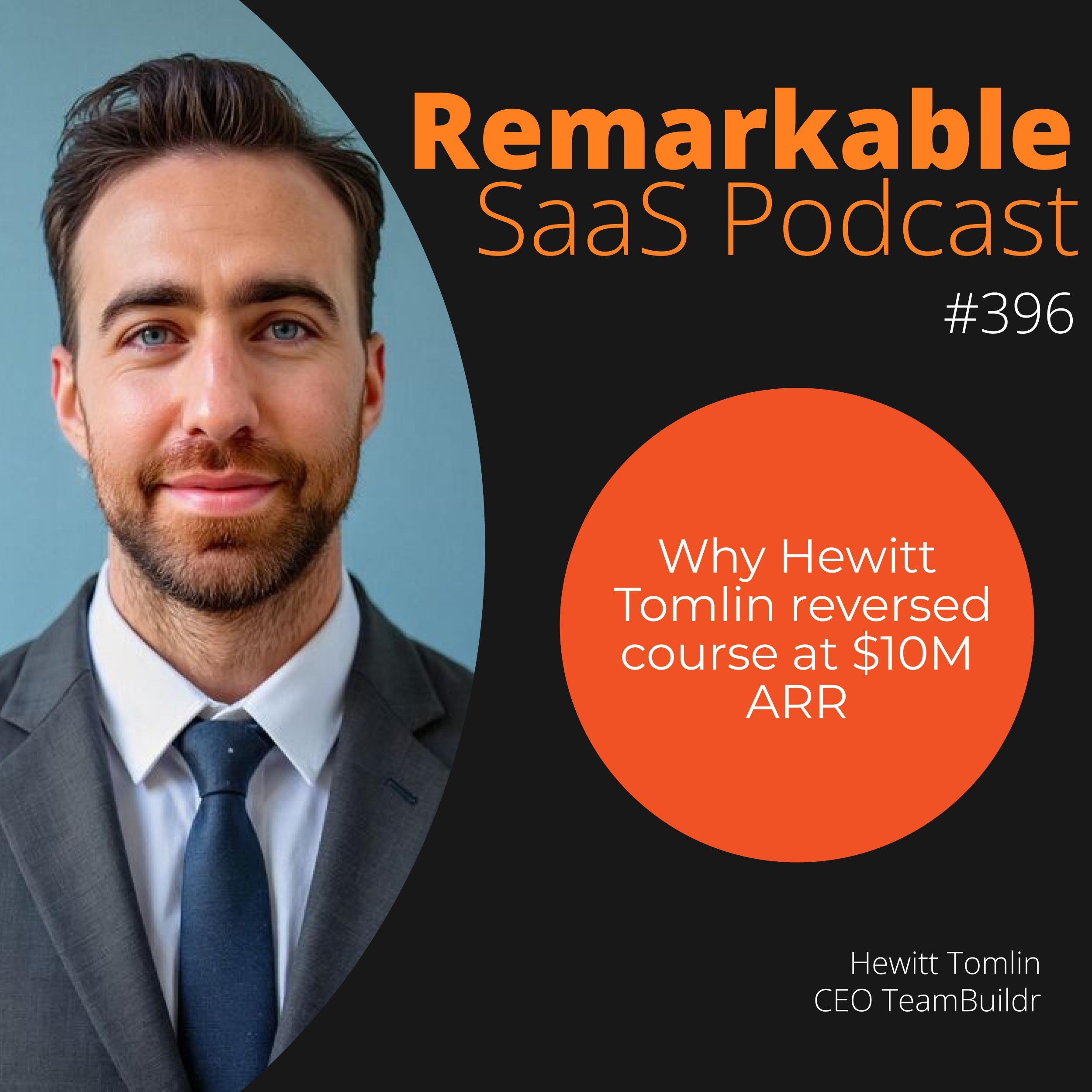
The podcast introduces its mission to help SaaS founders create must-have products through honest conversations. The episode features You It Tomlin, founder and CEO of TeamBuilder, a bootstrapped SaaS company serving strength and conditioning professionals, which has grown to over $10 million in annual revenue with around 50 employees. Tomlin discusses rejecting conventional growth strategies at this stage, instead focusing on deepening their existing successful model. He shares that early success came from leveraging customer relationships for insights rather than just revenue, and highlights a pricing mistake as a key learning moment. The company’s hiring practices prioritize professionals from the industry, fostering low attrition and a strong culture by treating employees as individuals and aligning company goals with personal purpose. Tomlin emphasizes the importance of loving the process over fixating on outcomes, mirroring the philosophy of the profession they serve. The conversation underscores building efficiency, customer-centricity, and sustainable practices over external funding or rapid expansion.
Your a SaaS founder, you've built something solid, but growth still feels harder than it should. Most SaaS companies don't fail because of their attack. They fail because they've never become a must-have to the right customer. This podcast is here to change that. I'm Tondova and this is the remarkable SaaS podcast. Every week I talk to founders in the trenches, facing friction, making bold moves and building companies at last. We dig into real choices around focus, positioning, customer pool, team alignment. The things that separate Forgettable software from the ones that people can't live without. No hype, no hex. Just honest conversations to help you build something that people would miss if it was gone. If your SaaS should be indispensable but isn't yet, this is your podcast. Let's get into it. The Guest of my podcast this week is you at Tomlin. Go founder and CEO at Team Builder. Our existing application is responsible for 10 million revenue. It's not bad. There's a good argument there for not changing anything and continuing to attack on 2 million a revenue a year. But no, we're convinced it's the right thing to do because we feel like if it's gotten us so far for 10 years, then the new version will carry us for 10 years into the future. This is you it. We dig into why you reject it is own growth strategy at 10 million in revenue while every instant set keeps building. You'll hear how a pricing mistake he calls his biggest error, forced and reckoning in how he makes decisions. The conversation reveals what happens when a bootstrap founder stops chasing more products, more features and more revenue and bids everything on going deeper into what already works. Well, how you it. Thank you for making time available today. Being the guest on the podcast. Thank you for having me. Pleasure. Pleasure. And it's been sometimes I had someone that's in the sports area. I had people that that had been creating a platform for gyms and for fitness tracking and these type of things. But now we got something for for athletes and coaches of athletes to increase performance, right? Yeah. That's a good one. I look forward to this. Before we start talking about your company, what drives you as an entrepreneur? What gives you energy? Oh, thank you for asking that. I've been on many podcasts and that's a very good question. Well, I don't have this great story about how since I was a child, I was selling lemonade or obsessed with solving problems. I more or less came out of college without a good sense of what I wanted to do with my talents and my small burgeoning skill set. And entrepreneurship sort of just arrived to me and I just took a great deal of pride in becoming an entrepreneur and getting some traction as an entrepreneur. And that's what sort of drives me is that it was a profession, if you will, that I was good at at a young age. And I took a lot of pride in that. I think that's simply the answer. Everyone has a starting point, right? And you go into it and I completely agree. At the moment, you get out of school. It's pretty hard to understand what you really want to do. And normally it's going to be something different than you expect. It's the same for me, by the way. So you, yeah, your history was coming through 8 cm software. Then you went, became a head of partnership at the contextually. And then, yeah, the origin story of team builder came around. What was that big idea that you got or the problem that you saw in the market that was screaming for something like you build it today? Well, the concept of what is team builder today predated my jobs out of college. It just wasn't yet a business. My partner in team builder was my roommate in my teammate in college. And we were working on solving a problem that we experienced, which was we, when we were college athletes, we received our training programs from our coach via paper and the iPhone came out our freshman year. So we were just a classic post iOS company. But actually, we were not a company until I learned what it was like to work at a company. So while team builder was an idea that we were working on and building, it was a software, I was working in tech startups, facilities management and contactually as a CRM business. So I honed my skills in sales and marketing and sort of learning what these small, the part of the benefit of working at a small company like these tech startups was that I got to see the CEO work on a day to day basis. I got to the meetings were very transparent as opposed to working at a big company. And that really aided my efforts at team builders to the point where three years after college, team builder was enough to provide an income to me. And I quit my full time job and I became self-employed at 24 years old. But self-employed with an income with a business that was earning revenue, which was pretty unusual. So that was more or less the origin story of team builder. Okay, so that's what I saw LinkedIn and some other sources. You started around 2011, 2012. So that's 30 years down the road. And what I've also learned is that it's been a journey, completely bootstrapped. And for reasons that you believe in, right? Again, I do believe in bootstrapping. However, similar to my career as an entrepreneur, I didn't have this bootstrapping ideal sort of finalized in the beginning. I did apply to accelerators. I did apply to incubators. I did seek angels only because I thought it was what you had to do. I just thought it was what you had to do. And we didn't get into any incubators, accelerators, and we didn't get any seed capital. We lost our business competition in college. So we truly were 100% bootstrapped. And then we committed to bootstrapping once we stood up a business that was revenue positive and made money and had customers. And then we realized we never needed the capital to begin with. But I wasn't wise at say 22 years old and chose to bootstrapped. It took me a few years to realize that I was able to bootstrapped. Yeah, exactly. If you do it for the right reason, if you build something that customers truly value, then these things will come by yourself. And you don't have to kind of, I call this funding independence. You create that funding independence. So it's not that you don't need to have funding or that you can't, you won't take funding. You don't, you just, it's a decision. And you're in charge. That I think is a very important point. Correct. That's a very big benefit. And by the way, all the benefits of bootstrapping, I've come to recognize in the retrospect. So funding, of course, is a benefit. Another great benefit of bootstrapping is the fewer the stakeholders in a company, the more efficient and workable that company is. It was my customers and it was myself and my partner. That's very few people solving a problem together. So what we built was very efficient because it was building in response to customers and not building in response to a business model or a mandate for profitability or a mandate for scale by an investor. And that's still the case today. And it just creates really efficient workability in our company to leave other stakeholders out of the conversation, such as an investor. Well, I mean, talking about that from what my research has done is that you're reaching or you've just crossed a 10 million revenue bar. Is that correct? That's right. And the number of people that you employ, 30? More than 30. Last year we were close to 50. It's somewhere between 45 and 50. Yeah. Okay, but still, that's pretty good ARR employee. It's, it's, it's, it's, it's, it's, it's, it's, it's, it's, it's, it's, it's, it's, it's host capability thing. Yeah, it is. And, you know, could we run this company with fewer employees? Yes, we could. Or just, we're in a position where we're seeking like a really, like a balance between growth and ambition and profitability and efficiency. We don't want to be too dogmatic and on one of the spectrum or the other. So this is, this is where we landed. Yeah. Exactly. Exactly. So yeah, going back to the, to the origin story now, I mean, if you, if you would explain team builder in, in two lines or three lines, what is the essence of the solution? Who, who you, who you could idea of customer profile? Team builder is a software service serving the strength and conditioning professionals. Strength and conditioning is a profession. It's a job function. Our software helps enhance this profession. It makes it more productive, more efficient, more effective with the athletes that they train. And notice that I didn't really mention a vertical college high school professional club. Jim, it doesn't matter. we focus on that on that job function of the strength coach. The strength coach's job is to make
athletes perform better and more durable and the demands of their sport, demands of the task. So if that's football, soccer, baseball, if it's being in the military, if it's being a police officer, it doesn't matter. Those are physical tasks and we can train to optimize the performance in those tasks. That's what the job is. So our software serves that profession. Yeah, exactly. I mean, have you never narrowed it down to a particular sport whereby you say, hey, the solution that we created could technically help a lot more people, but actually if it's about this particular thing, we are the best. The profession is more fluid than that. Of course, there are people who are strengthening conditioning coaches and LaLiga and they are going to be soccer. Strength coaches probably is a career, but that's very few. Many of these coaches are in gym settings. They work from sport to sport, university to university. So if you want to focus on specific sports, you're more or less married to that sport, whereas I like working with a profession because it gets really interesting. It actually turns into a little bit of a history lesson. You learn about how the strength and conditioning profession has a lot of roots in Eastern Europe and Soviet countries training for the Olympics. You learn how European football has its roots in strength and conditioning and its own history and research and then how the US system of strength and conditioning is rooted in American football, which is the contact sport. And all these sort of histories have influences on the profession themselves and it's all very fascinating. But the point is that they're all essentially trying to do the same thing. They're just optimizing for different outcomes. And exactly. Talking about it, of course, what I hear is, it could technically be one person that is actually a customer. That's right. And the name is team builder. So do you see this as a B2C play or a B2B play? Well, it is a B2B play. It is all interesting in that we don't necessarily convince an entire organization to purchase an on-board or software. We're a bottom up sales organization. We market to and sell to the strength and conditioning professional of which there may be one or there could be a staff of three or four. And perhaps they have to get permission and justify the acquisition of our software to someone else within the department. So the sale then becomes a little bit more sophisticated. However, we've had very little success selling top down. And that's because the impact our software makes is all that day-to-day workflow of the person who is really vested in looking at our software and potentially using it. So it's a small B2B, I would call it. Interesting how you call that, exactly. Well, I'm going back to the roots of this because you said you started it already early days just coming out of school. Then you had some professions. Did it as a side gig. At some point in time you decided to stop my job and make that the business. What has been an early decision that you appear to be really important for where you are today? Oh, I would say our hiring practices have gotten us to where we are today. Our company is known for very little attrition. We do not churn a lot of employees out. In fact, just late last year our first employee left the company. And that was after 10 years of say hiring our first employee. Now I do think that 100% retention is maybe not necessarily the best thing. It is okay at some point to let people move on to other things and to bring fresh blood in. However, we have passed down so much institutional knowledge in our company and so much cultural value by having low attrition that that is really I think like a cornerstone of having grown our business. So that's not necessarily a decision. So maybe it's not the best answer to your question. But our hiring practices and essentially that system is what I attribute to be one of our strengths. So how does that system work then? I mean, first of all, I mean, there's tons of solutions out there that are helping people make the right decisions and there's always of course still a gamble. I think these days you can find much more fit whether that's cultural fit or whether that's mindset fit or whatever the fit needs to be. But still, you know, the company is changing. The company starts with three people and now you 50. One customer now it has a thousand. Well, a few things in the nontenical positions. I have a bias towards hiring people who worked in the profession that is our customer. So I believe that when I hire people who've worked in the profession that we then turn around and sell to and support that they have a unique understanding of it. But more importantly, they have a respect for the profession. So the respect they honor it and that becomes highly visible in the interactions with the customers and the prospective customers. Number two, my employees, I treat as individuals. Yes, we have an employer employee relationship and then that's it. They're bigger than that. They are an individual with interests with the life outside of work. They have goals. They have aspirations. They have visions. They have challenges. They have personal challenges. And I think understanding that and acknowledging it goes a long way and sort of the mutual benefit in our company, the mutual understanding. So I really like to treat my employees as individuals as opposed to just keeping it professional or, you know, we have a workplace relationship. So I make a point to get with every new employee higher and get to know them personally. I don't just talk to them about their performance or their work. I like to understand a little bit about what their personality is like and how things are going outside the workplace, not necessarily to get involved or to help, but just understand that I'm aware of them as an individual. And I think our companies did a good job of that and people feel like they can beat up their true selves at work. And we stay away from the trap of being overly loyal to your company and also avoid the lack of loyalty of being not bought into the company. I think we try to find that right balance. Exactly. So what is that loyalty about? Is that truly in that profession and the joint bonds that you have about a profession? I think that's a big part of it. Yes. And I also understanding that having an honest conversation about goals and outcomes, as any company, we have goals and outcomes here that we achieve to hit, but understanding why is important. And yeah, I try to make sure that we don't set unreasonable goals and we don't simply grow and pursue growth because we happen to run a company in a capitalistic society or because that's just what you're taught is to grow. I like the frame growth as a company of something that is fulfilling and elicits like passion and challenge. Our company ought to achieve more and be ambitious because that's what makes a job meaningful when you come to work every day. And it's not about simply hitting arbitrary metrics. So we work with everyone to understand what they can do to help their department, their position and thus the company move in the right direction. We take our company's outcomes and tie it back to individual effort. We at least try to. And that way it becomes less arbitrary and more ties directly into the day-to-day purpose of someone who works at our company. Forgive me, but I can't not see the connection between what your business is about, strength and condition, profession. Because at the end I think that's really all about. I mean, what you do for your customer. What you actually do internally as well. Yeah, I mean, if we haven't really drawn that connection that literally, but a lot of the people who come to work here understand that. To transform yourself physically is a process. And you know, a few training sessions might could yield a small result. A few months can yield a pretty tangible result. A few years can make a really big difference for someone, athletically, health wise, far as their general fitness. However, those goals are nice surprises in my experience. And, at here's the process and enjoying the process and focusing on the process is really the best way to get to those outcomes. I really love talking about the process. Because if you don't like the process and you're fixated on the outcome, it makes for a really tough road, in my opinion. Why is this? Well, the process is constant. It's ever present, day-to-day. And the outcomes are fleeting. And sometimes outcomes are subtle. You know, sometimes you look in the mirror and maybe you didn't notice you look different or maybe you're surprised by the revenue number at the end of a given month. It's just, you know, it's not like a present you unwrap on Christmas day. Sometimes it just comes when you don't expect it. And if you don't like what you're doing in the meantime and you never know when the outcome is coming or the reward or the prize or whatever, it's
You know, then you can kind of feel lost. You feel directionless. You feel anxious, right? And if you can fall in love with the process and honor it and respect it, I think it just, that's where a lot of it lies is and understanding where you are in the present and accepting it for what it is. - Exactly, but I think that's also connection again to what you do as a professional as a business. - It certainly is. - Yeah. So, okay, you started, what I saw is, okay, you started as a single strength and condition platform. In the meantime, it is grown into a multitude of applications. But that first part, what was the hardest not to crack where it comes to get the growth going? - Well, the first couple of customers are always very difficult. When you're very young, you have something very novel in the market. Your early adopters are gonna be the early adopters. They're curious, they're open-minded and they're hard to convince. And then, of course, we all know the concept of crossing the chasm, how to reach critical scale and critical mass. That's always a difficult stage as well. I'll tell you what helped us cross the chasm was when we got our first users, whether they were paying or not paying, what we had to understand was that revenue was not worth much to our company. If you have 10 people paying you or 50 people paying you in the grand scheme of things, it's not that much money. So, where's the value in those early users? The value is in the relationships you have with them and what they're willing to deliver to you as far as insight. They are the ones who could tell us what sort of outcomes they were seeking in their job, who the other stakeholders were. How are they judged on their job performance within that athletic department? This is information that would be really hard to come by for us unless we were directly working to profession ourselves. We were outsiders. So, I really think that when we were revenue-positive, we were not thinking about taking revenue and leveraging revenue from $1 to $3. But the revenue was the revenue and the customers were the unique information, the special data that we could leverage into really good product and really good systems and processes. That's the difference there. It's not about multiplying dollars. It's about getting access to more users, which gives you access to more special information. - Exactly. So, how is the company changed with that knowledge? Because a lot of companies just changed and keep enhancing the product and selling the products. Has your company started to turn it into, what are the data players now? - Well, we fell into the trap of building more product, building new product, charging more for new product. I would say the last two years, my partner and I had more or less fell into a trap of thinking a little bit too much of our business economically. And we got away from our roots a little bit. This year, we decided to get back to our roots. It's like the theme for the year. And what that means is, as many as a couple of things, but from a product development perspective, we're less interested this year and take them broadening our platform and building a new marginal functionality. We're more interested in going deeper on our existing functionality and improving it. We have software pages on our application that have been around for years and years and years and years. Okay? They've done a good job. They've worked really well. And now it's time to come back and look at them and say, how can we make them even better? Because they're core to our platform. Whereas anything new that we build is marginal to our platform. So data, I haven't yet leveraged data as a core part of our business, our revenue business. Because again, our customer is a profession in a job function and they're seeking efficiency, operational efficiency, they're seeking outcomes, they're seeking to impress people that they work for and report to. So we're still very much a logistical software, something that aids and augments the job function. Large data sets might play a role in our future, but I think only when there's a demand from our customer base, I don't think we're ready to leverage data outside of our customer base just yet. Okay. So there's also no particular drive to do a lot of AI related functionality. You know, I think a pretty moderate position on the AI. I'm more or less inspired by the industrial revolution where man worked alongside machine and created really great outcomes. I'm really interested in how AI can assist our practitioners in becoming even better practitioners. I'm really interested in that. So AI for me, it was interesting because I'm doing a little bit more listening than building an AI right now. And while we have some AI projects working at the moment, we are not in a position as a small SaaS business to move rapidly on AI. It was a long ago while I was on another podcast and explained that I believe that Google and Meta and Amazon, AI is table stakes. They need to invest massively and they need to do the innovation and do the infrastructure. That's their business. They're much larger. As a small business, I cannot take risks with AI yet. I have to be very responsive to my customers and understand exactly how AI is going to directly impact positively their professions. - Yeah, exactly. - Yeah, and then by, for you can leverage these platforms and infrastructures, also to an extent that it's, yeah, not your core business or an area, as it might become your core business. I understand and I applaud for your approach there because a lot of companies just want to take the books and they come out with what you call marginal enhancements that don't bring the little. - Yeah, and they might charge for it too. And putting out my software vendors that I use on a daily basis or offering their AI tools and some are good and some are, I could do without. Yeah, AI's benefited me personally and my employees and that it synthesizes large amounts of information really, really rapidly. That is very helpful to my customers. And the data sets that they're interested in have to do their training environment, their team, their multiple teams, their training population, that's not a large data set. So you don't need necessarily the entirety of AI power for a small training population. So you have to think a little bit more critically about how AI innovations can help with a small data set such as a team or a university of athletes. - Yeah, exactly. It's all about the relevance and the context it's put into rather than that it makes sense. But what interests me is what you said about not going broader and adding marginal features to just keep going. You decided on going deeper. What are specific areas where you wanted to go deeper and had to do with building your mode further out or what was the core reason there? - Well, yeah, I did use the term mode when I talked about our workout building page. So of all the pages in our application, the most used one without a doubt, it's not even close, is the page where a coach sits down and writes a new training program. Because that's like the ever present task as time goes on I build training programs. And I have many considerations. I have the schedule, I have the physical demands that I'm emphasizing on injury and all these inputs. And so that page is sort of like the driving experience in a car. And everyone's got a driving experience among my competitors. But if yours is the best, then that is a mode. So think about rebuilding the car from the inside out is sort of what we're doing as opposed to adding new tires or adding a roof rack or an external system. That's what it is. So I think it's a mode building, but it's the mode where you really have to go and do the digging yourself. There's nothing external or secular about our mode. It really comes down to how much effort are you willing to put into understanding best and making it better than it already is. There's no shortcuts to the building this mode. - Let me make a small interruption here. You had just made an extra dream mark that sets his approach apart from how most SaaS companies think about competitive advantage. Instead of adding new products and features to stay ahead, he chose to rebuild the most used space in his entire application, the one responsible for most of his revenue. And possibly the most valuable thing he said was that there are no shortcuts to this kind of mode. You have to do the digging yourself. And this is what remarkable software companies do. They focus on the essence, it's yamming everything that doesn't move the needle. Then, the mastery out of curiosity, reading signs better than competition. And last, they have to be different. Not just better, playing by their own rules. You want to master these traits as well? Simply read my book. I've made the electronic version available for free. Just visit theremarkableaffect.com to grab your copy and inspiration will spark within 10 minutes back to the interview. - I admire that because I know how hard it is to say goodbye to certain features that have been there for years, all the effort that are going into it, I up to here. Now we're going to do a different day if we add a screen.
clean sheet of paper, how would we do it today? Yeah. How did you then decide, and what do you say yes or no to where it comes to creating an impact where people are going to say, wow. Well, there's a clean sheet of paper, and then there's also another stack of files. And that's the customer feedback over years and years and years that's been recorded. The exercise is taking this vast amount of customer feedback and then turning it into a cohesive, workable new version of your application. And we carry a lot of institutional knowledge, like I mentioned, James and I are the two original founders. So all these years of experience, you would hope. You would give us an advantage in taking on this task as opposed to giving it to someone fresh and new. So it's exciting for us. It feels like we're leveraging all of our 10 years of experience into this rebuild that we are sort of building the future for our company. Right now our existing application is responsible for 10 million revenue. Okay, it's not bad. There's a good argument therefore not changing anything and continuing to attack on 2 million a revenue a year. And it's such a refreshing sort of long-term vision to think and to increments of 10 years as opposed to turning profitability on a quarterly basis that would be more frustrating and stressful I think. How do you go about it by the way? Profitability, revenue, I mean the investment world that you don't have investors to talk about the little 40, the little 50. How do you go about it that is balance for you? You know, I do like the rule of 40 just because it's such a universally accepted metric for SaaS company. So I protect our status as a rule of 40 company, maybe a rule of 50. So I do create margin in our company and I do that by just being operationally efficient. I don't tend to now as opposed to the past invest in hiring and catbacks too prospectively. I tend to be more moderate with that. And then in terms of our growth, that's always the hard one is you know, we all want to grow and understanding why we want to grow is important. I think we want to grow because we want to extend our software experience to more people, more shane coaches, maybe other types of stakeholders and not necessarily just to you know, stand out on paper when it comes to prospective investors or a potential exit because it's hard to just keep that up with you know intrinsic motivation for me and for my employees. So we're doing that out of interest and curiosity. I'm curious in how we can grow. I don't necessarily feel like I'm giving myself a mandate to grow if that makes sense. Love what you say there. I mean, I wrote my book to remarkable effects and it's about the 10 trades that define remarkable software companies, where the companies that we start talking about and keep talking about. Trade number four is about you know, they master the art of curiosity and I think this is a fantastic example of that. How you can look at a business and be curious about where to take it so that it's of benefit to everybody that's involved and it's for you. It's employees, it's customers, potentially an investor. I think you're putting the right priorities there. Yeah. I was thinking of what you just said. Let me say yeah. Growth at the end, when you keep growing the company and it's then it can easily compound margins. What I read and I'm not sure whether it's completely true is that you also have a sort of a mindset of actively lowering prices. It sounds very counterintuitive to me and potentially a lot of other people and because lowering prices also means less margin per product, less margin per customer. But what is the theory behind that? Well, I did lower prices recently. However, we need to have an honest conversation. I raised prices last May and my costs go up year-over-year as a business owner. That's just inevitable. And therefore my prices periodically have to go up. Now, how periodically? Well, I rather not raise my prices year after year. It's just no one likes that's unstable for our customers. They don't like that volatility. So price raises sort of account for the past and for the future so that you want to do them periodically. And the price raise that I put into effect last May was meant to account for years of runway. And I think I overcooked it. I raised my prices too much and I recognized it in the market. It was a painful recognition. It was really painful. And I had to swallow a pill and say, look, I understand that I, even though I think this is a fair price for my software, the market determines what's fair, not me. And if the market can't handle this price in our customer volume dips and our lead volume dips, then I have to respond accordingly. So I decided to cut prices. And the other option was to hold the price firm because prices do season, right? In a couple of years, that price would have been baked into the market. The market would have caught up. And I could have ridden that train. But I decided that it just wasn't our company's ethos to sort of do that. I would rather come back with a price cut and work with more customers than allow the market to catch up. So I did decide to cut prices. And it was nice to be a company that cut prices in an environment where a lot of companies don't cut prices, right? Usually when a price is high, that's the floor. And you commit to the floor. And I just wasn't willing to commit to that floor because I felt like it went and can start ethos. I want to work with as many coaches as possible, not just the ones who are able to afford or software. Interesting. What you say there. Yeah. It says a lot about your company and how you go about delivering the value to your customers and being honest about the fill. I mean, every guy body can make a mistake that the price is too high. Even though you think it is the right price. But you're right. I always say price is a story in the mind of a customer. And if it's, if that's balanced, people are prepared to pay premium for things. But okay, that can also go too high. I like that saying the price is a story in the mind of a customer. But I'm thinking about on my end is not how they were thinking about it on their end. And you can explain it until you're blue in the face. But what matters for them is right here right now. So it was a tough pill to swallow. It was, I told my company, I told my employees. I think that was one of the biggest mistakes I've made as an entrepreneur was I, I did a full analysis. It was a very analytical decision. But I left my intuition behind a little bit when I raised those prices back in May of last year. And I've had regret since then. I really have. So what was the key lesson that you take away from that? I mean, to make you stronger from it. Well, you know, I think analysis is really good. The lesson is not to ignore analysis. It's analysis and your experience, your intuition in an industry that you've served for a long time. If you've served it for a long time, it's a yin and yang. They ought to work together. And maybe there are two different parts of the brain. But take the time and let those two parts work together and merge to make the right decision. I lean too much into my analytical brain there. And made a bold decision and I gave myself credit for making a bold decision. But I left behind my intuition all but while I did that. Well said. And it's this type of effective moment can be super powerful. And it gets you to the next the next stage again because you know, you know, we all do things. And yeah, sometimes it takes you the right direction. Sometimes it doesn't. Talking a little bit about your product portfolio these days because I saw there's four different products. Do you see yourself as a single platform or a single product company or a multi product company? Yeah, multi product company. It's a suite of products. I'm attempting to build more synergy in between the products and that's that's part of our development plan for the year. Now talk about pills to swallow. I think I'm swallowing a pill right now in that our strength product which is our original team builder product. That's our cash cow that's responsible for most of our revenue. And yes, we did build this over a decade plus. So I'm judging the other products on different timelines. However, the other products have not had as much success as team builder strength has. And I'm starting to realize a little bit that maybe my partner and I hit a home run on our first product and it's not a guarantee that we're going to hit home runs on the other products. And so far, they have been tougher journeys for us and new learning experiences. We're not simply repeating the playbook of team builder and enjoying the same amount of success. We're entering new markets with new stakeholders with different messaging. And it's been a humbling experience. But I've welcomed it because that's it's good for me in the middle of my career to understand that not everything I touched turns into a 10 million dollar company in 10 years. So yeah, so physically you actually moved, you created the product for a different buyer. So I'm not for to extend the value to your original buyer. Is that correct?
That's more or less correct. The OS product is a member management for gyms. It's essentially impossible to run a gym without a software that processes payments, schedules the classes, and connects the membership type to booking and everyone mind-body and it's a big industry. What I saw was that the fastest growing vertical within team builder strength was gyms and training facilities. I thought at the same time, if I wanted to create a new product, why not build it for the fastest growing customer segment, the gyms and facilities? We decided to take a shot at building member management. That was the origin of that product. It took you too far from your core. Or did it take you into a market that was much more competitive? It took us into a market that was much more competitive if that's right. And a buying process that's a little bit different. When we built the strength product, there was not much competition. It was Excel, was the competition. We rode a macroeconomic headwind of SaaS proliferating in places that SaaS didn't pre-exist. When we launched OS, we launched it into a pre-existing crowded SaaS market. Those are some macro fundamentals that are different about the two. It doesn't deter me. I still believe that the success of team builder was not entirely due to macroeconomic factors that we have some intrinsic values that helped us get there. And I'm willing to bet that those intrinsic values will create a decent business on the OS product. Yeah, exactly. I'd prove again how important pure differentiation is. Even if the market can be competitive, the market can be crowded with a lot of players. But if you have a clear way, something that the differentiation is defensible, then there's room for expounding. But it's the proof also. And I realize it also from my own career, where we started it as a finance play. They moved into payroll and into HR completely, even by a group and then into project management. It is hard. Although you think you build one suite for one company. And then you start doing acquisitions. Have you done acquisitions? The OS product was originally an acquisition of an asset out of Europe with no personnel. Yeah, exactly. That's another challenge to overcome that is bringing in a completely different culture. We have a different product. Yeah. Yeah, that's the one where I know for a fact, when we are to do it again, it would be three
fold as fast and threefold more efficient in the first time we did it. Yeah. Oh, exactly. Our decisions had to be made in acquisitions. I mean, you know, there's a part of me was trying to, quote, "do the right thing." But the right thing, it's very arbitrary. And really, I learned that you have to be very decisive post acquisition with what you do. Exactly. Yeah. Yeah. It's a synergy that needs to be a room for everybody to play and it needs to become a win, win, win, win, or at least a win, win situation. Rather than, okay, we come to consume you all. But this one was without people, right? There's just a couple of things. This one was without people. That's right. We didn't hear it there, customers, which, you know, the lesson there was we should have, we should have moved all the customers off the platform. I tried really hard to keep the existing customers, but it just wasn't a fit. It wasn't a fit for our vision for the product and we realized that way too late. We put a lot of time and effort into keeping these customers and at the end of the day, there was no point. Yeah. There was no point. The vision was too far off. Yeah. Yeah. It creates two different companies. It slows you down in so many different ways. It's the whole mechanism by, yeah. I choose your ICP, your ICD, I do custom profile in a really honest way and people who are clear about who you're for, but particularly who you're not for. Yeah. Yeah. And there was a little bit of scarcity, you might say. I mean, this small customer base was responsible for very little revenue. But it's a business shot entrepreneur. Very little revenue is still revenue and I was willing to go to extreme lengths to keep it. However, in the green scheme of things with a bigger perspective, yeah, I only know this in retrospect, the juice was on worth the squeeze, a clean break and a pivot to the US market would have been better. Yeah. Yeah, exactly. Yeah. No, these aren't the pranarial lessons. And there are other people. There's also a lot of doing this podcast to share these type of lessons because everybody is at some point being hit with it and then you better recognize it. So one last question before we finalize, how are you definition of success changed over the last 30 years for this company? Well, you know, I for a long time and still do to some degree have some insecurity about whether my success falls on my ability to exit and have a quality exit. And you know, I've been pivoting away from that and understanding that the success is sort of what I wake up to every day and get to work on. So I put a LinkedIn post on about this and nothing ever good came from fixating on the exit and judging my success by it. Not a good came from it. I made bad decisions for myself and for the company and I gave myself undue stress, unnecessary stress. And the success is that I'm here doing a podcast because I want to working at my desk today on a Tuesday because I want to talk to the employees that I want to talk to because I want to. And all the while, giving people really good jobs that are really compelling and growing a company with a really happy customer base and a highly functioning partnership that all exists today. So just being happy with where I am, if I can objectively say that I am and I am, then I feel pretty successful. And you know, my mentor told me that and he is successful by every objective definition he is successful. And he said one day, everything that is really good and really meaningful has come to me. I didn't necessarily have to go out and capture it. And he was essentially telling me, if I'm worried about the exit, the closure, the finality of this team builder venture is going to come to you as long as you think about it that way. And it was really nice to hear him say that because I do trust him and I believe him that that that will be the case. As long as I just focus on the process and that I'm happy in the process. So I'm very happy with my situation right here today on a Tuesday, March 3rd. And I think that's what feels successful to me. Perfect. Well said, it reminds me of something that I also wrote in my book about like moment you measure your success by the impact you help your customers create, the value of comeback to you in amounts or in volumes or in ways you can't even forecast for or hope for. And I think that's what I'm hearing here. I believe that too. I'm with you. And I think there's a reason why different cultures and religions on the world have different terms for that. It seems to be universal, doesn't it? Exactly. Exactly. Last question then. What will be a do and what will be a don't from your experience that you'd like to share with other entrepreneurs who aspire something similar to your building? Do get a mentor and it's very likely your mentor will come to you. You don't necessarily have to go out there and find one. It's you find one who you trust and who believes in you and gives you the space to be yourself and make your own decisions. It's just really nice. I've enjoyed that experience. So that's my do. And look, before I met my mentor, I was not interested in having a mentor at all. I wasn't interested. I was young, ambitious, smart or thought I was smart. And I took a lot of pride in being a solo per newer in my mid 20s. I felt really accomplished for not being dependent on anyone from my paycheck. And then I found a mentor and it's just the classic. The more you realize you don't know. And I'm 35 so I feel like I know less than ever. And I'm beginning to find a comfort in that. How comforting is it to know how much more there is to realize that it doesn't get old, right? There's so much more. And what's a don't? What's a don't? What not to do? Oh, I have one. Stop fixating on your competition. If you're on to something that's economically viable, you will have competition. Stop looking at them. Stop paying attention. You have your customers. You have yourself. You have your company. That's enough. That be aware. Let the customers talk to you about your competition. Don't create your own stories about your competition. Let your customers do that for you. So that's my don'ts. Don't get fixated on the secret of the question. That's a good point. Exactly. Yeah. It's a, again, it's another story that we perceive when it's very also not true. And it coming like you say competition is there might be able to, there might be delivering a similar type of solution. Doesn't mean they solve the same problem. Or that they solve the same problem but they don't solve it like you. And for every, for every problem is a different approach needed. That's right. hard work goes into the thought by
behind solving a problem. If a competitor is going to copy you without the hard work of doing the critical thinking, they're not going to achieve the same outcome because they don't know why they're doing what they're doing. That's exactly right. - Exactly. - That's for differentiation heights. So thank you very much. - Yeah. - Began people go to find out more about team builder or to say hi to you. - Oh, I'm a LinkedIn guy. I do all my, all my LinkedIn posts on a daily basis. And yeah, LinkedIn is kind of where I try a death to funnel all the business conversations. So it makes it easier. - Okay, perfect. - Team builder? - Yeah. - Team builder, our website and the websites are our main property. And you know, all the socials were a millennial SaaS company. So we're not hard to find. - Okay, perfect. Thank you very much. I'd like to congratulations and your openness and how you mindset about, you're going about things. Thanks for that. - Oh, well, thank you for giving me the platform to share. It's all in learning. I hope that no one receives this as the final, the final as advice from my experience. This is all in flux, right? This all changing all the time. - Exactly. Let's just make this whole industry very, yeah, the fascinating part of it. - Yeah. - Thank you. - All right, sir. Thank you. - And this wraps up my conversation with you with Tomlin. If you got value from this episode, please share it with other SaaS founders who need to hear this as well. And if you got 10 seconds, a quick rating or review on Apple Podcasts will help more people to find these conversations. Thank you for listening to the remarkable SaaS podcast. If you want more insights like this, subscribe to my daily email and press so with Tom. It's a two-minute shot of clarity for SaaS founders who want to create pool, not push. You can sign up along with getting my book at valueinspiration.com. See you in the next episode. (upbeat music) [Music]
Podcast Summary
Key Points:
The podcast focuses on helping SaaS founders build indispensable products by learning from real founder experiences, moving beyond hype to practical strategies.
Guest You It Tomlin, founder of TeamBuilder, shares his bootstrapped journey to over $10M ARR, emphasizing the value of customer focus, efficient operations, and deep market understanding over chasing growth or external funding.
Key insights include prioritizing the strength and conditioning profession as a niche, building a loyal team with low attrition by treating employees as individuals, and focusing on process over outcomes for sustainable success.
Summary:
The podcast introduces its mission to help SaaS founders create must-have products through honest conversations. The episode features You It Tomlin, founder and CEO of TeamBuilder, a bootstrapped SaaS company serving strength and conditioning professionals, which has grown to over $10 million in annual revenue with around 50 employees. Tomlin discusses rejecting conventional growth strategies at this stage, instead focusing on deepening their existing successful model.
He shares that early success came from leveraging customer relationships for insights rather than just revenue, and highlights a pricing mistake as a key learning moment. The company’s hiring practices prioritize professionals from the industry, fostering low attrition and a strong culture by treating employees as individuals and aligning company goals with personal purpose. Tomlin emphasizes the importance of loving the process over fixating on outcomes, mirroring the philosophy of the profession they serve.
The conversation underscores building efficiency, customer-centricity, and sustainable practices over external funding or rapid expansion.
FAQs
Most SaaS companies fail because they never become a must-have product for the right customer, not due to their initial approach or 'attack'.
It features honest conversations with founders about focus, positioning, customer pool, and team alignment to help build indispensable software, avoiding hype and focusing on real choices.
TeamBuilder is a software service for strength and conditioning professionals, helping them enhance productivity, efficiency, and effectiveness in training athletes across various sports and settings.
He started TeamBuilder as a side project while working at tech startups, and after three years, when it provided enough income, he quit his full-time job at age 24 to focus on it full-time.
Bootstrapping allows for funding independence, fewer stakeholders leading to more efficient operations, and the ability to build in response to customer needs rather than investor mandates for profitability or scale.
They hire individuals with experience in the strength and conditioning profession to ensure respect and understanding of customers, and treat employees as individuals with personal goals, fostering a balanced and loyal work environment.
Chat with AI
Loading...
Pro features
Go deeper with this episode
Unlock creator-grade tools that turn any transcript into show notes and subtitle files.
 PodcastTranscript AI